Slashdot Mirror
Domain: esa.int
Stories and comments across the archive that link to esa.int.
Stories · 342
-
Earth's Atmosphere Extends Much Farther Than Previously Thought (newatlas.com)
Contrary to general belief that Earth's atmosphere stops a bit over 62 miles from the surface, a new study based on observations made over two decades ago by the joint US-European Solar and Heliospheric Observatory (SOHO) satellite shows that it actually extends as far 391,000 miles (630,000 km) or 50 times the Earth's diameter. This makes the Moon a very high altitude aircraft. From a report: Launched on December 2, 1995 atop an Atlas IIAS launcher from Cape Canaveral Air Force Station in Florida, SOHO is parked in the first Lagrange point (L1) 930,000 miles (1.5 million km) from Earth where it has carried out studies of the Sun and the solar winds, and will continue to do so until at least 2020. From this vantage point, the observatory's Solar Wind Anisotropie (SWAN) instrument is able to measure the presence of hydrogen by looking at the Lyman-alpha line in the solar spectrum. And what works for the Sun, works for Earth. By turning SWAN on the Earth at the right times of the year, SOHO was able to detect hydrogen atoms from the atmosphere and measure how far out they extend into what space scientists call the geocorona. While the existence of the geocorona is well known -- the telescope set up by the Apollo 16 astronauts on the Moon even photographed it -- no one was sure how far out it reaches until now.
By looking at data collected by SOHO in the mid 1990s, scientists from Russia's Space Research Institute and elsewhere were able to work out the extent and density of the geocorona. What they found was that sunlight on the day side of the Earth compresses the hydrogen until it reaches a density of 70 atoms per cubic cm at an altitude of 37,000 miles (60,000 km), and on the night side it can expand out until it has a density of only 0.2 atoms per cubic cm at the distance of the Moon's orbit. According to the study leader Igor Baliukin, the geocorona is so tenuous that it poses no hazard to astronauts or spacecraft. -
Shocking Maps Show How Humans Have Reshaped Earth Since 1992 (vice.com)
An anonymous reader quotes a report from Motherboard: It's no secret that humans -- noisy, messy creatures that we are -- are vastly altering Earth's environments. But it's one thing to know this in the abstract, and another to see global changes laid out in detail, as they are in comprehensive new maps published this month in the International Journal of Applied Earth Observation and Geoinformation. Developed by geoscientist Tomasz Stepinski and his team at the University of Cincinnati's Space Informatics Lab (SPI), the intricate visualizations reveal that 22 percent of Earth's total landmass was altered between 1992 and 2015, mostly by humans. The most common change was forest loss due to agricultural development, and the second most common was the reverse -- farms to forests. The swift urbanization of grasslands, forests, and farms was also reflected in the maps.
Stepinski and his colleagues used satellite data collected by the European Space Agency's Climate Change Initiative, which included geospatial maps of land cover designed to monitor climate change. The team broke these maps into 81-kilometer-squared tracts and created a legend of color-coded tiles based on nine broad types of transitions that occurred between 1992 and 2015 (agriculture gains in yellow, forest losses in maroon, etc). The tiles are shaded to reflect the degree of change, with the lightest shade corresponding to regions altered by less than 10 percent, and dark patches representing regions that shifted by 30 percent or more. On a broad scale, the maps emphasize the massive influence of human activity on the planet. But the project has also revealed granular details about specific locations. -
ISS Marks 20 Years Orbiting Earth With Longest Timelapse Ever Made In Space (petapixel.com)
AmiMoJo writes: The International Space Station has been in orbit for 20 years, with the first module Zarya (Russian for "dawn") being launched on the 20th of November in 1998. To celebrate, the European Space Agency (ESA) has released the longest timelapse video made in space to date. "Captured by German astronaut Alexander Gerst, the time-lapse takes you on two trips around the world with labels marking countries that pass through the frame," reports PetaPixel. "Traveling at 28,800 km/h (17896 mph), it takes the station just 90 minutes to orbit the Earth. 21,375 individual photos shot on October 6th went into the video, which is played back at 12.5 times faster than real time." -
Spacecraft BepiColombo Poised For Mission To Mercury
The European Space Agency is launching a spacecraft to explore the mysteries of Mercury. BepiColombo, named after the Italian mathematician and engineer Giuseppe "Bepi" Colombo, is set to launch at 9:45 p.m. ET Friday aboard an Ariane 5 rocket from a spaceport in French Guiana. The launch will be livestreamed via ESA's website. NPR reports: The spacecraft is actually made up of two probes: One will go into orbit close to the planet, while the other, supplied by the Japan Aerospace Exploration Agency, will orbit farther away, measuring Mercury's magnetic field. "What this lets you do is look at that space environment around Mercury from two different perspectives at exactly the same time," says Nancy Chabot, a planetary scientist at the Johns Hopkins University Applied Physics Laboratory. That gives a clearer picture of what's changing during the 88 days it takes Mercury to make one revolution around the sun.
Radar measurements from Earth first suggested that there was ice on Mercury. Earlier this decade, NASA's Messenger mission was able to confirm that the ice was actually there. But Messenger only came close enough to see the ice at Mercury's north pole. The real icy action, Chabot says, is at the south pole. "The largest crater to host these water ice deposits is right smack dab at the south pole of Mercury," she says. "And so I'm very excited that BepiColombo is going to be in an orbit that passes much closer to the southern hemisphere." BepiColombo will take a rather circuitous path to Mercury. It will fly by Earth once, Venus twice and Mercury six times before it is in the right orientation to go into orbit around the innermost planet in our solar system. The entire trip will take slightly more than seven years. When BepiColombo gets into orbit, it may be able to see where Messenger crash-landed on the planet. It is estimated to have made a crater about 60 feet across.
UPDATE: BepiColombo successfully blasted off from Europe's spaceport in French Guiana, marking the third ever mission to Mercury. "Launching BepiColombo is a huge milestone for ESA (the European Space Agency) and JAXA, and there will be many great successes to come," ESA Director General Jan Woerner said in a statement. "Beyond completing the challenging journey, this mission will return a huge bounty of science." -
Spacecraft BepiColombo Poised For Mission To Mercury
The European Space Agency is launching a spacecraft to explore the mysteries of Mercury. BepiColombo, named after the Italian mathematician and engineer Giuseppe "Bepi" Colombo, is set to launch at 9:45 p.m. ET Friday aboard an Ariane 5 rocket from a spaceport in French Guiana. The launch will be livestreamed via ESA's website. NPR reports: The spacecraft is actually made up of two probes: One will go into orbit close to the planet, while the other, supplied by the Japan Aerospace Exploration Agency, will orbit farther away, measuring Mercury's magnetic field. "What this lets you do is look at that space environment around Mercury from two different perspectives at exactly the same time," says Nancy Chabot, a planetary scientist at the Johns Hopkins University Applied Physics Laboratory. That gives a clearer picture of what's changing during the 88 days it takes Mercury to make one revolution around the sun.
Radar measurements from Earth first suggested that there was ice on Mercury. Earlier this decade, NASA's Messenger mission was able to confirm that the ice was actually there. But Messenger only came close enough to see the ice at Mercury's north pole. The real icy action, Chabot says, is at the south pole. "The largest crater to host these water ice deposits is right smack dab at the south pole of Mercury," she says. "And so I'm very excited that BepiColombo is going to be in an orbit that passes much closer to the southern hemisphere." BepiColombo will take a rather circuitous path to Mercury. It will fly by Earth once, Venus twice and Mercury six times before it is in the right orientation to go into orbit around the innermost planet in our solar system. The entire trip will take slightly more than seven years. When BepiColombo gets into orbit, it may be able to see where Messenger crash-landed on the planet. It is estimated to have made a crater about 60 feet across.
UPDATE: BepiColombo successfully blasted off from Europe's spaceport in French Guiana, marking the third ever mission to Mercury. "Launching BepiColombo is a huge milestone for ESA (the European Space Agency) and JAXA, and there will be many great successes to come," ESA Director General Jan Woerner said in a statement. "Beyond completing the challenging journey, this mission will return a huge bounty of science." -
Bizarre Hexagon On Saturn May Be 180 Miles Tall (space.com)
Iwastheone shares a report from Space.com: The weird hexagon swirling around Saturn's north pole is much taller than scientists had thought, a new study suggests. Researchers have generally regarded the 20,000-mile-wide (32,000 kilometers) hexagon -- a jet stream composed of air moving at about 200 mph (320 km/h) -- as a lower-atmosphere phenomenon, restricted to the clouds of Saturn's troposphere. But the bizarre structure actually extends about 180 miles (300 km) above those cloud tops, up into the stratosphere, at least during the northern spring and summer, a new study suggests. The hexagon, which surrounds a smaller circular vortex situated at the north pole, has existed for at least 38 years; NASA's Voyager 1 and Voyager 2 spacecraft spotted the sharp-cornered feature when they flew by Saturn in 1980 and 1981, respectively. Scientists started to get much more detailed looks at the hexagon in 2004, when NASA's Cassini spacecraft began orbiting the ringed planet. But Cassini's hexagon observations were pretty much confined to the troposphere for a decade after its arrival; springtime didn't come to Saturn's north until 2009, and low temperatures in the stratosphere continued to compromise measurements by the probe's Composite Infrared Spectrometer (CIRS) instrument for another five years.
The formation of a stratospheric hexagon appears to be tied to the warming brought on by the change of seasons, the research team wrote in the new study. Indeed, Cassini spied a vortex high above the south pole during its early years at Saturn, when that hemisphere was enjoying summer. (Saturn takes 30 Earth years to orbit the sun, so seasons on the ringed planet last about 7.5 years apiece.) But the southern stratospheric vortex wasn't hexagonal. And neither, for that matter, is the vortex that spins around the south pole lower down, in the tropospheric clouds, the researchers said. "This could mean that there's a fundamental asymmetry between Saturn's poles that we're yet to understand, or it could mean that the north polar vortex was still developing in our last observations and kept doing so after Cassini's demise," study lead author Leigh Fletcher, of the University of Leicester in England, said in a statement. -
Chinese Space Official Seems Unimpressed With NASA's Lunar Gateway (arstechnica.com)
schwit1 shares a report from Behind The Black: At a science workshop in Europe this week, Chinese space officials made it clear that they found the concept of NASA Lunar Orbiting Platform-Gateway (LOP-G) to be unimpressive and uninteresting. Moreover, they said that while it appears we will be delaying our landings on the Moon for at least a decade because of LOP-G, they will be focused on getting and building a research station on the surface, right off the bat.
[From a report via Ars Technica:] "Overall, [Pei Zhaoyu, who is deputy director of the Lunar Exploration and Space Program Center of the China National Space Administration], does not appear to be a fan of NASA's plan to build a deep space gateway, formally known as the Lunar Orbital Platform-Gateway, at a near-rectilinear halo orbit. Whereas NASA will focus its activities on this gateway away from the Moon, Pei said China will focus on a 'lunar scientific research station.' Another slide from Pei offered some thoughts on the gateway concept, which NASA intends to build out during the 2020s, delaying a human landing on the Moon until the end of the decade at the earliest. Pei does not appear to be certain about the scientific objectives of such a station, and the deputy director concludes that, from a cost-benefit standpoint, the gateway would have 'lost cost-effectiveness.'" -
Telescope Offers 'Clearest View Yet' of Milky Way - Including Plasma Filaments (ska.ac.za)
Chris Reeve writes: The MeerKAT radio telescope was inaugurated in South Africa this past Friday, revealing the clearest view yet of the center of the Milky Way. What is especially surprising about the produced image are the numerous prominent filaments which seem to appear in the foreground.
Herschel made a similar announcement just three years prior that "Observations with ESA's Herschel space observatory have revealed that our Galaxy is threaded with filamentary structures on every length scale." Intriguingly, close inspection of yesterday's SKA image show these filaments twisting around one another, yet without combining — a phenomenon observable in most novelty plasma globes when the filaments are conducting electricity... The SKA telescopes is one of the first telescopes to witness these filaments because it is 50 times more powerful than any former telescope, but also because it is apparently one of the few telescopes which can observe dark mode plasmas. For these reasons, the SKA telescope will inevitably revive the debate over the underlying physical reasons for filaments which exhibit coherent thin magnetic structure over light-year distances.
The original submission included a comment with more information about the theory of a plasma universe. -
ESA Releases Largest Star Map Ever Online (gizmodo.com)
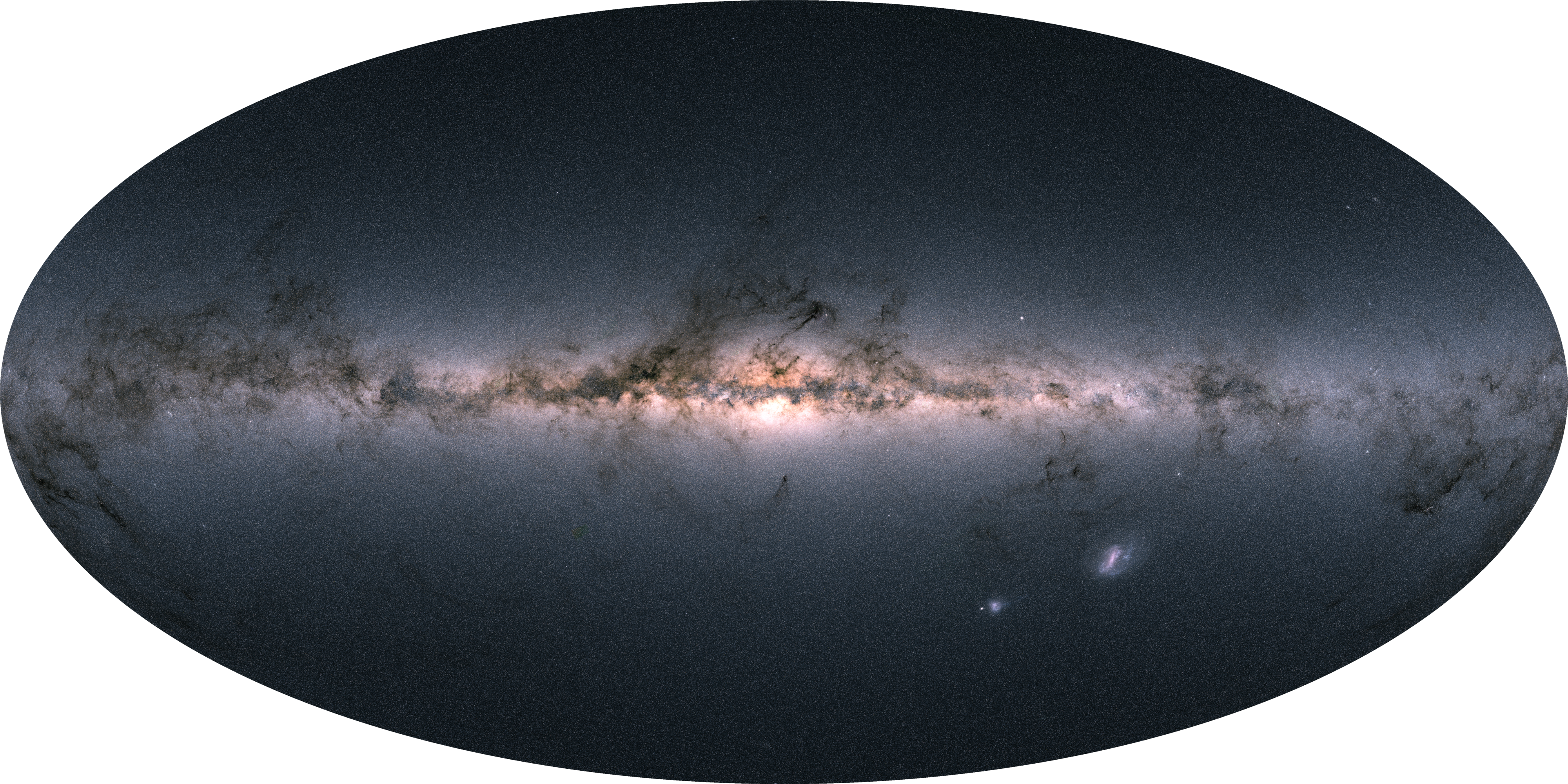
S810 writes: The European Space Agency (ESA) has released a treasure trove of data from its Gaia Spacecraft; totaling around 1.7 billion stars. This star map is the largest of its kind to date. In addition to the star map, the data also contains motion and color data of 1.3 billion stars relative to the Sun. Furthermore, it includes "radial velocities, amount of dust, and surface temperatures of lots of stars, and a catalogue of over 14,000 Solar System objects, including asteroids," reports Gizmodo. You can view the data here, and view a guide for what the data contains and how to use it here. -
ESA Releases Largest Star Map Ever Online (gizmodo.com)
S810 writes: The European Space Agency (ESA) has released a treasure trove of data from its Gaia Spacecraft; totaling around 1.7 billion stars. This star map is the largest of its kind to date. In addition to the star map, the data also contains motion and color data of 1.3 billion stars relative to the Sun. Furthermore, it includes "radial velocities, amount of dust, and surface temperatures of lots of stars, and a catalogue of over 14,000 Solar System objects, including asteroids," reports Gizmodo. You can view the data here, and view a guide for what the data contains and how to use it here. -
ESA Releases Largest Star Map Ever Online (gizmodo.com)
S810 writes: The European Space Agency (ESA) has released a treasure trove of data from its Gaia Spacecraft; totaling around 1.7 billion stars. This star map is the largest of its kind to date. In addition to the star map, the data also contains motion and color data of 1.3 billion stars relative to the Sun. Furthermore, it includes "radial velocities, amount of dust, and surface temperatures of lots of stars, and a catalogue of over 14,000 Solar System objects, including asteroids," reports Gizmodo. You can view the data here, and view a guide for what the data contains and how to use it here. -
Incredible New Gif Shows Cosmic 'Snow' On the Surface of a Comet (gizmodo.com)
Press2ToContinue shares a report from Gizmodo: What you're looking at is the surface of the comet 67p/Churyumov-Gerasimenko, which is orbited by the European Space Agency's Rosetta probe. The photo comes from Rosetta's OSIRIS, or Optical, Spectroscopic, and Infrared Remote Imaging System. The raw data was collected on June 1, 2016, and posted publicly on March 22 of this year. Twitter user landru79 processed the gif from this data release and shared it yesterday. In the foreground is the comet's surface (still several kilometers away from the probe), and three kinds of specks. The stars in the background belong to the constellation Canis Major, according to ESA senior advisor Mark McCaughrean. Some of the foreground stuff could be streaks from high-energy particles striking the cameraâ"it's a charge-coupled device (CCD), so even invisible particles can leave streaks in the results. And some could be dust from the comet itself. -
ESA Approves Gravitational-Wave Hunting Spacecraft For 2034 (newscientist.com)
The European Space Agency has approved the Laser Interferometer Space Antenna mission designed to study gravitational waves in space. The spacecraft is slated for launch in in 2034. New Scientist reports: LISA will be made up of three identical satellites orbiting the sun in a triangle formation, each 2.5 million kilometers from the next. The sides of the triangle will be powerful lasers bounced to and fro between the spacecraft. As large objects like black holes move through space they cause gravitational waves, ripples which stretch and squeeze space-time. The LISA satellites will detect how these waves warp space via tiny changes in the distance the laser beams travel. In order to detect these minuscule changes, on scales less than a trillionth of a meter, LISA will have to shrug off cosmic rays and the particles and light from the sun. The LISA Pathfinder mission, a solo probe launched in December 2015, proved that this sensitivity was possible and galvanized researchers working to realize the full LISA mission. -
Broadband Expansion Could Trigger Dangerous Surge In Space Junk (theguardian.com)
A new study from the University of Southampton warns that expanding broadband networks via launching "mega constellations" of thousands of communications satellites could increase catastrophic crashes of dangerous space junk in Earth's orbit. "Dr Hugh Lewis, a senior lecturer in aerospace engineering at the University of Southampton, ran a 200-year simulation to assess the possible consequences of such a rise in orbital traffic," reports The Guardian. "He found it could create a 50% increase in the number of catastrophic collisions between satellites." From the report: Such crashes would probably lead to a further increase in the amount of space junk in orbit, he said, leading to the possibility of further collisions and potential damage to the services the satellites were intended to provide. The European Space Agency, which funded Lewis's research, is calling for the satellites planned for orbital mega-constellations to be able to move to low altitudes once their missions are over so they burn up in Earth's atmosphere. They must also be able discharge all batteries, fuel tanks and pressure tanks to prevent explosions that would scatter debris. Lewis is presenting his research this week at the European conference on space debris at the ESA's center in Darmsadt, Germany. Krag said he expected some of the companies planning launches to attend. -
Japanese Spacecraft Spots Massive Gravity Wave In Venus' Atmosphere (theverge.com)
An anonymous reader quotes a report from The Verge: The Japanese probe Akatsuki has observed a massive gravity wave in the atmosphere of Venus. This is not the first time such a wave was observed on the Solar System's second planet, but it is the largest ever recorded, stretching just over 6,000 miles from end to end. Its features also suggest that the dynamics of Venus' atmosphere are more complex than previously thought. An atmospheric gravity wave is a ripple in the density of a planet's atmosphere, according to the European Space Agency. Akatsuki spotted this particular gravity wave, described in a paper published today in Nature Geoscience, when the probe arrived at the planet on December 7th, 2015. The spacecraft then lost sight of it on December 12th, 2015, because of a change in Akatsuki's orbit. When the probe returned to a position to observe the bow-shaped structure on January 15th, 2016, the bright wave had vanished. What sets the huge December wave apart from previously discovered ones is that it appeared to be stationary above a mountainous region on the planet's surface, despite the background atmospheric winds. The study's authors believe that the bright structure is the result of a gravity wave that was formed in the lower atmosphere as it flowed over the planet's mountainous terrain. It's not clear how the wave exactly propagates to the planet's upper atmosphere, where clouds rotate faster than the planets itself -- four days instead of the 243 days it takes Venus to rotate once. -
The Recent Changes In Earth's Magnetic Field (esa.int)
Europe's Swarm constellation of satellites have documented bigger-than-expected changes that have been occurring in the Earth's magnetic field. Earlier this year SpaceWeather.com reported that the data show clearly that "the field has weakened by about 3.5% at high latitudes over North America, while it has strengthened about 2% over Asia. The region where the field is at its weakest -- the South Atlantic Anomaly -- has moved steadily westward and weakened further by about 2%. These changes have occurred over the relatively brief period between 1999 and mid-2016."
Science writer Robert Zimmerman reports: It was already known that the field has weakened globally by about 10% since the 19th century. These changes appear to be part of that generally weakening. Some scientists have proposed that this is the beginning of an overall flip of the magnetic field's polarity, something that happens on average about every 300,000 years and last occurred 780,000 years ago. At the moment, however, we have no idea if this theory is correct. -
ESA: European Mars Lander Crash Caused By 1-Second Glitch (space.com)
An anonymous reader quotes a report from Space.com: The European Space Agency (ESA) on Nov. 23 said its Schiaparelli lander's crash landing on Mars on Oct. 19 followed an unexplained saturation of its inertial measurement unit (IMU), which delivered bad data to the lander's computer and forced a premature release of its parachute. Polluted by the IMU data, the lander's computer apparently thought it had either already landed or was just about to land. The parachute system was released, the braking thrusters were fired only briefly and the on-ground systems were activated. Instead of being on the ground, Schiaparelli was still 2.3 miles (3.7 kilometers) above the Mars surface. It crashed, but not before delivering what ESA officials say is a wealth of data on entry into the Mars atmosphere, the functioning and release of the heat shield and the deployment of the parachute -- all of which went according to plan. In its Nov. 23 statement, ESA said the saturation reading from Schiaparelli's inertial measurement unit lasted only a second but was enough to play havoc with the navigation system. ESA said the sequence of events "has been clearly reproduced in computer simulations of the control system's response to the erroneous information." ESA's director of human spaceflight and robotic exploration, David Parker, said in a statement that ExoMars teams are still sifting through the voluminous data harvest from the Schiaparelli mission, and that an external, independent board of inquiry, now being created, would release a final report in early 2017. -
ESA Launches Four Galileo Satellites (fortune.com)
The European Space Agency (ESA) has launched four additional Galileo satellites in to orbit on Thursday -- the first time the ESA has sent up so many satellites at once. The satellites will be used to thrust the EU into the global market for satellite navigation services, which it estimates will be worth 250 billion euros ($267 billion) by 2022, according to Fortune. The program has encountered some turbulence since the EU gave the go ahead with Galileo 16 years ago. In 2014, two Galileo satellites were launched into a wrong, lower orbit. As for today's launch, Slashdot reader nojayuk shares an excerpt from the ESA website: An Ariane 5 rocket has launched four additional Galileo satellites, accelerating deployment of the new satellite navigation system. The Ariane 5, operated by Arianespace, lifted off from Europe's Spaceport in Kourou, French Guiana at 13:06 GMT (14:06 CET, 10:06 local time) carrying Galileo satellites 15-18. The first pair was released 3 hours 35 minutes and 44 seconds after liftoff, while the second separated 20 minutes later. The Galileos are at their target altitude, after a flawless release from the new dispenser designed to handle four satellites. This was the first flight of a heavy-lift ES-variant of the Ariane V since the ATV resupply missions to the ISS. Previously Galileo satellites have been launched in pairs by Soyuz-Fregat craft from French Guiana. Two additional Ariane 5 launches each carrying four Galileo satellites are scheduled in 2017 and 2018. The full system of 24 satellites plus spares is expected to be in place by 2020. -
Long-Lost Comet Lander Philae Found (seeker.com)
astroengine writes: With only a month before its mission ends, the European Space Agency's Rosetta mission swooped low over Comet 67P/Churyumov–Gerasimenko to see the stranded Philae lander jammed in a crack. After months of searching for the lander, which made its dramatic touchdown on Nov. 14, 2014, mission scientists had a good idea as to the region the robot was in, but this is the first photographic proof of the lander, on its side, stuck in the craggy location called Abydos. "This wonderful news means that we now have the missing 'ground-truth' information needed to put Philae's three days of science into proper context, now that we know where that ground actually is!" said Rosetta project scientist Matt Taylor in a statement. -
Tiny Particle Blows Hole In European Satellite's Solar Panel (go.com)
An anonymous reader quotes a report from ABC News: A tiny piece of debris has punched a gaping hole in the solar panel of one of Europe's Earth observation satellites, causing visible damage but not enough to affect its routine operations, the European Space Agency said Wednesday. The unknown particle just a few millimeters big slammed into the back of a solar panel on Copernicus Sentinel-1A on Aug. 23. Using on-board cameras, engineers have determined that the hole is about 40 centimeters (16 inches) in diameter. The European Space Agency said the loss of power caused by the strike is "relatively small" -- less than 5 percent of the wing's usual output. The likelihood of such a strike is calculated at between 1:35 and 1:130 during the satellite's five-year lifetime, said Holger Krag, who heads the agency's space debris office. While the particle probably had a mass of less than 1 gram (0.04 ounces), scientists calculated that it was traveling at up to 40,000 kilometers an hour (24,856 mph) when it hit Sentinel-1A. Space.com has posted a video about the incident, showing images taken before and after the impact. -
British Astronaut Competes in London Marathon from ISS (cnn.com)
An anonymous reader writes: "British astronaut Tim Peake became the first man to complete a marathon in space on Sunday, running the classic 26.2 mile distance while strapped to a treadmill aboard the International Space Station..." reports Reuters. "The 44-year-old spaceman saw London's roads under his feet in real time on an iPad as, 250 miles below him, more than 37,000 runners simultaneously pounded the streets." Meanwhile, in a show of solidarity, two earth-bound runners ran the marathon wearing space suits.
CNN notes that Peake "ran the race for real in 1999," but this time competed with avatars that represented actual runners who were using the Run Social app. His zero-gravity run took longer -- more than three and a half hours -- while a Kenyan runner ultimately won the race, completing the whole 26.2-mile course in just two hours, three minutes and four seconds, the second-fastest time ever recorded. -
ESA Offering Prizes For First Radio Reception From Satellite (livejournal.com)
An anonymous reader writes: The European Space Agency education office set up a contest to receive the radio signals from their new Cubesat satellites: AAUSAT4, E-st@r-II or OUFTI-1. Prizes will be rewarded to those who receive the first signal (audio or waterfall) from TLM, packet or ham radio transponders. Even if you're not the first, any valid submission will be rewarded with a nice QSL card from ESA, reports one space site.
Arianespace's Soyuz is scheduled for liftoff on April 24 with a multi-mission satellite payload. Designated Flight VS14 in Arianespace's launcher family numbering system, the medium-lift Soyuz carries a mixed payload of the Sentinel-1B C-band radar observation platform, a trio of "Fly Your Satellite!" technology demonstrator CubeSats, and the Microscope scientific satellite. -
ESA's ExoMars Successfuly Lifts Off From Baikonur (esa.int)
vikingpower writes: The European Space Agency's second mission to Mars, ExoMars, was successfully launched from the Baikonur launch pad today. ExoMars will search for traces of life, either past or present, on the Red Planet, and is the precursor to a more full-fledged mission to Mars in 2018, comprising a rover. It consists of an orbiter and of Schiaparelli, a lander built by European industry and scheduled to land in October this year. Both missions are cooperations between ESA and RosKosmos, the Russian Federal Space Agency. If one of them met their ultimate goal -- proving there is or was life on Mars — the excitement here on Earth would be unimaginable. Mark Whittington adds a link to The Guardian's coverage and a bit of detail: The Russian-made launch vehicle lobbed a probe into space, the Trace Gas Orbiter, that will enter orbit around Mars later in 2016 and search for methane in the Red Planet's atmosphere. Methane can have a number of sources, but one of them is the waste product of microbial life. Both the Mars Express orbiter and the Mars Curiosity rover have detected some measure of methane, which could be produced by geological processes as well. -
ESA's ExoMars Successfuly Lifts Off From Baikonur (esa.int)
vikingpower writes: The European Space Agency's second mission to Mars, ExoMars, was successfully launched from the Baikonur launch pad today. ExoMars will search for traces of life, either past or present, on the Red Planet, and is the precursor to a more full-fledged mission to Mars in 2018, comprising a rover. It consists of an orbiter and of Schiaparelli, a lander built by European industry and scheduled to land in October this year. Both missions are cooperations between ESA and RosKosmos, the Russian Federal Space Agency. If one of them met their ultimate goal -- proving there is or was life on Mars — the excitement here on Earth would be unimaginable. Mark Whittington adds a link to The Guardian's coverage and a bit of detail: The Russian-made launch vehicle lobbed a probe into space, the Trace Gas Orbiter, that will enter orbit around Mars later in 2016 and search for methane in the Red Planet's atmosphere. Methane can have a number of sources, but one of them is the waste product of microbial life. Both the Mars Express orbiter and the Mars Curiosity rover have detected some measure of methane, which could be produced by geological processes as well. -
ESA's ExoMars Successfuly Lifts Off From Baikonur (esa.int)
vikingpower writes: The European Space Agency's second mission to Mars, ExoMars, was successfully launched from the Baikonur launch pad today. ExoMars will search for traces of life, either past or present, on the Red Planet, and is the precursor to a more full-fledged mission to Mars in 2018, comprising a rover. It consists of an orbiter and of Schiaparelli, a lander built by European industry and scheduled to land in October this year. Both missions are cooperations between ESA and RosKosmos, the Russian Federal Space Agency. If one of them met their ultimate goal -- proving there is or was life on Mars — the excitement here on Earth would be unimaginable. Mark Whittington adds a link to The Guardian's coverage and a bit of detail: The Russian-made launch vehicle lobbed a probe into space, the Trace Gas Orbiter, that will enter orbit around Mars later in 2016 and search for methane in the Red Planet's atmosphere. Methane can have a number of sources, but one of them is the waste product of microbial life. Both the Mars Express orbiter and the Mars Curiosity rover have detected some measure of methane, which could be produced by geological processes as well. -
ExoMars Probe Is Ready To Be Launched On Monday (cosmosup.com)
An anonymous reader writes: Run by the ESA and the Russian Space Agency Roscosmos, ExoMars is set to launch to Mars from the Baikonur Cosmodrome in Kazakhstan on March 14th with an orbiter-lander combo set. The orbiter, called the Trace Gas Orbiter, will look for trace gases in the Martian atmosphere. In its search for compounds made of carbon and hydrogen, and chemicals containing sulfur, the orbiter will be able to map the hydrogen on Mars up to a meter below the surface. The mission will create a map of Mar's water ice with ten times the resolution we have now. ExoMars 2016 will also include a small test lander known as Schiaparelli. The small lander will be testing the ESA's Mars landing technique, which will help when the ExoMars 2018 mission arrives with a more advanced lander and rover. The mission was originally scheduled to launch in January, but back in October the ESA discovered some issues with Schiaparelli's sensors used to monitor fuel pressure. Instead of risk the sensors leaking fuel and ruining the mission, they delayed the launch and removed the sensors altogether. The launch window of the mission stretches from March 14th through March 25th. And the launch will be live streamed from the ESA's website. -
ExoMars Probe Is Ready To Be Launched On Monday (cosmosup.com)
An anonymous reader writes: Run by the ESA and the Russian Space Agency Roscosmos, ExoMars is set to launch to Mars from the Baikonur Cosmodrome in Kazakhstan on March 14th with an orbiter-lander combo set. The orbiter, called the Trace Gas Orbiter, will look for trace gases in the Martian atmosphere. In its search for compounds made of carbon and hydrogen, and chemicals containing sulfur, the orbiter will be able to map the hydrogen on Mars up to a meter below the surface. The mission will create a map of Mar's water ice with ten times the resolution we have now. ExoMars 2016 will also include a small test lander known as Schiaparelli. The small lander will be testing the ESA's Mars landing technique, which will help when the ExoMars 2018 mission arrives with a more advanced lander and rover. The mission was originally scheduled to launch in January, but back in October the ESA discovered some issues with Schiaparelli's sensors used to monitor fuel pressure. Instead of risk the sensors leaking fuel and ruining the mission, they delayed the launch and removed the sensors altogether. The launch window of the mission stretches from March 14th through March 25th. And the launch will be live streamed from the ESA's website. -
Asteroid Impact Mission Sets Sights On New Laser Communications Record (esa.int)
Zothecula writes: Laser-based communications has the ability to beam enormous amounts of data at high speed, but the use of this technology in space is still in its infancy. To help push things along, ESA's proposed Asteroid Impact Mission (AIM) will carry out a record-setting demonstration of space laser communications across a distance of 75 million kilometers (46 million mi) while orbiting a binary asteroid. -
ESA-JAXA Team Wins 'America's Cup of Rocket Science'
An anonymous reader writes: NASA's Jet Propulsion Laboratory just announced the winners of the 8th edition of the Global Trajectory Optimization Competition, aka the America's Cup of Rocket Science. For the first time, a joint team from ESA and JAXA won the prestigious award. They had to design a nearly impossible mission to perform space-based Very-Long-Baseline Interferometry using the formation flight of three spacecraft around the Earth. Their incredibly complex trajectory can be seen here on the YouTube channel of the winning team. The full final ranking can be also downloaded here. -
ESA-JAXA Team Wins 'America's Cup of Rocket Science'
An anonymous reader writes: NASA's Jet Propulsion Laboratory just announced the winners of the 8th edition of the Global Trajectory Optimization Competition, aka the America's Cup of Rocket Science. For the first time, a joint team from ESA and JAXA won the prestigious award. They had to design a nearly impossible mission to perform space-based Very-Long-Baseline Interferometry using the formation flight of three spacecraft around the Earth. Their incredibly complex trajectory can be seen here on the YouTube channel of the winning team. The full final ranking can be also downloaded here. -
ESA-JAXA Team Wins 'America's Cup of Rocket Science'
An anonymous reader writes: NASA's Jet Propulsion Laboratory just announced the winners of the 8th edition of the Global Trajectory Optimization Competition, aka the America's Cup of Rocket Science. For the first time, a joint team from ESA and JAXA won the prestigious award. They had to design a nearly impossible mission to perform space-based Very-Long-Baseline Interferometry using the formation flight of three spacecraft around the Earth. Their incredibly complex trajectory can be seen here on the YouTube channel of the winning team. The full final ranking can be also downloaded here. -
Rosetta Probe's Comet Reaches Closest Approach To the Sun
An anonymous reader writes: The European Space Agency has released pictures taken by the Rosetta probe at comet 67P/Churyumov–Gerasimenko as it reached closest approach to the Sun. The comet has now travelled 750 million kilometers since Rosetta arrived, and the increased solar radiation has caused ices to sublimate and create jets of gas. "The activity reaches its peak intensity around perihelion and in the weeks that follow – and is clearly visible in the spectacular images returned by the spacecraft in the last months. One image taken by Rosetta's navigation camera was acquired at 01:04 GMT, just an hour before the moment of perihelion, from a distance of around 327 km." They've released both still images and animations of the comet's outgassing. "Rosetta's measurements suggest the comet is spewing up to 300 kg of water vapor – roughly the equivalent of two bathtubs – every second. This is a thousand times more than was observed this time last year when Rosetta first approached the comet. ... Along with gas, the nucleus is also estimated to be shedding up to 1000 kg of dust per second, creating dangerous working conditions for Rosetta." It's a fascinating, close-up look at a comet during its most volatile time. -
Rosetta Probe's Comet Reaches Closest Approach To the Sun
An anonymous reader writes: The European Space Agency has released pictures taken by the Rosetta probe at comet 67P/Churyumov–Gerasimenko as it reached closest approach to the Sun. The comet has now travelled 750 million kilometers since Rosetta arrived, and the increased solar radiation has caused ices to sublimate and create jets of gas. "The activity reaches its peak intensity around perihelion and in the weeks that follow – and is clearly visible in the spectacular images returned by the spacecraft in the last months. One image taken by Rosetta's navigation camera was acquired at 01:04 GMT, just an hour before the moment of perihelion, from a distance of around 327 km." They've released both still images and animations of the comet's outgassing. "Rosetta's measurements suggest the comet is spewing up to 300 kg of water vapor – roughly the equivalent of two bathtubs – every second. This is a thousand times more than was observed this time last year when Rosetta first approached the comet. ... Along with gas, the nucleus is also estimated to be shedding up to 1000 kg of dust per second, creating dangerous working conditions for Rosetta." It's a fascinating, close-up look at a comet during its most volatile time. -
Rosetta Probe's Comet Reaches Closest Approach To the Sun
An anonymous reader writes: The European Space Agency has released pictures taken by the Rosetta probe at comet 67P/Churyumov–Gerasimenko as it reached closest approach to the Sun. The comet has now travelled 750 million kilometers since Rosetta arrived, and the increased solar radiation has caused ices to sublimate and create jets of gas. "The activity reaches its peak intensity around perihelion and in the weeks that follow – and is clearly visible in the spectacular images returned by the spacecraft in the last months. One image taken by Rosetta's navigation camera was acquired at 01:04 GMT, just an hour before the moment of perihelion, from a distance of around 327 km." They've released both still images and animations of the comet's outgassing. "Rosetta's measurements suggest the comet is spewing up to 300 kg of water vapor – roughly the equivalent of two bathtubs – every second. This is a thousand times more than was observed this time last year when Rosetta first approached the comet. ... Along with gas, the nucleus is also estimated to be shedding up to 1000 kg of dust per second, creating dangerous working conditions for Rosetta." It's a fascinating, close-up look at a comet during its most volatile time. -
Pictures of a Comet From 9 Meters Away
An anonymous reader writes: Back in November, the European Space Agency triumphantly put a lander on the surface of a comet and then tragically lost contact with it when it failed to anchor and couldn't harvest enough energy to stay operational. In June, the lander awoke and for a short time was able to send more data back. Now the ESA has published a bunch of pictures and scientific papers about the data gleaned from Philae's short windows of activity, including images of its descent to the surface. Phil Plait summarizes and analyzes the release. The most impressive image is from a mere 9 meters over the surface of comet 67P/Churyumov-Gerasimenko. An animated gif shows the lander's descent near the surface through a handful of pictures. Two shots of the same area from the Rosetta probe show where Philae bounced off the surface, ejecting an estimated 180kg of material in the process. It's a fascinating, close-up look at a very distant and unusual world. -
Pictures of a Comet From 9 Meters Away
An anonymous reader writes: Back in November, the European Space Agency triumphantly put a lander on the surface of a comet and then tragically lost contact with it when it failed to anchor and couldn't harvest enough energy to stay operational. In June, the lander awoke and for a short time was able to send more data back. Now the ESA has published a bunch of pictures and scientific papers about the data gleaned from Philae's short windows of activity, including images of its descent to the surface. Phil Plait summarizes and analyzes the release. The most impressive image is from a mere 9 meters over the surface of comet 67P/Churyumov-Gerasimenko. An animated gif shows the lander's descent near the surface through a handful of pictures. Two shots of the same area from the Rosetta probe show where Philae bounced off the surface, ejecting an estimated 180kg of material in the process. It's a fascinating, close-up look at a very distant and unusual world. -
Comet Lander Falls Silent; Scientists Fear It Has Moved
vivaoporto writes: European scientists say the Philae comet lander fell silent on Monday, raising fears that it has moved again on its new home millions of miles from Earth. Over the last few weeks, Rosetta has been flying along the terminator plane of the comet in order to find the best location to communicate with Philae. However, over the weekend of 10-11 July, the star trackers struggled to lock on to stars at the closer distances. No contact has been made with Philae since 9 July. The data acquired at that time are being investigated by the lander team to try to better understand Philae's situation.
One possible explanation being discussed at DLR's Lander Control Center is that the position of Philae may have shifted slightly, perhaps by changing its orientation with respect to the surface in its current location. The lander is likely situated on uneven terrain, and even a slight change in its position – perhaps triggered by gas emission from the comet – could mean that its antenna position has also now changed with respect to its surroundings. This could have a knock-on effect as to the best position Rosetta needs to be in to establish a connection with the lander.
The current status of Philae remains uncertain and is a topic of on-going discussion and analysis. But in the meantime, further commands are being prepared and tested to allow Philae to re-commence operations. The lander team wants to try to activate a command block that is still stored in Philae's computer and which was already successfully performed after the lander's unplanned flight across to the surface to its final location. "Although the mission will now focus its scientific priority on the orbiter, Rosetta will continue attempting – up to and past perihelion – to obtain Philae science packets once a stable link has been acquired," adds Patrick Martin, Rosetta mission manager. -
Comet Lander Falls Silent; Scientists Fear It Has Moved
vivaoporto writes: European scientists say the Philae comet lander fell silent on Monday, raising fears that it has moved again on its new home millions of miles from Earth. Over the last few weeks, Rosetta has been flying along the terminator plane of the comet in order to find the best location to communicate with Philae. However, over the weekend of 10-11 July, the star trackers struggled to lock on to stars at the closer distances. No contact has been made with Philae since 9 July. The data acquired at that time are being investigated by the lander team to try to better understand Philae's situation.
One possible explanation being discussed at DLR's Lander Control Center is that the position of Philae may have shifted slightly, perhaps by changing its orientation with respect to the surface in its current location. The lander is likely situated on uneven terrain, and even a slight change in its position – perhaps triggered by gas emission from the comet – could mean that its antenna position has also now changed with respect to its surroundings. This could have a knock-on effect as to the best position Rosetta needs to be in to establish a connection with the lander.
The current status of Philae remains uncertain and is a topic of on-going discussion and analysis. But in the meantime, further commands are being prepared and tested to allow Philae to re-commence operations. The lander team wants to try to activate a command block that is still stored in Philae's computer and which was already successfully performed after the lander's unplanned flight across to the surface to its final location. "Although the mission will now focus its scientific priority on the orbiter, Rosetta will continue attempting – up to and past perihelion – to obtain Philae science packets once a stable link has been acquired," adds Patrick Martin, Rosetta mission manager. -
Black Hole Awakens After 26 Years
schwit1 writes: For the first time since 1989, the black hole in V404 Cygni, a system comprising a black hole and a star, has reawakened, suddenly emitting high energy outbursts beginning on June 15. The outbursts are probably occurring because the black hole is gobbling up material that has fallen into it. While the 1989 outburst helped astronomers gain their first understand of the behavior of a black hole in a star system, this outburst will help them understand how such systems evolve and change over time. The European Space Agency (ESA) reports: "First signs of renewed activity in V404 Cygni were spotted by the Burst Alert Telescope on NASA's Swift satellite, detecting a sudden burst of gamma rays, and then triggering observations with its X-ray telescope. Soon after, MAXI (Monitor of All-sky X-ray Image), part of the Japanese Experiment Module on the International Space Station, observed an X-ray flare from the same patch of the sky. These first detections triggered a massive campaign of observations from ground-based telescopes and from space-based observatories, to monitor V404 Cygni at many different wavelengths across the electromagnetic spectrum." -
Venus May Have Active Volcanoes
An anonymous reader writes: The European Space Agency's Venus Express spacecraft has discovered hot lava flows on the surface of Venus, providing the best evidence yet that the planet may have active volcanoes. "[U]sing a near-infrared channel of the spacecraft's Venus Monitoring Camera (VMC) to map thermal emission from the surface through a transparent spectral window in the planet's atmosphere, an international team of planetary scientists has spotted localized changes in surface brightness between images taken only a few days apart (abstract)." Venus is fairly similar to Earth in size and composition, which suggests it has an internal heat source. One of the biggest mysteries about Venus is how that heat escapes, and volcanic activity could be the answer. -
Online At Last: Comet Lander Philae Wakes Up
techtech writes with this news from the BBC: The European Space Agency (ESA) says its comet lander, Philae, has woken up and contacted Earth. Philae, the first spacecraft to land on a comet, was dropped on to the surface of Comet 67P by its mothership, Rosetta, last November. It worked for 60 hours before its solar-powered battery ran flat. The comet has since moved nearer to the sun and Philae has enough power to work again, says the BBC's science correspondent Jonathan Amos. An account linked to the probe tweeted the message, "Hello Earth! Can you hear me?" Watch this space for some more links to follow. Update: 06/14 13:39 GMT by T : From the ESA's Rosetta blog: When analysing the status data it became clear that Philae also must have been awake earlier: "We have also received historical data - so far, however, the lander had not been able to contact us earlier," [according to project manager Dr. Stephan Ulamec.] Now the scientists are waiting for the next contact. There are still more than 8000 data packets in Philae’s mass memory which will give the DLR team information on what happened to the lander in the past few days on Comet 67P/Churyumov-Gerasimenko. -
ESA Still Searching For Philae; May Have Zeroed In On a Possible Location
hypnosec writes with the news that the European Space Agency may have located the agency's Philae lander. The official Rosetta blog says Fortunately, it was possible to narrow down the lander’s final location by using the radio signals sent between Philae and Rosetta as part of the CONSERT experiment after the final touchdown. Combining data on the signal travel time between the two spacecraft with the known trajectory of Rosetta and the current best shape model for the comet, the CONSERT team have been able to establish the location of Philae to within an ellipse roughly 16 x 160 metres in size, just outside the rim of the Hatmehit depression. That means just a few candidates for Philae's current location, based on imaging performed by Rosetta's OSIRIS camera. -
First ISS-To-Earth 'Handshake' Demonstrates Space-to-Ground Remote Control
Zothecula writes: NASA astronaut Terry Virts, aboard the International Space Station, and ESA telerobotics specialist André Schiele, in the Netherlands, made space history this week with the first telerobotic "handshake" between space and Earth. Using special force feedback joysticks that acquire force data and create the sensation of pressure, Virts and Schiele brought the agencies closer to allowing astronauts in remote locations to naturally and safely control robotic devices and perform potentially dangerous or otherwise impossible tasks. -
ESA Satellite Shows Sudden Ice Loss In Southern Antarctic Peninsula
ddelmonte tips news that the ESA's CryoSat spacecraft has detected a sharp increase in the rate at which ice is being lost in a previously stable section of Antarctica. In 2009, glaciers at the Southern Antarctic Peninsula began rapidly shedding ice into the ocean, at a rate of roughly 60 cubic kilometers per year (abstract). From the ESA's press release: This makes the region one of the largest contributors to sea-level rise in Antarctica, having added about 300 cubic km of water into the ocean in the past six years. Some glaciers along the coastal expanse are currently lowering by as much as four m each year. Prior to 2009, the 750 km-long Southern Antarctic Peninsula showed no signs of change. ... The ice loss in the region is so large that it has even caused small changes in Earth’s gravity field, detected by NASA’s GRACE mission. Climate models show that the sudden change cannot be explained by changes in snowfall or air temperature. Instead, the team attributes the rapid ice loss to warming oceans. -
Using Satellites To Monitor Bridge Safety
__roo writes: In an effort to detect crumbling infrastructure before it causes damage and costs lives, the European Space Agency is working with the UK's University of Nottingham to monitor the movements of large structures as they happen using satellite navigation sensors. The team uses highly sensitive satnav receivers that transmit real-time data to detect movements as small as 1 cm combined with historical Earth observation satellite data. By placing sensors at key locations on the Forth Road Bridge in Scotland, they detected stressed structural members and unexpected deformations. -
Rosetta Spacecraft Catches Comet Eruption
An anonymous reader writes: On March 12, the Rosetta spacecraft was imaging Comet 67P/Churyumov-Gerasimenko from a distance of 75 kilometers (46 miles) and by pure chance it spotted an eruption of dusty material from the shaded nucleus. Long-duration spacecraft are essential if we are to fully understand the evolution of a comet as it gradually heats up during its approach to the sun. And it just so happens that Rosetta is always in orbit around 67P's nucleus, ready to spot any transient event that could erupt at any time on the surface
This latest event focuses on the comet's shaded underside. It is assumed that some sunlight slowly heated an outcrop, providing enough energy to sublimate subsurface ices, ejecting vapor and dust as a jet. The transient jet was imaged and measured by Rosetta's scientific imaging system OSIRIS. There is also the possibility that a wave of heating passed through the icy material, eventually producing a more explosive jet event. -
Rosetta Spacecraft Makes Nitrogen Discovery On Comet
An anonymous reader sends word that the European Space Agency’s Rosetta spacecraft has detected traces of molecular nitrogen on the comet 67P/Churyumov–Gerasimenko. "A peculiar mix of molecular nitrogen on the comet target of Europe's Rosetta spacecraft may offer clues to the conditions that gave birth to the entire solar system. Molecular nitrogen was one of the key ingredients of the young solar system. Its detection in Comet 67P/Churyumov–Gerasimenko, which Rosetta is currently orbiting, suggests that the comet formed under low-temperature conditions (a requirement to keeping nitrogen as ice), according to officials with the European Space Agency." -
Mars "Webcam" To Be Made Available For Public Use
randomErr writes If your group can make a good use case you can control of the ESA's Mars Express webcam. Proposals by schools, youth groups and astronomy clubs are due by March 27. The Visual Monitoring Camera (VMC), is a low-resolution camera intended for visuals of the Beagle lander separation. In May, Mars will be in solar conjunction. Signals between Earth and Mars Express will be disrupted by the sun so for three days the VMC camera can be freely pointed at almost any target in its orbit. -
Rosetta Photographs Its Own Shadow On Comet 67P/C-G
mpicpp notes an image release from the European Space Agency showing the shadow of its Rosetta probe on the comet it's currently orbiting. The probe snapped the picture from a very low flyby — only six kilometers off the surface. The image has a resolution of 11cm/pixel. The shadow is fuzzy and somewhat larger than Rosetta itself, measuring approximately 20 x 50 metres. If the Sun were a point source, the shadow would be sharp and almost exactly the same size as Rosetta (approximately 2 x 32 m). However, even at 347 million km from 67P/C-G on 14 February, the Sun appeared as a disc about 0.2 degrees across (about 2.3 times smaller than on Earth), resulting in a fuzzy “penumbra” around the spacecraft’s shadow on the surface. In this scenario and with Rosetta 6 km above the surface, the penumbra effect adds roughly 20 metres to the spacecraft’s dimensions, and which is cast onto the tilted surface of the comet. -
ESA Complete Spaceplane Test Flight; IXV Safely Returns To Earth
hypnosec writes The European Space Agency has successfully completed the first test flight of its Intermediate eXperimental Vehicle (IXV), as planned, wherein it saw the wingless spaceplane land in one piece in the Pacific Ocean. A Vega VV04 rocket took the IXV to an altitude of 340 km, from which it separated and continued up to 412 km. Reentering from this suborbital path, it recorded a vast amount of data from more than 300 advanced and conventional sensors. According to ESA the spaceplane few east around the globe during its descent and finally landed safely in the the Pacific Ocean west of the Galapagos Islands at about 15:20 GMT.