Slashdot Mirror
Domain: esa.int
Stories and comments across the archive that link to esa.int.
Comments · 950
-
Isn't any discussion about exoplanets+life mute?
How many suns exist?
From: http://www.esa.int/esaSC/SEM75BS1VED_index_0.html :"there are something like 10**11 to 10**12 stars in our galaxy"
From: http://www.universetoday.com/36610/how-many-galaxies-have-we-discovered/ :
"Astronomers think that there are hundreds of billions galaxies in the universe"
Ok, so estimate 500 billions - thats 500 000 000 = 5 x 10 ** 8
That would be 5 * 10 ** 19 = 50 000 000 000 000 000 000 possible stars/suns
That's a number beyond human comprehension and applying any statistical probability will return a true chance.
So - be assured that "we" are not alone and with current means can never visit other planets within one person's life-span.
What the heck! In the meantime, the basis for live as it was existing up to now on this planet the human race is going down the tube! -
Re:Who would ride that bomb?
According to this link there were more than 1700 successful Soyuz launches. Are you sure it's not as safe?
-
Re:Well duhI messed up my link earlier : I posted
http://slashdot.org/ecls.esa.int/ecls/attachments/ECLS/.../russianspacecraftcontam.pdf
When I should have posted : http://ecls.esa.int/ecls/attachments/ECLS/Russianspace-biocontaminantion/russianspacecraftcontam.pdf
While it's not a peer-reviewed paper, it looks as if someone is (or was) working towards such publication.
There are a number of credible references (including photos in that presentation) of fungi growing on the INNER surfaces of the rubber gaskets around the windows of Mir. Which should surprise no-one. Also, I'd expect that, like airplanes, the windows on Mir have an outer structural pressure-proof pane and an inner cosmetic pane, and therefore a potentially moist section in between which could form a biological habitat.
Elsewhere in the presentation is discussion of other microbes retrieved from the INNER surfaces of Mir ; which again, should surprise no-one apart from a Hollywood set-dresser.
OTOH, radiotrophic fungi are known to exist, as well as microbes surviving the vacuum of space, so it's not implausible,
Being radiotrophic is one set of evolutionary adaptations ; surviving at low PPO2 (partial pressure O2), PPCO2, PPH2, PPCH4, and low humidity (including vacuum as an extreme ; low PPeverything) are different evolutionary adaptations. I don't see any particular reasons that mutations to help in one direction are particularly likely to help in the other direction. So I'd consider them (unless proven otherwise) to be "independent experiments" in the terminology of statistics, and their probabilities are multiplicative. (This is why multiple-drug treatments are harder to evolve resistance to, compared to surviving sequential applications of several drugs to a single infection.)
There's a long way between implausible and impossible; but at best, I'd say we're looking at the "implausible" end of the spectrum.
-
Touch and Go sampling
The problem is not landing on the comet, the problem is that the comet's gravity is so weak that conventional sampling techniques will tend to push the spacecraft away, and it is not clear that you will be able to anchor the spacecraft firmly enough to avoid this. Similar problems exist with tether based sample return (where a long tether is used to match velocities with a target, and there are only a few seconds available to collect a sample).
There are various proposed solutions for this "touch and go" sampling problem. The recent Decadal Survey provides an overview. Hayabusa tried to fire pellets into Itokawa, to kick up some material for sampling. Other proposed solutions include cores and scoops, "sticky pads," brush wheel samplers. A reasonable approach would probably be to try several attempts, if possible.
-
Touch and Go sampling
The problem is not landing on the comet, the problem is that the comet's gravity is so weak that conventional sampling techniques will tend to push the spacecraft away, and it is not clear that you will be able to anchor the spacecraft firmly enough to avoid this. Similar problems exist with tether based sample return (where a long tether is used to match velocities with a target, and there are only a few seconds available to collect a sample).
There are various proposed solutions for this "touch and go" sampling problem. The recent Decadal Survey provides an overview. Hayabusa tried to fire pellets into Itokawa, to kick up some material for sampling. Other proposed solutions include cores and scoops, "sticky pads," brush wheel samplers. A reasonable approach would probably be to try several attempts, if possible.
-
Envisat
Why bother ? The UK already contributes to ESA, which has Envisat
-
Re:Intelligent
From ESA "A major problem was that the spacecraft's orbit was not accurately known, whereas ground stations normally require very accurate position information for pointing due to the antenna size."
-
Re:Clash of the titans
You should look up the epic of iceberg B-15, for a time "the largest floating thing on the planet." It was one of the Icebergs that calved from the break up of the Ross Ice Shelf, and 11,000 km^2 – that's the size of Jamaica, Bylot, or Bloshevik Island, and larger than the "big island" of Hawai'i. It broke apart several times, bashed into the Drygalski Ice Tongue, gouging out an 8km^2 piece, and floated on, breaking into smaller pieces, though some of its remains are still wandering around the Antarctic Ocean.
http://www.esa.int/esaCP/ESAAQTTHN6D_index_0.html [ESA]
The ESA has a great deal of imagery on it. -
ESA ACES
ESA will get there first, with the Atomic Clock Ensemble in Space (ACES), intended for the ISS in 2013, which should be good to ~ 10**-16 and will include a test of relativity. I believe that this is the JPL clock, which is aiming at 10**-15 stability, and a 2015 launch. (Both are fairly low earth orbits, with the JPL clock intended for an Iridium satellite.)
So, the JPL effort is cool, and I would love to see one flown to Mars or truly deep space, but this is one case where the Europeans are in the lead.
-
ESA ACES
ESA will get there first, with the Atomic Clock Ensemble in Space (ACES), intended for the ISS in 2013, which should be good to ~ 10**-16 and will include a test of relativity. I believe that this is the JPL clock, which is aiming at 10**-15 stability, and a 2015 launch. (Both are fairly low earth orbits, with the JPL clock intended for an Iridium satellite.)
So, the JPL effort is cool, and I would love to see one flown to Mars or truly deep space, but this is one case where the Europeans are in the lead.
-
Re:ACCURACY!
Better atomic clocks (yes on-board).
"the clocks on the Galileo satellites will allow you to resolve your position anywhere on the Earth's surface to within 45 cm." -
Re:I'm curious too...
This page has audio of the Phoenix probe descending through the amosphere
There is an animation of objects moving in the wind
Theoretically, if you had a fast enough light sensor, you could use video capture to record the changing reflections of light on an object due to the Martian wind. Like the old cub-scout science badge experiment of gluing a small piece of mirror to a plastic membrane over a paper cup, then watching the changing reflections of light due to air vibrations.
-
Re:A closer look
First, you get more detail if you're close. Second, they'll also be making in situ particle and magnetic measurements and those you can't get any other way.
It doesn't seem like there's a significant difference in optical resolution between 1 AU and 0.28 AU. Also, you can build better equipment cheaper down on earth.
I was also thinking about the magnetic field, but their page only mentions "Visible, extreme ultraviolet, X-rays". They wouldn't be distorted by the earth's magnetic field.
-
Re:A better way for the initial heavy lifting?
I don't think anybody at NASA was so stupid... maybe, at most, some political manager types who saw photos of Baikonur provided by U-2 flights, showing train tracks leading right to the launchpads? (a handy thing when transporting heavy, long, fairly narrow payloads on few very clearly defined routes, no need for silly expensive crawlers)
It would realistically give maybe, what, 10 m/s? 20, 30 tops? The launcher needs to achieve almost 8000 (and the speed is squared in kinetic energy...). But now with all the tremendous complication and much harder aborts, that's a horrible trade off (heck, the heavier construction necessary to survive such dynamic launch would most likely far more than offset any gains)
Genius of Korolev and some luck did the trick, when choosing early approaches (that did include striving for relative simplicity). So much so that essentially the same rocket turned out to be the most reliable -
Re:Pfft
I assumed that they'd be cast in a single pour, but apparently not: booster manufacturing process
-
Re:If the shuttle was a political compromise
When just few percent of the launchpad mass gets into LEO, such (50+%) waste matters a lot. "The most reliable
Besides, capsules can be largely reusable as well. And don't forget how much they can do, and did, that STS-class vehicle cannot. Plus, why would you want humans to do experiments in a capsule? Space stations are for that
And most of the space station modules historically lifted, did so on an expendable launcher. In fact, there is some talk of retrofitting few in-storage "western part style" ISS modules with small orbital tugs, launching them on average medium launchers, and docking them autonomously like all Russian and some Japanese and European modules do - what will most likely end up being less expensive (including the R&D and manufacture of tugs!), less wasteful, than launching such modules on STS was! (which was "required" for many ISS modules only because they were specifically constructed that way, to give the Shuttle some purpose).
Think about it for a second - STS was among the three most powerful, by far, launchers in history (if not the most powerful at take off, too lazy to check). And yet, its payload capability was merely in the range of many medium expendable launchers. Proton, Ariane 5, Delta IV, Atlas V, Falcon, Long March, Angara, Rus. Pick one.
One shot of such launcher already gives comparable amounts of stuff to work with (of course you also need to launch crew on a separate launch or two, but it still ends up more economical and with much greater possibilities, much longer stay). And, if doing one launch of STS-scale rocket but without the waste of a glorified glider, you'd have few times more in just that one launch (Energia was a bit more sensible like that from the start - the Buran was just its payload; another one was an 80 ton space station modules, one being also at the core of their Mars mission spacecraft which Energia was to asemble; SLS will be also capable of such, it will represent this more sensible approach)
And if you want to bring some stuff back... well, capsules also lead in the amounts of recovered, valuable, purpose-specific, actually reused equipment (also scientific missions, including half of NASA experiments of such type, most during the Cold War; another type, and few more variants of just this one capsule here -
Re:Combination Saturn V / Soyuz? hello 1960s!
Those strap on boosters are very unlike that of Soyuz / R-7 rocket. In the latter, they are very similar to core stage, burning the same fuel mixture (kerosene and oxygen; a mix very suitable for first stages, giving nice balance of good specific impulse, high fuel and exhaust density, hence small tanks and large static thrust; a sweet spot, one sort of aimed at in coupling and "averaging" characteristics of STS hydrogen-burning engines with SRBs
Generally, seeing capsules as a step backwards is at odds with basic chronology. Everybody at first expected "aerodynamic" or "spaceplane-ish" shapes from reentry vehicles, and worked towards it hard. They proved relatively unworkable. Blunt shape entry capsule was a relatively late innovation, an improvement; and a bit of a surprise. There's nothing wrong with capsules; physics, rocket equation, are a bitch.
Soyuz also worked out fine, being "the most reliable -
Re:In lieu of the moon or Mars
often times it's just more convenient to use a UAV anways.
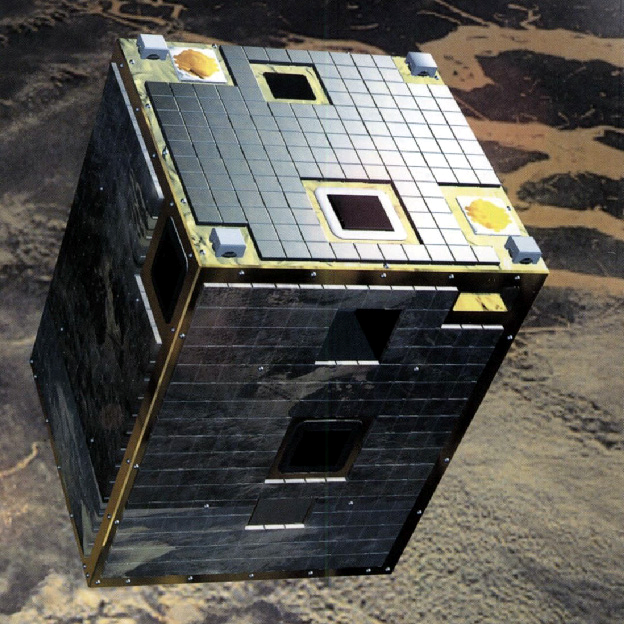
But not as cool. And that's one cool looking satellite. The Borg couldn't have designed it any better.
The Borg surely would have made all sides equal length.
-
Re:In lieu of the moon or Mars
often times it's just more convenient to use a UAV anways.
But not as cool. And that's one cool looking satellite. The Borg couldn't have designed it any better.
-
Re:The Borg have come...
Going AC to avoid karma whoring: borg satellite
-
Re:Chinese resource grab reaches new heights
Hey leave my Lagrangian points alone!
(I work on GAIA
http://www.esa.int/export/esaSC/120377_index_0_m.html
and would prefer not to share L2 with an asteroid!)
+ the closest Lagrangian points are quite a bit further out than the moon (we have to worry about when the moon gets between the spacecraft and the earth - the moon is not transparent to X band communications).
-
Re:Love the fact that it's a runway.
Baikonur started as a missile range. It was only sensible to merely expand (vs. new expensive mega-construction project) and use it as a spaceport - and not only because, for example, "the most reliable
Generally, if you look around you, you'll see that a significant elevation above sea level didn't seem to be the goal of any existing spaceport. There's a very good reason for that - by far most of the "effort" when trying to reach orbit is expanded not on height but on achieving high horizontal speed (and those are absolute basics of orbital mechanics BTW - so maybe you should reconsider the propriety of criticising existing approaches and praising "alternatives"?).
Shaving off 1 to 2% out of one minor factor, in exchange for massive headaches with maintaining mountainous spaceport, is a not a good deal. -
Re:Sounds like the 1979 Iran mission, repeated
Energia experience and tech lives on; quite a few of present and upcoming rockets make use of Energia-derived engines.
The concept of stacking multiple parallel stages is also being pushed further, and probably in a better way than Energia did it. Its approach to that was a bit flawed - either a big-hunkin'-stack around unique core stage, or using (and almost as an afterthought) the boosters singly (as Zenit).
But enter, for example, Angara. Made of 1 to 7 identical core stages (with... Energia-derived engines). Bringing the advantages of almost-mass-production, demonstrated by R-7. Perhaps even with a payload capability in the range of Energia, with a possible future heavy version of core Angara stage (so yeah, 2 versions would lose a bit the benefits of mass-production; but anyway, normal Angara 7 will also have a nice payload, and nobody does automatic docking more than the Russians - so it's perhaps even better to forget about heavy Angara core stages and just do multiple launches) -
Re:Sounds like the 1979 Iran mission, repeated
Russians are by far the most experienced at autonomous orbital rendezvouz (not much need for a spacewalk), and fairly good at launcher reliability for quite some time, so multiple launch route is the most sensible one - no need for large "dedicated" (small production run, expensive, unproven) launcher, you use what is almost mass-produced and reliable (it helps how the R-7 is "the most reliable
Plus, at that time they will have half a century of experience in operating the Soyuz - a spacecraft essentially capable of beyond LEO operation. Also the very first spacecraft which took macroscopic life (turtles, most notably -
Get it from ESA
As commented by others the dry run was done - the building is finished and we use metric
-
Re:How much is this in superdome volumes?
Ok, here's a link to the same story on esa.int. Hopefully now that the source of the same story has changed, it's more to your linking.
-
Re:Not really audio
Close but not quite. That's the simulated RADAR baseband knocked down to AF. Here's the "laboratory reconstructed" acoustic microphone rendition:
http://esamultimedia.esa.int/images/huygens_alien_winds_descent.mp3
Sounds like wind, doesn't it? -
More information on the CCD array
-
Re:ESA?
You must be american. This is about the European Space Agency: http://www.esa.int/
-
Link to actual press release
Oh good, I see we've got today's mandatory link to Michael Cooney's Layer 8 blog at NetworkWorld, the convenient middleman between Slashdot and news. This time he hasn't even bothered linking to the actual press release he's regurgitating, as far as I can tell. Still, more hits for NetworkWorld, that's what matters.
Anyone know if he's done a post on Bitcoin yet?
-
It just moved... to the Arctic
-
Re:Time?
You pretty much nailed it all on the head. The only thing that I wanted to add was that there has been one probe to move between two massive bodies (Earth and the Moon) using a continuous thrust system: the SMART-1 probe with its Ion engine. The downside: it took 13 months (it only took the Apollo astronauts a couple days) and used a series of really strange, constantly expanding orbits (basically a spiral), on the plus side it only took 1/10th of the total propellant mass that a chemically powered spacecraft would.
Ion/Hall/Plasma thrusters are great for moving cargo where you don't care too much about how long it takes (especially in the beginning of the mission). This type of technology could easily be used to move fuel to one of these "Gas Stations" in earth, moon, sun, or mars orbit. You could start this years before the need date (before you get busy testing out the manned space craft) then the chemical fuel could already be there when you're ready to launch the manned space craft.
-
Funny they don't mention Mars 500
I'm a bit disappointed that the article doesn't mention the cosmonauts that are already on their simulated way back from their simulated 520-day Mars mission:
Mars 500 timeline
Only half a year more and then they'll be let out of their Moscow container! -
Re:Win the Future
In the meantime, Russia works for few decades on a sustainable (vs. crash projects in the style of Apollo) means of deep space travel. BTW, ISS is a part of that work...
Heck, they have few decades of experience operating a manned spacecraft essentially capable of beyond-LEO operation (have $100 million? Get yourself a ride around the Moon - those are people behind almost all "orbital tourists"), a spacecraft which was the first to carry a macroscopic life beyond LEO (...around the Moon) and back, as Zond.
The technology which allowed them early lead in space was probably also largely a consequence of geopolitical reality and established US lead, in other field - huge bomber force. With "bomber gap" being just a myth, jumping on the next step was only reasonable for something perceived very much as a defense - so they had the first operational ICBM, R-7 Semyorka (not like "missile gap" wasn't a myth too - with just few rockets ready for launch a day later, and only if the policy of storing rockets and warheads separately was breached...). Not very good as an ICBM, not very practical. But - partly by chance, partly probably by the genius of Korolev & others involved - it turned out to be a fabulous launcher family; the most reliable
It launched Sputnik ; gave us the first photograph of far side of the Moon, first lunar flyby, first spacecraft reaching the escape velocity of the Earth & on circumsolar orbit; first lunar impact, soft landing + photos from the surface some time later; first flyby of another planet and atmospheric probes (well, and reaching the surface... crushed)
Also Gagarin. In fact, after Yuri, it launched every manned Soviet and Russian spacecraft (plus all "orbital tourists"). A century of service seems within its grasp (with new - yet unused - launchpad in Kourou...)
(BTW, will we ever drop the politically-motivated & quite absurd astronaut?) -
Will it be "most powerful" by time of launch?
Of course, for it to not be "most powerful", Angara (even more modular... much more late) would have to be on time, also with its heavy variant, at the least.
Anyway, such payloads aren't even strictly necessary for Mars sample return - not with our automatic rendezvous & docking capability (which we've done in the 60s, making the Shuttle obsolete before it seriously made its way to drawing boards)
At least those new launchers take an approach of very high modularity & semi mass-production - seems to be working fine for R-7 family, "the most reliable -
Re:Gravitational hole in the Indian Ocean?
Cool to see how the gravitation patter largely ignores the contours of the continent.
On the contrary, this is not entirely true. Looking at the complete 2D contour you can see that the contour lines of either high or low gravitational areas are almost always centered in the oceans, whereas the continents and landmasses almost always in the middle of the gravitational scale.
My completely uninformed gut feeling tells me that this data could go a long way in explaining why continents are located (or drifted to) where they are, and could possibly also make predictions about continental drifting in the future.
-
Re:Hard to believe
...or you might launch just the expendable observation platform(s - many of them, when using the expendable rocket which lifts X-37B as a payload; best of all: a rocket with Russian-made main engine)
I was hoping Shuttle taught us something (say, with the Hubble - it would be less expensive to have new ones; they are already relatively "mass" produced, as spysats... launched by expendable rockets; or what Zenit sats taught us - the most popular payload of "the most reliable
About the only sensible thing maybe going for it seems to be testing / ability to maybe do noticeably larger, per delta-V & fuel required [2], lifting inclination changes. Maybe.
1. Like those airplanes from "our" times (can be even done - take a Harrier, remove wings and canopy), no doubt influenced by rapid advances in marine tech; vs. what so called reality dictates. Spaceplanes can be seen as analogous to flying boats (not many of those around now); Catalina at best (& hopefully), Spruce Goose at worst. Imagine how much further we could be without STS (a craft obsolete long before its first mission; first automatic orbital rendezvous & docking taking place in the 60s) or Buran (pushed by ignorant Soviet generals as a "counterpart" to nonexistent strategic advantage of STS; engineers wanted to do something very different)
2. Assuming worth the mass budget for an airframe... -
Re:Didn't it use to be highly classified data?
> I wouldn't be surprised if the German data
Peter Pedant points out that GOCE is an ESA mission, so I assume the data is owned by ESA, not Germany.
http://earth.esa.int/dataproducts/accessingeodata/ suggests some data is free, other requires ESA approval.
Or use this Java app: http://earth.esa.int/EOLi/EOLi.html ? -
Re:Didn't it use to be highly classified data?
> I wouldn't be surprised if the German data
Peter Pedant points out that GOCE is an ESA mission, so I assume the data is owned by ESA, not Germany.
http://earth.esa.int/dataproducts/accessingeodata/ suggests some data is free, other requires ESA approval.
Or use this Java app: http://earth.esa.int/EOLi/EOLi.html ? -
cool...
...but can someone explain to me the scale and the unit of measure they use?
the whole heart-gravity map is here
-
Re:Too bad it's not a real Orion
That's dangerously close to "you need to spend (butt-loads of) money to save money" fallacy (why "routine space travel" dream should be of much significance, anyway? Also, I gave one or two replies nearby, no reason to repeat large parts of them)
The question isn't what's "doable", that's beside the point. Shuttle and Buran were doable, much easier in fact... and didn't deliver on any of its main points as advertised (it was supposed to be inexpensive and reliable, with fast turnaround, remember?). Set us back around 2 decades at least. Bled their space agencies dry for cash, caused cancellation of many great projects (many fantastic science missions, always the first to the axe...)
The question is what's practical. Spending half of GDP of the planet (or more...) isn't; no exploration in history operated on such basis.
And I didn't say "dumb payload" in the case of electromagnetic launcher, but "dumb rocket" - how it requires essentially the same tech as current rockets (yes, requires - at the least, there needs to be a massive kick at the apogee, otherwise what's being launched will deorbit at perigee), how it must (not just "most likely") be very similar to current launchers was the point; the "Pegasus" needs to be there, flying out of the end!
Again, not on a nice stationary platform (maybe with some simple multiplication of first stages (again, check Angara, from ~3 IIRC to 130+ tons in essentially single design) for the same effect as a megastructure), but moving on a high-g dynamic one... are you sure it will be inexpensive and reliable, with fast turnaround? Where have I heard that before...
All while the chemical "dumb rockets" are far from showing their full potential. We barely tried with what we know to significantly reduce costs - mass production (vs. skyrocketing (puns and all) costs with one-off massive projects). Maybe not necessarily to such or even such degree, but there's definitely a space for improvement. It's most likely not a coincidence that "the most reliable means of space travel" and "the most frequently used launch vehicle in the world" (plus one of most inexpensive ones) is about one and the same launch vehicle. -
Re:Really proud of the U.S.A.
Hubble is a joined ESA/Nasa program.
There are numerous ESA programs you perhaps are not aware of: VEnus Express, Rosetta, Mars Express, Double Star Cluster, Cassini-Huygens and and andI don't really get what your point is, but besides computer technology (mainly processors) and aero space industries the USA is on the decline since 30 or more years. OTOH the USA have those sparks of Elite Universities, some bright guys (like Jobs) and one of the greatest interior markets
angel'o'sphere
-
The future of telescopes.
The real future of telescopes will have no mirrors.
I'm not sure why no one has made a big deal out of this, but superconducting cameras have the potential to completely replace mirrors in telescopes, making them more robust and essentially eliminating complex alignment.
Why do I say this? Well, I reasoned this out myself, so maybe I'm wrong, but basically superconducting cameras are able to register every photon that sees them, sending off ~18000 electrons per photon hit. CCDs, on the other hand, send off 1 electron for every photon hit (I read that a while ago but I think those are the numbers).
Since CCD sensors are so much less sensitive, we use massive mirrors to magnify the amount of light hitting the sensor.
Well, it seems to me that if we had high resolution functional S-CAM sensors, we wouldn't need mirrors. We could just point them straight to the sky, and even if 18000 times fewer photons hit them, they'd have roughly the same or better output as a CCD.
Or, you could just lay out a giant array of S-CAM pixels, say, 10 meters in diameter. Then you'd basically have a ten meter telescope without the mirrors, *and* it would be vastly more sensitive.
I understand that using superconductors is currently an enormous pain in the ass, and I'm not expecting us to find a room-temp one any time soon, but even with the complexities of keeping the sensor cool, wouldn't that have enough advantages over a traditional system that it might be worth it? Maybe not yet, as the sensors currently have to be 0.3K, which seems to me to make it extremely challenging. But if we could make them with something warmer - say, liquid nitrogen cooled - then they might be viable.
Is there any flaw in my basic reasoning? I mean, maybe it would be more expensive than I imagine, but I feel like we should be looking into it. Imagine a football-field sized array of S-CAM sensors. I feel like we could pretty much see license plates on alien worlds at that point. And it wouldn't be nearly as fragile as something with a mirror.
http://sci.esa.int/science-e/www/object/index.cfm?fobjectid=36685
That is the third generation superconducting camera sensor that the ESA is working on. It only has 120 pixels, but I really believe we should be putting way more money into researching these...
-Taylor -
Re:Safe?
I'd trust "the most reliable means of space travel
BTW, the final mission to Mir of the above spacecraft was privately funded IIRC, so that's not a new approach... -
Re:Why not, indeed?
Yes, yes
BTW the main problem of N-1 was politically rushed schedule (gee, I wonder how "we must do this!"-driven megastructure would fare...) - its engines never even test fired as a group, before launch attempt.
But there's another outwardly quite complex rocket, few engines, many more nozzles, very "crude" timing of separation, the closest to mass production - it's also the most reliable
Of course, from your description of "requirement" to be asymmetrically loaded, to "allow" assymetrical thrust & mostly horizontal flight... it's clear you have no idea about the basics of rocketry, of physics (say, parts manifesting themselves in gravity turns, which dominate the dynamics of launch); just ideological derision of technology that "took away" the dreams described in works of fantasy, just puffy wishful thinking. -
Re:Odd, unsatisfying conclusion
Neal is saying, "You need to blindly pour tons of money into any fantasy wunderscenario that's pushed around, while forgetting how some of them were seriously looked at again, and again, and again"
There was nothing unobtanium-like during the 60s about R-7 Semyorka, the first operational (in 1957) ICBM. Which is used to this day as Soyuz rocket, "the most reliable -
Re:Stephenson & Rocket?
We are, among few things he does is basically hoping for "proper" airplanes from our times (we CAN build them! Take a Harrier, remove wings and canopy
Starting as an ICBM (the first operational ICBM, R-7 Semyorka) doesn't prevent getting "the most reliable -
Re:Okay, hold on a minute.
Here: http://www.esa.int/SPECIALS/Venus_Express/SEM0G373R8F_0.html I think the lameness filter detected my first reply but wathever heh. I watched on a short video called "The Asteroid that Flattened Mars" (I think you can easily google it) about similar effects on Mars triggered not by geological conditions of course but by an impact catastrophe.
-
Re:They're the ones supplying the ISS
Oh, but they did lost (three, actually) satellites previously - but again, it was a different rocket, Proton (their heavy workhorse, also with great success ratio; coincidentally, also envisioned at one point as an ICBM - one for Tsar Bomba!)
Generally, ISS is serviced by another launch vehicle (different manufacture lines, launch facilities, et al) - "the most reliable
Russians are damn good at this stuff. It might be largely our propensity to notice patterns which aren't there, in your impression of this "sequence" -
Re:It's not their fault
Readiness to "take just about anything to tip the odds in my favor" might take attention from, or even obscure some things which actually are important.
It's not like they're not doing something right, having the most reliable