Slashdot Mirror
Domain: euronuclear.org
Stories and comments across the archive that link to euronuclear.org.
Comments · 24
-
Re: fucking krauts
To clarify AC's point: https://www.euronuclear.org/e-...
The Chernobyl type of reactor has a positive void coefficient, which means that when a part of the water is replaced by steam the power will increase. At the Chernobyl experiment the steam content in the coolant channels increased suddenly causing a catastrophic power excursion. The presented analyses give details about the importance of the magnitude of the void coefficient. Also the delayed neutrons behaviour is described.
-
Re:Just needs a little nudge.
You're probably thinking of deuterium-tritium fusion.
H3 is a commonly-accepted way to abbreviate tritium in ASCII.
-
Re:sorry, it's not that simple
The web page unfortunately is the official site of the ITER project.
"Deuterium can be distilled from all forms of water." Yes, it can, but it's energy consuming and quite expensive.
No one doubted that. But that was not the topic, or was it?Also who claimed that we achieve 100% "efficiency" in neutron reuse?
Unfortunately, even if the tritium in the lithium blanket was remotely efficient or safe to extract from the extremely toxic and dangerous lithium
We are talking about a gas very close to hydrogen, right? Embedded in a salty/metal matrix in a vacuum right? There is nothing to extractHere is another site explaining the various reactions: https://www.euronuclear.org/in...
I only checked it as I was unsure how many neutrons are left over from a T+D reaction, unfortunately only one. So you are in so far right that most certainly extra tritium must be added to the reactor.
-
Re:Time to take nuclear seriously....
Nuclear is better than coal not only because it is "clean" of CO_2; it actually produces MORE energy!
8 kWh of heat can be generated by 1 kg of coal
24,000,000 kWh of heat can be generated by 1 kg of coal
(from https://www.euronuclear.org/info/encyclopedia/f/fuelcomparison.htm
Look at that comparison. It's not even close in degrees of magnitude!Energy density is a measure of energy that may be produced vs mass. (https://en.wikipedia.org/wiki/Energy_density)
via wikipedia:
Storage material Energy type Specific energy (MJ/kg) Energy density (MJ/L) Direct uses
Uranium (in breeder) Nuclear fission 80,620,000[2] 1,539,842,000 Electric power plants (nuclear reactors), industrial process heat (to drive chemical reactions, water desalination, etc.)
Thorium (in breeder) Nuclear fission 79,420,000[2] 929,214,000 Electric power plants (nuclear reactors), industrial process heat
Plutonium Nuclear decay 2,239,000 ? Thermal-Electric Generator (Space)
Tritium Nuclear decay 583,529 ? Electric power plants (nuclear reactors), industrial process heat
Hydrogen (compressed at 700 bar) Chemical 142 5.6 Rocket engines, automotive engines, grid storage & conversion
Methane or natural gas Chemical 55.5 0.0364 Cooking, home heating, automotive engines, rocket engines
Liquified Natural Gas(LNG) Chemical 53.6 22.2 mostly methane with a variable amount of ethane (so numbers are approximate), liquified for transport by ship -
Re:If it's anything like fusion...
The primary reason that fusion has stayed far away has been a demonstrated lack of funding. See https://upload.wikimedia.org/wikipedia/commons/a/ab/U.S._historical_fusion_budget_vs._1976_ERDA_plan.png. Even given that, there's been by pretty much all major metrics steady improvement in fusion. See e.g. https://www.euronuclear.org/e-news/e-news-15/listening.htm.
-
Re:Yes
How do you internalize the cost of a rare catastrophe (which would probably bankrupt any insurance company)?
There is a report by russia today that fukushima has cost $105 bn. Greenpeace (which hates nuclear power) claims a damage of $205 bn. So, the range of nuclear meltdown damages is in the range of hundreds of billions of dollars. Now, the insurance company munich re reports that they had to pay $31bn in 2014. I really think that it is doable to scale their business. So basically, there is one nuclear incident every 20 years world-wide. Lets be generous and say it costs around $400 bn. Now, the nuclear industry would have to pay $20 bn every year for such an insurance, world-wide. With a number of 438 reactors, that's $44 million per year. Energy companies make much much more with nuclear power on reactors in average than this amount, don't you think?
Why don't we start by internalizing the external costs of fossil fuels? That will drive us to alternatives REALLY quick.
Full agree. This is improperly internalized.
-
Re:Muon imaging
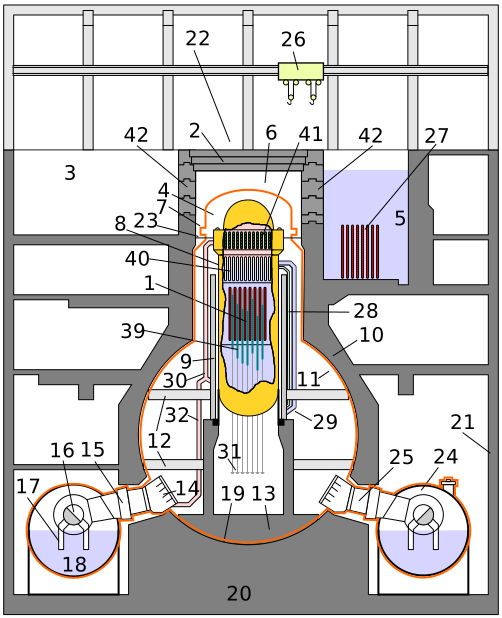
A bowling water reactor is 3 things. There is the reactor pressure vessel that looks like this. That sits inside a primary containment vessel. That then sits inside of a concrete bunker. The fuel probably burned through the pressure vessel but is inside the containment vessel.
-
Re:Baby with bathwater
Corrosion.
This has been essentially resolved very early on:
An out-of-pile corrosion test program was carried out for Hastelloy-N which indicated extremely low corrosion rates at MSRE conditions. Capsules exposed in the Materials Testing Reactor showed that salt fission power densities of more than 200 W/cm3 had no adverse effects on compatibility of fuel salt, Hastelloy-N, and graphite. Fluorine gas was found to be produced by radiolysis of frozen salts, but only at temperatures below about 100 C.
Operating it will also be a nightmare. Can you put a diver into molton salt to fix things?
What the? Why would you go for a dive in a super-heated radioactive salt at above 500 C? Below ~400C the salt solidifies, so no, you can't go dive in it any more than you can go for a dive in a salt mine. Moreover, I think you misunderstand the design of the core region of most molten salt reactors. They aren't great big tanks which you can move around in. Most are designed as a series of narrow tubes which the salt is pumped through, lined by moderator (typically graphite), all surrounded by a neutron reflector (usually heavy steel). Molten salt reactors are projected to be cheaper precisely because they don't require super-large forged pressure vessels. Regardless, even fairly large (in terms of capacity) PWR pressure vessels aren't really that big that you'd send a diver into it, even assuming anybody ever did that (fuel is loaded by crane from the top while the pressure vessel is open and completely submerged in water).
"expected effect: increased fossil fuel emissions due to sporadic running". Not sure what this is supposed to mean.
There are many problems with running thermal power plants, especially those with large boilers, sporadically, because they have lots of thermal inertia. For example, a lignite power plant has a minimum output level of ~30% - that's just a limitation of the thermodynamics of the system. If at a given point there's too much renewable capacity on the grid, the plant operator is forced to shut down completely. If, however, at some later point, say 6-8 hours later, renewables lapse again, the coal plant operator is told to perform a restart, but with a large coal plant it's not that simple to just load in new coal and throw in a match. They need to reheat the furnace, because otherwise the coal just won't burn. To reheat say a 600 MW lignite plant takes ~100000 liters of fuel oil - that's vaporized and blown into the furnace and burned and only after that the first coal can start to come in. All of the created CO2 and extra cost for the plant operator goes up the smoke stack and hasn't produced a single kWh. This is true, though to a lesser degree, for CCGT as well - large thermal inertia of the boiler and reheat system that is lost every time it's shut down and restart. The only guys who don't suffer from this significantly is OCGT, but they have terrible CO2 emissions per kWh compared to CCGT.
That Germany did not improve its CO2 emission despite a massive investment in renewables is primarly because they decided shut down nuclear power first rather than coal. A reduction is expected for the future when renewables start to replace fossil instead of nuclear.
If you have a look at the CO2/kWh graph I sent you, you'll notice that the reduction trend line starts in 1990 and the renewable buildout somewhere around 1999 and it hasn't really had much of an effect on the figure. In fact, when I do a linear fit on the first derivative of the CO2/kWh data, it appears as though the reduction trend will be slowing down an
-
Re:Pebble Bed
Thank you. It appears I was mistaken. Particularly France and Russia and maybe Japan would be good cases in point. Britain I would consider much less so, since nuclear appears all but dead there. Japan seems unresolved at this time. I understand zero of the 50 existing reactors in Japan were online at one point in the last few months. I have to wonder if that reprocessing plant will ever come online in Japan.
Still, we have 437 reactors worldwide, only 157 of which are in the four countries mentioned.
Of course countries could ship their fuel to other countries for reprocessing.
-
Re:This is disputed
1kg of uranium produces as much energy as 14 tonnes of coal.
1 kg of uranium is equivalent to 2.7 million kg of coal.http://www.euronuclear.org/info/encyclopedia/f/fuelcomparison.htm
No it's not. That site says,
"With a complete combustion or fission, approx. 8 kWh of heat can be generated from 1 kg of coal, approx. 12 kWh from 1 kg of mineral oil and around 24,000,000 kWh from 1 kg of uranium-235. Related to one kilogram, uranium-235 contains two to three million times the energy equivalent of oil or coal. The illustration shows how much coal, oil or natural uranium is required for a certain quantity of electricity. Thus, 1 kg natural uranium - following a corresponding enrichment and used for power generation in light water reactors - corresponds to nearly 10,000 kg of mineral oil or 14,000 kg of coal and enables the generation of 45,000 kWh of electricity. "
Complete fission is not possible, to begin with. Pay special attention to the last sentence, where it states the figure I quoted.
-
Re:This is disputed
1kg of uranium produces as much energy as 14 tonnes of coal.
1 kg of uranium is equivalent to 2.7 million kg of coal.http://www.euronuclear.org/info/encyclopedia/f/fuelcomparison.htm
-
Re:What is the REAL cost?
The true cost of Nuclear power is more than any other method.
Talk about easy mode! "Any other method" logically includes coal. And coal sucks. To put it in perspective, about twice as much electricity is produced each year from coal(44.9%) as from nuclear power(20.3%) in the USA.
What, you want healthcare costs included along with the fatalities? Okay, sure thing. How does $500B/year sound, for the USA ALONE?
I'd say I hate to break it to you, but that would be dishonest. I LOVE breaking this to you: The world could suffer a Chernobyl level event EVERY year and it would STILL come out cheaper than coal.
And while we are at it, lets add in all of the cost for nuclear power plant accidents both public and private funds and divide that by the the number of operating plants. Let's see, Three Mile Island, Chernobyl, Fukushima, smaller costly but less publicized accidents.
Let's see: Chernobyl: $235B, TMI: $975M, Fukushima: too early to tell. Let's go with roughly between Chernobyl and TMI: $118B. It's probably quite high, but eh. Total: $354B, or about 3/5ths the damage coal does to the USA alone each year.
As I've said before, Chernobyl's design wouldn't have been allowed anywhere, the cost would have been far less if it had been built with a containment dome. 437 reactors, leaving the share per nuclear plant at $810M per your stupid standard.
Let's put it into better context: End of 2012 nuclear power had produced 69,760 billion kwh. Chernobyl, TMI, and Fukushima amount to
-
Re:Nuclear
Hansen would be garner more support from a wider base and generally more acceptance if instead of trying to stop people from doing things he encouraged them to do something...such as invest in nuclear power...People respond better when you come to them with a solution rather than admonishments, guilt and doomsday predictions.
I agree with the admonishments and guilt part, but doomsday predictions are entirely appropriate and will work,, because people respond to fear. I'd love a reasonable, science-based debate, but the climate change debate is all about fear, and humans are wired to avoid danger and to overvalue threat information. You might get a friendlier discussion with hope and change, per those lying bastards the Democrats, but you'll get more vote with fear and disgust, per those lying bastard Republicans. So it depends on how you define "respond better." I think.
If the AGW crowd expended only half as much energy advocating and educating the public about nuclear power, and how it could solve the AGW problem, as they do with silly stunts and way over the top scenarios (50 feet higher eh?), it would be a win win. CO2 would be cut and we could tell the Oil Tyrants to fuck off and die.
50 feet higher is what will happen if we burn all the Canadian oil sands. It's only an overstatement in that it overstates perhaps how much oil we're going to consume in the near term, but Dr Hansen is not exaggerating the effects of doing so. Nuclear fission is not a panacea -- there is none. This is going to be a tough challenge, on a global scale, and we need something better than nuclear fission to solve it. It takes 15 Terawatts to power the world and each fission reactor apparently provides about 1 gigawatt, so to furnish 50% of the world's energy needs of today with nuclear, we'd need to build 1 billion nuclear fission reactors. I think we need a combination of fusion + solar-to-fuel (artificial photosynthetic fuel) technologies and that's going to take massive research funding. Maybe if we stopped the NFL budget for a year, we could solve the problem, LOL
I know that Hansen supports nuclear, including Breeder reactors for waste recycling, but he's not very vocal about it.
As a scientist, I'm frustrated by the apparent fact that most people don't care about the science. What we need to be vocal about is that climate change is real and something needs to be done about it. In America, many people don't even think this is a problem. My business school friend thinks that scientists are making this up in order to get research grants and Obama is pushing it so he can create a command economy. Seriously, that's how deniers think.
-
Re:1% of all nuke plants have melted down now.
Wonko the Sane who wants to be seen as some kind of expert claims:
Less than 0.04 per terawatt-hour is the rate of Cancer increase due to fission powerLets look at that.
http://www.euronuclear.org/info/encyclopedia/n/nuclear-power-plant-world-wide.htm
433 plants worldwide
Output of these plants 366555 mega watts orNow to take the terrawatts and make them hourly for the year. There is 8760 hours in a year.
3211 Terrawatt-hours per year * 0.04 percent rate of Cancer increase per Terrawatt-hour is a 128 percent Cancer increase rate per year,If Wonko the Sane is to be seen as a credible source - the nuclear energy industry brings you a 128% per year Cancer rate increase per year.
The 0.04 rate doesn't include things like acts where Humans seeks out to destroy fission plants in acts of violence. Does anyone think one group of Humans would not attack another group of Humans fission plants in either declared, undeclared or asymmetric war? How trusting are you, dear reader, of your fellow Man's ability to remain peaceful and not attack fission plants?
-
Re:Yes
I assume that these politicians saw the reality you are talking about.
They probably did. Then, because they're politicians, when Fukushima happened they promptly jumped on the anti-nuclear bandwagon again.
11 of Germany's 17 nukes are currently offline, yet there are no blackouts.
Probably because you're buying power from France and buying(and burning) more natural gas from Russia, increasing your CO2 emissions and marginally increasing the amount of pollution in your air. Then again ~43.6% of your power is generated from coal, so you might be burning more of that. 23.3% nuclear, 13% natural gas.
Also, your electricity averages 30.66 cents a kwh, compared to France's 19.25, so you're paying roughly 50% more for your avoidance of nuclear power. The USA? We average 9.28.
Of course, in the USA we are a touch more dependent upon coal, and a touch less on nuclear(until you shut reactors off in a knee-jerk reaction). 45% Coal, 24% natural gas, 20% nuclear for the USA. .
For all of Germany's investment into renewable energy, only 15% of it's power comes from renewables. The USA? 11%. A significant lead, but at what price?
Personally, I hate coal with a passion, such that yes, I'd love to take our investments into renewable power, plow it into nuclear, and get OFF of coal. Even with the occasional nuclear accident, coal power kills more people every year and costs more in increased medical expenses.
I'll also note that ideally you'd also build the nuclear plants as either cogeneration or even trigeneration plants - do more with that waste heat.
My 'plan' for the USA would be ~60% nuclear, 20% solar, 20% wind, 20% 'other' - mix of hydro, tidal, geothermal, etc...
-
Re:At least they admit it
-
Re:USD per watt and watts per sqm
For goodness sake, go learn about the Chernobyl disaster. It was completely avoidable and reads like a comic (because of all the WTF? moments) tragedy. It did not happen due to some bigwig worrying about their end year bonus. An accident such as this one today would only happen in a place where nuclear power was new and the ruling parties totalitarian idiots (I'm looking at you North Korea).
so the disasters from the inevitable F* up is huge.
Nuclear problems since the Chernobyl accident have shown how good management and safety systems makes the "huge" disaster a rather minor event. In a meltdown the plant itself is forfeit but there is little to no impact on the outside. There have only been two meltdowns at commercial plants. One was Chernobyl and one was Three Mile Island. There have been multiple partial meltdowns but non of these has created the "huge" impact you seem to think happens in nuclear accidents. All other meltdowns I could find were military and were in Russian submarines. Something tells me it wasn't the nuclear element that was the real problem when they are all limited to a single nation.
Nuclear power plants are not dangerous. Due to the overly paranoid safety and security constraints that they are put under they are highly unlikely to fail and in the event of a failure they are even more highly unlikely to have any impact on the surrounding environment or population.
2010 figures show 438 reactors active around the world. Many of these have been running for a couple of decades. There have been two meltdowns in that time and around nine partial meltdowns. Out of all of those plants over all of those years there has been ONE big accident.
I really hate that some anti-nuclear organisations have been so successful in telling the world that nuclear power is dangerous. Some normal, intelligent people are so uninformed it's really quite scary.
-
Re:Just Think..
I've lived next to Three Mile Island practically my entire life, I'm sure you are familiar with it. Yet, I'm not concerned in the slightest.
Why? Well statistically speaking, nuclear plants are incredibly safe. There are almost 500 nuclear reactors active in the world today, 104 of them being in the US. How many incidents have presented a sincere threat to human life in the past few decades? I can count the number on my hands. It's just not worth worrying about this sort of thing, unless your worry threshold is so low that you'd never live in a house in the woods for fear of falling trees.
My home as a child was surrounded by trees, on one particularly stormy night a sizeable branch from an oak tree fell onto the roof of my house and nearly broke through the roof. I'll consider becoming concerned about trees long before I ever start worrying myself about nuclear.
-
Re:Just Takes One
I don't think supercritical means what you think WRT reactors.
http://www.euronuclear.org/info/encyclopedia/s/supercritical-reactor.htm
http://www.nrc.gov/reading-rm/basic-ref/glossary/supercritical-reactor.htmlQuestion: How do you start a reactor without going supercritical?
-
More on pressure vessels
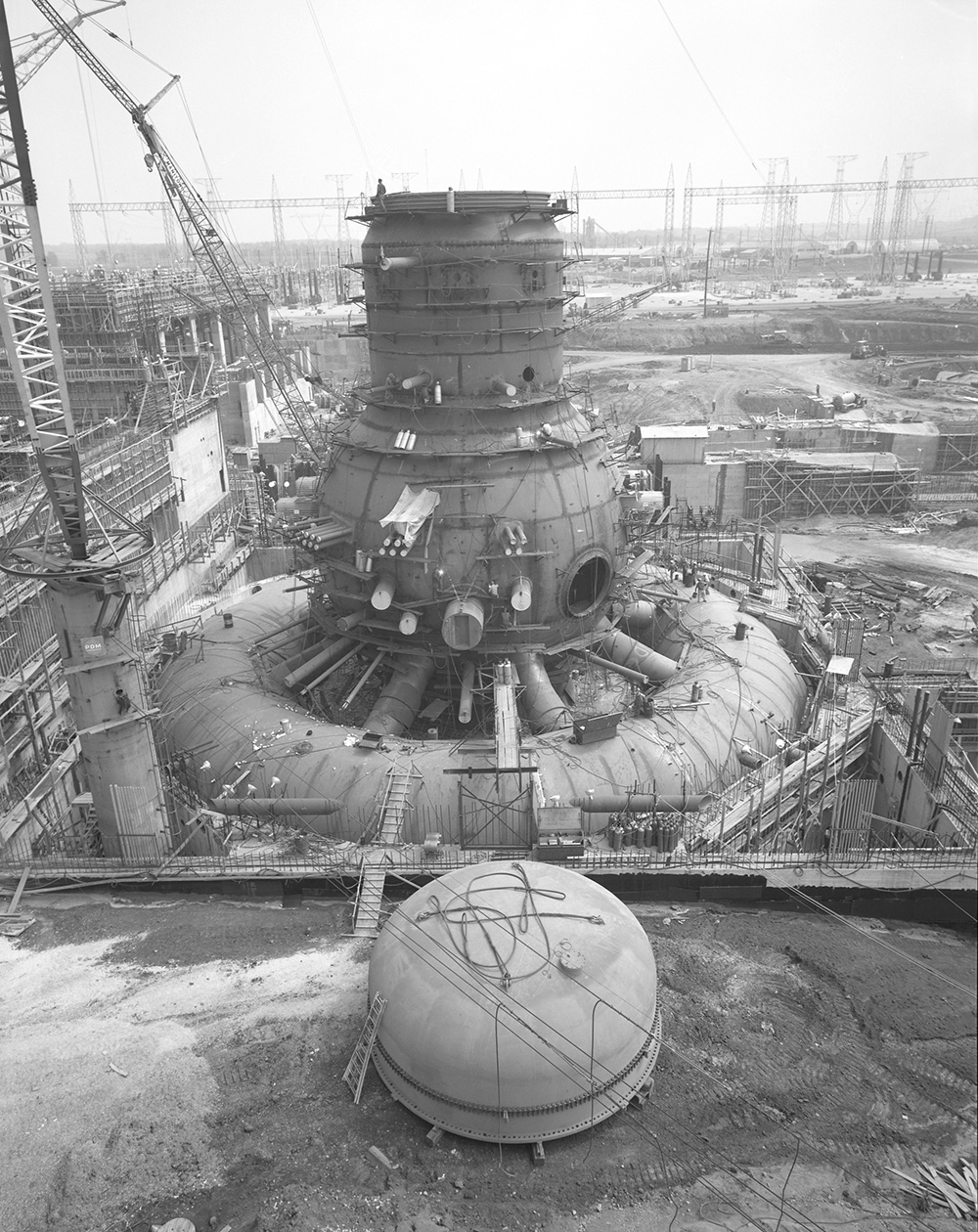
Nuclear reactor pressure vessels are a real problem. Most of the larger ones are in fact built up from welded sections. This isn't an easy welding job, and inspection of welds is a big headache. Several Japanese nuclear plants have had problems with cracks in pressure vessel welds, although in internal reactor components welded to the shell, not the shell itself. So making the pressure vessel and its internal support structures from one big forging makes a better product.
The environment of a reactor pressure vessel is tough. First, there's "embrittlement". Neutrons are constantly blasting apart the atoms in the pressure vessel, and over a period of years, this structural damage adds up. Then there's corrosion. There have been major corrosion problems requiring reactor shutdowns from carbon dioxide and boric acid corrosion inside the pressure vessel. Remember, this is a steam pressure vessel; at steam temperatures and pressures, minor corrosive effects at room temperature become big problems.
High quality welding of thick steel sections is a tough problem. Many approaches have been tried. The general idea is to make a V-shaped notch and fill it in during the welding process. Doing this in a way that's no weaker than the surrounding material is hard. Electric arc welding under an inert gas is the usual approach. Electron beam welding and laser welding have been tried. Then there's the problem of approach angle - welding on a vertical surface is not easy. Quality control requires X-rays, ultrasonic tests, and regulators that aren't corrupt.
So there's much to be said for building the pressure vessel as one big forging. Of course, then there's the problem of delivering a 550-ton object to the job site. There are companies that can do that, if you can find them a clear path from a seaport.
Sword making technology is relevant to the making of big forgings. Swords are built-up forgings. This is unusual in modern metalworking; most modern forged objects, like tools, are banged out in one piece by equipment much larger than the thing being manufactured. Big pressure vessels are built-up forgings; the scale requires it. In Japan, it's considered a good doctoral thesis in metallurgy to improve on sword making technology. So smart people are still thinking about the technology of built-up forgings. Nobody else bothers much.
Here's a US NRC fact sheet. on pressure vessels, and a similar European document.
-
Re:or evertything else...
NEI report - Average production costs: 1.83 cents/kwh nuclear, 2.07 for coal
UK report:
Gas-fired combined-cycle gas turbine 2.2
Gas-fired open-cycle gas turbine 3.1*
Nuclear fission plant 2.3
Coal-fired pulverised fuel steam plant 2.5
Coal-fired circulating fluidised bed steam plant 2.6
Coal-fired integrated gasification combined cycle 3.2
(* Open-cycle gas turbines are usually used for short periods to meet peaks in demand, so a more realistic cost is around 6.2 p/kWh when used for only 15 percent of the time.) -
Uranium Reserves
Here is an estimate of our Uranium reserves
-
Re:Open source + no hardware innovation: reusabili
Out of pure boredom and a little curiosity, it seems that with complete combustion or fission, you get approximately 8KWh of heat out of 1kg of coal.There seem to be about four different kinds of coal (Anthracite Solid and Broken, Bituminous Solid and Broken), and the previous link doesn't specify a type of coal, I'll go with the average of the cleaner burning two Anthracite coals (+-1300kg/m3).
The GPP doesn't state what kind of swimming pools we're talking about, but a single olympic swimming pool is (50*25*3*1300) 4875000 kg of coal, which is (4875000*8) 39000000 KWh. Assuming the coal doesn't burn completely, but only say 90% to it's potential, that's (39000000/365) 106849 years worth of continuous computing pleasure.
Assuming the GPP was talking about a backyard swimming pool, it seems they are about 70m3 on average, or 249 years worth of computing pleasure.
-
Re:No....Nuclear (fission) is better than coal... but it's not much better.
Firstly, carbon cost. Nuclear fission *does* have a carbon cost; this is chiefly the cost of fabricating the plants (which is substantial) but also includes the cost of mining and safely transporting the uranium used (and disposing of wastes safely). Once all this is factored in, the carbon cost isn't all that much better than coal. It is better, but the margin isn't much. (I wish I had the study to back this up, but it's something I read years and years ago).
Secondly, sustainability. Uranium supplies are limited. If all power generation switched to nuclear, uranium supplies would last 50 years or so: Global Uranium reserves says existing reserves are sufficient to cover existing reactors for "several decades". Coal will outlast fission by something like a century.
The third problem with nuclear is that the uranium and plutonium used for fuel *can* be used to fabricate nuclear weapons. Care in transport has so far prevented this, so far as we know, but there are other legs in the ABC trilogy that are much more cost-effective for terrorist purposes. The actual risk represented here is very difficult to assess; personally I suspect that warheads from the former Soviet bloc are a much bigger risk.
Pollution doesn't enter the picture IMO. Coal is *very* bad for pollution. If pollution is a factor, don't use coal. As others have said, recent studies indicate that *low-level* radiation may have beneficial effects, although there isn't enough evidence yet to be certain.
Nuclear *Fusion*, if we can get it going, would be great of course, and the technology is almost there - there have been test fusion plants with positive energy output. There have also been some promising developments in solar technology recently, almost doubling the efficiency of previous designs. A combination of solar and other renewable resources is pretty much the only way to go in the long term.
I agree that Sterling comes across poorly in this article. The sheep-like chorus of "Nuclear baaa-d!" without presenting a viable alternative (and continually referring to nuclear weapons as if a device designed to explode is the same as a plant designed *not* to explode) does not impress.
There are entirely legitimate reasons to avoid nuclear; it's not the panacea that other respondents here have represented it as, but neither is it the bogeyman that Sterling would have us think. Personally I think it's better than coal but worse than genuinely renewable sources such as wind and solar.