Slashdot Mirror
Domain: fairtax.org
Stories and comments across the archive that link to fairtax.org.
Comments · 326
-
Re: Not Enough!
I have mention on several posts taxing something else. I even said one time to check out the FairTax.
From a google search, the synopsis is:
"The Fair Tax Plan is a sales tax proposal to replace the current U.S. income tax structure. It abolishes all federal personal and corporate income taxes. It also ends all taxes on gifts, estates, capital gains, alternative minimums, Social Security, Medicare, and self-employment.Jan 29, 2018"
The organization has a website:
There's a Wikipedia page:
https://en.wikipedia.org/wiki/...
The best quote out of the Wikipedia page is footnote 62:
"Bill Archer, former head of the House Ways and Means Committee, asked Princeton University Econometrics to survey 500 European and Asian companies regarding the effect on their business decisions if the United States enacted the FairTax. 400 of those companies stated they would build their next plant in the United States, and 100 companies said they would move their corporate headquarters to the United States.[62] "
From that survey I am encouraged to believe that passing the FairTax would so tilt the playing field in favor of the USA that we would have really good jobs coming out our ears, prosperity would skyrocket, and we would generally see a second "gilded age" similar to the approx. 400% increase in the GDP between 1865 and 1913. The 16th Amendment authorizing the income taxes was passed in 1913. That created the poison we have now. Prosperity since then has been a rare thing. I believe the income taxes are mostly at fault for the stagnation of wages since about 1980, as the corporate rate of 35% chased manufacturing out of the USA to a great extent, those formerly well-paid manufacturing workers took much lesser-paid jobs in "service" industries, and created a class of people that like to work with their hands, are damned good at working with their hands, but sit home and collect unemployment, welfare, social security disability fraudulently sometimes, and generally are hugely underemployed in low-pay jobs while the good jobs are being done by Canadians, Mexicans, Indians, Chinese, Koreans, and Europeans, all of which had lower corporate income taxes. The FairTax book states that 22% of the price of any American-made good, on average, is composed of the expense in manufacturing in the USA attributable to income taxes of all sorts - corporate, personal for both workers and management making their labor more expensive, payroll, capital gains, etc. It takes about 30 - 33 hours to build a car in the US, workers make around $78 an hour including all benefits, and... multiplying those together, that's around $2,500. But income tax expense on a $40,000 SUV at 22% is $8,800. Which is more beneficial, paying workers $1.50 an hour and lowering the $2,500 to maybe $300, or abolishing the income tax and probably recovering half of that 22% - some of it belongs to workers so the company won't be able to recover, for instance, the worker's personal income tax, nor their share of the payroll taxes, but even 11% of the $40,000 SUV means a reduction in sticker price of $4,400 on that $40K American-made SUV. I just bought a Jeep Cherokee, the most "American Built" car on the planet, and could have gotten along nicely with that.
And it's not that the FairTax is so great, it is that the income taxes are so horrible. As early as just 50 years into the income taxes, JFK said:
"“The largest single barrier to full employment of our manpower and resources and to a higher rate of economic growth is the unrealistically heavy drag of federal income taxes on private purchasing power, initiative and incentive.” John F. Kennedy, Jan. 24, 1963 "
Getting rid of the income taxes would put rocket engines on the economy, I believe, and the FairTax is the only proposal that would do it. A flat tax won't do it because a flat tax is still an INCOME tax.
-
Re:Tariffs Aren't The Way To Do This
That's understandable, I forgot how difficult it is to understand this otherwise extremely simple tax system. It took me about 3 months to really get my mind around what it actually was, and that was just basically.
The best thing to do is to read the book, "The Fair Tax Book: Saying Goodbye to the Income Tax and the IRS." Don't know whether it is available at libraries or not, but is extremely cheap otherwise, $4.95 used at Amazon right now.
https://www.amazon.com/Fair-Ta...
Basically, the FairTax completely replaces all income taxes, including personal, corporate, capital gains, payroll, gift, self employment, inheritance, alternative minimum, and maybe 1 or 2 others I may be forgetting, there's lots of them. The FairTax, as described in House Bill HR25 and Senate bill S18, replaces all these income taxes with a simpler tax on new goods and services sold at retail. Tuition is exempt because it is treated as an investment. It takes a while to realize what is and what is not taxed - medical services received and paid for by your insurance is not taxed because that is not "retail", but a business-to-business transaction between the medical people and the insurance company. Your premiums to the insurance company are what is taxed. Things that are bought to conduct business are not taxed - the airlines' aircraft are not taxed because when being sold to the airlines, they are not sold at retail, but in a business-to-business transaction. If that airliner is ever sold to private parties, then that is a "conversion" from business to private use, and that sale is taxed at the market value of the airliner at the time of sale. One of the most significant features of the FairTax is the "prebate" that send, each month, a check from the federal government to each legal resident of the USA that is just large enough to pay the FairTax on spending up to the poverty level. The amount of the check is keyed to the size of the family - a single person would get 23% (the FairTax's inclusive rate of taxation) of the poverty level spending as defined by the government for a single person (around $12K right now, or $1K / month so the check would be $230 / month for a single person) and increases for marrieds, marrieds with X dependents, and so forth. I think the poverty level for a family of 4 is somewhere around $24K right now, so their monthly check would be $460.
There are many subtlities of the FairTax that take a while to realize. One is that, since businesses no longer pay corporate taxes, their costs to manufacture things in the USA goes down fairly dramatically. The FairTax book relates that 22% of the price of domestically manufactured goods is composed of income taxes at all levels, including increased costs of labor due to the individual's expense of personal income taxes and the "employee's share" of the payroll taxes. And a bit more obviously, the "employer's share" of the payroll taxes goes away too, so that frees up money for the business to use to lower prices or raise wages or raise dividends on their stocks. Fortunately, recipients of those benefits are US as consumers, US as employees, and US as stockholders.
Significantly, foreign manufacturers who manufacture goods outside the USA receive no such benefit when the income taxes go away, since they aren't paying US income taxes. So, while the prices of US goods are expected to fall by 10% - 20%, foreign manufactured goods will not fall in price at all, giving an advantage to US manufacturing. It is a great incentive for foreign companies to manufacture in the USA, which should skyrocket the number of jobs available and probably create a labor shortage which would create an upwardly spiraling wage rate.
There are websites for the FairTax, but the book is a basic read that explains things better for someone starting out learning the FairTax. One of the better websotes is:
There is much information there. Hope this helps.
-
Re:Second chance, really?
>"Even if there are no loopholes, a flat tax still means a tax increase for the poor and a tax cut for many wealthy people. "
? I would think that depends on the percent of tax proposed. If it were 10%, it would remain the same. As for cutting taxes to the wealth, again, that depends on how much income they were hiding. Some do a remarkably good job of it. Still, I think a more interesting proposal would be a consumption tax:
-
Second chance, really?
So it takes a SECOND breech before they decide to suspend the contract? If they have the option to suspend it now, why didn't they do it before? I think this speaks volumes about the competence of the IRS.
How about we move to a simple flat tax with no loopholes, which would dismantle 80% of the IRS and either pass the savings onto the taxpayers or use the savings to start paying off the 20 TRILLION DOLLAR national debt?
Even they admit they directly spend over 12 BILLION dollars a year, which goes up every year! Yet that doesn't include what it costs businesses and individuals to COMPLY with the insanely complicated tax codes. That compliance is estimated to cost the USA economy an additional $409 BILLION dollars every year. Wow, that works out to $3,500 dollars for every tax payer in the country, every year.
https://taxfoundation.org/comp...
-
Just think!
If the USA would get rid of the 16th amendment, implement a "fair or flat" tax https://fairtax.org/index a LOT of that money would find itself coming BACK into the USA, along with a ton of money from overseas corporations, since we'd be a tax haven for a lot of people & businesses. But, that would mean taking away the power congress & the senate have...the power to tax & keep people down.
-
Another reason to scrap the income tax
Yet another good reason why we should abolish the personal and corporate income tax in favor of the fair tax The fair tax is a consumption tax, but avoids any disproportionate impact on the poor by providing a pre-paid tax credit in the amount that a poor person would pay in taxes over the course of a year.
Everyone understands that taxation creates a disincentive for particular behavior, which is precisely why tobacco is taxed at such ridiculous levels. Why the hell do we tolerate a tax system which creates a disincentive for working and producing things?
Eliminating the ridiculously complex, multi-thousand page income tax code also gets rid of the government's favorite and most convenient mechanism for handing out favors to wealthy special interests. It creates an incentive for businesses to invest in the U.S. & makes U.S. goods more competitive vs. imports -
Re:Automatically fired
Check out the Fair Tax It's a consumption tax, but overcomes the regressive nature of a general sales tax by providing a tax "prebate" up to a certain income threshold.
Under the fair tax, the government would send everyone a check at the beginning of the year in the amount that a person with $X of income would pay in consumption taxes over the course of the year. If the tax was 8%, and the income threshold was $20k, every household would get a $1,600 check. Thus, a household at that exact income level would pay $0 in tax.
The fair tax also has the benefit of making domestic goods more competitive because taxes would not be baked in to the prices. Something like the fair tax is really the best way to go. Unfortunately, the voluminous income tax code is the politicians' favorite method of handing out favors to wealthy special interests, so we'll probably never see it happen. -
Re:It's worse than that
*In practice this is a little tricky, since defining what is "income" and what is "owned property" would have be done carefully to avoid loopholes.
Or you could avoid both these "tricky" scenarios and go with a pure consumption tax where you're taxed not on what you make or what you own but what you spend. Economic study after economic study proves this is the fairest, most equitable solution. The details can be found at FairTax.org. Practically every scenario of "well, that's great but what if somebody does THIS..." has been examined and accounted for.
-
Re:Eliminate all tax withholding
If people making $30,000 a year knew they paid over $1000 a month in taxes, the US government wouldn't have the resources to be so overweening.
Believe me every time I look at my W-2's I want to cry. Even though prosperity through hard work is a corner stone of American ideals the unfortunate truth is that income tax only punishes people for doing that hard work meanwhile some spoiled rich kid with a bunch of lawyers can evade our convoluted tax code and there are also those who game the welfare system that are rewarded for not working at all (Though I'll note that I'm not against welfare as some people do genuinely need it but there are those who abuse it).
The ideal solution would be to move to an all consumption tax that removes the punishment for working hard and saving into a tax on being a consumer and this works out perfectly because then it guarantees rich people will pay their fair share since they naturally spend far more in a month than most people will ever make in their life times. Well that's the theory anyway and I'm doubtful that we'll ever seen any major tax code reform enacted because the current system lends itself very well to corruption, discrimination and abuse by the very same people who would enact such an extensive reform.
-
Re:Let me get this right
You need to read about the "prebate" aspect of the Fair Tax. It eliminates the regression that concerns you.
In fact, most of what you wrote is so far off base, you should just go read about the Fair Tax at the source, so you can discuss it intelligently.
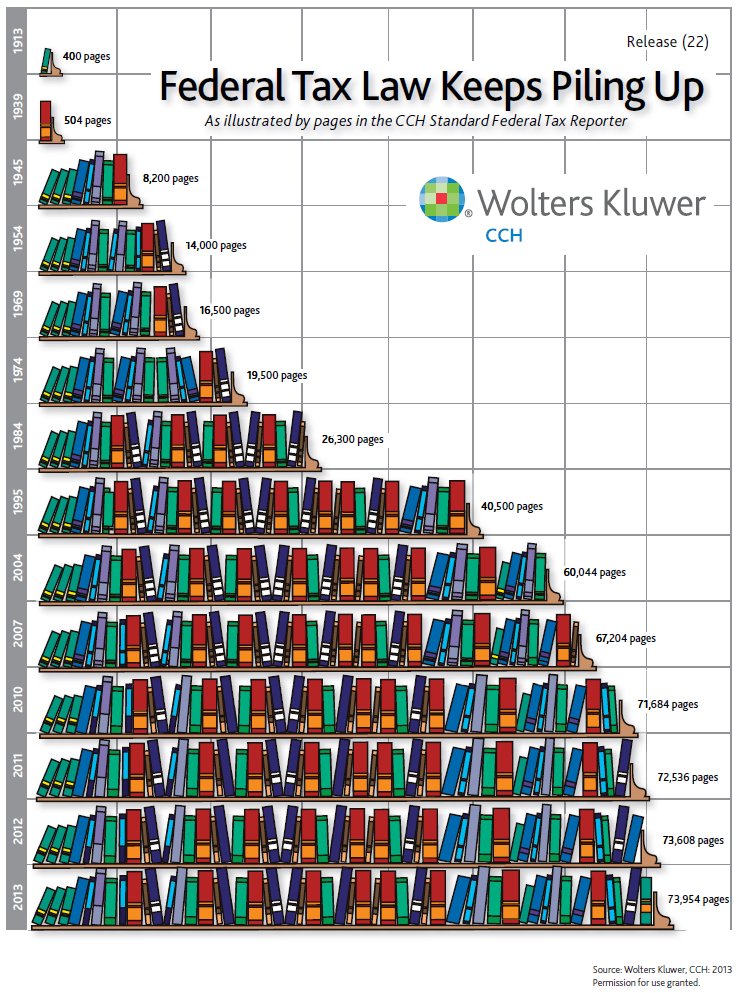
The current tax code consists of 73,000 pages of regulations, requiring a giant, intrusive bureaucracy, an armada of tax preparers, and a fleet of tax lawyers. It is unfair, and it is broken. Just imagine if all that effort, and all those people were put to productive use instead of accounting.
-
Excellent idea
Repeal the corporate income tax and personal income tax in favor of a consumption tax. Now, before you can say "that will hurt the poor" check out
Under this system, you get a tax "prebate" so that a poor person would still pay zero net tax over the course of the year. The consumption tax that they would pay on spending their meager income gets refunded before they pay it.
Think about it. Whether you're producing electronics or growing potatoes, work is the most productive activity in the economy. Consumption is the least productive. Furthermore, the ridiculously complicated tax code is where politicians love to include handouts to favored constituents. With the fair tax, the complexity disappears.
-
Re:Let me get this right
What KingOfBLASH is not a "progressive tax on consumption" but a luxury tax. Your comments are spot on.
For a progressive tax on consumption, the government would not need to track all purchases – or any purchases. The government sends out a "pre-rebate" check to everybody to cover their sales taxes – say $2,500 a year. If the sales tax was 20% and you spent $12,500 a year you would pay – net – no sales tax. If you spend less it is probably because you are poor and we can treat it as a form of welfare.
Take a look at http://fairtax.org/. I am not a fan of the organization because I think they are too dogmatic but they do put forward a well thought out argument and plan.
-
Re:Local testing works?
I had been backing a wealth-based tax instead of an income-based tax myself, but I like the Fair Tax idea too, now that I read about it: http://www.fairtax.org/site/Pa...
-
Fairtax
Bitcoin + http://www.fairtax.org/site/PageServer?pagename=FAQs makes sense.
-
Re:what a joke
I'm surprised we haven't had more "I don't recall..." moments from Obama. He'd be in good company.
http://www.theguardian.com/environment/2010/jun/17/gulf-oil-spill-bp-chief-tony-hayward
-
Re:Elsewhere
Any smart rich person that wants to remain rich will not hoard that much money. When you have millions/billions a 2% loss to inflation tends to be a lot of money. As for the second case, investments are a good thing. They keep the money cycling in the economy. I fail to see the problem there. If you are worried about people in poverty, there are forms of sale tax only taxation that address this. For example, Fair Tax addresses this by defining a poverty level income and then "prebating" the taxes. At the beginning of every month, everyone is given a check that amounts to what a person in poverty would normally pay in sales tax.
-
Re:The urban poor subsidized the rich for a while
Your state's stupid policy of taxing clothing is acknowledged and noted. Property tax has absolutely nothing to do with this issue. It is not a sales tax. Of course cars are sales-taxed everywhere that I know of in sales-tax states. I already stated that and pointed out that it acts quite progressively.
Contrary to your utterly unfounded beliefs, the fair tax would eliminate federal tax entirely on the lower class, benefit the middle class to a significant extent, and come down hard on the upper class. But you can educate yourself much more efficiently than I could do for you.
-
Re:The urban poor subsidized the rich for a while
Whether or not you see it is not the issue. It is revenue neutral (5th Q&A). If you think a 23% consumption tax is "very high percentage", fine for you. Considering what it would replace, a lot of us do not consider it high.
Capital gains tax is double taxation, simple as that. If you think double taxation is just dandy, then the status quo works for you. Other than objecting to this, I think your suggestion is infinitely superior to what we have now. On economic analysis, 10% wouldn't do it. It would have to be much more than that to be revenue neutral. Also, this solution does not do anything to eliminate the burden of the IRS and its enforcement operations.
-
Re:The urban poor subsidized the rich for a while
Oh, for christ sake. EVERYTHING connected with the government is "wide open to just removing" something (or adding something!) and making things worse. Fire is wide open to getting out of control. Maybe we should not use fire. Apologists for the shitty status quo always use arguments like this.
The EITC is not a prebate. It's not really even a rebate. It's what it says it is. A credit.
The fair tax prebate (Q&A #3) would be paid out monthly so those of limited means would not have to pay their sales tax and carry the burden while waiting for a rebate.
-
Re:Tax dodge
Consumption based taxes on a national level would still be collected by the IRS.
Depends on how the system is implemented, and in the case of the FairTax... the IRS can go away as collecting is moved to the states, to quote them:
No more complicated tax forms, individual audits, or intrusive federal bureaucracy. Retailers will collect the FairTax just as they do now with state sales taxes. All money will be collected and remitted to the U.S. Treasury, and both the retailers and states will be paid a fee for their collection service.
-
Re:No backlash will be headed off
4.2% of the population is far from "so few". Heck, I know some personally (they're in my family). It's sad when people will say to your face that you're stupid for working so hard when you could be like them and sit comfortably in their trailer watching TV and let the government take care of you... They've been doing it most of their life (not a "very short time"). Those that do get off welfare are quickly replaced by others who get put on it.
Don't even look at food stamps. Nearly 20% of Americans now! And the OWS answer? Let's punish the "evil rich"! Maybe I'm unusual, but I've always been hired by either an "evil rich person" or an "evil rich corporation"!
As far as tax loopholes go, maybe we should get rid of the monstrosity that is our current tax code. Something like the Fair Tax would completely eliminate loopholes!
OWS's plan of punishing job creators will do nothing more than destroy opportunities for those who want to succeed... It is time we stop pulling the successful down. We need to pull the poor up and give them the opportunity to succeed!
-
Re:No backlash will be headed off
Thank you for proving the point about "not having a clue".
4.1% of the U.S. population is not "so few". And I know some of these people first-hand (they're in my freaking family). They'd rather sit in their trailer and collect money from the government than work. They think I'm stupid because I bust my ass working when they can sit in their trailer and watch TV all day for the rest of their lives. And they've been doing it for the largest part of their lives (much more than "a very short time")!
Heck, we have nearly 20% of Americans on food stamps! And OWS answer? Let's stomp on those that are actually providing jobs and giving these people the opportunity to find meaningful employment and self-reliance! Oddly enough, I've only ever been hired to work by some "evil rich person" or "evil rich corporation". If it wasn't for these "evil rich", there'd be no jobs!
BTW... Want to get rid of the tax loopholes? Simplify the tax code! Something like the FairTax would be a great start. We don't need the monstrosity of a tax code that is full of loopholes!
I know it feels good to chant the rhetoric of OWS, but it is time to stop trying to drag down those that are actually creating jobs and employing people and start trying to pull everyone else up so that they can have those same successes. We shouldn't try to make the rich become poor, we should try to make the poor become rich! Penalizing the successful doesn't do anything more than stifle opportunities that the poor can use to crawl out of the assistance trap and create their own success stories.
-
Re:Can't we pass a bill banning sales tax instead?
There are bad taxes and there are even worse taxes. Applying a tax to income, especially WAGE income, is about the worst idea imaginable because you are punishing value-add productive activity.
Sales taxes are bad too, but consumption is the least productive thing that we do. Given the choice of two bad options, I'll take the option that encourages saving and provides a disincentive for consumption rather than the option that punishes productivity and work.
The whole "consumption-driven economy" is an unsustainable fraud and replacing income taxes with consumption taxes would help cure that insanity too.
As for the "regressive" nature of consumption taxes, there are good ways to address that with pre-bates so that the poor don't end up paying more tax.
-
Re:He's right
Even better, apply it to sales instead of income and make it easier as then you can see the direct effect of taxes at every transaction rather than hiding it in several layers of transactions. See http://www.fairtax.org/site/PageServer
Nice try, but stupid: we do have sales taxes in Europe. They don't work and create even more inequality.
Had that been useful we wouldn't have deep inequalities, I'll have you explain BerlusconiThe rich always end up paying very little, and the poor paying more.
Laws are always perverted in such a way as to favor the rich, because laws are paid by rich men (when the rich passing the laws are not the government themselves).
For the rich man paying 20% on christmas presents is nothing, while 20% on clothes for a poor person that 20% on everything he needs to buy in order to survive hurts to the bone. -
Re:Corporate Taxes == Political Favoritism
That's why the "fair tax" is more fair. http://www.fairtax.org/site/PageServer You can actually see the amount the government is taking at the consumer end transaction. It makes it much simpler to keep track of taxes and know how much the government is actually getting.
-
Re:He's right
Even better, apply it to sales instead of income and make it easier as then you can see the direct effect of taxes at every transaction rather than hiding it in several layers of transactions. See http://www.fairtax.org/site/PageServer
-
Re:Immigrants... right
This is one of the reason I find the Fair Tax to be an interesting idea.
-
Re:Let's hear it for the beancounters
From: http://www.fairtax.org/site/PageServer?pagename=FAQs
Business-to-business purchases for the production of goods and services are not taxed.
Under the FairTax, savings and investments are not taxed at all.
Think about the above harder. Are you still 100% sure there will be not enough loopholes to game the system?
If there aren't enough loopholes it'll be an amazing work of legislation. I'd love to see it. Unless of course it's the equivalent of 1000 pages of "IF THEN ELSE" statements
Astute readers would recognize that a Fair Tax as a concept is different from FairTax (TM), in the same way that Trusted Computing as a concept is different from Trusted Computing (TM). A flat tax on all purchasing can be codified in less than 5 pages of legalese, and would be way more fair than FairTax.
-
Re:Let's hear it for the beancounters
From: http://www.fairtax.org/site/PageServer?pagename=FAQs
Business-to-business purchases for the production of goods and services are not taxed.
Under the FairTax, savings and investments are not taxed at all.
Think about the above harder. Are you still 100% sure there will be not enough loopholes to game the system?
If there aren't enough loopholes it'll be an amazing work of legislation. I'd love to see it. Unless of course it's the equivalent of 1000 pages of "IF THEN ELSE" statements
-
Re:Let's hear it for the beancounters
Why should Disneyland be taxed on the materials? B2B is not taxed. Only B2C:
Business-to-business purchases for the production of goods and services are not taxed.
(all related quotes from http://www.fairtax.org/site/PageServer?pagename=FAQs )
As for the yacht the company only pays tax if the yacht is for personal use. If the yacht is a corporate yacht rented out for corporate events or revenue generation- it's business to business not personal.
It all depends on how the following is actually implemented:
Although it does not prohibit businesses from providing taxable property or services as gifts, prizes, rewards, or as remuneration for employment, the gift, reward, etc. is considered to be the conversion of property or services from business use to personal use and is therefore taxable.
Given that B2B is explicitly not taxed, I bet there'll be plenty of grey areas there where the tax lawyers can find a way to earn their keep.
Under the FairTax, savings and investments are not taxed at all.
I interpret that to mean you don't pay a sales tax when you buy shares in a company.
So if they don't write it tight enough, the yachts, planes etc could be rented from subsidiaries owned by some entity in the XYZ Islands or wherever. So Mr Billionaire pays sales tax on the rental amount - there is no transfer of yacht ownership at all. Mr Billionaire doesn't use the yacht on a daily basis - just rents it out for a few days a year, so it "clearly isn't treated as his private property", in fact he may not even rent the same yacht every year - could be a different yacht. During the other 99% of the year the subsidiary company is using it for their marketing and promotional purposes (as clearly shown by the ads and stuff on it).
See:
Under the FairTax, for an item to be considered "used" it must be:
(1) purchased before the FairTax is enacted, or
(2) the FairTax on the item must have been previously paid.
So if I were a billionaire I'll buy what I want before the enactment and rent the rest after enactment.
The main leakage will probably be the Mrs/Girlfriend insisting on owning her handbags, etc (which probably would be wise when she ends up being ex-Mrs/GF).
-
Re:Let's hear it for the beancounters
The Fair Tax would be an interesting way to handle these issues and it wouldn't require foreign cooperation.
-
Re:Not a "bad idea"
I'm sick to death of seeing knuckle dragging Neanderthals (who have voted the way their television told them to) have as much say as myself (if I don't understand what the vote is on, I'll make sure I read up on it).
There are a bunch of flaws with this sort of thinking:
* If your sources are not providing useful unbiased expertise on the subject, then your vote is no smarter than the "knuckle-dragging Neanderthals". For instance, if the main issue is tax policy, you'll get wildly different answers depending on whether you check with the Tax Policy Center, Americans for Tax Reform, FairTax.org, or the Cato Institute.
* If it's an issue like "Should we approve this school tax levy?", checking the sources won't help you make several value judgements (Should there be a well-funded public education system? Does the improvement in home values that comes from having a good school district outweigh the cost of the higher tax? What effects, if any, will the tax change have on local businesses?)
* For candidates rather than ballot issues, you may find yourself in the position of "I agree with Smith because of ABC, but disagree with him about DEF, while I like Jones' position on GHI but dislike JKL." Again, you're making value judgments which have nothing to do with level of education or research. -
Are taxes theft?
As the wildly different comments on this thread show, taxation is a very complex subject.
Theoretically, in the USA, people are entitled to the results of their labor. When someone takes your money from you by force (or threat of force) it is called theft. The people who advocate involuntary taxation are those who think that government is more important than peoples' rights.
The best plan I've seen so far is the Fair Tax Plan http://www.fairtax.org/site/PageServer . It still is not perfect, but it is about 90% better than what we have (based on the assumption that 90% of the the IRS would be eleiminated).
Of course, the key word is "involuntary"; What would happen if we had a national referendum and the PEOPLE set the tax rate? Reviewed every presidential election year?
-
Re:No love for financial institutions.
Do you know of a website which promotes a much simplified and universal tax scheme?
I do, but if I post it the topic will go off on a tangent of misinformed people bashing the suggestion, despite years and millions of dollars of non-partisan research behind it.
The problem is there's no such thing as a "perfect" system of taxation; there's no system everyone will agree is "fair," and very often people jump on my suggestion because, as a revenue neutral system, it doesn't do anything to solve the spending crisis the U.S. government is having (although, as a means to drive the economy it certainly could mitigate that problem).
People bash this idea because people can cheat the system (ignoring what they do now); they bash it because, as is, doesn't collect enough revenue to cover the U.S. budget (ignoring that that's how it is now); they bash it because they say it's regressive (although people at or near the poverty line will see their spending power increased).
Wouldn't it be great to have a system that encouraged earning and saving? A system where the government wouldn't have to intrude on your fourth amendment rights the way they do now? A system where companies and the very wealthy don't feel the need to shelter their money offshore? A system that would encourage businesses to come here instead of the other way around? A system where the government doesn't take interest free loans at your expense through withholding?
I am talking about the FairTax. No, I don't like the name. No, I don't think it's perfect. No, I don't think prices will come down enough to completely cover the cost of the FairTax as the authors suggest (although I do believe prices will drop when embedded taxes are removed). Yes, I am middle class. No, I don't think the wealthy will stop buying goods and services to avoid paying taxes.
Lastly, no, I'm not going to argue about the FairTax here. Most people are wildly misinformed about it, and make up straw man arguments about it to complain about, like how much it would "really" have to be (well, you know what taxes "really" have to be under the current system in order to cover the U.S. budget? Here's a clue: tax the wealthy at 100% and you're still not even covering the deficit):
Even if individuals earning more than $200,000 were taxed at a 100 percent marginal rate--and we confiscated their passports so they could not flee--the take would come to $1.27 trillion, or just 77 percent of this year's deficit.
(source: Not Taking Other People's Money).
I'm sick of defending the FairTax, with all it's positives over the current system, from complaints that apply equally the current, and every other, suggested system.
So there you have it: the FairTax would be a massive simplification; would not require government intrusion into your private lives; would repeal the 16th amendment; would be a boon to businesses and encourage offshore businesses to come home, and encourage foreign businesses to move here. People whine that they wouldn't get their deductions on things like home mortgage interest... of course you would; not just the interest, either - but the principle. But they can't wrap their heads around it and never come up with something better.
-
Re:My version
-
Re:How about simplifying it?
See the 3rd question from the bottom "Since business purchases are not taxable, how does the FairTax keep individuals from pretending to have a business so they can buy things tax free?" http://www.fairtax.org/site/PageServer?pagename=about_faq_answers
-
Re:Short Answer
No you didn't. You just shifted the entire burden of taxation onto the poor and middle class with your shitty, extremely regressive tax system that nobody but a few fringe libertarian types wants.
Why not do your own research into the facts instead of just repeating what your socialist comrades claim. They don't like the fair tax because it shifts power and control away from the centralized government, not because it's regressive (it's not).
-
Re:Short Answer
Even easier: http://www.fairtax.org/
There. I just fixed the tax code with a single link.
-
How about simplifying it?
Why work to simplify a problem system when there is a better, simpler, more fair way to do so?
Just abolish the IRS, let us all have our full paychecks, and implement the FairTax!
http://www.fairtax.org/site/PageServer?pagename=about_faq
http://www.fairtax.org/ -
How about simplifying it?
Why work to simplify a problem system when there is a better, simpler, more fair way to do so?
Just abolish the IRS, let us all have our full paychecks, and implement the FairTax!
http://www.fairtax.org/site/PageServer?pagename=about_faq
http://www.fairtax.org/ -
Re:DHS chose the wrong people
The more I see these numbers the less it actually bothers me. I'm not going to be one of those 400 people and I don't support wealth re-distribution, so it comes down to so what.
The root cause of this is an income based tax system with a tax code so full of exemption holes that nobody pays their "fair share".
We really need the fair tax and this wont be an issue any more. With everyone paying for what they actually spend and no exemptions, there is no more "they get more breaks than I do" -
Re:Surprised?
Something like this is an alternative to the "flat tax", all while not putting a tax burden on the impoverished.
-
Re:Corporations don't pay a penny in taxes
-
Re:Corporations don't pay a penny in taxes
-
Re:How can we out-innovate?
I agree, there is no fix, but there is a way to reduce the advantage of foreign competitors: the Fair Tax. It would eliminate all corporate income taxes and replaces them, and all other taxes, with a tax on consumption. This erases the advantage foreign companies gain from US companies paying what even the President admitted in his speech are among the highest corporate taxes in the world, and it reduces many other costs, eg, money wasted in record keeping for tax purposes.
Fair Tax doesn't fix everything, but it sure would help a lot.
-
Re:A read through the article...
http://fairtax.org/ seems like a good alternative which simplifies tax compliance. There are over 60,000 pages of tax law in the current regulations per http://politicalcalculations.blogspot.com/2008/05/67037-pages-of-us-tax-code-vs.html and the FairTax site.
-
Re:Of course...
You must be new here, Roman mir posts this dribble on a regular basis without any comprehension or thought as to what it means. He's like those dumb asses that advocate for a "fair tax" without comprehending that a sales tax that is even by fairtax.org's admission 23% would only result in more jobs being shipped over seas as it would clearly accentuate the difference in the cost of production between the US and the 2nd and 3rd world countries that have been dumping goods in the US at artificially reduced rates for years.
But OTOH it's nice to live in a nation where even whack jobs like that have the ability to spout their ignorant views without being incarcerated. -
Re:Headline Is So Very Wrong
-
Exactly!
The ridiculously complex tax code is to blame. It's time to flush it and start again. That's one of the concepts behind H.R.25, also known as the FairTax.
It's a misconception that corporations pay taxes. They don't. They get all their money from their customers (and some from investment). If you raise corporate taxes, the corporation raises prices to cover the tax. Why hide it like this? Just tax the customer, so we can all SEE how much tax we're paying. It's the only way to keep people involved in the battle to lower government spending, which is out of control.
-
Re:Good
No one want sit..besides most movie goers... and pre-teen kids are going to demand it as they get older.
It's hear, it's going to stay, and it will become the norm.
But yeah, lets ignore the numbers and demands and go with your two friends. I mena, what kind of myopic twit would think that thre 2 friends are what determins a trend? "Support the Fair Tax. http://fairtax.org/" ah, I see.
Pre-teen kids will grow up and stop demanding it as they get older. They also stop using MySpace and eventually start using proper English and punctuation as they learn that text-speech makes it impossible to land a job.
Hopefully along the way they learn to proof-read their posts, fix their improper usage of homonyms, fix their spelling, and learn that numbers from one to ten are spelled out, and not written as "2". They also learn that "lets" is actually "let us" so it requires an apostrophe between the last two letters.