Slashdot Mirror
Domain: free-soft.org
Stories and comments across the archive that link to free-soft.org.
Comments · 37
-
GPL means "General Public License"
Why is it remarkable? Is it because it is weird since the G of GPL already means GNU?
While the initial "G" in GNU does mean GNU (GNU is a recursive acronym for "GNU's Not Unix"), the "G" of "GPL" stands for "General"—General Public License. The GNU GPLs are so widely used and discussed that one can get away with saying "GPL" to mean one or more versions of the GNU General Public License. 'General' here means not specifically written for a particular GNU program. When GNU started different GNU programs had their own license—GNU Emacs General Public License for GNU Emacs, for example. It's not hard to see how this approach doesn't scale up well. The GNU GPLs are the license for many GNU programs. Today GNU GPL v3 is the latest such license and the license itself and GNU's pages about that license make it clear that the proper full name of this license is "GNU General Public License".
-
Re:Today
Before the GPL there was the GNU Emacs General Public License: http://www.free-soft.org/gpl_history/emacs_gpl.html
A bit of history of the first open source license: http://oreilly.com/openbook/freedom/ch09.html . -
Re:Wasn't GPL *intended* to be transitionary?
The GPL was written by RMS and the Free Software Foundation about ten years before the term "Open Source" was coined. The Free Software Definition and Open Source Definition are nearly identical and generally, if something is Free Software, it is Open Source and vice-versa. However, the FSF and OSI have deep philosophical differences. The primary difference is that the FSF considers software freedom to be most important, while the OSI considers the pragmatic value of source code availability to be the most important. I'm convinced that both FSF and OSI have important roles to play, as do permissive and Copyleft licenses. However, I can't agree with the proponents of the term "Open Source" who claimed that it was less confusing than "Free Software," as posts like yours make it clear that two competing terms make things more confusing rather than less.
If the GPL was intended to be temporary, it was only until copyright was no longer relevant to software. If you need an example of the relevance of Copyleft in general and the GPL specifically, you need only look at Android. Google has made it clear that they prefer permissively-licensed software so that they can choose whether or not to release source whenever they want. They exercised that power with Android 3 (Gingerbread) by releasing no source at all with the exception of Linux, which is under the GPL v2. The fact that many companies "take open source seriously" is no reason to abandon Copyleft but rather the exact opposite.
-
Re:The stench of microsoft
I'm sorry, GPL isn't oldschool, even if it has been around longer than you've been alive. That just makes you young.
Lets see:
GPL created: 1986 http://www.free-soft.org/gpl_history/
Microsoft founded: 1975 http://en.wikipedia.org/wiki/Microsoft
You must be old school, you've gotten so old you forgot what actually happened.
-
before open source?
David Axmark (the second founder of MySQL) and I released it 'open source like' (this was before open source) in 1995
i think that several people would disagree with that.
mySQL was seen at the time as an answer to mSQL, which was non-free, even to the point of sharing a very similar API.
funny how times and history change.
-
Richard was rightRichard was right.
Do you guys and gals remember when Richard did a short stint in a video for Sun following the announcement that Sun had decided to GPL Java ?
I can only imagine how happy Richard was on that day. He had every reason to be so. Not simply because Sun had chosen to use his license for Java-but rather because of a little bit of historical trivia that most Free Software users are too young to remember.
Now surely you know the name James Gosling. He was the one who created Java. But did you know that there is a rather interesting relationship between him and Richard ?
One of the single biggest reasons that Richard wrote the GPL and created what we now know as Free Software has everything to do with James Gosling.
"In the early years (1984 to 1988), the GNU Project did not have a single license to cover all its software. What led Stallman to the creation of this copyleft license was his experience with James Gosling, creator of NeWs and the Java programming language, and UniPress, over Emacs. While Stallman created the first Emacs in 1975, Gosling wrote the first C-based Emacs (Gosling Emacs) running on Unix in 1982. Gosling initally allowed free distribution of the Gosling Emacs source code, which Stallman used in early 1985 in the first version (15.34) of GNU Emacs. Gosling later sold rights to Gosling Emacs to UniPress, and Gosling Emacs became UniPress Emacs. UniPress threatened Stallman to stop distributing the Gosling source code, and Stallman was forced to comply. He later replace these parts with his own code. (Emacs version 16.56). (See the Emacs Timeline) To prevent free code from being proprietarized in this manner in the future, Stallman invented the GPL."
http://www.free-soft.org/gpl_history/Many people who are ignorant of this history have always been affronted by Stallman's use of the phrase "Java Trap". But is it really any wonder that Richard chose to use that expression-given what personally had transpired between him and James Gosling.
Bill Joy was the cofounder of Sun Microsystems. He is also the guy who originally wrote Vi. Bill Joy was also friends with James Gosling- and made Gosling's baby practically synonymous with the name Sun.
This little bit of trivia adds a whole lot to all of the flamefests over the years about Emacs vs. Vi. SunOS, which we now know as OpenSolaris, was the first heavily commercialized version of what we now know as BSD. Bill Joy used the code written at Berkley to create the original SunOS.
That Java is now GPL is nothing less than Sun saying to Richard-"Richard, you were right". And if one day OpenSolaris embraces the GPL Richard's victory will be complete.
You may think this is nothing but propaganda-but I encourage you to actually *learn* about the history of these giants of the computer world.
Now that the OpenJDK is %100 Free, %100 GPL, Richard has received the kind of vindication that hardly *anyone* in life ever gets. Cheers to you Richard and Cheers to Sun for seeing the light.
-
Re:Disagreement is bad?
Of course Gates & MS disagree with the GPL. They have since the 1978 computer-club letter
Um, how could they disagree with something that hadn't been invented yet?
http://www.free-soft.org/gpl_history/
The computer club letter was about software piracy, not free software. -
Gosling Emacs
Stallman copylefted GNU Emacs after UniPress took Gosling Emacs proprietary. This page explains the impetus.
-
Not exactly Stallman's choice
From http://www.free-soft.org/gpl_history/
"My later dealings with him personally showed that he was every bit as cowardly and despicable as you would expect from that history." -
Re:Unfortunately...
At this point, the GPL is mostly irrelevant to the Open Source movement. Once hailed as a means to safeguard the communal creation, exchange, and improvement of software, it's now being subverted by companies and individuals generating their own licenses loosely based on the GPL but permitting the commercial extension/closed-binary distribution of code for the right amount of money.
Huh? I really don't get what you're saying. You seem to be implying that the GPL and its way of doing open source predates other ways of doing it and other licenses. I don't think history agrees with you.
For one thing, some of the earliest open source software was simply released into the public domain. That's sort of the ultimate in permissive licensing -- way more permissive than the GPL is. Back in the 1980's, it was quite common for free software to be public domain.
Second, the GPL seems to have originated in June 1988, whereas the BSD license seems to have originated in June 1989. In my mind, that makes the BSD license and the GPL pretty close to contemporary. Both the BSD project and the GNU Project have histories that stretch several years back before the late 1980's, so in a sense those dates are not that significant and they are just the particular point that both groups felt it was necessary to be more formal about the licensing.
So, my perception is that there have been three strong open source traditions for quite some time: (1) GPL-style, and (2) BSD-style, and (3) public domain. The idea that non-GPL style free or open source software is a new thing just doesn't seem to fit with reality to me.
-
Re:Recognizing the need for the GPL...It also means that if anyone gives you the code, you are free to give it to anyone else. Remember, Stallman's original problem that instigated the FSF movement was that he had to sign an NDA to get the source code to a printer driver so he could fix it.
If they hadn't required an NDA, he would have happily fixed the problem, given the fix to anyone who asked, and moved on with his life. However, the NDA and copyright prevented him from doing so.
In the GNU Manifesto, RMS states:
The case of programs today is very different from that of books a hundred years ago. The fact that the easiest way to copy a program is from one neighbor to another, the fact that a program has both source code and object code which are distinct, and the fact that a program is used rather than read and enjoyed, combine to create a situation in which a person who enforces a copyright is harming society as a whole both materially and spiritually; in which a person should not do so regardless of whether the law enables him to.
It's reasonably clear that RMS things Copyright is harmful, and in his world, harmful things shouldn't exist. I remember reading FSF documents that end up saying that if copyright went away, the world would be a better place. However, I can't find a better cite then that in the 60 seconds I tried. Read RMS's early writtings, it's there. However, he might have changed his mind over the years.
Kirby
-
Re:Too many fronts for Microsoft
The battle is being fought on too many fronts.
Check out the front lines:
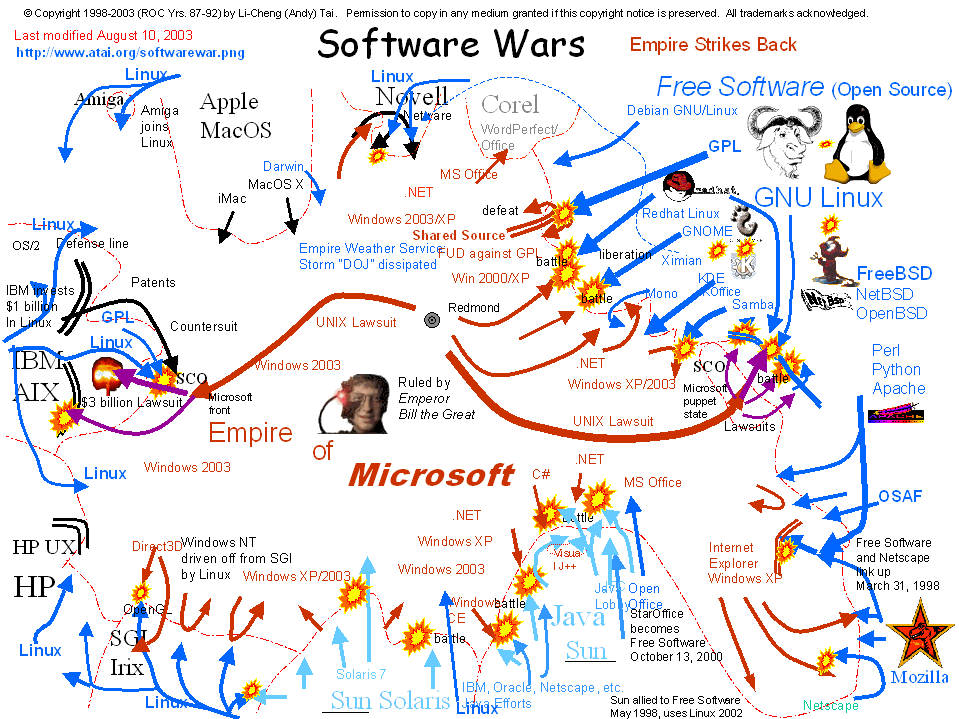
Software Wars;
Yep, we have Microsoft surrounded
Enjoy, -
hmmmm...
Of course his alternative is his own software, I just don't see what the problem is with GPL. All it does is make sure that if you want your code open, anyone else wants to use it has to keep theirs open as well. It encourages idea sharing, not some money making scheme for rising third world nations. If you want some interesting history of the GPL check this out http://www.free-soft.org/gpl_history/
-
Re:Free culture is free
Projects which use the GPL aren't about keeping their code "free," they're about keeping their code open. When I talk about "free" I'm talking about complete freedom and both closed-sounce (Windows) and the GPL (Linux) simply do not provide complete freedom. Sure Linux is "open" (the code is viewable), but you need to figure out soon that there is a difference between "open" and "free." That's why I am not arguing that the GPL isn't an open-source license; it obviously is. But again, that doesn't make code under the GPL truly "free" (even though many people like to think it does).
Here, maybe this will help. GPL'd software is "free" as in libre, and that is how the word is used in the term "free software". All your long-winded, semantic meandering is not going to change that.
-
Old FSM?
There was an old Free Software Magazine that was backed by the FSF in China that had two issues and then died years ago (first issue was in Dec 2001).
Directory listing of FSM issues. They made #3 but I don't think it was ever officially released (I actually submitted a really bad draft of an article for it that ended up being 'published' because I lost net access for about six months...)
The old FSM was officially endorsed by the FSF. This one appears to not have that. It looks like it is far better written than the other FSM though. Not all of the articles are focused on Free Software though (e.g. the one in issue0 about OS X).
-
Re:BSD vs. GNU again
It's not an issue of somebody making a proprietary fork of emacs and selling it.
That's funny, because the GNU GPL is exactly about making a propieratry fork of Emacs. Look up the history of the GPL. -
Had a similar problem...
-
A few editorial notes.
Quoting the article:
GCC is, of course, released under the GNU Public License, and I own a commercial license for the Intel compiler.
Actually, the name of the license is the GNU General Public License. It is "General" because when the GNU project began there was no single license used throughout the project;
[...] while GCC has not quite reached the performance of its commercial competitor [...]
GCC can be commercial too -- many firms distribute copies of GCC for a fee. I believe the author should have said "proprietary" meaning that what the Intel compiler program does, exactly, is secret. As RMS said when describing a proprietary web video streaming application he didn't want MIT to use to distribute a feed of his talk on copyright and globalization:
"What it does is secret. You can't study it; you can't change it; and you certainly can't publish it in your own modified version. And those are among the freedoms that are essential in the definition of "free software."
GCC, by contrast, is free software licensed under the GNU General Public License. Getting back to the article:
These "coyote" benchmarks provide an excellent example of the advantages of "open" software development.
Here I don't think "open" was the best choice of words, I think "free" would have been more accurate. The GNU Compiler Collection was originally the GNU C Compiler and first written by RMS. I guarantee you that RMS did not and does not now do work for the open source movement. He makes effort to make that point clear (like when he corrected Mike Uretsky who made the same mistake). The FSF asks you not to lump their work in with the work of the open source movement. Eben Moglen spoke at Harvard some months ago and also made this distinction. Prof. Moglen makes it clear why they are so adamant on this point:
"We need to keep reminding people that what's at stake here is free speech. We need to keep reminding people that what we're doing is trying to keep the freedom of ideas in the 21st century, in a world where there are guys with little paste-it labels with price tags on it who would stick it on every idea on earth if it would make value for the shareholders. And what we have to do is to continue to reinforce the recognition that free speech in a technological society means technological free speech. I think we can do that. I think that's a deliverable message."
I don't think he's overstating the case.
Finally, there's a common misunderstood myth repeated in the end of the article:
"Choice" is the key word here -- choice is good, be it in democracy or software. Intel provides a useful alternative to GCC for development on ia32 systems. One compiler might have a great environment for developing GUI code; another compiler might generate fast code. GPL-like freedom may be important -- or not -- as individual circumstances dictate.
Many people believe this, I've even heard a variant of this myth being repeated by a representative of the Mozilla Foundation. Choice is no substitute for software freedom, in fact they speak to different aims entirely and in computer software choice is not as important as software freedom. If all we have are three web browsers to choose from (say, Microsoft Internet Explorer, Netscape, and Opera) choice is satisfied. B
-
Re:Downloading music itself is not illegal...
Let's not forget that a lot of the anti-copyright sentiment around here magically disappears whenever we have a GPL violation article.
I don't know that it's exactly the same sort of copyright discussion, though. Yes, I will grant you that there are some zealots on either side either screaming "copyrights aRe teh suck! everything got to be free!" or "obey the RIAA or die", but the more reasonable arguments I've heard against the current state of copyrights are made by people who don't like the fact that the Mickey Mouse copyright, for intance, has been extended to the point that it will not expire until a week after the next ice age.
The GPL, to my knowledge, wasn't created until 1985 at the earliest (I couldn't find an exact date here, but it seemed to cover the topic fairly well for a short read) and therefore anything that's licensed under the GPL can be no more than 20 years old. Ergo, the people who have what I would consider legitimate issues with the current state of affairs in the copyright world won't have the same bone to pick with GPL'd material for a while yet. Also, zealots and non-zealots alike seem to enjoy pointing out that GPL is intended to grant rights to consumers that would not otherwise exist, whereas traditional copyrights mostly appear to do the opposite.
The mouth-foaming extremists, though, let's just agree to ignore them, k? -
Re:HEY....
well....maybe your a troll, SCO exec, or a newb but here's a quick answer since you weren't modded away, the rush is over, and I'm bored: NO. Submitting code is not as easy as mailing a letter to mom. And for one thing, you actually have to contribute something useful for it to be accepted. To get the idea, Check this site out and think about the chances of someone actually pulling it off. You know, this person would actually need access to good code, USEFUL code, code that gets accepted; this person would have to maintain that code because things break when someone adds ANYTHING to the source and it would look mighty suspicious if the person drops contact all of a sudden. This person would also need to leave a nil traceable papertrail. Not impossible, but if its so easy, why dont you try to slip one past and see for yourself? On the other hand, if someone contributes code and claims negligence because they didn't know that they did not in fact own the rights to the code, then the person who leaked that code should be held responsible, not the project maintainers who knew nothing of the incedent. Now the iffy legal part is correctly establishing who owns the code and whether it was leaked illegally. If so, then it should be identified and removed.
But... how does this add up to the GPL being flawed? It is a LICENSE that was meant to preserve the IP and recognition of the author(s) without having to close the source -which means people wouldnt have to keep reinventing the wheel; it cannot function as a cvs/rcs source code accounting program. I cannot stress this enough: The GPL is an inanimate object. It has no means of control over who submits code to that of which it is licensing, no means on how to defend itself against "pirates" who want to burn the license and claim the code on their own behalfs. In fact, NO LICENSE, beit shareware, EULA, freeware, BSD, etc., can control these types of issues, people will do what they want. Its up to the authors of the code to decide how they want to license their software and perceive if someone has wronged them by failing to comply with the license; users are not forced to use the software and noone is pushing acceptance of the $free$ GPL'd code down the developers throats; the courts will decide what and if anything should be enforced, and the police will decide how to enforce it.
No, the GPL has been around for 20 years now and is just fine - its U.S. copyright and DMCA laws that are inherantly flawed. Its the proving whose code is whose that this mess is about, and someone is clearly lying. This weakness you speak of is a social issue. There would be no SCO stories if everyone shared their code like civilized humans, kept IP royalties to less than seven years, and linus had a crystal ball to tell him years ago that he should keep a fascist code insertion policy into the kernel to avoid the allegations that freaks would spend their time trying to sabotage the kernel. And if you check out freshmeat.net, you'll find much GPL'd code that is doing fine. Time will tell when the GPL's value will be tested. Proving authorship is another issue entirely, but if the GPL cannot convince a court that you released the code with a binding request to those who modify and redistribute it that they must also include the original source code, and if it can't convince the court that those who break it should be penalized, then the license has served only to provide a false sense of security. But if it makes you feel better about posting your hard work to millions of people, most of whom will probably not care and some might try to steal, then so be it. Its better than keeping it locked in a vault until you die merely because its not bringing you $$$. I believe that most non-profit open source is just someone's pet project that they want to share for either fame & glory or just to make the world a better place. Its annoying if someone takes your code and br -
Do as I say, not as I do...
Gosling is a "big fan" of open source? Maybe now he is, but don't forget the fun we all had with him concerning UnixEmacs (aka Gosmacs). He wrote a free Emacs clone, actively distributed source and solicited improvements, then sold it to a commercial company which immediately started throwing lawyers around. True, Gosling never promised to keep the source freely available, but it was a tacit assumption by the contributors which he deliberately chose not to correct. Here's one very terse account of the story.
-
Re:GPL
The GPL first appeared in in the June 1988 issue of the GNU Bulletin.
The current GPL (version 2) was released in June 1991.
The History of the GPL -
Re:Been there, done that.
Which one? RMS didn't write the first emacs, that was Gosling.
That is incorrect.
RMS wrote the first emacs as an extension to TECO. Gosling wrote the first C-based emacs, but Gosling is also a conniving rat (like Tatu Ylonen) who promised RMS he could use his Emacs code, then changed his mind and threatened legal action. More recently, he has fraudulently claimed credit for inventing Emacs.
-
"If I don't get my candy...
then I won't go to school!"... are words that you can hear come out of a 3-5 year old. Basically, they are threatening you to oblige to their demands or they won't do something that is required of them.
As you can actually see, school is an important part of mental development for the child. In the context of this post, Mr. Schulze is the child and SPI is the school.
Just because he didn't get his candy, he is threatening to quit SPI? And pray, tell me, what possible good can this achieve? Even the purpose of SPI is unclear (No news for the whole year?).
And what is the role of free software? Just simply to reduce (possibly halt) Microsoft's domination? Only MS? Why not Apple, they too produces propietry OS? Or Macromedia for their overpriced web graphics tools?
Am I the only one to see that neither of these bodies actually serve any useful purposes other than (sigh) more propaganda for the Open Source community? Even in this area, they suck like hell! Somehow I fear for the longevity of the projects under the co-ordination of SPI.
So Mr. Shulze, basically you're just acting selfish. You have access to the minds and opinions of the SPI people and yet you decide to just quit them altogether. Thanks for helping out to futher dysfunctionalize the SPI.
Mod me as you will... it's only karma. -
Re:License Issues w/ PineActually, the GPL predates pine -
According to Pine's history page, pine was conceived in 1989. The GPL first got its name in 1988 as documented here, and the GNU Project was first announced in 1983.
Btw, as a Pine user, I can assure you that the license doesn't allow all the freedom I want. The primary system on which I use Pine runs Debian. Due to pine's non-free license (and, likely, the advent of mutt), Pine fell out of active maintenance by Debian. So, I have to fetch and build the source myself outside the package system instead being able to apt-get security updates. Even prior to that, Debian switched to only distributing pine as a source package - apparently due to the Pine license change "clarifying" that distributing modified versions is forbidden.
I wouldn't go so far as to call the pine license Evil, but I think it is unfortunate. If there were a clone with the same interface, so as to not disrupt the long-time pine users on the system (including myself), I'd switch to it. As it stands, pine has about 7 years of finger memory going for it.
-
Actually, James Gosling Motivated the GPL
Richard Stallman wrote the GPL to protect himself (and others) after James Goslings's shenannigans with Gosling Emacs. See the history here
I don't know when Gosling started working at SUN, but I don't think SUN had anything to do with the original creation of the GPL.
BTW, Sun was growing fast, but IBM was the big monopolist of the time (and hadn't yet realized the monster they created in Microsoft). -
$lashdot: News for Nerds? Or Propaganda for the Im$lashdot: News for Nerds? Or Propaganda for the Impressionable?
Day in and day out, $lashdot sings the praises of "open source" software. New readers of the site must be a little puzzled to find items like "GPL Violation discovered" and "Open Source Guru Speaks" listed on the main page alongside the "straight" science and technology news. Unfortunately, few people really know what Open Source stands for. Perhaps Richard Means Stallman, one of the founders of the movement, can elucidate.
"[The GNU goal was] to be able to use a computer without using any proprietary software,"
declaims RMS. [cnn.com] "Because that way, you can lead a better life." Of course, the only way to get rid of proprietary software is to destroy the software companies that produce it. One way this is accomplished is by putting software that would normally be public domain under a license RMS himself created, called the "General Public License," or "GPL." Simply put, this license allows code to be reused-- unless the final product is distributed without its source code, as a proprietary product must be.
Software is a commodity, and people will often take the cheapest product, even if they have to spend inordinate amounts of time struggling with poor documentation and clumsy user interfaces. "One of the best things I could do with my life is: find a gigantic pile of proprietary software that was a trade secret, and start handing out copies on a street corner so it wouldn't be a trade secret any more," enthuses RMS. [free-soft.org] "Perhaps that would be a much more efficient way for me to give people new free software than actually writing it myself."
ItÂs time to stop the doubletalk and start thinking about the real meaning of intellectual property. By some measures, intellectual property is the main export of the developed countries of the world. Artists, actors, and musicians make a living off the intellectual property they produce. Programmers and engineers create designs to be sold. And journalists and writers depend on intellectual property. Ironically, the only jobs not deeply tied to intellectual property are the jobs many $lashdot readers affect to despise, like service workers, menial laborers, and administrators. If $lashdot readers canÂt stomach Scott McNealy, maybe they would prefer to work with Ronald McDonald. From the other side of the fast food counter.
Not everyone enjoys working at a menial job in the day, simply in order to slave away at poorly organized programming projects. Not everyone enjoys being told that he has the "freedom" to work, without pay, for a small clique of free software partisans. It is one thing to oppose microsoftÂs monopoly on the desktop, and the RIAA's slow strangulation of fair use rights. It is quite another to embrace a whole economic and political ideology that centers around the exploitation of childlike programming savants.
This message is not a troll, although many $lashdot readers may take it as such. It is simply a warning to users to think carefully before they blindly follow the political lead of Rob Malda, Jon Katz, and the like. I encourage readers to repost the text of this message, and others like it, to the supposedly "free" message boards of $lashdot and other sites.
Peace out, and God bless. -
$lashdot: News for Nerds? Or Propaganda for the Im$lashdot: News for Nerds? Or Propaganda for the Impressionable?
Day in and day out, $lashdot sings the praises of "open source" software. New readers of the site must be a little puzzled to find items like "GPL Violation discovered" and "Open Source Guru Speaks" listed on the main page alongside the "straight" science and technology news. Unfortunately, few people really know what Open Source stands for. Perhaps Richard Means Stallman, one of the founders of the movement, can elucidate.
"[The GNU goal was] to be able to use a computer without using any proprietary software,"
declaims RMS. [cnn.com] "Because that way, you can lead a better life." Of course, the only way to get rid of proprietary software is to destroy the software companies that produce it. One way this is accomplished is by putting software that would normally be public domain under a license RMS himself created, called the "General Public License," or "GPL." Simply put, this license allows code to be reused-- unless the final product is distributed without its source code, as a proprietary product must be.
Software is a commodity, and people will often take the cheapest product, even if they have to spend inordinate amounts of time struggling with poor documentation and clumsy user interfaces. "One of the best things I could do with my life is: find a gigantic pile of proprietary software that was a trade secret, and start handing out copies on a street corner so it wouldn't be a trade secret any more," enthuses RMS. [free-soft.org] "Perhaps that would be a much more efficient way for me to give people new free software than actually writing it myself."
ItÂs time to stop the doubletalk and start thinking about the real meaning of intellectual property. By some measures, intellectual property is the main export of the developed countries of the world. Artists, actors, and musicians make a living off the intellectual property they produce. Programmers and engineers create designs to be sold. And journalists and writers depend on intellectual property. Ironically, the only jobs not deeply tied to intellectual property are the jobs many $lashdot readers affect to despise, like service workers, menial laborers, and administrators. If $lashdot readers canÂt stomach Scott McNealy, maybe they would prefer to work with Ronald McDonald. From the other side of the fast food counter.
Not everyone enjoys working at a menial job in the day, simply in order to slave away at poorly organized programming projects. Not everyone enjoys being told that he has the "freedom" to work, without pay, for a small clique of free software partisans. It is one thing to oppose microsoftÂs monopoly on the desktop, and the RIAA's slow strangulation of fair use rights. It is quite another to embrace a whole economic and political ideology that centers around the exploitation of childlike programming savants.
This message is not a troll, although many $lashdot readers may take it as such. It is simply a warning to users to think carefully before they blindly follow the political lead of Rob Malda, Jon Katz, and the like. I encourage readers to repost the text of this message, and others like it, to the supposedly "free" message boards of $lashdot and other sites.
Peace out, and God bless.Troll 46 of 139 from the annals of the Troll Library .
-
$lashdot: News for Nerds? Or Propaganda for the Im$lashdot: News for Nerds? Or Propaganda for the Impressionable?
Day in and day out, $lashdot sings the praises of "open source" software. New readers of the site must be a little puzzled to find items like "GPL Violation discovered" and "Open Source Guru Speaks" listed on the main page alongside the "straight" science and technology news. Unfortunately, few people really know what Open Source stands for. Perhaps Richard Means Stallman, one of the founders of the movement, can elucidate.
"[The GNU goal was] to be able to use a computer without using any proprietary software,"
declaims RMS. [cnn.com] "Because that way, you can lead a better life." Of course, the only way to get rid of proprietary software is to destroy the software companies that produce it. One way this is accomplished is by putting software that would normally be public domain under a license RMS himself created, called the "General Public License," or "GPL." Simply put, this license allows code to be reused-- unless the final product is distributed without its source code, as a proprietary product must be.
Software is a commodity, and people will often take the cheapest product, even if they have to spend inordinate amounts of time struggling with poor documentation and clumsy user interfaces. "One of the best things I could do with my life is: find a gigantic pile of proprietary software that was a trade secret, and start handing out copies on a street corner so it wouldn't be a trade secret any more," enthuses RMS. [free-soft.org] "Perhaps that would be a much more efficient way for me to give people new free software than actually writing it myself."
ItÂs time to stop the doubletalk and start thinking about the real meaning of intellectual property. By some measures, intellectual property is the main export of the developed countries of the world. Artists, actors, and musicians make a living off the intellectual property they produce. Programmers and engineers create designs to be sold. And journalists and writers depend on intellectual property. Ironically, the only jobs not deeply tied to intellectual property are the jobs many $lashdot readers affect to despise, like service workers, menial laborers, and administrators. If $lashdot readers canÂt stomach Scott McNealy, maybe they would prefer to work with Ronald McDonald. From the other side of the fast food counter.
Not everyone enjoys working at a menial job in the day, simply in order to slave away at poorly organized programming projects. Not everyone enjoys being told that he has the "freedom" to work, without pay, for a small clique of free software partisans. It is one thing to oppose microsoftÂs monopoly on the desktop, and the RIAA's slow strangulation of fair use rights. It is quite another to embrace a whole economic and political ideology that centers around the exploitation of childlike programming savants.
This message is not a troll, although many $lashdot readers may take it as such. It is simply a warning to users to think carefully before they blindly follow the political lead of Rob Malda, Jon Katz, and the like. I encourage readers to repost the text of this message, and others like it, to the supposedly "free" message boards of $lashdot and other sites.
Peace out, and God bless.From the annals of the Troll Library .
-
Slashdot: News for Nerds? Or Propaganda for the ImSlashdot: News for Nerds? Or Propaganda for the Impressionable?
Day in and day out, Slashdot sings the praises of "open source" software. New readers of the site must be a little puzzled to find items like "GPL Violation discovered" and "Open Source Guru Speaks" listed on the main page alongside the "straight" science and technology news. Unfortunately, few people really know what Open Source stands for. Perhaps Richard Means Stallman, one of the founders of the movement, can elucidate.
"[The GNU goal was] to be able to use a computer without using any proprietary software,"
declaims RMS. [cnn.com] "Because that way, you can lead a better life." Of course, the only way to get rid of proprietary software is to destroy the software companies that produce it. One way this is accomplished is by putting software that would normally be public domain under a license RMS himself created, called the "General Public License," or "GPL." Simply put, this license allows code to be reused-- unless the final product is distributed without its source code, as a proprietary product must be.
Software is a commodity, and people will often take the cheapest product, even if they have to spend inordinate amounts of time struggling with poor documentation and clumsy user interfaces. "One of the best things I could do with my life is: find a gigantic pile of proprietary software that was a trade secret, and start handing out copies on a street corner so it wouldn't be a trade secret any more," enthuses RMS. [free-soft.org] "Perhaps that would be a much more efficient way for me to give people new free software than actually writing it myself."
ItÂs time to stop the doubletalk and start thinking about the real meaning of intellectual property. By some measures, intellectual property is the main export of the developed countries of the world. Artists, actors, and musicians make a living off the intellectual property they produce. Programmers and engineers create designs to be sold. And journalists and writers depend on intellectual property. Ironically, the only jobs not deeply tied to intellectual property are the jobs many slashdot readers affect to despise, like service workers, menial laborers, and administrators. If slashdot readers canÂt stomach Scott McNealy, maybe they would prefer to work with Ronald McDonald. From the other side of the fast food counter.
Not everyone enjoys working at a menial job in the day, simply in order to slave away at poorly organized programming projects. Not everyone enjoys being told that he has the "freedom" to work, without pay, for a small clique of free software partisans. It is one thing to oppose microsoftÂs monopoly on the desktop, and the RIAA's slow strangulation of fair use rights. It is quite another to embrace a whole economic and political ideology that centers around the exploitation of childlike programming savants.
This message is not a troll, although many slashdot readers may take it as such. It is simply a warning to users to think carefully before they blindly follow the political lead of Rob Malda, Jon Katz, and the like. I encourage readers to repost the text of this message, and others like it, to the supposedly "free" message boards of slashdot and other sites.
Peace out, and God bless.From the annals of the Troll Library .
-
Re:He wrote the original EMACS, huh? Whatta guy!
Yup. Here's a link:
http://www.free-soft.org/gpl_history/ -
censor this quickMy IP address will shortly be banned. Read this while you can.
Slashdot: News for Nerds? Or Propaganda for the Impressionable?
Day in and day out, Slashdot sings the praises of open source software.
New readers of the site must be a little puzzled to find items like GPL
Violation discovered and Open Source Guru Speaks listed on the main
page alongside the straight science and technology news. Unfortunately,
few people really know what Open Source stands for. Perhaps Richard Means
Stallman, one of the founders of the movement, can elucidate.
[The GNU goal was] to be able to use a computer without using any
proprietary software, declaims RMS.
Because that way, you can lead a better life. Of course, the only way to
get rid of proprietary software is to destroy the software companies that
produce it. One way this is accomplished is by putting software that would
normally be public domain under a license RMS himself created, called the
General Public License, or GPL. Simply put, this license allows code
to be reused-- unless the final product is distributed without its source
code, as a proprietary product must be.
Software is a commodity, and people will often take the cheapest product,
even if they have to spend inordinate amounts of time struggling with poor
documentation and clumsy user interfaces. One of the best things I could
do with my life is: find a gigantic pile of proprietary software that was
a trade secret, and start handing out copies on a street corner so it
wouldn't be a trade secret any more, enthuses RMS. Perhaps that would be a
much more efficient way for me to give people new free software than
actually writing it myself.
Its time to stop the doubletalk and start thinking about the real
meaning of intellectual property. By some measures, intellectual property
is the main export of the developed countries of the world. Artists,
actors, and musicians make a living off the intellectual property they
produce. Programmers and engineers create designs to be sold. And
journalists and writers depend on intellectual property. Ironically, the
only jobs not deeply tied to intellectual property are the jobs many
slashdot readers affect to despise, like service workers, menial laborers,
and administrators. If slashdot readers cant stomach Scott McNealy, maybe
they would prefer to work with Ronald McDonald. From the other side of the
fast food counter.
Not everyone enjoys working at a menial job in the day, simply in
order to slave away at poorly organized programming projects. Not everyone
enjoys being told that he has the freedom to work, without pay, for a
small clique of free software partisans. It is one thing to oppose
microsofts monopoly on the desktop, and the RIAAs slow strangulation of
fair use rights. It is quite another to embrace a whole economic and
political ideology that centers around the exploitation of childlike
programming savants.
This message is not a troll, although many slashdot readers may
take it as such. It is simply a warning to users to think carefully before
they blindly follow the political lead of Rob Malda, Jon Katz, and the
like. I encourage readers to repost the text of this message, and others
like it, to the supposedly free message boards of slashdot and other
sites.
Peace out, and God bless. -
mod me down, karma policeSlashdot: News for Nerds? Or Propaganda for the Impressionable?
Day in and day out, Slashdot sings the praises of "open source" software. New readers of the site must be a little puzzled to find items like "GPL Violation discovered" and "Open Source Guru Speaks" listed on the main page alongside the "straight" science and technology news. Unfortunately, few people really know what Open Source stands for. Perhaps Richard Means Stallman, one of the founders of the movement, can elucidate.
"[The GNU goal was] to be able to use a computer without using any proprietary software," declaims RMS. "Because that way, you can lead a better life." Of course, the only way to get rid of proprietary software is to destroy the software companies that produce it. One way this is accomplished is by putting software that would normally be public domain under a license RMS himself created, called the "General Public License," or "GPL." Simply put, this license allows code to be reused-- unless the final product is distributed without its source code, as a proprietary product must be.
Software is a commodity, and people will often take the cheapest product, even if they have to spend inordinate amounts of time struggling with poor documentation and clumsy user interfaces. "One of the best things I could do with my life is: find a gigantic pile of proprietary software that was a trade secret, and start handing out copies on a street corner so it wouldn't be a trade secret any more," enthuses RMS. "Perhaps that would be a much more efficient way for me to give people new free software than actually writing it myself."
It's time to stop the doubletalk and start thinking about the real meaning of intellectual property. By some measures, intellectual property is the main export of the developed countries of the world. Artists, actors, and musicians make a living off the intellectual property they produce. Programmers and engineers create designs to be sold. And journalists and writers depend on intellectual property. Ironically, the only jobs not deeply tied to intellectual property are the jobs many slashdot readers affect to despise, like service workers, menial laborers, and administrators. If slashdot readers can't stomach Scott McNealy, maybe they would prefer to work with Ronald McDonald. From the other side of the fast food counter.
Not everyone enjoys working at a menial job in the day, simply in order to slave away at poorly organized programming projects. Not everyone enjoys being told that he has the "freedom" to work, without pay, for a small clique of free software partisans. It is one thing to oppose microsoft's monopoly on the desktop, and the RIAA's slow strangulation of fair use rights. It is quite another to embrace a whole economic and political ideology that centers around the exploitation of childlike programming savants.
This message is not a troll, although many slashdot readers may take it as such. It is simply a warning to users to think carefully before they blindly follow the political lead of Rob Malda, Jon Katz, and the like. I encourage readers to repost the text of this message, and others like it, to the supposedly "free" message boards of slashdot and other sites.
Peace out, and God bless.
-
./readmeSlashdot: News for Nerds? Or Propaganda for the Impressionable?
Day in and day out, Slashdot sings the praises of "open source" software. New readers of the site must be a little puzzled to find items like "GPL Violation discovered" and "Open Source Guru Speaks" listed on the main page alongside the "straight" science and technology news. Unfortunately, few people really know what Open Source stands for. Perhaps Richard Means Stallman, one of the founders of the movement, can elucidate.
"[The GNU goal was] to be able to use a computer without using any proprietary software," declaims RMS. "Because that way, you can lead a better life." Of course, the only way to get rid of proprietary software is to destroy the software companies that produce it. One way this is accomplished is by putting software that would normally be public domain under a license RMS himself created, called the "General Public License," or "GPL." Simply put, this license allows code to be reused-- unless the final product is distributed without its source code, as a proprietary product must be.
Software is a commodity, and people will often take the cheapest product, even if they have to spend inordinate amounts of time struggling with poor documentation and clumsy user interfaces. "One of the best things I could do with my life is: find a gigantic pile of proprietary software that was a trade secret, and start handing out copies on a street corner so it wouldn't be a trade secret any more," enthuses RMS. "Perhaps that would be a much more efficient way for me to give people new free software than actually writing it myself."
It's time to stop the doubletalk and start thinking about the real meaning of intellectual property. By some measures, intellectual property is the main export of the developed countries of the world. Artists, actors, and musicians make a living off the intellectual property they produce. Programmers and engineers create designs to be sold. And journalists and writers depend on intellectual property. Ironically, the only jobs not deeply tied to intellectual property are the jobs many slashdot readers affect to despise, like service workers, menial laborers, and administrators. If slashdot readers can't stomach Scott McNealy, maybe they would prefer to work with Ronald McDonald. From the other side of the fast food counter.
Not everyone enjoys working at a menial job in the day, simply in order to slave away at poorly organized programming projects. Not everyone enjoys being told that he has the "freedom" to work, without pay, for a small clique of free software partisans. It is one thing to oppose microsoft's monopoly on the desktop, and the RIAA's slow strangulation of fair use rights. It is quite another to embrace a whole economic and political ideology that centers around the exploitation of childlike programming savants.
This message is not a troll, although many slashdot readers may take it as such. It is simply a warning to users to think carefully before they blindly follow the political lead of Rob Malda, Jon Katz, and the like. I encourage readers to repost the text of this message, and others like it, to the supposedly "free" message boards of slashdot and other sites.
Peace out, and God bless.
-
slashdot expos�Slashdot: News for Nerds? Or Propaganda for the Impressionable?
Day in and day out, Slashdot sings the praises of "open source" software. New readers of the site must be a little puzzled to find items like "GPL Violation discovered" and "Open Source Guru Speaks" listed on the main page alongside the "straight" science and technology news. Unfortunately, few people really know what Open Source stands for. Perhaps Richard Means Stallman, one of the founders of the movement, can elucidate.
"[The GNU goal was] to be able to use a computer without using any proprietary software," declaims RMS. "Because that way, you can lead a better life." Of course, the only way to get rid of proprietary software is to destroy the software companies that produce it. One way this is accomplished is by putting software that would normally be public domain under a license RMS himself created, called the "General Public License," or "GPL." Simply put, this license allows code to be reused-- unless the final product is distributed without its source code, as a proprietary product must be.
Software is a commodity, and people will often take the cheapest product, even if they have to spend inordinate amounts of time struggling with poor documentation and clumsy user interfaces. "One of the best things I could do with my life is: find a gigantic pile of proprietary software that was a trade secret, and start handing out copies on a street corner so it wouldn't be a trade secret any more," enthuses RMS. "Perhaps that would be a much more efficient way for me to give people new free software than actually writing it myself."
It's time to stop the doubletalk and start thinking about the real meaning of intellectual property. By some measures, intellectual property is the main export of the developed countries of the world. Artists, actors, and musicians make a living off the intellectual property they produce. Programmers and engineers create designs to be sold. And journalists and writers depend on intellectual property. Ironically, the only jobs not deeply tied to intellectual property are the jobs many slashdot readers affect to despise, like service workers, menial laborers, and administrators. If slashdot readers can't stomach Scott McNealy, maybe they would prefer to work with Ronald McDonald. From the other side of the fast food counter.
Not everyone enjoys working at a menial job in the day, simply in order to slave away at poorly organized programming projects. Not everyone enjoys being told that he has the "freedom" to work, without pay, for a small clique of free software partisans. It is one thing to oppose microsoft's monopoly on the desktop, and the RIAA's slow strangulation of fair use rights. It is quite another to embrace a whole economic and political ideology that centers around the exploitation of childlike programming savants.
This message is not a troll, although many slashdot readers may take it as such. It is simply a warning to users to think carefully before they blindly follow the political lead of Rob Malda, Jon Katz, and the like. I encourage readers to repost the text of this message, and others like it, to the supposedly "free" message boards of slashdot and other sites.
Peace out, and God bless.
-
Slashdot: News or Propaganda?Slashdot: News for Nerds? Or Propaganda for the Impressionable?
Day in and day out, Slashdot sings the praises of "open source" software. New readers of the site must be a little puzzled to find items like "GPL Violation discovered" and "Open Source Guru Speaks" listed on the main page alongside the "straight" science and technology news. Unfortunately, few people really know what Open Source stands for. Perhaps Richard Means Stallman, one of the founders of the movement, can elucidate.
"[The GNU goal was] to be able to use a computer without using any proprietary software," declaims RMS. "Because that way, you can lead a better life." Of course, the only way to get rid of proprietary software is to destroy the software companies that produce it. One way this is accomplished is by putting software that would normally be public domain under a license RMS himself created, called the "General Public License," or "GPL." Simply put, this license allows code to be reused-- unless the final product is distributed without its source code, as a proprietary product must be.
Software is a commodity, and people will often take the cheapest product, even if they have to spend inordinate amounts of time struggling with poor documentation and clumsy user interfaces. "One of the best things I could do with my life is: find a gigantic pile of proprietary software that was a trade secret, and start handing out copies on a street corner so it wouldn't be a trade secret any more," enthuses RMS. "Perhaps that would be a much more efficient way for me to give people new free software than actually writing it myself."
It's time to stop the doubletalk and start thinking about the real meaning of intellectual property. By some measures, intellectual property is the main export of the developed countries of the world. Artists, actors, and musicians make a living off the intellectual property they produce. Programmers and engineers create designs to be sold. And journalists and writers depend on intellectual property. Ironically, the only jobs not deeply tied to intellectual property are the jobs many slashdot readers affect to despise, like service workers, menial laborers, and administrators. If slashdot readers can't stomach Scott McNealy, maybe they would prefer to work with Ronald McDonald. From the other side of the fast food counter.
Not everyone enjoys working at a menial job in the day, simply in order to slave away at poorly organized programming projects. Not everyone enjoys being told that he has the "freedom" to work, without pay, for a small clique of free software partisans. It is one thing to oppose microsoft's monopoly on the desktop, and the RIAA's slow strangulation of fair use rights. It is quite another to embrace a whole economic and political ideology that centers around the exploitation of childlike programming savants.
This message is not a troll, although many slashdot readers may take it as such. It is simply a warning to users to think carefully before they blindly follow the political lead of Rob Malda, Jon Katz, and the like. I encourage readers to repost the text of this message, and others like it, to the supposedly "free" message boards of slashdot and other sites.
Peace out, and God bless.
-
Try also......this page, which lists (with links) nearly every toolkit known in this solar system. As for printing support or other solar systems, I plead my usual ignorance.
--