Slashdot Mirror
Domain: free.fr
Stories and comments across the archive that link to free.fr.
Comments · 1,346
-
The right tool for the right job
Remember how programmers always talk about using the right tool for the right job?
If you want to do something like graphing, then why not learn a language like R, where you can easily and interactively create amazing visuals in very little time? I write code in Java, python, bash, and interact with Oracle and MySQL database. R fits in as a nice way to visualize data, and it's very easy to script up solutions that you can plug into your programming pipeline.
Check out http://addictedtor.free.fr/graphiques/index.php for examples (with source code) -
Re:bad UI
I took the picture you pointed on Wikipedia. I'm a French citizen alerting other citizens about the dangers of the current electronic voting solutions. My reporting about the French presidential election (1st round) at Issy-les-Moulineaux (100% electroning voting, ESS iVotronic). Sorry it's in French for now. http://oumph.free.fr/textes/vote_electronique/200
7 0422-1er-tour-presidentielle/ (Summary: technical problems, bad translations, opacity, no citizen control, badly printed tickets, etc.) My reporting about the training for polling station presidents and vice-presidents (in French too): http://oumph.free.fr/textes/vote_electronique/form ation_vote_electronique.html (Summary: badly printed tickets, bad translations, bad ergonomy, no control, missing votes, etc.) What a pity! -
Re:bad UI
I took the picture you pointed on Wikipedia. I'm a French citizen alerting other citizens about the dangers of the current electronic voting solutions. My reporting about the French presidential election (1st round) at Issy-les-Moulineaux (100% electroning voting, ESS iVotronic). Sorry it's in French for now. http://oumph.free.fr/textes/vote_electronique/200
7 0422-1er-tour-presidentielle/ (Summary: technical problems, bad translations, opacity, no citizen control, badly printed tickets, etc.) My reporting about the training for polling station presidents and vice-presidents (in French too): http://oumph.free.fr/textes/vote_electronique/form ation_vote_electronique.html (Summary: badly printed tickets, bad translations, bad ergonomy, no control, missing votes, etc.) What a pity! -
Re:Sound quality.
It's not simple waveform shaping, and you can't just use simple passive networks to get it. Tube amps may have higher THD, but THD doesn't correlate with blind tests of perception, because the type of distortion matters, and THD is unweighted. Tubes and transistors have different types of nonlinearity. Tubes have a 3/2 power law, whereas transistors are exponential. This, and common circuit topology used in the respective camps, result in tube amps having high THD but mostly consisting of even low order harmonics, which are inaudible to as much as a few percent. Many tube amps are also in class A and thus avoid the crossover distortion that is audible in the parts per million. Then the clipping characteristics of tubes are much better, whereas when a solid state amp clips, you get huge amounts of transient intermodulation-like effects. Various other things such as masking distortions created by say jitter in the digital system, speaker interactions, etc., can play apart. Finally, tubes lack the thermal memory distortion that transistors have; though these can be dealt with in solid state amps, it's rarely done: http://peufeu.free.fr/audio/memory/
-
Re:There's no debate
Jitter is actually a bigger problem than the filtering. Plus, 96 kHz... that means even higher clock frequency and more jitter sensitivity. It's a big issue, and the distortions produced when jitter (phase noise) gets in the DAC chip are complex and audible in the ppm, unlike the low order even harmonics of class A tube or MOSFET amps. A good technical paper on the nature of jitter-induced distortions in digital audio: http://www.essex.ac.uk/ese/research/audio_lab/mal
c olmspubdocs/C134%20Paper%20121st%20convention%20(c orrected).pdf
Class D amps have a long way to go. THD is meaningless, as the blind test studies by GedLee that were presented at the Audio Engineering Society convention a few years ago show, THD doesn't correlate with the distortion detectability, since the type of distortion is far more important. Crossover distortion from class B and AB stages, and effects of jitter, are audible in the parts per million. There's another type of distortion that doesn't affect THD measures at all, but is perceptually significant: thermal memory distortion. There's a good description of it and ways to decrease it here: http://peufeu.free.fr/audio/memory/ (there's also an AES paper linked there that describes how to measure it in real amps). Of course, tubes don't exhibit such distortion, and is my guess as to one of the reasons some people prefer them despite higher THD than typical solid state amps (however, this higher THD is simply due to most tube amps being simple; a tube with constant current load is more linear than any single solid state device; you can easily make a tube amp as linear as a solid state one if you use as many tubes as you would transistors). -
Re:i'm not so sure...
Hmm, I could suggest a virtualdub clone or another amazing program if you still want to give linux a try.
-
Re:Open source crack? Interesting.
The mirrors change fairly regularly. Just google "antiwpa.tk" to find one. The full source code is available for download on the site.
The forum usually has up to date info.
You need a valid OEM (or retail, if that's the cd your using) key. Hint: google "system locked preinstallation". If you use one from a keygen WGA will likely fail.
In case of a bad mirror, make sure to run it through Online malware scan. That scans with AntiVir, ArcaVir, Avast, AVG Antivirus, BitDefender, ClamAV, Dr.Web, F-Prot Antivirus, F-Secure Anti-Virus, Fortinet, Kaspersky Anti-Virus, NOD32, Norman Virus Control, Panda Antivirus, Rising Antivirus, VirusBuster, and VBA32. If you got it from a good mirror it will be clean.
Moderaters: please either ignore this post or mod it down (offtopic, troll, or flamebait). Please do not mod up. -
Re:Sorry, couldn't RTFA
Don't forget to download this.
Sometimes I forget that the internet has ads... No joke. -
Re:awesome machine
This app does:
http://www.3ivxcrush.com/
We're working on an Intel native version and already have multiprocessor/all processor support in the G4 and G5 versions.
Video of all 4 processors in action on a Quad G5:
http://youtube.com/results?search_query=3ivx+Crush &search=Search
Download Freebie:
http://gerome.free.fr/discovering3ivxcrush/3ivxCru sh_1.0.1.dmg -
Re:WinAMP
Assuming these are mp3, at an average size of 3.5 MB per file, we're talking somewhere in the neighborhood of 70 GB. Correct me if my assumptions are unfounded. I'd call that "medium-big," but not huge.
Anyway, if you're looking for a good GTK jukebox (and yes, Rhythmbox totally blows), check out gmusicbrowser. Excellent browser, can use gstreamer or mpg321/ogg123/flac123 or mplayer as a backend, very adaptable interface, snappy as hell with my 80GB or so (mixed bag of flac/ogg/mp3), I can't speak for how well it'd hold up under a heavier load. It's initial scan with that much data takes a goddamn long time (start it before you go to bed), but once the files are scanned, you're golden. You can set it up to scan for new/deleted/changed files on startup, which is much faster and less processor-intensive than the initial scan, but even that can be turned off or done manually from the prefs menu. Enjoy! -
Comparisons to other emulators?
-
Re:Once again the fanatics take charge
We *need* an alternative to GCC. If I had one...
Try TCC. Feel free to write the rest of the toolchain.
But you know what? They could probably stay at whatever gcc they are shipping now for a very long time.
On one of my systems there is still kgcc -> -
There is truth to that comment.
Vista has not improved anything over the common use of running a program, other than present a number of hurdles brought by various trespass of Legislature to impose the over-run homage of transient societies to draw wealth where none was deposited.
If anyone wants to try Windows Vista, then I suggest to first buy Linspire and use Click'N'Run to download Qemu or Bochs, then install Microsoft Windows Vista in that little sandbox. Only feed Vista what nothing else can eat.
Of'course, I just downloaded FreeSpire. LinSpire and FreeSpire are only building a handy UI to a Debian Package Management (apt), while Microsoft is subverting the entire system with illogical rules imposed by corruptible legislatures that don't even know NX in a processor from Annex of a territory or idea. Even now, Click'N'Run needs its repository freshened, so its better to support someone that actually has the Will to compete.
Of'course, ****Spire is the lesser evil, but they are on our leash (GPL). -
Re:Virtualisation negates the need for a compile fVirtualization is great, but it's not perfect solution here:
- Installing a dozen operating systems is a lot of work. It was nice to be able to take advantage of work someone else has already done.
- If you use continuous integration tools like buildbot to test after every checkin, it's best to leave the systems running all the time. I don't have enough RAM to have a dozen operating systems running on my machine at once. VMware at least has some ability to be started and stopped programmatically, but that's more work and is obviously slower.
- Virtualization tools don't target other architectures, and emulation tools (like QEMU) are generally slow. Not everything is x86.
I used to use SourceForge's Compile Farm (in addition to HP's Test Drive) to test sigsafe. I need to write assembly for the cross-product of supported processors and operating systems. Without the ability to log in, compile, run my automated tests, and use a debugger, I can't support a platform. This decision means I'll have to drop sparc support. It's a shame - I learned a lot from writing assembly for these different platforms.
-
Missing Program
How on earth did he not include Onyx? I'd probably say its top 5... http://www.titanium.free.fr/pgs/english.html from the site: It allows you to run misc tasks of system maintenance, to configure certain hidden parameters of the Finder, Dock, Dashboard, Exposé, Safari, Login window and many Apple's applications, to delete cache, to remove a certain number of files and folders that may become cumbersome, to see the detailed info of your configuration, to preview the different logs and CrashReporter reports, to check the Preferences files and more. I would even go so far as to say it deserved to be number one...
-
Re:VMsQEMU still emulates only an x86 PC, not other architectures. Qemu can emulate other architectures too, it's just not as fast as when running as a virtual machine on x86 cpus.
-
Power != POWER; Sparc != SPARCQEMU won't do POWER The SF.net CompileFarm was not there to provide 'power'. It was there to provide access to different systems for compilation of your project. Anyone using it for 'power' was abusing it. cbreaker said POWER; you said "power". There is a difference between "power" and the POWER architecture, and QEMU doesn't emulate the 64-bit POWER architecture. There is also a difference between "spark" and the SPARC architecture, and QEMU's support for SPARC is still very immmature. (Source: QEMU Status)
-
Doctoring? Yes.
Yes, Adnan Hajj's unfortunate images were "doctored" as in "given too much medicine," the medicine being dust & scratch removal.
But it was not faked, nor was image content "cloned" with that tool.
This Image Is Not Faked
The next step, if someone was paying me for this, would be to try to replicate the disaster using some readily-available dust & scratch removal software, like Sane for the GIMP.
If Hajj's lawyer or Reuters were laying appropriate bucks at my feet, I would explore the problem through SciPy and PIL.
Hajj's disastrous image is an example of the kinds of errors we will have to get used to recognizing.
In the olden days, we would correct scratches by putting a drop of light mineral oil on the negative and putting glass over that. The oil filled in the scratches similar to the way the DCTs fill in the scratches nowadays.
Reuters deserved some reputation damage, as Hajj's photos aren't all that great and quite obviously Reuters's photo editor was asleep at the switch.
But accusing them of publishing faked photos is in this case fakery itself: pretending to knowledge that nobody has.
(Claimer: I was a photojournalist for various school organs for about a decade. I've done DSP professionally several times, and love doing it in my free time as well. If you count my PWM synth for the Apple ][, I've been doing DSP since 1979.) -
Linux : Speaking of which...
Think about the AV products for Linux or Mac. Most of them clean Windows viruses out of files/emails so that they won't infect other machines
Speaking of which, it is a pity that the opensource world wasn't represented :
ClamAV is a very good solution, it also has a Windows client which may lack real-time on-access scan, but has numerous plugins (like, for example, built-in for Outlook, or downloadable for FireFox) and few hacks for on-access scanning.
It has been regularly touted for its fast response time against new threats, it supports hrdware acceleration.
It's just a shame that nobody included the anti-virus in the comparison chart. It may not be a ready-for-joe-6pack AV product (no on-access scan) but it's a nice complement for power users. -
Re:HL2 - solid art direction
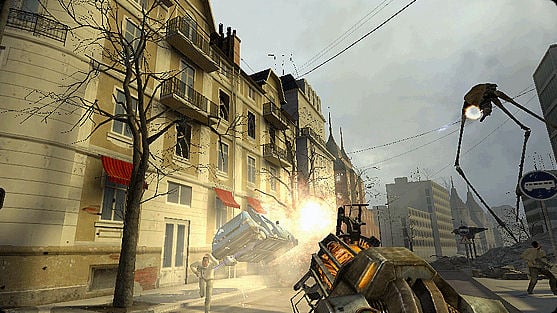
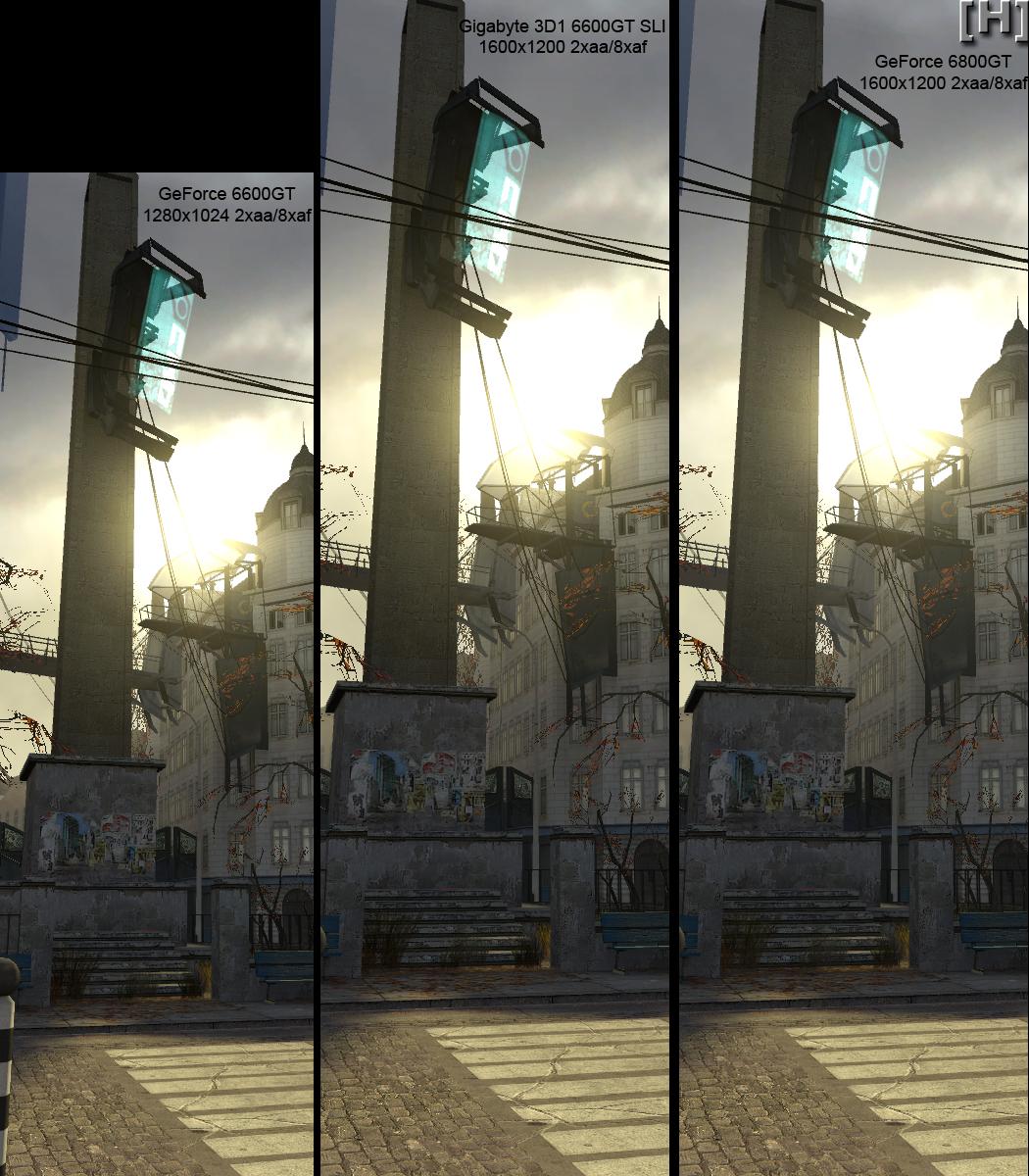
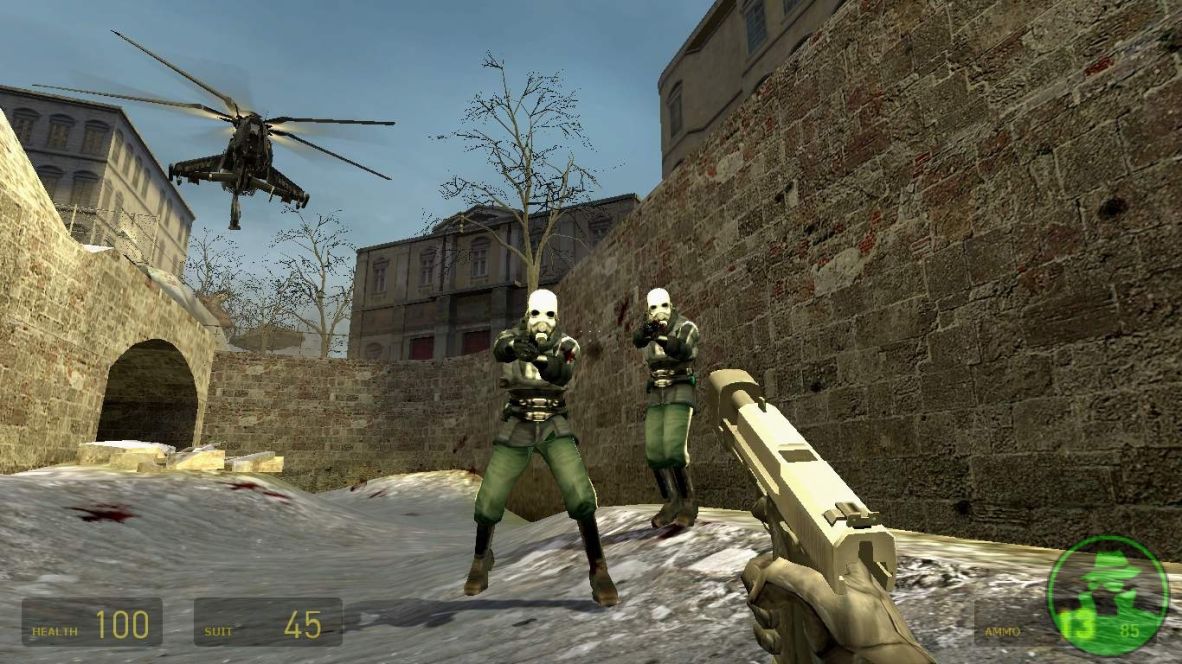
The thing that people forget is that HL2's art direction was amazing. I can't think of another title in recent memory that had a higher level of visual cohesiveness on a reasonable polybudget. For example, darkness consistently equals safety throughout the game, whereas any point you're exposed to sunlight is a location shrouded in danger. This is consistent both internally and externally. No-one, to my knowledge, has followed this color styling, yet it is an effective technique at making the player feel like an unwelcome outcast.
You can see how minimalist this tree really is. They only gave it just enough branches to cover the illusion, but not so many that it holds up to actual inspection. Another shot of said tree, from a more common angle. By not wasting any polys, they really can afford to put more on-screen. Heck, look at leaves. Artificially close, they are a big smear. But from the distance you normally see them, they can stick thousands of these things on screen, and they look beautiful.
Love the look of brick? Notice how in this shot they've burned the bump maps and damage maps and everything into the same texture? The increases the repetition in texture, but if you vary your geometry sufficiently the player will never notice. All they'll notice is a lot more is going on on-screen than they're used to. This technique looks terrible for big-open walls, but Half Life studiosly avoids big open walls within proximity of the player.
They even used a distinct pallete of blacks, muted browns, and light blues. This was far before anyone else was using anything but super-saturated primary colors.
Ignoring any technical accomplishments, this is an achievement of strong visual composition and consistent, solid art direction. -
Re:CSS for Documents?
I've been searching for an easy and fast way to publish documents.
In the places where I worked I saw people were loosing too much time
with text processors. Instead of focusing on content they were fiddling
with fonts, colors,
What is needed is separation of content and style :
text then style, content then presentation.
Opera CTO is right with HTML and CSS,
but they might not be appropriate for publishing.
PDF is a good format for publishing and it is widely used but
it is missing the template feature.
Lyx can do the trick but template customization and generation
is not easy for non (latex)latex aware people (non programmers).
I've searched for such a mean to separate text and style, you just type text,
then your style is automatically applied, check my web page :
http://fredboboss.free.fr/pyfpdf/index.php
At last you get a PDF ready for publishing, this is just a proof of concept,
but the idea is that you can keep your content an change the style
whenever needed.
I don't know what ODF format consists in, but a good document format
for producing document ready for publishing would allow seperation of
content and style à la CSS stylesheet so that users can just concentrate
on text.
fred -
Re:Incorporate Quicksilver/Launchbar technology
About Dashboard, try this:
First put a few widgets on your dashboard. Then logout and login. Launch Terminal, extend its window all the way down so you can see a lot of processes, and launch top. Now invoke Dashboard, and move your widgets so you can see the terminal window. See those new 'DashboardC' processes that just popped up, eating your RAM (and sometimes your CPU). They weren't here before.
You can read in the Dashboard technology brief (http://images.apple.com/macosx/pdf/MacOSX_Dashboa rd_TB.pdf), page 5: 'Each widget runs as a separate UNIX process in its own environment, or "sandbox," and is restricted to the same privileges as the user running it'.
However if you really want to deactivate it, try Onyx, it's just a tickbox to mark or not in one of the panes.
As for Spotlight, don't misunderstand me, I also think it could use some beefing, I just objected to using it as a launcher (I'm not even planning to abandon QS when Leopard comes, even if Spotlight improves as a launcher as Apple announced). In fact I even removed the Apps from its index, so as to make it just a file search and nothing else.
May I suggest trying Spotlaser to help with your searches?
Have fun spotlighting! -
Re:Too true
your post reminds me of a an argument by a British chap that LHD cars are illogical and that there would be less fatalities on the road if every nation of the world would start driving on the left. He used the Japan example to prove his point.
I am perfectly comfortable driving with the gear stick on the left or the right and I don't get mixed up between break and gas pedal since
However I do confess that upon switching from RHD to LHD I have my left hand trying to open the door whenever a gear shift is due
Have you ever tried World Wind for more than 5 minutes?
If you had posted 3 years ago I could have used your post as a layout for a review about GE when it was made freely accessible first.
By now I know both GE and WW well enough to say that although superficially they might appear similar they are fundamentally different and address different requirements, exactly in the same way as Windows and Linux (or VW and Porsche) do.
By the way, I am involved with both: if you are a GE user you will be familiar with the Tracks4Africa layer in "featured content" (you will need version 4 installed)
http://www.tracks4africa.com/t4a_google.asp
and with the World Wind South Africa program for the local schools
http://www.space.gov.za/worldwind/
I try to maintain an open objective mind. I suggest you do the same. Nevertheless I feel entitled for being biased since WW terrain data
http://ige09.free.fr/3d/WW/compWW-GE.en.php?lng=en
and open source nature allows me to achieve results which I cannot dream to achieve with GE
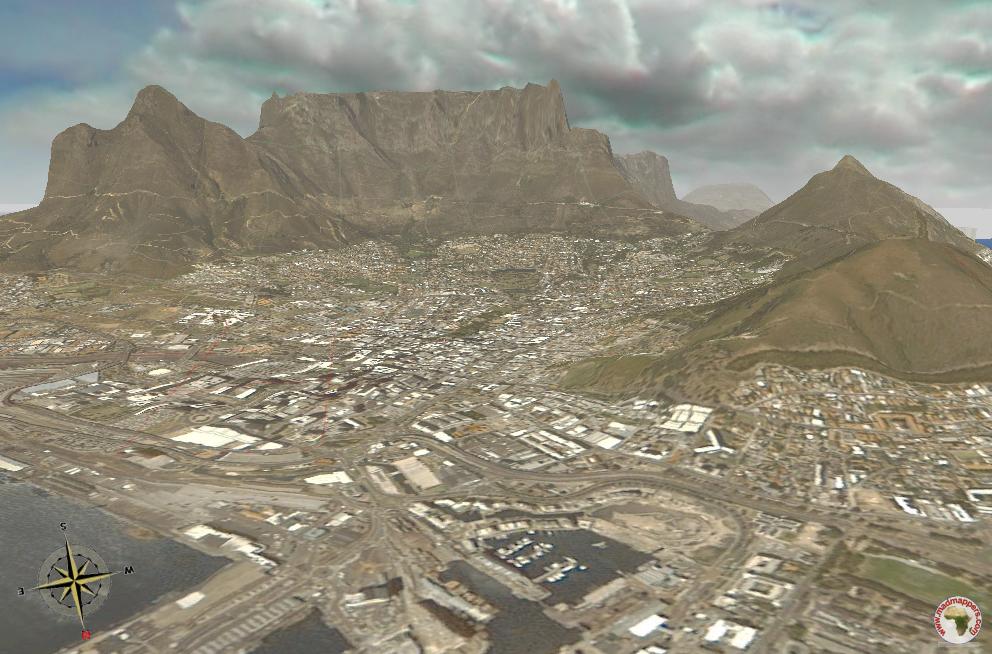
http://www.madmappers.com/pub/CapeTown_Spot5_c.jpg
That was done with WW version 1.35 (SOMEBODY: fix the broken clouds plug-in in 1,4 !)
I am enjoying testing (and learning) the new WW version 1.4 with hill shading and other innovations.
WW1.4 - TOO GOOD TO BE TRUE !!!
Ciao
Maurizio -
Already Done
VMWare and Parallels may not be willing to let users run OS X in their virtual machines, but there are others that do. For example, Mac-on-Linux, QEMU, and PearPC. All these are open-source, too.
-
Re:Driver Management
Previously I was using the Logitech Quickcam Web via the qc-usb driver which died after 4 years of nearly constant use. Now I'm using a Logitech QuickCam Communicate STX (the older model product id 0x08ad) supported via the qspcav driver. Overall both of these drivers have been very stable for me, YMMV.
-
Been there, done that...
-
Re:SNOOD!!
If you like snood you should also get Frozen Bubble, a free open-source version of bust-a-move. It looks and plays really well, I played through all 100 levels last night in fact...
It's controlled with the keyboard but if you have bluetooth and a wii remote you could get a tilt control version going on your PC with some hacking around.
Or you could play the java in-browser version, it might even work in Opera on the Wii already. -
Big claims are made for Go, the board game
-
Metal Group "Dimmu Borgir" did this before
Dimmu Borgir, a Norwegian Black Metal group, ripped a song from the Amiga game "Agony", composed by Tim Wright. The original was a beautiful piano piece that you could listen to in the title screen. The band stole the melody and used it in the song "Sorgens Kammer" ("The Chamber of Sorrow" in Norwegian).
They never acknowledged the ripoff, simply substituting the song with another one in the album. Pathetic. -
Metal Group "Dimmu Borgir" did this before
Dimmu Borgir, a Norwegian Black Metal group, ripped a song from the Amiga game "Agony", composed by Tim Wright. The original was a beautiful piano piece that you could listen to in the title screen. The band stole the melody and used it in the song "Sorgens Kammer" ("The Chamber of Sorrow" in Norwegian).
They never acknowledged the ripoff, simply substituting the song with another one in the album. Pathetic. -
Re:Apples to Oranges
rtfa. not qemu, but qemu accelerator.
http://fabrice.bellard.free.fr/qemu/qemu-accel.htm l -
Re:Will it be avaliable worldwide?
I got one of those wifi SD cards. No complaints since, except that means I have to schlep around my SD card separately. When I have my Zire 72, I pretty much want it solely for browsing and a near-perfect emulator of NES, SNES, GB, and Genesis systems.
-
Re:These aren't the big issues at all
In case you're looking for a good wireless solution for Linux/BSD, I've recently discovered that Ralink RT2500 chipset based wireless cards work really well. Ralink even has a GPL'ed driver for Linux! I've since replaced all of the POS Intel PRO/2200BG adapters in my house with these, at an amazing $18 a pop.
Ubuntu 6.10 has the RT2x00 driver built-in, and so does OpenBSD. Setting it up in BSD was a breeze; just configure it with ifconfig like any other card. Ubuntu was a little more work-- I tried a number of different GUIs until I found one that addressed all of my issues, and it's probably the best one I've seen so far. RutilT is, unfortunately, not in any of Ubuntu's repos, but compiling it was not difficult. In case you're interested, I -
Re:Tecos and cablecos raped our asses for decades
The French are making the rest of the broadband world look like savages with their Freebox service. EUR30/month gets you upto 28Mbps down, 1Mbps up as well as a few hundred TV channels, tens of radio stations and video on demand. That's just the start of it though, you can point VLC at the box and watch TV on your computer (I was just watching Sky News over wireless on my MacBook) *and* vice versa - that is, play content sitting on your computer on your TV, navigating through it with the remote!
-
Re:Tecos and cablecos raped our asses for decades
The French are making the rest of the broadband world look like savages with their Freebox service. EUR30/month gets you upto 28Mbps down, 1Mbps up as well as a few hundred TV channels, tens of radio stations and video on demand. That's just the start of it though, you can point VLC at the box and watch TV on your computer (I was just watching Sky News over wireless on my MacBook) *and* vice versa - that is, play content sitting on your computer on your TV, navigating through it with the remote!
-
Re:Virtualization?
After running various Windozes in VMware for a couple of years I recently switched to QEMU. It works very well with a reasonable speed using the kernel accelerator module KQEMU.
-
QEMU
Just wanted to point out that qemu can also do virtualisation on Linux, just like Vmware, with a closed-source kernel module. It works quite well too. http://fabrice.bellard.free.fr/qemu/qemu-accel.ht
m l -
Re:Why???
Maybe it would be so I'm gonna try! I've installed Qemu with the acceleration module that promises native execution (or near) speeds! I also did a little bit of leg work and found some Qemu disk images at OSZoo. I'm downloading both Kubuntu and Ubuntu images to try out on my MCE system.
I hope it works well, will find out in a couple hours when the torrents finish. -
Re:Lenovo != IBM
Yes, IBM sold the Thinkpad line to Lenovo. But the IBM logo continues to appear on Thinkpads, including the X60. Apparently IBM also sold the temporary right to use the IBM logo to "sustain sales momentum".
So it's a natural mistake to look at a Thinkpad and infer that IBM still plays some role in its development and deployment. Like many such branding exercises, Lenovo's use of the IBM logo is just a bit dishonest.
-
Virtualisation on Linux
-
A few other things too
Firstly, I'm surprised to see a smaller quantity and variety of things people have built than I would have expected.
I already voted "Telescope" above, but I actually have somewhat of a list of things I've built:
- A number of kites. I think the coolest one is a Nasa Parawing. A couple yards of ripstop nylon and some strong kite thread, and you've got a simple kite that will drag you across the ground.
- A weaving loom (not a real fancy one)
- A MAME cabinet. OK, so I didn't finish the whole cabinet, but I did build the controller.
- I also have the standard pile of finished electronics kits and other odd projects. -
Real men used no floating-point!
Back around 1990, I wrote a game called Alpha Waves (Preview). Back then, the problem was not using integers to approximate floating point math, it was avoiding integer multiplications, because those were expensive compared to additions. For those of you with a curious mind, you can take a look at http://cc3d.free.fr/cube.s for the original source code.
So here is a quizz, the first one answering wins the admiration of the crowd:
- How did that engine avoid multiplications?
- How did it compute sine and cosines?
- What low-level hardware trick did it use in two-player mode, and how could that be used for performance tuning?
I believe Alpha Waves was the first video game on personal computers with full-screen "real" 3D (i.e. not scaled sprites), and I also believe it was the first 3D game with two simultaneous players sharing a screen. Would anybody have data to confirm or infirm that?
--
-- Physics for Dummies -
Real men used no floating-point!
Back around 1990, I wrote a game called Alpha Waves (Preview). Back then, the problem was not using integers to approximate floating point math, it was avoiding integer multiplications, because those were expensive compared to additions. For those of you with a curious mind, you can take a look at http://cc3d.free.fr/cube.s for the original source code.
So here is a quizz, the first one answering wins the admiration of the crowd:
- How did that engine avoid multiplications?
- How did it compute sine and cosines?
- What low-level hardware trick did it use in two-player mode, and how could that be used for performance tuning?
I believe Alpha Waves was the first video game on personal computers with full-screen "real" 3D (i.e. not scaled sprites), and I also believe it was the first 3D game with two simultaneous players sharing a screen. Would anybody have data to confirm or infirm that?
--
-- Physics for Dummies -
Re:New PDA Feature?
I'll agree with you there - back in the 1980's the first home computers came out. One guy at our electronics club got a ZX80 (the white computer with a flat keyboard), while another guy at our computer club had an Atari 400. When I had the chance to use these systems, I would end up having pins and needles in my finger tips after less than an hour. Fortunately, my Dad agreed on buying a computer with a full size keyboard to learn touch-typing.
-
SQL Servers can be pretty expensive
Oracle typically costs hundreds of thousands of dollars to run on an enterprise DB server like an E20K or E25K. The commercial version retails for around, if I'm not mistaken, tens of thousands of dollars per CPU (and these things can have up to 75 processors in them, though anywhere between say 8-24 is closer to what most have in them) and most companies with an Oracle DB on them are going have at least two systems.
Microsoft SQL Server is indeed cheaper than Oracle for commercial use, but it requires you run Windows (which you also have to pay for - not forgetting relevant per-client license fees), which is a dubious enough prospect on it's own if you have a commercial service relying on it - the real kicker is Windows only retails for x86 systems (i.e. only suitable for low to mid range use). Even the X4600 systems (which support up to 8 dual core AMD64 CPU's, and indeed are insanely fast) are not going to be suitable big iron DB server replacements any time soon.
An experienced DBA can set up a new installation in a couple of minutes.
Well given the cost of the system compared to what's freely available anyway, I should hope it would be quick.
Installing it and getting a DB up and running still takes longer than this does though:
#apt-get install mysql-server
#mysqladmin create my_database
#mysql
mysql> GRANT ALL on my_database.* TO user_account@localhost IDENTIFIED BY 'p4ssw0rd';
mysql> exit;
You can install MySQL on a Mac with only basic motor skills in your right hand in about two minutes (just double click the icon, click "Next"->(etc)->"Next"->"Done"), and it has a GUI control panel to start and stop it too, so you literally don't need to open a terminal window.
The real cost is in the time spent compensating for whatever your database platform's tool support shortcomings are. I love Microsoft SQL Server for this reason: I rarely have to reinvent anything.
I completely agree with the sentiment that having tools is a worth consideration. Apart from the pretty good CLI interface on MySQL (one of the reasons I think it has wider adoption than PostgreSQL, which is less user friendly), I use CocoaMySQL, though phpMyAdmin is more popular of course. There are also Windows utilities, and a range commercial tools from MySQL AB. There are similar offerings for other databases like PostgreSQL.
Personally I only tend to prefer something liek Oracle over a free, open source database when I know I need good performance and a reasonable level of reliability and I have to store a metric truckload of data (I work in the telcoms/large network provider industry so it's not uncommon), and coming up with a way of doing the same thing with something like MySQL or PostgreSQL just isn't worth the overhead.
I actually try to avoid using something like Oracle if I can, not because I have a problem with the product (and not because of cost) but more because the more Oracle databases you have, the greater chance some muppet (9 times out of 10, a consultant, who knows bupkis) will break it performing routine maintenance.
I think something that's worth bearing in mind is you don't always need to use a database, even when using one seems like the obvious thing to do. This might sound odd to some people, but it's becoming increasingly common to consider other approaches, now people are being asked to build systems that need to store ever more data. Basically, you can store you data in much the way as large service providers have been storing mail and web content for years.
For example, say you have to store a record of a list of transactions going through a system. Could be authentication logs, could be B2B data, something generic (it's not an approach suitable for everything, but it is a very flexible method of storage).
You might be better off using a disk base format like this:
-
Re:"matches create superheated plasma fireballs"
I'll reword it. Matches create a stable plasmoid at one atmosphere when placed inside of a microwave. Plasmoid/Plasma ball. Eh....
-
Actually, it does work
Here's a much better description.
-
Re:You've never had a good DM, have you?
No, it is well established that there are four types of roleplayers.
The Real Man
The Real Roleplayer
The Loonie
The Munchkin -
Lifter Project
Can a craft using an electrically charged aluminum outer shell (for propulsion) be sufficient to repel radiation? Lifter Project http://jnaudin.free.fr/html/lifters.htm Now, if we can only get some super capacitors to power the craft.
-
Re:Let's face it
I don't know, man. I still see much re-watchability in the Tomb Raider movies. But I'm a guy