Slashdot Mirror
Domain: frontiersin.org
Stories and comments across the archive that link to frontiersin.org.
Comments · 27
-
Re:Do these machines actually do anything useful?
It's been tested to work thousands of times better than traditional CPUs at simulated annealing operations; however, research leveraging DWave offerings have been slow to come out. You can reach an article where researchers used DWave technology to conduct their experiments. In addition, there are numerous published papers leveraging DWave tech including application in ML and optimization tasks (traffic).
But, healthy skepticism should setup a box around our confidence in any published research until it's verified--preferably on non-DWave systems, something which is pretty damn difficult today.
-
Do they define mature content ? (do not mod)
I am trying to read https://www.frontiersin.org/ar... but for some reason I am not getting anything but a blank page. Do they define mature content as opposed to violent content ?
-
Curious result
So violent video games lead to higher moral reasoning skills, but mature (by this they mean 'M' rated games) games don't. However, you look at their own study data (full study here) in particular Table B1, they show that there's a nearly perfect correlation (.98) between violent and mature. I don't think I've ever seen a correlation that high in any study, but it's besides the point. Since they're that strongly correlated how do they get the result as stated in the summary?
Maybe I just need to read the whole study instead of skimming through it, but the results seem strange to me. I think that this is obviously a study that would benefit from multiple repetitions and with a larger sample size. -
Re: People don't change
The Greeks and Romans weren't destroying entire ecosystems
Yes they were. North Africa was known as "the breadbasket of the Roman Empire". Today it is the Sahara Desert. Destructive farming practices destroyed millions of tonnes of topsoil. They also exterminated many species, including the North African Elephant.
Sahara oscillates between desert and savanna due to solar forcing with a period of 41,000 years (Ref.)
I can find no support whatsoever of any Roman influence in the wikipedia article.In fact, whether human activity is a factor at all is debated
If it was a factor, then earlier than the Roman empire. -
Re:Dear Editors, Sorry to be pedantic, but ...
True point, but as it turns out orthogonal to the study -- the summary is pretty misleading even for around here. The study was about the presence of plastics in the lakes, and that some of the plastics contain high levels of heavy metals. They didn't find heavy metals in the water itself, and specifically punt on whether it's even possible for the heavy metals to leach from the plastics:
The migratability of hazardous elements from the polymeric matrix is likely to determine their environmental impacts and is recommended as a future area of research.
-
Charts
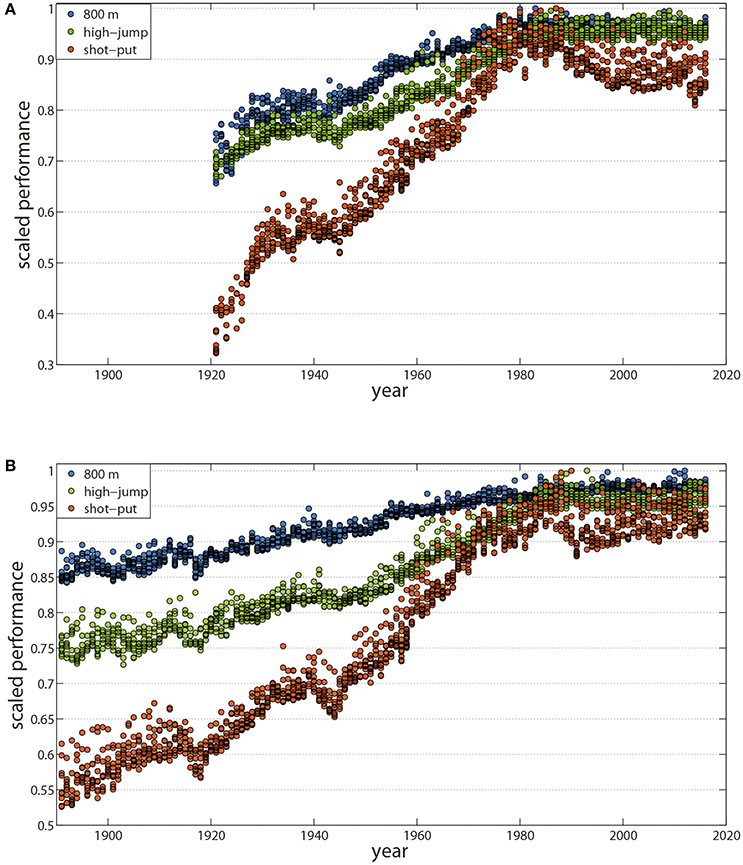
Here is the chart of peak athletic performance. I didn't realize it had plateaued so much since 1980.
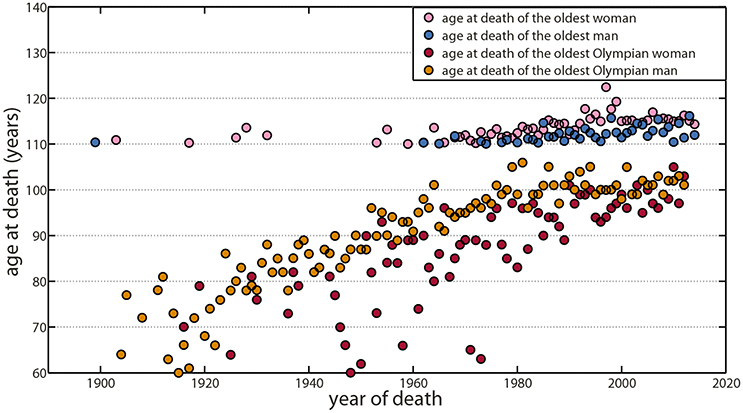
Chart of oldest person, compared with oldest living olympian since olympians tend to live longer.
The paper is basically an argument against Aubrey de Grey, who claims that in the near future, we will figure out specific technologies (and de Grey lists them) that will allow us to live 200 or even 500 years. Unfortunately the argument is weak (as I understand it), because it relies on analysis of aggregate technology improvements (technologies including things like washing hands and antibiotics).
The obvious counter-argument would be, "Of course, sometimes progress goes fast, sometimes slow; sometimes in spurts, sometimes it stalls. Regardless of whether it comes fast or slow, when we figure out the solutions to these problems, we will live a really long time." In that sense, the paper knocks down something of a strawman (by not addressing their opponent's strongest argument). -
Charts
Here is the chart of peak athletic performance. I didn't realize it had plateaued so much since 1980.
Chart of oldest person, compared with oldest living olympian since olympians tend to live longer.
The paper is basically an argument against Aubrey de Grey, who claims that in the near future, we will figure out specific technologies (and de Grey lists them) that will allow us to live 200 or even 500 years. Unfortunately the argument is weak (as I understand it), because it relies on analysis of aggregate technology improvements (technologies including things like washing hands and antibiotics).
The obvious counter-argument would be, "Of course, sometimes progress goes fast, sometimes slow; sometimes in spurts, sometimes it stalls. Regardless of whether it comes fast or slow, when we figure out the solutions to these problems, we will live a really long time." In that sense, the paper knocks down something of a strawman (by not addressing their opponent's strongest argument). -
Re:Voting booths are not the bottleneck.
Why in nine hells would anyone expect that in very localized samples like voting districts!? Do you think voters in the Rodeo Drive district would be more or less conscientious than voters in the Compton district?
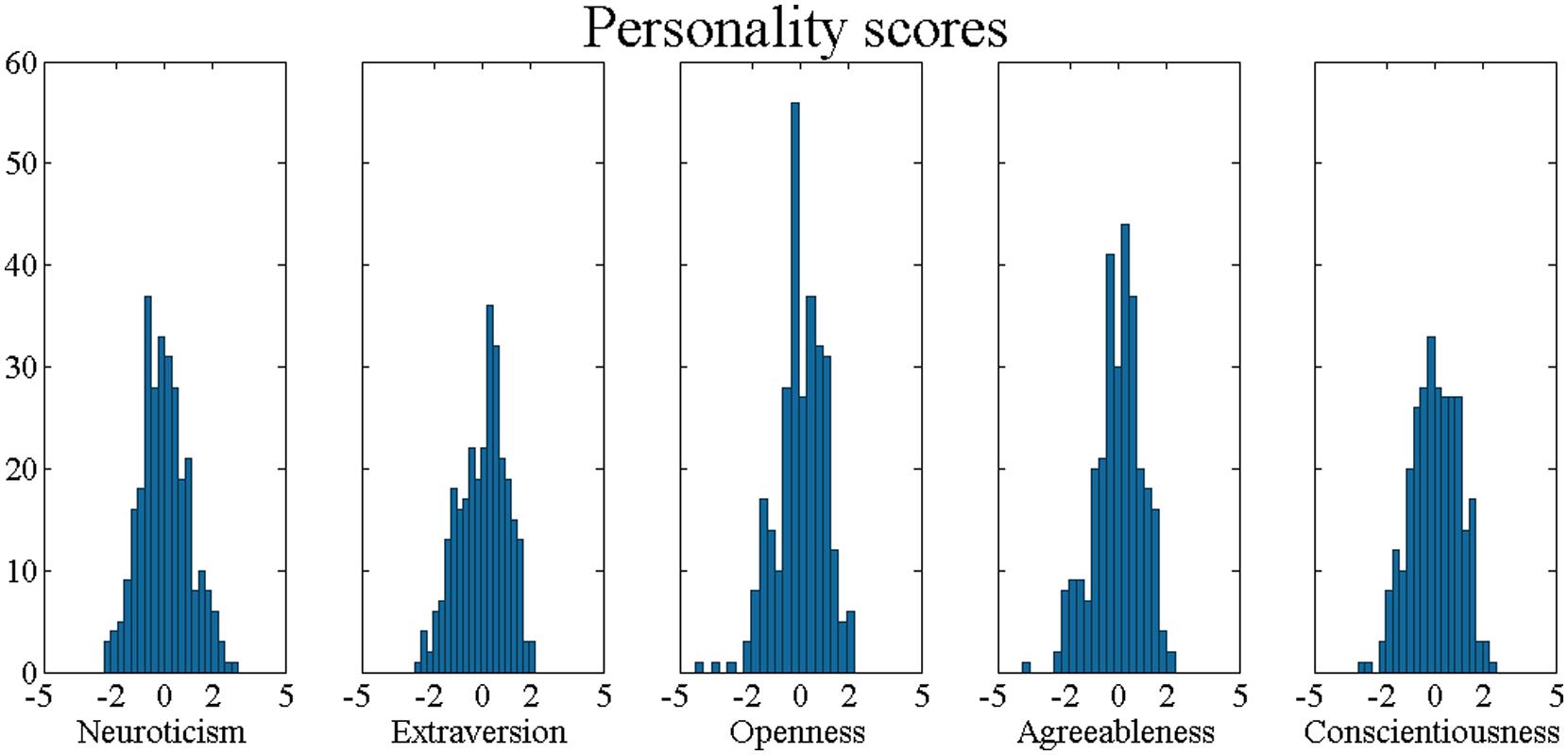
Because conscientiousness is an unambiguously defined scientific concept from the Big 5 personality trait model, and studies show that its distribution is well approximated by a normal curve: Source
What's more, it isn't strongly correlated with race, political party, or economic status, although there are small variations between populations - in other words, variation between individuals is far more significant than variation between groups. So in this scenario, a distribution that presents as "random" except in very detailed analysis is more plausible than some scenario where all the low-conscientiousness people congregate on one end of town. Essentially, the lower class doesn't have a monopoly on having the "disorganized" attribute - research tells us that this aspect of personality is fairly evenly distributed throughout the population.
That said, it would be fair to point out that other factors besides personality are at play here - an organized person who is working two jobs may be less well-prepared than an affluent housewife just because of logistical differences. Likewise with education, etc. The overall point, though, is that there's no good reason for this problem to exist. Even if it was due to some inherent difference in voting difficulty for a given population, a reasonable election committee would seek to distribute their resources such that the locations with the highest demands had the highest amount of help.
-
Decoupled journals
Why do all of those have to be a function of the journal?
There are existing preservation networks that will serve information for free (eg, Archive.org). Much of the editing should really be costs borne by the author -- some authors require little to no editing, while other times I'm asked to peer review stuff that's absolute crap.** Maybe you do something so that you can help out people w/ editing if they can't afford it so you don't create bias
There was an article years ago about how putting all of these things together made it difficult to innovate: Decoupling the scholarly journal.
Publishers talk about all of their costs
** One was *so* bad that I said I doubted that the co-authors had actually read it, as most of them were native English speakers. The journal editor said no, that would never happen that someone would just insert other author's name without their permission. Then I pointed out papers by those other authors that I would've expected to have seen cited, even if just to explain the difference between those other projects
-
Nope
Solar panels have an albedo of about 0.11 http://journal.frontiersin.org... but for a farm, they transfer energy out of the area, so rather than turning 89% of sunlight into local heat they turn about 71% into heat locally, less than a desiduos forest which turns more than 80% of incoming sunlight into heat.
-
Lead girls to water bottles to stoke CS interest?
New UW Study: "College undergraduates who were not computer science majors (in order to focus on recruitment) entered a classroom in t(he computer science department at Stanford University, which was decorated in one of two ways (Cheryan et al., 2009). For half the participants, the room had objects that other undergraduates associated highly with computer science majorsâ"Star Trek posters, science fiction books, and stacked soda cans. For the other half of participants, the room contained objects that other undergraduates did not associate with computer science majorsâ"nature posters, neutral books, and water bottles. Women in the room that did not contain the stereotypical objects expressed significantly more interest in majoring in computer science than those in the room that did fit the stereotypes. For men, the environment did not affect their interest in computer science (Cheryan et al., 2009)."
-
Re:that and once you divide them into two categori
(I'm the GP.)
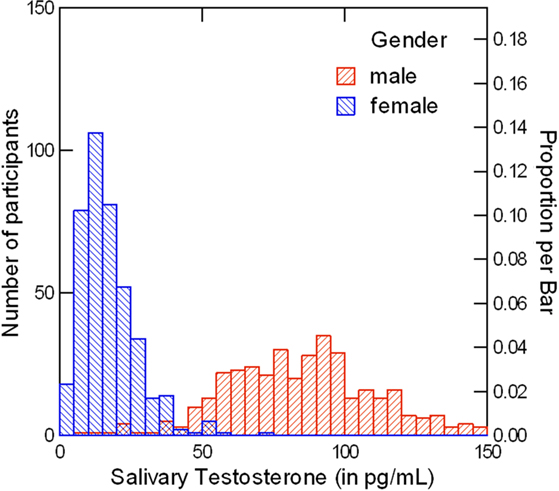
While the two groups correspond pretty closely, there is some overlap. Looking for data on it, the best I found is this graph, which gives a vague idea of what the distribution looks like (and the reference mentions measurement by saliva samples not blood samples, so less invasive).
I actually wasn't as worried about correctly categorizing low vs. high testosterone individuals as wondering if there was a correlation along the lines of "lower testosterone individuals were even better at working in teams" which would be more precise than the binary classification of gender and help distinguish whether the effect is biological or cultural.
-
Re:I am a scientist in real life (IAAS?)
I don't know what cool-aid the NIH is feeding you, but for people that are rich enogh to have custom drugs made for them, cancer is already cured provided they seek treatment eairly enough (Steve Jobs was a moron and waited too long). Peptide, dendritic cell, and T-cell vaccines all work quite well once you sequecne the turmor.
-
Re:phase change
Wikipedia thinks: "When the North Tower collapsed, debris fell on the nearby 7 World Trade Center building (7 WTC), damaging it and starting fires. These fires burned for hours, compromising the building's structural integrity, and 7 WTC collapsed at 5:21 p.m."
But I'd love to hear the real truth about the 9/11 attacks and Obama's birth certificate. Please elucidate.
-
Re:Big Bang is RELIGION
It's kind of useless arguing with me since I shouldn't be putting words in the mouth of Ethan Siegel, and arguing on whether it is appropriate to call dark matter tiny really has no bearing on what I'm telling you about God and the Universe. But just in case you find it a pleasure to discuss these fine points with me, the very notion of mass distributed over volume involves statistics, and as you know, you can make statistics tell any story.
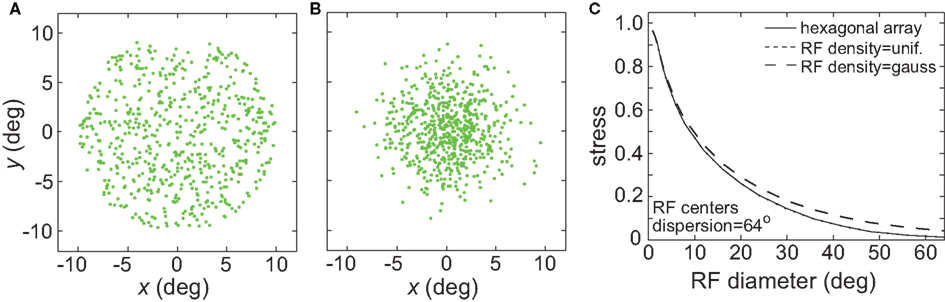
Consider this figure that I just randomly found so I don't have to draw one myself. You can see that the two clouds of green dots span about the same space. But the cloud on the right is more concentrated than the cloud on the left. You can imagine a third figure where there are several clumps of dots and still has the same overall space and density. Do you count the space between the dots as occupancy? Do you impose some form of density threshold to eliminate spaces that are simply too sparse? Not to mention that an atom consisting of a dense nucleus and a cloud of electrons is really more than 99.999% of space.
I'm not saying your Wikipedia references are wrong; they want to paint a picture illustrating the pervasiveness of dark matter, but Ethan Siegel is also entitled to say the amount is tiny. Tininess is really in the eyes of the beholder.
-
Re:Here is the problem
Concerning impact factors, they seem a little indirect.
Actually, it's worse, journal rank is unscientific and counter productive. Unfortunately, the bean counters seem to love it.
-
Re:Good start, now....
I have been in academia for more than twenty years and can say without a doubt that being around experts in a field cannot be replaced.
What happens if you want to do something interesting in the field and can't afford to chill with experts for twenty years?
Then computational neuroscience is not going to be your bag. I also learned in this time that coming to college doesn't always mean graduating with a degree in order to find out what you want to do with the rest of your life. But, if you want to do scientific research and have any impact then you should go the research and academia route. If you want to just play, go play. You don't have to be an enrolled student to go to the library and read journals, although a lot of them are no longer printed so sooner would be better. If you're that enthusiastic about it you could always subscribe to a few journals. Here's a few to look at:
http://www.springer.com/biomed/neuroscience/journal/10827
http://www.frontiersin.org/computational_neuroscience
http://www.cnsorg.org/journalsThat last one is a list of pertinent journals in the field.
The most important thing to get out of college *is* figuring out what you want to do with the rest of your life. If that's dropping out to start your own neuroscience company then by all means go forth and conquer!
-
Re:Study and practice this in private.
To amplify the above comment, as a neuroscientist with a computational background: don't try to go it alone.
There are a few reasons for this:
1) Research in the field is done by groups because the main problem in generating an 'interesting simulation problem' is carefully defining a scope and a target. That's really hard to do, and generally involves careful discussions between people with different knowledge bases and priorities. If you can't give a clear and succinct answer to the question "How, if successful, will this research advance the field?" to somebody like Larry Abbott, you aren't working on a 'real world problem.'2) The state of the field is generally about 2 years ahead of the published literature. Unless you have collaborators who routinely attend talks and meetings, and know what people in your area(s) of interest are doing, it's very easy to wind up on the wrong track.
3) Modeling is only useful if it leads to experimental predictions that can be tested, and so needs to be part of an ongoing collaborative interaction between people collecting data, people analyzing it, and people modeling it. Without the entire loop in place, it's difficult to make useful contributions. Also related: outside of things like gene arrays, and a few other standardized approaches, most data in the field is collected by bespoke setups, so even understanding how to parse a data set requires interaction with the people who collected it.
So to answer the original questions:
(1) There are so many that it's impossible to specify. Very little computational neuroscience these days requires more than a workstation. You need to get into a collaboration to reduce the scope of the question for it to be answerable.(2) It's probably easier than you think, but again it requires collaboration with somebody who's in industry or academia (the latter is probably easier). There are several people I know who informally collaborate doing neural modeling or data analysis with established labs. There are plenty of researchers who welcome informal collaboration, as long as it's competent.
(3) It really depends on who you wind up collaborating with, and the type of question. Neuron and Genesis are compartmental modelling simulators, which you'll only use if you wind up working with people on the molecular end of the spectrum (ie. figuring out intracellular processes). Most systems level work is done using Matlab (some Mathematica and Python as well).
(4) Get involved with non-DIYers. Find a lab to collaborate with! Go to SFN next year, and/or ICCNS/ICANNS/CoSyne/etc (see for example: http://www.frontiersin.org/events/Computational_Neuroscience). Go to posters and talk with people. If you see something interesting, ask if they'd be interested in collaboration.. or ask them your question (1). It'll probably take multiple attempts to find the right group, but there are a ton of groups out there.
Finally, I'd just like to emphasize that working on 'real world' problems in neuroscience (computational or not) is a time consuming endeavor. If you don't think you'll be able to devote several hundred hours a year at the least, it'll be hard for you to find tractable problems.
-
Re:arXiv is not peer reviewed
There does exist a site for uploading preprints called arXiv. The difference is that preprints aren't peer reviewed and thus aren't quite as citable in publications that strongly prefer "published sources with a reputation for fact-checking and accuracy".
Actually, in my experience this is not the problem, you can cite whatever you want. Considering this article, such reputation for fact-checking and accuracy does not really exist anyway (i.e. the higher the ranking of a journal, the higher the probability that articles have to be retracted). The real problem is, articles that do not appear in a journal count less or nothing on the authors curriculum, unless you are a genius like Grisha Perelman, who, AFAIK, published the proof of the Poincare conjecture only on arXiv.
-
Re:Autistic huh?
Delusions would help a person believe that he would not get caught. If you have never had an obsession, you may not understand how it affects people with autism. I am not saying that he did not know that it was illegal. I think he should be prosecuted to the fullest extent of the law. In his case autism is not an excuse merely a partial explanation for some of his behavior, that does not excuse him or exclude him from the law. In prison he should be treated for his psychiatric conditions just like other prisoners. It is up to the court psychiatrist to determine if he can live safely with the general population in prison due to his autistic symptoms. BTW They are getting closer and closer to be able to do medical tests to see if a person has one of the many types of autism. See: http://www.frontiersin.org/Journal/10.3389/fnhum.2013.00671/abstract
-
Re:Separation of publishing from reputation/filter
#1 is called an overlay journal (they don't actually host the content, they just review & link to stuff on other servers).
#2 is effectively part of what Priem and Hemminger suggested as a Decoupled Journal, in which you break up the various tasks and pay for them individually.
#3 is is just simple bibliometrics / scientometrics, which are easy so long as you have sufficient identifiers (DOI, bibcode, etc.), and can agree on what the proper thing to measure is.
-
paywall / links to summary
Could you possibly post a link to a version that is not hidden behind a paywall? Perhaps a pre-print on your own research site; perhaps an HTML web page summary of your work?
.It looks like they use Python scripting in their NENGO simulator: http://www.frontiersin.org/neuroinformatics/10.3389/neuro.11/007.2009/abstract
-
"Decoupled Journals"
What you propose has been around for more than a decade with what are called overlay journals.
But the thing is, you're only dealing with published items, so there's no built-in way of improving the article. (asking for clarifications, improving poor grammar, etc.)
Another alternative was proposed in Jason Priem (known for the Altmetrics Manifesto) and Brad Hemminger's Decoupling the scholarly journal (PubMed), discussing the different functions that journals perform, alternatives (such as overlay journals, PLoS One, post-publication review, etc.), and then breaking it down into bits that can be separated from each other.
You can then either do that bit in-house, or outsource specific parts, without having to deal with those cases where a society sells (licenses?) their journal to Elsevier or Wiley.
-
Put it in the grant / subscription fees
I've been on grant review boards -- a large number of the grants submitted make an assumption that they'll publish a paper a year, and include the 'page fees' (or whatever is appropriate in their field) in their grant proposal to cover the publishing of the research information.
Now, conversely, I really liked Jason Priem and Bradley M. Hemminger's recent article, 'Decoupling the Scholarly Journal', which talks about the basic tasks that a journal does, and how they don't all need to be done by a single entity. (I admit, I've only scanned it, I need to go back and read it more thoroughly, so hopefully I haven't misrepresented it)
The problem with your assumption that journals are covered by subscription fees is that the rates for library subscriptions has been rising so significantly that many are rebelling, and just dropping the subscriptions entirely. Some have designated the savings to go into a pool to pay author fees, but I'm also personally against the current model of author-pays-on-acceptance. (as it means they're subsidizing all of the rejections; it's been pointed out that journals pride themselves on exclusivity ("we only accept 2%"), so are unlikely to establish fees on submission as it may pre-filter the rejections)
-
Re:Still a long, LONG way to go...
Mod parent up. The linked article (and the MIT press release) are misleading. The closest thing I can find to a peer-reviewed publication by Poon has an abstract is here (no, I can't find anything throught the official EMBC channels--what a disgustingly closed conference):
https://embs.papercept.net/conferences/scripts/abstract.pl?ConfID=14&Number=2328
And there's some background on Poon's goals here:
http://www.frontiersin.org/Journal/FullText.aspx?ART_DOI=10.3389/fnins.2011.00108&name=neuromorphic_engineering
The goals seem to me to be about studying specific theories about information propagation across synapses as well as studying brain-computer interfaces. They never mention building a model of the entire visual system or any serious artificial intelligence. We have only the vaguest theories about how the visual system works beyond V1, and essentially no idea what properties of the synapse are important to make it happen.
About two years ago, while I was still doing my undergraduate research in neural modeling, I recall that the particular theory they're talking about--spike-timing dependent plasticity--was quite controversial. It might have been simply an artifact of the way the NMDA receptor worked. Nobody seemed to have any cohesive theory for why it would lead to intelligence or learning, other than vague references to the well-established Hebb rule.
Nor is it anything new. Remember this story from ages ago? Remember how well that returned on its promises of creating a real brain? That was spike-timing dependent plasticity as well, and unsurprisingly it never did anything resembling thought.
Slashdot, can we please stop posting stories about people trying to make brains on chips and post stories about real AI research? -
Wrong
The linked article does not actually refers to the Scientific article (why not?), so I went and did some digging.
http://frontiersin.org/neuroscience/behavioralneuroscience/paper/10.3389/fnbeh.2010.00031/
Nothing like "monkeys like to watch TV". The experiment only measure the activity of the monkey's brain when it is watching the movie, but not when it is NOT watching the movie or when it is watching something else. Actually the paper is more about this new brain wave sensor that they are developing than about monkeys and TVs. Like a previous commenter said - if you have a monkey stuck into a chair, with a bunch of probes dug into its brain, in a dark room, it will get interested in a movie shown in front of him. Duh! (and, according to the article, at least 60% of the trials where thrown away because the monkey did not actually look at the movie).
-
Re:How can they distinguish from normal behavior?
Yeah, if only there were some place where scientists would publish their research saying exactly what they did and what they found.
They did account for that.