Slashdot Mirror
Domain: fyngyrz.com
Stories and comments across the archive that link to fyngyrz.com.
Comments · 142
-
Re:SQLite
SQLite is fine for multiuser-read / singleuser-write. Also for built-in per-instance DBs in applications. Which covers a heck of a lot of use cases, online and not. Something else that's pretty awesome is it is trivial to compile SQLite right into an application. This serves both to make the application less complicated to install, and to ensure that the DB format, behavior and performance won't change when other parts of the host system change. Less opportunity for Apple / Linus / Microsoft / etc. to Break Your Shit(TM)
Within the Python2 environment, where I do a lot of my work, I use a convenient wrapper for SQLite (and another for PostgreSQL.)
Both DBs are very useful to me. I looked at MySQL and wasn't convinced there was any benefit to adding it to my toolbox, so... none of that.
-
$0 cost to receive actual RF from RF recordings
You can download my SdrDx for either Windows or OS X, download a saved RF file, and start receiving from a recording of, for instance, a ham band during a contest, or a SW band with some interesting stations on it. No SDR required to fool around, and the software is free.
You can tune around, play with bandwidths, demodulation modes, noise blanking, peak tracking, notch and other filtering, the analysis scope, etc. WIth a recording, you get the span of the spectrum that was recorded (for instance, 200 khz of spectrum) but within that, you can do pretty much whatever you want.
Works with OS X 10.6.8 and up, XP and up.
If you want to use an actual SDR, SdrDx leans decidedly towards the middle and high end, but supports anything using the RFSPACE protocols, so (obviously) pretty much any RFSPACE SDR model, the Andrus MK 1.5, and the AFDRI. Also supports the Funcube. No one has written an RFSPACE compatible server for the RTL sticks, but perhaps someday they will.
-
Re:Agenda 21 at it's finest.
-
Re: Assumption is the mother of consumerism
If you can encourage others by honestly explaining the benefits of your life experience, please do so!
I try to do so. I write software I hope people will get good use out of; I write about social issues, superstition, AI issues and more. I keep an oar in around here most of the time as well, as you'll see if you navigate my comment history.
I'm old and creaky now, so these are the things I can realistically do.
-
Re: Assumption is the mother of consumerism
If you can encourage others by honestly explaining the benefits of your life experience, please do so!
I try to do so. I write software I hope people will get good use out of; I write about social issues, superstition, AI issues and more. I keep an oar in around here most of the time as well, as you'll see if you navigate my comment history.
I'm old and creaky now, so these are the things I can realistically do.
-
Re: Assumption is the mother of consumerism
If you can encourage others by honestly explaining the benefits of your life experience, please do so!
I try to do so. I write software I hope people will get good use out of; I write about social issues, superstition, AI issues and more. I keep an oar in around here most of the time as well, as you'll see if you navigate my comment history.
I'm old and creaky now, so these are the things I can realistically do.
-
Re: Assumption is the mother of consumerism
If you can encourage others by honestly explaining the benefits of your life experience, please do so!
I try to do so. I write software I hope people will get good use out of; I write about social issues, superstition, AI issues and more. I keep an oar in around here most of the time as well, as you'll see if you navigate my comment history.
I'm old and creaky now, so these are the things I can realistically do.
-
There are ideas. Here's one.
Humans have no idea how the human, or any other brain, work
We do have some ideas. This, for instance
-
Tin foil detected
All I can tell you is stay away from ice cream stands, and prep for the apocalypse.
-
Re:Easter eggs
My software is SdrDx. Details here: Very much a "radio person's" design.
As for the eggs, that's not all of em -- those are the easiest to find, too. And they're a thing that's been in there for a couple of years or so, I figure it's not much a secret. Also, there's not much overlap between slashdot and my users. If any. Lastly, I don't think of them as exclusive so much as I do something fun to find.
You might be the first, if it turns out to be something you can use.
-
Re:Easter eggs
-
Cumbered
And this is why closed source combined with black-box development is so much safer than open source. Sigh.
I really don't mind -- actually, I think I'd be kind of of flattered -- if people were able to look at my code, go "hey, I can use that" and then proceed to use it. And in fact, I've written a fair bit of code I think would fall into that vein. I think I could write something book-length in the line of "cool coding stuff" and quite a few programmers would find it quite useful. I've been doing this since the early 70's. I write signal processing, and image processing (but I repeat myself, sorta) and AI code, with a strong background in embedded and special-purpose systems, a bunch more.
But because a lawyer might look at my code, and use it to screw me, and through me, my family and employees quite harshly?
Bang. Closed source. The opposite of furthering progress by virtue of passing along what I've learned. I give away some of my work product such as this, but you will never see my source code because of the legal environment.
As far as I'm concerned, if I wrote it without referring to "other" source code, then no one else has any claim on my work. I don't have any idea how to fix copyright and patent and still retain the supposed commercial motivation to create, but fact is, as it stands, it's completely fucktarded.
Pisses me off, it does.
-
The path to AI and the "laws"
The "laws" are not laws, they are fictional props.
If we continue on the current path, which is to emulate human brain organization:
First, any resulting conscious, intelligent entities will not think "algorithmically", as TFS presumes. They will operate largely as we do.
Second, vulnerability to religion will most likely take essentially the same form it does in humans.
--fyngyrz
posting anon due to slashdot's idiotic anonymous moderator limitations
-
The path to AI and the "laws"
The "laws" are not laws, they are fictional props.
If we continue on the current path, which is to emulate human brain organization:
First, any resulting conscious, intelligent entities will not think "algorithmically", as TFS presumes. They will operate largely as we do.
Second, vulnerability to religion will most likely take essentially the same form it does in humans.
--fyngyrz
posting anon due to slashdot's idiotic anonymous moderator limitations
-
50 Mhz lower limit? Ouch.
Most hams (including myself) are interested in HF (and others are interested in SWL and the new below-AM BCB ham frequencies.)
50 MHz means 6 meters and above -- basically, nothing that has any regularly occurring usable propagation modes. Many of these upper bands are almost dead -- I've not heard anyone on 2 meters or 70 cm around here in the last year -- but 10 through 160 meters (28 MHz through 1.8 MHz) are busy as heck, and of course all the SW spectrum in between.
Worse, we're almost certain to be about to slide down the sunspot curve, making the already mostly dead-by-choice bands completely dead-by-nature, propagation-wise.
RFSPACE's upcoming new unit is
Then there's funcube dongle pro plus... 50 khz through 1.8 GHz, albeit without adequate filtering up front. But it's reasonably cheap, so there's that. (and I already supported it, PITA though it was, so it's not subject to the no-more-USB-devices rule.)
Well, whatever they end up with, I sure hope it's ethernet-connected and uses the standard SDR protocol as do Andrus, AFEDRI and RFSPACE. I've supported my last black sheep USB device (every darned OS has radically different USB interfacing and requirements... building my free cross-platform SDR software is most tricky with regard to USB issues. Ethernet, by comparison, is almost identical on all platforms -- the same SDR protocol / interfacing code works fine across linux, Windows and OS X.)
-
I care too.
at least try to improve things.
I think you might give me at least a little credit on that score if you were familiar my writing, research and other offerings.
Maybe ask the government to grant snowden clemency? Nah. Why exert the effort to click an online petition when it is so much easier to just bitch about how hopeless things are?
I am signatory.
-
Re:You are not Us
So what experience do you have that leads you to be so adamant that typing speed is a major factor in coding?
Not is. Can be.
Among other things, I write major applications and libraries, generally in c or c++ these days. I've been at it for about 45 years, coming from an assembler background. I extensively document what I write, both for the user and within the code (you'd have to download the import library to see the docs... the link is just to the cover page.) I also wrote the user documentation system (in Python/SQL) itself. I often produce as fast as I can type (35-40wpm) when coding, and almost all the time when documenting. There is no question in my mind that my productivity would be reduced if my typing speed or accuracy were to be seriously impacted in any way.
In my early career, I worked alongside a lot of very good people, and I can't recall any that were really noticeably similar to one another. IMHO, really good programmers tend to not fit stereotypes very well as they are not only (necessarily) brilliant, but are bringing some kind of broader experience to the table. Later on, I ran a couple of hardware and software companies for about 25 years, producing first for 6809 custom hardware of my design (coin-op arcade industry), then the Amiga and later on software-only for Windows.
During that time, aside from my own work, I hired, directed and supervised many programmers and a small group of hardware engineers as well. I'm well acquainted with various combinations of lines-per-whatever, reliability, and complexity across a pretty good sample of coworkers and employes -- my own observation consequent to this is that there is a very wide range of acceptable performance, and for various reasons, at that. These days I'm retired and spend my time doing AI research, real-time signal processing and image processing applications, working on building an interior into my home with my SO's considerable assistance, and generally whatever else takes my interest. I still write as fast as I can go when I'm writing, chewing up about a keyboard a year. Matias keyboards.
That's my experience. In no way am I suggesting it is, or should be, yours. Just avoid painting me (and by extension, everyone) with your own particular brush and I'll shut up. About this, at least.
-
Re:You are not Us
So what experience do you have that leads you to be so adamant that typing speed is a major factor in coding?
Not is. Can be.
Among other things, I write major applications and libraries, generally in c or c++ these days. I've been at it for about 45 years, coming from an assembler background. I extensively document what I write, both for the user and within the code (you'd have to download the import library to see the docs... the link is just to the cover page.) I also wrote the user documentation system (in Python/SQL) itself. I often produce as fast as I can type (35-40wpm) when coding, and almost all the time when documenting. There is no question in my mind that my productivity would be reduced if my typing speed or accuracy were to be seriously impacted in any way.
In my early career, I worked alongside a lot of very good people, and I can't recall any that were really noticeably similar to one another. IMHO, really good programmers tend to not fit stereotypes very well as they are not only (necessarily) brilliant, but are bringing some kind of broader experience to the table. Later on, I ran a couple of hardware and software companies for about 25 years, producing first for 6809 custom hardware of my design (coin-op arcade industry), then the Amiga and later on software-only for Windows.
During that time, aside from my own work, I hired, directed and supervised many programmers and a small group of hardware engineers as well. I'm well acquainted with various combinations of lines-per-whatever, reliability, and complexity across a pretty good sample of coworkers and employes -- my own observation consequent to this is that there is a very wide range of acceptable performance, and for various reasons, at that. These days I'm retired and spend my time doing AI research, real-time signal processing and image processing applications, working on building an interior into my home with my SO's considerable assistance, and generally whatever else takes my interest. I still write as fast as I can go when I'm writing, chewing up about a keyboard a year. Matias keyboards.
That's my experience. In no way am I suggesting it is, or should be, yours. Just avoid painting me (and by extension, everyone) with your own particular brush and I'll shut up. About this, at least.
-
Re:You are not Us
So what experience do you have that leads you to be so adamant that typing speed is a major factor in coding?
Not is. Can be.
Among other things, I write major applications and libraries, generally in c or c++ these days. I've been at it for about 45 years, coming from an assembler background. I extensively document what I write, both for the user and within the code (you'd have to download the import library to see the docs... the link is just to the cover page.) I also wrote the user documentation system (in Python/SQL) itself. I often produce as fast as I can type (35-40wpm) when coding, and almost all the time when documenting. There is no question in my mind that my productivity would be reduced if my typing speed or accuracy were to be seriously impacted in any way.
In my early career, I worked alongside a lot of very good people, and I can't recall any that were really noticeably similar to one another. IMHO, really good programmers tend to not fit stereotypes very well as they are not only (necessarily) brilliant, but are bringing some kind of broader experience to the table. Later on, I ran a couple of hardware and software companies for about 25 years, producing first for 6809 custom hardware of my design (coin-op arcade industry), then the Amiga and later on software-only for Windows.
During that time, aside from my own work, I hired, directed and supervised many programmers and a small group of hardware engineers as well. I'm well acquainted with various combinations of lines-per-whatever, reliability, and complexity across a pretty good sample of coworkers and employes -- my own observation consequent to this is that there is a very wide range of acceptable performance, and for various reasons, at that. These days I'm retired and spend my time doing AI research, real-time signal processing and image processing applications, working on building an interior into my home with my SO's considerable assistance, and generally whatever else takes my interest. I still write as fast as I can go when I'm writing, chewing up about a keyboard a year. Matias keyboards.
That's my experience. In no way am I suggesting it is, or should be, yours. Just avoid painting me (and by extension, everyone) with your own particular brush and I'll shut up. About this, at least.
-
Re:AI. It's like 3D TV. We don't have it.
We can't even define what "conscious" actually means other than "we recognize it when we see it".
Ah. but I can. And I have.
-
Intelligence: How does it work?
An essential characteristic of intelligence is that we don't know how it works.
Actually, I think we do. We at least have an actual model, free of woo-woo, for which no counter evidence has been brought forth as yet.
Even the low level stuff seems to finally be yielding some clarity.
-
Expectation of privacy
Expectation of privacy has nothing to do with encryption. Encryption is simply hardening a boundary.
If I put a letter in an envelope, you getting to it is utterly trivial -- the use of one fingernail. But that doesn't in any way erode my expectation of privacy. If, on the other hand, I encrypt the letter, all I've done is harden the boundary -- my expectation is still the same: I don't think you have a right to access that letter.
If I close the front door to my house, but I don't lock it, I'm NOT inviting you in. I expect you to knock, and to wait. If I lock the door, I have hardened the boundary, but I have not in any way changed the why of my expectations. If I then add a bar and hooks, I have further hardened the boundary, but the basic point remains exactly the same: My expectation is that you will knock and wait. As long as you meet my expectation, none of that hardening would have any effect upon you. The only ones who are affected by hardened boundaries are those who sunder our expectations.
If a woman wears a dress, is she giving us permission to look up it? Obviously not.
Clearly, "because you can", is insufficient justification to "just do it."
It's not about the envelope. It's not about the lock. It's not about encryption. It's not about the dress.
It's about mutually understood social boundaries. The scam the government is constantly trying to pull is pretending that hardening is the issue, rather than social boundaries. They are doing what governments do, which is constantly strain to accrue more power. If they are not restrained in this process, they will do so -- regardless of the expense to our rights, liberties, and social expectations.
I cordially invite everyone to read this. Carefully.
-
As to biology
In addition to very high complexity, fixed topology (meaning, using primarily electrical, chemical and timing means as opposed to topological modification to operate), general problem solving networks, I am fairly confident that we develop plenty of what can accurately be described as single-skill networks, topologically tuned to individual problems by continuous cut-and-fit until the errors drop. I lay out why right here.
-
Oh, the media, lol.
They're basically a really simple linear discriminant.
Actually, most of them are nonlinear. Sigmoid function is common, and there are much more exotic things going on too, such as fuzzy logic-based discriminants. Bottom line is that any discriminatory function is of interest.
There's also some fascinating stuff going on with time discriminants where they're having very encouraging results.
Odds are excellent that both (time and transfer function) are part of a solution that is most human-neuron-like. But it isn't by any means a given that we have to go there to make actual AI work. That's just how we work. Also, I am fairly confident, like this.
-
It really doesn't work that way
If you condemn free trade without condemning capitalism in general, all you are doing is redrawing the lines so they suit you.
Well, it's an interesting assertion, but you've not actually demonstrated this. Consequently I can't see taking it any more seriously than any other baseless remark. More to the point, I don't condemn free trade, I actually think it's a lovely idea, but as it turns out, when implemented without regard for human nature, it doesn't actually work. There are many ideas like this. For instance, it would be absolutely lovely if we could open our homes to anyone who needs shelter from a storm. Unfortunately, this tends to lead to us being raped and murdered in our beds. And so on.
So in light of free trade's actual failure to function as hoped for, my position is that we need to examine it to see why it failed, and then fix the problems so identified. In my opinion, this is not rocket science: Free trade fails because there is no level playing field, specifically because our offerings of economic parity are incorporated, while our offerings of social parity are not. This establishes massively unequal costs we cannot control, and so the playing field tilts in direct response and proportion.
To say that free trade is a fundamental requirement of human equality and/or decency is just hand-waving. Yes, all other things being equal, free trade could be a foundational element of a uniformly consistent world economic structure. But that's not the world we actually live in. Here, in reality, if we wish to develop a system system as good as it can be, then we must do it in a significant degree of isolation from systems that are fundamentally incompatible with the mechanisms that drive such a system. This is the only way it can be done. You may, if you're a raging optimist, imagine that were we to achieve such a thing, or even go a long way towards it, that it might serve as a model for other societies to emulate, but I think we already know where that leads: no one in power wants to abandon, or even significantly alter, the conditions that got them there and are keeping them there. That's just as evident inside our borders as out -- it is why it is so difficult to even begin to address the corruption that pervades our legislatures and our judiciary.
Capitalism, in the long term, seems fundamentally incompatible with basic human decency
Possibly pure capitalism is. However, since we've not been operating as anything even remotely close to pure capitalism in the last 60 years or so (that's the limit of my observations, not a pointer to any functional boundary I know of), what is relevant is what we are, rather than a pure ism. And what we are is very close to being compatible with human decency. We're getting along towards a universal medical system, we have social safety nets and so forth. Further, at the social level, we reward those who do charity with status. It all needs considerable work, but it certainly is many steps above the cold calculations of profit and loss already.
(and most religious morality)
The vast majority of religious morality is canned nonsense produced by the disingenuous in order to facilitate control over the deluded. The sooner it is excised from our economic and legal systems and is replaced by economic- and legal-sanity, the better off our country will be. I cannot, and do not, speak about other countries here, but I know very well the extensive damage the poison of religion has done to ours.
and will eventually produce gross inequalities
What you fail to recognize is that gross inequalities exist from the very start. They are the irreducible axioms of the human condition. Most of the implications of the statement "all men are created equal" are not just wrong, but nonsensical. The only sane rest
-
Re:Offense or defense?
The way I see it, an unqualified threat is a promise of action.
If the action promised is violence, and the threat is credible, then the recipient of the threat has been adequately notified that conflict is actually under way.
As the recipient has been assured that violence is immanent in some measure, preempting the other party's violence is reasonable, sensible and should be socially acceptable on every level.
Qualified threats are something else entirely, the question of coercion arises as does the authority of the individual making the threat with regard to the qualification. For instance you could say to me "if you raise your hand to my wife, I will beat you senseless." This is a qualified threat covering an issue where you have adequate authority to assert both the rule and the consequence. No violent response of mine could be justified.
I would be remiss if I didn't point out that US law tends not to agree with me on these matters. The way I see things is pretty much laid out here.
-
Privacy
I came away with this definition: privacy is autotomy -- the right to conduct your affairs without unreasonable and uninvited interference.
Ouch. Please read this.
-
No waiting required
-
Orwell
Oblig/meta: Orwell was an optimist
-
Agency isn't constrained to the physical
Hawking can't lift a finger without external, artificial assistance. Does that make him an idiot?
If I were able to cut your head from your body, but keep it running, so to speak, now that you can't speak to us (no lungs) and we see no interesting activity on your part, would that make you an idiot?
If I drug you so you are fully conscious, but cannot move, are you then an idiot?
Intelligence is not bound to the ability to do anything material. Intelligence is about manipulating information. Induction, association, that sort of thing. Agency with regard to conceptual matters. Consciousness... well, I have ideas about that, but they're just ideas at the moment.
-
A Theory of Mind
What interests me the most are the levels of subconscious/consciousness and where all this combines to create our singular, waking awareness.
Then you might be interested in reading this, which describes how it might all work, and how an (actual) AI could be made to work.
-
If only
-
Re: Finally!
-
USB vs Ethernet vs Other
I write multi-platform software that utilizes some fairly dense data streams. Some of the devices are USB; some are Ethernet.
For the curious, it's software defined radio; it's not unusual to see 16-bit data at 4 MHz coming in across the interface, which is a 64 Mb/s load, doable, but heavy, for a 100 Mb/s connection. There are devices that do 18 MHz at 16 bits. That can take up a considerable portion of a 1 Gb connection - 288 Mb/s. Day to day on my machine, I work with 800 kHz 16 bit data, or about 12 Mb/s for a 400 kHz receive bandwidth. All of these add some overhead on top of the main data stream too, as does TCP itself, so really, the loads are heavier.
Ethernet support basically has to be written once. How networking operates can be abstracted to be the same across OSX, linux, and Windows without much effort at all (Qt does this), and the TCP network stack is generally pretty fast and well behaved. And it is stable. (I could insert a rant about Apple's half-assed UDP support here, but...)
USB support varies considerably from one platform to another. Abstracting it is a huge PITA, requires lots of conditional compilation, and doesn't turn out that well, either. And that's without dealing with new USB drivers coming from the OS manufacturer that overwrite (and break) previously installed drivers. Nothing as fun as a user telling me "everything was working, now nothing is."
It's to the point where I won't directly support new USB SDRs. Every one I've done so far has added to my support load; whereas adding a new network-based SDR is painless, works the day I release it, and is still working a year later. In fact, if they adhere to the established SDR networking protocols, I don't even have to do *anything*, it'll just work. When someone asks me to support a new USB SDR, I tell them to write a network server for it using the established networking protocols. That way, when the USB breaks, as it seems it inevitably will, it's the responsibility, and support load, of the network server author, rather than mine.
It's also worth noting that as networking speeds have gone up, previous networking devices still work, and the new ones can crank pretty fast.
Then we get to remote issues; how far can you place a USB device from the computer that's talking to it? How about firewire or Thunderbolt? Now consider Ethernet. I can run an SDR that is quite a bit more distant from my computer, and I don't really have to do much to make that happen. I can have a bunch of them on the same subnet or even remote them out in the world. And then there's sharing. Same device, no reconfiguration, I can use it from OSX or Windows or linux without it even knowing that's happening. I can even go wireless transparently. I routinely sit on the couch and surf the HF and VHF bands on my laptop using WIFI as the data transport from the SDRs.
For any device that can manage it and still obtain acceptable performance, Ethernet looks like an excellent solution to me. If you really must have bus-like speeds, as in graphics engines and SSDs, ok, fine, Thunderpants, Displaypunt, Firepliers, etc. But please, if you're designing a peripheral with any kind of lesser bandwidth requirements, consider Ethernet as your interface. Everything is so much easier to deal with.
IMHO.
-
Better Solution
Try this solution on for size (also something that will never be implemented, but...):
-
Re:Yes
I wrote my own in Python; uses PostgreSQL to hold the data, gives me unlimited stylesheet and substitution capabilities, generates HTML or whatever I want directly. Table of contents, indexes in various formats, footnotes, endnotes (references), chaptering and sub-sectioning, local and global variables, image handling and conversions, etc. Works a charm. And since I wrote it, I can add to it, fix it, etc.
Here's an example of an output document:
When I want to typeset something crazy, I do it in an image manipulation system and then shovel the image in; that's about the only thing I've run into that would require more work than I'm willing to put in.
-
Re:Story time
Yes, tubes and fets share various characteristics, but there are a lot of things they don't share and I guarantee you that a good grounding (hah!) in fets of all kinds isn't sufficient to go off and do tube design beyond the very simplest applications. There have been some seriously weird tubes with no corresponding single-semiconductor solution; quite aside from the huge range of voltages involved, there are screen grids, directly heated cathodes, gas-filled regulators, CRTs (imagine depending on knowledge of a FET to make a CRT work, eh?), coupling issues, various kinds of noise peculiar to tubes, weird stuff like microphonics, just a whole host of interesting issues and devices. Plus, things you'd take as similar act quite differently, even starting just from a rectifier diode. And tubes glow in the dark. You're thinking orange, right? But an OA2 in normal operation is a beautiful, bright purple. And there are tubes that are green bar graphs, tubes that can display characters...
Yes, that ham made a huge difference for me, and I try to do the same - happy to wear the "Elmer" hat. Been an extra class for decades now. Also, lately, been working on a free software defined radio app, so in way, I'm getting right back to my roots.
-
Re:Creation vs Reality
If you experience a thing, you know it exists.
Absolutely untrue. Artificially: I point at LSD. Involuntarily: I point at dreams. Voluntarily: I point at imagination. "Experience" is a mental state. It's not in any way an assurance that you're perceiving reality. That requires quite a bit more, starting with the basics: consensuality, repeatability, and so forth. Things notably lacking in the realm of superstition.
Some of us have experienced God, yet you're absolutely sure that all those people are insane.
No. Not insane. Are those who dream insane? Are those who alter reality with drugs insane? Are gamers insane? Book readers? Theatergoers? I'm just sure claims of this particular class -- those of a god or gods -- arise from something along the lines of these issues. That doesn't address the class of falsely superstitious people who are engaged in defrauding and otherwise taking advantage of the susceptible; those people are simply despicable, a much simpler and easier to understand proposition.
-
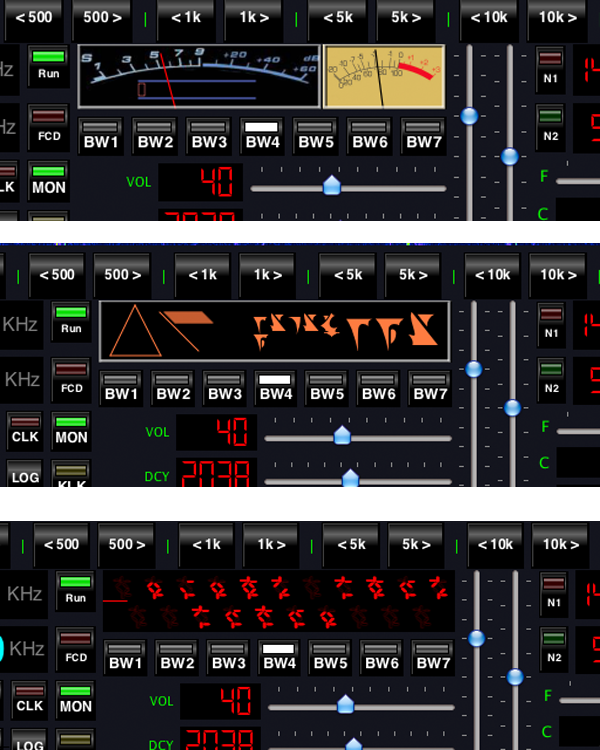
Re:Native Klingon support
What SDR software is that?
-
Re:I think lists are an even bigger problem
Good points on priorities. See also on privacy: http://fyngyrz.com/?p=25
I saw that link on slashdot recently in someone's comment, and it is an insightful essay on privacy. There is a sense that a certain degree of privacy is both a human right and a human requirement in our society, and government should have a duty to protect it (even for reasons beyond ensuring the government remains accountable to the people policitcally).
But failing that, we should at least have David Brin's "Transparent Society" where everyone can watch the watchers:
http://www.davidbrin.com/transparency.htmlSee also my suggestion:
http://pcast.ideascale.com/a/dtd/The-need-for-FOSS-intelligence-tools-for-sensemaking-etc./76207-8319There are also chilling effects. My house has electric heat, so if I grew hydroponic vegetables instead of running the heaters in winter, I would still get the heat via the lights (thermodynamics) and I'd also get fresh veggies all winter. But I know if I buy a lot of hydroponic equipment, I'll most-likely end up on some government list somewhere to have my door kicked in (see another comment here by someone else about an example of that and our misguided drug laws). Or see:
http://www.tampabay.com/news/publicsafety/pinellas-hydroponic-garden-shop-has-attention-of-deputies-searching-for/1204506So, buy hydropoincs and have your dogs shot as a result of data mining?
"Why do SWAT teams kill all dogs when serving a warrant at a household?"
http://answers.yahoo.com/question/index?qid=20110721154445AAWtx8uOr, see also:
http://en.wikipedia.org/wiki/Four_Horsemen_of_the_InfocalypseAlthough another reasons I don't do it is concerns about humidity and mold, and also finding the space, so that is not the only concern, beyond the cost of the equipment.
Thankfully, in the USA we are nowhere near the total squashing of dissent like was accomplished using the 1930s German gestapo secret police, although they apparently mostly used neighbors turning in neighbors since it was before the internet:
http://en.wikipedia.org/wiki/Gestapo
"According to Canadian historian Robert Gellately's analysis of the local offices established, the Gestapo wasâ"for the most partâ"made up of bureaucrats and clerical workers who depended upon denunciations by citizens for their information.[36] Gellately argued that it was because of the widespread willingness of Germans to inform on each other to the Gestapo that Germany between 1933 and 1945 was a prime example of panopticism.[37] Indeed, the Gestapo -- at times -- was overwhelmed with denunciations and most of its time was spent sorting out the credible from the less credible denunciations.[38] Many of the local offices were understaffed and overworked, struggling with the paper load caused by so many denunciations.[39] Gellately has also suggested that the Gestapo was "a reactive organization" "...which was constructed within German society and whose functioning was structurally dependent on the continuing co-operation of German citizens".[40]
After 1939, when many Gestapo personnel were called up for war-related work such as service with the Einsatzgruppen, the level of overwork and understaffing at the local offices increased.[39] For information about what was happening in German society, the Gestapo continued to be mostly dependent upon denunciations.[41] 80% of all Gestapo investigations were started in response to information prov -
Re:10x today's internet traffic
And with a final goal of thousands of antennas collecting up to 30 GHz signals across nearly the full spectrum
Hmmm. Sounds like a marvelous database for us SDR freaks to troll through, big chunks of spectrum at a time, eyes on the waterfall and spectral displays.
All ya need to do is create a server that will supply a file that is a chunk-o-spectrum as baseband IQ data, and you'll likely have a whole bunch of eyes on it for you. You'd certainly have mine!
-
Re:But
Maybe I can help you out. Works under OSX or Windows. Free.
I could even provide you with a recording of a portion of the AM band including one or more stations where Rush is afflicting the spectrum, so you could repeatedly hit the mute button, lol...
-
Re:Why do you need a phone?
Like many other people, I maintain a open wifi connection specifically to provide for public access. Likewise, I maintain an open 144 MHz repeater, and a while ago, a packet BBS that could take and deliver email. I also write free software such as this. When I mean something to be free, or shared for free, there's no negative to taking advantage of that. When I write commercial software, I make sure that I've made the transaction required clear.
Many commercial and/or public establishments make open wifi available; coffee houses, McDonalds, libraries, etc. Doesn't hurt a thing to use those connections.
Now if you prefer not sharing, that's fine -- that's your choice. If you want your connection(s) closed, then by all means close them. The point of an open connection is that it's open. Such things can be used responsibly. A text message, simple text email or IM is absolutely insignificant to any particular wifi connection. A compressed voice connection isn't horrible, bandwidth-wise, either. The more open connections there are, the better it all works as far as portability goes.
Just FYI, the financial benefit I was talking about was the lack of a phone bill; in such a situation, you need to keep your own wifi available, obviously, and you can certainly use that, and keep it closed, without using anyone else's if you want to. You know, it was only a few years ago that almost no one had a portable phone. We survived just fine that way.
Perhaps you might consider learning to share a bit. You know, like open source or free software. Or not. I don't care. I posted to offer those who were open minded a change to consider an opportunity. Not to convert anyone. I'm already phone-bill free, you see.
As for stealing, I'm pretty sure you don't know what that word means.
-
Re:The theory of gravity is under review :)
Secondly, it's a pointless, valueless question. It's on exactly the same level as "is there a Santa Claus?" There's zero evidence for such a thing, despite thousands of yeas of looking for same, so, other than writing fiction or cult-building, there's no reason to assume there is one, and therefore no reason to worry about whether there is one (or several.) When you concern yourself with it, you're simply self-identifying as a cultist or an intellectual lightweight.
Just because Santa is somebody's father in a suit doesn't mean he doesn't exist.
Or would you claim Officers of the Law do not exist? They, too, are just somebody's father in a suit
-
Re:Texas would like to think of it as a hypothesis
You know why people like those in Texas keep getting elected? And here's a hint, it isn't because they are stupid.
Agreed. It's because the voters are victims, or frauds.
-
Re:The theory of gravity is under review :)
And atheists are different?
Yes, they certainly are. Atheists don't have or hold a belief in a god or gods. That's all. From there, they vary enormously.
Big bang was the atheist answer to God for nearly a century.
No. Big bang is a scientific theory, currently the best performing one there is (that could change, and that's fine), that has nothing whatsoever to do with atheism or "God", any more than big bang would be offered, or taken, as "the answer" to Santa Claus or any other made-up story character.
Those theories don't answer the question of "is there a creator?" any better than a theology.
First of all, those theories are not attempting to find such an answer. They are attempting to describe how the reality around us, as is, developed as far back as we have evidence for, albeit extremely indirect, diffuse evidence. Nowhere in actual cosmology, which is what we're talking about here, does the issue of god or gods arise. It's a physics question, not a question of superstition.
Secondly, it's a pointless, valueless question. It's on exactly the same level as "is there a Santa Claus?" There's zero evidence for such a thing, despite thousands of yeas of looking for same, so, other than writing fiction or cult-building, there's no reason to assume there is one, and therefore no reason to worry about whether there is one (or several.) When you concern yourself with it, you're simply self-identifying as a cultist or an intellectual lightweight.
The day theists have evidence, they've changed the game, and everyone -- including atheists -- will be utterly fascinated to examine that evidence. Until then, theists are in a boat that isn't so much intellectually leaky, as sunken.
-
Re:The theory of gravity is under review :)
Calling them "god-tards" just shows how bigoted and closed-minded you are.
-
Re:If this kind of image mining is a problem
The only ads that bother me are pop ups, and I don't ever serve those. I don't block ads myself, though I like to think I'm pretty quick to knock off a pop-up. Don't like pop-up menus either, come to that... if I didn't click on it, I don't want it to react. Hover menus are stupid, IMHO.
I actually think it's useful that they offer me things that I might actually want. Much more interesting than ads for things I'm not even remotely interested in. If I go look at monitors on Amazon, I see banners with monitors, swingarms, etc. for several days. Fine with me.
You know, if I put something in the commons one way or another, I try to be explicit about it, like my SDR software . I actually mean it to be free. But I do like earning an income, even it's its very small, from my web operations, and should an ad catch the eye of a visitor, and they click on it... that's fine with me. They don't have to click on an ad, and the content has value if you're into SDRs. If you're not into SDRs, I can't imagine why you'd be there anyway, lol.
I guess I feel that earning isn't evil, and particularly not so if the surfer gets something of real value. Contrariwise, I serve a lot of pages where no one clicks on anything, and in that case, I took a risk and I knew the bounds of it. Making sure images can't be deep mined defines what my risk is a little better, that's all. You want the image, you'll have to come get it.
I used to have a moderately heavy GIF animation on one of my sites, thing was *really* subject to deep mining. It was a trace of a diamond rotating, refraction and reflection zipping away. (here now) So I wrote a CGI that moved it every few hours, and put a note under it that basically said, if you want to use the image, save it, put it on your own site, and bless ya, but don't link to it here. You had to see the log of image misses to really understand how many people ignored the gift of the image, and just ate up my bandwidth.
One guy went so far as to watch the site with his *own* CGI, and follow the image around. So I wrote the appropriate apache esoterica, and when a request for that image came in from his site, I served him up his own... special... version. About 24 hours later, I looked, and he'd finally moved the animation to his own storage and was serving it himself.
-
Re:Unauthorized
one, the full second amendment includes a bit about a militia.
Yes. This is a benefit gained by forbidding the government from infringing; that fighting citizens can be consistently prepared to be called up. That's what militia and well-regulated mean. None of which changes the instruction to the government, which forbids it from infringing on our already existing right to keep and carry arms.
Two, we're already restricting what arms can be carried.
That bad law is extant does not justify its existence. We had law that created and supported slavery. Would you then claim that because such law existed, that's the way things should be? You see the glaring logical flaw in claiming that because "we're already doing it", "it's right"? The fact is, it's right if it's right, and otherwise, it's wrong.
Three, licensing is not the same thing as a ban. Yes, it is a restriction
It's an infringement; such a strong one, in fact, that it completely obviates the right to keep and carry arms; the government is explicitly enjoined from making any such legislation. It's wrong. From start to finish. Barring amendment of the 2nd to change it fairly radically, licensing is utterly unlawful, specifically because the constitution says so.
Man, I know you're one of the more level-headed posters here.
Why, thank you, sir.
If you're going down the rabbit hole of selectively quoting the constitution, ignoring commonly-accepted precedent and basic logic, I'm not sure if there's any hope for any sort of reasoned debate anymore.
I assure you, I am not. I will debate any point you like in this particular argument, and I will do so as honestly as I can. I try to keep my responses cogent and aimed at the subject brought up; I do not leave out the explicatory phrase from my shorter arguments in order to hide anything, but rather because it is not an instruction to government, while the final phrase is most definitely nothing else but. I am perfectly ready to talk about the explicatory phrase as well, should that really concern you. And in that regard...
May I respectfully point you to a fuller exposition on the matter of mine? You'll find it here.
-
2nd Amendment
You are very confused. "Militia" meant every citizen, in every state, of fighting age (18-45.) Not "state organization." See the Militia act(s) of 1792.
Also, while we're talking about the 2nd amendment, "well regulated" meant uniformly supplied and equipped. It didn't mean made orderly by legislation.
The 2nd can only be meaningfully read with these understandings; further, it breaks neatly into two sections, the first being informational: "A well regulated Militia, being necessary to the security of a free State" and the second consisting of a limit on government action: "the right of the people to keep and bear Arms, shall not be infringed."
Consequently, if you run into a law that infringes on your right to keep or carry arms in any way, shape or form, you've found an unconstitutional law. Concealed carry laws, license laws, "can't carry a knife or nunchuk" laws, chemical glassware laws, etc., etc. All thoroughly unconstitutional.
The problem we have is, our government has been ignoring the constitution for decades at its convenience. Executive, legislative, and judiciary have all been complicit in this. The citizens have, for the most part, not reacted. So the reality of our current situation is that we're not operating as a constitutional republic: We're a de facto corporate oligarchy. So the fact that the government ignores and otherwise violates the constitution seems to be in line with the public's... apathy and ignorance, if nothing else. But it may be something more profound than that. It may be that this change in governance is actually where we want to go. In which case, all talk of revolution will be by a tiny majority, and it will never come to pass. Just as an aside, that's how I'm betting. Your average American wants cheeseburgers and episodes of "Lost." And that's about the end of it.