Slashdot Mirror
Domain: gnu.org
Stories and comments across the archive that link to gnu.org.
Comments · 13,360
-
Re:Konqueror + Gecko?
The first link on Google for "kdebindings gecko konqueror" is this comment.
It seems likely that you have just copied the first part of that.
If not, please explain how you can "easily tell konqueror to use gecko". -
Re:What about ethics?
They've discussed a closely related topic when talking about HESSLA.
-
Re:How about these?
-
Re:How about these?
-
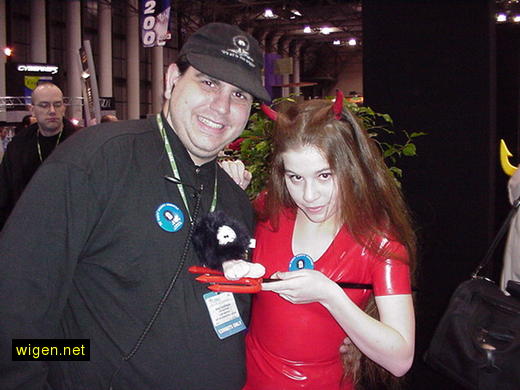
I'd rather develop things with this babe...
IMPORTANT UPDATE: Please show your support for Ceren in this poll of Geek Babes!
Is it any wonder people think Linux users are a bunch of flaming homosexuals when its fronted by obviously gay losers like these?! BSD has a mascot who leaves us in no doubt that this is the OS for real men! If Linux had more hot chicks and gorgeous babes then maybe it would be able to compete with BSD! Hell this girl should be a model!
Linux is a joke as long as it continues to lack sexy girls like her! I mean just look at this girl! Doesn't she excite you? I know this little hottie puts me in need of a cold shower! This guy looks like he is about to cream his pants standing next to such a fox. As you can see, no man can resist this sexy little minx. Don't you wish the guy in this pic was you? Are you telling me you wouldn't like to get your hands on this ass?! Wouldn't this just make your Christmas?! Yes doctor, this uber babe definitely gets my pulse racing! Oh how I envy the lucky girl in this shot! Linux has nothing that can possibly compete. Come on, you must admit she is better than an overweight penguin or a gay looking goat! Wouldn't this be more liklely to influence your choice of OS?
With sexy chicks like the lovely Ceren you could have people queuing up to buy open source products. Could you really refuse to buy a copy of BSD if she told you to? Personally I know I would give my right arm to get this close to such a divine beauty!
Don't be a fag! Join the campaign for more cute open source babes today!
$Id: ceren.html,v 9.0 2004/08/01 16:01:34 ceren_rocks Exp $ -
Re:Swiss Internet voting built on two-factor autheActually, you are incorrect. The world's first national vote took place in the Netherlands in June for the national and European Elections via the use of the KOA voting system developed for the Dutch government.
This system has since been open sourced under the GPL license and my new research group here at University College Dublin is working on completing, documenting, evaluating, and formally specifying the system.
I led the evaluation of this system's external network security for the Dutch government while at the SoS Group at Radbound University Nijmegen.
I was also the co-author of the vote tally application for the European Elections in Holland. That application was written in less than eight weeks using formal methods to ensure that the software of extremely high quality and indeed every vote was counted. This system was written in Java with JML annotations and was partially statically checked (verified) with ESC/Java2.
See the paper "Electronic and Internet Voting in The Netherlands for more high-level information.
-
More importantly, what would you ask Ceren?
IMPORTANT UPDATE: Please show your support for Ceren in this poll of Geek Babes!
Is it any wonder people think Linux users are a bunch of flaming homosexuals when its fronted by obviously gay losers like these?! BSD has a mascot who leaves us in no doubt that this is the OS for real men! If Linux had more hot chicks and gorgeous babes then maybe it would be able to compete with BSD! Hell this girl should be a model!
Linux is a joke as long as it continues to lack sexy girls like her! I mean just look at this girl! Doesn't she excite you? I know this little hottie puts me in need of a cold shower! This guy looks like he is about to cream his pants standing next to such a fox. As you can see, no man can resist this sexy little minx. Don't you wish the guy in this pic was you? Are you telling me you wouldn't like to get your hands on this ass?! Wouldn't this just make your Christmas?! Yes doctor, this uber babe definitely gets my pulse racing! Oh how I envy the lucky girl in this shot! Linux has nothing that can possibly compete. Come on, you must admit she is better than an overweight penguin or a gay looking goat! Wouldn't this be more liklely to influence your choice of OS?
With sexy chicks like the lovely Ceren you could have people queuing up to buy open source products. Could you really refuse to buy a copy of BSD if she told you to? Personally I know I would give my right arm to get this close to such a divine beauty!
Don't be a fag! Join the campaign for more cute open source babes today!
$Id: ceren.html,v 9.0 2004/08/01 16:01:34 ceren_rocks Exp $ -
Re:Defacing?
Regarless, I think it's clear how SCO will use this... to try and attack the FOSS community. I think it is time to re-publish Stallman's My Doom and You
-
Give credit where credit is due.
This is a substantial piece of progress for widespread recognition and acceptance of OSS.
No, it is a substantial piece of progress for widespread recognition and acceptance of the older free software movement. The FSFE doesn't speak for "OSS" (open source software). In fact the FSF tells us that the two movements are not the same. This essay explains much and is one of the most underrated essays the FSF has published.
While I'm sure that the open source movement will get some increased publicity from this (largely from people who don't understand what "open source" really means or don't know the difference between the philosophies of the two movements), it's important to understand recent history and see how the messages of the FSF and OSI differ. It's also important and fair to give credit where credit is due. Here, that means using the phrase "free software". I don't know who wrote the blurb at Wikinerds, but they were wrong. The FSFE's press release doesn't mention "open source" or "OSS" at all. Your article is vastly overrated.
-
but Ceren is bug-free!
IMPORTANT UPDATE: Please show your support for Ceren in this poll of Geek Babes!
Is it any wonder people think Linux users are a bunch of flaming homosexuals when its fronted by obviously gay losers like these?! BSD has a mascot who leaves us in no doubt that this is the OS for real men! If Linux had more hot chicks and gorgeous babes then maybe it would be able to compete with BSD! Hell this girl should be a model!
Linux is a joke as long as it continues to lack sexy girls like her! I mean just look at this girl! Doesn't she excite you? I know this little hottie puts me in need of a cold shower! This guy looks like he is about to cream his pants standing next to such a fox. As you can see, no man can resist this sexy little minx. Don't you wish the guy in this pic was you? Are you telling me you wouldn't like to get your hands on this ass?! Wouldn't this just make your Christmas?! Yes doctor, this uber babe definitely gets my pulse racing! Oh how I envy the lucky girl in this shot! Linux has nothing that can possibly compete. Come on, you must admit she is better than an overweight penguin or a gay looking goat! Wouldn't this be more liklely to influence your choice of OS?
With sexy chicks like the lovely Ceren you could have people queuing up to buy open source products. Could you really refuse to buy a copy of BSD if she told you to? Personally I know I would give my right arm to get this close to such a divine beauty!
Don't be a fag! Join the campaign for more cute open source babes today!
$Id: ceren.html,v 9.0 2004/08/01 16:01:34 ceren_rocks Exp $ -
Re:This is really funny
This isn't so funny when you think about it: what will happen in a few decades? Either we'll live in a dream world without polution, religion and where everyone will be educated and respect each other OR we'll live in a hellish nightmare where books will be forbidden (read this one more time, is it some kind of prophecy?)
Of course I doubt Microsoft and its patents will still exist as it is now. -
Re:Free Forking?Didn't Microsoft try to make their own Java implementation(J++) and didn't sun go after them for it because it didn't stick to the java standards? Is that open source?
Sun went after Microsoft because they had a contractual agreement which stated they had to produce a product with certain attributes before they can call it "Java".
Sun has never prevented alternative Java implementation, there are many.
As far as open-source there is Kaffe, GNU Classpath, GCJ, Jikes and others.
All those projects need help. And I am sure Sun is not the reason they are not getting it.
Put your money and time where your mouth is and support open-source Java
-
Re:Free Forking?Didn't Microsoft try to make their own Java implementation(J++) and didn't sun go after them for it because it didn't stick to the java standards? Is that open source?
Sun went after Microsoft because they had a contractual agreement which stated they had to produce a product with certain attributes before they can call it "Java".
Sun has never prevented alternative Java implementation, there are many.
As far as open-source there is Kaffe, GNU Classpath, GCJ, Jikes and others.
All those projects need help. And I am sure Sun is not the reason they are not getting it.
Put your money and time where your mouth is and support open-source Java
-
What about GCJ and Kaffe and others?You are only stuck with the JRE for Java because Sun keeps you from having a choice. If Java were an open standard, there would be dozens of different implementations, and those implementations would work out amongst themselves what features were important core features and what features were vendor-specific extensions.
Yeah right! Magical open-source developers will come out of nowhere right?
If you want open-source Java, and feel serious about helping out, then you have GCJ and Kaffe.
Sun has allowed alternative JVMs for a long time and there are now many other JVMs to choose from.
You have your opportunity you develop Open-source Java, put your time and money where your mouth is, support Kaffe today!
Or do you just want to freeload off Sun's investement in their JVM?... Even if they already provide it for free.
-
Re:web based
gnu/hurd?
What is a kernel doing in that list? -
FSF just clarified LGPL and Java
We have just got a clarification from the FSF on LGPL and Java: http://www.gnu.org/licenses/lgpl-java.html Essentially, it means what it ought to mean: its only the library that is LPGL, not anything you build from it. Inheritance of class or interface is also allowed.
-
Re:Haskell just won't cut it
Tell that to RMS: http://www.gnu.org/prep/standards/standards.html#
S ource-Language -
Re:Darcs is KISS
- Your comment would still be correct if I changed every occurence of "darcs" with "arch" (except for the command lines, of course).
Not quite. Arch isn't simple to use.
- So, what's the difference between Arch and Darcs?
From the perspective of a Darcs user:
Darcs is much simpler to use.
Darcs doesn't have branches, because every repository is conceptually a branch.
Darcs' patch format is just text (Arch uses a tarball).
Darcs has no notion of persistent file identity (which I consider a plus).
Darcs involves less typing; a repository is just a directory, or an SSH path, or an HTTP URL; compare that to Arch's tendonitis-inducing archive/patch/branch names: lord@emf.net--2003-example/hello-world--mainline-
- 0.1--patch-1. (Yes, you will need to type this all the time on command lines.)Arch has the concepts of archives -- every user first has to set up an archive into which you pull repositories. You then check out code from your archive, check it back in it. Very tedious. In Darcs, a repository is analogous to Arch's archive.
The archive concept also increases the number of commands Arch has support: in addition to the normal checkout, commit etc. commands, it must support a similar, orthogonal set of commands for manipulating archives, and it has to have all this glue for tying archives and repositories.
How many commands do Darcs and Arch have?
$ darcs -h | grep "^ " | wc -l
30
$ tla help | grep "^
104To Arch's defense, you don't need to know every command; some of them are fairly esoteric.
Try the Arch tutorial someday. It's an incredibly long and tedious tutorial, and by the end of it, you probably won't remember the command to set up a new archive.
Comparing Darcs and Arch feels a bit like comparing Python and Java (or, in terms of typing, Lisp and Dylan).
-
Huzzah for new shows
I'm all happy that there's a new TV show dedicated to Open Source, but I would have hoped they could find a better musical act than Richard Stallman.
-
Or.....
Gneo*: That sounds like a really good deal. But...I think I've got a better one. How 'bout I give Microsoft the finger, and I start replacing ALL my crappy installations of Microsoft Windows with GNU and free software, FREE...as in freedom... That way we'll all be free of the evil tyrrany.
Agent Smith^WGates:Hmmm, Mr. Anderson, you disappoint me.
Gneo: You can't scare me with this gestapo crap. I know my rights, I want to use my free software.
Agent Smith^WGates:Tell me, Mr. Anderson. What good is your free software if you can't use a computer without our (evil unpronouncable) NGSCB...Next-Generation Secure Computing Base...?
(If you don't get this, read the Trusted Computing FAQ (incidentally by a guy called Mr. Anderson) and google for trusted (aka trecherous) computing. Also, this study on effects on free software in PDF (also by Mr. Anderson). Also, the FSF's summary.)
[* blend of GNU and Neo. Also note that Gnu sounds like new which is English for `neo'...uhhh...I need a life]
Parts of this post are fair-use copies of The Matrix screenplay and/or parent post.
-
Re:Changes to the GPL
The "viral" aspect of the GPL applies only in certain circumstances. (Maybe "viral" is not the best term.) These circumstances are when a developer chooses to combine code with GPL-covered code or if a software package is used with a GPL-covered library. (Not everyone agrees with respect to dynamic linking and GPL requirements. See this article which tries to use an analogy of a written work referencing a copyrighted character elsewhere.) The "viral" rule about licensing copies under the GPL also applies when copies are distributed to the public.
Of course, if a library was licensed under a proprietary license, it is extremely likely that dynamically linking to the library would be restricted. This would be especially true if the license was a contract that exceeded normal copyright restrictions.
The LGPL is designed to enforce copyleft for libraries while allowing the library to be used as a library with proprietary software. Sometimes, there may be competing proprietary libraries that do the same thing as a copylefted library. In this case, the GPL could discourage usage of the library. (It is OK to use the regular GPL for libraries instead.) To help free software, it would be better to use the GPL for libraries that do not have competing proprietary libraries. Note that an LGPL-covered library can only be used like a library regarding proprietary software. For instance, distributing copies of the library under a proprietary license would not be permitted.
-
Re:Draft Copy?
Well, if it was me, I wouldn't include that for the following reason.
This is nonsense. They cannot ask for any more damages than what they get under copyright law (and a copyright license is pointless without copyright law). See my aunt post.I guess the idea is to stick with pure usage restrictions
This is totally wrong as section 0 of the GNU GPL specifically states that there are no restrictions on usage (of software licensed under it).avoid all money issues for corruption reasons.
Of course there are money issues for someone if they are succesfully prosecuted or sued for illegally copying or distributing software licensed under the GNU GPL (like any other work of art under any license): fines and compensation respectively. This is not really corruption as it is stated in the law (of almost every jurisdiction). (If you do object to people being fined or having to give compensation for breaking the law (or to the existence of copyright law) then campaign to have the law changed.) -
Re:Awesome quoteYou mean without the Linux kernel? Um, wouldn't we be using BSD?
We'd probably all be hurding and it would be the most advanced kernel on the planet.
In free software it does not matter, does it? What gets implemented one place is free to move around.
-
Re:no patents?
The LZW patent expired last year. GIFs are patent free.
From the FSF page about GIF:
Of the places whose patent databases we were able to search, the latest expiration date seems to be Friday 11 August 2006.
Note that the patent which expires at that date is not the Unisys patent, but an IBM patent also covering LZW (and therefore GIF).
Now, I guess IBM is unlikely to sue (it would probably hurt their Linux strategy), but that doesn't make that patent disappear. -
Re:Draft Copy?If you want proof of the GNU GPL's existence check the copy on the FSF's website.
(If you are instead suggesting that a judge has never found anyone guilty of copyright violation for not following the terms of the GNU GPL (when that is the only license they had for a piece of software) you are unfortunately mistaken.)
-
Re:Draft Copy?I'm guessing the reasons for the perceived slowness of the GNU GPL's development are that it is such a good document that no one
- can think of any ways to really improve on it
- wants to hastily change it lest they somehow damage its legal watertightness ("if it ain't broke don't fix it").
However, there is now talk of releasing a new version (GNU GPL 3.0) and maybe a first draft of the new version sometime "soon" (in terms of it's slow development cycle--some people are bandying around 2006 as a possible date). There is no draft ATM but possible changes that have been talked about in the past include:
- an anti-DMCA clause;
- clarification of the section on granting patent licenses (and better protection against algorithmic patents in general);
- possibly something about trusted/trecherous computing to stop free software being effectively shackled by that technology;
- possibly allowing the offer of source code for binaries without source to refer to a URI where it can be downloaded (as opposed to the out-dated snail-mail method);
- clarification (and possible tightening) of "as a special exception, the source code distributed need not include anything that is normally distributed...with the major components...of the operating system on which the executable runs..." to close the loophole that people could argue quite a wide defintion of "major components of OS";
- most significantly, a new clause saying that source code must be available to users who use the software remotely over a network (e.g.: the Internet). [See the relevant official GNU-GPL FAQ and section 2(d) of the Affero GPL (which is very similar to what the FSF are considering for the new GNU-GPL clause).]
See this FSF presentation and NewsFourge's two-part article interviewing RMS for more background--neither recent. Those are the main official sources I could find.
I'm sure a public draft will be released for discussion some time before anything gets finalised.
-
This has been under consideration for over 2 years
The FSF has been working with Affero to address this issue. Check out the list of GPL-incompatible free software licenses under the section called "Affero General Public License" which says:
The Affero General Public License is a free software license, copyleft, and incompatible with the GNU GPL. It consists of the GNU GPL version 2, with one additional section that Affero added with FSF approval. The new section, 2(d), covers the distribution of application programs through web services or computer networks. The Affero GPL is incompatible with the GNU GPL version 2 because of section 2(d); however, the section is written so that we can make GNU GPL version 3 upward compatible with the Affero GPL. That is why we gave our approval for Affero to modify the GNU GPL in this way.
The Affero General Public License is online as well. I'm sure both organizations would welcome your feedback.
-
Not as simple as previously stated.
The GPL works very well at the moment. Introducing a new version could confuse what is at the moment a very easy to understand concept-- if you alter GPLed code you have to let everyone use your alterations as GPLed code as well-- as well as creating schisms in OSS development.
Actually, private derivatives are allowed. Having the freedom to make derivatives one does not share with others in any form is required by the definition of free software:
You should also have the freedom to make modifications and use them privately in your own work or play, without even mentioning that they exist.
Also, use of a program (that is, merely executing the program) is not a power regulated by US copyright law. And the GPLv2 specifically states that it does not control this activity:
Activities other than copying, distribution and modification are not covered by this License; they are outside its scope. The act of running the Program is not restricted [...]
So, no, "if you alter GPLed code you have to let everyone use your alterations as GPLed code as well" is untrue.
Also, you have (perhaps inadvertantly) repeated one of the most misleading parts of the article (and the editorial linked to the article): Associating the GPL with the open source movement profound miscredits who did what and what goals the GPL was written to achieve.
This latest revision of the GPL has almost nothing to do with "OSS" development. The open source movement (which doesn't like to talk about software freedom) did not exist when the current version of the GPL (version 2) was written. The free software movement (which is based on software freedom) predates the open source movement by over a decade. This upcoming version (version 3) of the GPL will be the first version of the GPL written since the open source movement started. As far as I know, nobody from the open source movement is writing the next revision of the GPL; it is still written by the people at the FSF (most notably, RMS and Eben Moglen, both of whom make it quite clear in their speeches that they are doing work to promote software freedom). So, the open source movement is receiving a great deal of credit for work it did not do and the danger of tying the GPL with the open source movement is that the open source movement's philosophy, which doesn't object to proprietary software, will be conflated with a license built to create and maintain a commons where software freedom is the rule.
-
Not as simple as previously stated.
The GPL works very well at the moment. Introducing a new version could confuse what is at the moment a very easy to understand concept-- if you alter GPLed code you have to let everyone use your alterations as GPLed code as well-- as well as creating schisms in OSS development.
Actually, private derivatives are allowed. Having the freedom to make derivatives one does not share with others in any form is required by the definition of free software:
You should also have the freedom to make modifications and use them privately in your own work or play, without even mentioning that they exist.
Also, use of a program (that is, merely executing the program) is not a power regulated by US copyright law. And the GPLv2 specifically states that it does not control this activity:
Activities other than copying, distribution and modification are not covered by this License; they are outside its scope. The act of running the Program is not restricted [...]
So, no, "if you alter GPLed code you have to let everyone use your alterations as GPLed code as well" is untrue.
Also, you have (perhaps inadvertantly) repeated one of the most misleading parts of the article (and the editorial linked to the article): Associating the GPL with the open source movement profound miscredits who did what and what goals the GPL was written to achieve.
This latest revision of the GPL has almost nothing to do with "OSS" development. The open source movement (which doesn't like to talk about software freedom) did not exist when the current version of the GPL (version 2) was written. The free software movement (which is based on software freedom) predates the open source movement by over a decade. This upcoming version (version 3) of the GPL will be the first version of the GPL written since the open source movement started. As far as I know, nobody from the open source movement is writing the next revision of the GPL; it is still written by the people at the FSF (most notably, RMS and Eben Moglen, both of whom make it quite clear in their speeches that they are doing work to promote software freedom). So, the open source movement is receiving a great deal of credit for work it did not do and the danger of tying the GPL with the open source movement is that the open source movement's philosophy, which doesn't object to proprietary software, will be conflated with a license built to create and maintain a commons where software freedom is the rule.
-
Re:Changes to the GPL
mailing $15 for the source code when the binary is available free online goes against its principles
According to the GPL FAQ, that's already disallowed:Does the GPL allow me to charge a fee for downloading the program from my site?
Yes. You can charge any fee you wish for distributing a copy of the program. If you distribute binaries by download, you must provide "equivalent access" to download the source--therefore, the fee to download source may not be greater than the fee to download the binary.
-
GPL Server Hole
Hopefully they will plug the server hole. As it stands right now, the GPL makes no sense for server-side applications.
-
Stability, GLibc and the road back to Mozilla
A few years ago, when Phoenix was first released, I was among the first to try it. Pleased by its relative stability, speed and overall lightweight character, I started using it as my primary browser. Later releases brought further improvements, like extensions. Fast forward to 2004:
Improvements:
- Auto-update
- Improved search
- Skin
- Download manager
Side-effects:
- Firefox is very unstable compared to Phoenix
- The development team has started linking Firefox against glibc 2.3
The improvements are of little to no benefit IMHO:
- Auto-update is too unreliable and impractical when you're not root. It's actually quicker to do it the old-fashioned way
- Being a slightly conservative bastard who can't appreciate eye candy if it isn't female, I've never used skins.
- The improved search is an exception. The colours are handy if you're visually scanning a large document and it eliminates the window blocking your view. It's actually a bit like vim's search.
- The download manager is not very practical. It gives clueless lusers a harder time infecting their PC's, but it's "hidden" into the browser and the actions surrounding a download take more time now than ever before.
The decay which has been accompanying all this development is quite severe:
- The stability issues cause two crashes on an average day for me. Some sites actually cause crashes whenever viewed. In most cases the sites contain buggy html and javacrypt, but that should not crash the browser. Notable examples include WebCT and requested popups.
- Although most modern distros use glibc 2.3, I'm not going to switch for a while.
I've tried setting up a chroot for it, but the latest version of gcc appears to be unable to compilethe latest glibc.
According to the gcc maintainers this is a bug in glibc.
According to the glibc maintainers this is a bug in gcc.
blah rant rave curse slap stab blam, etc
Even though there's a hack to get it working, I'm staying with glibc 2.2 until both groups have stopped trying to break eachother's code.
But there's always PLAN B. And after three hours of compiling firefox 1.0, it turns out that the degradation curve since 0.8 has not changed course.
Some common sense inhibitor snaps in my skull and I ditch firefox. Alternatives:
Konqueror toy
Dillo incomplete
Links rules my console, but it has some
inherent disabilities
etcetcetc.
But there's always the "dead" Mozilla. It turns out that Mozilla is not as dead as commonly thought.
Mozilla has become much lighter nowadays. The e-mail, news and chat is seperated from the browser package now and doesn't swallow memory anymore and it's noticeably faster than before.
It can also use extensions, block popups and evil javascript code, and some other features we've started to like about Firefox. Among the differences are a more intuitive download manager and unfortunately the old text search. But the most important differences are its much greater stability and the fact that it is backwards compatible with glibc 2.2 and possibly even older versions.
So, contrary to the mainstream momentum, I've switched back to Mozilla. Getting it working took a few mouseclicks instead of a full compile and minutes instead of hours. I live happily ever after.
If you're having nervous breakdowns with firefox, consider this move.
Steven. -
Stability, GLibc and the road back to Mozilla
A few years ago, when Phoenix was first released, I was among the first to try it. Pleased by its relative stability, speed and overall lightweight character, I started using it as my primary browser. Later releases brought further improvements, like extensions. Fast forward to 2004:
Improvements:
- Auto-update
- Improved search
- Skin
- Download manager
Side-effects:
- Firefox is very unstable compared to Phoenix
- The development team has started linking Firefox against glibc 2.3
The improvements are of little to no benefit IMHO:
- Auto-update is too unreliable and impractical when you're not root. It's actually quicker to do it the old-fashioned way
- Being a slightly conservative bastard who can't appreciate eye candy if it isn't female, I've never used skins.
- The improved search is an exception. The colours are handy if you're visually scanning a large document and it eliminates the window blocking your view. It's actually a bit like vim's search.
- The download manager is not very practical. It gives clueless lusers a harder time infecting their PC's, but it's "hidden" into the browser and the actions surrounding a download take more time now than ever before.
The decay which has been accompanying all this development is quite severe:
- The stability issues cause two crashes on an average day for me. Some sites actually cause crashes whenever viewed. In most cases the sites contain buggy html and javacrypt, but that should not crash the browser. Notable examples include WebCT and requested popups.
- Although most modern distros use glibc 2.3, I'm not going to switch for a while.
I've tried setting up a chroot for it, but the latest version of gcc appears to be unable to compilethe latest glibc.
According to the gcc maintainers this is a bug in glibc.
According to the glibc maintainers this is a bug in gcc.
blah rant rave curse slap stab blam, etc
Even though there's a hack to get it working, I'm staying with glibc 2.2 until both groups have stopped trying to break eachother's code.
But there's always PLAN B. And after three hours of compiling firefox 1.0, it turns out that the degradation curve since 0.8 has not changed course.
Some common sense inhibitor snaps in my skull and I ditch firefox. Alternatives:
Konqueror toy
Dillo incomplete
Links rules my console, but it has some
inherent disabilities
etcetcetc.
But there's always the "dead" Mozilla. It turns out that Mozilla is not as dead as commonly thought.
Mozilla has become much lighter nowadays. The e-mail, news and chat is seperated from the browser package now and doesn't swallow memory anymore and it's noticeably faster than before.
It can also use extensions, block popups and evil javascript code, and some other features we've started to like about Firefox. Among the differences are a more intuitive download manager and unfortunately the old text search. But the most important differences are its much greater stability and the fact that it is backwards compatible with glibc 2.2 and possibly even older versions.
So, contrary to the mainstream momentum, I've switched back to Mozilla. Getting it working took a few mouseclicks instead of a full compile and minutes instead of hours. I live happily ever after.
If you're having nervous breakdowns with firefox, consider this move.
Steven. -
bittlbee
-
BSDers bet on gorgeous Ceren
IMPORTANT UPDATE: Please show your support for Ceren in this poll of Geek Babes!
Is it any wonder people think Linux users are a bunch of flaming homosexuals when its fronted by obviously gay losers like these?! BSD has a mascot who leaves us in no doubt that this is the OS for real men! If Linux had more hot chicks and gorgeous babes then maybe it would be able to compete with BSD! Hell this girl should be a model!
Linux is a joke as long as it continues to lack sexy girls like her! I mean just look at this girl! Doesn't she excite you? I know this little hottie puts me in need of a cold shower! This guy looks like he is about to cream his pants standing next to such a fox. As you can see, no man can resist this sexy little minx. Don't you wish the guy in this pic was you? Are you telling me you wouldn't like to get your hands on this ass?! Wouldn't this just make your Christmas?! Yes doctor, this uber babe definitely gets my pulse racing! Oh how I envy the lucky girl in this shot! Linux has nothing that can possibly compete. Come on, you must admit she is better than an overweight penguin or a gay looking goat! Wouldn't this be more liklely to influence your choice of OS?
With sexy chicks like the lovely Ceren you could have people queuing up to buy open source products. Could you really refuse to buy a copy of BSD if she told you to? Personally I know I would give my right arm to get this close to such a divine beauty!
Don't be a fag! Join the campaign for more cute open source babes today!
$Id: ceren.html,v 9.0 2004/08/01 16:01:34 ceren_rocks Exp $ -
Re:Cedega and GPL
Is this [charging for software/subscription] not a violation of the GPL, and exactly the sort of thing it was written to prevent?
The GPL was not written to prevent charging for software, either a flat-rate charge or a subscription - from the GPL: "When we speak of free software, we are referring to freedom, not price. Our General Public Licenses are designed to make sure that you have the freedom to distribute copies of free software (and charge for this service if you wish)" (my emphasis)
Now, I'm not a lawyer, and it is possible that Transgaming are breaking the GPL - but certainly not by charging a subscription.
-
Re:Open Source QNX
why are we not making an open-source QNX clone?
There is, its actually a prequel called The HURD -
Re:this is BAD in my opinion
Just when the name "Mozilla" and "firefox" started to become creditable, then all of a sudden AOL wants back in! They will just make an adware version of firefox that also installs aol icons all over the place, and slap the name Netscape on it.
Just as Richard M. Stallman predicted.
Netscape can use our changes in any way at all--even in proprietary licensed versions of the software... [it] says that working on a free program means contributing to a proprietary software product.
-
BSD Sponsors Hot Geek Babe!
IMPORTANT UPDATE: Please show your support for Ceren in this poll of Geek Babes!
Is it any wonder people think Linux users are a bunch of flaming homosexuals when its fronted by obviously gay losers like these?! BSD has a mascot who leaves us in no doubt that this is the OS for real men! If Linux had more hot chicks and gorgeous babes then maybe it would be able to compete with BSD! Hell this girl should be a model!
Linux is a joke as long as it continues to lack sexy girls like her! I mean just look at this girl! Doesn't she excite you? I know this little hottie puts me in need of a cold shower! This guy looks like he is about to cream his pants standing next to such a fox. As you can see, no man can resist this sexy little minx. Don't you wish the guy in this pic was you? Are you telling me you wouldn't like to get your hands on this ass?! Wouldn't this just make your Christmas?! Yes doctor, this uber babe definitely gets my pulse racing! Oh how I envy the lucky girl in this shot! Linux has nothing that can possibly compete. Come on, you must admit she is better than an overweight penguin or a gay looking goat! Wouldn't this be more liklely to influence your choice of OS?
With sexy chicks like the lovely Ceren you could have people queuing up to buy open source products. Could you really refuse to buy a copy of BSD if she told you to? Personally I know I would give my right arm to get this close to such a divine beauty!
Don't be a fag! Join the campaign for more cute open source babes today!
$Id: ceren.html,v 9.0 2004/08/01 16:01:34 ceren_rocks Exp $ -
EB's McHenry fails to convince.
We don't know what most readers would do with EB if they were given the freedom to change and distribute it because they are not given that freedom. Even McHenry concedes that the Wikipedia claim is true--they were able to get a lot of volunteers to edit and revise. He must say this because he tries to use it to justify a poor review of Wikipedia later on. This freedom to make copies, change the work, and distribute copies (verbatim or modified) is one of the issues Wikipedia takes up (the first in its list of values, in fact). This sense of freedom (not zero price) is apparently quite important for Wikipedia ("The license we use grants free access to our content in the same sense as free software is licensed freely." from Wikipedia:Copyrights).
And that, right there, is why Britannica and its brethern win. When something is wrong or slanted in Britannica, no-one blames the readers. It's an editor or contributer who gets the rap.
Taking the blame doesn't help anything if it doesn't result in getting problems fixed. EB's approach is about framing the debate in terms they are comfortable with an excluding others from building on their work. The practical outcome of this for me is that too many encyclopedias I've seen fail to address important social movements of the day (like the free software movement, encouraging an ethical approach to computer software, and the only significant challenge to one of the largest monopolies of our day--Microsoft's proprietary software), or they are updated too infrequently to talk about things I want to learn more about (like the recent goings-on and the history of the anti-war movement).
Other practical considerations are left out too: What if I want to make a copy of EB in case EB goes away? EB is under a restrictive license which doesn't allow me to do things I want to do. Contacting EB has not produced the kind of feedback I was looking for, including pointers to primary sources and essays written by people in the know on topics I care about. The end result of this is that I can't help myself by helping like-minded neighbors find these topics either.
To review Wikipedia, McHenry presents something closer to an all-or-nothing case ("assessing an encyclopedia...can't be done in any thoroughgoing way") where a complete reading is infeasible but clearly one must read something from the encyclopedia or else one can't say anything about its content. And then he says that he "chose a single article, the biography of Alexander Hamilton.". McHenry actively arguing against sampling--assessing the figurative lay of the land by looking at many places, not by looking at one hand-picked part and making that review stand for the rest.
But since he thinks this one-article approach is an appropriate yardstick, I figure two can play that game. I chose to look up something from the online EB about the free software movement and I found no entry (not even in the subscriber's short list). "GNU", in the context of computer software, seemed to elicit no response, neither did "open source" (which could have pointed to how the open source and free software movements differ), but "GNU/Linux" provides a hit (only because of the word "Linux"). Unfortunately EB falls into a trap much like the reviewer cited for Wikipedia's Hamilton entry--he picked the Alexander Hamilton entry because he knew that Hamilton's birthdate was likely to be wrong (and thus set up bad dates for the remainder of the entry), and that is exactly what he found. In my setup to fail, I know that exactly what Linux is and how it ought to be credited is controversial. Yet EB goes on boldly claiming that Linux is an operating system (when actually it is only part of an operating system called a "kernel"), and EB seems to make no distinction between free as in price and free as in the freedoms to share and
-
Re:buy an icon collection
I hope you know that the GPL can apply to things other than software, and in this case the "source code" would consist of (for example, with SVGs) the XML used to create it, or the image data itself in an open format such as PNG.
-
Re:Patent bubble will lead to burst
I've been pondering this idea for a few days....
Maybe here's how we can speed up the reform of the patent system while protecting the open source community and raising money for OSS. The FSF no doubt already has one of the largest intellectual property portfolios on earth. What would happen if the open source community, arguably the largest organized creative community in the world, started patenting everything they could and then licensing it in a manner designed to encourage openess and protect the community from external ip threats?
The patents could be licensed on an I'll show you mine if you show me yours basis. You get permanent free access to our patents if we get permanent free access to yours. I'm sure it would be hell to word the licesne appropriately and the cost of discovering potential ip and filing for all those patents would be enormous but....
We would presumably amass an enormous ip portfolio which could be used for several purposes. It could theoretically generate revenue for the FSF. It could be used as amunition against companies seeking to threaten the open source community with ip suits. Eventually, we may amass so many patents that it becomes impossible to develop anything without agreeing to our open-source-esque patent licenses.
The tyranny of the system would become evident and reform would follow. In between now and then, we'd get protection for OSS. -
My question: How damn hot is Ceren?!
IMPORTANT UPDATE: Please show your support for Ceren in this poll of Geek Babes!
Is it any wonder people think Linux users are a bunch of flaming homosexuals when its fronted by obviously gay losers like these?! BSD has a mascot who leaves us in no doubt that this is the OS for real men! If Linux had more hot chicks and gorgeous babes then maybe it would be able to compete with BSD! Hell this girl should be a model!
Linux is a joke as long as it continues to lack sexy girls like her! I mean just look at this girl! Doesn't she excite you? I know this little hottie puts me in need of a cold shower! This guy looks like he is about to cream his pants standing next to such a fox. As you can see, no man can resist this sexy little minx. Don't you wish the guy in this pic was you? Are you telling me you wouldn't like to get your hands on this ass?! Wouldn't this just make your Christmas?! Yes doctor, this uber babe definitely gets my pulse racing! Oh how I envy the lucky girl in this shot! Linux has nothing that can possibly compete. Come on, you must admit she is better than an overweight penguin or a gay looking goat! Wouldn't this be more liklely to influence your choice of OS?
With sexy chicks like the lovely Ceren you could have people queuing up to buy open source products. Could you really refuse to buy a copy of BSD if she told you to? Personally I know I would give my right arm to get this close to such a divine beauty!
Don't be a fag! Join the campaign for more cute open source babes today!
$Id: ceren.html,v 9.0 2004/08/01 16:01:34 ceren_rocks Exp $ -
"Stealing" customers? MSIE and Safari "free"?
An anonymous reader contends that
"[...] Opera's future seems uncertain as Firefox's growing popularity may hurt Opera by stealing potential customers. With Internet Explorer, Firefox, and Safari all free, is there room for a non-free browser in the market?"
Isn't this (1) outcompeting to get more (2) users? I doubt most Firefox users are Mozilla Foundation customers because I doubt most Firefox users paid for their copy of Firefox (which is okay by me, sharing at whatever price we choose is fundamental to software freedom). As for the first point, isn't it possible people are choosing Firefox because it works well for what most web users want most of the time?
And speaking of software freedom: MSIE, Safari, and Firefox are not free in the same way. You pay for MSIE and Safari when you buy the Microsoft Windows and MacOS X operating systems (if not in other ways by buying other Microsoft and Apple products), and if you pay you still don't get software freedom with either browser (although, to be fair, the Mozilla Foundation endorses the open source movement). Firefox is free in both the sense of software freedom and the side-effect that freedom grants us: free to share for zero price.
-
Re:Motive
where is the rule that says SysMaster must state on the front page thy use Asterisk PBX?
s/Asterix PBX/GPL'ed software/g
Without this, your argument is a straw man.
How about right here -
Let the Copyright Holder Handle It
Please follow this advice: gather what details you can & notify whoever holds the copyright on the GPLed software you believe is being abused.
-
Ham Radio in a Changing Electronics LandscapeGoing to the Dayton Hamvention this year after a 20 year absence was eye-opening. There just weren't many people under 50 to be seen.
I think several trends are at work in amateur radio right now. First is that advances in chip integration have made it more difficult to homebrew equipment. There are fewer and fewer "catalog" parts around with simple functions. This, plus surface mount packaging, have made electronic products cheaper but electronic experimentation much more difficult for the average person.
Another trend is the commercial annihilation of distance. Talking across the country on two-way radio loses its thrill when one can do the same on a cell phone more or less for free, and much more reliably.
Software Defined Radio (SDR) is a bright spot in ham radio today. Forget about the Big Project flavor of Gnu Radio. Amateur SDR projects tend to be quite simple - sometimes ingeniously so - and approach the subject from the experimenter's point of view, not the engineer's. Most are based on the simple proposition that a recent commodity PC plus sound card make a pretty decent digital signal processor.
Organizations like ARRL and TAPR have encouraged digital radio up to and including SDR, though they have each tried to firmly guide the direction of amateur SDR. In fairness, ARRL has published many articles in its experimenter's magazine and in an excellent online compendium.
Two independent projects show the range of amateur SDR. The SDR-1000 is a hardware/software project turned semi-commercial, with a steep price of entry. Flex Radio Systems also has a unique definition of Open Source. On the other hand, the SDRadio project is an independent software receiver that is slowly morphing into a community effort. The project forum is brimming with good ideas.
There are other, loosely related projects such as narrowband signal processing and Digital Radio Mondiale (broadcast) decoders being done by hams. From these resources it's easy to see SDR as an emerging force in rejuvenating ham radio, even though today the various efforts are quite fragmented.
-
Re:Out of the loop
Picture transmission (different color use different band, so you hear this odd static. Since by law you can't encrypt it, no porn). Different band? I guess if you're trying to obfuscate things, you could use multiple bands, but the law doesn't let you really do that either. And anything obscene is not permitted, as you know
I think that was meant to read as "band = scanline" not "20 meters for blue and 40 meters for red"...
Also don't forget about Software Defined Radio -- lots of hams doing SDR stuff now. http://www.gnu.org/software/gnuradio/
Alex / AB2RC -
Re:tis a sad day
What does this have to do with free software?
-
Open Source vs Anonymous Source
You can see where this is going.
Recapping:
- Microsoft source gets into the wild through negligence on someone's part
- Microsoft starts offering generous Royalty-Free terms on various internet protocols (though many are peeved that the blanket protection seemingly covers protocols not actually owned by MS. In the confusion, people not paying attention will be confused.)
- Microsoft, like HP, Novell and Red Hat before them, and, after all the FUD cloud emanating from the corpse company called SCO, offers indemnification against customers getting blackmailed by Intellectual Property Threats (like what SCO attempted to do to Autozone and Daimler Chrysler).
If you thought it was difficult doing a thorough Theo code audit for security was a formidable task, even given the open source code, then imagine the difficulty of looking through all of the source and wondering if any of it infringes on anyone's claimed "Intellectual Property". There aren't any options to diff and grep to complete such a task, AFAICT. The other half of the comparison remains under lock and key, except to those with rights to the IP.
Linus' policy of requiring signed patch contributions to the Linux source looks more and more like a good and proper defensive measure. I'd feel better if other high profile FOSS projects had systems of signing patches and an examinable web of trust between the major contributors. Go ahead and accept patches, but let each contributor sign them.
The whole issue of IP indemnification reeks of a deliberate strategy to slow the growth of free and open source deployments by sowing doubt into the minds of decision makers considering use of FOSS for their business but must consider risk in their decision (and a limited amount of time and information on which to base a decision).
Transparency should make FOSS less IP infringing quickly compared to closed source, where IP infringements can be compiled away from easy recognition by the IP owners.