Slashdot Mirror
Domain: gnu.org
Stories and comments across the archive that link to gnu.org.
Comments · 13,360
-
Re:Ah yes, the GNU "operating system"
Somehow the "created the GNU operating system" (past tense) on the TLC web page did not convey the fact that, yes, GNU has in fact tried to create a kernel barely functions and no one uses.
Even as late as 1990, RMS admitted that "we aren't doing any kernel work. It does not make sense for us to start a kernel project now, when we still hope to use Mach" (see the source of this quote).
Obviously, RMS thinks GNU is an "operating system" without a kernel, as illustrated by the diatribe on Linux on the GNU home page. And that is what I was mocking in a fun, Slashdotty, flamebait sort of way. -
Re:Ah yes, the GNU "operating system"
Somehow the "created the GNU operating system" (past tense) on the TLC web page did not convey the fact that, yes, GNU has in fact tried to create a kernel barely functions and no one uses.
Even as late as 1990, RMS admitted that "we aren't doing any kernel work. It does not make sense for us to start a kernel project now, when we still hope to use Mach" (see the source of this quote).
Obviously, RMS thinks GNU is an "operating system" without a kernel, as illustrated by the diatribe on Linux on the GNU home page. And that is what I was mocking in a fun, Slashdotty, flamebait sort of way. -
Ah yes, the GNU "operating system"
I am not sure if I am the only one, but the last time I tried to boot into gcc and the gcc utilities on my x86 processor, nothing happened. It wouldn't even boot. Weird... Said something about "no kernel found."
The neat thing is that I wrote a small C program the other day that organizes my contacts, it did the same thing when I tried to boot into it. I must have written an operating system, too!
Seriously, RMS has TLC drinking the koolaid, too... -
Re:GPL Search Engine?Try the FSF/UNESCO Free Software Directory -- I cannot currently get the (Python-based) SE on there to work ATM, but when it does, you should be able to search for "General Public License".
Also try the ODP OSS categories for good sites to mine &c.
Both are of course directories (not SE's) but IMO that is even better.
-
Gnaa!, a new host for Freesoftware development
Dear Free Software friends,
A self organized development hosting facility, Gnaa! (Gnaa is Not An Acronym), is available to all Libre Software developpers and users at http://gnaa.org/. It was created in January 2004 and is offering the same services as Savannah and SourceForge.net.
Philosophically, Gnaa! follows the lead of the Free Software Foundation. Projects hosted on Gnaa! will be distributed under licensing terms compatible with each other so that they can be mixed freely. Running these projects on your own machine will not require any non-free software.
The self organized side of Gnaa! means that it is run by its users. Anyone is welcome to contribute to the maintainance of the hardware and software platform. Entering the Gnaa! maintainers team can happen within the hour : propose yourself, answer support requests if you can, provide a patch to implement the feature you want. No contribution will be ignored or discarded: if you make a mistake we rely on you to fix it.
Because Gnaa! is philosophically and technically compatible with Savannah, we started to implement an import/export procedure so that projects can move freely between Gnaa! and Savannah. The compromission of Savannah last year showed that it is critical to have many Free Software development facilities where projects can be backed up easily.
Happy Hacking,
About:
Gnaa! has been started in January 2004 by Loic Dachary (Savannah's project iniator), Mathieu Roy (myself, deeply involved in Savannah since 2002) and Vincent Caron (involved in Savannah since the summer 2003). The hardware is provided by the Free Software Foundation France and the bandwidth is offered by Free, a French Internet Services Provider.
-
Re:Before the trolls come out.
What does trolltech say about this?
Trolltech released Qt under the GPL. No interpretation of the GPL on their part does add anything new to this fact. As you say yourself, Trolltech has a financial interest to make you believe that you have to pay for their product under as many circumstances as possible. But in reality the only things that count are copyright law and the additional rights that are granted to you by the GPL license. I already knew the link you posted, and I think it is a bit misleading.
The GPL-FAQ from the FSF is very clear about intra-company distribution:
Does the GPL require that source code of modified versions be posted to the public?
I don't think that this clarification has to be part of the license, because these are consequences that follow from the application of copyright law (which is different in different countries). Maybe it could be part of the preamble, but then again, you can't put every remote implication into this document.
Thankfully I don't care about
Your post didn't deserve a downmod, but a reply. -
Anything with a runtime library like GCJ's is ...
Quoting from the GCJ web site: "Compiled applications are linked with the GCJ runtime, libgcj, which provides the core class libraries, a garbage collector, and a bytecode interpreter. libgcj can dynamically load and interpret class files, resulting in mixed compiled/interpreted applications."
Anything with a runtime library like GCJ's is easily decompiled. That's because the code largely consists of calls to the library.
Another thing: I understand that people who visit Slashdot sometimes have less than the normal social sophistication. But it is possible to learn. The first step in learning is to avoid attacking the other person when you disagree.
I have expressed a reasonable opinion, I think. However, in this thread I've been called a "dork conspiracy nut" and you said, "You obviously know nothing about the subject", when you obviously didn't visit the GCJ web site and read the second paragraph.
There is a VERY important issue here: The business logic of even something as simple as an e-commerce web site is very, very complex. There nothing difficult about it, but it is detailed and complex. The underlying issue is that it is extremely easy to discover all the steps by de-compiling a business application. There's no complex math. There's no complicated understanding required. It is much easier to de-compile than to invent all the steps yourself.
Microsoft's license agreement for its compilers specifically prevents its customers from competing with Microsoft. How's that for an anti-trust violation? Big companies are VERY aware of this issue. They cripple the competition any way they can; that's their mentally disturbed idea of how to live their lives. There's no conspiracy; that's just the way they do business.
I'm taking my time to give my opinion because giving it could make a difference. We should all realize that C# is just another distraction from working to get the language that we all really need. C# has nice features, but someone should express some ideas that show that the success is very limited. The designer of C# is just a cog in the adversarial business machine. -
Re:Konsole slow?
What about GNU Screen? It has the added benifit of allowing you to attach to an already-running session from a new terminal (or ssh session).
-
Re:Qt & BSD license
I highly recommend actually reading the GPL.
For the lazy:
2. b) You must cause any work that you distribute or publish, that in whole or in part contains or is derived from the Program or any part thereof, to be licensed as a whole at no charge to all third parties under the terms of this License.
Anything using GPL'd software must also be GPL'd. -
Stop the faggotry!
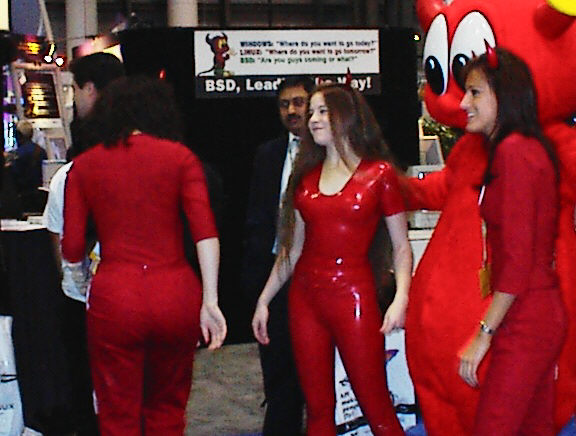
Is it any wonder people think Linux users are a bunch of flaming homosexuals when its fronted by obviously gay losers like these?! BSD has a mascot who leaves us in no doubt that this is the OS for real men! If Linux had more hot chicks and gorgeous babes then maybe it would be able to compete with BSD!
Linux is a joke as long as it continues to lack sexy girls like her! I mean just look at this girl! Doesn't she excite you? I know this little hottie puts me in need of a cold shower! This guy looks like he is about to cream his pants standing next to such a fox. As you can see, no man can resist this sexy little minx. I mean are you telling me you wouldn't like to get your hands on this ass?! Linux has nothing that can possibly compete. Come on, you must admit she is better than an overweight penguin or a gay looking goat!
With sexy chicks like the lovely Ceren you could have people queuing up to buy open source products. Could you really refuse to buy a copy of BSD if she told you to? Don't you wish you could get one of these? Personally I know I would give my right arm to get this close to such a divine beauty!
Don't be a fag! Join the campaign for more cute open source babes today! -
Re:For your perusal
Wow, that sounds just like the GPL (must give back modifications).
You couldn't be more wrong. The GPL does not require you to release your modified version.Repeat 20 times for good measure.
your modifications are your own (how will MS know about them)
No, they aren't. That's exactly the point. Even if MS doesn't know about them, it's still theirs, by the letter and spirit of that clause. -
Re:Really? Infamous?
In fact, the MS compilers still don't pay much attention to them.
Their most recent compiler (VS.net 2003) is much more standards compliant than you give it credit. Besides compiler limits, there are only five noncompliant aspects of their compiler. Most complaints that people had with the lack of compliance in VisualC++ were fixed in the 2003 release.
GCC 3.3 isn't fully standards compliant either. Reading through the 3.4 changes it looks like they've been working on some of the same issues. C++ in general is a very complicated language. There are very few compilers that implement every aspect of the language. It's generally more important to fix the compiler bugs that affect real code than to implement the aspects of the language that are very rarely encountered. -
Yay!
Finally a morally acceptable alternative to listening to RMS's Free Software Song all day.
-
Re:I love the disclaimer...
There are no warranties for software covered by the GPL either:
THERE IS NO WARRANTY FOR THE PROGRAM, TO THE EXTENT PERMITTED BY APPLICABLE LAW
Can you imagine an auto manufacturer taking responsibility if you blow out a tire on one of the cars they made? No.
So why should software be any different? The claims above (uninterrupted service, etc) could very easily be caused by network conjestion, or even something as stupid as the network plug falling out the back of the computer. A reasonably good effort is all that they can do - because it would be prohibitively expensive to make, test, deploy and use otherwise. Software would be a lot more reliable if the user had to go through a 30-point checklist before they were allowed to touch their computer (as they often do with critical applications - medical equipment, space navigation, powerplants, etc), but that would just be stupid and unusable for consumers.
I don't like RealPlayer either, but you don't have to buy their software if you don't want to. -
OSS does not address many business needsBusiness has a lots of needs that OSS does not address. In part, this is probably because business coding is the most mind-numbing coding one can do, so volunteers don't take them on often. GNU Enterprise may eventually help here, but it's going to take a long time, and bringing the necessary expertise to the table will be difficult (if the gnue project even realizes it needs this expertise).
What sort of needs does a big business have? Well, they all need to manage human resources. Most need to track items in their warehouses and perhaps training for their employees. The industrial sector will have many additional needs to track equipment, schedule resources, control work authorizations, and safely take equipment in and out of service. Running an enterprise call system also takes more than a PHP app.
There are dozens of other highly generic needs that I haven't mentioned, but all take extensive effort to set up, customize, and integrate into a business environment. And these things are *mission critical*: millions of dollars can ride on the availability of the software. Open source can eventually get here, but it will have to (first) be written, (second) creep up through small business, and (third) be vetted and pushed by consultants who can make money from long-standing service contracts.
I'm not trying to be pessimistic about open source, but there are many unmet needs here. Don't expect to run a serious business without proprietary software. In fact, be as objective as possible when evaluating software needs for your business... pretend that you have to defend every decision in front of someone who doesn't care about the distiction b/t free and non-free software. Someone who only thinks in terms of money, growth potiential, implementation schedules, and risk. If OSS can't stand its ground here (even with the price advantage), drop it. Don't jeporadize your business, and (if you're working for someone else) don't give your boss a bad taste of what OSS is all about.
Stallman--as much as I support the guy--completely misses the real world when he says that "any business based on proprietary software deserves to fail". Deserving or not, any medium or large business that is not based on proprietary software will fail.
I hope open source can one day address these needs, especially for small businesses and start-ups, but I'm not too worried even if it can't. If Linux becomes good enough in other aspects, these proprietary apps will be made to run on Linux too (and some of them already do). "Mostly" free is good enough for me.
-
Re:Try a Mix
Your opinion comes from a demonstrably spurious source.
MySQL and ReiserFS are both made available under the terms of the GNU General Public License.
The GPL allows people to do absolutely whatever they want with software obtained under it, including using it to run their business in a commercial environment. The GPL does not allow one to distribute the product which was obtained through the GPL in a non-GPLed product, or to distribute products which contain GPLed products under a non-GPL license.
MySQL AB and Hans Reiser make their money by offering alternative commercial licenses which will allow you to distribute the work you derive from their work under a non-GPL license. This only means you have to pay them if you want to release software which links to the code they wrote
-
Do you want free software?
Perl.
Roxen WebServer (very intuitive, and GPL!).
Phew!! And that's a short list!! There are hundreds and hundreds and hundreds of open source, free-for-all applications.... so many it's almost absurd not to use them!! Go ahead and get them!
-
Re:not enough
Not all implementations depend on Sun. Check out Classpath. Granted, there's a lot of work to be done on it, and it's nowhere near production-ready, but my hat's off to them.
-
"Illicit copying is theft" get its comeuppance.
Of course, those who pay attention to the FSF will not find this to be news. The FSF has discussed this misframing of the debate for some time now:
Copyright apologists often use words like ``stolen'' and ``theft'' to describe copyright infringement. At the same time, they ask us to treat the legal system as an authority on ethics: if copying is forbidden, it must be wrong.
So it is pertinent to mention that the legal system--at least in the US--rejects the idea that copyright infringement is ``theft.'' Copyright apologists are making an appeal to authority...and misrepresenting what the authority says.
The idea that laws decide what is right or wrong is mistaken in general. Laws are, at their best, an attempt to achieve justice; to say that laws define justice or ethical conduct is turning things upside down.
RMS has also been clear about this issue in his talks. He also takes on the misframing of the issue in the phrase "intellectual property", giving credit to GNU when discussing the variant of the GNU OS featuring the Linux kernal, saying "commercial" software to refer to non-free software, and distinguishing between the open source and free software movements.
-
"Illicit copying is theft" get its comeuppance.
Of course, those who pay attention to the FSF will not find this to be news. The FSF has discussed this misframing of the debate for some time now:
Copyright apologists often use words like ``stolen'' and ``theft'' to describe copyright infringement. At the same time, they ask us to treat the legal system as an authority on ethics: if copying is forbidden, it must be wrong.
So it is pertinent to mention that the legal system--at least in the US--rejects the idea that copyright infringement is ``theft.'' Copyright apologists are making an appeal to authority...and misrepresenting what the authority says.
The idea that laws decide what is right or wrong is mistaken in general. Laws are, at their best, an attempt to achieve justice; to say that laws define justice or ethical conduct is turning things upside down.
RMS has also been clear about this issue in his talks. He also takes on the misframing of the issue in the phrase "intellectual property", giving credit to GNU when discussing the variant of the GNU OS featuring the Linux kernal, saying "commercial" software to refer to non-free software, and distinguishing between the open source and free software movements.
-
"Illicit copying is theft" get its comeuppance.
Of course, those who pay attention to the FSF will not find this to be news. The FSF has discussed this misframing of the debate for some time now:
Copyright apologists often use words like ``stolen'' and ``theft'' to describe copyright infringement. At the same time, they ask us to treat the legal system as an authority on ethics: if copying is forbidden, it must be wrong.
So it is pertinent to mention that the legal system--at least in the US--rejects the idea that copyright infringement is ``theft.'' Copyright apologists are making an appeal to authority...and misrepresenting what the authority says.
The idea that laws decide what is right or wrong is mistaken in general. Laws are, at their best, an attempt to achieve justice; to say that laws define justice or ethical conduct is turning things upside down.
RMS has also been clear about this issue in his talks. He also takes on the misframing of the issue in the phrase "intellectual property", giving credit to GNU when discussing the variant of the GNU OS featuring the Linux kernal, saying "commercial" software to refer to non-free software, and distinguishing between the open source and free software movements.
-
Re:Great for SSH
Bogus argument. SSH is large, but its functionality is well received. If you're looking for a small, simple encrypted remote login client-server, look into SSL(and SASL) enabled telnet. netkit ships with SSL support now. ftp://ftp.uk.linux.org/pub/linux/Networking/netki
t . (The netkit README does not suggest running telnetd, however. Take it as you will.) The FSF also has a telnet daemon under the GNU inetutils project. I don't see SSL encryption, but I do see kerberos. -
Re:Great for SSH
Bogus argument. SSH is large, but its functionality is well received. If you're looking for a small, simple encrypted remote login client-server, look into SSL(and SASL) enabled telnet. netkit ships with SSL support now. ftp://ftp.uk.linux.org/pub/linux/Networking/netki
t . (The netkit README does not suggest running telnetd, however. Take it as you will.) The FSF also has a telnet daemon under the GNU inetutils project. I don't see SSL encryption, but I do see kerberos. -
Re:spybot
if you're running windows, you have already lost. usloth is a marketing company; their products are spyware. this may be unpleasant to acknowledge, so forget about the names of things, and categories, etc. look at the behvior: software running outside your purview that transmits arbitrary personal information to someone else.
if you are willing to accept this behavior, that's fine. but if not, install free software and, once you have regained your dignity, help others do the same.
-
No, feat. are not only on the lang. ! The truth :
But also on the platform.
Do not forget that Java (the name) is used for 2 things : The Java platform, and the Java language.
By default, you application for the Java platform using Java language itself (like you defacto develop in C# for MS.net), but there are lots of differents language that can compile to java's bytecode as well.
IMHO, the strength of Java is the platform and not the language. Without the platform concept, it would never have been different from his ancestors C++/SmallTalk/ObjectiveC ! There is the big difference with
MS.net only run on some MS windows OS (No Mono is not&will not be a complete and real
This is no b*illsh*it but just truth.
If you want to contribute to Java libre world then i invite you to join the FSFGNU Classpath project, as they are building a full GPL implementation of the Java platform!
This can exist because all Java spec (JSR+TCK) are available to the public (including Reference Implementation) so even if the RI is not GPL, you can just create a new implementation that apply whatever license you want. That's how Java managed to balance freedom & compatibility
Linux+Java is the baregain for enterprise solution, and with Java 1.5 and Linux 2.6 functionality & TCO are there ! Here we got the reference platform for developement of the next decade. -
There is hope here!
My friends, I know we all want Open Source to succeed. However, it has come to my attention that the amount of attention being lavished on Linux by the community at the expense of BSD ignores one key advantage that the vernerable OS from Berkeley has over everyone's favourite from Finland.
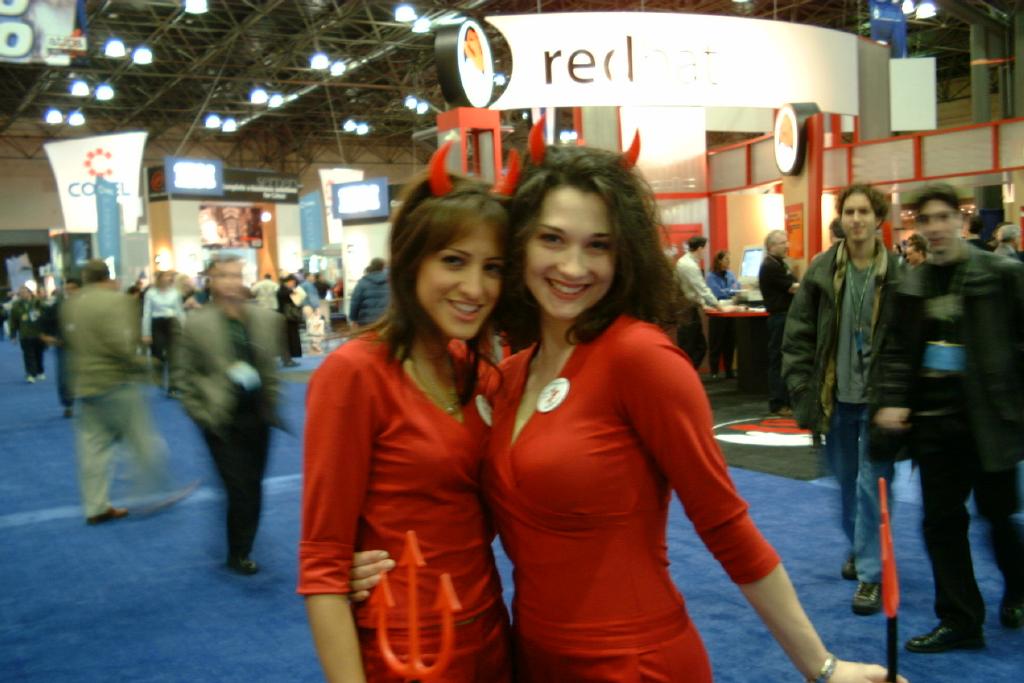
How can people say BSD is dying when it has a mascot like this?! Linux needs to get its act together if it's going to compete with the kind of hot chicks and gorgeous babes that BSD has to offer!
How can you take Linux seriously when its fronted by losers like these?! Would you buy software from them? Would you even walk on the same side of the street as them?! I don't think so! You Linux groupies need to find some sexy girls like her! I mean just look at this girl! Doesn't she excite you? I know this little hottie puts me in need of a cold shower! This guy looks like he is about to cream his pants standing next to such a fox. As you can see, no man can resist this sexy little minx. I mean are you telling me you wouldn't like to get your hands on this ass?!
With sexy chicks like the lovely Ceren you could have people queuing up to buy open source products. Could you really refuse to buy a copy of BSD if she told you to? Come on, you must admit she is better than an overweight penguin or a gay looking goat! Don't you wish you could get one of these? Personally I know I would give my right arm to get this close to such a divine beauty!
Join the campaign for more cute open source babes today! -
Re:changes to KHTML?
Please read the license text, it is much more enlightening than flame wars. It states in 2.c that " You must cause the whole of the work to be licensed at no charge to all third parties under the terms of this License." This means that you may in fact take the source which is published under LGPL and change it, even take charges for it, but it will always be LGPL, thus open source. At least I understand it this way. The license is an interesting read, since the consider it "lesser" to their original license, the GPL.
-
But only BSD has super-babes!
You just can't take Linux seriously when its fronted by losers like these. Would you buy software from them? I don't think so! You Linux groupies need to find some sexy girls like her! I mean just look at this girl! Doesn't she excite you? I know this little hottie puts me in need of a cold shower! This guy looks like he is about to cream his pants standing next to such a fox. As you can see, no man can resist this sexy little minx. I mean are you telling me you wouldn't like to get your hands on this ass?!
With sexy chicks like the lovely Ceren you could have people queuing up to buy open source products. Could you really refuse to buy a copy of BSD if she told you to? Come on, you must admit she is better than an overweight penguin or a gay looking goat! Don't you wish you could get one of these? Personally I know I would give my right arm to get this close to such a divine beauty!
Join the campaign for more cute open source babes today! -
Re:Taxes on Internet purchases
I frequently find NEW books that I want selling at or below the price that Powell's is selling their *used* copies for.
Their prices are not always the best on common books. For rare/out-of-print ones, they're pretty good. (I've always found better deals on out-of-print martial arts and Asian bodywork there than at any other on-line bookseller.) And Powells is not, to my knowledge, evil like Amazon.
-
Is Ceren invited?
You just can't take Linux seriously when its fronted by losers like these. Would you buy software from them? I don't think so! You Linux groupies need to find some sexy girls like her! I mean just look at this girl! Doesn't she excite you? I know this little hottie puts me in need of a cold shower! This guy looks like he is about to cream his pants standing next to such a fox. As you can see, no man can resist this sexy little minx. I mean are you telling me you wouldn't like to get your hands on this ass?!
With sexy chicks like the lovely Ceren you could have people queuing up to buy open source products. Could you really refuse to buy a copy of BSD if she told you to? Come on, you must admit she is better than an overweight penguin or a gay looking goat! Don't you wish you could get one of these? Personally I know I would give my right arm to get this close to such a divine beauty!
Join the campaign for more cute open source babes today! -
Re:Where is the open source?
-
Copyleft is what ensures and preserves freedom.
You're confusing Open Source with Free Software. Free Software licenses protects the code from being "stolen" and used in a non-Free product. Open Source licenses merely let users who have the source do what they will with it (with varying restrictions).
I appreciate that you're trying to distinguish between the two movements, as this is apparently very necessary (even for Slashdot readers). But what you're saying just isn't true.
The Open Source Initiative (OSI) has approved of the GNU General Public License (GPL). That is to say, the definition of "open source" was written sufficiently broadly as to allow the GPL to qualify. Of course, the GPL was written by the Free Software Foundatiy on well before the OSI began. The Free Software Foundation wrote the GPL for their own benefit and reading only the preface makes it clear which movement's philosophy are being described (hint: not the open source movement's philosophy). Thus, the distinction you're making is not accurate.
-
Copyleft is what ensures and preserves freedom.
You're confusing Open Source with Free Software. Free Software licenses protects the code from being "stolen" and used in a non-Free product. Open Source licenses merely let users who have the source do what they will with it (with varying restrictions).
I appreciate that you're trying to distinguish between the two movements, as this is apparently very necessary (even for Slashdot readers). But what you're saying just isn't true.
The Open Source Initiative (OSI) has approved of the GNU General Public License (GPL). That is to say, the definition of "open source" was written sufficiently broadly as to allow the GPL to qualify. Of course, the GPL was written by the Free Software Foundatiy on well before the OSI began. The Free Software Foundation wrote the GPL for their own benefit and reading only the preface makes it clear which movement's philosophy are being described (hint: not the open source movement's philosophy). Thus, the distinction you're making is not accurate.
-
Open Source
``I thought that the whole point of open source is so nobody can take the software, change it, and then sell it as their own.''
You're confusing things. Open source means that you _can_ modifiy the software, and sell it. (See the open source definition.)
Depending on the license, you can even redistribute software without the source code. The MIT license and BSD license, for example, allow you to do pretty much anything you want with the code, as long as you retain the copyright license.
Copyleft is the requirement that software is free, and remains free. This is what is expressed in the GPL. This is also known as the GPL's "viral nature", because it requires derived works to be released under GPL if they are redistributed. -
Open Source
``I thought that the whole point of open source is so nobody can take the software, change it, and then sell it as their own.''
You're confusing things. Open source means that you _can_ modifiy the software, and sell it. (See the open source definition.)
Depending on the license, you can even redistribute software without the source code. The MIT license and BSD license, for example, allow you to do pretty much anything you want with the code, as long as you retain the copyright license.
Copyleft is the requirement that software is free, and remains free. This is what is expressed in the GPL. This is also known as the GPL's "viral nature", because it requires derived works to be released under GPL if they are redistributed. -
To hell with those spammers
Chessbrain is kind of a cool hack, and I would respect that, if they weren't filthy spammers. Here is a typical Chessbrain spam. Notice the spam body image is hosted off of chessbrain.net. (Filthy, filthy, incompetant, spammers.
-
you seem to be missing the point.
since programmers are ~ 1% of total market, u will get ~ 1% total dollars
They're not in it for the money. KDE is Free Software. Among many, many other things, it means you can get it free of charge. KDE is made for everyone, not just coders. The thing is, it's in active development... new features being constantly added, bugs being constantly fixed. KDE is not the type of organization to rush a half-assed product with, say, 40,000+ known bugs to market. And yes, they know they're going against the grain of the big moneymakers. Their aim is to make good software, not money. And they know it's not perfect yet, so don't be a dick about it. You want features, tell them about it. They like new ideas, and you may actually have some decent ones (even if you have a hard time spelling them). -
You misunderstand RMS' views and history.
Enter RMS. Who advocates giving US IP to everyone who wants it. An event that would sink this country forever.
RMS has never "advocate[d] giving US IP to everyone who wants it". In fact he consistently explains why the term "intellectual property" (which is what you mean by "IP") hurts us and encourages muddled thinking. He has also said as much in his talks. If you have citations to the contrary, I'd like to read them or hear them.
As for "sinking this country forever", it's ironic that initially this country began its copyright policy by not honoring foreign copyright (much to some British authors' dislike, like Dickens) and with a far shorter term of copyright than we have today (without which, it's reasonable to estimate, some authors, including Mark Twain, wouldn't have written as much as they did). But again, RMS gives us some valuable insight on copyright policy.
It's also ironic that you get so much about RMS' views wrong and that he has already rebutted much of what you have to say.
-
You misunderstand RMS' views and history.
Enter RMS. Who advocates giving US IP to everyone who wants it. An event that would sink this country forever.
RMS has never "advocate[d] giving US IP to everyone who wants it". In fact he consistently explains why the term "intellectual property" (which is what you mean by "IP") hurts us and encourages muddled thinking. He has also said as much in his talks. If you have citations to the contrary, I'd like to read them or hear them.
As for "sinking this country forever", it's ironic that initially this country began its copyright policy by not honoring foreign copyright (much to some British authors' dislike, like Dickens) and with a far shorter term of copyright than we have today (without which, it's reasonable to estimate, some authors, including Mark Twain, wouldn't have written as much as they did). But again, RMS gives us some valuable insight on copyright policy.
It's also ironic that you get so much about RMS' views wrong and that he has already rebutted much of what you have to say.
-
It begins with being uninformed on what RMS says.
Lots of people on Slashdot who criticize RMS make the mistake of describing their critique such that it's clear they did not read or hear RMS' views. Then people who have read and heard him cite his words to correct the erroneous restatement. I play RMS' talks on the radio on my community radio station (Digital Citizen, alternate Wednesdays 8-10p WEFT 90.1 FM in Champaign, Illinois) and run-of-the-mill radio listeners do respond favorably to what he has to say. They call me on and off-air and tell me so (I just started taking on-air callers and will do more of this in the future). I'm hoping we'll get the equipment and mirroring to do webcasting soon because we have a number of programs of interest to a wide audience, not just my free software/copyright law/patent law public affairs show.
One of the things people most often misstate is the difference between the open source and free software movements. The FSF essay on this issue is excellent and widely underread. I think RMS gets a profoundly unfair shake on this and other websites.
-
Richard Stallman is not an Opensource advocate
He is a Free Software advocate.
Everyone seems to be inaccurate about what exactly Stallman's visit came to advocate. Human lives are saved and lost on literal accuracy - please attempt to be accurate. -
I've got ground for copyright infingement
In addition, it's not a zero sum game, so if I "steal" some of your GPL'd code, you still have it, so you have no grounds to bitch about me making it proprietary.
If a developer were to "steal"
Regardless you are correct the price of the GPL license is high, intentionally (Gnu Manifesto) -
Re:Excellent timing.
Just correcting, RMS does Free Software, not Open Source. There are some serious differences between these two movements.
-
Like Cisco said...
It's none of their business to decide who can use their stuff and who can't. If this were allowed wouldn't we have companies deciding not to sell their goods and services to homosexuals and black people?
I don't think it's right what the Chinese government is doing but I also don't think it's right to pick and choose who to sell to. I mean if they didn't buy Microsoft they'd download something better and it would make life even harder for those poor Chinese. -
Re:Gnome - vi
Wow, you're right - awesome!
-
Yes the FSF does require assignment
You're right - the GPL does not require any kind of copyright assignment, but I never said it did. I said the FSF requires copyright assignment on contributions to GNU projects. Let me say that again: "GNU projects", not "GPL-licensed software" - there's a big difference. For example, GCC is a GNU project, and the Contributing to GCC page says:
Before we can incorporate significant contributions, certain legal requirements must be met.
The FSF prefers that a contributor files a copyright assignment for large contributions. See some documentation by the FSF for details and contact us (either via the gcc@gcc.gnu.org list or the GCC maintainer that is taking care of your contributions) to obtain the relevant forms. It's a good idea to send assignments@gnu.org a copy of your request.
If a contributor is reluctant to sign a copyright assignment for a large change, a disclaimer is acceptable as well. However, a copyright assignment is more convenient if a contributor plans to make several separate contributions.
Small changes can be accepted without a copyright disclaimer or a copyright assignment on file.
And it's not just the GCC project. Check out http://www.gnu.org/prep/maintain_5.html#SEC5, where the FSF's "Information For Maintainers of GNU Software" explains the mechanics of copyright on GNU projects.
-
Yes the FSF does require assignment
You're right - the GPL does not require any kind of copyright assignment, but I never said it did. I said the FSF requires copyright assignment on contributions to GNU projects. Let me say that again: "GNU projects", not "GPL-licensed software" - there's a big difference. For example, GCC is a GNU project, and the Contributing to GCC page says:
Before we can incorporate significant contributions, certain legal requirements must be met.
The FSF prefers that a contributor files a copyright assignment for large contributions. See some documentation by the FSF for details and contact us (either via the gcc@gcc.gnu.org list or the GCC maintainer that is taking care of your contributions) to obtain the relevant forms. It's a good idea to send assignments@gnu.org a copy of your request.
If a contributor is reluctant to sign a copyright assignment for a large change, a disclaimer is acceptable as well. However, a copyright assignment is more convenient if a contributor plans to make several separate contributions.
Small changes can be accepted without a copyright disclaimer or a copyright assignment on file.
And it's not just the GCC project. Check out http://www.gnu.org/prep/maintain_5.html#SEC5, where the FSF's "Information For Maintainers of GNU Software" explains the mechanics of copyright on GNU projects.
-
Re:The FSF does not require that!
The requirement is not part of the GPL, and other authors are free to decide their own policy, but in projects administered by the FSF, they do ask that you either assign copyright to them or disclaim all rights over your code (effectively making it public domain) so that the FSF has clear ownership of the code it is distributing.
-
The FSF does not require that!
Here is a link to the GPL in html format. Find me where it says you are REQUIRED to assign to the FSF your copyright.
In reality, you keep the copyright and have every right to distribute your work under another license - even a commercial/proprietary/closed-source one. But you can't take back all the copies you gave out under the GPL, nor deny the rights of those who accepted those copies.
After all, your own master copy isn't under the GPL, it's not licensed to you at all - it's just yours! You can distribute it under any license you want.
Show me where the FSF says otherwise! -
Re:Where will Groklaw head...
You do realise the Free Software world has been around a hell of a lot longer than when Linux got popular in the late 90s, don't you?
Yes, I do. However, back then it had no enemies of the size of this one. It was a small world, by hackers, for hackers ("Join us now..."). Now we are seeing a big world, where our aunts and uncles are using Free software, where IBM is running commercials on linux, and where Microsoft is realizing where it's biggest threat of this decade resides (hopefully, it's _last_ threat