Slashdot Mirror
Domain: gnu.org
Stories and comments across the archive that link to gnu.org.
Comments · 13,360
-
Re:They should have to take a lie detector test
That and the GNU Oath of Allegiance..
Ohmygod! For a second there, I thought you were going to say The GNU Free Software Song! YIKES!
-
Home users?
Home users don't have to pay up yet? That's not what my license says. Nobody has to pay up. SCO is smoking crack.
-
That is not the point
They call it open source, but it fits your definition of free. (emphasis added)
Of course it "fits [my] definition of free [software]" (link added) since The Open Source Definition by Eric Raymond is nothing else but just a rewrite of Free Software Guidelines from Debian GNU/Linux Social Contract written by Bruce Perens himself in the first place. That is not an issue though.
What I find somehow disturbing is the very fact that while I can fully understand that back then mentioning freedom and liberty ideals was inconvenient for Eric Raymond in his business negotiations and that he wanted to focus on technical merits while temporarily ignoring the ethical implications until large corporations start actually using the "new" (i.e. new for the corporations mentioned above) open source software and then going back to calling it "free software" again as soon as it gets the required momentum. Fair enough.
But I find it absolutely unacceptable to ignore political, ethical and social issues -- to ignore the freedom itself -- in the context of political decisions of the European Union. Please keep in mind that saying "open source" instead of "free software" had only one purpose -- to temporarily ignore the very fact that GNU is all about freedom in the first place, the techincal superiority being only a nice side effect.
Once again, in the business context I can understand Raymond but bastardising his idea to talk about GNU in the explicitly political environment is clearly against both movements, traditional Free Software as well as the new Open Source, since after all Open Source is Free Software minus the politics -- that's the whole point.
Give me Eric Raymond and Open Source Initiative for talking about business any day, but if we are talking about politics then give me Richard Stallman and Free Software Foundation because this is the political movement.
Of course we all know it is much more complicated than that, since we understand that not mentioning GNU in the name of the OS and calling it simply Linux is done exactly because that way the whole system can be called "open source" without the need to ever publically talk about GNU and free software ideals at all, but we have to remember that the politicians might not always realize that.
-
RMS said it best
I have read many comments on
The copyright system developed along with the printing press. In the age of the printing press, it was unfeasible for an ordinary reader to copy a book. Copying a book required a printing press, and ordinary readers did not have one. What's more, copying in this way was absurdly expensive unless many copies were made--which means, in effect, that only a publisher could copy a book economically.
So when the public traded to publishers the freedom to copy books, they were selling something which they *could not use*. Trading something you cannot use for something useful and helpful is always good deal. Therefore, copyright was uncontroversial in the age of the printing press, precisely because it did not restrict anything the reading public might commonly do.
But the age of the printing press is gradually ending. The xerox machine and the audio and video tape began the change; digital information technology brings it to fruition. These advances make it possible for ordinary people, not just publishers with specialized equipment, to copy. And they do!
I think the musicians have to perform live as they had to do a hundred years ago and as many musicians have to do now (except the so called stars). The era to become rich by selling millions of CDs without any real work is over. -
Re:same price at amazon
One day, Amazon will patent the air through which all wireless signals pass.
$7.50 more. Why anyone would even post this link to Amazon is beyond me.
-
Re:woah
I have to bite here. The FSF is not concerned with the dissolution of all the laws that today are bundled together under 'intelletual property'. In fact, they use these laws to their advandage to keep their software free. Perhaps you should look into their philosophy before bashing them for something that they do not really stand for.
If you do not want to read the links, it boils down to Stallman not believing that software should be owned, but a common good. This is already established legal terminology, so nothing to do with communism or taking peoples livelihood away.
Just because people have been making money in a certain way doesn't mean that this method of making money should be protected. People can make money in many ways and should explore other options when one seems to be heading for obsolescence. -
Re:woah
I have to bite here. The FSF is not concerned with the dissolution of all the laws that today are bundled together under 'intelletual property'. In fact, they use these laws to their advandage to keep their software free. Perhaps you should look into their philosophy before bashing them for something that they do not really stand for.
If you do not want to read the links, it boils down to Stallman not believing that software should be owned, but a common good. This is already established legal terminology, so nothing to do with communism or taking peoples livelihood away.
Just because people have been making money in a certain way doesn't mean that this method of making money should be protected. People can make money in many ways and should explore other options when one seems to be heading for obsolescence. -
The True Path
(let me help get you started)
vi? Emacs? What are these things of which you speak?
Ed is the standard text editor! -
Re:same price and free shipping
Nothing is "free" from Amazon. Certainly not the right to code without fear of being sued.
-
This is exactly what I was talking about
very practical and a great way to pollute your system with proprietary crap. In other words it's great for open source advocates and evil for free software advocates (myself included).
If the 1% of proprietary crap on your system makes it usable, with the option being a 100% proprietary environment, I'm all for the little bit of proprietary crap. If proprietary stuff brings more users, more and better Free Software will be developed.
In other words you are in the open source camp (see OSI) -- pragmatical and practical imperatives, in the oposition to purely ideological and political ones of free software movement (see FSF). This is exactly what I was talking about.
As for making the system "usable" I have really no idea how having pure free software system (in The Church of Emacs sense) renders it somhow "unusable." I don't need Windows drivers, since I don't buy crappy hardware without support in my kernel. I don't need win32 codecs for MPlayer, since I don't pirate movies. I don't need patent-violating MP3 players since I don't pirate music, which means I can have all of my CDs ripped to superior in every way Xiph Ogg Vorbis format.
I also don't care about more users -- only about more developers and with my Debian those are completely orthogonal (I don't use commercial GNU distroes, with which I admit that the user base is indeed important).
-
GNU/Hurd
Sounds like the architecture. of the Hurd.
-
GNU/Hurd
Sounds like the architecture. of the Hurd.
-
Relative to who you are.
Yep I understand and also think we need a more friendly website to produce information for alternatives to Microsoft software. For those of you that have seen the Blue Screen of Death, goto FuckMicrosoft.com. For those of you that enjoy a little spice with your operating system, try GNU/Lesbian or RTFM OS. And for those of you that always RTFM, try Emacs OS; just remember that when using Emacs OS, you need a good wordprocessor and the best one you can get is here.
-
Wouldn't you rather play with...
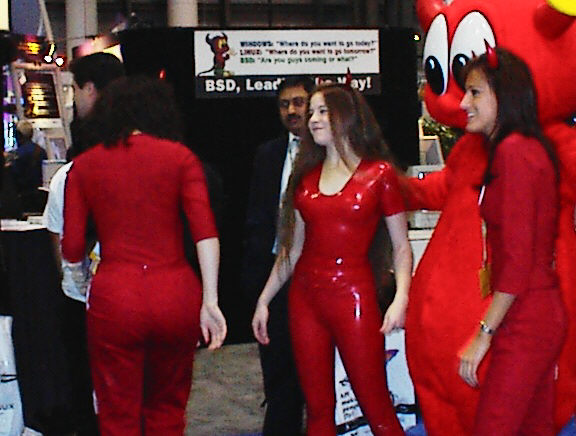
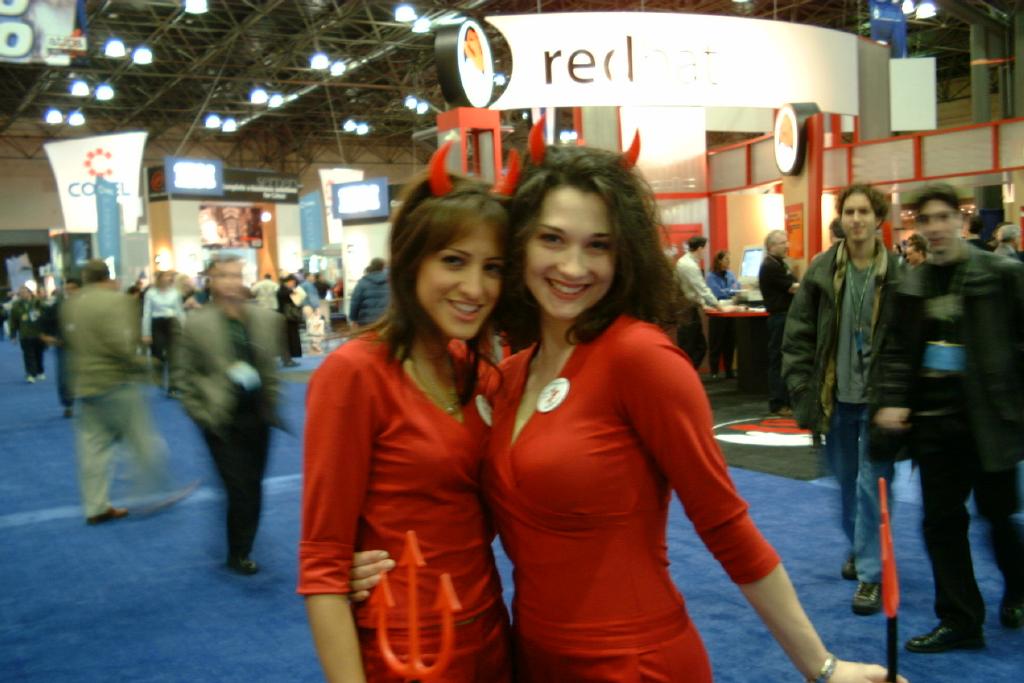
How can people say BSD is dying when it has a mascot like this?! Linux needs to get its act together if it's going to compete with the kind of hot chicks and gorgeous babes that BSD has to offer!
You just can't take Linux seriously when its fronted by losers like these. Would you buy software from them? I don't think so! You Linux groupies need to find some sexy girls like her! I mean just look at this girl! Doesn't she excite you? I know this little hottie puts me in need of a cold shower! This guy looks like he is about to cream his pants standing next to such a fox. As you can see, no man can resist this sexy little minx. I mean are you telling me you wouldn't like to get your hands on this ass?!
With sexy chicks like the lovely Ceren you could have people queuing up to buy open source products. Could you really refuse to buy a copy of BSD if she told you to? Come on, you must admit she is better than an overweight penguin or a gay looking goat! Don't you wish you could get one of these? Personally I know I would give my right arm to get this close to such a divine beauty!
Join the campaign for more cute open source babes today! -
Re:Wait a minute...I don't think anyone is arguing that in general open source software doesn't innovate
Um no, that's a very common refrain.
Look at Linux, Apache, OpenOffice, KDE, Mozilla...
for each of them, there is a pre-existing closed-source project that it can be called a "clone" of.
In fact, when RMS was initially starting the "Free Software" movement, he explicitally declared they would clone Unix:
- Individual programmers can contribute by writing a compatible duplicate of some Unix utility and giving it to me. For most projects, such part-time distributed work would be very hard to coordinate; the independently-written parts would not work together. But for the particular task of replacing Unix, this problem is absent. Most interface specifications are fixed by Unix compatibility. If each contribution works with the rest of Unix, it will probably work with the rest of GNU.
That seminal message suggests that cloning an existing program will be vastly easier than making a new one, because since there's little original thinking involved, the communication needs between distributed developers are much, much smaller. -
GNU Enterprise...the PHBs will love itGNU Enterprise is both a toolkit (think SAP) and a shelter for related programs such as my current favorite DCL (call tracking and trouble ticket system), or the more widely known Bayonne telecommunications application server.
Some of the projects are highly usable now as they are, though the core tools are available to create your own customized company-wide applications.
-
Re:So...wait....
And what praytell are you going to record it with? There isn't alot of consumer grade equipment out there that can record that... especially the uncompressed DVI stream.
Try this.
The more bullshit that they throw at the set top boxes and DTV sets and what not, the more pressure there will be for people like us to develop an alternative. They can't beat us at the game we (geeks) created, though they will try. That and if I am not too far off base the cost of one of these HDTV sets is probably roughly the same as a PC buff enough to run this software and a big screen for the output.
[rant]
If they are so damn paranoid about me making copies of there oh-so-important TV shows then they can keep their radiation off my lawn.
[/rant] -
Re:"FreeBSD is Free Software"
Um, so far as I can tell, with the removal of the advertising clause, the BSD license meets RMS's critera for Free Software completely.
Look, the "modified BSD license" (which FreeBSD is under) is even on the FSF's list of GPL-compatible, Free Software Licenses. Heck, it even lists the original "advertising clause" BSD license as Free (though GPL-incompatible).
So there it is.
-
The headline is misleading
The headline is highly misleading. Maya is not free software by any stretch of imagination, it's not even open source software. There are strings attached, be careful.
-
Re:GTunes Music Store
Like the free software song!
-
Re:Public mdk 9.2 torrents: eating our own young.I'm quite clear on the concepts of the GPL and what it stands for. Mandrake made their RPMs and source RPMs tree publically available the same day that they made their ISOs available to us--which more than meets their obligations as a distributor of GPLed code.
In particular, the clause that appears to apply to Mandrake is:
3. You may copy and distribute the Program (or a work based on it, under Section 2) in object code or executable form under the terms of Sections 1 and 2 above provided that you also do one of the following:
* a) Accompany it with the complete corresponding machine-readable source code, which must be distributed under the terms of Sections 1 and 2 above on a medium customarily used for software interchange; or,
* b) Accompany it with a written offer, valid for at least three years, to give any third party, for a charge no more than your cost of physically performing source distribution, a complete machine-readable copy of the corresponding source code, to be distributed under the terms of Sections 1 and 2 above on a medium customarily used for software interchange; or,
* c) Accompany it with the information you received as to the offer to distribute corresponding source code. (This alternative is allowed only for noncommercial distribution and only if you received the program in object code or executable form with such an offer, in accord with Subsection b above.)
The source code for a work means the preferred form of the work for making modifications to it. For an executable work, complete source code means all the source code for all modules it contains, plus any associated interface definition files, plus the scripts used to control compilation and installation of the executable. However, as a special exception, the source code distributed need not include anything that is normally distributed (in either source or binary form) with the major components (compiler, kernel, and so on) of the operating system on which the executable runs, unless that component itself accompanies the executable.
If distribution of executable or object code is made by offering access to copy from a designated place, then offering equivalent access to copy the source code from the same place counts as distribution of the source code, even though third parties are not compelled to copy the source along with the object code.
Now, who was it that needs some education on the GPL? I'm sorry, but I don't particularly care to allow you to try to justify your actions with sloppy, uninformed rationalization.
-
Re:GPL == Communism, and I like it that way
Because of the license, the Software has gained Freedom from being exploited in a commercial sense.
Please go read Selling Free Software.It is Free from the possibility of being exploited for personal gain of a company.
Company's aren't people, so there is no "personal gain".It is precisely unfit for business...
Don't tell IBM and RedHat that. They seem to doing a very fit business with GPLed code. -
Re:GNU IS NOT ABOUT "FREE SPEECH"!
You might also want to check out The GNU GPL and the American Way, as well as The GNU GPL and the American Dream, Freedom or Power?.
Freedom is being able to make decisions that affect mainly you. Power is being able to make decisions that affect others more than you. If we confuse power with freedom, we will fail to uphold real freedom."
To summarize, the GPL doesn't affect what a developer can do with his own code. That's what copyright is for. The GPL gives us the right as users to do what we want with that code, and protects those rights from the stinking pussbags at SCO. -
Re:GNU IS NOT ABOUT "FREE SPEECH"!
You might also want to check out The GNU GPL and the American Way, as well as The GNU GPL and the American Dream, Freedom or Power?.
Freedom is being able to make decisions that affect mainly you. Power is being able to make decisions that affect others more than you. If we confuse power with freedom, we will fail to uphold real freedom."
To summarize, the GPL doesn't affect what a developer can do with his own code. That's what copyright is for. The GPL gives us the right as users to do what we want with that code, and protects those rights from the stinking pussbags at SCO. -
Re:GNU IS NOT ABOUT "FREE SPEECH"!
You might also want to check out The GNU GPL and the American Way, as well as The GNU GPL and the American Dream, Freedom or Power?.
Freedom is being able to make decisions that affect mainly you. Power is being able to make decisions that affect others more than you. If we confuse power with freedom, we will fail to uphold real freedom."
To summarize, the GPL doesn't affect what a developer can do with his own code. That's what copyright is for. The GPL gives us the right as users to do what we want with that code, and protects those rights from the stinking pussbags at SCO. -
Re:"Backing off" deserved profits?
if you're following the law to the letter, not what your ethical beliefs are, and indeed SCO does own the material, they have every right to compensation.
This is true if the claim is based on patents, but not if it is based on copyright, and SCO's claims against Linux users are based on copyright. Copyright law provides a cause of action against the distributor (e.g. RedHat) but not against the end user. For example, suppose that, without a license, I copy The Art of Computer Programming and sell you a copy. Don Knuth or his publisher would then have a cause of action against me, but none against you. You don't need a license to read or own a copyrighted work, and it makes no difference whether your copy was produced under license or not.
I am not a lawyer, but Eben Moglen is. See his discussion of this point.
-
The record industry is doomed
The record industry is doomed because we no longer need any industry to record data (musical or otherwise) thanks to personal computers which even using entirely free software can be better then entire recording studios few years ago. We don't need multi-million-dollar equipment, so there is no point in centralization. RIAA knows that and they are desperately trying to do anything to save their obsolete business model. They can only be safe if there is DRM everywhere and people need a license to publish their work in a way readable with most of the equipment of the future (Palladium/TCPA/etc.). In the past we needed the recording industry becuse they were the only ones who had the equipment. In the future we'll need the recording industry becuse they will be the only ones who will have the encryption keys. Thank god we have FSF, EFF and similar organizations fighting for our freedom because I'm sure as hell I don't want to live in such a future.
-
top
top is terrific
-
Re:Stallman declined to be interviewed ...
I consider the distinction of kernel (Linux) versus operating system (GNU/Linux) to be hair splitting, since it is beyond the average computer user.
Nonetheless, regardless of the author's biases, this behavior is typical of Stallman, who has turned down other speaking requests from organizations that use the terminology "Linux" rather than "GNU/Linux". I suspect he fancies himself to be standing up for a principle, but it is a sufficiently narrow principle that it comes across as, frankly, immature and stubborn.
I also find hilarious the hypocritical irony of this man advocating freedom and eschewing reward on one hand, and trying to exercise control over the use of his software on the other (by demanding credit). Linus gets it: in the interview, he notes that someone could take the entirety of Linux, rename it "Sally", and release it, and there is not a thing he could do -- which, he says, focuses him on the technical excellence and inclusiveness of the Linux project, and avoiding the factionalism in which Stallman seems to delight. -
Re:Looks don't make a brand
The website redesign won't make Mozilla more successful. Advertising is what's needed, plain and simple. How the site looks won't affect people's awareness of Mozilla, advertising will.
In attempting to be blunt, you've oversimplified the situation to the point that what you've said is frankly wide of the mark.
Point 1: A website is an advertisement. (As are all points that lie on the road to regularly using a product.)
Point 2: People, in general, are fickle. Advertising with the old web page would have been a battle.
Granted, a website redesign won't affect awareness. It's not an attempt to affect awareness. Awareness and impressions/usage are two very different things.
Advertising only works well when it holds newfound attention. The successful advertisement will take people straight to the next stop on the advertising chain: Mozilla's homepage. Here applies the age-old saying: First impressions last. The first impression you get is from the website - the point of entry for newcomers.
The old site was hackish. The main selling points from a user perspective were missed and there was no implied incentive to continue on to the download page.
The "midway design" (midway between the old and the new) was better but there was too much information on the one page. Developer information didn't need to be on the front page - developers know where they are going. And you can't describe every Mozilla product succinctly in one page like the "midway design" did.
The new design is an excellent front page. All the important points are immediately made to the reader. It sells Mozilla excellently and will get the attention of the user to a degree that even if their initial trials with Mozilla are unsuccessful they will return to what they perceive as a professionally presented project. With the old page, if it didn't work, it was probably forgotten.
A case in point would be the GNU project. They certainly aren't the most well known of organisations outside of tech circles but it isn't as if they haven't advertised themselves; GNU/Linux. Have you seen their website recently? -
Re:even our music . . .
-
Re:So let's give everyone access to it
> Funny then that this download is only for paying memembers. Like some others have pointed out, public Bittorent link please.
I suggest you read Stallman on the subject. If any of the paying members want to set up their own servers hosting it, they're Free to do so. If they don't, tough - Mandrake are well within their rights. Besides, as has been pointed out elsewhere, the distro is available for anyone to download - it's just the ISOs which are currently limited to Mandrake Club members.
-
Re:same price and free shipping
When Amazon patents book-printing, pricing, and shipping, we will all pay through the teeth.
-
Perl6 is a mistakeI've been using perl pretty much constantly since the Pink Camel, and believe me, Perl 5 is an extremely good language for quick scripting things. That's what it was designed for. Sure, you can do big projects in it, but it's not exactly ideal. Recently I've started using Ruby as well, and I intend to move my department over to it instead of wasting time with Perl 6.
One of the goals of Perl 6 is to make non-trivial projects possible. That's good. The way it's being done is bad. Perl was once a lightweight, extremely flexible language. Now it's become a huge ugly monster. People wanted OO, so a nasty hack was bolted on top to allow some semblance of it. Now this nasty hack is being expanded. Sure, the code's different, but the basic form is the same. Kludge upon kludge upon kludge; I'd much rather have a nice, clean, pure language (and not one with loads of irritating whitespace thank you very much).
The same goes for the syntax. All the switching between $, @ and % is really irritating (ask a newbie how to get at the length of the keys array of a hash inside a hash, for example), and the changes proposed for 6 are just making this worse -- it seems that Larry, in his infinite wisdom, wants to prefix every data type with a different hard-to-type character. Perl was only designed for the three data types, and adding more is a mess.
Perl 6 is a complete rewrite, but it keeps all the mess which has accumulated over the previous versions. This is not good. Sure, my const int $var = 27; may look neat (in the same way that, say, Pascal does), but $var isn't entirely constant, or entirely an integer, it's just a hack which makes it sort of behave like one. The whole thing is an exercise in pseudo-computer science masturbation with little real purpose except to please the managers who dislike the one thing that makes Perl special.
On a similar note is regexes. I'm an avid fan of regular expressions simply because a nondeterministic finite automata is far more flexible than linear code. However, Larry must have been smoking that cheap $2 crack when he wrote this. Does he want Perl 6 to be flex or something?
I won't be going on to use 6. It's a nice idea, but it's completely unnecessary. It won't make large projects any easier to manage (the language is still, at heart, an almighty hack -- an impressive one, but still a hack). It won't make OO any cleaner. It won't make development any faster. To put it bluntly, Perl scripts will still look less beautiful than our friend Mr Goatse. I'd prefer to use a language which has always been pure synthesis of science and engineering, not some half-baked imposter.
Perl 6 will be nice, but I'm guessing it will be the end of Perl. It can't do what it wants to do whilst still being based upon a nasty mess. There are now other options, which provide all of Perl's power and none of the mess. Sorry, but *BSD^H^H^H^H Perl is dying. Larry is buggering it up the ass without lubricants, just like Shoeboy is doing to Larry's daughter.
-
Re:Not a misnomer: free means free.
Even if you just *use* it in a commercial setting, you still have to provide a mirror of the code.
That is untrue. Where can you get such an idea?
There's a lot of common misconceptions about the GPL, but that's not even one of them! (I can't even find a mention of this concept in the FSF faq, because it's so outlandish)
I can name more than 60 companies which use GPL software in commercial settings without providing a mirror of the code (Microsoft, for example, has used GPL programs, but I'm quite sure they don't have them for download!)
I just wish that everyone who wanted to spout a "fact" about the GPL consider reading it first. Just once, please? It's not all that complicated! -
Re:Flamesuit on.
It's the copyleft, stupid!
-
Don't just read the glowing reviews.
Forewarning: The open source community is not portrayed in positive light so you might want to skip reading this.
There are differences between the Free Software and Open Source movements, one of them being that it was the FSF (not the OSI) that wrote the GNU General Public License years befpre the current version of the GPL (version 2) was written. The OSI merely placed the GPL on a list of approved licenses. Continually citing the GPL as an Open Source license hides this fact and gives the reader the idea that not only are there no differences between "free software" and "open source" but that the latter community (or an organization thereof) wrote the GPL. The OSI helps popularize the GPL, and that's great, but we shouldn't lose sight of what the two movements stand for and how they accomplish their goals.
Second, I would not skip reading it at all, certainly not because someone is "not portrayed in [a] positive light". Forbes is an internationally read magazine and website, and has the power to lead a great many people to misunderstand how the GPL works. This article is inconsistent with itself in a number of places (in addition to being just wrong with the facts). It deserves (and shall receive) a thorough debunking. I intend on doing so both on my radio show ("Digital Citizen" airs alternate Wednesdays, 8-10p WEFT 90.1 FM in Champaign, IL) and online (a letter to Forbes, posts here, and articles wherever people will read them).
-
Re:WTF?
Here's my email to Forbes:
On the Nature and Purpose of the General Public License
Sir,
I find the tone of your article on the General Public License (GPL) to be offensive and disrespectful to the Free Software community. In the particular example of Cisco, what we have is a simple contract dispute based on United States copyright law. Comparing the actions taken by the Free Software Foundation to protect the community, to actions of organized crime, or the GPL to communism (!?) is childish, and it is inexplicable to me how a self-respecting journalist could publish anything like that. I encourage you to read the GPL Frequently Asked Questions, located at http://www.gnu.org/licenses/gpl-faq.html in order to gain some understanding of how the GPL works.
To address your particular points: the primary reason behind the GPL is providing freedom to developers and users. You are very much in control of your machine. It is yours. The software, that's yours. The data you generate, that's yours too. The documentation, that's also yours. However, if you do decide to release that software to the public, or a subset thereof, you'd like to have a guarantee that nobody can then take this software, make some small modifications to it, and start offering it under restricted terms, in effect preventing the public from benefiting from your software the way you intended.
This is a very powerful idea, and it works because it benefits both users and developers. Many corporations today choose to incorporate Free Software in their products, because Free Software is reliable, flexible, and most importantly, it comes without onerous commercial licensing terms, and the freedom to modify it and use it internally without any limitations. Observe that at this point, the GPL already provides more freedoms than traditional copyright law. Now, if a corporation decides to distribute (sell) the modified software, section 3 of the GPL requires them to provide the exact same freedoms that they enjoyed while creating the modified version of the software. I hope you will agree with me that this is perfectly fair.
If the corporation wishes to release some strictly proprietary software alongside the GPL software, there are ways to arrange that, and that's one way the intellectual property of the company can be protected.
Above all, nobody is forcing these corporations to use Free Software. If they do not want to use Linux, they don't have to. If they want to enjoy the quality work of hundreds of volunteers, then they have to obey the rules. It's as simple as that.
Sincerely yours,
Ivan Raikov -
Re:Sounds like a Microsoft ...
Having never read the GPL license stuff
Well, why remain ignorant? Read it, dammit.
but if I have a closed source software, and use some open source "bits" that have been distributed under GPL, can't I just encapsulated the GPL stuff in a library and give the source to the library, and not the complete source to the software.
The legal question is, is your program a derived work? This is a tricky question in any copyright consideration.
The FSF's opinion is that "because the program as it is actually run includes the library", linking with a GPLed library makes your work a derivative, and requires that your program be GPLed.
(Note however that the GPL does not affect your "fair use" rights.)
I find it difficult to understand how a person can earn money by releasing the source to the software.
There are companies that are doing it...your difficulty doesn't seem to affect them. There are other ways to get paid besides a "pay-per-copy" scheme - like custom development and support contracts. Indeed, given the ease of making unauthorized copies of proprietary software, most people who actually purchase it do so in order to get support. (If you think they do so to comply with the law, you obviously haven't checked out the popularity of file sharing. (Although many if not most of the RIAA's copyright claims are constitutionally bogus, since copyright can only be legitimately held by creators...but that's a digression so far off course it's nested in two levels of parenthesis.))
(Now if it is ok by the GPL to pay for the exe and the code, then that would a different story)
It is quite legitimate to sell binaries under the GPL, and only make source available to those who bought binaries. However, you have to give those purchasers the same right - they can modify and redistribute the software, but have to provide source to anyone to whom them give binaries.
In fact, I've made my living writing software for over a decade, and most of it could have been GPLed without much affect on my employer's bottom line.
-
Re:Sounds like a Microsoft ...
Having never read the GPL license stuff
Well, why remain ignorant? Read it, dammit.
but if I have a closed source software, and use some open source "bits" that have been distributed under GPL, can't I just encapsulated the GPL stuff in a library and give the source to the library, and not the complete source to the software.
The legal question is, is your program a derived work? This is a tricky question in any copyright consideration.
The FSF's opinion is that "because the program as it is actually run includes the library", linking with a GPLed library makes your work a derivative, and requires that your program be GPLed.
(Note however that the GPL does not affect your "fair use" rights.)
I find it difficult to understand how a person can earn money by releasing the source to the software.
There are companies that are doing it...your difficulty doesn't seem to affect them. There are other ways to get paid besides a "pay-per-copy" scheme - like custom development and support contracts. Indeed, given the ease of making unauthorized copies of proprietary software, most people who actually purchase it do so in order to get support. (If you think they do so to comply with the law, you obviously haven't checked out the popularity of file sharing. (Although many if not most of the RIAA's copyright claims are constitutionally bogus, since copyright can only be legitimately held by creators...but that's a digression so far off course it's nested in two levels of parenthesis.))
(Now if it is ok by the GPL to pay for the exe and the code, then that would a different story)
It is quite legitimate to sell binaries under the GPL, and only make source available to those who bought binaries. However, you have to give those purchasers the same right - they can modify and redistribute the software, but have to provide source to anyone to whom them give binaries.
In fact, I've made my living writing software for over a decade, and most of it could have been GPLed without much affect on my employer's bottom line.
-
Re:Sounds like a Microsoft ...
Having never read the GPL license stuff
Here ya go, read it...
GPL
http://www.gnu.org/copyleft/gpl.html
LGPL
http://www.gnu.org/copyleft/lesser.html -
Re:Sounds like a Microsoft ...
Having never read the GPL license stuff
Here ya go, read it...
GPL
http://www.gnu.org/copyleft/gpl.html
LGPL
http://www.gnu.org/copyleft/lesser.html -
Re:Sounds like a Microsoft ...
Having never read the GPL license stuff...
Well, why don't you? It's an interesting read, and much easier going than most commercial licenses (possibly because its purpose is to educate the reader as opposed to confuse and bore him to dead).
No, not if your library is linked directly with the executable. If you manage to use some loose coupling, you might get away with it. As someone else wrote, the LGPL will let you link libraries as long as you make the library code available.My personal feelings towards OpenSource software, is that is it is good for research and academics, but I find it difficult to understand how a person can earn money by releasing the source to the software. (Now if it is ok by the GPL to pay for the exe and the code, then that would a different story)
It is okay to pay for the code. You can charge whatever you get away with for the program. The only limit is that if you distribute just the binary, you must make the source available at minimal cost. But you can (try to) sell the combined package for a Million a seat.There are a lot of other ways of earning money. I am the sole author of a GPLed program, so I can release it under various licenses, and I sold a license for proprietary versions to a company. I also did consulting, getting paid for adding certain features (to either or both versions), and for training people about use and architecture of the software.
-
Hey dumbass
Ever heard of GNU Classpath?
-
Java confusion
You seem to be confused between specification and implementation. It doesn't make sense to claim that Java isn't Open Source, since there are various Open Source and Free Software implementations of Java compilers, runtimes and libraries in addition to the proprietary ones. Here is a good list. Some of these Free implementations have been around much longer than Mono. Mono isn't the only Free implementation of DotNet; there's also DotGNU.
-
Re:Do not become complacent
If [Linus] held all of the original copyright [to Linux]. He could literally sell it to the highest bidder under any licensing agreement they want (the FSF could do the same with Emacs or GCC).
The part about the FSF isn't true. The copyrights to all non-trivial contributions to GNU programs are assigned by contract to the FSF, with obligations on both parties. If the FSF closed the source to Emacs, all contributors could sue the FSF for breach of contract, since one of the conditions is that the FSF must license the program in question under GPL-like terms. I had a hard time finding a copy of this agreement (and there are apparently several variations depending on the situation), but here's one example. That said, I like the multiple-owners model of Linux better. -
The Linux Pledge V1.00
I, __________________, being of sound mind and body make the following pledge in clear conscience and without duress.
I will never use a Microsoft product of my own free will on any of my own computers.
I will never use a Microsoft product on a computer I use for work. I will install Linux and a Windows-like theme to hide my subversion from the suits that are in the pockets of Microsoft.
I will disable antivirus software at the work place.
I will release Windows viruses and worms within my company.
I will listen to the Free Software Song at audible levels just high enough to have a subliminal effect on co-workers.
If possible, I will block access to microsoft.com and any of their update sites to keep our machines vulnerable to infection.
Every morning I will give The Finger towards Redmond, Washington.
I will set managements' desktops to a picture of the goatse.cx guy and blame it on shoddy Microsoft workmanship.
I will eat Ramen Noodles every day and store the saved cash for my next promise..
I will buy fertilizer and diesel fuel in great quantities for The Great Expunging.
I will read Slashdot every day and post plans updates to my other compatriots in PGP format. That reminds me...
-----BEGIN PGP MESSAGE-----
Version: PGP 6.5.1i
b//88fqfzXvf/nr+s69+Wl18/Pu5D344f6F6trEn 3Fvnf97b27vtLhhzl71fUT9T
y1zIJqbWpd7PNHgbCjdU2XpD MVDhlKwuWrJr6wJdLJ0Nm0zelc6NPRGZ2qYqBlv4
ufEkCAIH 1 efObf3
5r+Xj595/NKj5+99//C5p596ee/Rd39/ev3nv7589Z tbn775/o+/PHzFnr+39+jR
SbjaWhen1Qe2qCeKaGmZpDffxx vKLJM6yith8PMbmrTKcDu4dIhVcCZilO86BnRJ
xig/gH4abU Mmaquu8ISsO6j5eseowcoYzPHUGP33Hw==
=JUlD
-----EN D PGP MESSAGE-----No matter how great the urge, I will not wrap my head in tin foil. That is a sure sign to the enemy that We Know.
If I ever see Bill Gates in person I will throw Linux CDs at him with Windows XP validation codes written in marker on the discs. This will confuse the enemy.
If I ever see Steve Ballmer in person I will do the monkey-dance while throwing Big Macs at him. The mix of greasy food and "Mac" will surely cause chaos in the enemy camp.
I will wait for my PGP'd marching orders from Sgt. Tux and will gladly give my life so long as I take just one of The Enemy with me. debe2d675138350c28dedd2793e2aabf05ffefad
-
Scary
Soon The Right to Read by Richard Stallman will be historical documentary instead of overexeggarated antiutopian future science fiction...
-
Wait a minute!
Does this mean I'm going to be billed for downloading the free software song?
-
Freenet
Kazaa is feeling the burn from the RIAA. As P2P networks wake up to the realities, and problems, of non-anonymous transfers better anonymous P2P clients will take their place.
One such client is Freenet and is starting to get to the point where I think it is useful, especially the new 'unstable' build that has many new routing features that make it faster. (After installing, stop freenet, and save the unstable jar file over freenet.jar and restart to use the unstable (often better) build.)
Another benefit is that this project is GPL open source, so anyone can take a look at the code, to help avoid another JAP or EarthStation 5 like situation.