Slashdot Mirror
Domain: gnucash.org
Stories and comments across the archive that link to gnucash.org.
Comments · 203
-
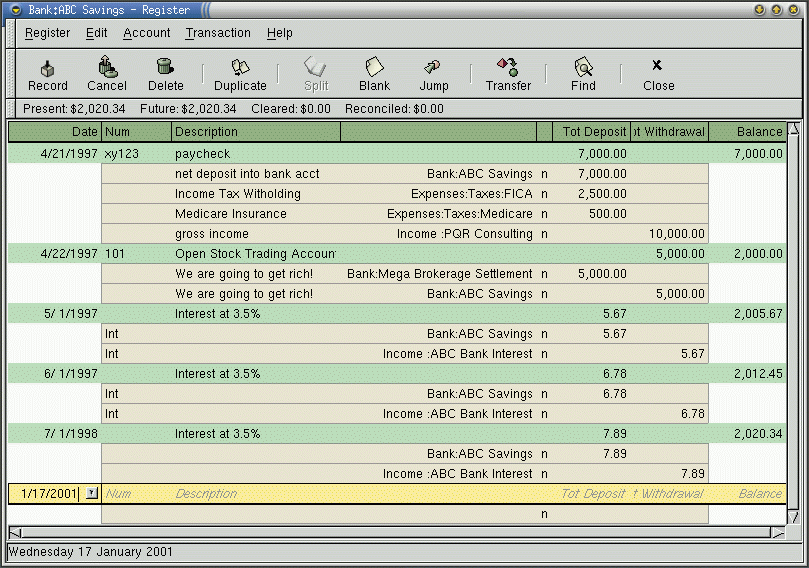
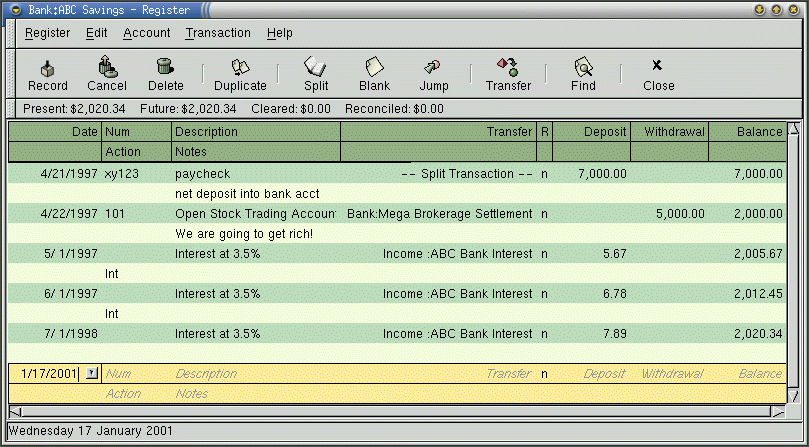
Re:GNUCashI use gnucash, not even the latest version, and I just added a description a transaction. I have used it for more than a year, through several versions, and it has always had that giant blank "description" field sitting right there in the register window.
Have a few screen shots:
http://www.gnucash.org/images/gnome-1.6/savings-j
o urnal.gifhttp://www.gnucash.org/images/gnome-1.6/savings-d
o uble.gifOr am I somehow completely misunderstanding what you mean by "add a description to a transaction" ?
My objections to gnucash are that it requires too many librarys for functions that I never use due to in the integration with gnome, and that it doesn't have a text-only mode of interfacing with it.
-
Re:One hitch
OK - replying to myself here.
The GNUCash website has a big warning about the size and depencies upon it's front page - so I guess this is a known issue.
I spent a while looking around the site, and from the screenshot page I see they're using the word 'Druid' instead of 'Wizard' for lots of things - eg. "QIF Data Import Druid" that's great!
-
Kapital
I asked myself the same question only a few weeks ago. I came to the conclusion that Kapital from theKompany was the best option. You'll probably need KDE and Linux or FreeBSD to run it.
Somewhat ironically, I'm using GnuCash until I can afford to buy it.
Both Kapital and GnuCash claim to be able to import Quicken data files, which is a very handy feature.
Kapital is reviewed here.
Freshmeat also has a brief review that compares many Linux/Unix financial products.
If none of these seems sufficient, maybe Quicken runs under WINE. Has anybody tried doing so?
-
GNUCash
I've heard good things about GNUcash and it seems quite popular.
See GNUCash.org for more info. -
Some software to look into...
If you are looking for cheap, maintainable, stable software to replace your current Windows environment, then look into this :
Slackware Linux.
KDE.
OpenOffice (maybe StarOffice or Hancom Office or KOffice).
Mozilla (or maybe Netscape 6 or Opera).
The GIMP.
XMMS.
MPlayer.
GNUCash (or maybe Kapital).
Evolution.
NEdit.
Or if you need anything else, check out Freshmeat.
-
gcc not the only one
GnuCash does.
-
LindowsOS bundled apps are a choice
As long as the applications that people want to run (office, quicken, etc.) REQUIRE windows to be installed
They want to run office, but do they need to run Microsoft Office® brand office as opposed to OpenOffice.org brand office? They want to run personal finance, but do they need to run Quicken® brand personal finance as opposed to GnuCash brand personal finance?
The choice is not adding another operating system to my computer. The choice is choosing NOT to buy a second operating system.
Well, LindowsOS ($100) is less than one-third the price of Windows XP Professional retail ($300), which is important to those building PCs for their friends and family either from parts or from a $400 naked PC from Wal*Mart.
-
Re:Same scale as QB?Double entry accounting is vital. It's not there to check math--it's to accurately represent the flow of money. Its invention was what fueled the Italian Rennaissance. Its use is what enables one to accurately track one's financial status. It's a Good Thing.
Double entry does not mean that you need to enter things twice--not with a computer to do it for you. What it means is that every transaction involves taking money from one account and putting it in another. Unlike a cheque register, where money just flows in and out, a double entry system shows where money comes from and where it goes.
GnuCash is a pretty good DE accounting system. It's been designed modularly. The transaction engine is suitable for business use--it's the front end which is currently more-or-less a personal use sort of thing. Although you'd be surprised how usable it would be for a smallish business. It does have quite a way to go, admittedly. But it gets better with each release.
-
Re:SQL LedgerSorry...you're wrong. Read their roadmap. It clearly states that they're aiming at the casual/home user and are not sure yet whether they event want to go the direction of a business accounting system at all. On the other hand, their Project goals page already has estimates on how much time the implementation of certain small business features would take and mentions some possibilities. So to me it is not quite clear in which direction they want to move now.
Anyway: GNUCash is *NOT* a business accounting system; the GNUCash people have said so themselves. It may become one in the future, but it is not right now.
-
Re:SQL LedgerGNUCash is *not* a business accounting system.
Um, I think they would disagree. One of their stated goals is to allow small business accounting, kind of at the same scale as QuickBooks. Whether they've achieved that is open to debate, and you can argue about how large a business they could support, but I don't think you can completely dismiss the product.
-
Re:The prices really do keep going up.
You could also try GnuCash.
-
Re:Why MS should be running scared.
I've never used it, but GnuCash seems to be a pretty popular Quicken alternative.
-
Information about Xandros's parentHere is some information that isn't quite clear from the article. Xandros is being funded by Linux Global Partners, who claim to be funding such high-profile companies/projects as Ximian, Codeweavers, Gnucash, and Gobe; as well as some more dubious projects like Linux Utilities (whose web site is atrocious and LGP doesn't even link to directly).
I'm not sure what constitutes some of these relationships; I thought Gnucash had been cut loose, but maybe I'm wrong. Does anyone have information about these corporate sponsorships, or what Xandros's acquisition of Corel means for them?
-
We doGnuCash uses guile scheme extensively.
Good things about using guile scheme:
- Functional programming (map, lambda etc.) is a nice way to work, most of the time. You can often write less code to do the same thing than you would in other languages, and the workings are often clearer.
- Scheme makes translating data into an externally writable format, and reading back in again, trivial. It's kinda like instant XML
- Mixing C and scheme is easy, particularly with the nifty tool g-wrap one of the other GnuCash developer maintains
- Guile is getting better with every release.
Major downsides to scheme
- There's a lot fewer programmers out there who know scheme than, say, Perl. This puts up a bit of a barrier to participation for some people.
- The language is sometimes almost too flexible, allowing people to write scheme in idiosyncratic style that's a little hard to read. There's less agreement on the "right way to do things" that you might find in, say, C.
However, it's not an insuperable barrier. Provided people use a bit of common sense and design clean interfaces (and document them) it's generally not too much of a problem.
- Guile is constantly being improved
In any case, I'm convinced that using guile has been a big net win for the project.The scope that scheme is used in just keeps growing, because it's just so damn convenient.
Disclaimer: speaking for me, not my employer.
-
Quick question...
Why is there no link to the GnuCash website, either in the article, the related links or in the comments? Yes, I dropped my filter down to -1 *shudder*, and searched the source.
Nothin'. Just curious. -
Cool stuff, but...Is anything being done to make GnuCash competitive with Quicken and other products? The tour at the web site depicts a competitive feature set, but there's more to it than auto-incrementing check numbers: I, for one, would rather use the GPL'ed alternative, but most consumers will look for convenience-related features - for example, integration with their favorite online bill-paying service.
Though my question is about GnuCash specifically, I guess it does address the larger issue about how Open Source projects compete for market share and mind share with the products of well-capitalized corporations that can form strategic partnerships that (despite the shortcomings of Closed Source software generally) offer real value to consumers. Any thoughts?
Thanks for taking the time to respond,
- Brad Heintz
-- -
Helping the community?
Hmmm... 2 or 3 GnuCash developers independently post story submissions to
And
Thanks Slashdot story selectors! The GnuCash folks did their part and wrote a bunch of code that works really well... ignore it if you must, but don't piss on their efforts.
-
Re:Is it really necessary..
It's never necessary, unless of course you want one of the cool new features in that library. It doesn't take too many active developers before you're pulling in a lot of new technology and thus a lot of new library dependencies.
For most people this won't be a problem since their distro will figure it out, and for everybody else that's trying to install RPMs or build from source, take a look at the mailing list archives on gnucash.org. If gnucash didn't use brand-new tools like Guppi and Gnome 1.4 libs, much of the cool new stuff in gnucash 1.6 wouldn't be there.
It's not really DLL hell, since you can have multiple copies of the same library installed for use by different apps. DLL hell would be if gnucash blew away the libs that gnumeric needs, and then reinstalling gnumeric screwed up the libs that nautilus wants, etc.
Caution: contents may be quarrelsome and meticulous!
-
Relax.
The software requirements require "60 libraries" because "The majority of the GNUCash 1.6.0 dependancies are satisfied by Gnome 1.4".
If major distros don't yet support the libraries of recent software releases, that's fine with me. The push for newer versions should come from bleeding edge software.
Aside from that, I personally commend the code reuse of GNUCash. Functionality needs to be reused as much as possible: We're working alongside giants. Let's stand on each other's shoulders.
\\\ SLUDGE -
Re:Limited time?If people are doing something even vaguely useful on this system (chiefly porting/testing/debugging software), IBM would almost certainly leave their account open as long as they wanted one.
For instance, when the <plug>GnuCash</plug>developers get the RPC-enabled, PostGres-driven backend fully up to speed (it works, but it's not production-use material yet) it'd be a blast to port it to this architecture. If we did, do you really think IBM would cut off access?
Go you big red fire engine! -
Re:Dead? When was it alive?
I have no problems with people deciding that Linux isn't for them, but the previous comment was along the lines of "I don't care if it's better, I still won't use it". That's the only thing that raised my eyebrows, it seemed incongruous for someone otherwise known as a power user.
On the topic of Quicken, you might be interested in GnuCash, which I've found a pretty good general checkbook replacement with a lot of other neat stuff too. Financial exchange with banking institutions is one of the medium-range goals for the tool, so that might be available sometime after the imminent stable 1.6 release. As far as whether your bank will let you connect with it, well, I'm not sure how they would tell that it's not Quicken on Windows - the protocols they use (like OFX, etc.) are standardized.
Caution: contents may be quarrelsome and meticulous!
-
Re:What IS Lisp based off?
Well, Lisp isn't really based of anything, at least, not off of any other programming langauges. It is based on the concept of the Lambda Calculus, which is something of a way to describe programs in a mathematical way. Or, something like that. <g> Honestly, I've never gotten a great definition of lambda calculus, but I'm content that Lisp is cool.
Now, as to why you haven't heard of it before, my guess is because you are either not a University Computer Science graduate, or you haven't branched into functional programming. Most universities will cover it at least very briefly in some sort of programming languages class, though rarely do they do it justice.
As for functional programming, it's a programming paradigm, like imperative or object oriented programming. It tends to be very powerful, often makes use of constructs which are terse (fewer lines of code to do the the same thing than required in other langauges) and generally makes extensive use of recursion.
Lisp is very interesting, however. Even though it is usually thought of as a functional language, it actually provides excellent support for functional, imperative, and object oriented programming. In fact, many people think the Common Lisp Object System (CLOS) is one of the best Object Oriented Programming implementations available. It was also the first object oriented langauge that was standardized (by ANSI or ISO, I don't remember for sure which one).
It's also been around for a while. In fact, Lisp is one of the oldest programming langauges still in somewhat common use today. (The only older language being Fortran, which predates it by about 5 years, as I recall.)
If you've never had any experience with functional programming, I strongly encourage you to investigate and study[1] it a little, even if you never really use it, because you will learn a great deal about programming in general for your time invested.
Now, as for what applications have been written in it, the canonical example is GNU Emacs. At it's core, Emacs is basically a lisp interpreter, and most of the editor is then written in Lisp.
While applications that are written entirely in Lisp are perhaps not as well known, one of the most common places to find Lisp is as an extension language for other programs. Here are a handfull that make impressive use of Lisp:
The GIMP uses Scheme, a dialect of Lisp for it's Script-Fu, which can be used to programatically execute anything that can be done by hand.
Autodesk, the makers of the industry leading CAD software AutoCAD use their own dialect of Lisp, called AutoLISP, for programming and customising the AutoCAD software.
Siag Office is a free small, Open Source, and very impressive, Office Suite making extensive use of Scheme. (SIAG == Scheme In A Grid). It includes a very cool Spreadsheet program, as well as others, and is highly customisable.
GnuCash makes use of the Guile library to provide Scheme as an extension and scripting language for the application.
Speaking of Guile, Guile is the official extension language library of the GNU project. Using Guile to provide Scheme scripting, you can add support for scripting and extensibility to any application. Guile is used in many applications including GnuCash (mentioned above), the SCWM Window Manager, the TeXmacs editor (integrating Tex support into an Emacs like editor), and many others.
One last example is the Sawfish Window Manager, which seems to be among the most popular Window Managers around these days. It makes use of an Emacs-ish philosophy, having a very small core program, including a lisp interpreter, and implementing most of its feature set on top of that with lisp.
This is, of course, not an exhaustive list of applications written in, or making use of, Lisp, however I think everyone here will prolly recognise a few names there.
[1] If you're interested in learning more about Lisp, I strong suggest you take a look the book Structure and Interpretation of Computer Programs. The full text is available online at the link here, and it is one of the best books ever written about Computer Science. It's also used as an early CS text book at MIT.
-
Re:substance
You could pay $30 for a "preview release", or $40 for a final version. Or you could just run Quicken instead.
Or you could use the just-as-polished, already available, open source product.
I am a huge supporter of Gnucash, and use it to keep the books for the Victoria Linux Users Group, but it is neither highly polished nor finished.The killer features that I saw in the screenshot of Kapital were a functioning print chequing module and an address book which implies A/R and A/P.
I hope this gives the gnucash folks some impetus to catch up to a Linux based competitor
-
substanceRegarding Kapital:
You could pay $30 for a "preview release", or $40 for a final version. Or you could just run Quicken instead.
Or you could use the just-as-polished, already available, open source product.
I bet you'd like some screenshots
An aside:
People always whine about KDE vs Gnome and relative freedom, GPL, FSF, blahblahblah. But it is interesting to note that Ximian and Eazel release ALL their products under Free licenses. TheKompany says "We will be offering Kapital under a closed-source license. However, we are considering a limited open-source license, under whose terms purchasers of the software also receive source code. We are exploring other options for making the software as open as possible."Actions speak louder than words.
-
substanceRegarding Kapital:
You could pay $30 for a "preview release", or $40 for a final version. Or you could just run Quicken instead.
Or you could use the just-as-polished, already available, open source product.
I bet you'd like some screenshots
An aside:
People always whine about KDE vs Gnome and relative freedom, GPL, FSF, blahblahblah. But it is interesting to note that Ximian and Eazel release ALL their products under Free licenses. TheKompany says "We will be offering Kapital under a closed-source license. However, we are considering a limited open-source license, under whose terms purchasers of the software also receive source code. We are exploring other options for making the software as open as possible."Actions speak louder than words.
-
99% ain't enough sometimes
I don't know whether it's generally true, but I know that the GnuCash project builds seperate RPM's for Mandrake and RedHat, because the library versions on each are quite different.
Go you big red fire engine! -
Re:KDE: one of the most successful OSS projects
KDE comes with so many other good programs as well, like KNode (News reader) and KMail (lightweight email program)... Does GNOME have any comparable programs?
Errr... yes! Pan is probably the best free newsreader for any platform, Evolution is an incredibly well-integrated mail, calender and addressbook program, and Balsa is a very decent more lightweight mail reader. For office programs, Gnumeric is way more advanced than KSpread, Guppi (still in CVS) is one of the only serious free graphical data analysis tools, GnuCash is very polished, and Dia rocks. Graphically, Sodipodi is shaping up very nicely, gPhoto rules, and the GIMP integrates better with a GNOME environment than with KDE. And then there's XMMS (the best mp3/ogg/mpeg/divx Linux player), Grip (the best CD player/ripper combo) and GStreamer for multemedia; there's GnomeICU, Gabber, Gaim and X-Chat for messaging; there's Gnapster for file-sharing; and there's more useful utilities (e.g. Bug Buddy), system utilities (e.g. Red Carpet), and panel applets than you could shake a stick at. And I know I've missed out quite a few more (Gnome-DB, Oregano and Dr. Genius have just spring to mind - and, yes, Galeon, which rocks and is now my primary browser). In other words, GNOME is hardly short on applications.
If anything, I've often found it to be the other way round. While Konqueror rules, and KWord is much better featured than AbiWord (though I personally dislike the interface), I think where KDE usually excels is in the underlying desktop core, rather than the applications. But that's just my opinion.
PS Sorry for ranting. -
Re: 2.4.0 & XFree86 4.0.2Yeah, I'm having similar problems with 2.4.0 and XFree86 4.0.2. I went back to 2.2.16--which is playing havoc with my System.map, 'cause I'm too lazy to get a proper copy:-) Anytime I'd run Netscape, or a few other apps (xmms, gnucash), after a fairly short period of time the entire system would hang. 'Twas bloody annoying. I refuse to be reduced to only the console--this is my desktop machine here--and thus for the nonce I am back to 2.2.16.
I've a feeling I might need to fiddle with the shm filesystem and it'll go away; I understand that it's needed to make shared memory (and hence X) run properly.
-
Re:but... let the punishment fit the crime.What this does is to impose significant danger to those that would be cavalier about pretending to ignore the license.
Note that the Linux kernel is a somewhat pathological case in that it has a quite entirely huge number of independent contributors. Which has the implication that if someone takes the cavalier action of ignoring its license, they're not offending one person, but hundreds.
A more logical scenario is for a software package with somewhat fewer contributors.
Let's say GnuCash, where the major contributors amount to maybe a dozen people, some in a role of agent of the "Gnumatic" company. If someone grabbed the sources, and started selling a thinly veiled version, the license arrangement that I outlined might result in the "grabber" being assessed direct damages of maybe a couple hundred thousand dollars, trebled to something under $1M. Plus something for the number of copies of the software sold
That seems to me to be a not unreasonable sort of "damage" to have associated with misuse. It seems reasonable to me to have an "economic stick" associated with this in addition to the "legal stick."
A company may not wish to release their modified version under the GPL; it seems not unreasonable to me for them to be able to, for a significant price, do so.
If Intuit grabbed GnuCash code (not a likely thing to have happen, mind you), I don't think a judge would have any problem with imposing a judgement of a few million dollars.
It may appear to you that a $1B judgement for "ripping off" the Linux kernel seems high; I would suggest the rather contrary position that with the amount of money NASDAQ investors saw fit to drop into Linux-related enterprises in the last couple years that $1B is not necessarily the slightest bit outrageous.
Supposing Microsoft ripped off OS software from, oh, say, Digital Equipment Corporation, would you find it "outrageous" for there to be a settlement amounting to hundreds of millions of dollars of value? There are some entertaining theories out there surrounding just that sort of scenario that happen not to involve any legal judgements but rather some interesting "negotiated settlements."
In short, most projects wouldn't result in $Billion judgements, and for those that would, such large sums do not seem desparately ludicrous...
-
WingspanBank.com
I've been using wingspanbank.com for about 9 months now, and I'm thoroughly impressed with their web interface. Runs in any 128-bit secure browser, including netscape for linux. In fact, that was my main motivation for switching to them.
Additionally, they have EXCELLENT customer support and a fair range of services, all of which are free. I can even make a withdrawal at another bank's ATM and wingspan rebates their atm fees automatically! Great rates on their interest-bearing checking accounts, investment services, free bill pay... you name it. if its a service you can get from an online bank, wingspan's got it.
The only drawback is not having a brick-and-mortar bank to go to. Being an internet-only bank, without those b&m branches it means you have to either mail a check to them for deposit (they provide postage-paid envelopes for this purpose) or do it electronically, i.e. direct-deposit. Sometime in the next few months though they are supposed to allow deposits to be made via certain other bank's ATMs, making it easier to deposit Grandma's birthday check.
All things considered, I highly recommend this institution if you need an online bank. BTW, i forgot but they can let you download your statements in money or QIF format, the latter of which is readable by GnuCash. -
Re:Make Money?
It's a valid concern. After all, they're giving away all their products free, gratis and for nothing. You have to, really. Unless you've got a kick-ass game, it's tough to sell Linux software.
It sounds like they want to be a combination of portal and information pusher (remember Pointcast?). I think if they can get almost all free information, plus some exclusive information, assembled in one point they can succeed. If I want to know when Courtney Love is coming to town (per the article) I can check hole.com. However, if they want to tell me that Courtney Love is coming to town on the 17th, I have no plans that evening (according to Evolution), I have enough in my bank account (according to Gnucash) to buy a ticket from TicketMaster, and it was all done on my box so their server didn't have to know any of that stuff, that might be useful.
-- -
Re:Implicit Sexism?
No sexism implied here, I think. Throughout this whole series, I've been looking at these books from the point of view of my mother. Could someone who's used a computer for simple tasks for a few years learn how to use Linux from a book?She's in the market for a new computer, and she wants Linux on it. (Now that Gnucash does everything she'd been using Quicken for, the only thing standing in the way is the OfficeJet.)
I've given her the RedHat book to read, and I think she can handle it. Then it's off to another book in this series of articles, because there's so much more to learn.
Thus, the reason for the feminine pronoun in this case is because I had a specific example in mind.
-- -
Re:Usual attack, bewareNow if Intuit would get off its sorry butt and port Quicken, that would pretty much round out the picture.
It seems even they have felt the Wrath Of The GNU already...
See, I never used GnuCash nor Quicken, Money or any of the like, I'm only pointing out the existence of a GPL clone. Is GnuCash worth the bandwidth?
-
Less Duplication Doesn't Mean One ProjectFrankly, I'm a fair bit disappointed that there has not been much interest in GCC alternatives like TENDRA and lcc , as there is room for people to take some different approaches, learning some things from each other, thereby having better long term results than merely having one development stream.
I'm quite glad that GNOME and KDE and GNUstep are using different tools and languages to try to solve the "GUI problem," as they can find different aspects of the solutions thereof, and can be more aggressive in their experimentation as they do not risk "disaster for all" should they try something and fail.
And the above two points ignore the factor that despite their duplications of effort, they may all the same be avoiding larger multiples of duplication of effort. After all, in the MS-DOS world, there were literally dozens of spreadsheet and word processor packages, and it is really only out of quite rapacious behaviour on the part of Microsoft that package counts on Windows fell to more like a half-dozen. (MS Office, MS Works, Lotus Suite, Borland/WP Suite, with, likely, some others that few bother thinking about...)
Duplication of effort does diminish; there used to be about a dozen "Quicken Clone" projects, many of which have consolidated into working on GnuCash. There used to be two GCC projects, which have consolidated to one.
-
Is it just me... or I don't need an office suite?
The typical requirements of a typical home/office user.
Ok, here's the poor programmer's office suite.
A word processor with standard features such as the ability to select fonts, a spelling and grammar checker, table generation, minimal ability to embed objects (images, etc.) and a UI to die for (none of this adding of every possible button and tray everywhere nonsense).
Use LaTeX and ispell for that. If you need a UI, try LyX, a WYSIWYG frontend to TeX/LaTeX. If you want to write a quick letter, go to vi/jed/joe, make it a postcript file and print it.
A money managment app.
Ok, as every
A schedule app. Because being late (or worse: forgetting completely!) is bad.
Use at and cron; you can have your todo's sent to your mailbox.
MAYBE a presentation program. This is something that a corporate user would need more than anyone else.
You can use XV for this. Make the presentation using the image editors below, and show it as slides with XV (or any other similar program).
A simple bitmap editing program. Perhaps a vector drawing program instead (Print quality higher per size/complexity ratio).
Try the GIMP for pixel manipulation and/or xfig for vector drawing.
The ability to share files and parts of files seamlessly within the app set.
Isn't this what stdin/stdout are for?
A spreadsheet/database program. (Personally, I would leave this out as I have no use for it, and most people don't either.)
Use MySQL, and access it through your browser using your http server. This way you can even customize the UI!
Anything beyond this is frivolous.
I agree 100%.
--
-
How about the reliability question?The problem with a "NC" where no storage sits locally is that this means that your applications are 100% dependant on the reliability of the network connection betwixt you and where ever storage resides.
With the limited reliability of ISP connections, that is a severely dangerous dependancy.
What if...
- You get half-way done work on a "Oracle Word Processor" document, haven't saved it recently, and then the ISP connection goes wonky?
- Ditto for running GnuCash?
- Ditto for any application that saves documents as complete files ?
If Oracle provides a set of "databased applications," where documents are "saved" based on pushing DB updates out to a networked database, where updates are pushed out ASAP, that may be one thing. (One thing that assumes applications that we don't know, with any certainty, exist.)
Supposing that scenario is true, and there is some persistent local storage where updates can be queued if the network connection goes down, that's a bit better still.
But unless there's a whole lot more to "Oracle Office Applications" than impressions suggest (the last I heard, Oracle Office was a somewhat lame mail client reminiscent of the email functions of Lotus Notes), the overall system would resultantly be LESS RELIABLE THAN MS-WINDOWS.
And the only way for it to be wonderfully reliable would be if there was a set of terribly proprietary Oracle Applications that would tie your documents quite forcibly to sitting at Oracle. A situation rather scarier than the present one of documents being held hostage to What Format Will Microsoft Make You Use Today?
I just don't see this working out. The reasoning not fully agreeing with yours, but the conclusions certainly being similar...
-
Different kind of Open Source software
I mostly agree with CmdrTaco that running an open source project is complicated, as the folks learned from releasing Slashcode (btw, I also have quite specific complaints about the management of Slashcode project, but that's another story).
But seems to me that there is a fundamental difference between a generic, huge-user-base software (mostly clients or desktop software, e.g. my favourites gnucash or fetchmail) and software that was originally developed for a very specific, site-related task and therefore suffering from a lot of idiosincrasies of the only installation.
For SourceForge, as for Slash, first was the site, then the software used to run it. Then, at a very later stage, you try to repackage the whole thing in order to let someone else use it, which is a very complicated thing and needs an extra set of efforts.
-
HTTP Download is workingHere's the URL:
http://www.gnucash.org/pub/gnucash
As a side note, I'd like to point out that this release is really big news because the GnuCash team finally realized that deploying on 3 GUI widget platforms simultaneously (Motif, GTK, and Qt) was sapping at their development time and just leading to breakage. The previous post-xacc releases were a huge pain to build, which lead to the emergence of other Quicken substitutes like Gnofin.
From my initial test run, it looks like GnuCash has a new customer. Congratulations!
- Richie
-
ftp.gnucash.org not responding, try http
The sources and binaries are also available
via http -
Data FormatsOne matter that is not mentioned as an evaluation criterion is that of what data format is used.
I don't think it is possible to overestimate the importance of the issue of data formats, at least not in the context of looking at word processors. If you want your document to be usable five years from now, it is ludicrously unacceptable to use whatever "document embedding" scheme MSFT uses this year.
The format has several notable effects:
- If it is "text-based," this may mean that you can email documents without worrying about special encodings.
Note that the spreadsheet XESS promotes this as a "selling feature."
(Others may say, uuencode is your friend. )
- If it is text-based, this means that you may be able to modify the document using other tools than the word processor.
That's useful for debugging, solving problems, modifying the document when you move it over to a laptop that doesn't have the word processor installed and have to use vi.
- If the format is based on some normative standard, this means that you can expect to be able to create documents using external tools.
For instance, if the program uses an XML-based format, it becomes reasonable to write a Perl, Python, or Scheme.
Example-of-the-week: I've been working on generating spreadsheet files for use with Gnumeric. The plan is to write Scheme scripts that pull data out of GnuCash, and generate reports. I haven't gotten to the "extraction" part, but have generated some pretty slick demo spreadsheets.
Someone in a law (or para-law) office might want to create a document template scheme where they run a K001 GUIed program that asks for names and sundry fields, and then generates legal documents. Given a sufficiently "open" format, that's pretty practical.
Using formats where there's at least some visible ASCII text seems to me to be the only reasonable way to go. I'll remain a bit skeptical of XML; just 'cause it's buzzword-compliant doesn't mean that the DTD will be in use in the long term...
- If it is "text-based," this may mean that you can email documents without worrying about special encodings.
-
Re:Good for RedHatThey probably can't afford Intuit, even with their grossly overinflated stock. Intuit is a multibillion dollar company, I believe.
#ifdef PLUG
I'm part of a team working on a decent, GPL'd, accounting package for Linux. We're not quite Quicken yet, but we're working on it! Check out (with CVS preferably) Gnucash.
#endif -
Re:Good for RedHatThey probably can't afford Intuit, even with their grossly overinflated stock. Intuit is a multibillion dollar company, I believe.
I'm part of a team working on a decent, GPL'd, accounting package for Linux. We're not quite Quicken yet, but we're working on it! Check out (with CVS preferably) Gnucash.
-
Not even the kernel . . .I've never doubted BillG's intelligence. Often doubted his concept of business ethics, though. Like most Slashdotters, I'm also extremely sceptical that he retains any programming ability (if indeed, he ever had any).
Therefore, I'd like to challenge Bill to get a (non-documentation) patch accepted into *any* well-known free software project. In fact, I'd personally like to ask Bill to use his newly acquired free time to help out with GnuCash project.
On the theory that people contribute to free software to scratch a personal itch, I reckon Bill might like to add support for arbitrary-precision arithmetic to prevent floating-point overflows . . .
-
Extensions for GnuCash?
Could GNU cash be extended with tax specific functionality in a similar way to Quicken's tax package?
According to http://www.gnucash.org (an excellent site) there is a scheme-based API for writing extensions to the package. Possibly this could allow for modules for specific tax systems...
I've recently installed v1.3 and found it easy enough for a non-financially-aware geek like me to get organised pretty quickly. Excellent for personal finance, but probably not in the race for professional requirements just yet.
-
Re:Not only Wine...
way back in 1998 somebody posted this article:
http://slashdot.org/articles/98
I'm a windows user at home for the most part, so I haven't tried GNUCash Has anybody? Seems like it could be a nice alternative to Quicken/Quickbooks on a VM (Free or otherwise).
-
Devils Advocates...Yes, that probably is a useful form of "Anonymous Coward."
If you look at one of the threads that my comments spawned, there's some opportunity for such... One AC commented on the Henry Spencer quote that I use as
It surely would be difficult to contribute usefully to a discussion when playing multiple roles.
-
Re:Try GnuCash
Yes, it can import Quicken 3.0 QIF files. See http://www.gnucash.org/Docs/xacc-quick en.html (note X-Accountant is GnuCash's old name).
-
Try GnuCashThere's a GPL'd graphical accounting program called GnuCash that seems to be on par with QuickBooks. They do have screenshots, check it for yourself at www.gnucash.org.
Actually, to my knowledge there are a bunch of open-source accounting systems for Linux/*nix. Some of them can import Quicken files. Don't know about GnuCash specifically, though. There's a general summary here for those interested.
-
Re:Reasons not to use Linux
For Quicken, at least, try GnuCash - it claims to be able to read Quicken files and provide some of the same functionality. Can't help you with the rest, though...:-)
-
Quicken Clone
Check Gnucash in the feature list I found this "Quicken files are automatically merged to eliminate duplicate transactions". Let me know if it is what you need.