Slashdot Mirror
Domain: google.com
Stories and comments across the archive that link to google.com.
Stories · 3,747
-
Egyptian Government To Adopt Free Software On Larger Scale
ezabi writes "After announcing a 43 million USD license agreement with Microsoft, the Egyptian government was faced with a protest from FOSS enthusiasts staging a protest before the cabinet. Later, representatives from the community had a meeting with the minister of communications and information technology. Such a meeting led to the ministry issuing a press release (in Arabic) stating its commitment to gradually move to open source (Google Translate to English) as a strategic option for future projects. It's worth mentioning that all governmental websites used in the elections and constitution referendum were all based on open source solutions." -
Moscow Plane Crash Caught On Passerby's Dash Cam
acidradio writes "Yesterday a Tupolev 204 (Russian-made aircraft equivalent to an Airbus 321 or a shortened 757) overran the runway at Moscow Vnukovo airport and crashed into a nearby highway. A plane crash is always bad, but what makes this seem different is how well it was recorded. It seems like everyone in Russia has a dashcam, here is footage. A driver who just happened to be driving by on the nearby M3 highway (right about here on the map) is pelted by flying nose wheels and a row of coach-class seats! An accident like this has probably never been filmed so up close. We are getting better and better at recording accidents and disasters (whether by coincidence due to overuse of surveillance or maybe on purpose). What does that say about our level of documentation and recording of people's everyday lives? And what's the deal with dashcams in every Russian car?" -
Bloomberg: Steve Jobs Behind NYC Crime Wave
theodp writes "Rudy Giuliani had John Gotti to worry about; Mike Bloomberg has Steve Jobs. Despite all-time lows for the city in homicides and shootings, NYC Mayor Michael Bloomberg said overall crime in New York City was up 3.3% in 2012 due to iPhone, iPad and other Apple device thefts, which have increased by 3,890 this year. 'If you just took away the jump in Apple, we'd be down for the year,' explained Marc La Vorgna, the mayor's press secretary. 'The proliferation of people carrying expensive devices around is so great,' La Vorgna added. 'It's something that's never had to be dealt with before.' Bloomberg also took to the radio, urging New Yorkers who didn't want to become a crime statistic to keep their iDevices in an interior, hard-to-reach pocket: 'Put it in a pocket in sort of a more body-fitting, tighter clothes, that you can feel if it was — if somebody put their hand in your pocket, not just an outside coat pocket.' But it seems the best way to fight the iCrime Wave might be to slash the $699 price of an iPhone (unactivated), which costs an estimated $207 to make. The U.S. phone subsidy model reportedly adds $400+ to the price of an iPhone. So, is offering unlocked alternatives at much more reasonable prices than an iPhone — like the $299 Nexus 4, for starters — the real key to taking a bite out of cellphone crime? After all, didn't dramatic price cuts pretty much kill car stereo theft?" -
Death Valley Dethrones Impostor As Hottest Place On Earth
Hugh Pickens writes "Adam Nagourney reports that after a yearlong investigation a team of climate scientists announced that it is throwing out a reading of 136.4 degrees claimed by the city of Al Aziziyah, Libya on Sept. 13, 1922 making the 134-degree reading registered on July 10, 1913, at Greenland Ranch in Death Valley the official world record as the hottest place on earth. 'It's about time for science, but I think we all knew it was coming,' says Randy Banis. 'You don't underestimate Death Valley. Most of us enthusiasts are proud that the extremes that we have known about at Death Valley are indeed the most harsh on earth.' The final report by 13 climatologists appointed by the World Meteorological Organization, the climate agency of the United Nations, found five reasons to disqualify the Libya claim, including questionable instruments, an inexperienced observer who made the reading, and the fact that the reading was anomalous for that region and in the context of other temperatures reported in Libya that day. 'The more we looked at it, the more obvious it appeared to be an error,' says Christopher C. Burt, a meteorologist with Weather Underground who started the debate in a blog post in 2010." -
Want a Job At Google? Better Know Microsoft Office!
theodp writes "After recent Slashdot discussions on Google's quest to unseat Microsoft Office in business and whether Google Docs and MS-Word are an even matchup, let's complete the trilogy by bringing up the inconvenient truth that numerous Google job postings state that candidates with Microsoft Office expertise are 'preferred' to those lacking these skills. 'For example,' notes GeekWire, 'when hiring an executive compensation analyst to support Google's board, the company will give preference to candidates who are 'proficient with Microsoft Excel."' Parents and kids at schools that have gone or are going Google are reassured that, 'it is more important to teach technology skills than specific programs' and that 'Google itself uses Google Apps to run its multi-billion dollar company.' Which, for the most part, is true. Just don't count on getting certain Google jobs with that attitude, kids!" -
Want a Job At Google? Better Know Microsoft Office!
theodp writes "After recent Slashdot discussions on Google's quest to unseat Microsoft Office in business and whether Google Docs and MS-Word are an even matchup, let's complete the trilogy by bringing up the inconvenient truth that numerous Google job postings state that candidates with Microsoft Office expertise are 'preferred' to those lacking these skills. 'For example,' notes GeekWire, 'when hiring an executive compensation analyst to support Google's board, the company will give preference to candidates who are 'proficient with Microsoft Excel."' Parents and kids at schools that have gone or are going Google are reassured that, 'it is more important to teach technology skills than specific programs' and that 'Google itself uses Google Apps to run its multi-billion dollar company.' Which, for the most part, is true. Just don't count on getting certain Google jobs with that attitude, kids!" -
Jury Hits Marvell With $1 Billion+ Fine Over CMU Patents
Dupple writes with news carried by the BBC of a gigantic tech-patent case that (seemingly for once) doesn't involve Samsung, Apple, Microsoft, or Google: "'U.S. chipmaker Marvell Technology faces having to pay one of the biggest ever patent damage awards. A jury in Pittsburgh found the firm guilty of infringing two hard disk innovations owned by local university Carnegie Mellon.' Though the company claims that the CMU patents weren't valid because the university hadn't invented anything new, saying a Seagate patent of 14 months earlier described everything that the CMU patents do, the jury found that Marvell's chips infringed claim 4 of Patent No. 6,201,839 and claim 2 of Patent No. 6,438,180. "method and apparatus for correlation-sensitive adaptive sequence detection" and "soft and hard sequence detection in ISI memory channels.' 'It said Marvell should pay $1.17bn (£723m) in compensation — however that sum could be multiplied up to three times by the judge because the jury had also said the act had been "wilful." Marvell's shares fell more than 10%.'" -
Linux, Apache, Perl, X10, Webcams... and Christmas Lights
An anonymous reader writes "Clement Moore writes
'Twas the night before Christmas,
and while not a creature was stirring (not even an optical mouse),
/.'ers were posting & moderating with squeals of delight.
When out on the Internet there arose such a clatter,
I sprang from my keyboard to see what was the matter.
I knew in a moment it must be Alek's Controllable Christmas Lights Webcam.
But remembered in previous years it was a hoax - /. said damn.
And then, in a twinkling, I realize Alek has done it for real — W'OH!
With 20,000 lights plus giant inflatable Elmo, Frosty, Santa, SpongeBob, and Homer Simpson — D'OH!
The X10 controls and 3 live webcams provide such clarity,
that it has raised over $70,000 for Celiac charity.
'Merry Christmas to all, and to all a good night!'" -
VPN Providers Say China Blocks Encryption Using Machine Learning Algorithms
An anonymous reader writes "The internet control in China seems to have been tightened recently, according to the Guardian. Several VPN providers claimed that the censorship system can 'learn, discover and block' encrypted VPN protocols. Using machine learning algorithms in protocol classification is not exactly a new topic in the field. And given the fact that even the founding father of the 'Great Firewall,' Fan Bingxing himself, has also written a paper about utilizing machine learning algorithm in encrypted traffic analysis, it would be not surprising at all if they are now starting to identify suspicious encrypted traffic using numerically efficient classifiers. So the arm race between anti-censorship and surveillance technology goes on." -
Gmail Drops Support for Connecting To Pop3 Servers With Self -Signed Certs
DECula writes "In a move not communicated to its users beforehand, Google's Gmail servers were reconfigured to not connect to remote pop3 servers that have self-signed certificates, leaving folks with unencrypted connections, or no service when getting email from other services. Not good for the small folks. One suggestion was to allow placing the public keys on Google's side in the user configuration. That would be a heck of a lot better than just dropping users into never never land." Apparently, "valid" now means "paid someone Google approves to sign the certificate." It's not like commercial CAs have the best security track record either. -
Google's Image Search Now Requires Explicit Queries For Explicit Results
Several readers sent word of a change to Google's implementation of SafeSearch for image searches. There used to be three settings: Off, Moderate, and Strict. (You can still see these settings on, for example, Google's UK image search.) Now, for U.S. users they've made Moderate the default, and the only other option is to "Filter Explicit Results." Going into settings provides no way to turn it off. That said, Google still lets users search for explicit content if the search terms they enter are specific to that type of content. A Google rep said, "We are not censoring any adult content, and want to show users exactly what they are looking for — but we aim not to show sexually-explicit results unless a user is specifically searching for them. We use algorithms to select the most relevant results for a given query. If you're looking for adult content, you can find it without having to change the default setting — you just may need to be more explicit in your query if your search terms are potentially ambiguous. The image search settings now work the same way as in Web search." -
Guatemala Judge Orders McAfee Released
An anonymous reader points out an AP report which says a judge in Guatemala has ordered the release of John McAfee from a detention center. "Lawyer Telesforo Guerra said the judge notified him verbally of the ruling, but added that it may take a day for formal written notification to win McAfee's release, possibly as soon as Wednesday." McAfee, on the run from Belizean police, was arrested in Guatemala several days ago after making himself known to authorities. He did so because a pair of reporters who were interviewing him posted a photo which included metadata on the photo's location. In a live broadcast on Sunday, McAfee expressed a desire to return to the U.S. "I simply would like to live comfortably day by day, fish, swim, enjoy my declining years. My long-term plan was simply to get away from Belize, think, and decide what to do." -
Google Sync Clobbers Chrome Browsers
If you use Chrome along with Google's Sync, you may have noticed something strange Monday: normally stable Chrome crashing. An article at Wired (excerpt below) explains why: "Late Monday, Google engineer Tim Steele confirmed what developers had been suspecting. The crashes were affecting Chrome users who were using another Google web service known as Sync, and that Sync and other Google services — presumably Gmail too — were clobbered Monday when Google misconfigured its load-balancing servers. ... Steele wrote in a developer discussion forum, a problem with Google's Sync servers kicked off an error on the browser, which made Chrome abruptly shut down on the desktop. 'It's due to a backend service that sync servers depend on becoming overwhelmed, and sync servers responding to that by telling all clients to throttle all data types,' Steele said. That 'throttling' messed up things in the browser, causing it to crash." -
Google Sync Clobbers Chrome Browsers
If you use Chrome along with Google's Sync, you may have noticed something strange Monday: normally stable Chrome crashing. An article at Wired (excerpt below) explains why: "Late Monday, Google engineer Tim Steele confirmed what developers had been suspecting. The crashes were affecting Chrome users who were using another Google web service known as Sync, and that Sync and other Google services — presumably Gmail too — were clobbered Monday when Google misconfigured its load-balancing servers. ... Steele wrote in a developer discussion forum, a problem with Google's Sync servers kicked off an error on the browser, which made Chrome abruptly shut down on the desktop. 'It's due to a backend service that sync servers depend on becoming overwhelmed, and sync servers responding to that by telling all clients to throttle all data types,' Steele said. That 'throttling' messed up things in the browser, causing it to crash." -
Bennett's Whimsi-Geek Gift Guide For 2012
Frequent contributor Bennett Haselton writes this week with his favorite novelty science gift items for 2012. Levitation engines, puzzles, optical illusions brought to life, and all of the tips and tricks he's found for getting the products to work correctly. Decorative, whimsical, and not too expensive — except for the items that have earned it by being pretty amazing. Read on for the details, and be sure to mention other good possibilities (Just 14 shopping days left until Christmas) in the comments below.You already know how to find all the latest iPad or iPhone accessories, or how to find all the licensed merchandise if your BFF is a fan of some specific franchise. The items in this list are things that most people wouldn't even think to look for, but that I thought seemed interesting once I found out that they existed.
I'm more of a science geek than a gadget geek, so this list is built around optical illusions, whimsy, conversation pieces that demonstrate some scientific principle, and a reasonable budget. (The "Swinging Sticks Kinetic Energy Sculpture" from ThinkGeek is a work of art, but at $225, the price is apparently set to extract as much as possible from all the people who have to have one after seeing it in Iron Man 2.)
Also, unless otherwise noted, I've actually tried everything listed here and verified that it actually works; there were some items that I really wanted to make work, but couldn't. The Double Sand Sculpture, for example, looks great (especially in colors other than that ugly orange), but in all three models that American Science & Surplus sent me — the original plus the two free replacements — air bubbles formed in the hourglasses after a few days, which blocked the sand grains from flowing through the apertures. I could also never get Educational Innovations' Color Changing Nail Polish to change color, even under a UV light. And I loved the look of the Tornado Fountain from Fascinations.com, but no matter how I calibrated it, the drain at the bottom made a squirting and scraping sound like the last dregs of water draining from a bathtub, which pretty much killed its potential as a "tranquil" conversation piece. (As far as I can tell, any tabletop water fountain that costs less than $100 is either too noisy or doesn't work, but I haven't given up looking.) Of course, if you can get any of those things to work, more power to you.
For most of these items I've included the tips and tricks that I've accumulated for getting the full effect out of the product, tips that in some cases would have saved me a lot of hassle if I'd known them when the product first arrived. So you get the full benefit of my impulsive early-September Christmas shopping.
Neither I nor Slashdot make any profit from these links (except some items are from ThinkGeek, which is a corporate cousin of Slashdot for a few more weeks — but I didn't know that when I was making this list, and besides, it's not like you can put together a geek gift guide without including some stuff from ThinkGeek anyway).
Here are some of the things I've found that look as cool in person as they do in their catalog photos, and actually work:
- - - - - - - - - - - - - - - - - - - -
Levitron Revolution
Made by Fascinations.com, $100 from Innovatoys.com.I bought my first "Levitron"-branded product out of a Sky Mall catalog 15 years ago, assuming the picture of the levitating spinning top had to be a doctored photo, and half-set on proving that the product was a sham. I had spent enough time trying to levitate repelling magnets as a kid to conclude that it "couldn't be done," but I held out the faintest glimmer of hope that this might be the holy grail that I'd given up chasing about 10 years earlier. When the box arrived, I spent all evening and a sleepness night trying to get it working (the original product had to be calibrated and balanced very carefully, and you could waste a lot of time trying to make it work if the weights or alignments were slightly off), until just as the sun was coming up, I got the spinning top to levitate above the magnetic base for about four seconds before falling, and felt as if it had all been worth it. And the Levitron product line has come a long way since then, so you probably won't have to journey to the edge of your sanity to get this latest one working.
The Levitron Revolution is a levitation device which uses a base containing four computer-controlled magnets, and a magnetic disc that levitates about 1/2-inch above the base and can support a weight of up to 1 pound placed on top of it while continuing to levitate. It still takes a bit of practice to learn how to position the disc above the base to start the levitation, but the payoff is worth the effort. You can even rotate the base sideways and upside down, and the levitating disc will stay in the same position relative to the base while you turn it.
I used mine to levitate a crystal specimen that I got from a specialty gem store, which set me back about another $30, but I liked the way it glittered in the lights from the magnetic base. The rock was labeled "quartz / pyrite / sphalerite" at the store, and if you're looking for a similar rock to go with the Levitron Revolution, it looks like you can find one on Google Shopping for less than I paid for mine.
You can also use the Levitron Revolution for homemade illusions like levitating a cupcake in mid-air. (A Hostess dessert cup has a circular cavity on top to hold strawberries and whipped cream; turn it upside down and it fits perfectly over the Levitron disc. The book underneath the cupcake in the video was hollowed out to contain the magnetic base.)
Innovatoys sells several other Levitron products made by Fascinations, which all fall into two categories: those based on the classic Levitron design (which include any product showing the yellow-necked Levitron spinning top), and those based on the newer Levitron Revolution technology (everything else). I also have a Levitron CherryWood which is part of the "classic" lineup. The pros and cons of the two series are:
- The classic Levitron levitates the spinning top a full two inches above the base, which is much more visually impressive than the 1/2-inch that the magnetic disc floats above the base of the Levitron Revolution.
- The classic Levitron has to be hand-spun, however, and takes even more practice to operate than the Levitron Revolution.
- The classic Levitron has to be perfectly level for the top to float (the base comes with three adjustable legs to help you level it perfectly); the Levitron Revolution can be tilted and rotated, and the magnetic disc will continue to float in position relative to the base.
- The classic Levitron levitates in a very delicate equilibrium, with just the slightest touch being enough to push the floating top out out of balance and make it fall, so it can't be used to support other objects (and the top is spinning so fast that you wouldn't be able to see anything attached to it anyway). The Levitron Revolution floating disc can be touched and objects can be placed on top of it without pushing it out of equilibrium.
- The classic Levitron requires no power to operate, but because the top has to keep spinning at a high rate for the gyroscopic force to keep it from flipping over, after about two minutes the air friction will slow down the top enough that it falls. The Levitron Revolution will levitate forever as long as the DC power supply is connected.
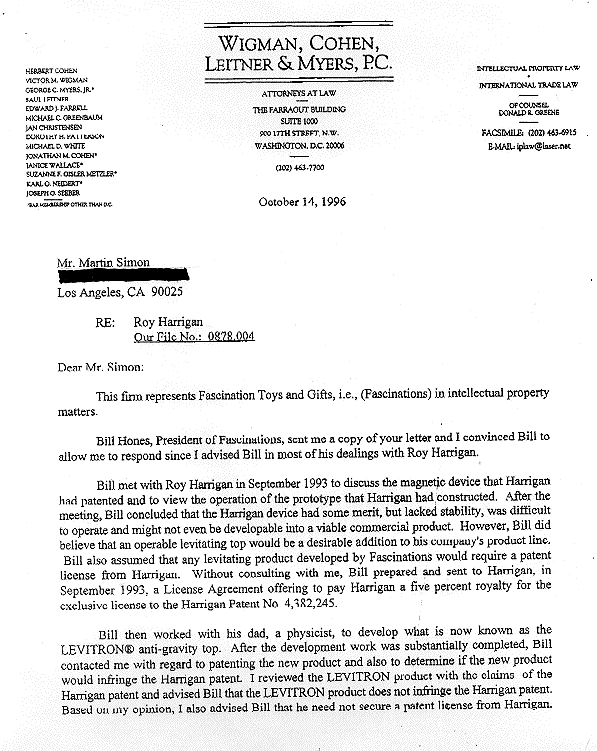
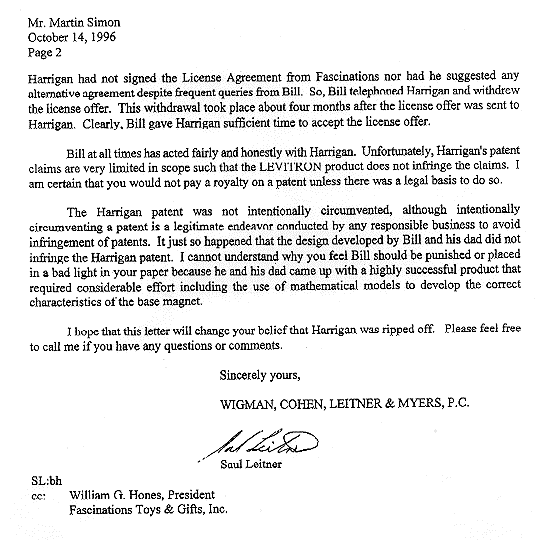
The Levitron invention itself has something of a contentious history (recounted here and here). Evidently, the physicist Ray Harrigan had patented a similar device a few years earlier and showed it to Bill Hones, who later got his own patent for a similar device and called it the "Levitron," but Hones was advised by his own lawyer that his own invention was sufficiently different from Harrigan's that he could market it without infringing Harrigan's patent or giving him credit or royalties. Apparently Harrigan was so disgusted and distrustful of his own lawyer that he never took the issue to court, so we'll never know what a judge would have thought. (The only issue which was ever litigated in court was over a former re-seller's use of the trademark "Levitron" — but that seems more straightforward, since the company that made up the word and trademarked it, owns it, completely separate from the merits of the invention that bears the name.) Some physicists have mixed feelings about the Levitron because of this, but it was apparently Harrigan's choice not to pursue the issue. (Besides, the new Levitron Revolution design uses nothing of Harrigan's idea, so some might feel that it's less "tainted".)
For cheaper levitation that takes no skill to operate, you can get the Diamagnetic Levitation Kit from Educational Innovations or search for pyrolitic graphite levitation on eBay — much less visually impressive though, with the graphite sheet levitating only 1 millimeter above the magnets.
Or for a more expensive conversation piece, the Levitron Lamp ($450 from InnovaToys or $400 from WorldToHome) levitates an entire lampshade above the base. I haven't tried that one out though.
- - - - - - - - - - - - - - - - - - - -
Levitating Picture Frames
Heart-shaped frame $25 from ZOpid; rectangular frame $70 from Hammacher Schlemmer.Computer-controlled levitation operating on a similar principle to the Levitron Revolution products. The $25 ZOpid picture frame is currently hanging out in Amazon limbo with a solitary 1-star review from a customer whose model broke after 4 months. But I think they look fine, and I'm giving two of them as gifts and crossing my fingers that I'm not that unlucky. With both the ZOpid and the Hammacher Schlemmer frames, unfortunately, there's apparently no way to switch off the LED lights (short of turning off the whole model).
Protip: You can prepare these as gifts by using photos downloaded from a friend's Facebook profile, but Facebook reduces the quality of uploaded photos, so that if you print them out, the pixellation will be noticeable up close. If you want the photos to look the best, you need to print them from high-res originals.
- - - - - - - - - - - - - - - - - - - -
Hanayama Japanese Pocket Puzzles
$13 from ThinkGeek and other vendors; some puzzles available for slightly less on eBay.Some disassembly puzzles are complete fails, either because there are so many separately moving pieces that you can't manipulate the puzzles in your hands at all (e.g. Yin and Yang"), or the moving parts are hidden from view so you can only "solve" them by pure guesswork (e.g. the "Bolted Closed" puzzle). The Hanayama pocket puzzles actually get it right — you can see all the pieces and move them comfortably in your hands, so solving them is just a matter of figuring out the right sequence of moves.
These are basically grown-up versions of the twisted nail puzzles you might have grown up with (and which you could also get, of course, as much cheaper stocking stuffers). But the Hanayama ones look good as shelf knick-knacks as well.
Hanayama pocket puzzles come with no solution included, but you can download a solution by going to this page and submitting your email address to request a download link.
- - - - - - - - - - - - - - - - - - - -
LED Jellyfish Mood Lamp
$35 from ThinkGeek and other vendors; no cheaper alternatives on eBayWorks more or less as shown in the video, with one caveat: In both the first model that I tried, and the free replacement ThinkGeek sent me when I reported the problem, the transitions between the different colors were much more abrupt and jarring than the smooth "color fade" shown in the video. (For some reason, some color LEDs would switch from completely on to completely off at the same time that other LEDs would switch on.) Unfortunately this small problem completely breaks the "reverie" effect of staring at the jellyfish floating around in the water, so I just set mine to a single color without using the transition effect.
Protip: You have to use real distilled water like the instructions tell you. I tried to make it work with regular tap water, and bubbles kept forming around the jellyfish and causing them to float to the surface. Fill it with distilled water and the jellyfish should sink beneath the surface without too much trouble.
Note, Fascinations has come out with a similar product, again sold on Innovatoys.com; I haven't tried that one, so it might be better (might actually get the color transition right), or it might not. Discovery Kids also makes a similar product which I haven't seen and which has been pulling pretty bad reviews on Amazon.
- - - - - - - - - - - - - - - - - - - -
Vino Vault and Cryptex Puzzle Pod
$30 and $22 from 4Thought Products LLCThe Puzzle Pod is a gift container that can only be opened by arranging the 5 rings to spell out a 5-letter password. It arrives pre-configured with the keyword "GRAPE"; once opened, you can re-configure the Pod with a new 5-letter secret word, seal a gift inside, and gift it to a recipient who has to find the secret word to open the puzzle and retrieve the gift. (It's re-usable, and you can set a different 5-letter "password" every time.) The Vino Vault is a larger version of the Puzzle Pod that can hold a bottle of wine.
I've only sampled the Puzzle Pod, so I can just vouch for the fact that it works exactly as described and doesn't get stuck or break easily. When you line up the letters of the secret word correctly, it actually slides smoothly open like it's supposed to.
- - - - - - - - - - - - - - - - - - - -
Ambiguous Vase
$33 from Grand Illusions Ltd (ships from the UK)This is a real-life version of the Rubin vase optical illusion. For years, Grand Illusions sold only a ceramic version for about $400 (plus another $200 to ship to the U.S.), but in November 2012 they released the $33 plastic version. It can also be used as a real vase (as long as you don't mind the barrier running down the center that divides the two halves).
- - - - - - - - - - - - - - - - - - - -
Steam Powered Top
$14 from Grand Illusions (ships from the UK)The world's simplest steam engine, made from a tube of copper pushed through a piece of cork, as shown in the demo video. Wikipedia explains the principle here — when the water in the copper tube is heated by the candle flame and boils, it expands and pushes out the ends of the tubes (driving the spinning motion). When the water contracts again, in sucks in water through the ends of the tubes — but the sucking motion pulls in water from all directions (while the expulsion of water pushes in only one direction), so the suction doesn't counteract the propulsion, and the top continues spinning.
Now, the original version is from Germany (and comes with detailed German instructions); the version that I got came with a sheet of English instructions that weren't as detailed. The instructions say to push the copper tube through the cork platform and "bend the tube at a 90-degree angle"; however if you just try bending the tube, it will probably crimp and create a hole, making it useless. To bend the tube so that it curves gradually, place your thumb on the cork next to where the tube protrudes, and use the fingers of your other hand to gently push the tube so that curves around your thumb. (This is spelled out in the original German instructions.)
Also, the instructions say to fill the copper tube by holding it under running tap water. This didn't work at all for me, since the tube is only about 2mm wide and the surface tension of water makes it hard to "push" it into a tube that small. Fortunately, a straw from a grocery-store juicebox fits perfectly over the other end of the copper tube, so if you submerge the other end in water, you can suck on the straw to fill the tube that way. (It's just copper after all, not lead.)
Finally, if you leave the cork floating in water too long, it eventually gets waterlogged and sinks, and as far as I can tell it's very hard to dry it out and bring it back to its original buoyancy. The workarounds for this are: (1) to increase the buoyancy, first put another tea light directly into your bowl of water so that it floats, and then lower the top into the water on top of that tea light, which will then help keep the top afloat; and (2) don't leave the top floating in water when not in use.
- - - - - - - - - - - - - - - - - - - -
"Flying F*CK" Remote-Control Helicopter
$20 from ThinkGeekAgain with the ThinkGeek swag; I swear I didn't know.
This is pretty self-explanatory, except I've tried two of them and the product doesn't seem to work too well as an actual remote-control helicopter; one of them couldn't hover in place (its two modes were "shooting up at the ceiling" or "falling"), and with the other, the R/C didn't seem to work through furniture. But that's probably OK since the whole point of this gift is in the giving and not the having.
In my case, I hid it behind a friend's chair at his birthday party, then at the appropriate time gave a speech ending with, "And so I thought, what do I give my friend to mark this occasion? What do I give? After much thought, I decided, this is what I give:..." There followed a dramatic pause where I pressed the "up" control on the remote, and nothing happened, whereupon I muttered, appropriately enough, "Fuck", then wandered over behind my friend's chair, repeated the setup line, pressed the remote button, at which point the copter shot up, banged into a chair and fell to the ground, whereupon for my third attempt I just picked it up and held it on the palm of my hand, pressed the remote, and the copter took flight and finally delivered the punch line, and all was good. If I'm there when he re-gifts it (since we both agreed that was the point of a gift like this), I hope it works better for him.
- - - - - - - - - - - - - - - - - - - -
Falling Sand Sculptures
$13 for the smaller 'Sandscape'; $80 for the larger 'Deep Sea Round'; both available from Educational InnovationsThese both make good decorations and shelf widgets. The sand in the Sandscape always falls in more or less the same pattern, since it's pre-determined by the gaps in the shelves holding the sand; the Deep Sea Round is more interesting since the pattern is determined by the placement of air bubbles and varies every time.
Pro tip: water evaporates from both of these, so eventually the water level will drop and the volume of air will increase, getting in the way of the sand flow. The 'Deep Sea Round' comes with a syringe that you can use to draw out air and inject more water into the aperture on the side. The cheaper 'Sandscape' doesn't come with a syringe, but it has a hole in the side where you can use a syringe to inject more water, if you buy the syringe separately.
- - - - - - - - - - - - - - - - - - - -
Galileo Thermometer
$17 for a wood-mounted model from Office Playground; cheaper ones available without wood mountingJust your basic elegant conversation piece demonstrating the principle that the density of a liquid changes with temperature. Pro tip: If you get the wood mounted one, before emailing the seller to complain that it's not working because all the spheres are bunched together at the wrong end, make sure it's not upside-down. (I realized, before I hit Send, that the felt-covered end goes on the bottom.)
- - - - - - - - - - - - - - - - - - - -
All of the remaining items on this list do exactly what they say they do, with no need for any special instructions not included by the manufacturer, so I'm just going to list them:
Glass Water Faucet — $50 from Uncommon Goods — a nice double optical illusion (faucet suspended in space, and glass-as-water).
Slicked Grandfather Clock — $30-$60 depending on who's selling it.
Tin Can Robot Kit — about $15 from various vendors — my stepdad and I assembled one using one of his beloved Hansen's soda cans.
Mini metal DIY sculptures — the Metal Works sculptures from Innovatoys ($7-$12) take some time to assemble but they come out looking pretty much like the pictures and make good shelf decorations. These Mikro sculptures ($10 and up, also available from Grand Illusions if you're filling your shopping cart there) are a bit easier to assemble since you just have to bend some shapes out from the metal sheet that they're carved from.
Ulexite "Television Stones" — $10 from Educational Innovations — a naturally occuring rock containing thousands of parallel fiber optic strands. Give it as a gift together with a square of patterned fabric so you can see the eerie effect when you place the rock against the fabric and the pattern "magically" appears on the opposite side of the rock.
And finally, if you need a last-minute gag gift for someone, browse through the gum and hand sanitizers from BlueQ.com — they're not geek-themed, but at $5.49 for the hand sanitizers and $1.39 for the gum, you can afford to stock up so you'll have a reserve of gag gifts suited for a variety of different people's tastes (except, of course, good taste).
And those are my favorites for gift-giving season 2012. You can send me suggestions for any items in this category that I've missed; I'll be back for Valentine's Day.
- - - - - - - - - - - - - - - -
Remember, if you have a feature idea, we'd love to hear it. -
Bennett's Whimsi-Geek Gift Guide For 2012
Frequent contributor Bennett Haselton writes this week with his favorite novelty science gift items for 2012. Levitation engines, puzzles, optical illusions brought to life, and all of the tips and tricks he's found for getting the products to work correctly. Decorative, whimsical, and not too expensive — except for the items that have earned it by being pretty amazing. Read on for the details, and be sure to mention other good possibilities (Just 14 shopping days left until Christmas) in the comments below.You already know how to find all the latest iPad or iPhone accessories, or how to find all the licensed merchandise if your BFF is a fan of some specific franchise. The items in this list are things that most people wouldn't even think to look for, but that I thought seemed interesting once I found out that they existed.
I'm more of a science geek than a gadget geek, so this list is built around optical illusions, whimsy, conversation pieces that demonstrate some scientific principle, and a reasonable budget. (The "Swinging Sticks Kinetic Energy Sculpture" from ThinkGeek is a work of art, but at $225, the price is apparently set to extract as much as possible from all the people who have to have one after seeing it in Iron Man 2.)
Also, unless otherwise noted, I've actually tried everything listed here and verified that it actually works; there were some items that I really wanted to make work, but couldn't. The Double Sand Sculpture, for example, looks great (especially in colors other than that ugly orange), but in all three models that American Science & Surplus sent me — the original plus the two free replacements — air bubbles formed in the hourglasses after a few days, which blocked the sand grains from flowing through the apertures. I could also never get Educational Innovations' Color Changing Nail Polish to change color, even under a UV light. And I loved the look of the Tornado Fountain from Fascinations.com, but no matter how I calibrated it, the drain at the bottom made a squirting and scraping sound like the last dregs of water draining from a bathtub, which pretty much killed its potential as a "tranquil" conversation piece. (As far as I can tell, any tabletop water fountain that costs less than $100 is either too noisy or doesn't work, but I haven't given up looking.) Of course, if you can get any of those things to work, more power to you.
For most of these items I've included the tips and tricks that I've accumulated for getting the full effect out of the product, tips that in some cases would have saved me a lot of hassle if I'd known them when the product first arrived. So you get the full benefit of my impulsive early-September Christmas shopping.
Neither I nor Slashdot make any profit from these links (except some items are from ThinkGeek, which is a corporate cousin of Slashdot for a few more weeks — but I didn't know that when I was making this list, and besides, it's not like you can put together a geek gift guide without including some stuff from ThinkGeek anyway).
Here are some of the things I've found that look as cool in person as they do in their catalog photos, and actually work:
- - - - - - - - - - - - - - - - - - - -
Levitron Revolution
Made by Fascinations.com, $100 from Innovatoys.com.I bought my first "Levitron"-branded product out of a Sky Mall catalog 15 years ago, assuming the picture of the levitating spinning top had to be a doctored photo, and half-set on proving that the product was a sham. I had spent enough time trying to levitate repelling magnets as a kid to conclude that it "couldn't be done," but I held out the faintest glimmer of hope that this might be the holy grail that I'd given up chasing about 10 years earlier. When the box arrived, I spent all evening and a sleepness night trying to get it working (the original product had to be calibrated and balanced very carefully, and you could waste a lot of time trying to make it work if the weights or alignments were slightly off), until just as the sun was coming up, I got the spinning top to levitate above the magnetic base for about four seconds before falling, and felt as if it had all been worth it. And the Levitron product line has come a long way since then, so you probably won't have to journey to the edge of your sanity to get this latest one working.
The Levitron Revolution is a levitation device which uses a base containing four computer-controlled magnets, and a magnetic disc that levitates about 1/2-inch above the base and can support a weight of up to 1 pound placed on top of it while continuing to levitate. It still takes a bit of practice to learn how to position the disc above the base to start the levitation, but the payoff is worth the effort. You can even rotate the base sideways and upside down, and the levitating disc will stay in the same position relative to the base while you turn it.
I used mine to levitate a crystal specimen that I got from a specialty gem store, which set me back about another $30, but I liked the way it glittered in the lights from the magnetic base. The rock was labeled "quartz / pyrite / sphalerite" at the store, and if you're looking for a similar rock to go with the Levitron Revolution, it looks like you can find one on Google Shopping for less than I paid for mine.
You can also use the Levitron Revolution for homemade illusions like levitating a cupcake in mid-air. (A Hostess dessert cup has a circular cavity on top to hold strawberries and whipped cream; turn it upside down and it fits perfectly over the Levitron disc. The book underneath the cupcake in the video was hollowed out to contain the magnetic base.)
Innovatoys sells several other Levitron products made by Fascinations, which all fall into two categories: those based on the classic Levitron design (which include any product showing the yellow-necked Levitron spinning top), and those based on the newer Levitron Revolution technology (everything else). I also have a Levitron CherryWood which is part of the "classic" lineup. The pros and cons of the two series are:
- The classic Levitron levitates the spinning top a full two inches above the base, which is much more visually impressive than the 1/2-inch that the magnetic disc floats above the base of the Levitron Revolution.
- The classic Levitron has to be hand-spun, however, and takes even more practice to operate than the Levitron Revolution.
- The classic Levitron has to be perfectly level for the top to float (the base comes with three adjustable legs to help you level it perfectly); the Levitron Revolution can be tilted and rotated, and the magnetic disc will continue to float in position relative to the base.
- The classic Levitron levitates in a very delicate equilibrium, with just the slightest touch being enough to push the floating top out out of balance and make it fall, so it can't be used to support other objects (and the top is spinning so fast that you wouldn't be able to see anything attached to it anyway). The Levitron Revolution floating disc can be touched and objects can be placed on top of it without pushing it out of equilibrium.
- The classic Levitron requires no power to operate, but because the top has to keep spinning at a high rate for the gyroscopic force to keep it from flipping over, after about two minutes the air friction will slow down the top enough that it falls. The Levitron Revolution will levitate forever as long as the DC power supply is connected.
The Levitron invention itself has something of a contentious history (recounted here and here). Evidently, the physicist Ray Harrigan had patented a similar device a few years earlier and showed it to Bill Hones, who later got his own patent for a similar device and called it the "Levitron," but Hones was advised by his own lawyer that his own invention was sufficiently different from Harrigan's that he could market it without infringing Harrigan's patent or giving him credit or royalties. Apparently Harrigan was so disgusted and distrustful of his own lawyer that he never took the issue to court, so we'll never know what a judge would have thought. (The only issue which was ever litigated in court was over a former re-seller's use of the trademark "Levitron" — but that seems more straightforward, since the company that made up the word and trademarked it, owns it, completely separate from the merits of the invention that bears the name.) Some physicists have mixed feelings about the Levitron because of this, but it was apparently Harrigan's choice not to pursue the issue. (Besides, the new Levitron Revolution design uses nothing of Harrigan's idea, so some might feel that it's less "tainted".)
For cheaper levitation that takes no skill to operate, you can get the Diamagnetic Levitation Kit from Educational Innovations or search for pyrolitic graphite levitation on eBay — much less visually impressive though, with the graphite sheet levitating only 1 millimeter above the magnets.
Or for a more expensive conversation piece, the Levitron Lamp ($450 from InnovaToys or $400 from WorldToHome) levitates an entire lampshade above the base. I haven't tried that one out though.
- - - - - - - - - - - - - - - - - - - -
Levitating Picture Frames
Heart-shaped frame $25 from ZOpid; rectangular frame $70 from Hammacher Schlemmer.Computer-controlled levitation operating on a similar principle to the Levitron Revolution products. The $25 ZOpid picture frame is currently hanging out in Amazon limbo with a solitary 1-star review from a customer whose model broke after 4 months. But I think they look fine, and I'm giving two of them as gifts and crossing my fingers that I'm not that unlucky. With both the ZOpid and the Hammacher Schlemmer frames, unfortunately, there's apparently no way to switch off the LED lights (short of turning off the whole model).
Protip: You can prepare these as gifts by using photos downloaded from a friend's Facebook profile, but Facebook reduces the quality of uploaded photos, so that if you print them out, the pixellation will be noticeable up close. If you want the photos to look the best, you need to print them from high-res originals.
- - - - - - - - - - - - - - - - - - - -
Hanayama Japanese Pocket Puzzles
$13 from ThinkGeek and other vendors; some puzzles available for slightly less on eBay.Some disassembly puzzles are complete fails, either because there are so many separately moving pieces that you can't manipulate the puzzles in your hands at all (e.g. Yin and Yang"), or the moving parts are hidden from view so you can only "solve" them by pure guesswork (e.g. the "Bolted Closed" puzzle). The Hanayama pocket puzzles actually get it right — you can see all the pieces and move them comfortably in your hands, so solving them is just a matter of figuring out the right sequence of moves.
These are basically grown-up versions of the twisted nail puzzles you might have grown up with (and which you could also get, of course, as much cheaper stocking stuffers). But the Hanayama ones look good as shelf knick-knacks as well.
Hanayama pocket puzzles come with no solution included, but you can download a solution by going to this page and submitting your email address to request a download link.
- - - - - - - - - - - - - - - - - - - -
LED Jellyfish Mood Lamp
$35 from ThinkGeek and other vendors; no cheaper alternatives on eBayWorks more or less as shown in the video, with one caveat: In both the first model that I tried, and the free replacement ThinkGeek sent me when I reported the problem, the transitions between the different colors were much more abrupt and jarring than the smooth "color fade" shown in the video. (For some reason, some color LEDs would switch from completely on to completely off at the same time that other LEDs would switch on.) Unfortunately this small problem completely breaks the "reverie" effect of staring at the jellyfish floating around in the water, so I just set mine to a single color without using the transition effect.
Protip: You have to use real distilled water like the instructions tell you. I tried to make it work with regular tap water, and bubbles kept forming around the jellyfish and causing them to float to the surface. Fill it with distilled water and the jellyfish should sink beneath the surface without too much trouble.
Note, Fascinations has come out with a similar product, again sold on Innovatoys.com; I haven't tried that one, so it might be better (might actually get the color transition right), or it might not. Discovery Kids also makes a similar product which I haven't seen and which has been pulling pretty bad reviews on Amazon.
- - - - - - - - - - - - - - - - - - - -
Vino Vault and Cryptex Puzzle Pod
$30 and $22 from 4Thought Products LLCThe Puzzle Pod is a gift container that can only be opened by arranging the 5 rings to spell out a 5-letter password. It arrives pre-configured with the keyword "GRAPE"; once opened, you can re-configure the Pod with a new 5-letter secret word, seal a gift inside, and gift it to a recipient who has to find the secret word to open the puzzle and retrieve the gift. (It's re-usable, and you can set a different 5-letter "password" every time.) The Vino Vault is a larger version of the Puzzle Pod that can hold a bottle of wine.
I've only sampled the Puzzle Pod, so I can just vouch for the fact that it works exactly as described and doesn't get stuck or break easily. When you line up the letters of the secret word correctly, it actually slides smoothly open like it's supposed to.
- - - - - - - - - - - - - - - - - - - -
Ambiguous Vase
$33 from Grand Illusions Ltd (ships from the UK)This is a real-life version of the Rubin vase optical illusion. For years, Grand Illusions sold only a ceramic version for about $400 (plus another $200 to ship to the U.S.), but in November 2012 they released the $33 plastic version. It can also be used as a real vase (as long as you don't mind the barrier running down the center that divides the two halves).
- - - - - - - - - - - - - - - - - - - -
Steam Powered Top
$14 from Grand Illusions (ships from the UK)The world's simplest steam engine, made from a tube of copper pushed through a piece of cork, as shown in the demo video. Wikipedia explains the principle here — when the water in the copper tube is heated by the candle flame and boils, it expands and pushes out the ends of the tubes (driving the spinning motion). When the water contracts again, in sucks in water through the ends of the tubes — but the sucking motion pulls in water from all directions (while the expulsion of water pushes in only one direction), so the suction doesn't counteract the propulsion, and the top continues spinning.
Now, the original version is from Germany (and comes with detailed German instructions); the version that I got came with a sheet of English instructions that weren't as detailed. The instructions say to push the copper tube through the cork platform and "bend the tube at a 90-degree angle"; however if you just try bending the tube, it will probably crimp and create a hole, making it useless. To bend the tube so that it curves gradually, place your thumb on the cork next to where the tube protrudes, and use the fingers of your other hand to gently push the tube so that curves around your thumb. (This is spelled out in the original German instructions.)
Also, the instructions say to fill the copper tube by holding it under running tap water. This didn't work at all for me, since the tube is only about 2mm wide and the surface tension of water makes it hard to "push" it into a tube that small. Fortunately, a straw from a grocery-store juicebox fits perfectly over the other end of the copper tube, so if you submerge the other end in water, you can suck on the straw to fill the tube that way. (It's just copper after all, not lead.)
Finally, if you leave the cork floating in water too long, it eventually gets waterlogged and sinks, and as far as I can tell it's very hard to dry it out and bring it back to its original buoyancy. The workarounds for this are: (1) to increase the buoyancy, first put another tea light directly into your bowl of water so that it floats, and then lower the top into the water on top of that tea light, which will then help keep the top afloat; and (2) don't leave the top floating in water when not in use.
- - - - - - - - - - - - - - - - - - - -
"Flying F*CK" Remote-Control Helicopter
$20 from ThinkGeekAgain with the ThinkGeek swag; I swear I didn't know.
This is pretty self-explanatory, except I've tried two of them and the product doesn't seem to work too well as an actual remote-control helicopter; one of them couldn't hover in place (its two modes were "shooting up at the ceiling" or "falling"), and with the other, the R/C didn't seem to work through furniture. But that's probably OK since the whole point of this gift is in the giving and not the having.
In my case, I hid it behind a friend's chair at his birthday party, then at the appropriate time gave a speech ending with, "And so I thought, what do I give my friend to mark this occasion? What do I give? After much thought, I decided, this is what I give:..." There followed a dramatic pause where I pressed the "up" control on the remote, and nothing happened, whereupon I muttered, appropriately enough, "Fuck", then wandered over behind my friend's chair, repeated the setup line, pressed the remote button, at which point the copter shot up, banged into a chair and fell to the ground, whereupon for my third attempt I just picked it up and held it on the palm of my hand, pressed the remote, and the copter took flight and finally delivered the punch line, and all was good. If I'm there when he re-gifts it (since we both agreed that was the point of a gift like this), I hope it works better for him.
- - - - - - - - - - - - - - - - - - - -
Falling Sand Sculptures
$13 for the smaller 'Sandscape'; $80 for the larger 'Deep Sea Round'; both available from Educational InnovationsThese both make good decorations and shelf widgets. The sand in the Sandscape always falls in more or less the same pattern, since it's pre-determined by the gaps in the shelves holding the sand; the Deep Sea Round is more interesting since the pattern is determined by the placement of air bubbles and varies every time.
Pro tip: water evaporates from both of these, so eventually the water level will drop and the volume of air will increase, getting in the way of the sand flow. The 'Deep Sea Round' comes with a syringe that you can use to draw out air and inject more water into the aperture on the side. The cheaper 'Sandscape' doesn't come with a syringe, but it has a hole in the side where you can use a syringe to inject more water, if you buy the syringe separately.
- - - - - - - - - - - - - - - - - - - -
Galileo Thermometer
$17 for a wood-mounted model from Office Playground; cheaper ones available without wood mountingJust your basic elegant conversation piece demonstrating the principle that the density of a liquid changes with temperature. Pro tip: If you get the wood mounted one, before emailing the seller to complain that it's not working because all the spheres are bunched together at the wrong end, make sure it's not upside-down. (I realized, before I hit Send, that the felt-covered end goes on the bottom.)
- - - - - - - - - - - - - - - - - - - -
All of the remaining items on this list do exactly what they say they do, with no need for any special instructions not included by the manufacturer, so I'm just going to list them:
Glass Water Faucet — $50 from Uncommon Goods — a nice double optical illusion (faucet suspended in space, and glass-as-water).
Slicked Grandfather Clock — $30-$60 depending on who's selling it.
Tin Can Robot Kit — about $15 from various vendors — my stepdad and I assembled one using one of his beloved Hansen's soda cans.
Mini metal DIY sculptures — the Metal Works sculptures from Innovatoys ($7-$12) take some time to assemble but they come out looking pretty much like the pictures and make good shelf decorations. These Mikro sculptures ($10 and up, also available from Grand Illusions if you're filling your shopping cart there) are a bit easier to assemble since you just have to bend some shapes out from the metal sheet that they're carved from.
Ulexite "Television Stones" — $10 from Educational Innovations — a naturally occuring rock containing thousands of parallel fiber optic strands. Give it as a gift together with a square of patterned fabric so you can see the eerie effect when you place the rock against the fabric and the pattern "magically" appears on the opposite side of the rock.
And finally, if you need a last-minute gag gift for someone, browse through the gum and hand sanitizers from BlueQ.com — they're not geek-themed, but at $5.49 for the hand sanitizers and $1.39 for the gum, you can afford to stock up so you'll have a reserve of gag gifts suited for a variety of different people's tastes (except, of course, good taste).
And those are my favorites for gift-giving season 2012. You can send me suggestions for any items in this category that I've missed; I'll be back for Valentine's Day.
- - - - - - - - - - - - - - - -
Remember, if you have a feature idea, we'd love to hear it. -
FCC Chief Urges FAA To Ease Airplane Electronics Ban
Hugh Pickens writes "AFP reports that Federal Communications Commission chairman Julius Genachowski is calling for an easing of the ban on using mobile phones and other electronic devices on airplanes during takeoff and landing, saying devices such as smartphones 'empower people' and can boost economic productivity. 'I write to urge the FAA to enable greater use of tablets, e-readers and other portable electronic devices during flight, consistent with public safety,' the FCC chief said in the letter to FAA Administrator Michael Huerta. The ban is in place based on the assumption that devices could interfere with an airplane's navigation equipment. But a number of news stories have questioned the validity of this claim, and many point out that some people forget to turn off their devices during flights. The FCC studied the question several years ago but found insufficient evidence to support lifting the ban at the time. But not everyone has been forced to put their gadgets away. Earlier this year the FAA approved iPads instead of paper flight manuals in the cockpit for pilots, but the agency still refuses to allow passengers to read on Kindles and iPads during takeoff and landing." -
Parrot Drives Robotic Buggy
grrlscientist writes "Proving that robots aren't just for people any longer, an African grey parrot, Pepper, has learned to drive a robot that was specially designed for him. Pepper, whose wings are clipped to preventing him from flying around his humans' house and destroying their things, now manipulates the joystick on his riding robot to guide it to where ever he wishes to go. This robotic 'bird buggy' was the brainchild of his human companion, Andrew Gray, a 29-year-old electrical and computer engineering graduate student at the University of Florida." -
Stay Home When You're Sick!
theodp writes "If you've got Google CEO Larry Page's billions, you can reduce your chances of getting sick this winter by personally providing free flu shots to all San Francisco Bay Area kids at Target pharmacies. 'Vaccinating children,' explains the Shoo the Flu initiative's website, 'will not only improve children's health, it will also dramatically reduce the risk of the flu spreading to adults.' But Tim Olshansky doesn't have Page's money, so he'll have to settle for trying to get it through people's thick heads that they really have to stay home when they're sick. 'Why do people still come to the office when they're coughing up a lung?' asks the exasperated Olshansky. 'Because unfortunately, there is a still a strong perverse culture that equates staying at home when sick with weakness. This is a flawed belief and should be questioned. Given that we have the tools now to complete most tasks from home, there is no strong reason to compel people to come to the workplace.' So, does your employer encourage employees to stay home when they're sick? How?" -
Google Launches Private Android App Stores
Trailrunner7 writes "Malicious apps have emerged as perhaps the most serious threat to mobile devices at the moment, and the major players, such as Apple and Google, have tried several different methods of preventing them from getting into their app stores and into the hands of users. Now, Google is taking one more step with the launch of a new service called the Private Channel for Google Apps, which gives enterprises and other organizations the ability to create private app stores and control the apps their users can download. Private Channel is essentially a way for organizations to stand up their own miniature app stores inside of Google Play--the main app store for Android devices--and publish apps to it. That gives these organizations the ability to point their users directly to the apps they want users to download for their Android devices. The new service will include some of the security features built into Google Play, most notably the anti-malware system and the ability to authenticate users." -
Splashtop's Cliff Miller Talks About Their New Linux App (Video)
Yes, you can now have full remote access to your home computer or a server at work that's running Ubuntu Linux. Really any Linux distro, although only Ubuntu is formally supported by Splashtop. What? You say you already control your home and work Linux computers from your Android tablet with VNC? That there's a whole bunch of Android VNC apps out there already? And plenty for iOS, too? You're right. But Cliff says Splashtop is better than the others. It can play video at a full 30 frames per second, and has low enough latency (depending on your connection) that you can play video games remotely in between taking care of that list of server issues your boss emailed to you. Or perhaps, in between work tasks, you take a dip in the ocean, because you're working from the beach, not from a stuffy office. It seems that work and living locations get a little more remote from each other every year, and Splashtop is helping to make that happen. This video interview is, itself, an example of how our world has gotten flatter; Cliff was in China and I was in Florida. The connection wasn't perfect, but the fact that we could have this conversation at all is a wonder. Please note, too, that while Cliff Miller is now Chief Marketing Officer for Splashtop, he was also the founder and first CEO of TurboLinux, so he is not new to Linux. And Splashtop is the company that supplied the "instant on" Linux OS a lot of computer manufacturers bundled with their Windows computers for a few years. Now, of course, they're focusing on the remote desktop, and seem to be making a go of it despite heavy competition in that market niche. -
Syrian Malware Servers Survive, Then Die
Nerval's Lobster writes "A massive outage knocked Syria's Internet offline Nov. 29 — with the exception of five servers implicated in serving malware earlier this year. But the next day, those five servers went dark as well. Internet analytics firm Renesys suggested late Nov. 29 that those five servers were likely offshore. 'Now, there are a few Syrian networks that are still connected to the Internet, still reachable by traceroutes, and indeed still hosting Syrian content,' the company wrote in a blog post. 'These are five networks that use Syrian-registered IP space, but the originator of the routes is actually Tata Communications. These are potentially offshore, rather than domestic, and perhaps not subject to whatever killswitch was thrown today within Syria.' By the morning of Nov. 30, those five servers went offline. 'The last 5 networks belonging to Syria, a set of smaller netblocks previously advertised by Tata Communications, have been torn down and are no longer routed,' Renesys wrote." CloudFlare has a blog post confirming that the Syrian government was responsible for flipping the switch, contrary to their claims. Meanwhile, Anonymous has started targeting the Syrian government's remaining websites and helping to get communications channels flowing out of Syria. Google is reminding people of its Speak2Tweet service, which lets people post to Twitter through voicemail over still-functioning phone lines. -
New Humble Bundle Is Windows Only, DRM Games
jbernardo writes "After all the indie, multi-platform (including 4 for android) and DRM free releases, the latest Humble Bundle release is a polarizing one. It features non-indie games, it is Windows only, and the games are saddled with DRM. There is already a very vocal discussion on the Humble Bundle Google+ thread, but it seems it is selling well." -
PressureNET 2.1 Released: the Distributed Barometer Network For Android
cryptoz writes "Cumulonimbus has released a new version of their open source, global barometer network. The network is built around an Android app called pressureNET which uses barometric sensors in new phones (such as the Nexus 4, Galaxy Nexus, Galaxy S3, Note, and others) in order to build the comprehensive network. They plan to use the data to improve short-term weather prediction, and the gives a teaser of the new data visualization tool they are building." -
Swedish Stock Exchange Hit By Programming Snafu
New submitter whizzter writes "I was reading the Swedish national news today and an image in a stock exchange related article struck my eye. An order had been placed for 4 294 967 290 futures (0xfffffffa or -6 if treated as a 32-bit signed integer), each valued at approximately 16,000 USD, giving a neat total of almost 69 trillion USD. The order apparently started to affect valuations and was later annulled, however it is said to have caused residual effects in the system and trading was halted for several hours." -
Hackers Stole Information From IAEA Servers
porsche911 writes "A hacker group called 'Parastoo' have broken into an International Atomic Energy Agency computer and released details of more than 100 IAEA experts. They are asking the experts to criticize Israel's nuclear arsenal (English translation)." The IAEA confirms the breach happened, but that it was of a decommissioned server. The statement from Parastoo courtesy of Cryptome. -
Mozilla Dropping 64-Bit Windows Nightly Builds For Now
hypnosec writes "Plans for 64-bit Firefox for Windows have been put on hold by Mozilla in a bid to concentrate more on the 32-bit version. Eliminating the 64-bit nightly builds was proposed by Benjamin Smedberg, a Firefox developer, last week. Some of the reasons Smedberg cited include missing plugins for 64-bit version; lack of windowproc hooking which facilitates smooth functioning of whatever plugins are available; and the inability to work on the crash reports submitted for the 64-bit versions because they were not on high priority. The proposal, it seems, has been accepted as is evident from this bug report." The bug tracking system seems unable to differentiate between 64-bit and 32-bit builds, causing a few issues since Windows 64-bit builds are much buggier. They also intend to reintroduce 64-bit Windows nightlies some time next year. -
Statistics Key To Success In Run-and-Gun Basketball
theodp writes "Two decades before Moneyball hit the Big Screen, Coach David Arseneault of tiny Grinnell College came up with a unique style of run-and-gun basketball that he called The System, the principles of which were subjected to statistical analysis in Keys to Success in a Run-and-Gun Basketball System, a paper for the 2011 Joint Statistical Meetings. Well, as they say, sometimes The System works. On Tuesday, biochem major Jack Taylor, just three games into his career as a Grinnell College basketball player, made national news when he poured in 138 points — yes, 138 points — in a 179-104 victory over Faith Baptist Bible College. Even LeBron and Kobe were impressed. The old NCAA Division III record of 89 was set last year by Taylor's Grinnell teammate, Griffin Lentsch. Taylor's feat also bested what was deemed to be the unbeatable overall NCAA scoring record of 113 points, set by NCAA Division II performer Clarence 'Bevo' Francis of Rio Grande in 1954." -
Google Warns Against UN Net Conference
another random user writes "Google has warned that a forthcoming U.N.-organized conference threatens the 'free and open internet.' Government representatives are set to agree a new information and communications treaty in December. It has been claimed some countries will try to wrest oversight of the net's technical specifications and domain name system from U.S. bodies to an international organization. However, the U.N. has said there would be consensus before any change was agreed." Google is using its Take Action page to encourage people to speak out on this issue. -
Google Warns Against UN Net Conference
another random user writes "Google has warned that a forthcoming U.N.-organized conference threatens the 'free and open internet.' Government representatives are set to agree a new information and communications treaty in December. It has been claimed some countries will try to wrest oversight of the net's technical specifications and domain name system from U.S. bodies to an international organization. However, the U.N. has said there would be consensus before any change was agreed." Google is using its Take Action page to encourage people to speak out on this issue. -
Form1 3D Printer and Kickstarter Get Sued For Patent Infringment
An anonymous reader writes "3D Systems, one of the big fish in 3D printer manufacturing, filed a suit against Formlabs's hugely popular Form1 printer put forth on Kickstarter. The crowdfunding effort has amassed close to 3M US Dollars, of an initial 100K requested. 3D Systems accuses Formlabs and Kickstarter of knowingly infringing one of its still valid blanket patents on stereolithography and cross-sectional printing of 3D objects. The company is probably going to go for the kill, as one can deduce from the demands on their complaint." In "The State of Community Fabrication" presentation at HOPE9, Far McKon noted that no one had yet filed a patent lawsuit against a 3D printing company, but it looks like his fears have come true. -
With Pot Legal, Scientists Study Detection of Impaired Drivers
Hugh Pickens writes "A recent assessment by the National Highway Traffic Safety Administration, based on random roadside checks, found that 16.3% of all drivers nationwide at night were on various legal and illegal impairing drugs, half them high on marijuana. Now AP reports that with marijuana soon legal under state laws in Washington and Colorado, setting a standard comparable to blood-alcohol limits has sparked intense disagreement. Unlike portable breath tests for alcohol, there's no easily available way to determine whether someone is impaired from recent pot use. If scientists can't tell someone how much marijuana it will take for him or her to test over the threshold, how is the average pot user supposed to know? 'We've had decades of studies and experience with alcohol,' says Washington State Patrol spokesman Dan Coon. 'Marijuana is new, so it's going to take some time to figure out how the courts and prosecutors are going to handle it.' Driving within three hours of smoking pot is associated with a near doubling of the risk of fatal crashes. However, THC can remain in blood and saliva for highly variable times after the last use of the drug. Although the marijuana 'high' only lasts three to five hours, studies of heavy users in a locked hospital ward showed THC can be detected in the blood up to a week after they are abstinent, and the outer limit of detection time in saliva tests is not known. 'A lot of effort has gone into the study of drugged driving and marijuana, because that is the most prevalent drug, but we are not nearly to the point where we are with alcohol,' says Jeffrey P. Michael, the National Highway Traffic Safety Administration's impaired-driving director. 'We don't know what level of marijuana impairs a driver.'" -
Google Releases Raw Election Polling Results
An anonymous reader writes "Last week, Nate Silver ranked Google Consumer Surveys as one of the most accurate polling firms of the 2012 US election. This week, Google has released the raw data that went into its election-day prediction, and is running a contest for interesting visualizations of that data. They provide a few examples of their own, including a WebGL globe view." -
Google Engineers Open Source Book Scanner Design
c0lo writes "Engineers from Google's Books team have released the design plans for a comparatively reasonably priced (about $1500) book scanner on Google Code. Built using a scanner, a vacuum cleaner and various other components, the Linear Book Scanner was developed by engineers during the '20 percent time' that Google allocates for personal projects. The license is highly permissive, thus it's possible the design and building costs can be improved. Any takers?" Adds reader leighklotz: "The Google Tech Talk Video starts with Jeff Breidenbach of the Google Books team, and moves on to Dany Qumsiyeh showing how simple his design is to build. Could it be that the Google Books team has had enough of destroying the library in order to save it? Or maybe the just want to up-stage the Internet Archive's Scanning Robot. Disclaimer: I worked with Jeff when we were at Xerox (where he did this awesome hack), but this is more awesome because it saves books." -
Government Surveillance Growing, According To Google
SternisheFan writes with news that Google has updated is Transparency Report for the sixth time, and the big takeaway this time around is a significant increase in government surveillance. From the article: "In a blog post, Google senior policy analyst Dorothy Chou says, ' [G]overnment demands for user data have increased steadily since we first launched the Transparency Report.' In the first half of 2012, the period covered in the report, Chou says there were 20,938 inquiries from government organizations for information about 34,614 Google-related accounts. Google has a long history of pushing back against governmental demands for data, going back at least to its refusal to turn over search data to the Department of Justice in 2005. Many other companies have chosen to cooperate with government requests rather than question or oppose them, but Chou notes that in the past year, companies like Dropbox, LinkedIn, Sonic.net and Twitter have begun making government information requests public, to inform the discussion about Internet freedom and its limits. According to the report, the U.S. continues to make the most requests for user data, 7,969 in the first six months of the year. Google complied with 90% of these requests. Google's average compliance rate for the 31 countries listed in the report is about 47%." -
Germany Exports More Electricity Than Ever Despite Phasing Out Nuclear Energy
An anonymous reader writes "Der Spiegel reports that Germany has exported more electricity this year than ever before, despite beginning to phase out nuclear power. In the first three quarters of 2012, Germany sent 12.3 terawatt hours of electricity across its borders. The country's rapid expansion into renewable energy is credited with the growth. However, the boost doesn't come without a price. The German government's investments into its new energy policy will end up costing hundreds of billions of dollars over the next two decades, and it still relies on imports for its natural gas needs. It also remains to be seen whether winter will bring power shortages. Is Germany a good example of forward-looking energy policy?" -
Do Recreational Drugs Help Programmers?
jfruh writes "Among the winners of last night's election: marijuana users. Voters in both Washington and Colorado approved referenda that legalized marijuana for recreational use, though the drug remains illegal under federal law. There's been a long-standing debate among programmers as to whether recreational drugs, including pot and hallucinagens like LSD, can actually help programmers code. Don't forget, there was a substantial overlap between the wave of computer professionals who came of age in the '60s and that era's counterculture." (There's even a good book on that topic.) -
Google Wallet May End Up Inside Your Actual Wallet
Several outlets are reporting, based on screenshots posted by Android Police that Google is (or "may be" — CNet calls the report "loosely sourced") about to introduce a lower-tech variant on its smartphone-based Google Wallet payment system. Instead of transferring payment information from an NFC-equipped phone, this would mean a physical payment card (like a conventional plastic credit or debit card), but one linked via Google's databanks to the user's existing bank or credit accounts. Upsides: less to carry, a simple way to suspend or cancel service on them (should the card be lost or stolen), and doesn't require you to carry your phone to make a credit or debit transaction — handy, since NFC readers are still thin on the ground. Downside: while perhaps no worse than putting the same information on your phone, it's one more step toward giving a third party all of your personal information in one place. A card that fits in a wallet probably makes a lot of sense: I live in a city with at least three pay-by-phone options in trials or fully available (CitiBank, Isis, and Google Wallet), but I can't buy ice cream or coffee with them yet. And there's no reason a card-shaped token couldn't use mag-stripes and NFC, too. -
Linus Torvalds Tries KDE, Likes It So Far
sfcrazy writes "Linus Torvalds has never been a big fan of Gnome owing [to] its extreme simplicity. Even Gnome 3.x failed to impress the father of the Linux kernel. He has now given KDE a try after a long time. Linus using your software is double edged sword, especially if Linus doesn't like it — get ready for the harshest, yet the most honest and useful criticism. Interestingly, Linus has so far liked KDE, and for one simple reason: 'But ah, the ability to configure things. And I have wobbly windows again.' This should make KDE developers a bit happier." Evidently, Linus didn't get the message that desktop UIs for Linux don't matter any more, since he keeps acting like they do. -
Nonpartisan Tax Report Removed After Republican Protest
eldavojohn writes "On September 14th a report titled 'Taxes and the Economy: An Economic Analysis of the Top Tax Rates Since 1945' (PDF) penned by the Library of Congress' nonpartisan Congressional Research Service was released to little fanfare. However, the following conclusion of the report has since roiled the GOP enough to have the report removed from the Library of Congress: 'The results of the analysis suggest that changes over the past 65 years in the top marginal tax rate and the top capital gains tax rate do not appear correlated with economic growth. The reduction in the top tax rates appears to be uncorrelated with saving, investment, and productivity growth. The top tax rates appear to have little or no relation to the size of the economic pie. However, the top tax rate reductions appear to be associated with the increasing concentration of income at the top of the income distribution. As measured by IRS data, the share of income accruing to the top 0.1% of U.S. families increased from 4.2% in 1945 to 12.3% by 2007 before falling to 9.2% due to the 2007-2009 recession. At the same time, the average tax rate paid by the top 0.1% fell from over 50% in 1945 to about 25% in 2009. Tax policy could have a relation to how the economic pie is sliced—lower top tax rates may be associated with greater income disparities.' From the New York Times article: 'The pressure applied to the research service comes amid a broader Republican effort to raise questions about research and statistics that were once trusted as nonpartisan and apolitical.' It appears to no longer be found on the Library of Congress' website." -
Apple Loses Trademark Claim Against iFone in Mexico
sfcrazy writes "Apple is having trouble in Mexico right before the holiday season. The company has lost rights to the name iPhone in the country, as it was already owned by a Mexican telecom company called iFone (Google translation of Spanish original). iFone registered its trademark in 2003, four years before Apple iPhone was launched. In 2009, Apple filed a complaint with the Mexican Industrial Property Institute demanding that iFone stop using is name because it could confuse users. That claim was since denied, and iFone is looking to turn the tables." -
Linus Torvalds Advocates For 2560x1600 Standard Laptop Displays
beeudoublez points out a Google+ post by Linus Torvalds arguing that today's standard laptop display resolution is unreasonably low. He said, "...with even a $399 tablet doing 2560x1600 pixel displays, can we please just make that the new standard laptop resolution? Even at 11"? Please. Stop with the 'retina' crap, just call it 'reasonable resolution.' The fact that laptops stagnated ten years ago (and even regressed, in many cases) at around half that in both directions is just sad. I still don't want big luggable laptops, but that 1366x768 is so last century." -
Surfcast Sues Microsoft Over Tile Patent
An anonymous reader writes with news of a company suing Microsoft for infringing upon a patent for tiles with live content. From the article: "SurfCast, in a complaint filed yesterday in a U.S. District Court in Maine, said Microsoft infringes one of its four patents — No. 6,724,403 — by 'making, using, selling, and offering to sell devices and software products' covered by SurfCast's patent. That includes mobile devices using the Windows Phone 7 and Windows Phone 8 operating systems as well as PCs using Windows 8/RT." -
Google Launches Open Source Voter Information Tool
An anonymous reader writes "Google announces a new Voter Information Tool which, as its name implies, can be used by voters to find relevant information such as where you can vote and for whom. The search giant is releasing the new feature just over a week in advance of the US Presidential Election on November 6. This raises the question: can Google influence the elections even more than it already does via lobbying?" I've found Ballotpedia useful as well. -
The IDE As a Bad Programming Language Enabler
theodp writes "When it comes to monolithic IDEs, Wille Faler has lost that loving feeling. In IDEs Are a Language Smell, Faler blogs about a Eureka! moment he had after years of using Eclipse for Java development. 'If the language is good enough,' Faler argues, 'an IDE is strictly not needed as long as you have good support for syntax highlighting and parens matching in the case of Clojure, or indentation in the case of Haskell.' So why do Java coders turn to Eclipse? 'Because [of] a combination of shortcomings in the Java compiler and Java's OO nature,' explains Faler, 'we end up with lots and lots of small files for every interface and class in our system. On any less than trivial Java system, development quickly turns into a game of code- and file-system navigation rather than programming and code editing. This nature of Java development requires IDEs to become navigation tools above all.' Yes, only an IDE could love AbstractSingletonProxyFactoryBean!" -
Dragon Capsule Heads Home From ISS
An Anonymous Coward sent word that the SpaceX Dragon capsule is heading home from the International Space Station. From the article: "The unmanned Dragon space capsule set off from the International Space Station Sunday for the cargo-laden return trip to Earth after successfully delivering its first commercial payload, NASA said. Using a robotic arm, an astronaut aboard the floating laboratory detached and released the capsule at 1329 GMT after an 18-day mission to resupply the space station, the first ever by a privately-owned company, SpaceX. The next step will be to bring the capsule out of orbit by intermittently firing its onboard engines to slow its speed. It is then supposed to parachute into the Pacific Ocean off the California coast at 1920 GMT." -
The Greatest Battle of the Personal Computing Revolution Lies Ahead
As tablets and computer-phones flood the market, the headlines read: "The Personal Computer is Dying." But they are only half true: an artifact of the PC is dying, but the essence of the PC revolution is closer to realization than ever before, while also being closer to loss than ever before.Certainly one way to define the Personal Computer stems from the era of the IBM PC: a gray box with a monitor, mouse, and keyboard (or a laptop). But the idea of the Personal Computer dates back quite a while — back to Alan Kay's Dynabook, the Lisp Machine, etc.
The Apple Knowledge Navigator provided a vision of personal computing far more dynamic than that dull gray box. Although still a pale comparison, tablet and phone platforms are beginning to look awfully similar.
The essence of those pre-PC Personal Computers was that of the user controlling the device. You control the data, you control the software; the Personal Computer is a uniquely personal artifact that the user adapts to his own working style. One consequence of this is that creating is as easy (perhaps easier) as consuming content. Another nice side effect is that your data remains private by virtue of local storage.
In many ways, then, a tablet or phone comes significantly closer to a personal computer than that dull gray box under your desk. For example, on Android, the screen ceases to be a place to throw icons and becomes a rich canvas of widgets. Additionally, my phone fits into my pocket and is always there. Ubiquitous cellular coverage gives me access to my data from most anywhere. The touchscreen and interface conventions make direct manipulation shine in a way you just can't get from a screen two feet away on a desk.
And, those are just superficial improvements over the desktop. Albeit tied to proprietary services, Google's voice search and Siri are inching closer to the dream of personal Intelligent Agents reminding us all that our mothers called us earlier today and want us to pick up the birthday cake for the surprise party With a few taps I can search basically all of my data, not to mention the collective knowledge of mankind.
But the software running on these devices has a dark side. Want to access your music collection the go? You have to get it from Google Play. Want to have lightweight instant messaging? You have to use GTalk. Or take ebook readers (certainly personal devices): that book you just downloaded to your Kindle is DRMed and stuck there! That intelligent agent? Apple records everything you bark at her and can take her away at a moment's notice.
Furthermore, the software on these devices is geared almost exclusively toward content consumption. You can listen to music all day long, but don't try multi-track recording. That ebook reader is great for reading, but you can't scratch notes in the margins of any of your books or sit down with one and scrawl out your latest manuscript. Clearly, some of this is from the youth of these new systems, but it is distressing to see them geared first toward consumption (the Newton, for example, was geared from the start as a device for creation).
The "cloud" as implemented by Amazon, Google, Apple, et al. is a distinct threat to the personal computer. Loss of control over our own data is perhaps the worst part of the cloud. We're easily seduced by genuinely useful features like access to our contacts and music from any device without having to manually sync anything. It's certainly more convenient to purchase a digital movie on Amazon Prime than to hunt down a DVD, and Netflix is definitely nicer for most people than cable television. But when you buy a movie on Amazon, you don't really own it.
Underlying many of these cloud services (especially media-related ones) is Digital Restrictions Management. Whether it be the files themselves or the protocol used to transmit data, DRM is used to control what you can do with your data, restricting even what programs you can use to interact with seemingly neutral files. Worse, networked DRM services can and have led to lost data when it is no longer profitable for the company to run the verification servers.
The only copying that DRM discourages effectively is the sneakernet. And, given that the sneakernet has existed since recordable media has existed, it doesn't seem like the sneakernet is really much of a threat to creative business. I might lend a friend a CD (or even let her copy a few files), but just as I don't unwrap that CD and torrent it through The Pirate Bay, I'm not going to download a movie from Amazon and do the same. There's really no incentive to do so, for most people — most people pirate because that's what you have to do to get the media you want, not because you have a compulsive desire to share things with your closest 10,000 friends.
In order to prevent what is effectively sharing between actual friends, pushers of DRM-infected data want us to completely cede control of our own data!
And they have made people accept it: Steam, Netflix, and Amazon Prime are wildly popular. All of those services are great ideas, but all of them treat you as if you were a criminal.
Worse yet, the spread of Software-as-a-Service is returning us to the bad old days: that powerful PC in your pocket is quickly becoming no more than a glorified terminal. The open peer-to-peer network is being subverted from an enabler of collaboration never before seen into yet another scheme to tether users to proprietary, centralized services. And, as SaaS expands, privacy recedes. No longer is it implicit that your documents are yours alone; now you write and store things using Google Docs and have no expectation of privacy (legally), despite expecting privacy. Amazon knows what you read; Netflix knows what you watch; Google knows what you visit.
Control over the programs you run, and more importantly can write, is key to a personal computer being personal. And it seems absurd that that right might be taken away, but behold: the iPhone and soon Mac Store are these mythical walled gardens. You have to subvert your device to gain real control! And the natural path for Apple is to restrict Macs similarly to iOS devices.
And so we are all-too-near an Orwellian nightmare where vendors dictate what we can do with and how we can use our own data.
But what about the hardware itself? It could be argued that a device isn't really personal for some set of people if they can't change all of the software. Here too we see some promise, and some pitfalls.
The shift to tablet and phone hardware has meant a shift from x86 machines running PC BIOS to thousands of ARM boards, each with its own peculiar way of being programmed. Things you take for granted on x86, like being able to even boot, require custom code. And let's not even begin talking about all of the DSPs and co-processors. Vendors aren't always forthcoming with documentation for their boards, and, even worse, those that do port Linux to their hardware often blatantly violate the GPL and do not distribute kernel sources. This restricts the utility of perfectly fine hardware: often to the detriment of the user and to the benefit of the manufacturer.
Anyone who finds they can't upgrade to the latest version of Android because their vendor won't support it, and the community cannot support it because of non-free drivers, knows what losing control over their hardware is like (RIP HTC Dream).
It might seem like a minor setback ("I guess I have to buy a new phone"), but the lack of specifications or support marginalizes alternative operating systems. There's Meego, Tizen, Open webOS, Firefox OS, SHR, etc., but experimenting with them on your device is a non-starter. Imagine if the x86 were so closed (something we may not have to only imagine much longer): it is doubtful that GNU/Linux or the multitude "alternative" OSes would exist (Atheos, Haiku, L4Linux, even the Hurd). Ever more closed hardware is putting us into a position where two or three companies will dictate everything about the computing experience going forward, with no room for freethinking tinkerers to revolutionize how we interact with our devices.
We are staring at a bleak future, and living in a bleak present in some ways. But there is hope for the battle to be won by the Personal Computer instead of the Terminal.
The Internet is not yet merely glorified cable television. Hypertext, email, instant messaging, trivial file transfer, etc. have revolutionized how mankind communicates (understatement of the decade). Once upon a time the dream was that everyone would be a first-class netizen: your IP was publicly routeable and with a bit of know-how you had a server. Instead, thanks to grossly asymmetric pipes and heavy NATing, it is rare for any individual to run their own servers. Instead we turn to Google, Amazon, et al and cede control over our data.
But now broadband connections are spreading fast (I've gone from 100Kbit/s to 2Mbit/s upstream in three years just with basic service), IPv6 is really here, and software is being written to challenge the centralized "cloud" model being pushed on us from above.
We've had a few victories already: SMTP is still in use, XMPP is the dominant chat protocol (and IRC refuses to die), RSS/Atom aggregation decentralizes news, and the core network protocols are developed in the open.
But Google still controls Android, and myriad services control your data. Part of this is because they have easy client and server interfaces; sure you could run gallery2 and Wordpress on your own server, but I can just snap a photo on my phone and it's up on Facebook 40 seconds later (well, if their app worked, it would be).
Luckily, there are people working on making easy to use "cloud" services. In particular, ownCloud. ownCloud provides a framework for hosting and syncing data between your devices and sharing data with others. The important part is not so much the central server, but the clients they are writing. Eventually, it should be possible to e.g. replace the Google contact/mail/calendar sync and Google Drive, while adding these features to the desktop. Integration in KDE is already underway.
Imagine, instead of being tied to Google you could move the central server to the hosting provider of your wish (or pack up your data and move it to greener pastures if you're not running your own). And, perhaps more subtle (but the real liberation): Your data would be freely movable between all operating systems (interesting that you have to go through hoops to sync your GMail contacts with anything else, and Abandon All Hope Ye who wants to share between an Apple device and anything else). Additionally, the server is designed to respect your privacy (you can e.g. only store encrypted data server-side).
On the hardware side, projects like Firefox OS are very important: having a "mobile" Free Software OS developed in the open might be essential when the dominant open platforms are developed monolithically by corporations with no interest in protecting user control of data.
And then for developing the next generation of devices, folks like Rhombus Tech are pushing for the development of interchangeable CPU boards for embedded devices, and the FSF is expanding their focus to include open hardware.
There are two serious threats that would undermine any resistance: IPv4 exhaustion and draconian content policing. The former issue is technical and likely to solve itself: in the long run multi-level NAT would be too costly, switching hardware will be replaced as it is obsoleted, etc. The latter is political and represents the most serious threat of all. If we cannot communicate freely and the pipes are owned by the very organizations whose business interests will be harmed... we've already seen how brazen the current IP regime can be, and it will take vigilance on the part of many to prevent them from having their way.
Where will we be in ten years? If Google, Amazon, Apple, and Old Media get their way, in a new dark age of computing. Certainly, you'll have a fancy tablet and access to infinite entertainment. But you will own nothing. Sharing data will be controlled by a chosen few entities, the programs you can run or write will be limited in the name of security, and privacy will be dead.
History shows that personal computing survived despite Apple and Microsoft in the 80s and 90s. So, I'm hopeful that other forces will win: the forces of Free Culture and Free Software. If they succeed (or are at least not crushed), the future is much brighter: most content will be available DRM-free, users will control their computing environments, and the egalitarian promise of the Internet will be realized (in no small part thanks to IPv6).
-
The Greatest Battle of the Personal Computing Revolution Lies Ahead
As tablets and computer-phones flood the market, the headlines read: "The Personal Computer is Dying." But they are only half true: an artifact of the PC is dying, but the essence of the PC revolution is closer to realization than ever before, while also being closer to loss than ever before.Certainly one way to define the Personal Computer stems from the era of the IBM PC: a gray box with a monitor, mouse, and keyboard (or a laptop). But the idea of the Personal Computer dates back quite a while — back to Alan Kay's Dynabook, the Lisp Machine, etc.
The Apple Knowledge Navigator provided a vision of personal computing far more dynamic than that dull gray box. Although still a pale comparison, tablet and phone platforms are beginning to look awfully similar.
The essence of those pre-PC Personal Computers was that of the user controlling the device. You control the data, you control the software; the Personal Computer is a uniquely personal artifact that the user adapts to his own working style. One consequence of this is that creating is as easy (perhaps easier) as consuming content. Another nice side effect is that your data remains private by virtue of local storage.
In many ways, then, a tablet or phone comes significantly closer to a personal computer than that dull gray box under your desk. For example, on Android, the screen ceases to be a place to throw icons and becomes a rich canvas of widgets. Additionally, my phone fits into my pocket and is always there. Ubiquitous cellular coverage gives me access to my data from most anywhere. The touchscreen and interface conventions make direct manipulation shine in a way you just can't get from a screen two feet away on a desk.
And, those are just superficial improvements over the desktop. Albeit tied to proprietary services, Google's voice search and Siri are inching closer to the dream of personal Intelligent Agents reminding us all that our mothers called us earlier today and want us to pick up the birthday cake for the surprise party With a few taps I can search basically all of my data, not to mention the collective knowledge of mankind.
But the software running on these devices has a dark side. Want to access your music collection the go? You have to get it from Google Play. Want to have lightweight instant messaging? You have to use GTalk. Or take ebook readers (certainly personal devices): that book you just downloaded to your Kindle is DRMed and stuck there! That intelligent agent? Apple records everything you bark at her and can take her away at a moment's notice.
Furthermore, the software on these devices is geared almost exclusively toward content consumption. You can listen to music all day long, but don't try multi-track recording. That ebook reader is great for reading, but you can't scratch notes in the margins of any of your books or sit down with one and scrawl out your latest manuscript. Clearly, some of this is from the youth of these new systems, but it is distressing to see them geared first toward consumption (the Newton, for example, was geared from the start as a device for creation).
The "cloud" as implemented by Amazon, Google, Apple, et al. is a distinct threat to the personal computer. Loss of control over our own data is perhaps the worst part of the cloud. We're easily seduced by genuinely useful features like access to our contacts and music from any device without having to manually sync anything. It's certainly more convenient to purchase a digital movie on Amazon Prime than to hunt down a DVD, and Netflix is definitely nicer for most people than cable television. But when you buy a movie on Amazon, you don't really own it.
Underlying many of these cloud services (especially media-related ones) is Digital Restrictions Management. Whether it be the files themselves or the protocol used to transmit data, DRM is used to control what you can do with your data, restricting even what programs you can use to interact with seemingly neutral files. Worse, networked DRM services can and have led to lost data when it is no longer profitable for the company to run the verification servers.
The only copying that DRM discourages effectively is the sneakernet. And, given that the sneakernet has existed since recordable media has existed, it doesn't seem like the sneakernet is really much of a threat to creative business. I might lend a friend a CD (or even let her copy a few files), but just as I don't unwrap that CD and torrent it through The Pirate Bay, I'm not going to download a movie from Amazon and do the same. There's really no incentive to do so, for most people — most people pirate because that's what you have to do to get the media you want, not because you have a compulsive desire to share things with your closest 10,000 friends.
In order to prevent what is effectively sharing between actual friends, pushers of DRM-infected data want us to completely cede control of our own data!
And they have made people accept it: Steam, Netflix, and Amazon Prime are wildly popular. All of those services are great ideas, but all of them treat you as if you were a criminal.
Worse yet, the spread of Software-as-a-Service is returning us to the bad old days: that powerful PC in your pocket is quickly becoming no more than a glorified terminal. The open peer-to-peer network is being subverted from an enabler of collaboration never before seen into yet another scheme to tether users to proprietary, centralized services. And, as SaaS expands, privacy recedes. No longer is it implicit that your documents are yours alone; now you write and store things using Google Docs and have no expectation of privacy (legally), despite expecting privacy. Amazon knows what you read; Netflix knows what you watch; Google knows what you visit.
Control over the programs you run, and more importantly can write, is key to a personal computer being personal. And it seems absurd that that right might be taken away, but behold: the iPhone and soon Mac Store are these mythical walled gardens. You have to subvert your device to gain real control! And the natural path for Apple is to restrict Macs similarly to iOS devices.
And so we are all-too-near an Orwellian nightmare where vendors dictate what we can do with and how we can use our own data.
But what about the hardware itself? It could be argued that a device isn't really personal for some set of people if they can't change all of the software. Here too we see some promise, and some pitfalls.
The shift to tablet and phone hardware has meant a shift from x86 machines running PC BIOS to thousands of ARM boards, each with its own peculiar way of being programmed. Things you take for granted on x86, like being able to even boot, require custom code. And let's not even begin talking about all of the DSPs and co-processors. Vendors aren't always forthcoming with documentation for their boards, and, even worse, those that do port Linux to their hardware often blatantly violate the GPL and do not distribute kernel sources. This restricts the utility of perfectly fine hardware: often to the detriment of the user and to the benefit of the manufacturer.
Anyone who finds they can't upgrade to the latest version of Android because their vendor won't support it, and the community cannot support it because of non-free drivers, knows what losing control over their hardware is like (RIP HTC Dream).
It might seem like a minor setback ("I guess I have to buy a new phone"), but the lack of specifications or support marginalizes alternative operating systems. There's Meego, Tizen, Open webOS, Firefox OS, SHR, etc., but experimenting with them on your device is a non-starter. Imagine if the x86 were so closed (something we may not have to only imagine much longer): it is doubtful that GNU/Linux or the multitude "alternative" OSes would exist (Atheos, Haiku, L4Linux, even the Hurd). Ever more closed hardware is putting us into a position where two or three companies will dictate everything about the computing experience going forward, with no room for freethinking tinkerers to revolutionize how we interact with our devices.
We are staring at a bleak future, and living in a bleak present in some ways. But there is hope for the battle to be won by the Personal Computer instead of the Terminal.
The Internet is not yet merely glorified cable television. Hypertext, email, instant messaging, trivial file transfer, etc. have revolutionized how mankind communicates (understatement of the decade). Once upon a time the dream was that everyone would be a first-class netizen: your IP was publicly routeable and with a bit of know-how you had a server. Instead, thanks to grossly asymmetric pipes and heavy NATing, it is rare for any individual to run their own servers. Instead we turn to Google, Amazon, et al and cede control over our data.
But now broadband connections are spreading fast (I've gone from 100Kbit/s to 2Mbit/s upstream in three years just with basic service), IPv6 is really here, and software is being written to challenge the centralized "cloud" model being pushed on us from above.
We've had a few victories already: SMTP is still in use, XMPP is the dominant chat protocol (and IRC refuses to die), RSS/Atom aggregation decentralizes news, and the core network protocols are developed in the open.
But Google still controls Android, and myriad services control your data. Part of this is because they have easy client and server interfaces; sure you could run gallery2 and Wordpress on your own server, but I can just snap a photo on my phone and it's up on Facebook 40 seconds later (well, if their app worked, it would be).
Luckily, there are people working on making easy to use "cloud" services. In particular, ownCloud. ownCloud provides a framework for hosting and syncing data between your devices and sharing data with others. The important part is not so much the central server, but the clients they are writing. Eventually, it should be possible to e.g. replace the Google contact/mail/calendar sync and Google Drive, while adding these features to the desktop. Integration in KDE is already underway.
Imagine, instead of being tied to Google you could move the central server to the hosting provider of your wish (or pack up your data and move it to greener pastures if you're not running your own). And, perhaps more subtle (but the real liberation): Your data would be freely movable between all operating systems (interesting that you have to go through hoops to sync your GMail contacts with anything else, and Abandon All Hope Ye who wants to share between an Apple device and anything else). Additionally, the server is designed to respect your privacy (you can e.g. only store encrypted data server-side).
On the hardware side, projects like Firefox OS are very important: having a "mobile" Free Software OS developed in the open might be essential when the dominant open platforms are developed monolithically by corporations with no interest in protecting user control of data.
And then for developing the next generation of devices, folks like Rhombus Tech are pushing for the development of interchangeable CPU boards for embedded devices, and the FSF is expanding their focus to include open hardware.
There are two serious threats that would undermine any resistance: IPv4 exhaustion and draconian content policing. The former issue is technical and likely to solve itself: in the long run multi-level NAT would be too costly, switching hardware will be replaced as it is obsoleted, etc. The latter is political and represents the most serious threat of all. If we cannot communicate freely and the pipes are owned by the very organizations whose business interests will be harmed... we've already seen how brazen the current IP regime can be, and it will take vigilance on the part of many to prevent them from having their way.
Where will we be in ten years? If Google, Amazon, Apple, and Old Media get their way, in a new dark age of computing. Certainly, you'll have a fancy tablet and access to infinite entertainment. But you will own nothing. Sharing data will be controlled by a chosen few entities, the programs you can run or write will be limited in the name of security, and privacy will be dead.
History shows that personal computing survived despite Apple and Microsoft in the 80s and 90s. So, I'm hopeful that other forces will win: the forces of Free Culture and Free Software. If they succeed (or are at least not crushed), the future is much brighter: most content will be available DRM-free, users will control their computing environments, and the egalitarian promise of the Internet will be realized (in no small part thanks to IPv6).
-
NetFlix Caught Stealing DivX Subtitles From Finnish Pirates
An anonymous reader writes with word that NetFlix recently opened its streaming service in Finland and was promptly caught stealing movie subtitles from a local DivX community site. How were they caught? NetFlix failed to remove references to the pirate site in the subtitles. -
How Google Cools Its 1 Million Servers
1sockchuck writes "As Google showed the world its data centers this week, it disclosed one of its best-kept secrets: how it cools its custom servers in high-density racks. All the magic happens in enclosed hot aisles, including supercomputer-style steel tubing that transports water — sometimes within inches of the servers. How many of those servers are there? Google has deployed at least 1 million servers, according to Wired, which got a look inside the company's North Carolina data center. The disclosures accompany a gallery of striking photos by architecture photographer Connie Zhou, who discusses the experience and her approach to the unique assignment."