Slashdot Mirror
Domain: greentechmedia.com
Stories and comments across the archive that link to greentechmedia.com.
Comments · 126
-
Re:Its all in the taxes and incentives.
What this really means is that the average price in Texas would go down if they had sufficient storage to allow price leveling with something analogous to peak shaving. Unfortunately the state legislators aren't being helpful there:
Changes to Texas’ energy market can take years to move from concept to completion, and face plenty of opportunities for being derailed along the way, as we've noted in our coverage of the slow development of demand response in Texas, or the stalled attempt to pass legislation to allow utility Oncor to own distributed energy storage assets.
Another way this could be resolved was if they could export this energy easily to other states, but in order to avoid FERC regulation they have mostly isolated themselves and are limited in what they can export. Again, that is a legislation issue.
-
Re:It'd be hilareous if not so sad...
There are multiple 50+GW battery installations in Japan,
50+ what? GW is a unit of power, not energy. How much energy do these magic batteries store?
A quick web search shows that in 2014 a 400MWhr system was described as "the biggest in the world".
Also, in 2013 METI were boasting about: "World’s largest battery storage system to be installed in Japan" for a 60MWhr system coming online in March 2015.
So your "50+GW" rubbish is not only meaningless, it's a flat out lie,
-
Re:Doubtful
At present, the TCO is about the same because the lower maintenance and fuel costs are offset by the increased up-front cost. And that is with the government tax credits included. A search for electric car TCO gives dozens of articles that seem to corroborate this.
In the long-term, I believe the TCO of electric cars will probably become lower. I'm betting that electric cars will last longer, the maintenance curve will not increase as the engine ages, and that green electricity sources will widen the gap between gasoline and electricity costs. But at some point we will lose the tax credits.
Just so no one thinks I'm cherry picking my search results: Here are the first 6 Google hits (other than PDFs) and they all agree:
http://www.plugincars.com/tota...
http://www.pluginamerica.org/d...
http://tdworld.com/site-files/...
http://www.greentechmedia.com/...
http://www.forbes.com/sites/to...Most of the results are tepid, arguing things like "hey, electric cars are NOT actually more expensive" or "well, it's about the same long term." but are hesitant to declare a clear winner.
-
Re:Nice but his arguments make not much sense
I would ask them? Perhaps they are not connected to a grid and want to be self sufficient? Or they like to test nw technology?
Hint: I live there. I found out about the battery system in the little magazine all electric subscribers here get. We're not connected to the national grid, but we have an intertie with Anchorage.
No it is not. At which time of the day would you have surplus in such an amount that storing makes sense? There is none. Pretty simple.
Well now, how do you determine this? You're just declaring it like it's truth, with nothing to back it up. When would there be a surplus? Let's look at current examples: Hawaii, on the weekend, moderate weather. A good amount of sun, a lot of businesses are closed and people are out doing outside things. Result: All their roof panels are over-producing.
So we're looking at a potential overproduction period of 10 am to 2 pm.
When would we then discharge the batteries, outside of emergencies and such? 6pm to 11pm, by the looks of that chart.
And before you are close to 100% production or even significantly above, storage is *nice to have* but certainly not needed.
How are you defining '100% production'? Because I'd be considering demand as well. The optimal point to store is when production is high and demand is low.
What you perhaps mean is that you need more pumped storage to balance the grid when the amount of "undispatchable" renewals increase. But that is in terms of GW not GWh, so it is reaction time and not storage capacity that is needed.
1. No, I do NOT mean more 'pumped storage', I mean storage, period. You're acting like you believe there's only 'ONE TRUE SOLUTION!!!'. Personally, I believe that there are multiple solutions, each with it's own costs and benefits.
2. Yes, you need more storage as undispatchable power sources come online.
3. I'm very well aware of the difference between GW and GWh. See where I use the term 'power' for GW, and 'energy' for GWh. With renewables you want to install enough generation to cover the energy needed, and enough storage to cover not just the peak power needs, because you still need enough energy to cover the whole peak that exceeds the power coming from renewables.
4. That being said, you can avoid some of the storage issues by installing enough baseload capability, such as nuclear, to cover things like night-time use. -
Re:Hawaiian Electric
Here is an interesting quote from the first report;
Distributed PV contributes less variability to the grid, but it presents a challenge in high-penetration scenarios (in the absence of a smart grid) because of the inability of the utility to curtail its power production, which results in less flexibility for grid operators.
The study even admits it is incomplete
Although reliability challenges increase with increasing levels of variable
renewable generation, this study found those challenges are manageable from the standpoint of the bulk power system for the scenarios studied with the mitigation approaches recommended. Note that this study did not look at the capital costs for the higher renewable energy scenarios or the mitigation strategies. It also did not assess the integration issues at the distribution level of the power systems.If you read that paper you will see that there are ways to integrate solar into the grid. The issue is that those methods require modifications and equipment to implement. How much will those changes cost? Who should pay for those changes?
The study even points toward the need for more studies;
The insights from the Hawaii Solar Integration Study form a large body of knowledge for future grid integration studies, and the results can be used to further our understanding of grid integration in other island systems as well as in mainland U.S. systems with high regional solar and wind penetrations.
The second article is about connecting three grids and little if anything about the impact of solar on the grid
The last article is a complaint and does not prove anything.
Here is the entire article;Maui homeowners and photovoltaic system installers are expressing frustration at requirements that they pay for expensive "interconnection studies" before installing solar panels, with no guarantee that their project will be approved after the study is complete.
There is no reference to how much an interconnection study costs. Here is a better explanation about what an interconnection requirements study (IRS) is and what it is necessary in certain instances. An IRS looks into the local grid capacity to handle the input of electricity from the new installation and whether or not local upgrades would be required to accommodate it. Note that an IRS is only required when there is a lot of solar already on the local grid.
Note that the first two articles deal with much higher level grid issues and not local grids.
Look at the current policy from Hawaiian Electric. Notice that IRS's are only required if DML is >250%. They may be required at lower levels depending on the age and capability of the local grid.
I fail to see how any of this supports the statement that interconnect study requirement is unnecessary,
Sorry but posting a few links to article with the words "Hawaii", "grid" and "integration" is not research.
-
Re:With the best will in the world...
If the process can be operated in a way similar to aluminum refining, then it can be tuned to use excess power raising the average power level without raising the peak power level. Aluminum refineries are often located where excess variable power is available for this reason. This also fits well with the solar power supply curve which peaks significantly before the evening demand curve.
-
Re:SolarCity Are a bunch of hucksters
OK. Possibly I misunderstood what was required to allow a push connection to the electrical grid. OTOH, it was a couple of decades ago that we put in solar panels (with a grid connection, and, obviously, not Solar City), so also perhaps the rules have changed.
The bank would also want security for the loan, perhaps you could get better terms from them. If the Solar City salesman you contacted said they don't do "off the grid" installations...that doesn't seem to be what the company currently says. Maybe they didn't, maybe it's flim-flam, maybe your salesman didn't want to do it. From your description he was clearly lousy at his job.
OTOH, this http://www.greentechmedia.com/... might be related to your experience. However this http://blog.solarcity.com/put-... seems to bolster your point. But this http://cleantechnica.com/2012/... disagrees with that. These were all published at different points in time, so quite possibly the position is in flux. Their site doesn't seem to address the question directly for residential customers.
So I think you are basically correct, if you want an "off the grid" solar installation you should go with someone else until they are ready to make a clear statement. But for the larger installations that they are talking about in this Press Release, attaching to the grid appears to be an afterthought. (It couldn't really be an afterthought, but it seems designed for locations where good grid connections cannot be assumed.)
-
Re:Space for solar hasn't been much of a concern
You don't actually need a second meter for net metering(though your power company requiring it is entirely possible), though it's 'nice' to know how much energy your array is generating(and to tell you if something is wrong), but most inverters have that. Your standard electric meter is perfectly happy to run backwards, and that's all that's necessary for 'net' metering.
We have smart meters now, they are digital and they take the readings remotely. I am pretty sure they require a second meter, these can't run backwards, or so that is what I understand.
Looking it up, you're serviced by Oncor, right? It's probably because of their Incentives, specifically $539 per kW, and $0.3462/kWh. That's not net metering. That's selling your energy for 3 times the regular going rate. Just remember that solar generally displaces more expensive peak power.
No, CoServ:
It is straight net metering, they simply subtract what you generate and put to the grid from what you take, no more or less.
http://www.coserv.com/Customer...
Oncore has some nice incentives to installing solar, CoServ does not. But then I pay less for power from CoServ, so there is that (nothing is free).
Net metering won't go away until you're getting up past Hawaii install levels, where a substation's power flow might actually go negative during the day. Daytime power demand is sufficiently higher that they're still more than breaking even on solar panels saving them 'expensive' power.
Net metering is already being challenged by the power companies... it is not a technical issue, it is a revenue and political issue.
It is also reasonable... Imagine if 20% of their customers install solar, they still expect the grid to be there at night and during bad weather, yet don't want to pay anything. What if 20% of the customers install enough solar to produce 100% of the annual power use. What then, no bill at all? So they want the grid to stay up and to be able to draw power when they want it, but to pay nothing at all?
That can't last.
-
Re:Space for solar hasn't been much of a concern
I think someone needs to invent a method to store energy. Elon Musk is bright, perhaps he could make some of these energy storage things.
http://www.greentechmedia.com/...
Lithium battery prices are halving every 6 years, solar panels on average drop by 40% per annum!! The obvious conclusion is that solar+battery is going to wipe out everything else.
-
Wind and Solar Converge
I recently noticed an interesting convergence. The long term growth of both solar and wind capacity is exponential. The growth rate for solar is higher than for wind power but wind power is currently ahead in capacity. If we take a capacity factor of 20% for solar and 30% for wind, how long does it take to cover the roughly 20 TW of world energy demand?
For solar, taking 200 MW of capacity in 1995 and 100,000 MW in 2012 http://en.wikipedia.org/wiki/G... we get to 100,000,000 MW in 39 years from 1995 since (log(100 TW)-log(200 MW))/(log(100,000 MW)-log(200 MW))/17 years)=39 years. So 2034 is when we may expect solar PV to cover all energy demand.
For wind, taking 7,600 MW of capacity in 1995 and 369,553 MW in 2014 http://www.gwec.net/wp-content... we get to 60,000,000 MW in 39 years from 1997 since (log(60 TW)-log(7,600 MW))/(log(369,533 MW)-log(7.500 MW))/17 years = 39 years. So, 2036 is where we may expect wind power to cover all energy demand.
So, within just a couple years of each other, either technology can be projected to grow to cover all current demand.
A driver for ongoing exponential growth for PV is the still falling cost of manufacture. It is expected that panels will cost $0.36/W to produce in 2017. http://www.greentechmedia.com/...
This seems to be a faster rate than pledges coming in for Paris are anticipating so we might have some confidence that those pledges are going to be met. -
Re:You expected truth from the Greens?
-
Re:Politicians will be stupid but scientists/techn
Finally solar power is becoming cost competitive even with coal.
Capacity =/= generation. Generation is generally 20% of capacity due to solar's awful capacity factor, which is why its NOT competitive with coal (really, nothing is). I would love for this to be true, because as a tech solar seems like the elegant solution we need-- you make the panel, it magically makes energy, win win! Except thats not the reality. Things like latitude (germany is pretty far north, for example, which affects their generation), the fact that panels dont last forever (need replacement after 15-30 years), their high cost to make, and their low efficiency conspire to kill "the dream". Enough soapboaxing-- lets look at actual figures.
(Sources from wikipedia, and from thence many other sites)
A chart of energy prices by source, Germany. Note how coal is generally 1/2 to 1/3 the cost of solar.US DOE estimates for 2019 (scroll down for chart). The fun facts--Total system costs (per mWh):
* Coal (various types): 95 - 147
* Natural gas (various types): 66 - 128
* Advanced Nuclear: 96
* Solar, Thermal: 243
* Solar, PV: 130Note the first column, which is where solar really gets thrashed. Your installed solar capacity may be 1000MWh, but your average output over the year will generally be 200MWh because your capacity factor sucks. Go towards the poles, it will be far worse (as Germany is discovering). Take a look here, you can see that while Germany has a boatload of solar capacity (beating out everything else), its actual generation lags behind everything except gas and hydro.
Im not cherry-picking these, either; one of those links youll note appears to be to a "green" site. Im just grabbing the first links I see, which mesh with every other piece of info I've seen on the subject. The TL;DR is that solar is crazy expensive and not really a great pick for northern countries. Maybe Im wrong and Germany will hit 100% of its generation year round eventually-- but I seriously doubt it. Solar is great as long as you dont expect it to carry the full weight of your country's energy needs; its really not made for that.
The real tragedy to me is that Germany is scaling down its nuclear, with the upshot that its still having to rely heavily on coal. If we did live in a world driven by science and rationality, we would see solar / wind / nuclear on an upswing and coal on a downswing. Thats not happening because many "green" types will worry about the nuclear boogeyman, and claim that if we work for 100 years we can possibly get solar to be cost competitive and efficient enough to actually generate a country's energy.
-
Re:Science by democracy doesn't work?
Unless it happens to be fossil fuel production and usage. Then we tend to pretend positive externality doesn't exist.
Actually, it's the opposite. Both sides recognize that oil gets rewarded a lot for externalities. The alternative fuel side point out that energy has a long history of being subsidized (thus their green energy should get subsidized too)
Meanwhile, the oil side point out that by cost per kilowatt hour, oil gets less subsidies (so people should get off their backs)
The ones who pretend oil has no positive externalities are ones with political agendas. Namely, an agenda favoring oil. They'll pretend to be libertarians or fiscal conservatives, saying "nobody" should get subsidies. But they don't want the oil subsidies to be cut. So they pretend oil has no positive externalities thus aren't getting subsidies and thus there's nothing to cut from oil - only cut everybody else's subsidies!
This behavior isn't limited to oil of course. It's an American tradition. Though the rest of the world does it too, America is exceptional here, what with its obsession to freedom.
-
Re:Maybe I'm missing something
Rooftop solar and battery storage cannot even begin to compete with efficient central generation and distribution.
I would think utilities think 10, 20 maybe 30 years ahead. Because they have to invest in building things. Large things.
In Germany they had a public opinion that renewable energy would be a good thing, so politics created a fund which put money behind it, lots of money.
The result:
http://www.greentechmedia.com/...Investments by electrical companies have become really hard to do, because they are making less and less money on their investments:
"Wholesale electricity prices in Germany have dropped 60 percent since 2008 as renewable energy, which is heavily subsidized and has priority access to the grid, gets dispatched first due to its much lower short-term marginal production costs than traditional plants, displacing natural gas, coal and nuclear power."
http://instituteforenergyresea...Their next goal ? Funding energy storage technologies:
http://www.energystorageforum....So what did the largest utility company do ?:
http://www.theguardian.com/env... -
Re:Obligatoriness Extraordinaire
Sadly, there just aren't enough places with lakes to store anything like the amount of power we'd need to store. You also have to deal with transmission loss between the solar site and the point of use. There was this proposal a while back to use massive, carved granite/stone blocks to store power but it doesn't seem to have achieved much mention beyond its initial proposal.
-
Article ignores variability
The article discusses wind power vs. coal and other types of power purely on the basis of cost, with absolutely no discussion of reliability.
If wind power is as cheap as he claims, then with a reliable storage technology wind would be a total no-brainer. But as it is, wind can only be part of a strategy. You can't count on wind for base load, and when wind varies you need to have other types of power (such as natural gas) ready to pick up the slack.
I'm hoping that the Ambri liquid metal batteries will do everything that Professor Sadoway claims. If so, they will change everything, and I will be cheering for more wind and solar. Until then, wind power only can serve as a niche producer.
-
Yet some states are in the process
of making it difficult for homeowners to utilize this technology thanks to the regulatory capture of giant utility companies. http://www.law360.com/articles/573896/enviros-blast-pa-limits-on-customer-solar-generation http://www.greentechmedia.com/articles/read/as-hawaii-demands-utility-reform-thousands-of-solar-installers-are-laid-off This along with downgrading of utilities stock by one of these banks or analysts (I can't recall which right now), we are going to see utility companies use their political connections to stifle this until they can have full control of the solar electricity production.
-
And Nat Gas plants will back up Tesla ...
Wind is going for 2.5 cents per kWh http://www.greentechmedia.com/... and solar is going for 5 cents a kWh http://www.greentechmedia.com/... Why would you pay more?
To get the power when you need it, not when and if it happens to be available.
Re-newable sites are often paired with non-renewables for that reason. One of the big political proponents of solar in Germany is the coal industry. New coal plants are being built to backup the renewable plants. Similar story hear. If there is not sufficient excess power on the grid to serve Tesla then you will probably see some new natural gas based plants be built to make sure such excess is available.
-
And Nat Gas plants will back up Tesla ...
Wind is going for 2.5 cents per kWh http://www.greentechmedia.com/... and solar is going for 5 cents a kWh http://www.greentechmedia.com/... Why would you pay more?
To get the power when you need it, not when and if it happens to be available.
Re-newable sites are often paired with non-renewables for that reason. One of the big political proponents of solar in Germany is the coal industry. New coal plants are being built to backup the renewable plants. Similar story hear. If there is not sufficient excess power on the grid to serve Tesla then you will probably see some new natural gas based plants be built to make sure such excess is available.
-
Maybe Musk reads the news...
Wind is going for 2.5 cents per kWh http://www.greentechmedia.com/... and solar is going for 5 cents a kWh http://www.greentechmedia.com/... Why would you pay more?
-
Maybe Musk reads the news...
Wind is going for 2.5 cents per kWh http://www.greentechmedia.com/... and solar is going for 5 cents a kWh http://www.greentechmedia.com/... Why would you pay more?
-
Re:In other news...
"but until it makes financial sense enough to get places like China and India to start using this stuff"
They are:
Chinaâ(TM)s Coal Consumption Has Finally Decreased
Beijing Cut Coal Use By 7 Percent, Proving IntentionsHow many times do I have to say renewables are getting cheap?
http://costofsolar.com/cost-of...
(2013 charts out of date - solar is cheaper now!)Solar is not 4-5 times more expensive now, it is reaching parity with coal.
Solar at Grid Parity in Utah, a Coal State With No RPS"a huge jump in technology."
Lots of them, and they're not slowing down.
http://bxhorn.com/wp-content/u...I have given you the proof that wind is cheapest and you choose to ignore it. How can a generator that requires fuel competewith a generator that doesn't require fuel?
Like I said, your arguments are all out of date.
There is ZERO chance that solar will knock off 3/4ths of their costs in the next decade.
It's funny, because if you care to look, you'll see that from 1977 the price of solar went from $76.00 a watt to less thaqn $0.74 a watt now, that's one hundred times less.
You seem to be having difficulty facing the truth of the current situation.
Global installed wind:
http://www.eenews.net/assets/2...Global installed solar (take your pick):
https://www.google.co.uk/searc... -
Re:mdsolar again
New wind PPAs are going for 2.5 cents per kWh, http://www.greentechmedia.com/... new nuclear PPA's are going for 15.5 cents per kWh. http://www.rmi.org/Knowledge-C... Looks like you've got you numbers wrong. You can get six times more wind power and have it delivered much sooner for the same cost so there is a large opportunity cost for nuclear power.
-
Re:Huge bird and fish kills
Hard to beat this price with a new nuclear plant. http://www.greentechmedia.com/... Can't beat it with old nuclear http://www.nukefree.org/news/V... Your information appears to out of date.
-
Re:Right, because $50,000 investments are easyOk, many things wrong with what you have said there.
1) HECO only stopped net metering for less than a year. In fact, they are getting ready to re-start it NOW.Hawaiian Electric is also restarting its long-delayed plan to bring a smart meter to every customer by 2018, he said. In February, HECO picked Silver Spring Networks for a deployment that’s meant to include customer energy management portals, direct load control, volt/VAR optimization, prepayment options, and distributed generation integration, as well as smart meters.
2) with HECO charging $.332 / kWH, they are the MOST expensive electricity in the nation (national average is
3) all of the island utilities are being forced to change their systems. Basically, they are all looking for large quantities of storage.
And here and here.
Basically, in less than 5 years, HECO and the rest of Hawaii will lead the nation, if not the world, in having one of the most cleanest electricity going. Also, since flow batteries are now lower costs than nat gas plants, that means that HECO will likely be forced to DROP their prices. I would not be surprised to see them drop all the way below the mainland's average costs. -
Re:Right, because $50,000 investments are easyOk, many things wrong with what you have said there.
1) HECO only stopped net metering for less than a year. In fact, they are getting ready to re-start it NOW.Hawaiian Electric is also restarting its long-delayed plan to bring a smart meter to every customer by 2018, he said. In February, HECO picked Silver Spring Networks for a deployment that’s meant to include customer energy management portals, direct load control, volt/VAR optimization, prepayment options, and distributed generation integration, as well as smart meters.
2) with HECO charging $.332 / kWH, they are the MOST expensive electricity in the nation (national average is
3) all of the island utilities are being forced to change their systems. Basically, they are all looking for large quantities of storage.
And here and here.
Basically, in less than 5 years, HECO and the rest of Hawaii will lead the nation, if not the world, in having one of the most cleanest electricity going. Also, since flow batteries are now lower costs than nat gas plants, that means that HECO will likely be forced to DROP their prices. I would not be surprised to see them drop all the way below the mainland's average costs. -
Morgan Stanley is ALWAYS wrong
What will happen is that Utilities WILL change, but they will not die. They are expected to deliver not just electricity, but nat gas in most of them.
Instead, what will happen is that they will simply move away from peaking plants, and use batteries instead. These will be charged by wind, nukes, and nat gas power plants through the night. Then in the daytime, they will be able to provide solid electricity quickly.
In addition, this will allow utilities to move away from a large multiple utility grid (America has 3 grids), and instead use a number of small grids in which excess local solar is sold to the utility for their batteries, while a faster, larger grid will allow for large base-load plants to provide electricity.
For those of you who say that batteries are not coming, then ignore Tesla and focus on multiple companies that are doing flow batteries.
In particular, my favorite remains EOS energy.
These are now being built and tested by multiple utilities. For example, on the east coast, which has high prices for electricity, they are now testing these.
Then we have California that requires that utilities will have more than 1 GWH of storage.
So, when MS is claiming that Utlities are dead, they could not be more wrong. They will just transform and very likely will make a decent profit upon their grid and energy storage. -
Re:What are the other 99% supposed to do?
The plans for this factory have it automated to hell, employing a skeleton crew of human beings.
The plans include 6,500 employees.
https://www.greentechmedia.com... -
Re:Thanks for pointing out the "briefly" part.
What does 22GW look like? If all of the collectors and ancillary equipment were in the same place, how many acres would the facility be?
It looks like about 2 percent of total generation capacity in the United States (which has a bit more than 1,000 GW).
And this is something that makes me crazy when talking about Germany's initiatives. I think what they're doing is fantastic, and definitely the way of the future, don't get me wrong. But there are posts in Slashdot that are the equivalent of, "Oh, let's just do the same thing here to...it looks easy!" And nothing could be farther from the truth.
Issue 1: Geographic size.
Renewables are great in that they *can* be cheap and are, almost always, quite clean. But in the US we have a couple of challenges. One, the best place for wind farms is not too close to large population centers. Sure you can put a few wind turbines here and there, but if you want meaningful amounts of power, you need to take advantage of lightly-populated regions with lots of reliable wind...and these aren't exactly close by to cities. Given the amount of area that a solar farm takes up, the same holds true there as well, though not always to the same degree of distance. Now, enter VARS. Without voltage support, the power won't travel these long distances. T. Boone Pickens made this mistake...he got ready to build out large wind farms, and then suddenly discovered that the distance over which the power had to travel to get to the people who needed it was a nightmare.Issue 2: Balancing.
Power grids must keep generation and load in balance. Otherwise, you get multiple bad things, including underfrequency and overfrequency events. I won't go into the full details of that (it's a rabbit hole) but suffice to say that it is very very bad. And the balance doesn't just have to be within X power company, as they are interconnected with their neighbors. Entire groups of such companies themselves are organized into managed groups under the control of a Balancing Authority. In some markets there's energy trading, and in others it's more tightly regulated so that such speculation isn't permissible.But I digress. Under the old way (nuclear, hydroelectric and fossil fuel generation) load was variably predictable and uncontrollable by the power companies, but generation was something they had solid control over. If load went up, they either increased output at a plant or spun up reserve capacity...if load went down, they went the other way. But when you have renewables, you lose a degree of that positive direct control. The wind slows down and your wind turbines suddenly push less power. The sun comes out and you suddenly have more watts on the grid than you want to have. In Hawaii, HECO has issued a moratorium on new solar panels on homes, because it's so bad that it's threatening to destabilize their grid...the only grid on the planet where one single modern power company has control of the whole thing. (Hawaii isn't interconnected because, well...see above over 'nightmare of pushing power over long distances'.) And just the number of people who have their own photovoltaic panels on their homes is causing them grief. Because of how unpredictable sunlight is...in Hawaii. Yeah, it really is that freakin' bananas. It was expected based on their ideal combination of zero interconnectivity, steady weather and fairly stable power consumption levels (not having industrial facilities makes load prediction pretty easy) that they could support 20% penetration of distributed power generation using PV. They're at 10% now, and in trouble.
So, yeah...in short: Germany's done a great job leading the way. But their power grid is 1/20th the size of ours in terms of power generation/usage, and their nation is also a fraction of ours in size. So what they did can't just be copied and pasted into the US to get us to the same proportion of renewable generation.
-
Re:Buggy whips?
In the US, all those "oil company tax breaks" are available to ALL manufacturing companies - including Boeing, Ford, Texas Instruments, etc. And they all take them. How are they "subsidies for oil companies"? If anything they are subsidies for manufacturers - which includes solar and wind. They are not exclusive to oil.
On your list, how many of those subsidies are restricted to oil companies only? I know for a fact that at least in China, solar and wind (and magnets and silicon - the bases for windmills and solar cells) get not just 0% interest loans, but direct ownership of solar panel manufacturers. Which itself carries massive benefits within China.
So again, which of those subsidies you outline are available only for oil? Especially in the US - which is the relevant country here, given we're talking about the Koch brothers? I'd suggest that NONE of the subsidies in the US actually exist as oil-industry-only subsidies. And that you'll find them heavily used by other industries as well. But you will find 30% Federal subsidies for solar purchases. And we see that solar is subsidized by the US Federal Government at the rate of nearly $1,212 per $1 for coal, per kW hour generated. Who's getting what subsidies?
-
Re:Don't look at DARPA for the Prius of motorcycle
At the same time converting free solar energy into usable form of electricity is deemed unviable because the capital costs are high.
Fortunately, that is not true. Solar adoption is increasing very rapidly. From an article 6 months ago:
two-thirds of all solar PV capacity in place worldwide has been installed since January 2011.
Let's put that into perspective. It took nearly four decades to install 50 gigawatts of PV capacity worldwide. But in the last 2 1/2 years, the industry jumped from 50 gigawatts of PV capacity to just over 100 gigawatts. At the same time, global module prices have fallen 62 percent since January 2011.
Even more amazingly, the solar industry is on track to install another 100 gigawatts worldwide by 2015 -- nearly doubling solar capacity in the next 2 1/2 years.
Yes, it will still take a while to make a real dent in the world's huge energy demands, but doubling every few years is pretty impressive!
-
Re:Storage
You are correct that there is no good way to store grid-level amounts of power. The best we have is pumped hydro, but we will never build any more of that. (Environmentalists are working hard to try to tear down existing dams, so good luck building new ones to make pumped hydro storage. And the best sites have already been built anyway.)
I do have hopes that the Ambri liquid-metal batteries will work as promised. I'm not an expert on this stuff, but the technology does seem to make sense as far as I can tell.
Practical grid-scale energy storage would really help solar and other renewable energy sources become practical and dependable.
-
Re:DOE says AVERAGE 35. Maybe 11 at 1PM in SoCal
It's the current installed cost of utility scale solar.
-
Re:What a nonsense post...
You missed the entire point of the article.
Solar prices have dropped significantly. In the last 3 years, solar panels and batteries have dropped over 3 fold in cost. Utility solar is being installed at $2 per watt at the most recent data we have - prices are *lower* now.
Unsubsidized solar+batteries beats subsidized nuclear handily in most energy markets.
Palo Verde is on 4000 acres (1,600ha) and produces 3.72GW. This is very typical of US nuclear plants. 16 million square meters at 50% coverage and 15% efficiency is about 1.2GW.
So 3x the land usage for solar over nuclear, assuming you don't use strip mall parking lots or rooftops."Useless" (not useful for mining/farming etc) land in the USA only costs $60 per acre per year to lease. A pittance. Even $50,000 an acre land cost only increases the cost of a utility solar installation like 8%.
Colorado, a state that has *no* feed in tariff, no carbon dioxide tax, and renewable mandates already more than met - solar and wind are beating out anything else. All this project gets is the 10% federal rebate.
Look at this capital cost comparison (pg 6)
http://www.eia.gov/forecasts/capitalcost/pdf/updated_capcost.pdfRun the numbers on that capcost list at 4% interest along with O&M etc. with PV at $2/watt. You install the solar at 2.5x (which gives you a coverage of about 0.5) and then back with about 2.5 kilowatt-hours of LiFePO4 batteries per (less than $200 per kilowatt-hour in volume, 20,000 cycles at 1C leave it with 65% capacity). Extra nighttime demand shortfall is already covered by existing non-fossil fuel baseload wind power (existing nuclear, hydro, and pumped storage, and also wind). About 45 days a year you buy power to cover solar shortfall or use fossil-fuels (fossil fuel plants already bought and paid for). So I gigawatt of "other" power can be replaced by 2.5 gigawatts of solar and 6.25 gigawatt-hours of batteries.
Nuclear has maybe 15 more years, and only in countries like Russia and China, before it must dramatically reduce its capital and operating costs. Otherwise its R.I.P. nuclear. You won't hear any announcements about new nuclear plants.
P.S. Solar and battery prices continue to drop rapidly.
P.P.S. Source for $2/watt installed (IKEA announced $2.60 *installed* per watt in England on people's roofs too coming soon).
http://www.seia.org/sites/default/files/Figure2.8_0.jpgDisclaimer: I'm neither a solar or nuclear religious nut. I like solutions that don't waste money. Right now solar+batteries beat nuclear handily.
-
Re:Why subsidize?
The problem with subsidizing Solar manufacturing is that you can't ever compete with China. Effectively, companies like Solyndra feed off the funding and quickly fold leaving an empty husk in the process. This is the "choosing winers and losers" that Republicans don't like. It simply isn't fair.
Last year, the US Department of Commerce slapped tariffs on Chinese solar panels after the WTO agreed that the Chinese were dumping (too late for Solyndra).
Solyndra is suing 3 Chinese solar companies under the Sherman anti-trust act for driving the company out of businessChina was dumping solar panels onto the world market.
Not fair indeed.Now subsidizing Solar ENERGY, now that I can get onboard with
I'm not sure I understand what you mean by "subsidizing Solar ENERGY,"
Do you think it's more cost efficient to subsidize the purchase price of expensive solar panels,
or more effective to subsidize research into better & cheaper solar panels?Personally, I'd choose to fund R&D.
-
Re:Look up those words before you use them
Peak production from solar occurs at 12 noon, peak demand occurs at 6PM.
If you're going to be an condescending asshole, you might as well get your facts correct.
Peak production for solar in the summer generally occurs at 1 PM, not 12 PM (during non-daylight savings time the peak is at 12 PM).
Peak demand for the year is generally between 3-5 PM, not 6 PM and typically around 4:30 PM.
At 4:30 PM solar output is starting to drop, but is still producing significant power since many utility scale plants use tracking systems which allow production to remain very flat for a few hours around solar noon. Fixed pitch solar can easily be biased towards mid-late afternoon peaks by aiming farther west rather than south which most systems aim for in order to maximize energy production instead of aiming to match production to demand.
It would not take much storage for your typical home PV system to shift load to the utility peak - probably no more than 5-10 kWh of storage for your typical house.
References:
California ISO Today's Outlook
California ISO Renewables Watch
California ISO Peak Load History
Are Solar Panels Facing the Wrong Direction? -
Re:Honestly
But clean technologies are taking off quickly.
Like they say, the stone age didn't end because we ran out of stones. We just have to get to a point where fossil fuel recovery is more expensive than solar and wind (and solar and wind power stored in batteries.)
-
Re:How is this not a good idea?
You will remember great hits like Solendra, A123, and Fisker.
Last year, the US Department of Commerce slapped tariffs on Chinese solar panels after the WTO agreed that the Chinese were dumping (too late for Solyndra).
And Solyndra is suing 3 Chinese solar companies under the Sherman anti-trust act for driving the company out of businessThe Chinese bought A123, with the US Government's approval.
Fisker is the last man standing, but they're at the whim of their now-chinese-owned battery supplier, who has been trying to invalidate their previous contract.All your examples had negative narratives pushed by conservative media.
Unfortunately, those narratives never actually had much relation to reality. -
Re:Just the numbers, Jack...
What you want is annual mean insolation at the surface of the Earth in watts per square meter - there is a map here.
Germany appears to be around 100 w/m^2. Most of CONUS is higher than that, with a large area of 200 w/m^2, and an area of 250 w/m^2 in the SouthWest.
So in most of the US, equivalent annual power from a 1 GW nuclear reactor could be replaced by a 100% efficient solar collector 2.2 km on a side , as opposed to Germany where it needs to be 3.1 km on a side.
You will be glad to know that there are three large solar plants being built in the Mojave desert:
Ivanpah Solar Power Facility 392MW solar thermal. It takes up an area equivalent to a square 4km on a side. It is about halfway complete with over 100,000 heliostats installed, see satellite images.
Mojave Solar Project 250MW concentrated solar parabolic trough plant
Antelope Valley Solar Ranch 230MW photovoltaic plant, that has been vandalized by opponents.
-
And this is news how?
Someone writes in a journal for Atomic Scientists says that competing technologies cannot possibly supply the worlds power needs. And people are surprised about this.
Greentech Media recently had an article on how the feasibility of running just on renewables: http://www.greentechmedia.com/articles/read/how-about-99.9-percent-renewables.
PV is becoming cheaper per watt all the time, and they are also figuring out how to get energy on overcast days.
Some of the worlds best minds are busy trying to figure out how to build supercapacitors: http://singularityhub.com/2013/01/29/the-super-supercapacitor/ . Once they get those puppies up and running PV will take the world by storm.
-
Re:Funded by Koch brothers and Getty family ...
Actually I seem to recall that gas produces far less CO2 for energy produced that coal or oil. The thing is though, that we should take this as an opportunity to move to clean energy because it is better all round. No pollution, no digging dirty great holes in the ground (and I am in Australia, we are famous for the size of our holes in the ground). Sure it will be more expensive in the short term, but maybe that reflects the TRUE cost of energy, and you can bet your bottom dollar that it will plummet in price if the world made a commitment to full conversion. As a side benefit there would be huge investment into energy storage which should finally give us flying cars.
There was a recent study on how green energy could provide all of our energy needs in Green:tech http://www.greentechmedia.com/articles/read/how-about-99.9-percent-renewables.
Incidentally I was in Saudi Arabia in December and while I was there the king announced a US$25 billion program of investment in solar PV. He must know something we don't...
-
Re:hmm
We should just stop fantasizing about it replacing nuclear anytime soon.
That is more about politics than it is about capability. You don't even need storage if you are prepared to oversupply enough. 180% covers 90% of the time, and a 270% oversupply will give you 99.9%. Figures based on the US continent I believe, so does not assume a world grid. The later oversupply figure is expected to be cost effective by 2030 as green tech becomes more cost efficient.
A breakthrough in energy storage technology in the next 17 years would short circuit that time frame.
In other words we can start the process of phasing out dirty energy right now.
Source: http://www.greentechmedia.com/articles/read/how-about-99.9-percent-renewables.
-
Re:How can it go "really wrong"?
" What am I missing - how can it go "really wrong"?"
From the wikipedia article.
" Later Prime Minister Naoto Kan issued instructions that people within a 20 km (12 mi) zone around the Fukushima Daiichi nuclear plant must leave, and urged that those living between 20 km and 30 km from the site to stay indoors.[402][403] The latter groups were also urged to evacuate on 25 March.[404]"
So they had to evacuate a semicircle with a 30 Km radius. This is is 1414 sq km, or 546 sq miles. That sounds "really wrong" to me. Now I could find places in Nevada where there is no more than a handful of people in 546 sq miles, but this was in Japan.
More importantly, nuclear power's economics have fallen apart. Until the natural gas runs out, that is the preferred energy choice for anyone that can get it. Ottherwise, even with a below average 33% capacity factor, wind is now cheaper than nuclear. (It looks like a draw until you remember that nuclear's capacity factor is 92% (refueling outages count) or lower, (Crystal River in FL, San Onofre in CA, Trojan in OR.)
And in prime sites, solar is now cheaper than nuclear. In fact, it apparently can tie gas.
http://www.greentechmedia.com/articles/read/PV-Project-SunPowers-Henrietta-Plant-With-a-PPA-Price-Below-0.104-/The cost of PV is not done dropping yet. If the sodium sulfur battery installed at Presidio TX works out, then storage in flat or dry places is feasible. Pumped storage is already feasible in hilly places with water.
I am an ex-Navy Nuke. It sounds odd to say it, but in the US there is no point to nuclear power. In Japan they have wind in Hokkaido, and there are some rain shadowed areas on the southern two islands for PV. Honshu has water power available in small scale locations, (And I wouldn't build a really big dam in that earthquake-prone area anyway.)
Japan has made huge cultural changes in the past, and they have the industrial and technical skills they would need. They can certainly make a national policy change to go all out on PV/wind/tidal/geothermal etc. They seem to be hung up on saving face for the existing leadership at the moment. They shouldn't foreign battleships in the harbor to change their minds.
-
Re:Get ready for....nothing!
The price is coming down significantly year on year, as others have responded. According to this report http://www.greentechmedia.com/articles/read/New-Study-Solar-Grid-Parity-Is-Here-Today/ it has already reached grid parity.
The biggest problem for new projects is that the ROI is over the life of the panels, leading to big up front capital costs. A return based on 25 years is way too long for many investors.
The nice thing about solar is that cost per watt continues to improve, and regular stories like this indicate that it has a way to fall yet. Once it gets cheap enough everyone will have them, even if only to power air conditioning on hot sunny days.
-
10 million? Is that all?
As energy subsidies go, this is so small as to be not worth discussing.
Over the last century, oil and gas subsidies have averaged ~$4 billion a year. So this is nothing.
http://www.greentechmedia.com/articles/read/Subsidies-For-Oil-Gas-Nuclear-vs.-Renewables/
-
US Ethanol Market incentives are a mess.
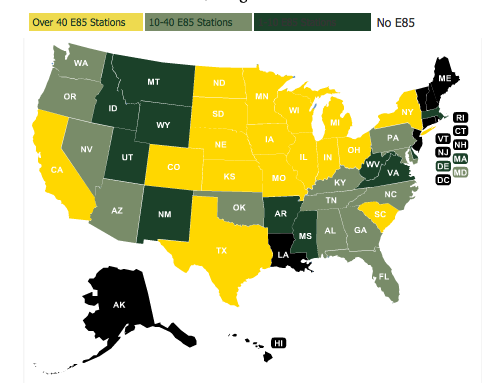
E85 always has limited distribution in the United States. See the follolwing map http://www.greentechmedia.com/images/wysiwyg/research-blogs/blend-wall-visual.jpg. Flex Fuel vehicles sales needed E85 pumps and E85 pumps needed flex fuel vehicles. Most of these pumps are in the rural US.
The US is currently close to the E10 blend wall (we have the capacity make all the ethanol to include in all our gasoline that is 10%) this limits the construction of new ethanol plants. It also limits the construction of new non-corn ethanol plants because the current plant as the existing plants control marginal capacity with existing established plants.
Additionally we are exporting ethanol to Brazil and importing ethanol from Brazil to meet advanced blender credits. http://cornandsoybeandigest.com/energy/us-importing-exporting-ethanol-and-brazil
This is all the result of short sighted incentives. The entire US ethanol market is a mess, however sugar cane shortages in Brazil will keep American corn farmers happy for at least a year. And ethanol plants are now planning to sell off the oil portion of the distillers grains in an attempt to put more to their bottom lines. http://sdcornblog.org/archives/tag/corn-oil
-
Re:If China treats this like they did Solar Panels
Just this month the WTO upheld a 2009 US anti-dumping tariff on imported Chinese tires.
The US solar panel association split a couple of months ago, with US-only companies leaving the original org because its Chinese owned or controlled member corps were preventing the org from getting the US government to oppose China's dumping. The new org has already got the US government working on fighting the dumping.
Dumping happens. This is what it looks like. And this is what it looks like when the US government actually defends the country from foreign competitors attacking us unfairly.
-
Re:Honest Question
Simple Solution, though it will get panned here on
Great - let's start by going after the big wastes in spending - namely cutting defense spending significantly. Once that's done, we can worry about money spent on trying to accelerate development of renewable energy resources.
http://www.greentechmedia.com/articles/read/solyndras-loan-guarantee-vs.-military-boondoggles/
-
Re:Who let the cat out of the bag?
Well, I'm from liberal about-to-legalize-gay-marriage (wo0t!) New York and I think it's a ridiculous waste of money too. 2 Billion dollars for a 500 megawatt generating plant? Please. This is some kind of sick joke.
The 500 MW is obviously peak power output, meaning that average power is going to be 200 MW, TOPS. 2 BILLION dollars for a 150 MW generating station. That's beyond pathetic. A natural gas fired station that provided that kind of power output could be built for 5% of that kind of money. The argument for this being a good investment into the technology is even more absurd. It's just a solar thermal plant using hot oil
In the same program, there seem to be a $2Bn grant to Areva and another 8.3 billion one to Georgia power (you'll have to scroll a bit to get to the table - the article is actually critical of the loan guarantee). And a few hundred million here and there to others. The grant to Abengoa seems to be 1.4 billion, and the other one seems to be $400 million (so, it's about 200 million short of the 2 billion claimed in TFS).
Apparently, Abenoga achieving a 30% higher energy efficiency by changing the design; that's definitely worth a few million right there. The other plant costs $400 million, and it uses 'conventional' solar technology that's been around for decades.
Do I really need to explain what kind of advancements the nuclear fusion community could do with 2 billion dollars? We're right on the edge (like, this year) of demonstrating fusion ignition in the laboratory at the National Ignition Facility, a lab that houses the most powerful laser in the world and the largest, most complicated optical system ever constructed, at a cost barely more than 50% of this useless, make-work, feelgood project. $2 billion could go a long way toward building a gigawatt level power plant demonstration reactor after NIF achieves ignition, instead of wasting it on this nonsense that produces laughably insignificant amounts of energy.
Unfortunately for that argument, fusion always seems 10 years off; right now, I'd rather invest the same money in solar or wind, in hopes of improving efficiency to build plants that we can use in the next two-three years rather than wait for fusion, which is just around the corner. No, really. We haven't achieved energy production yet, but we'll do so if you invest in us exclusively! Just wait and watch!
And until then, continue using coal and natural gas. Oh, and nuclear fission, of course. Except that fission plants are expensive too, and take about 10 years to complete, anyway. Forget investing in anything else!
Thanks, I think I'd rather have an expensive solar plant, as opposed to a non-existent fission plant!
-
Re:Why not more?
It's $2B for these two projects. $30B total, but that includes all 'green technologies', incl. some nuclear power projects and several car projects.