Slashdot Mirror
Domain: heise.de
Stories and comments across the archive that link to heise.de.
Stories · 328
-
Sendo Can't Get Microsoft Source; Ditches Windows
An anonymous submitter wrote: "Just when you thought the award-winning data leech Microsoft had become invincible... cellphone manufacturer Sendo, in a statement on the front page of its web site, announces the termination of its Z100 smartphone development on the Microsoft platform, licensing the rival Symbian from Nokia instead. (Further reports by ZDnet and Heise.)" -
Big Brother Lifetime Award Goes To Microsoft
D4C5CE writes "Microsoft's ceaseless "success" in bringing instability, insecurity and breaches of privacy as well as a deplorable lack of open standards to almost Every Desktop on Earth has now earned them an "Oscar" for Data Leeches, the Lifetime Award for "outstanding mis-achievement" from the BigBrotherAwards 2002 in Germany. Microsoft's Data Protection Officer actually attended the ceremony to collect the prize (probably delighted that unlike the "laureates" of last year's event in Austria, at least he would not receive live cockroaches), and this unlucky winner took the opportunity to make some critical remarks on the company's communications regarding the Windows Media Player and Digital Restrictions (or, euphemistically, in his words: Rights) Management technologies which he deemed crucial for modern business models, rather than acknowledging that it's in fact not just the advertising but the approach itself which is fundamentally flawed." -
Ogg beats MP3 & The Rest In Listening Test
Nice2Cats writes "The Ogg Vorbis format came out far ahead of MP3, MP3Pro, RealAudio Surround, and Windows Media 9 Beta in a comparison of different audio formats by Germany's respected computer magazine c't. More than 6,000 people took part in the test. Heise says Ogg's dominance was most pronounced with 64 kBit/sec samples; the full magazine article (out on Monday) mentions that in pre-tests, some people actually mistook the 128 kBit/sec Ogg samples for the uncoded version. Let's hear it for those strangely named open source file formats!" -
Ogg beats MP3 & The Rest In Listening Test
Nice2Cats writes "The Ogg Vorbis format came out far ahead of MP3, MP3Pro, RealAudio Surround, and Windows Media 9 Beta in a comparison of different audio formats by Germany's respected computer magazine c't. More than 6,000 people took part in the test. Heise says Ogg's dominance was most pronounced with 64 kBit/sec samples; the full magazine article (out on Monday) mentions that in pre-tests, some people actually mistook the 128 kBit/sec Ogg samples for the uncoded version. Let's hear it for those strangely named open source file formats!" -
Slashback: Google, Prince, Bayesian
Updates from the field on Google access in the People's Republic of China, Lance Bass's space-shot (shot down), the gaming ban in Greece, recording artists and Internet music downloads, and more. Read on for the details.Please confirm, over. After reports that the People's Republic of China was blocking access to Google, an anonymous reader writes: "I'm working in China, and for the last 3 days Google and some other sites were not accessible. But since even sending SMS to europe didn't work I don't think it was censoring, more like routing problems of some sort. Anyway, Google is back and reports of slashdot blocking are also overrated :)"
Cradle of Democracy, or Regular Cradle? Many readers have written to point out that, just like they promised to in March, the government of Greece has gone ahead and banned electronic games. xlurker, for instance, writes "In an unbelievable move the Greek government has banned all public play of computer games with enactment of law 3037/2002. An english translation of it can be read here. This has been reported in the Greek newspaper Kathimerini and recently confirmed in detail at the German Heise site (Google translation). The law encompasses all appliances that play games, as ludicrous this sounds, it spans from cells ph ones and computers to gameboys and consoles. Greek internet cafes are protesting and international gaming events are being cancelled and relocate d. The bill was passed as a last ditch effort by the government to combat gambling. Thousands of Greek citizens have protested the blanket anti-gaming law. Online petitions can be found here and at the Greek Net Cafe site."
Welcome to your new email account. In addition to the Bayesian spam filter for Qmail mentioned in a previous Slashback, an anonymous reader writes "An article here talked about using statistical methods to classify spam (and perhaps other mail) automatically. A real implementation of this has been released (currently beta) here that acts as a POP3 proxy and works with any mail client. It inserts an X-Text-Classification: header in each mail message containing a classification of the mail into any of a number of classes that the user defines. The code is mostly Perl and an LGPL library so although the current version is for Windows it will work on other platforms and the author is asking for suggestions and testers."
Yes, I'd like to be paid in unlucky-pop-star weights, please. 21mhz writes "Reuters reports: Russia's space agency has scrapped 'N Sync singer Lance Bass's plans to join an October space mission after the U.S. pop star failed to meet payment deadlines. More details from AP. The guys that do real stuff at ISS will get an extra cargo package the weight of the unlucky pop singer."
And Lo, eleven shall have been selected, and it is so. AmateurHuman writes "After two delays, Wizards of the Coast, the makers of Dungeons & Dragons, have announced that the first stage of the New Fantasy Setting Search is completed. Eleven out of 11,000 entries were selected. Good job to those lucky eleven!"
Slashdot is not responsible for the content of external links. ttyp writes "We've all seen Janis Ian's opinions about P2P and the RIAA but, man, does Prince take it to a new level! Check out the artist's commentary A Nation of Thieves wherein Prince wonders, 'How long, however, b4 a critical mass of established artists realize that it is in their best interests, both artistically and commercially, 2 leave the system 4 good? How long b4 a critical mass of young aspiring artists become aware of the enslaving aspects of the system and r careful not 2 get involved in it without a maximum of precautions? And how long b4 a critical mass of art lovers get 2gether 2 provide these artists with a real, valuable, legitimate, truthfully enthusiastic alternative audience that completes the process of rendering the xisting system artistically irrelevant?' Also check out the links to other commentaries on this page."
-
Draw!
An anonymous reader writes "Heise (publisher of the famous german computer magazine c't) started a most unusual CPU benchmark, today. A dual P4 Xeon 2400 and a dual AthlonMP 2000+ have to prove their abilities to ... play chess! The opponents are running two of the best chess AIs (Previews of Deep Fritz 7 and Shredder 6), so there are four different configurations. With each configuration about 55 matches (~24h) are played. As yet AMD/Fritz is leading, but the benchmark has just started. You can follow the duell online [Sorry, site is in german, but the graphics of the java-applet should be multi-lingual]. What's next? Who wouldn't like to see a Linux/Windows mine sweeper death match!" -
Draw!
An anonymous reader writes "Heise (publisher of the famous german computer magazine c't) started a most unusual CPU benchmark, today. A dual P4 Xeon 2400 and a dual AthlonMP 2000+ have to prove their abilities to ... play chess! The opponents are running two of the best chess AIs (Previews of Deep Fritz 7 and Shredder 6), so there are four different configurations. With each configuration about 55 matches (~24h) are played. As yet AMD/Fritz is leading, but the benchmark has just started. You can follow the duell online [Sorry, site is in german, but the graphics of the java-applet should be multi-lingual]. What's next? Who wouldn't like to see a Linux/Windows mine sweeper death match!" -
Draw!
An anonymous reader writes "Heise (publisher of the famous german computer magazine c't) started a most unusual CPU benchmark, today. A dual P4 Xeon 2400 and a dual AthlonMP 2000+ have to prove their abilities to ... play chess! The opponents are running two of the best chess AIs (Previews of Deep Fritz 7 and Shredder 6), so there are four different configurations. With each configuration about 55 matches (~24h) are played. As yet AMD/Fritz is leading, but the benchmark has just started. You can follow the duell online [Sorry, site is in german, but the graphics of the java-applet should be multi-lingual]. What's next? Who wouldn't like to see a Linux/Windows mine sweeper death match!" -
EU to Require Opt-In for Commercial Email
D4C5CE writes "EuroCAUCE (Usenet message below) and Heise (in German) report that the European Parliament has voted to ban spam by adopting the "opt-in" system for unsolicited commercial email, finally freeing the way for the entry into force of a "European Parliament and Council directive concerning the processing of personal data and the protection of privacy in the electronic communications sector". The news of the parliamentary U-turn comes after a recommendation by the "Committee on Citizens' Freedoms and Rights, Justice and Home Affairs" to permit "opt-out" marketing had received critical coverage, causing countless spam victims world-wide to alert the Members of the European Parliament to the big mistake they were about to make, and it is hoped to become the useful precedent of a workable approach for US lawmakers currently evaluating means to regulate spam as well." The Parliament's daily notebook has an overview. Individual EU countries still have to implement this with legislation before it is effective.From: Beebit <beebit-u03@euro.cauce.org>
Newsgroups: news.admin.net-abuse.email, talk.politics.european-union
Subject: European Parliament Supports 'Opt-In' for Commercial Email
Date: Thu, 30 May 2002 13:08:11 +0200
The European Parliament has decided to accept the Council's Common Position which would require senders of advertisements by "electronic mail" to have the recipient's prior consent. "Electronic mail" is defined broadly enough so as to include text messaging systems based on mobile telephony in addition to email.
The 'opt-in' requirement for electronic mail will be in Article 13, Paragraph 1 of the new Directive concerning the processing of personal data and the protection of privacy in the electronic communications sector which will enter into force following its publication in the Official Journal. The Directive will guide the enactment of legislation throughout the European Economic Area, which includes the 15 EU Member States and European Free Trade Association members Norway, Iceland, and Liechtenstein. EU Members Austria, Denmark, Finland, Germany, Greece, and Italy as well as EFTA member Norway had already implemented 'opt-in' in their national legislation.
Further provisions in the same Article would allow companies to send advertising via email for their own products or services of a similar category to addresses which they had obtained in the course of a sale, unless and until the customer has registered an objection. Customers are to be given the opportunity to object "free of charge and in an easy manner" both at the time the contact details are collected and with each advertising message.
All in all, is an extremely welcome development, and should serve as an example and inspiration for legislators in other territories. We are absolutely delighted to see Parliament joining the Commission and the Council in taking a stand to protect European consumers and network users. It only remains to extend similar protection to corporate citizens. This will probably have to be within the framework of other legislation than that pertaining to the processing of "personal data".
~~~
The European Coalition Against Unsolicited Commercial Email is an all-volunteer, ad-hoc grouping of Internet users and professionals dedicated to bringing about an end to an unethical practice by technical and legislative means. http://www.euro.cauce.org/en/ -
EU to Require Opt-In for Commercial Email
D4C5CE writes "EuroCAUCE (Usenet message below) and Heise (in German) report that the European Parliament has voted to ban spam by adopting the "opt-in" system for unsolicited commercial email, finally freeing the way for the entry into force of a "European Parliament and Council directive concerning the processing of personal data and the protection of privacy in the electronic communications sector". The news of the parliamentary U-turn comes after a recommendation by the "Committee on Citizens' Freedoms and Rights, Justice and Home Affairs" to permit "opt-out" marketing had received critical coverage, causing countless spam victims world-wide to alert the Members of the European Parliament to the big mistake they were about to make, and it is hoped to become the useful precedent of a workable approach for US lawmakers currently evaluating means to regulate spam as well." The Parliament's daily notebook has an overview. Individual EU countries still have to implement this with legislation before it is effective.From: Beebit <beebit-u03@euro.cauce.org>
Newsgroups: news.admin.net-abuse.email, talk.politics.european-union
Subject: European Parliament Supports 'Opt-In' for Commercial Email
Date: Thu, 30 May 2002 13:08:11 +0200
The European Parliament has decided to accept the Council's Common Position which would require senders of advertisements by "electronic mail" to have the recipient's prior consent. "Electronic mail" is defined broadly enough so as to include text messaging systems based on mobile telephony in addition to email.
The 'opt-in' requirement for electronic mail will be in Article 13, Paragraph 1 of the new Directive concerning the processing of personal data and the protection of privacy in the electronic communications sector which will enter into force following its publication in the Official Journal. The Directive will guide the enactment of legislation throughout the European Economic Area, which includes the 15 EU Member States and European Free Trade Association members Norway, Iceland, and Liechtenstein. EU Members Austria, Denmark, Finland, Germany, Greece, and Italy as well as EFTA member Norway had already implemented 'opt-in' in their national legislation.
Further provisions in the same Article would allow companies to send advertising via email for their own products or services of a similar category to addresses which they had obtained in the course of a sale, unless and until the customer has registered an objection. Customers are to be given the opportunity to object "free of charge and in an easy manner" both at the time the contact details are collected and with each advertising message.
All in all, is an extremely welcome development, and should serve as an example and inspiration for legislators in other territories. We are absolutely delighted to see Parliament joining the Commission and the Council in taking a stand to protect European consumers and network users. It only remains to extend similar protection to corporate citizens. This will probably have to be within the framework of other legislation than that pertaining to the processing of "personal data".
~~~
The European Coalition Against Unsolicited Commercial Email is an all-volunteer, ad-hoc grouping of Internet users and professionals dedicated to bringing about an end to an unethical practice by technical and legislative means. http://www.euro.cauce.org/en/ -
Swiss ISPs Must Archive E-mail For 6 Months
the_danielsan writes: "I first thought this (this ain't yellow press) would be a joke, but apparently swiss ISPs are now enforced to monitor all outgoing mails up to a period of 6 month - at their own cost! sunrise, a larger ISP, speaks of 50,000 to 100,000 CHF (that's about 31,405 to 62,810 USD according to my currency calculator) to update their systems. heise Newsticker has the same story running (both German). I can't believe this." For non-German readers, babelfish does a decent job with these articles. -
German Elections Go Open Source
Get Behind the Mule writes "The Heise news ticker is reporting that the software used by the German government to handle the results of the Bundestag election (that's the national parliament) on September 22nd will be based on open source platforms. The system will be written in Java and deploy Tomcat, JBoss and MySQL, and is being developed by the Berlin software firm IVU (here's their press release), working with the Statisches Bundesamt (the federal statistics office). It's not clear from the announcements whether the source code of the application itself, and not just the servers it runs on, will be publically available. Nevertheless, one is reminded of the argument of Peruvian congressman Dr. Edgar David Villanueva Nuñez (seen recently in Slashdot) that open source software enables citizens of a democracy to see for themselves whether the work of government, such as elections, is conducted as it should be. All of the announcements are in German, so go fish. The software, as described in the announcements, will compute preliminary results (which are announced as soon as possible after the polls close), run plausibility checks, and determine the Bundestag membership as well as distribution of seats to the political parties. It will use web clients for entry of voting data, data import, presentation of results, and preparation of printed results. It will be based on a three-level architecture (apparently standard J2EE) and deploy Enterprise Java Beans." -
German Elections Go Open Source
Get Behind the Mule writes "The Heise news ticker is reporting that the software used by the German government to handle the results of the Bundestag election (that's the national parliament) on September 22nd will be based on open source platforms. The system will be written in Java and deploy Tomcat, JBoss and MySQL, and is being developed by the Berlin software firm IVU (here's their press release), working with the Statisches Bundesamt (the federal statistics office). It's not clear from the announcements whether the source code of the application itself, and not just the servers it runs on, will be publically available. Nevertheless, one is reminded of the argument of Peruvian congressman Dr. Edgar David Villanueva Nuñez (seen recently in Slashdot) that open source software enables citizens of a democracy to see for themselves whether the work of government, such as elections, is conducted as it should be. All of the announcements are in German, so go fish. The software, as described in the announcements, will compute preliminary results (which are announced as soon as possible after the polls close), run plausibility checks, and determine the Bundestag membership as well as distribution of seats to the political parties. It will use web clients for entry of voting data, data import, presentation of results, and preparation of printed results. It will be based on a three-level architecture (apparently standard J2EE) and deploy Enterprise Java Beans." -
Gigahertz Mac Finally SPEC'd
FrkyD writes "C't magazine puplished a story with the results of a test they designed using a Mac OS X-adapted benchmark suite by the Standard Performance Evaluation Corporation (SPEC) entitled CPU2000. SPEC allows comparisons to be made within a certain framework with the Intel competition. They compared the G4/1 GHz running Mac OS X with a PIII/1 GHz (Coppermine) running Windows and Linux." -
Gigahertz Mac Finally SPEC'd
FrkyD writes "C't magazine puplished a story with the results of a test they designed using a Mac OS X-adapted benchmark suite by the Standard Performance Evaluation Corporation (SPEC) entitled CPU2000. SPEC allows comparisons to be made within a certain framework with the Intel competition. They compared the G4/1 GHz running Mac OS X with a PIII/1 GHz (Coppermine) running Windows and Linux." -
Slashback: Decade, Fragmentation, RDRAM
Slashback brings you updates and amplifications on the SSSCA, the future of RAMBUS and Intel, fragmentation of filesystems, a book reviewer who's been publishing online longer than some slashdot readers have walked erect, and more. Read on for the details.A screenplay written by Jack Valenti? cc_pirate writes: "Apparently Sen. Fritz Hollings (D - Disney, er - SC) completed his hearings today on how the media needs to have content protection included in computers. Intel and other high tech companies resist and are chastized by Hollings."
Penguins are the new Turtles. Gerein writes "After many months of extreme lobbying, personal attacks, public petitions and surveys, the war over the future OS of the Bundestag (German parliament) is finally over (previous /. stories). As heise reports (in german, use the fish) Linux won't make it to the desktops (they're going with XP) but will take over the 150 servers. The last critical question over the directory service has finally been decided in favor to OpenLDAP instead of Active Directory. It's not the complete victory for Linux, many had hoped for, but it's a start for more Open Source in the German government."
Full disclosure seems like a nice idea. Merlynnus writes: "Yahoo! is running a story, Copy-protected CD makers lose battle, in which Music City Records, Fahrenheit Entertainment and digital rights management company Sunncomm have 'agreed' to stop collecting personal info, and to label copy-protected CDs as defective, er, play-challenged in certain devices. The agreement came as the result of court action by a Cali resident, Karen DeLise, over the Charlie Pride CD, 'Charley Pride: A Tribute to Jim Reeves.' Did that CD really need copy-protecting?"
This should have been transparent. Metrollica writes: "It turns out the transparent aluminium article at Spiegel was misunderstood. Sci-fighter published a correction. The transparent substance was not aluminium but alumina, shorthand for aluminium oxide. Slashdot reported on transparent aluminium here."
Odds are, somebody's written a thesis on it ... and here one is. Whether in response to this Ask Slashdot question or just a lucky guesser, Cine writes: "The standard filesystem benchmarking tools such as Bonnie++, Postmark , Mongo and others all test the optimum case for the block layouting algorithm. But in practice one also is interested to know how a filesystem performs when it is or was heavily used over a longer period (e.g. months and years).So Constantin Loizides has written a Master Thesis about the performance of filesystems under the influence of fragmentation."
Intel-Rambus break not as simple as portrayed. Controlio writes: "Tom's Hardware Guide has posted a clarification regarding the EBN story with the sensational headline, 'Intel to drop support of Rambus in new CPU products'. The article was also posted on Slashdot. Tom reports:
EBN had the sensational headline Intel to drop support of Rambus in new CPU products, but the story goes on to say, "Intel will continue using Direct Rambus memory with its network processors. Also, although not new products, the next iterations of its 850 and 860 chipsets, supporting a 533MHz front-side, will support RDRAM when they arrive, probably in the second half of this year." A little misleading, wouldn't you say? Hard to tell, but you read it for yourself, and make your own call.
Great. More sensational journalism. Maybe someone should submit Jack Robertson's resume to Fox News."Finally, some congratulations are in order. danny writes (does he ever): "February 28th marks the 10th anniversary of my first book review; there are now over six hundred. I have written an account of ten years writing book reviews, which illustrates something of how online publication has changed over the years."
-
Slashback: Decade, Fragmentation, RDRAM
Slashback brings you updates and amplifications on the SSSCA, the future of RAMBUS and Intel, fragmentation of filesystems, a book reviewer who's been publishing online longer than some slashdot readers have walked erect, and more. Read on for the details.A screenplay written by Jack Valenti? cc_pirate writes: "Apparently Sen. Fritz Hollings (D - Disney, er - SC) completed his hearings today on how the media needs to have content protection included in computers. Intel and other high tech companies resist and are chastized by Hollings."
Penguins are the new Turtles. Gerein writes "After many months of extreme lobbying, personal attacks, public petitions and surveys, the war over the future OS of the Bundestag (German parliament) is finally over (previous /. stories). As heise reports (in german, use the fish) Linux won't make it to the desktops (they're going with XP) but will take over the 150 servers. The last critical question over the directory service has finally been decided in favor to OpenLDAP instead of Active Directory. It's not the complete victory for Linux, many had hoped for, but it's a start for more Open Source in the German government."
Full disclosure seems like a nice idea. Merlynnus writes: "Yahoo! is running a story, Copy-protected CD makers lose battle, in which Music City Records, Fahrenheit Entertainment and digital rights management company Sunncomm have 'agreed' to stop collecting personal info, and to label copy-protected CDs as defective, er, play-challenged in certain devices. The agreement came as the result of court action by a Cali resident, Karen DeLise, over the Charlie Pride CD, 'Charley Pride: A Tribute to Jim Reeves.' Did that CD really need copy-protecting?"
This should have been transparent. Metrollica writes: "It turns out the transparent aluminium article at Spiegel was misunderstood. Sci-fighter published a correction. The transparent substance was not aluminium but alumina, shorthand for aluminium oxide. Slashdot reported on transparent aluminium here."
Odds are, somebody's written a thesis on it ... and here one is. Whether in response to this Ask Slashdot question or just a lucky guesser, Cine writes: "The standard filesystem benchmarking tools such as Bonnie++, Postmark , Mongo and others all test the optimum case for the block layouting algorithm. But in practice one also is interested to know how a filesystem performs when it is or was heavily used over a longer period (e.g. months and years).So Constantin Loizides has written a Master Thesis about the performance of filesystems under the influence of fragmentation."
Intel-Rambus break not as simple as portrayed. Controlio writes: "Tom's Hardware Guide has posted a clarification regarding the EBN story with the sensational headline, 'Intel to drop support of Rambus in new CPU products'. The article was also posted on Slashdot. Tom reports:
EBN had the sensational headline Intel to drop support of Rambus in new CPU products, but the story goes on to say, "Intel will continue using Direct Rambus memory with its network processors. Also, although not new products, the next iterations of its 850 and 860 chipsets, supporting a 533MHz front-side, will support RDRAM when they arrive, probably in the second half of this year." A little misleading, wouldn't you say? Hard to tell, but you read it for yourself, and make your own call.
Great. More sensational journalism. Maybe someone should submit Jack Robertson's resume to Fox News."Finally, some congratulations are in order. danny writes (does he ever): "February 28th marks the 10th anniversary of my first book review; there are now over six hundred. I have written an account of ten years writing book reviews, which illustrates something of how online publication has changed over the years."
-
Slashback: Decade, Fragmentation, RDRAM
Slashback brings you updates and amplifications on the SSSCA, the future of RAMBUS and Intel, fragmentation of filesystems, a book reviewer who's been publishing online longer than some slashdot readers have walked erect, and more. Read on for the details.A screenplay written by Jack Valenti? cc_pirate writes: "Apparently Sen. Fritz Hollings (D - Disney, er - SC) completed his hearings today on how the media needs to have content protection included in computers. Intel and other high tech companies resist and are chastized by Hollings."
Penguins are the new Turtles. Gerein writes "After many months of extreme lobbying, personal attacks, public petitions and surveys, the war over the future OS of the Bundestag (German parliament) is finally over (previous /. stories). As heise reports (in german, use the fish) Linux won't make it to the desktops (they're going with XP) but will take over the 150 servers. The last critical question over the directory service has finally been decided in favor to OpenLDAP instead of Active Directory. It's not the complete victory for Linux, many had hoped for, but it's a start for more Open Source in the German government."
Full disclosure seems like a nice idea. Merlynnus writes: "Yahoo! is running a story, Copy-protected CD makers lose battle, in which Music City Records, Fahrenheit Entertainment and digital rights management company Sunncomm have 'agreed' to stop collecting personal info, and to label copy-protected CDs as defective, er, play-challenged in certain devices. The agreement came as the result of court action by a Cali resident, Karen DeLise, over the Charlie Pride CD, 'Charley Pride: A Tribute to Jim Reeves.' Did that CD really need copy-protecting?"
This should have been transparent. Metrollica writes: "It turns out the transparent aluminium article at Spiegel was misunderstood. Sci-fighter published a correction. The transparent substance was not aluminium but alumina, shorthand for aluminium oxide. Slashdot reported on transparent aluminium here."
Odds are, somebody's written a thesis on it ... and here one is. Whether in response to this Ask Slashdot question or just a lucky guesser, Cine writes: "The standard filesystem benchmarking tools such as Bonnie++, Postmark , Mongo and others all test the optimum case for the block layouting algorithm. But in practice one also is interested to know how a filesystem performs when it is or was heavily used over a longer period (e.g. months and years).So Constantin Loizides has written a Master Thesis about the performance of filesystems under the influence of fragmentation."
Intel-Rambus break not as simple as portrayed. Controlio writes: "Tom's Hardware Guide has posted a clarification regarding the EBN story with the sensational headline, 'Intel to drop support of Rambus in new CPU products'. The article was also posted on Slashdot. Tom reports:
EBN had the sensational headline Intel to drop support of Rambus in new CPU products, but the story goes on to say, "Intel will continue using Direct Rambus memory with its network processors. Also, although not new products, the next iterations of its 850 and 860 chipsets, supporting a 533MHz front-side, will support RDRAM when they arrive, probably in the second half of this year." A little misleading, wouldn't you say? Hard to tell, but you read it for yourself, and make your own call.
Great. More sensational journalism. Maybe someone should submit Jack Robertson's resume to Fox News."Finally, some congratulations are in order. danny writes (does he ever): "February 28th marks the 10th anniversary of my first book review; there are now over six hundred. I have written an account of ten years writing book reviews, which illustrates something of how online publication has changed over the years."
-
Slashback: Bundestux, Kerberos, Blizzard
Slashback tonight with several updates and amplifications, starting with a nice report on the current state of the effort to put Linux into the heart of the German government, but also bits on Starcraft, cleaning up UNIX config, and Kerberos.This deserves a hearty 'Jawohl!' DocSnyder writes: "Since the Bundestux campaign started collecting votes in favor of putting Free Software into the German parliament (Bundestag), more than 25000 people have done so. A lot of online discussions - in addition to Heise News and Linux-Community.de, even some Bundestag parties have put up their online forums - are very active to share user experience about GNU/Linux and Free Software. (Sorry for most of the linked sites speaking German, it's simply too much to translate at once.)
After several open letters and press releases have been exchanged between lobbyists and politicians, some information about a research performed by the German company Infora appeared on Heise News (english version), recommending an all-Microsoft infrastructure with the exception of some security-critical services like e-mail. The detailed paper is still not available.
An internal test (english version) between the Bundestag administration, SuSE, IBM and Microsoft confirmed that GNU/Linux and Free Software are in fact ready for the Bundestag's IT infrastructure, yet the testers don't like the copy&paste method used by KDE and recommend Windows for the desktops.
Last week, the Bundestag members (MdB) Jörg Tauss and Hans-Joachim Otto have been invited by Heise for an online chat with the community. While Jörg Tauss is a clear supporter of open standards and Free Software, Hans-Joachim Otto takes the internal test as well as Infora's research as primarily relevant for the coming decision.
On Saturday, MdB Uwe Küster summarized some details in an interview. He considered the decision - officially due Feb 28 - as almost finalized. The solution would show GNU/Linux on most servers, Windows XP and Office XP on the desktops, keeping proprietary data formats and lock-in interfaces up to the next upgrade cycle, which in fact would have been problem number one to solve.
All in all, the community has provided lots of experience, ideas and solution paths which finally seem to be largely ignored in the decision finding process towards the successor of a homogenous Microsoft Windows NT4 infrastructure, which has to be replaced until 2003 when Microsoft will no longer provide support for NT4."
That's a lot of cleaning up to do! maffew writes "A lot of feedback and ideas have been flying around since my article How to fix the Unix configuration nighmare was featured on freshmeat and slashdot. So we've created an ongoing web site and mailing list for people to continue discussing, organising, and hopefully in the end coding. It's all at unixconfig.sourceforge.net.
Meanwhile here's a link to the permanent home for the nightmare article. This is where I'm making revisions and adding links."
Raise your hand if this would mean seeing it for the 4th time ... Chris Brewer writes "In case you've been living on a different planet, The Fellowship of the Ring picked up Five Baftas, the British equivalent of the Oscars, including Best Director, Best Film, and Peoples Choice. During a live interview (Real only) after the awards, Peter Jackson announces that a preview for The Two Towers will be shown from the March 22 screenings of The Fellowship."
At long last ... something? If you've followed the strange relationship Microsoft has had with Kerberos, you may feel grateful to the anonymous coward who writes: "It would seem that Microsoft is granting the world a royalty-free, non-exclusive license to implement their Kerberos extension."
Here's some comfort for Starcraft players. An Anonymous Coward writes "As stated on Blizzard's battle.net service, the latest Starcraft patch supports UDP play, so some of the compelling reasons to use bnetd have been addressed. Whatever you may think of Blizzard and the DMCA, at least it shows Blizzard is listening to its fans."
-
Slashback: Bundestux, Kerberos, Blizzard
Slashback tonight with several updates and amplifications, starting with a nice report on the current state of the effort to put Linux into the heart of the German government, but also bits on Starcraft, cleaning up UNIX config, and Kerberos.This deserves a hearty 'Jawohl!' DocSnyder writes: "Since the Bundestux campaign started collecting votes in favor of putting Free Software into the German parliament (Bundestag), more than 25000 people have done so. A lot of online discussions - in addition to Heise News and Linux-Community.de, even some Bundestag parties have put up their online forums - are very active to share user experience about GNU/Linux and Free Software. (Sorry for most of the linked sites speaking German, it's simply too much to translate at once.)
After several open letters and press releases have been exchanged between lobbyists and politicians, some information about a research performed by the German company Infora appeared on Heise News (english version), recommending an all-Microsoft infrastructure with the exception of some security-critical services like e-mail. The detailed paper is still not available.
An internal test (english version) between the Bundestag administration, SuSE, IBM and Microsoft confirmed that GNU/Linux and Free Software are in fact ready for the Bundestag's IT infrastructure, yet the testers don't like the copy&paste method used by KDE and recommend Windows for the desktops.
Last week, the Bundestag members (MdB) Jörg Tauss and Hans-Joachim Otto have been invited by Heise for an online chat with the community. While Jörg Tauss is a clear supporter of open standards and Free Software, Hans-Joachim Otto takes the internal test as well as Infora's research as primarily relevant for the coming decision.
On Saturday, MdB Uwe Küster summarized some details in an interview. He considered the decision - officially due Feb 28 - as almost finalized. The solution would show GNU/Linux on most servers, Windows XP and Office XP on the desktops, keeping proprietary data formats and lock-in interfaces up to the next upgrade cycle, which in fact would have been problem number one to solve.
All in all, the community has provided lots of experience, ideas and solution paths which finally seem to be largely ignored in the decision finding process towards the successor of a homogenous Microsoft Windows NT4 infrastructure, which has to be replaced until 2003 when Microsoft will no longer provide support for NT4."
That's a lot of cleaning up to do! maffew writes "A lot of feedback and ideas have been flying around since my article How to fix the Unix configuration nighmare was featured on freshmeat and slashdot. So we've created an ongoing web site and mailing list for people to continue discussing, organising, and hopefully in the end coding. It's all at unixconfig.sourceforge.net.
Meanwhile here's a link to the permanent home for the nightmare article. This is where I'm making revisions and adding links."
Raise your hand if this would mean seeing it for the 4th time ... Chris Brewer writes "In case you've been living on a different planet, The Fellowship of the Ring picked up Five Baftas, the British equivalent of the Oscars, including Best Director, Best Film, and Peoples Choice. During a live interview (Real only) after the awards, Peter Jackson announces that a preview for The Two Towers will be shown from the March 22 screenings of The Fellowship."
At long last ... something? If you've followed the strange relationship Microsoft has had with Kerberos, you may feel grateful to the anonymous coward who writes: "It would seem that Microsoft is granting the world a royalty-free, non-exclusive license to implement their Kerberos extension."
Here's some comfort for Starcraft players. An Anonymous Coward writes "As stated on Blizzard's battle.net service, the latest Starcraft patch supports UDP play, so some of the compelling reasons to use bnetd have been addressed. Whatever you may think of Blizzard and the DMCA, at least it shows Blizzard is listening to its fans."
-
Slashback: Bundestux, Kerberos, Blizzard
Slashback tonight with several updates and amplifications, starting with a nice report on the current state of the effort to put Linux into the heart of the German government, but also bits on Starcraft, cleaning up UNIX config, and Kerberos.This deserves a hearty 'Jawohl!' DocSnyder writes: "Since the Bundestux campaign started collecting votes in favor of putting Free Software into the German parliament (Bundestag), more than 25000 people have done so. A lot of online discussions - in addition to Heise News and Linux-Community.de, even some Bundestag parties have put up their online forums - are very active to share user experience about GNU/Linux and Free Software. (Sorry for most of the linked sites speaking German, it's simply too much to translate at once.)
After several open letters and press releases have been exchanged between lobbyists and politicians, some information about a research performed by the German company Infora appeared on Heise News (english version), recommending an all-Microsoft infrastructure with the exception of some security-critical services like e-mail. The detailed paper is still not available.
An internal test (english version) between the Bundestag administration, SuSE, IBM and Microsoft confirmed that GNU/Linux and Free Software are in fact ready for the Bundestag's IT infrastructure, yet the testers don't like the copy&paste method used by KDE and recommend Windows for the desktops.
Last week, the Bundestag members (MdB) Jörg Tauss and Hans-Joachim Otto have been invited by Heise for an online chat with the community. While Jörg Tauss is a clear supporter of open standards and Free Software, Hans-Joachim Otto takes the internal test as well as Infora's research as primarily relevant for the coming decision.
On Saturday, MdB Uwe Küster summarized some details in an interview. He considered the decision - officially due Feb 28 - as almost finalized. The solution would show GNU/Linux on most servers, Windows XP and Office XP on the desktops, keeping proprietary data formats and lock-in interfaces up to the next upgrade cycle, which in fact would have been problem number one to solve.
All in all, the community has provided lots of experience, ideas and solution paths which finally seem to be largely ignored in the decision finding process towards the successor of a homogenous Microsoft Windows NT4 infrastructure, which has to be replaced until 2003 when Microsoft will no longer provide support for NT4."
That's a lot of cleaning up to do! maffew writes "A lot of feedback and ideas have been flying around since my article How to fix the Unix configuration nighmare was featured on freshmeat and slashdot. So we've created an ongoing web site and mailing list for people to continue discussing, organising, and hopefully in the end coding. It's all at unixconfig.sourceforge.net.
Meanwhile here's a link to the permanent home for the nightmare article. This is where I'm making revisions and adding links."
Raise your hand if this would mean seeing it for the 4th time ... Chris Brewer writes "In case you've been living on a different planet, The Fellowship of the Ring picked up Five Baftas, the British equivalent of the Oscars, including Best Director, Best Film, and Peoples Choice. During a live interview (Real only) after the awards, Peter Jackson announces that a preview for The Two Towers will be shown from the March 22 screenings of The Fellowship."
At long last ... something? If you've followed the strange relationship Microsoft has had with Kerberos, you may feel grateful to the anonymous coward who writes: "It would seem that Microsoft is granting the world a royalty-free, non-exclusive license to implement their Kerberos extension."
Here's some comfort for Starcraft players. An Anonymous Coward writes "As stated on Blizzard's battle.net service, the latest Starcraft patch supports UDP play, so some of the compelling reasons to use bnetd have been addressed. Whatever you may think of Blizzard and the DMCA, at least it shows Blizzard is listening to its fans."
-
Slashback: Bundestux, Kerberos, Blizzard
Slashback tonight with several updates and amplifications, starting with a nice report on the current state of the effort to put Linux into the heart of the German government, but also bits on Starcraft, cleaning up UNIX config, and Kerberos.This deserves a hearty 'Jawohl!' DocSnyder writes: "Since the Bundestux campaign started collecting votes in favor of putting Free Software into the German parliament (Bundestag), more than 25000 people have done so. A lot of online discussions - in addition to Heise News and Linux-Community.de, even some Bundestag parties have put up their online forums - are very active to share user experience about GNU/Linux and Free Software. (Sorry for most of the linked sites speaking German, it's simply too much to translate at once.)
After several open letters and press releases have been exchanged between lobbyists and politicians, some information about a research performed by the German company Infora appeared on Heise News (english version), recommending an all-Microsoft infrastructure with the exception of some security-critical services like e-mail. The detailed paper is still not available.
An internal test (english version) between the Bundestag administration, SuSE, IBM and Microsoft confirmed that GNU/Linux and Free Software are in fact ready for the Bundestag's IT infrastructure, yet the testers don't like the copy&paste method used by KDE and recommend Windows for the desktops.
Last week, the Bundestag members (MdB) Jörg Tauss and Hans-Joachim Otto have been invited by Heise for an online chat with the community. While Jörg Tauss is a clear supporter of open standards and Free Software, Hans-Joachim Otto takes the internal test as well as Infora's research as primarily relevant for the coming decision.
On Saturday, MdB Uwe Küster summarized some details in an interview. He considered the decision - officially due Feb 28 - as almost finalized. The solution would show GNU/Linux on most servers, Windows XP and Office XP on the desktops, keeping proprietary data formats and lock-in interfaces up to the next upgrade cycle, which in fact would have been problem number one to solve.
All in all, the community has provided lots of experience, ideas and solution paths which finally seem to be largely ignored in the decision finding process towards the successor of a homogenous Microsoft Windows NT4 infrastructure, which has to be replaced until 2003 when Microsoft will no longer provide support for NT4."
That's a lot of cleaning up to do! maffew writes "A lot of feedback and ideas have been flying around since my article How to fix the Unix configuration nighmare was featured on freshmeat and slashdot. So we've created an ongoing web site and mailing list for people to continue discussing, organising, and hopefully in the end coding. It's all at unixconfig.sourceforge.net.
Meanwhile here's a link to the permanent home for the nightmare article. This is where I'm making revisions and adding links."
Raise your hand if this would mean seeing it for the 4th time ... Chris Brewer writes "In case you've been living on a different planet, The Fellowship of the Ring picked up Five Baftas, the British equivalent of the Oscars, including Best Director, Best Film, and Peoples Choice. During a live interview (Real only) after the awards, Peter Jackson announces that a preview for The Two Towers will be shown from the March 22 screenings of The Fellowship."
At long last ... something? If you've followed the strange relationship Microsoft has had with Kerberos, you may feel grateful to the anonymous coward who writes: "It would seem that Microsoft is granting the world a royalty-free, non-exclusive license to implement their Kerberos extension."
Here's some comfort for Starcraft players. An Anonymous Coward writes "As stated on Blizzard's battle.net service, the latest Starcraft patch supports UDP play, so some of the compelling reasons to use bnetd have been addressed. Whatever you may think of Blizzard and the DMCA, at least it shows Blizzard is listening to its fans."
-
Slashback: Bundestux, Kerberos, Blizzard
Slashback tonight with several updates and amplifications, starting with a nice report on the current state of the effort to put Linux into the heart of the German government, but also bits on Starcraft, cleaning up UNIX config, and Kerberos.This deserves a hearty 'Jawohl!' DocSnyder writes: "Since the Bundestux campaign started collecting votes in favor of putting Free Software into the German parliament (Bundestag), more than 25000 people have done so. A lot of online discussions - in addition to Heise News and Linux-Community.de, even some Bundestag parties have put up their online forums - are very active to share user experience about GNU/Linux and Free Software. (Sorry for most of the linked sites speaking German, it's simply too much to translate at once.)
After several open letters and press releases have been exchanged between lobbyists and politicians, some information about a research performed by the German company Infora appeared on Heise News (english version), recommending an all-Microsoft infrastructure with the exception of some security-critical services like e-mail. The detailed paper is still not available.
An internal test (english version) between the Bundestag administration, SuSE, IBM and Microsoft confirmed that GNU/Linux and Free Software are in fact ready for the Bundestag's IT infrastructure, yet the testers don't like the copy&paste method used by KDE and recommend Windows for the desktops.
Last week, the Bundestag members (MdB) Jörg Tauss and Hans-Joachim Otto have been invited by Heise for an online chat with the community. While Jörg Tauss is a clear supporter of open standards and Free Software, Hans-Joachim Otto takes the internal test as well as Infora's research as primarily relevant for the coming decision.
On Saturday, MdB Uwe Küster summarized some details in an interview. He considered the decision - officially due Feb 28 - as almost finalized. The solution would show GNU/Linux on most servers, Windows XP and Office XP on the desktops, keeping proprietary data formats and lock-in interfaces up to the next upgrade cycle, which in fact would have been problem number one to solve.
All in all, the community has provided lots of experience, ideas and solution paths which finally seem to be largely ignored in the decision finding process towards the successor of a homogenous Microsoft Windows NT4 infrastructure, which has to be replaced until 2003 when Microsoft will no longer provide support for NT4."
That's a lot of cleaning up to do! maffew writes "A lot of feedback and ideas have been flying around since my article How to fix the Unix configuration nighmare was featured on freshmeat and slashdot. So we've created an ongoing web site and mailing list for people to continue discussing, organising, and hopefully in the end coding. It's all at unixconfig.sourceforge.net.
Meanwhile here's a link to the permanent home for the nightmare article. This is where I'm making revisions and adding links."
Raise your hand if this would mean seeing it for the 4th time ... Chris Brewer writes "In case you've been living on a different planet, The Fellowship of the Ring picked up Five Baftas, the British equivalent of the Oscars, including Best Director, Best Film, and Peoples Choice. During a live interview (Real only) after the awards, Peter Jackson announces that a preview for The Two Towers will be shown from the March 22 screenings of The Fellowship."
At long last ... something? If you've followed the strange relationship Microsoft has had with Kerberos, you may feel grateful to the anonymous coward who writes: "It would seem that Microsoft is granting the world a royalty-free, non-exclusive license to implement their Kerberos extension."
Here's some comfort for Starcraft players. An Anonymous Coward writes "As stated on Blizzard's battle.net service, the latest Starcraft patch supports UDP play, so some of the compelling reasons to use bnetd have been addressed. Whatever you may think of Blizzard and the DMCA, at least it shows Blizzard is listening to its fans."
-
Slashback: Bundestux, Kerberos, Blizzard
Slashback tonight with several updates and amplifications, starting with a nice report on the current state of the effort to put Linux into the heart of the German government, but also bits on Starcraft, cleaning up UNIX config, and Kerberos.This deserves a hearty 'Jawohl!' DocSnyder writes: "Since the Bundestux campaign started collecting votes in favor of putting Free Software into the German parliament (Bundestag), more than 25000 people have done so. A lot of online discussions - in addition to Heise News and Linux-Community.de, even some Bundestag parties have put up their online forums - are very active to share user experience about GNU/Linux and Free Software. (Sorry for most of the linked sites speaking German, it's simply too much to translate at once.)
After several open letters and press releases have been exchanged between lobbyists and politicians, some information about a research performed by the German company Infora appeared on Heise News (english version), recommending an all-Microsoft infrastructure with the exception of some security-critical services like e-mail. The detailed paper is still not available.
An internal test (english version) between the Bundestag administration, SuSE, IBM and Microsoft confirmed that GNU/Linux and Free Software are in fact ready for the Bundestag's IT infrastructure, yet the testers don't like the copy&paste method used by KDE and recommend Windows for the desktops.
Last week, the Bundestag members (MdB) Jörg Tauss and Hans-Joachim Otto have been invited by Heise for an online chat with the community. While Jörg Tauss is a clear supporter of open standards and Free Software, Hans-Joachim Otto takes the internal test as well as Infora's research as primarily relevant for the coming decision.
On Saturday, MdB Uwe Küster summarized some details in an interview. He considered the decision - officially due Feb 28 - as almost finalized. The solution would show GNU/Linux on most servers, Windows XP and Office XP on the desktops, keeping proprietary data formats and lock-in interfaces up to the next upgrade cycle, which in fact would have been problem number one to solve.
All in all, the community has provided lots of experience, ideas and solution paths which finally seem to be largely ignored in the decision finding process towards the successor of a homogenous Microsoft Windows NT4 infrastructure, which has to be replaced until 2003 when Microsoft will no longer provide support for NT4."
That's a lot of cleaning up to do! maffew writes "A lot of feedback and ideas have been flying around since my article How to fix the Unix configuration nighmare was featured on freshmeat and slashdot. So we've created an ongoing web site and mailing list for people to continue discussing, organising, and hopefully in the end coding. It's all at unixconfig.sourceforge.net.
Meanwhile here's a link to the permanent home for the nightmare article. This is where I'm making revisions and adding links."
Raise your hand if this would mean seeing it for the 4th time ... Chris Brewer writes "In case you've been living on a different planet, The Fellowship of the Ring picked up Five Baftas, the British equivalent of the Oscars, including Best Director, Best Film, and Peoples Choice. During a live interview (Real only) after the awards, Peter Jackson announces that a preview for The Two Towers will be shown from the March 22 screenings of The Fellowship."
At long last ... something? If you've followed the strange relationship Microsoft has had with Kerberos, you may feel grateful to the anonymous coward who writes: "It would seem that Microsoft is granting the world a royalty-free, non-exclusive license to implement their Kerberos extension."
Here's some comfort for Starcraft players. An Anonymous Coward writes "As stated on Blizzard's battle.net service, the latest Starcraft patch supports UDP play, so some of the compelling reasons to use bnetd have been addressed. Whatever you may think of Blizzard and the DMCA, at least it shows Blizzard is listening to its fans."
-
Sun to Charge for Star Office 6.0
biwillia writes: "According to this heise article (in German, or Google translated), free versions of Star Office will now only be available to Solaris users. Free versions for Linux and Windows users will no longer be offered. A homemade translation of the first paragraph reads, 'With version 6.0 of Star Office, scheduled to be released in May, Sun has changed the product politics of their Office package, which had been freely distributed since the aquisition of Hamburg-based Star Division. In the future, Sun wishes to charge license fees for usage of the Windows and Linux versions. Only the version for Sun's own operation system Solaris will remain free.'" -
Australia Spying On Its Own
AVIDLY INTERESTED writes: "Well well, the Australian government has been caught out spying on its own citizens, despite denying for years that they do this type of thing. This story at The Age shows that the Defence Signals Directorate listens to just about every bit of communications in Australia. The interesting thing about this story is the background to it. In this case the govt spied because they were trying to win an election, and needed evidence to demonise a ship that was docking in Australia carrying a bunch of refugees. National security be damned, this is echelon for political gain. Is it happening anywhere else?" -
Slashback: SmoothWall, Gopher, Be
Slashback tonight on the slipping of Be through the fingers of Palm, further squashing of ZeoSync, the age of gophers, the invention of everyone's favorite electric-powered pronoun, and more -- just read on.But can you backtrack through a google cache? pointym5 writes "Checked out the ZeoSync web site lately? Remember all those PhDs on the scientific staff? Well, like I'm sure others did, I sent e-mail to a few of them expressing interest in more technical details. All that I contacted responded with absolute disclaimers of any relationship whatsoever with ZeoSync. This morning I note that most names are gone from the 'org chart' and the scientific team list. There are only five left, including Dr. Piotr Blass, 'developer of one of the world's first web sites.' Wow!"
How smooth is smooth? juct writes: "I appreciate it, that Slashdot gave the SmoothWall Team an opportunity to answer to the concerns in my review of their firewall. But it is full of errors and might leave a wrong feeling of security. So I invite everybody to my Tour on SmoothWall where you can judge for yourself."
Whispered words of wisdom, 'Let it be.' Sander van Dragt writes: "Many BeOS news lately. Not all so good for the BeOS community though. BeUnited, the organization which tried to license BeOS from Palm, has received today a final answer from Palm: '...we have made a firm decision NOT to license any part of this technology other than that which we incorporate into the Palm OS.' It is already known that the new 32-bit PalmOS will feature some elements of the Be technology, but that OS is built for PDAs, not for the desktop."
You can read that letter and the rest of the article on OS news.
And take this as you will -- An Anonymous Coward writes: "osnews.com is reporting that there is a new version of BeOS on the way... A German company called 'yellowTab' is said to be ready to ship a new version of BeOS (Just when everyone thought it was dead, and the final shovel full of dirt laid on top), get the full article here ... Hrm, I sure liked BeOS, I hope this one works out."
Dig, my brethren -- the Gopher Palace is almost complete! SuperguyA1 writes "Lwn is reporting that the gopher team has done it again with a 3.0 release marking Gopher's 10th anniversary. Happy birthday gopher. Thanks for helping me find all the muds I wasted so much time in college on:)"
"Bad connection, say again, you invented WHAT?" mi writes: "Yahoo! reports a potential problem, the Segway Scooter may have in Japan -- a Japanese robotics professor seems to have a patent on something very very similar since 1996. On the other hand, the USPTO knew about, when granting the patent to Segway's Dean Kamen, but still found Mr. Kamen's invention worthy of a patent in 1999. My favorite is the Kazuo Yamafuji's words: 'I would hand over my patent for one dollar if Mr. Kamen admitted that we were first.' Indeed, he just sat on the invention for 15 years."
-
Slashback: SmoothWall, Gopher, Be
Slashback tonight on the slipping of Be through the fingers of Palm, further squashing of ZeoSync, the age of gophers, the invention of everyone's favorite electric-powered pronoun, and more -- just read on.But can you backtrack through a google cache? pointym5 writes "Checked out the ZeoSync web site lately? Remember all those PhDs on the scientific staff? Well, like I'm sure others did, I sent e-mail to a few of them expressing interest in more technical details. All that I contacted responded with absolute disclaimers of any relationship whatsoever with ZeoSync. This morning I note that most names are gone from the 'org chart' and the scientific team list. There are only five left, including Dr. Piotr Blass, 'developer of one of the world's first web sites.' Wow!"
How smooth is smooth? juct writes: "I appreciate it, that Slashdot gave the SmoothWall Team an opportunity to answer to the concerns in my review of their firewall. But it is full of errors and might leave a wrong feeling of security. So I invite everybody to my Tour on SmoothWall where you can judge for yourself."
Whispered words of wisdom, 'Let it be.' Sander van Dragt writes: "Many BeOS news lately. Not all so good for the BeOS community though. BeUnited, the organization which tried to license BeOS from Palm, has received today a final answer from Palm: '...we have made a firm decision NOT to license any part of this technology other than that which we incorporate into the Palm OS.' It is already known that the new 32-bit PalmOS will feature some elements of the Be technology, but that OS is built for PDAs, not for the desktop."
You can read that letter and the rest of the article on OS news.
And take this as you will -- An Anonymous Coward writes: "osnews.com is reporting that there is a new version of BeOS on the way... A German company called 'yellowTab' is said to be ready to ship a new version of BeOS (Just when everyone thought it was dead, and the final shovel full of dirt laid on top), get the full article here ... Hrm, I sure liked BeOS, I hope this one works out."
Dig, my brethren -- the Gopher Palace is almost complete! SuperguyA1 writes "Lwn is reporting that the gopher team has done it again with a 3.0 release marking Gopher's 10th anniversary. Happy birthday gopher. Thanks for helping me find all the muds I wasted so much time in college on:)"
"Bad connection, say again, you invented WHAT?" mi writes: "Yahoo! reports a potential problem, the Segway Scooter may have in Japan -- a Japanese robotics professor seems to have a patent on something very very similar since 1996. On the other hand, the USPTO knew about, when granting the patent to Segway's Dean Kamen, but still found Mr. Kamen's invention worthy of a patent in 1999. My favorite is the Kazuo Yamafuji's words: 'I would hand over my patent for one dollar if Mr. Kamen admitted that we were first.' Indeed, he just sat on the invention for 15 years."
-
SmoothWall Firewall Review
ray-x sent in a pointer to a review by c't of the Smoothwall firewall product. c't's reviewer described several flaws in the firewall. We asked Smoothwall for their comments on the review, which are posted below.Daniel Goscomb, one of the lead developers of Smoothwall, responds:
In our opinion this article is extremely badly researched and written. Furthermore it shows a lack of knowledge on the author's part.
The main concern he has is that of people being able to log in to the firewall and read configuration files. This point is irrelevant as there is only a single user that can access the shell, root. This also removes the need of shadow password files, if you have access to the machine to get the passwd file, you are already in as root anyhow.
Secondly he complains of plain text passwords for the ppp passwords. This is not our doing. The passwords are stored in this format as pppd requires them to be in plain text in the two files. He also mentions that the permissions of these files are wrong. If he looked a little more closely he would have seen that they are in fact symlinks to the 2 real files, which do have the proper permissions on them.
He also mentions the same "problem" with the shared keys system in FreeSWAN. Again, they are stored like this as FreeSWAN requires them in this format to read them.
As to the part about user authentification of the CGI scripts. This is completely irrelevant. There is no authentication in the CGI scripts. The authentication is done via .htaccess files, and has no interaction with the CGI at all, other than when you change the passwords.
I also find it disturbing that the author gave us no room for comment in his article, nor did i see anything to suggest he had even asked us about these so called "problems". We would have been happy to answer any questions he had.
Sincerely,
Daniel Goscomb.
-
SmoothWall Firewall Review
ray-x sent in a pointer to a review by c't of the Smoothwall firewall product. c't's reviewer described several flaws in the firewall. We asked Smoothwall for their comments on the review, which are posted below.Daniel Goscomb, one of the lead developers of Smoothwall, responds:
In our opinion this article is extremely badly researched and written. Furthermore it shows a lack of knowledge on the author's part.
The main concern he has is that of people being able to log in to the firewall and read configuration files. This point is irrelevant as there is only a single user that can access the shell, root. This also removes the need of shadow password files, if you have access to the machine to get the passwd file, you are already in as root anyhow.
Secondly he complains of plain text passwords for the ppp passwords. This is not our doing. The passwords are stored in this format as pppd requires them to be in plain text in the two files. He also mentions that the permissions of these files are wrong. If he looked a little more closely he would have seen that they are in fact symlinks to the 2 real files, which do have the proper permissions on them.
He also mentions the same "problem" with the shared keys system in FreeSWAN. Again, they are stored like this as FreeSWAN requires them in this format to read them.
As to the part about user authentification of the CGI scripts. This is completely irrelevant. There is no authentication in the CGI scripts. The authentication is done via .htaccess files, and has no interaction with the CGI at all, other than when you change the passwords.
I also find it disturbing that the author gave us no room for comment in his article, nor did i see anything to suggest he had even asked us about these so called "problems". We would have been happy to answer any questions he had.
Sincerely,
Daniel Goscomb.
-
Even Flash Can Get Viruses
Mechel Conrad writes: "Heise Online(German) writes about a Virus called SWF/LFM-926. It consists of a Macromedia Flash movie and seems to be the first of its kind. It uses Flash's scripting language in order to open a debug terminal creating and executing a file called V.COM, which infests other .SWF Files. Although the virus is not very dangerous and not widespread yet, it suggests clear security holes in Flash." The translation of the Heise article is quite readable, too. Update: 01/08 22:47 GMT by T : bdavenport adds: "this report on Yahoo lists a new Shockwave virus as low grade due to the need of manual downloading. infoworld is reporting that McAfee has upgraded to high risk after several Fortune 500 firms have reported it in the wild, arriving as an email attachment." -
Slashback: Highness, Hominess, Hole-ines
Slashback tonight with updates on SSH vulnerabilities, the Queen's web server, the European answer to GPS (in danger, it seems) and your ever-thinner rights to use software for anything you don't have specific permission for.Sometimes being British means self-flagellation. Ferox writes: "The November Web Site Survey from Netcraft reveals something interesting: 'Two years ago the Queen of England became an unlikely icon for the Linux revolution when her webmaster replaced Solaris as the platform for the Royal Family's site, citing the better price/performance of the Dell/Linux platform over the previous incumbent, Sun/Solaris. The open source community celebrated and speculated on when the Apache web server might receive the "By Royal Appointment" moniker. This week the site has changed platforms again, this time to Microsoft-IIS.'"
Keep your hands and passwords inside the car at all times. Niels Provos passed along word of his ongoing research into network security, with some slightly depressing news about the state of Internet security.
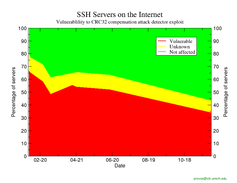
Even though the CRC32 bug has been found over a year ago, over 30% of all servers are still vulnerable today. Graph at http://www.citi.umich.edu/u/provos/ssh/crc32.png.
In February 2001, Razor Bindview released their "Remote vulnerability in SSH daemon crc32 compensation attack detector" advisory, which outlined a gaping hole in deployed SSH servers that can lead to a remote attacker gaining privileged access.
In November 2001, Dave Dittrich published a detailed analysis of the "CRC32 compensation attack detector exploit." This exploit is currently widely in use. CERT released Incident Note IN-2001-12.
At the Center for Information Technology Integration, Niels Provos and Peter Honeyman have been scanning the University of Michigan for vulnerable SSH server software to identify and update vulnerable SSH servers. However, scans of the Internet show that system and security administrators must react and update their SSH servers. At this writing, over 30% of all SSH servers appear to have the CRC32 bug.
A simple solution is to remove support for Version One of the SSH protocol. The majority of servers on the Internet support the SSH v2 protocol. To test whether your network has vulnerable SSH servers, you might use the ScanSSH tool.
References: "ScanSSH - Scanning the Internet for SSH Servers", Niels Provos and Peter Honeyman, 16th USENIX Systems Administration Conference (LISA). San Diego, CA, December 2001. This information is also available at http://www.citi.umich.edu/u/provos/ssh/
Don't play with your food, or your games. janolder writes "In the matter of the Civilization III translation project (articles on slashdot, apolyton and heise), the fans have gotten the short end of the stick. The project web site (translation.civ3.de) has been down for a while. Earlier this week, both the web site operator and Kai Fiebach, the project leader, signed Infogrames' cease and desists out of fear of further legal action. The legal position (not to mention the moral postion) of the fans did not appear to be too weak - EULA's are not binding in Germany and supplying patches to a program is certainly not the same as translating a book and distributing the translated manuscript.
Infogrames Germany has issued another press release (translation and my comments) justifying their legal action and position. It makes for an interesting peek into the mindset of a game publisher.
The good news is that Infogrames is considering a more timely release of Civilzation III in Germany.
The bad news is that the cease and desists apparently forbid any modification of Civ3 in any way, shape or form. So no more custom maps for your friends, custom rules or any such copyright infringing activity, please! Is it just me, or has the world suddenly become a less interesting place?"
Not as if Americans always know where we are, either. ByTor-2112 writes "Hate to be the bearer of bad news so soon after a story is posted, but as I commented on the previous story, it appears that galileo has some funding issues. Honestly, did anyone really expect the EU to go through with it? It took them long enough to agree on a common currency!"
-
Slashback: Regionalism, Rivalry, Zensur
Slashback with more (below) on: censorship in germany, Xbox gushing, *nix-ish Window managers on That Darn Operating System, and more. Enjoy!Even the Gates family probably hates being ripped off by region coding. jmcmurry writes: "I just tried out my daughters Winnie The Pooh from Poland, which can only be played (until today) on my Mac Cube running OS X (I did the region free crack when running OS 9). I own an Xbox with DVD player and thought, hey wouldnt hurt to try it out, since I was in the market to buy a Region Free DVD player (which can cost $400 an up) I plugged everything in, put the DVD in, and lo and behold, it plays the DVD from Poland (region code 2) This makes up for the cost of the Xbox ..."
Nein! Nein! Speaking of things that do (or don't) work by region, several readers submitted information which indicates the pooh-poohing of alleged censorship-by-DNS manipulation in Germany's state of Nordrhein-Westfalen was premature. It turns out that some interesting redirects which seemed to be a technical error or a misguided proof-of-concept, and which were quickly turned off, were reinstated shortly thereafter.
Thorsten Hornung was among the several to write on this topic. "Meanwhile ISIS has reblocked the sites, as Heise online reported (German!) due to pressure from the president of the local Government Mr. Büssow.
The local government of Düsseldorf which is responible for media services in North Rhine-Westphalia has posted a statement on its site (German) about the initial lift of the blockade saying that it believes the censoring meassures have been lifted due to complaints by users. Much worse is that furthermore public accuse people complaining about the censorship to be Right Extremists: 'The local government believes, due to the content of many emails it received today, that they [People Complaining] are users of Right Extremist Internet Content.'
The German Constitution (Grundgesetz) does not allow censorship however there are some restrictions on free speech especially regarding Nazi propaganda."
Winners sometimes use Gnomes. Prashant writes: "Cygwin is turning out to be a breeze of fresh air for people stuck on windows for one reason or another. I can use the familiar bash shell on any platform(win, *nix) I am on, and don't have to deal with the DOS prompt. I use all the gnu tools from cygwin distro. rcs, cvs, vim, perl, python, ruby, apache the list goes on. Not only that, I successfully ran postgresql on Cygwin. The XFree86 port of Cygwin itself can be huge cost saving over commercial X-servers for Windows. I have tried KDE on Cygwin version 1.1.2. I was impressed with it. Here is something new: GNOME ported to Cygwin as well. Let the rivalry ontinue on Windows.
It's all about having options. I would love be 100% Linux user but again sometimes it's not you who decides what os runs on your machine. So till Windows gets replaced by Linux by the authorities, happy cygwining."
This addition brought to you by ... Solar Power! basfromasd writes "The winner of the 3000 km World Solar Challenge race from Darwin to Adelaide has reached the finish in a record breaking time. The winning car, Nuna, was built by the Alpha Centauri team, consisting of 10 university students of TU Delft and University of Amsterdam. Some technical details can be found at their site and at ESA. Results and pictures of the race are at the Centre for Photovoltaic Engineering of UNSW website. Well done for a first time contestant, showing that skill and intelligence can match the resources of factory sponsored teams. They found some good sponsors though: GaAs solar cells are not cheap. Neither are Li-Ion batteries. Some of the solar cells were used in the Hubble Space Telescope before and brought back to earth in 1993. The other cars did not make it before today's curfew. The runner up, Aurora, stopped just outside of Adelaide for the night and is expected to finish tomorrow morning."
-
Infogrames Serves Civ3 Fans With Cease and Desist
janolder writes "According to multiple articles on heise online (German only), the leader of an effort to localize Civilization III for Germany, Kai Fiebach, has been slapped with a cease and desist letter, including $500 lawyer bill from Infogrames Germany. A grassroots effort to help Kai and tell Infogrames off is forming." "Background: Most European versions of Civ3 are late. With a slated release for March 2002, Kai and a group of Civ3 fans decided to translate portions of Civ3 to German and to make the result available as a set of files to be applied to the US on time for Christmas. Kai informed Infogrames of his effort and even offered to join forces with their localization team if only the game would be released sooner. Sadly, Infogrames reacted by sending Kai a cease and desist letter, alleging copyright infringement. The home page of the translation effort has already been taken down.The reason for Infogrames' reaction seems to be that Infogrames Germany doesn't make a single penny on the US version of the game sold through Amazon Germany and other vendors."
-
German State Alters DNS To Censor Web Sites [updated]
Rabenwolf writes: "In the German state of North Rhine-Westphalia, the first ISP (ISIS Multimedia) has given in to pressure from the state government and has started to block foreign websites with supposedly "illegal content" by changing the corresponding DNS entries. ISIS customers trying to access these sites are redirected to the website of the local government. ISPs in North Rhine-Westphalia will have to pay a fine if they continue to provide access to sites with "illegal content" through their DNS servers. It's not as bad as China or Saudi-Arabia, but it makes you think... An article from the heise newsticker is here, and if you don't sprechen Deutsch, Google might help." Update: 11/22 15:23 GMT by T : As sqrt points out, this report is misleading: "A single technican altered the DNS Entries to demonstrate it is possible. His changes were already reversed. Heise already posted a new story about this today." -
German State Alters DNS To Censor Web Sites [updated]
Rabenwolf writes: "In the German state of North Rhine-Westphalia, the first ISP (ISIS Multimedia) has given in to pressure from the state government and has started to block foreign websites with supposedly "illegal content" by changing the corresponding DNS entries. ISIS customers trying to access these sites are redirected to the website of the local government. ISPs in North Rhine-Westphalia will have to pay a fine if they continue to provide access to sites with "illegal content" through their DNS servers. It's not as bad as China or Saudi-Arabia, but it makes you think... An article from the heise newsticker is here, and if you don't sprechen Deutsch, Google might help." Update: 11/22 15:23 GMT by T : As sqrt points out, this report is misleading: "A single technican altered the DNS Entries to demonstrate it is possible. His changes were already reversed. Heise already posted a new story about this today." -
German Federal Government Approves Eavesdropping
Raymond Gannon writes: "Without further commotion, the Federal Cabinet approved the controversial telecommunication monitoring regulation in its session in Berlin today. The proceedings catalogue for eavesdropping on surfers and (cell) telephone users become legal." -
German Federal Government Approves Eavesdropping
Raymond Gannon writes: "Without further commotion, the Federal Cabinet approved the controversial telecommunication monitoring regulation in its session in Berlin today. The proceedings catalogue for eavesdropping on surfers and (cell) telephone users become legal." -
Linux Kernel Bugs
Armin Herbert writes: "According to this mail from Rafal Wojtczuk and a german article on Heise Online, there's a new severe bug in all Linux Kernels, from 2.2.0 up to 2.4.10, which allows users to become root on your system. Kernel 2.4.12 fixes this problem, and RedHat, Caldera and other distributors already supply patches for their Kernels. See Bugtraq for more information." Important notes for anyone running a multi-user system. Update: 10/19 16:12 GMT by J : If I'm reading Nergal's writeup correctly, 2.4.10 is still vulnerable to the local DoS, but not to the local root exploit. Separate issues. And as pheared points out, there is one unverified report of a custom 2.4.12 being vulnerable as well; please try the exploit on your system and let us know what you find. This is a big one, you can expect the kiddies have already added this to their rootkits. Update your systems now! -
Watch Heise's Robot Challenge In Progress
osolemirnix writes: "Starting today, the Robot Challenge initiated by c't Magazine / Heise Publishing takes place at the Systems computer fair show in Munich, Germany. The robots have to collect trash while driving through a maze (2x3 meters) and and deliver the trash in a special color-coded area. They have about 40 entries of bots and the challenge goes on all week, so check it out if you're at the Systems. Unfortunately the robot challenge web pages are in german, but you can check the live webcams here." So either quickly learn German, or use the Fish. The current c't (print) magazine has great pictures of the competing robots, too. -
Watch Heise's Robot Challenge In Progress
osolemirnix writes: "Starting today, the Robot Challenge initiated by c't Magazine / Heise Publishing takes place at the Systems computer fair show in Munich, Germany. The robots have to collect trash while driving through a maze (2x3 meters) and and deliver the trash in a special color-coded area. They have about 40 entries of bots and the challenge goes on all week, so check it out if you're at the Systems. Unfortunately the robot challenge web pages are in german, but you can check the live webcams here." So either quickly learn German, or use the Fish. The current c't (print) magazine has great pictures of the competing robots, too. -
Watch Heise's Robot Challenge In Progress
osolemirnix writes: "Starting today, the Robot Challenge initiated by c't Magazine / Heise Publishing takes place at the Systems computer fair show in Munich, Germany. The robots have to collect trash while driving through a maze (2x3 meters) and and deliver the trash in a special color-coded area. They have about 40 entries of bots and the challenge goes on all week, so check it out if you're at the Systems. Unfortunately the robot challenge web pages are in german, but you can check the live webcams here." So either quickly learn German, or use the Fish. The current c't (print) magazine has great pictures of the competing robots, too. -
EU May Fine Microsoft
Yokaze writes: "The Wall Street Journal reports about a leaked European Comission document, that suggests that the EU may fine MS for anti-competitive behaviour. The fine can be up to 10% of the annual revenue, or $2.5 billion and may include the demand to remove certain programs from Windows. The report harshly criticized MS way of taking influence in the case, even speaking of trying to mislead the observers. Regarding the report of the WSJ, European Competition Commissioner Mario Monti said, that the case is still at a preliminary stage, since MS still has the right to defend itself at a hearing. Or in his own words: 'To speak of a fine when Microsoft has not yet disputed the Commission's preliminary findings both in fact and law -- as it it's right -- is premature.' Since the original is for subscribers only, take a look at Yahoo or the more detailed report from BBC News. Lastly with some different details a report from Heise in German." -
The Internet Backlash
An AC wrote to say that "telepolis has an article telling you why the DMCA and the companies who pushed it forward are doomed to fail. It's nothing new but a good summary of the neverending copyright discussion." The author's summary is good but I disagree with the conclusion -- there's no reason to believe that some deus ex machina is suddenly going to save net users from a police state. -
The Internet Backlash
An AC wrote to say that "telepolis has an article telling you why the DMCA and the companies who pushed it forward are doomed to fail. It's nothing new but a good summary of the neverending copyright discussion." The author's summary is good but I disagree with the conclusion -- there's no reason to believe that some deus ex machina is suddenly going to save net users from a police state. -
Patenting In The Burst Test
gerddie writes "Heise has an interview with S. Kiesewetter-Köbinger, a patent examiner of the German PA, about the cultural break, software patents will impose to Europe if they become valid. He points out the danger to open source and science, and that with patents on software even mathematical methods would become patentable because there is no longer any difference. There is also a companion article competition in the court room, that gives some more insight in the history and current state of the patent system. All is in german, but as always the fish is your friend." -
Patenting In The Burst Test
gerddie writes "Heise has an interview with S. Kiesewetter-Köbinger, a patent examiner of the German PA, about the cultural break, software patents will impose to Europe if they become valid. He points out the danger to open source and science, and that with patents on software even mathematical methods would become patentable because there is no longer any difference. There is also a companion article competition in the court room, that gives some more insight in the history and current state of the patent system. All is in german, but as always the fish is your friend." -
Patenting In The Burst Test
gerddie writes "Heise has an interview with S. Kiesewetter-Köbinger, a patent examiner of the German PA, about the cultural break, software patents will impose to Europe if they become valid. He points out the danger to open source and science, and that with patents on software even mathematical methods would become patentable because there is no longer any difference. There is also a companion article competition in the court room, that gives some more insight in the history and current state of the patent system. All is in german, but as always the fish is your friend." -
Slashback: Exactitude, Fortitude, Picnic
Slashback tonight with another assortment of corrections, amplifications, looks backward (and even looks forward to looks backward). In this last case, it looks like you may even get fed.You mean we have to reprint all the invitations? Reader Ian Cowley wrote with a slight correction about the end of an era:
"Your article on slashdot.org about the billionth second of the epoch is sort of (but not entirely) flawed.
Yes, UNIX systems will report 1000000000 seconds at 01:46:40 on 9th September. Which of course means the 1 billionth number will be 01:46:39.
But, these systems do not account for leap seconds. According to TAI (international atomic time), the 1 billionth second since the beginning of January 1st 1970 will occur at 01:46:17 on 9th September 2001, as 22 leap seconds have been inserted since 1970 (the first was 1972, the last 1999).
So celebrations of the 1000000000th second should be at 01:46:17, whilst 01:46:40 can be reserved for celebrating 1000000000 displayed on UNIX system clocks."
Errr ... thanks. We'll just have to start at "Unix Day, Observed."
What price the capture and humiliation of virus spreaders? JayHerrick writes: "We have posted a small bit of JSP that reports the number of times our server has been queried for a 'default.ida' page. It's stylish, it's cool, and it'll probably get Pepsi all mad at us because we ripped the Code Red logo off one of the bottles." Equally stylish, despite the name, is a small tool named codeRedNeck, described by reader mindriot thus: "As CodeRed probes port 80 of a machine, CodeRedNeck first answers on that port and then goes silent, thus forcing the worm to wait until the connection times out." He advises: "Read the original idea by Tom Liston. Heise also has more on this."
Even More Auspicious dates. No matter which date you choose to mark it, Linus' little kernel-that-could is about to mark its tenth birthday. ikluft writes:
"The "Linux10" Linux 10th anniversary picnic and BBQ will be held on Saturday, August 25 from 11AM to 6PM at Sunnyvale Baylands Park in Sunnyvale, California. Details and directions can be found at Linux10.org. If you can attend, please use the RSVP form so the organizers know how much food and soft drinks to provide (only provided if you RSVP.)
Reader big_drew adds: "The event is free (food, softdrinks, cds -- sorry, no free beer, but byo is ok)" and says "If you can't make it out to CA, you can still get the t-shirt (profits will be used to fund the picnic)."Linux10 is being organized as a family event -- bring the kids. In support of that goal, it is also a no-media event. Linux and Open Source enthusiasts who work for the media may attend and participate while off-duty.
Linux10 will gladly link to other Linux 10th anniversary events. Let us know the URLs for those events."
Anyone want to organize a picnic in the vicinity of Knoxville, TN? :) I can bring some pasta salad and watermelon.
Ten candles all around here, too. Simon Spero writes: "As noted in http://www.w3.org/History.html, today, August 6th, is the 10th anniversary of the first public release of the CERN Web Software."
-
Adobe Responds to KIllustrator
j7953 writes: "German news service heise online reports that Adobe wants to settle the KIllustrator case. According to the article (here's Google's translation), they demand that KIllustrator gets a new name, but don't want to stop its distribution or development. They also promise that the author won't have to pay anything."