Slashdot Mirror
Domain: heybryan.org
Stories and comments across the archive that link to heybryan.org.
Comments · 44
-
Yeah, I remember. So 15 yrs ago I wrote this:
http://pdfernhout.net/on-fundi...
"Consider again the self-driving cars mentioned earlier which now cruise some streets in small numbers. The software "intelligence" doing the driving was primarily developed by public money given to universities, which generally own the copyrights and patents as the contractors. Obviously there are related scientific publications, but in practice these fail to do justice to the complexity of such systems. The truest physical representation of the knowledge learned by such work is the codebase plus email discussions of it (plus what developers carry in their heads).
We are about to see the emergence of companies licensing that publicly funded software and selling modified versions of such software as proprietary products. There will eventually be hundreds or thousands of paid automotive software engineers working on such software no matter how it is funded, because there will be great value in having such self-driving vehicles given the result of America's horrendous urban planning policies leaving the car as generally the most efficient means of transport in the suburb. The question is, will the results of the work be open for inspection and contribution by the public? Essentially, will those engineers and their employers be "owners" of the software, or will they instead be "stewards" of a larger free and open community development process?"And also, earlier, this to Ray Kurzweil in 2000:
http://heybryan.org/fernhout/k...
"... It will be difficult for you to change your opinion on this because you have been heavily rewarded for riding the digital wave. You were making money building reading machines before I bought my first computer -- a Kim-I. But, I think someday the contradiction may become apparent of thinking the road to spiritual enlightenment can come from material competition (a point in your book which deserves much further elaboration). To the extent material competition drives the development of the digital realm the survival of humanity is in doubt.
Still, you are a bright guy. If you study ecology and evolution in more detail, I think you may change your conclusion, or at least admit the significant probability of a bad outcome, and that we should plan
accordingly.
If you do change your opinion in the future, and wish to fund work related to helping ensure humanity survives the birth of the digital realm, please remember me.
MOSH to the end I guess!"The Bayh-Dole Act is a big part of that disaster (letting universities privatize gains and tightly control use of what they make an with public funds rather than insist publicly funded research goes into the public domain):
https://en.wikipedia.org/wiki/...
https://www.theatlantic.com/ma...Anyway, I'm still trying to limp along making glacially slow progress doing free stuff (Twirlip/Pointrel/etc.) on GitHub in increasingly vanishing spare time... My latest small increment:
"High Performance Organizations Reading List"
https://github.com/pdfernhout/... -
Also, Kurweil misunderstood evolution
As I wrote to Kurzweil in 2001 (reposted by someone else along with four others I sent): http://heybryan.org/fernhout/k...
From that email:
There is not necessarily an adaptive value to intelligence in a
certain niche -- because intelligence has power, mass, heat-dissipation,
and time costs. For example, consider the Hydra, which is a tiny
multi-tentacled aquatic creature that lives off of stinging smaller
organisms like Daphnia and pulling them into its body cavity. It has a
simple neural net it uses to coordinate its feeding behavior. Why
doesn't the hydra have a brain the size of a human? That may sound like
a stupid question, but bear with me. The Hydra could not support the
energy required to operate a brain from its current feeding behavior. It
could not protect the brain from predators. Its mobility would be
impaired by being attached to a brain that large. It would be unable to
reproduce as quickly. Also, the value of a human-sized brain to a hydra
is minimal, because there would be little the brain could accomplish
using the Hydra's few microscopic tentacles, limited sensory apparatus
(no eyes, no ears) and limited mobility choices. Further, the Hydra must
react instantly in its tiny world, and a big brain would take too long
to process the information. So, for the Hydra, a large brain makes no
sense.There are aquatic creatures with brains as big or large than human
brains (dolphins or whales) but they have a very different ecological
niche and a totally different scale and physical structure. And there
are a lot fewer whales and dolphins than Hydra in the universe.What might this mean in a human sense? Perhaps human brains are the size
they are because there isn't too much value in being that much smarter
because the cost of the additional intelligence is outweighed by the
diminishing returns of additional predictive value. For example, some
studies show earlier types of human-like creatures like the Neanderthal
or Cro-Magnon had a larger brain size than present-day humans.The precis you posted, which is otherwise technical and advanced, is
using a technical term "evolution" as it is colloquially often (mis)used
to mean "progress". The two are not the same. And frankly, what is
"progress" for one may be "decay" for another, just as what is "good"
for one may be "evil" for another, as these have to do with individual
goals which may conflict. This weakens your entire argument.I might go a step further. Because of your essentially "religious"
belief based on a limited view of evolutionary theory, you are ignoring
the obvious issues relating to the [diminishing] returns of intelligence, or
the adaptive value of "dumber" organisms. Thus, as I pointed out in an
earlier email to you, when you talk of downloading a human-derived AI
into a network, you ignore the fact that that large intelligence may not
be able to compete effectively in the network, in the same way as if one
grafted a human brain onto a tiny Hydra and threw it into a lake it
would not survive. What organisms do survive in a lake? Many, many tiny
things. Maybe a few fish. But the largest number are tiny things like
bacteria, algae, Daphnia and Hydra. By analogy, most of the digital
organisms in a large network will be tiny, and they might rapidly
consume larger creatures or parasitize them. Obviously, you can get big
fish in a lake -- but their numbers are small compared to the numbers of
other smaller organisms.Because you have been heavily rewarded in your life for being
intelligent in various ways, the value of being unintelligent (or
differently intelligent) is probably a difficult concept to wrestle with
(as it was for me, and as I think it would be for most thinkers).
Ironically, both my wife and I didn't finish our PhDs in E&E in large
part becaus -
Kurzweil needs to study evolution more
See his book http://www.fantastic-voyage.net/ However, a mistake Ray Kurzweil seems to be making is in assuming that individually isolated vitamins and such will have the same affect on the human body as the same nutrient as part of a whole food (the kind of food all humans have been eating for thousands of years -- until fairly recently). Dr. Joel Fuhrman in "Eat to Live" and his other writings shows why that assumption of individual nutrients having value is generally wrong (for example, with isolated beta carotene). And that also ignores that supplements may contain toxic by-products of the extractive process. That is why Ray is treading on fairly dangerous ground with his regime. That said, some very specific supplements like vitamin D, Omega-3s, Iodine, B-Complex, and a few others may be good to add to a diet with 90% of calories from vegetables, fruits, and beans (and some nuts, seeds, and whole grains) and which otherwise avoids most artificial non-food supplements. See:
http://www.drfuhrman.com/library/foodpyramid.aspxAnd also:
http://www.drfuhrman.com/library/gbombs.aspx
" G-BOMBS: Greens, Beans, Onions, Mushrooms, Berries, and SeedsI emailed Ray about this probably a couple years ago, concerned for his health, but not sure if he read it or believed it. In general, it is not clear to me that Ray understands evolution very well.
I get the feeling Ray has a cartoonish view of it (this coming from someone who studied in a PhD program in ecology and evolution). If he had studied evolution, he'd be more likely to think about how natively evolved digital piranha would be likely to chew up the runtime of uploaded minds with meat-space origins. I suggested to him about a decade ago he go talk to some academics who knew a lot about evolution, but it is not clear he has.
If he had, he might also see how quickly AI slaves might evolve away from what he designed them to be -- especially if he designs them primarily through competitive economic and military purposes rather than through love, compassion, joy, community, and wonder.Someone put up some letters I've sent him in the past about such topics:
http://heybryan.org/fernhout/A key point I make in one: "I just wrote this about your 2005 book and I send you the first copy. Essentially, I suggest that while you are right in presenting the trends leading up to the singularity, ultimately your view of what should be done as we approach it and afterwards is more a result of the mirror effect of the singularity reflecting your own unacknowledged current personal biases in a quasi-Republican/Libertarian direction. The most productive response to the singularity may come from a very different perspective -- that of a return to the gift economy ideals of most hunter/gatherer societies, as exemplified by GNU/Linux these days."
See, for example:http://books.google.com/books/about/The_Dictionary_of_Alternatives.html?id=IKZVKMPEQCEC
"This dictionary provides ammunition for those who disagree with the early twentieth-first century orthodoxy that 'There is no alternative to free market liberalism and managerialism'. Using hundreds of entries and cross-references, it proves that there are many alternatives to the way that we currently organize ourselves. These alternatives could be expressed as fictional utopias, they could be excavated from the past, or they could be described in terms of the contemporary politics of anti-corporate protest, environmentalism, femin -
A list of threats I put together back in 1999
http://www.kurtz-fernhout.com/oscomak/fears.htm
====
The race is on to make the human world a better (and more resilient) place before one of these overwhelms us:
* Autonomous military robots out of control
* Nanotechnology virus / gray slime
* Ethnically targeted virus
* Sterility virus
* Computer virus
* Asteroid impact
* Y2K
* Other unforeseen computer failure mode
* Global warming / climate change / flooding
* Nuclear / biological war
* Unexpected economic collapse from Chaos effects
* Terrorism w/ unforeseen wide effects
* Out of control bureaucracy (1984)
* Religious / philosophical warfare
* Economic imbalance leading to world war
* Arms race leading to world war
* Zero-point energy tap out of control
* Time-space information system spreading failure effect (Chalker's Zinder Nullifier)
* Unforeseen consequences of research (energy, weapons, informational, biological)
====The solution I proposed there was developing a free and open source distributed library of information about how to make things, working towards the goal of creating self-replicating space habitats that can duplicate themselves from sunlight and asteroidal ore.
However, since then I think the deepest issue is changing how we thing, so we can move beyond, as in my sig, the irony of using the technologies of abundance from a perspective of fighting over misperceived scarcity. Bucky Fuller talked about that too, in moving from "weaponry" to "livingry". See also:
http://www.pdfernhout.net/recognizing-irony-is-a-key-to-transcending-militarism.html
http://anwot.org/Here are some emails I wrote to Ray Kurzewil on these themes years ago that someone else put up on their site: http://heybryan.org/fernhout/
I essentially suggested that uploaded human minds would have their runtime consumed by the digital equivalent of natively-evolved digital piranha. I also suggested that the direction we come out of any singularity may have a lot to do with the moral direction we are pursuing as we go into it -- and that AI created mainly out of human military and economic competitiveness against other humans probably would not node well for having a happy singularity. That is why it is important to move our global society into a more compassionate direction before creating such AIs.
-
Great post on engineering and futurism
Marshall Brain and James P. Hogan are two authors worth reading on these topics.
http://marshallbrain.com/manna1.htm
http://www.jamesphogan.com/books/info.php?titleID=29&cmd=summaryMartin Ford also has a great website in this area:
http://econfuture.wordpress.com/Lots more links and stuff on my site: http://www.pdfernhout.net/
And here are copies of some emails I sent to Ray Kurzweil over the years (someone else made a copy of them here) trying to get him to think more deeply about evolutionary and social issues related to the singularity:
http://heybryan.org/fernhout/Basically, I tried to say much like what you are saying. Our trajectory coming out of any singularity may have a lot of influence on our path coming out of one. It just seems like common sense that more compassion, community, and cooperation now might make a big differnece later. See also Alfie Kohn's work:
http://www.alfiekohn.org/books/nc.htm
"No Contest, which has been stirring up controversy since its publication in 1986, stands as the definitive critique of competition. Drawing from hundreds of studies, Alfie Kohn eloquently argues that our struggle to defeat each other -- at work, at school, at play, and at home -- turns all of us into losers."My sig below sums up my years of thinking on all this.
-
Transcending Kurzweil's thinking?
Yes, S-curves are common in nature. Although we are stil facing discontinuities in our economics. By me on that:
http://knol.google.com/k/paul-d-fernhout/beyond-a-jobless-recovery
http://dougengelbart.org/colloquium/forum/discussion/0061.html
http://dougengelbart.org/colloquium/forum/discussion/0126.htmlRoy Amara first said Kurzweil's law of accelerating returns:
http://en.wikipedia.org/wiki/Roy_Amara
"We tend to overestimate the effect of a technology in the short run and underestimate the effect in the long run."I sent Ray Kurzweil some emails on why he gets evolution wrong and why uploaded minds will be eaten by digital pirahna (someone else put up copies):
http://heybryan.org/fernhout/Another key point is here by me:
http://groups.google.com/group/openmanufacturing/msg/1f6bb622cafc8c29?hl=en
"Is the Singularity like Harry Potter's "Mirror of Erised"? ("Erised" is "Desire" spelled backwards.) What would we see in the mirror if we are a financially successful capitalist (hint, hint)? Does capitalist ideology dominate "mainstream" singularity thinking? What is the danger of seeing capitalism and competing over scarce resources as the way to build the future of abundance? Or could we see cooperation, or at least, balance, as a better way forward to a world that works for everyone, and where the capacity to collectively create, monitor, and respond outweighs the individual or collective ability to destroy and harm? "There is a low-tech way to prevent cancer, heart disease, and many other illnesses now, and that is to be sure to get enough vitamin D and to eat lots of vegetables and fruits.
http://www.vitamindcouncil.org/treatment.shtml
http://www.alternativeratreatments.com/eat-to-live.html
Although it is true that it has taken modern science and technology to prove why that works and to communicate that finding. Kurzweil is probably taking too many potions for his health, sadly. He should check out Dr. Fuhrman's January retreat in Princeotn, NJ on health.With all that said, I still have a lof respect for Ray Kurzweil's accomplishments and predictions and his efforts to help humanity with technology. I just think some of his pedictions show some of the limts of his perspective based on who he has been, which is true for any of us.
-
Re:10GUI and similar GUIs are overrated
I used to have about 50 to 100 windows open under KDE. I was also thinking of porting konqueror to use the windowing manager for multiple tabs-- seriously, why have tabs in a browser, when it's the GUI's job in general? I like tabs, of course. Firefox seems to crash at 100 tabs. Opera handles maybe 400 for me.
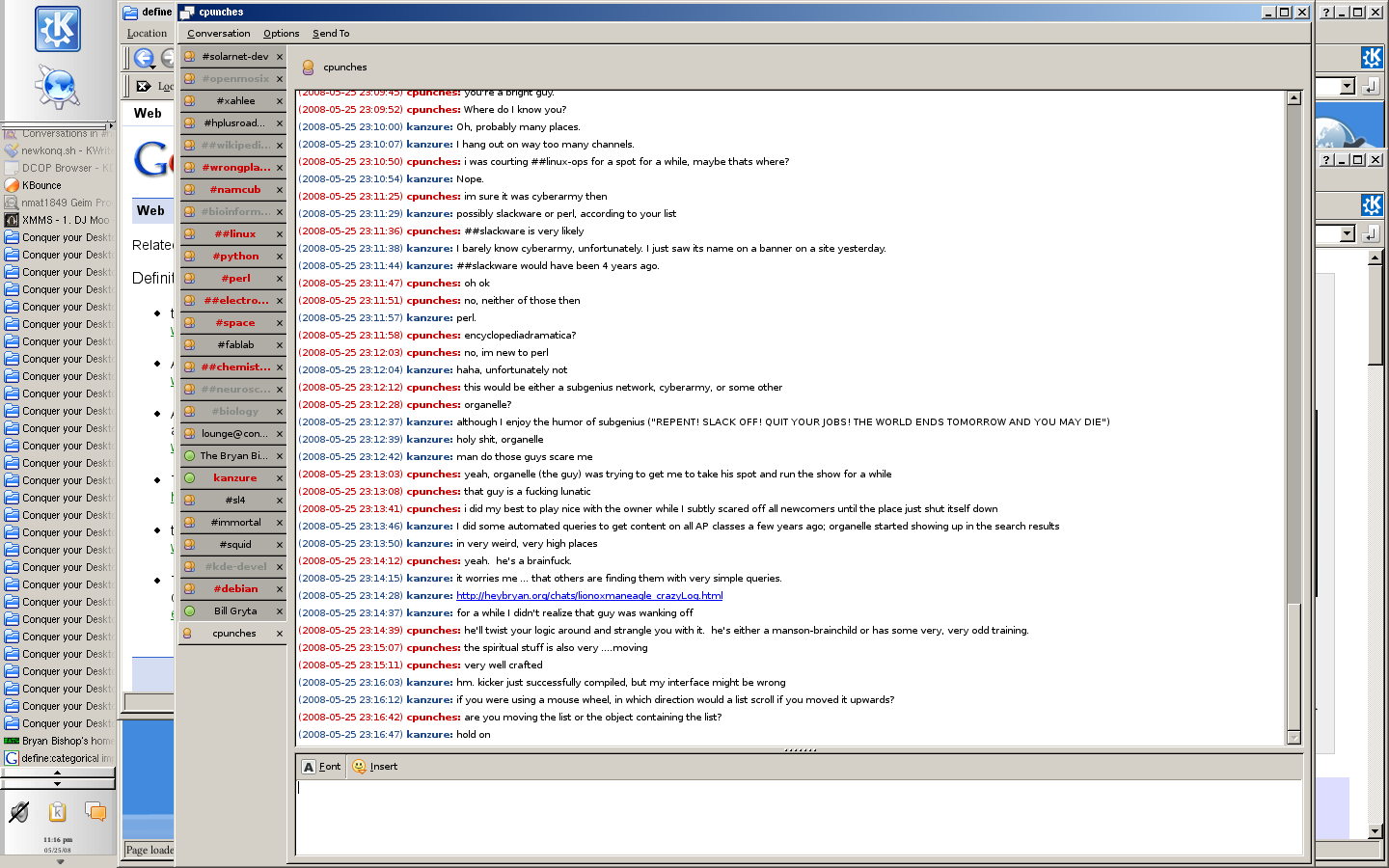
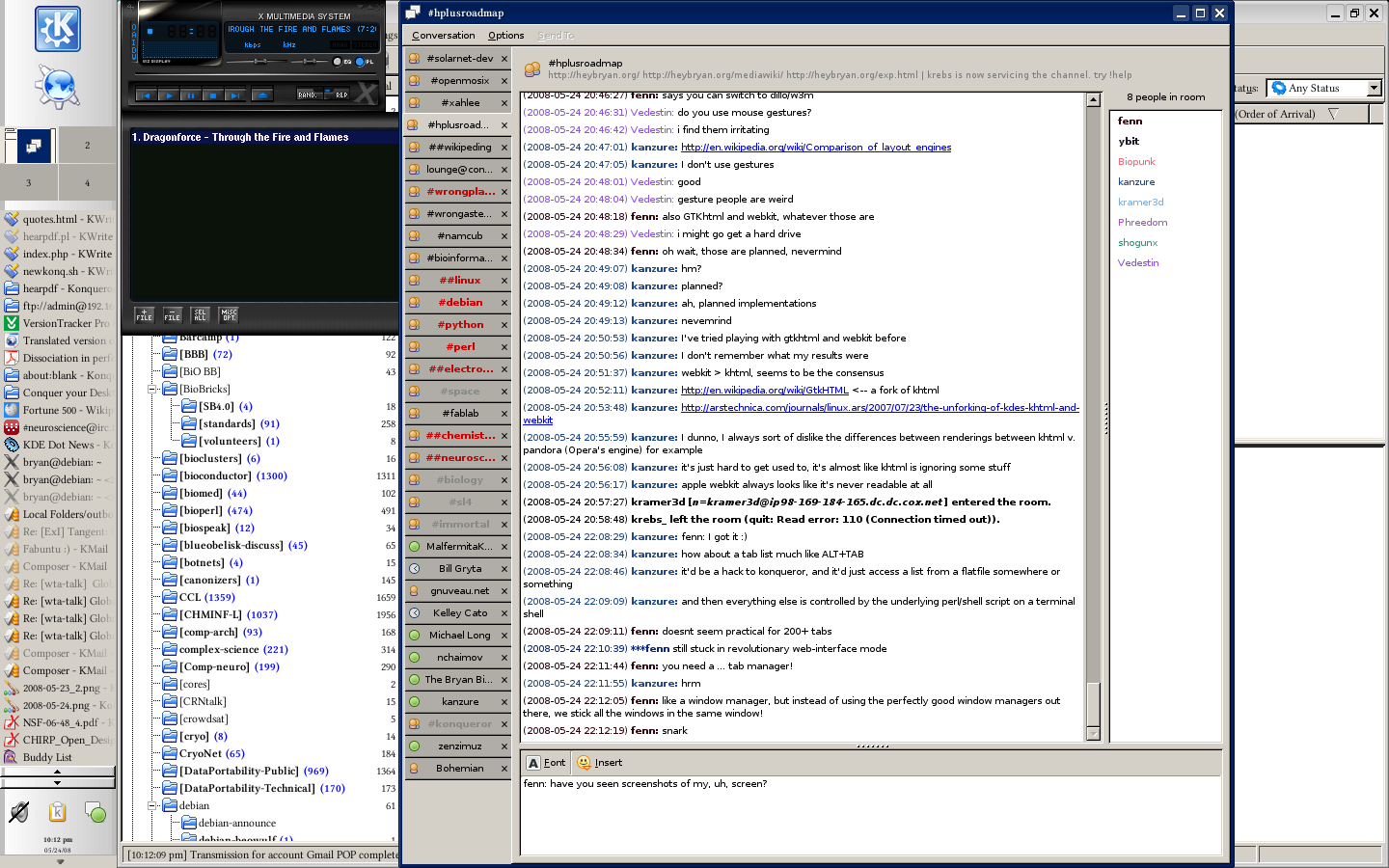
So what I did is instead of a double-width horizontal taskbar, I used a vertical taskbar. Here's a screenshot:
http://heybryan.org/shots/2008-05-25_KDEhacks.png
why: 2008-05-24_2.png
I had to modify kicker to get the mouse scrollwheel working, though. Apparently they wanted users to manually click the up/down scroll arrows. No thanks. -
Re:10GUI and similar GUIs are overrated
I used to have about 50 to 100 windows open under KDE. I was also thinking of porting konqueror to use the windowing manager for multiple tabs-- seriously, why have tabs in a browser, when it's the GUI's job in general? I like tabs, of course. Firefox seems to crash at 100 tabs. Opera handles maybe 400 for me.
So what I did is instead of a double-width horizontal taskbar, I used a vertical taskbar. Here's a screenshot:
http://heybryan.org/shots/2008-05-25_KDEhacks.png
why: 2008-05-24_2.png
I had to modify kicker to get the mouse scrollwheel working, though. Apparently they wanted users to manually click the up/down scroll arrows. No thanks. -
Re:Start laughing now
All great points.
Related:
http://www.timesonline.co.uk/tol/news/science/article1695546.ece
"A study commissioned by the Government that suggests robots could one day have rights was attacked by leading scientists yesterday as a red herring that has diverted attention from more pressing ethical issues."Related links:
http://en.wikipedia.org/wiki/Midas_World
http://www.marshallbrain.com/manna1.htm
http://www.whywork.org/rethinking/whywork/abolition.html
http://en.wikipedia.org/wiki/Jobless_recovery (organized mostly by me)My senior thesis in college about 25 years ago was about intelligence and survival, and argued, as you suggest, that there may be a law of diminishing returns to intelligence.
Still, with that said, the problem today is not so much about intelligence as values (or emotions, like my point on Descartes' Error, or Einstein said a similar thing here).
http://www.sacred-texts.com/aor/einstein/einsci.htmHere are some letters I wrote to Ray Kurzweil (and someone else put on their site) about why his vision of the singularity reflects his own (capitalist, competitive) values more than any necessity of how it has to be:
http://heybryan.org/fernhout/ -
Typing can work
You should try typing out the lecture. Here are my results through high school and college (and for the record, you're all wimps and sissies):
biology notes
Building Brains (it was a quasi "ai" class)
psych
other crap
Also: learn LaTeX. -
Typing can work
You should try typing out the lecture. Here are my results through high school and college (and for the record, you're all wimps and sissies):
biology notes
Building Brains (it was a quasi "ai" class)
psych
other crap
Also: learn LaTeX. -
Typing can work
You should try typing out the lecture. Here are my results through high school and college (and for the record, you're all wimps and sissies):
biology notes
Building Brains (it was a quasi "ai" class)
psych
other crap
Also: learn LaTeX. -
Typing can work
You should try typing out the lecture. Here are my results through high school and college (and for the record, you're all wimps and sissies):
biology notes
Building Brains (it was a quasi "ai" class)
psych
other crap
Also: learn LaTeX. -
Re:Complexity orders of magnitude bigger
He doesn't seem to have studied ecology and evolution, either (as bright as he is). From a letter I sent to him in 2007 which was posted by someone else here (it contains a book review):
http://www.heybryan.org/fernhout/kurzweil1.html
"""
I think if Kurzweil studied more evolutionary biology from the
professional literature, he would not have a rosy view of things like,
say, uploading your brain in a digital world. It is, frankly, naive to
think that an uploaded brain derived from duplicating a clunky chemical
architecture would compete with the populations of digital organisms which
might evolve native to a digital context. In short, those uploaded brains
are going to be eaten alive by digital piranha that overwrite their
computer memory and take over their runtime processor cycles. It has taken
evolution billions of years to lead up to the mammalian immune system, yet
Kurzweil seems to thing an effective digital immune system or nanobot
immune system can be developed in a few years. More likely the result will
be ages of chaos and suffering until co-evolutionary trends emerge. But
that would be in line with the other phase changes and their effect of
most human lives when militaristic agricultural bureaucracies emerged, or
when industrial empire building emerged. These evolutionary factors exist
even for the current elite if they uploaded themselves. So, the only
alternative may be to avoid building such a competitive landscape into the
digital world. as much as possible -- and likely that will involve
reducing the competitiveness of those building the digital world driven
through short term greed. It is almost as either we all go together into
the digital world in a reasonable level peace and prosperity or no one
goes for long. And it is time we need in a digital world to adapt to it --
perhaps even as much as a second gained from a peaceful digital world
might be all it takes to ensure humanities survival of the singularity.
And that perhaps one second of peaceful runtime then needs to be bought
now with a lot of hard work making the world a better place for more people.
The important thing is to remember that Kurzweil's book is a
quasi-Libertarian/Conservative view on the singularity. He mostly ignores
the human aspects of joy, generosity, compassion, dancing, caring, and so
on to focus on a narrow view of logical intelligence. His antidote to fear
is not joy or humor -- it is more fear. He has no qualms about enslaving
robots or AIs in the short term. He has no qualms about accelerating an
arms race into cyberspace. He seems to have an significant fear of death
(focusing a lot on immortality). The real criticisms Kurzweil needs to
address are not the straw men which he attacks (many of whom are being
produced by people with the same capitalist / militarist assumptions he
has). It is the criticisms that come from those thinking about economies
not revolving around scarcity, or those who reflect of the deeper aspects
of human nature beyond greed and fear and logic, which Kurzweil needs to
address. Perhaps he even needs to address them as part of his own continued
growth as an individual. To do so, he needs to intellectually,
politically, and emotionally move beyond the roots that produced the very
economic and political success which let his book become so popular. That
is the hardest thing for any commercially successful artist or innovator
to do. It is often a painful process full of risk.
"""
-
Re:Undue Credit to Kurzweil
The Singularity is a mirror. I agree that Ray Kurzweil is a brilliant guy who has done a lot of good stuff with music as well as reading machines for the blind and in other areas. Unfortunately, he has been so heavily rewarded for his success doing so through a market system that emphasizes competition and creating artificial scarcity through patents and copyrights, that while he understands the problem of exponential technological change, ironically, the only solutions he can see are to create more artificial scarcity using post-scarcity tools of abundance. This is a very common mistake, so he is in good company. But it is a very unfortunate one. Some more comments in emails related to that:
http://www.heybryan.org/fernhout/ -
Ok, really this time
-
Kurzweil's narrow perspective on the Sigularity
Essentially, the Singularity is a mirror. It is in some ways just a mirror of our own choice of virtues or lack thereof.
http://en.wikipedia.org/wiki/VirtuesLIke Harry Potter looking into the mirror or Erised, Ray Kurzweil looks into that mirror of the Singularity and sees himself: a very logically intelligent business person interested in accelerating technology by promoting artificial scarcity through patents and copyrights. Thus, he pushes for a singularity filled with competition and artificial scarcity, rather than one filled with cooperation and abundance for all. What's the danger in that? While we may not know enough yet to make a friendly AI with humane values, we certainly know enough to make some nasty dumb replicators and military robotics programmed to kill widely, plus we already have nuclear and bio weapons. As I say here:
http://www.pdfernhout.net/post-scarcity-princeton.html
"Perhaps our biggest danger as as society is in putting the *tools* (some being useful as weapons) of a post-scarcity civilization into the hands of scarcity-preoccupied minds. (Especially minds following outdated military dogmas like unilateral security instead of mutual security.) As Albert Einstein said, with the advent of atomic weapons, everything has changed but our thinking. And if nobody listens to Albert Einstein about this, why should they listen to me?"Kurzweil also doesn't understand ecology and evolution very well, in terms of making assumptions about the value of intelligence without seeing how it plays an adaptive role in only certain ecological niches.
More comments on those themes as emails I've sent to Ray Kurzweil, archived by someone else here:
http://heybryan.org/fernhout/What does this chart suggest about a law of diminishing returns for being more intelligent?
http://www.highnorth.no/Library/Myths/br-si-bo.htmLook at the ratios, and see the Fin whale ratio of brain to bodymass. It's tiny.
Bigger may be better up to a point, but it looks like a law of diminishing returns sets in.
One might posit some sort of inverse square law for the usefulness of increasing amounts of computational capacity to an organism, given perhaps exponentially increasing difficulty in creating more detailed or longer-term predictions of the world. This is an issue weather forecasters may wrestle with, in terms of facing chaotic behavior impacting predictability in weather systems. It's called "the Butterfly effect" where a small mistake or mismeasure may have increasingly big implications over time. So there is a need for constant remeasuring and recalibration of the models, which reduces the value of predictions and related computations. This is kind of like a game of chess where pieces were moved randomly by outside forces every once in a while, reducing the value in looking ahead too much.
Obviously, architecture can play a part in changes in intelligence too. But even Jupiter Brains might get dementia or turn uncommunicative.
Anyway, so this ratio of brain sizes and body mass may suggest the same thing. It's not that bigger is not better in some sense, it is just that it it only justifiable energetically up to a point.
Consider that a Right whale's testes may weigh over a two thousand pounds compared to that whale's fifteen pound or so brain, or about 100X bigger, whereas for humans the ratio is approximately reversed, the brain 100X larger. (Fin whales' testes are closer to 100 pounds, or 7X brain size, but still much larger than their brains.) So, you can see what nature is betting on when body size goes up.
It's not like whale's could not easily have brains that were 10X bigger. Whales are social, and even communicate around the p
-
Re:Brain Hacking
You have to sandbox it. You do not want to randomly delete a random neurotransmitter receptor from the brain, as an example. You need to make experiments that test this on organotypical slices of neurons [or grow brains in a jar]. Kind of like in a neurofarm. But the problem with neurofarms is that you need to have millions of nodes of experimentation, or massive Markram simulations because of the number of chemical possibilities at all of the receptor sites, plasma membranes, dendritic/axonic connectional possibilities, minicolumn rules, etc. How are you going to get that many nodes, that many instances of experimentation? Sounds like a job for a clanking replicator, really. Maybe automated manufacturing. And while you are working on this, how about some open source rTMS?This is very exciting as it could point to a future where you can literally hack your own brain.
Do you have a backup? -
Re:Brain Hacking
You have to sandbox it. You do not want to randomly delete a random neurotransmitter receptor from the brain, as an example. You need to make experiments that test this on organotypical slices of neurons [or grow brains in a jar]. Kind of like in a neurofarm. But the problem with neurofarms is that you need to have millions of nodes of experimentation, or massive Markram simulations because of the number of chemical possibilities at all of the receptor sites, plasma membranes, dendritic/axonic connectional possibilities, minicolumn rules, etc. How are you going to get that many nodes, that many instances of experimentation? Sounds like a job for a clanking replicator, really. Maybe automated manufacturing. And while you are working on this, how about some open source rTMS?This is very exciting as it could point to a future where you can literally hack your own brain.
Do you have a backup? -
Re:Brain Hacking
You have to sandbox it. You do not want to randomly delete a random neurotransmitter receptor from the brain, as an example. You need to make experiments that test this on organotypical slices of neurons [or grow brains in a jar]. Kind of like in a neurofarm. But the problem with neurofarms is that you need to have millions of nodes of experimentation, or massive Markram simulations because of the number of chemical possibilities at all of the receptor sites, plasma membranes, dendritic/axonic connectional possibilities, minicolumn rules, etc. How are you going to get that many nodes, that many instances of experimentation? Sounds like a job for a clanking replicator, really. Maybe automated manufacturing. And while you are working on this, how about some open source rTMS?This is very exciting as it could point to a future where you can literally hack your own brain.
Do you have a backup? -
Re:Brain Hacking
You have to sandbox it. You do not want to randomly delete a random neurotransmitter receptor from the brain, as an example. You need to make experiments that test this on organotypical slices of neurons [or grow brains in a jar]. Kind of like in a neurofarm. But the problem with neurofarms is that you need to have millions of nodes of experimentation, or massive Markram simulations because of the number of chemical possibilities at all of the receptor sites, plasma membranes, dendritic/axonic connectional possibilities, minicolumn rules, etc. How are you going to get that many nodes, that many instances of experimentation? Sounds like a job for a clanking replicator, really. Maybe automated manufacturing. And while you are working on this, how about some open source rTMS?This is very exciting as it could point to a future where you can literally hack your own brain.
Do you have a backup? -
Open Source SpaceThere are a number of open source groups that are interested in going forward with spacetech. This isn't your typical NSS, L5, Mars Soc., or other "write to your representatives" ordeal - this is more like the NewSpace groups - Google Lunar X Prize teams (Interplanetary Ventures, Team FREDNET, Team Cringely, etc.).
One of the projects I am participating in is a free / open source manufacturing system, a repository of models and manufacturing instructions ("fabhat" like redhat), geared towards space exploration. An explanation can be found here and here, with a mailing list accessible from here. We're on freenode in #hplusroadmap (see this for help). Hope some Slashdotters will show up.
There are other groups out there, so if you want a huge list, try my linkdump, and also see OpenVirgle -- an offshoot of Google's Project Virgle.
What started as an April Fool joke by Google for 2008 called Project Virgle is now a real and genuine effort by an increasing number of people to create ideas and ways in which humankind can live sustainably in space using free and open source technology. This project is a place for all space enthusiasts to cooperate on simulations of space settlements. Rather than argue whether L5 or Mars or the asteroids or the Moon or the rings of Saturn should be humankind's first space settlement, we could be asking what is common between those efforts so that that groundwork can be shared.
So no longer is "space advocacy" is enough. You have to actually do it for it to count at all. Btw, for anybody interested, the manufacturing system is based off of debian apt (apt-get install, but for spacetech) and gentoo portage and other repository systems. Technically it's just git, but with elements of the semantic web sprinkled in. A physical "grounding" of the semantic web so that we can assemble the massive amounts of information on the net and apply it towards various goals -- space habitats, von Neumann probes, astrochickens, sugar rockets, but also other non-space based systems (which will eventually be required anyway). To demonstrate the system (dubbed OSCOMAK, SKDB, sometimes metarepo), we're starting with origami instructions. Something sufficiently simple.
OSCOMAK:The OSCOMAK project will foster a community in which many interested individuals will contribute to the creation of a distributed global repository of manufacturing knowledge about past, present and future processes, materials, and products. OSCOMAK stands for "OSCOMAK Semantic Community On Manufactured Artifacts and Know-how".
- Bryan -
Open Source SpaceThere are a number of open source groups that are interested in going forward with spacetech. This isn't your typical NSS, L5, Mars Soc., or other "write to your representatives" ordeal - this is more like the NewSpace groups - Google Lunar X Prize teams (Interplanetary Ventures, Team FREDNET, Team Cringely, etc.).
One of the projects I am participating in is a free / open source manufacturing system, a repository of models and manufacturing instructions ("fabhat" like redhat), geared towards space exploration. An explanation can be found here and here, with a mailing list accessible from here. We're on freenode in #hplusroadmap (see this for help). Hope some Slashdotters will show up.
There are other groups out there, so if you want a huge list, try my linkdump, and also see OpenVirgle -- an offshoot of Google's Project Virgle.
What started as an April Fool joke by Google for 2008 called Project Virgle is now a real and genuine effort by an increasing number of people to create ideas and ways in which humankind can live sustainably in space using free and open source technology. This project is a place for all space enthusiasts to cooperate on simulations of space settlements. Rather than argue whether L5 or Mars or the asteroids or the Moon or the rings of Saturn should be humankind's first space settlement, we could be asking what is common between those efforts so that that groundwork can be shared.
So no longer is "space advocacy" is enough. You have to actually do it for it to count at all. Btw, for anybody interested, the manufacturing system is based off of debian apt (apt-get install, but for spacetech) and gentoo portage and other repository systems. Technically it's just git, but with elements of the semantic web sprinkled in. A physical "grounding" of the semantic web so that we can assemble the massive amounts of information on the net and apply it towards various goals -- space habitats, von Neumann probes, astrochickens, sugar rockets, but also other non-space based systems (which will eventually be required anyway). To demonstrate the system (dubbed OSCOMAK, SKDB, sometimes metarepo), we're starting with origami instructions. Something sufficiently simple.
OSCOMAK:The OSCOMAK project will foster a community in which many interested individuals will contribute to the creation of a distributed global repository of manufacturing knowledge about past, present and future processes, materials, and products. OSCOMAK stands for "OSCOMAK Semantic Community On Manufactured Artifacts and Know-how".
- Bryan -
Open Source SpaceThere are a number of open source groups that are interested in going forward with spacetech. This isn't your typical NSS, L5, Mars Soc., or other "write to your representatives" ordeal - this is more like the NewSpace groups - Google Lunar X Prize teams (Interplanetary Ventures, Team FREDNET, Team Cringely, etc.).
One of the projects I am participating in is a free / open source manufacturing system, a repository of models and manufacturing instructions ("fabhat" like redhat), geared towards space exploration. An explanation can be found here and here, with a mailing list accessible from here. We're on freenode in #hplusroadmap (see this for help). Hope some Slashdotters will show up.
There are other groups out there, so if you want a huge list, try my linkdump, and also see OpenVirgle -- an offshoot of Google's Project Virgle.
What started as an April Fool joke by Google for 2008 called Project Virgle is now a real and genuine effort by an increasing number of people to create ideas and ways in which humankind can live sustainably in space using free and open source technology. This project is a place for all space enthusiasts to cooperate on simulations of space settlements. Rather than argue whether L5 or Mars or the asteroids or the Moon or the rings of Saturn should be humankind's first space settlement, we could be asking what is common between those efforts so that that groundwork can be shared.
So no longer is "space advocacy" is enough. You have to actually do it for it to count at all. Btw, for anybody interested, the manufacturing system is based off of debian apt (apt-get install, but for spacetech) and gentoo portage and other repository systems. Technically it's just git, but with elements of the semantic web sprinkled in. A physical "grounding" of the semantic web so that we can assemble the massive amounts of information on the net and apply it towards various goals -- space habitats, von Neumann probes, astrochickens, sugar rockets, but also other non-space based systems (which will eventually be required anyway). To demonstrate the system (dubbed OSCOMAK, SKDB, sometimes metarepo), we're starting with origami instructions. Something sufficiently simple.
OSCOMAK:The OSCOMAK project will foster a community in which many interested individuals will contribute to the creation of a distributed global repository of manufacturing knowledge about past, present and future processes, materials, and products. OSCOMAK stands for "OSCOMAK Semantic Community On Manufactured Artifacts and Know-how".
- Bryan -
Repeat these experiments at home
I drew up some plans to make what I call a "moontank". At the moment, the design is for cyanobacteria, however adding plants would be an interesting modification. The idea is to use a vacuum chamber here on earth and to make up something that looks like the same environment as found on the moon. Sprinkle in some bacteria, do some directed selection experiments, and see what we can get out of it.
-
Homebrew nanotechnology projects
Check this out:
* STM/AFM machines for $100 - use a very finely pointed wire to scan across a surface at tens of thousands of atoms per second (raster scanning) to visualize the super small. Hear anything about nanolithography? Hop to it.
* STM-based DNA sequencing [nanopores?]. Rumor has it that ZS Genetics is going to be doing this by the end of 2008.
* DIY graphene transistors -- this was the subject of a recent article. Might be better than semiconductor nanocrystal synthesis (like Kovio). You can do this a few ways, such as punching holes in graphene (very dense pencil marks), or scanning probe lithography, chemical etchants like in si fabbing, etc.
* Have I missed anything?
Off-topic: other alternate transistors like LiquiFET, etc. -
Homebrew nanotechnology projects
Check this out:
* STM/AFM machines for $100 - use a very finely pointed wire to scan across a surface at tens of thousands of atoms per second (raster scanning) to visualize the super small. Hear anything about nanolithography? Hop to it.
* STM-based DNA sequencing [nanopores?]. Rumor has it that ZS Genetics is going to be doing this by the end of 2008.
* DIY graphene transistors -- this was the subject of a recent article. Might be better than semiconductor nanocrystal synthesis (like Kovio). You can do this a few ways, such as punching holes in graphene (very dense pencil marks), or scanning probe lithography, chemical etchants like in si fabbing, etc.
* Have I missed anything?
Off-topic: other alternate transistors like LiquiFET, etc. -
Homebrew nanotechnology projects
Check this out:
* STM/AFM machines for $100 - use a very finely pointed wire to scan across a surface at tens of thousands of atoms per second (raster scanning) to visualize the super small. Hear anything about nanolithography? Hop to it.
* STM-based DNA sequencing [nanopores?]. Rumor has it that ZS Genetics is going to be doing this by the end of 2008.
* DIY graphene transistors -- this was the subject of a recent article. Might be better than semiconductor nanocrystal synthesis (like Kovio). You can do this a few ways, such as punching holes in graphene (very dense pencil marks), or scanning probe lithography, chemical etchants like in si fabbing, etc.
* Have I missed anything?
Off-topic: other alternate transistors like LiquiFET, etc. -
Homebrew nanotechnology projects
Check this out:
* STM/AFM machines for $100 - use a very finely pointed wire to scan across a surface at tens of thousands of atoms per second (raster scanning) to visualize the super small. Hear anything about nanolithography? Hop to it.
* STM-based DNA sequencing [nanopores?]. Rumor has it that ZS Genetics is going to be doing this by the end of 2008.
* DIY graphene transistors -- this was the subject of a recent article. Might be better than semiconductor nanocrystal synthesis (like Kovio). You can do this a few ways, such as punching holes in graphene (very dense pencil marks), or scanning probe lithography, chemical etchants like in si fabbing, etc.
* Have I missed anything?
Off-topic: other alternate transistors like LiquiFET, etc. -
Homebrew nanotechnology projects
Check this out:
* STM/AFM machines for $100 - use a very finely pointed wire to scan across a surface at tens of thousands of atoms per second (raster scanning) to visualize the super small. Hear anything about nanolithography? Hop to it.
* STM-based DNA sequencing [nanopores?]. Rumor has it that ZS Genetics is going to be doing this by the end of 2008.
* DIY graphene transistors -- this was the subject of a recent article. Might be better than semiconductor nanocrystal synthesis (like Kovio). You can do this a few ways, such as punching holes in graphene (very dense pencil marks), or scanning probe lithography, chemical etchants like in si fabbing, etc.
* Have I missed anything?
Off-topic: other alternate transistors like LiquiFET, etc. -
Homebrew nanotechnology projects
Check this out:
* STM/AFM machines for $100 - use a very finely pointed wire to scan across a surface at tens of thousands of atoms per second (raster scanning) to visualize the super small. Hear anything about nanolithography? Hop to it.
* STM-based DNA sequencing [nanopores?]. Rumor has it that ZS Genetics is going to be doing this by the end of 2008.
* DIY graphene transistors -- this was the subject of a recent article. Might be better than semiconductor nanocrystal synthesis (like Kovio). You can do this a few ways, such as punching holes in graphene (very dense pencil marks), or scanning probe lithography, chemical etchants like in si fabbing, etc.
* Have I missed anything?
Off-topic: other alternate transistors like LiquiFET, etc. -
Homebrew graphene transistors
SciAm is running an April 2008 article on graphene, so here are my notes on graphene fabrication. This is pretty neat, and worth some amateur experimentation. You can make the AFM/STM for ~$100 USD. As for graphene, there are some instructions on that page for chemically synthesizing it, or just use pencil graphite and write over a piece of paper. Another cool idea is figuring if we can use mechanical force to use a very thin pencil tip to write a circuit. JohnFlux in ##physics on freenode mentions that resistors could be used as a poor man's piezo, just heat up the metal (or perhaps pencil) and it will move. It will move very slowly. But a start.
-
Homebrew graphene transistors
SciAm is running an April 2008 article on graphene, so here are my notes on graphene fabrication. This is pretty neat, and worth some amateur experimentation. You can make the AFM/STM for ~$100 USD. As for graphene, there are some instructions on that page for chemically synthesizing it, or just use pencil graphite and write over a piece of paper. Another cool idea is figuring if we can use mechanical force to use a very thin pencil tip to write a circuit. JohnFlux in ##physics on freenode mentions that resistors could be used as a poor man's piezo, just heat up the metal (or perhaps pencil) and it will move. It will move very slowly. But a start.
-
DIY STM
$100 - put together an STM (or another instrument of your desire; scroll down for the relevant links and text).
-
Directed Eureka MomentsI recently published some material on my site on incubation theory, which basically states that insights can occur in the background. Some quotes from the page.
I have especially noticed this fact in regard to ideas coming to me in the morning or evening in bed while in a semi-hypnagogic state.
And:Incubation sometimes requires a very long break: Feynman noted that "You have to do six months of very hard work first and get all the components bumping around in your head, and then you have to be idle for a couple of weeks, and then - ping - it suddenly falls into place
-
At the risk of losing mod points
So, here's to studying mathematics:
* My bookmarks on mathematics [~600?]
* Wikipedia mathematics portal-- recursively read through these, do a depth-five and you should be good to go.
* Synopsis of elementary results in pure and applied mathematics (G. S. Carr)-- lists 1200 theorems in mathematics, re: Ramanujan. Highly recommended.
And some math discussion forums:
* Mathematics help
* Another one
* More
* Even more
Also use irc.freenode.net #math and #not-math, as well as efnet. -
Medical implications
In invasive BCIs, a big problem is getting information out of the head, so many researchers have been using wireless transmission of power and data either by RF (popular) and less commonly IR. The reason they do this is because of infections- and you do not want a brain infection. So how does this heat conduit really work? A direct link from inside the skull to outside the skull is not a good idea, and if there's any skin in between the heat sink and the conduit then that skin is going to die. Maybe it's causing more problems than it solves. If it does what it says it does, then we could easily throw in some more BCIs and not have to worry about too much heat dissipation, which has this nasty tendency to kill brain cells. I maintain a small page on neurotech.
-
Silicon!
Here's my notes on silicon semiconductor manufacturing, but this 'polymer sandwhich' method is entirely new to me. From what I can recall, manufacturing tactics usually include chemical etching with masks to make marks into the wafer or sometimes with specialized lasers. From the summary of the article, it looks like this latest process lets us do periodic lines via adding mechanical energy so that we fracture the plates. Ironic, since we usually try to avoid fracturing our wafers.
-
Nanotech science
From my collection:
* Nanotechnology information [archived] [2002]
* Bibliography of nanotechnology and nanoscience [pdf] [2004]
* Brad Hein's nanotechnology website
* Ned Seeman's DNA nanotech bibliography
* MEMS/nanotech reading list
* Even more publications in nanotechnology
* sci.nano archives
* The open micro/nano-manufacturing project
* Nanotech in scifi
And if anybody has links on nanomechanical synthesis, that'd be much appreciated. IIRC, nanolithography is one of the main areas of development, along with nonlinear optics to get the required precision manufacturing. -
Next generation search technology
Let the user become the crawler- and do not eliminate the search giants (just don't rely on them completely). Already I sort of operate like a (slow) crawler with my queues of links to read, bookmarks (be weary- big load) and indexing those very interesting or important pages, sharing related tidbits, etc. Just feels like the natural extension, though I am sure that many people will want to stick with traditional GUIs and "back/forward" habits. There is also some interesting discussion in ATLAS-L re: future search infrastructures. So, in the spirit of promoting development in this area, linkage:
* Grub article (now defunct)- was distributed peer-to-peer crawler. (see also)
* Boitho, another distributed crawler
* YaCy- another peer-to-peer crawler
* How to build a web spider
* C++ web crawler lib
* LibWWW (perl)
* W3C's WebBot
* The Internet Archive's Heritrix crawler
* WebSPHINX- customizable crawler
Somehow, this is like an extension of surfraw. I imagine that soon enough we will start up an open source crawler-browsing hybrid software package, though have been surprised that nothing like it has popped up yet- it's (usually) the way of the programmer to make sure that he has the ability to do what the giants are doing. Maybe we have all been collectively blinded by graphical web browsers (IE, Firefox, Opera, etc.) and "click-click-click" thinkware? -
Getting off the rock (again)
My posted content re: gettting off of this third rock, and do not neglect the one reply to the post either. Also, for the experimentalists out there I have some collected bookmarks re: aerospace, DIY jet engines, etc..
-
Digital natives and librariesHere's some digital natives information and to quote Wikipedia:
The term digital native is being applied to individuals who have grown up immersed in technology.
There is also an interesting page re: libraries in science fiction:That introduces the concept of the ultimate library, the computer. So far, at least, librarians know the computer largely as a replacement for the card catalog, but the computer as a library in itself sits in the future like the Sphinx demanding the answer to its riddle. And if you don't give the right response it will bite your head off--or at least sit there blocking the way to all the information it contains.
Also, Kevin Kelly of Wired magazine fame has previously written on civilizations as creatures where the libraries are the self-replicating centrality or nucleus. From video game interfaces, perhaps information scientists and librarians will get some clues and help make fast-paced content retrieval, just as quickly as we can run our virtual spaceships over virtual terrains. I have made some scripts and extensions in the past to illustrate, and I am terribly sorry for the following WMV formatted video. The joltiness in the following video is in fact Firefox and not CamStudio: video clicky. -
Getting off the rockCopied from my notes:
- The Artemis Project - The project is a private venture to establish a permanent, self-supporting community on the Moon. Brief overview of the Artemis project.
- The Mars Society - To further the goal of the exploration and settlement of the Red Planet.
- The Moon Society - An international nonprofit educational and scientific foundation formed to further the creation of communities on the Moon involving large-scale industrialization and private enterprise.
- National Space Society - grassroots organization dedicated to the creation of a spacefaring civilization. Magazine.
- Stanford on the Moon (by 2015?) And yes, Stanford as in the university.
- Space Frontier Foundation - seems to have projects for space colonization, missions to the Earth's moon, and so on. Looks like a large scale organization.
- The Space Settlement Initiative
- Space Access Society - activism for getting out of the NASA-only paradigm/reality.
- Students for the Exploration and Development of Space - `... is dedicated to expanding the role of human exploration and development of space. We also seek to educate the public in such a way as to attain this goal. `
- Space Studies Institute - `SSI's stated mission is: Opening the energy and material resources of space for human benefit by completing the missing technological links to make possible the productive use of the abundant resources in space.`
- International Space University - `The International Space University provides graduate-level training to the future leaders of the emerging global space community at its Central Campus in Strasbourg, France, and at locations around the world. ` (mentions 'systems engineering' on the About page)
- Space Settlement Institute - `The Space Settlement Institute is a non-profit association founded to help promote the human colonization and settlement of outer space. `
- Cygo's Space Initiative - plan and conduct exploration missions to minor planets, build and mass produce (while in space) a multi-purpose interconnectable module, and to offer products and services using space and the materials therefrom.
- Freeluna - `Freeluna.com is dedicated to the proposition that the colonization of outer space is critical for the long term survival of the human species, and that colonization of the moon and the exploitation of the moon's natural resources is one of the very best first steps in that incredible journey off planet.`
- Island One Society - associated with the Artemis society, seems to be mostly a resource-help site.
- The Living Universe Foundation - `The Living Universe Foundation seeks to bring the galaxy alive with life from Earth, while healing the damage that humanity has already inflicted upon the Earth. We believe that expansion into space in the immediate future is a step towards accomplishing this aim.` turmith@yahoo.com --- This organization was inspired by the publication of a certain book. This is heavily related to Project Atlantis or Oceania (artifical floatin
-
As good of time as any,
I have collected an assortment of market links re: daytrading, financial information exchange protocols, etc.. And if we can find any better links, that would be useful- the stock markets do not need to remain hidden from our eyes.