Slashdot Mirror
Domain: house.gov
Stories and comments across the archive that link to house.gov.
Stories · 337
-
White House E-mail Scandal Widens
Spamicles alerts us to a report just issued (PDF) by the House Committee on Oversight and Government Reform. At least 88 White House officials used Republican National Committee email accounts for government business. The RNC has destroyed at least some of the emails from 51 of those officials. Law requires emails sent by officials to be stored or recorded. There is evidence that White House lawyers and the (current) Attorney General knew of this but did not act to stop it. From the article: "These e-mail accounts were used by White House officials for official purposes, such as communicating with federal agencies about federal appointments and policies... Given the heavy reliance by White House officials on RNC e-mail accounts, the high rank of the White House officials involved, and the large quantity of missing e-mails, the potential violation of the Presidential Records Act may be extensive." -
Safemedia's CEO Tells Congress He Can Stop P2P
palewook writes "Yesterday, Safwat Fahmy appeared in front of the House Science and Technology Committee. During Fahmy's testimony [PDF], he claimed Safemedia's "P2P Disaggregator" technology uses traffic-shaping systems and network-filtering systems that can destroy contaminated P2P networks. And their Clouseau product will make it impossible to send or receive any illegal P2P transmission on any installed network. However, Clouseau allows tunneling and SSH and never opens packets to determine file legality." -
USPTO Examiner Rejected 1-Click Claims As "Obvious"
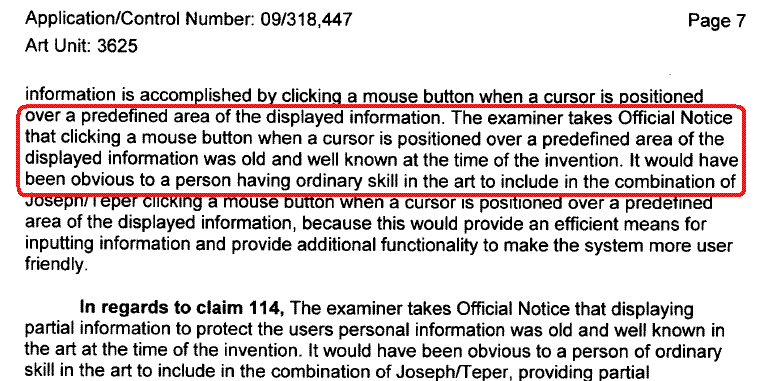
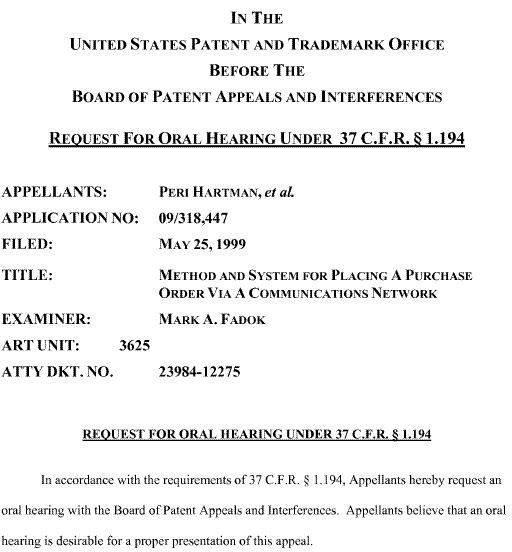
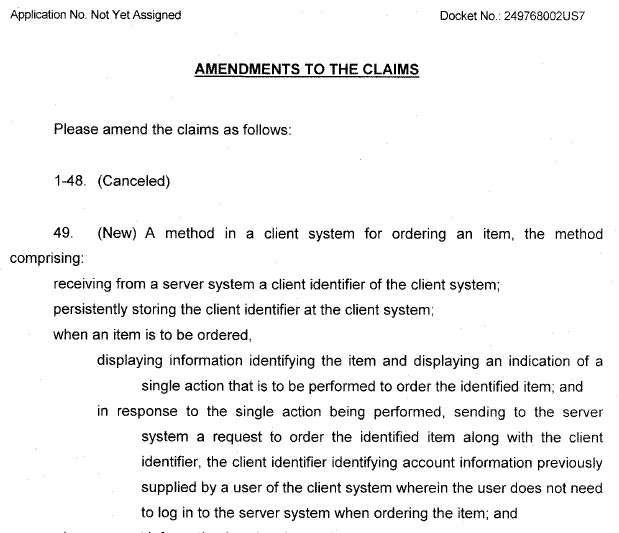
theodp writes "Faced with a duly unimpressed USPTO examiner who rejected its new 1-Click patent claims as 'obvious' and 'old and well known,' Amazon has taken the unusual step of requesting an Oral Appeal to plead its case. And in what might be interpreted by some as an old-fashioned stalling tactic, the e-tailer has also canceled and refiled its 1-Click claims in a continuation application. As it touted the novelty of 1-Click to Congress last spring, Amazon kept the examiner's rejection under its hat, insisting that 'still no [1-Click] prior art has surfaced.' The Judiciary Committee hearing this testimony included Rick Boucher (VA) and Howard Berman (CA), both recipients of campaign contributions from a PAC funded by 1-Click inventor Jeff Bezos, other Amazon execs, and their families." -
Resolution To Impeach VP Cheney Submitted
Congressman Dennis Kucinich (D-Ohio) has submitted a resolution, HR 333, to impeach VP Dick Cheney on charges of "high crimes and misdemeanors." The charges were submitted on 24 April 2007. Congressman Kucinich has posted his supporting documents online, including a brief summary of the impeachment procedure (PDF), a synopsis (PDF), and the full text (PDF) of the impeachment resolution. -
Resolution To Impeach VP Cheney Submitted
Congressman Dennis Kucinich (D-Ohio) has submitted a resolution, HR 333, to impeach VP Dick Cheney on charges of "high crimes and misdemeanors." The charges were submitted on 24 April 2007. Congressman Kucinich has posted his supporting documents online, including a brief summary of the impeachment procedure (PDF), a synopsis (PDF), and the full text (PDF) of the impeachment resolution. -
Resolution To Impeach VP Cheney Submitted
Congressman Dennis Kucinich (D-Ohio) has submitted a resolution, HR 333, to impeach VP Dick Cheney on charges of "high crimes and misdemeanors." The charges were submitted on 24 April 2007. Congressman Kucinich has posted his supporting documents online, including a brief summary of the impeachment procedure (PDF), a synopsis (PDF), and the full text (PDF) of the impeachment resolution. -
Resolution To Impeach VP Cheney Submitted
Congressman Dennis Kucinich (D-Ohio) has submitted a resolution, HR 333, to impeach VP Dick Cheney on charges of "high crimes and misdemeanors." The charges were submitted on 24 April 2007. Congressman Kucinich has posted his supporting documents online, including a brief summary of the impeachment procedure (PDF), a synopsis (PDF), and the full text (PDF) of the impeachment resolution. -
Fair Use Bill Introduced To Change DMCA
An anonymous reader tips us to a Washington Post blogger's note that Representatives Boucher (D-VA) and Dolittle (R-CA) today introduced the FAIR USE Act to update the DMCA to "make it easier for digital media consumers to use the content they buy." Boucher's statement on the bill says, "The Digital Millennium Copyright Act dramatically tilted the copyright balance toward complete copyright protection at the expense of the public's right to fair use..." The Post failed to note the history. Boucher has been introducing this bill for years; here are attempts from 2002 and 2003. The chances may be better in this Congress. And reader Rolling maul writes in to note Ars's disappointment with the bill for leaving the DMCA's anti-circumvention provisions intact: "Yet again, the bill does not appear to deliver on what most observers want: clear protection for making personal use copies of encrypted materials. There is no allowance for consumers to make backups of DVDs, to strip encryption from music purchased online so that it can be played anywhere, or to generally do any of the things that the DMCA has made illegal." -
Amazon Using Patent Reform to Strengthen 1-Click
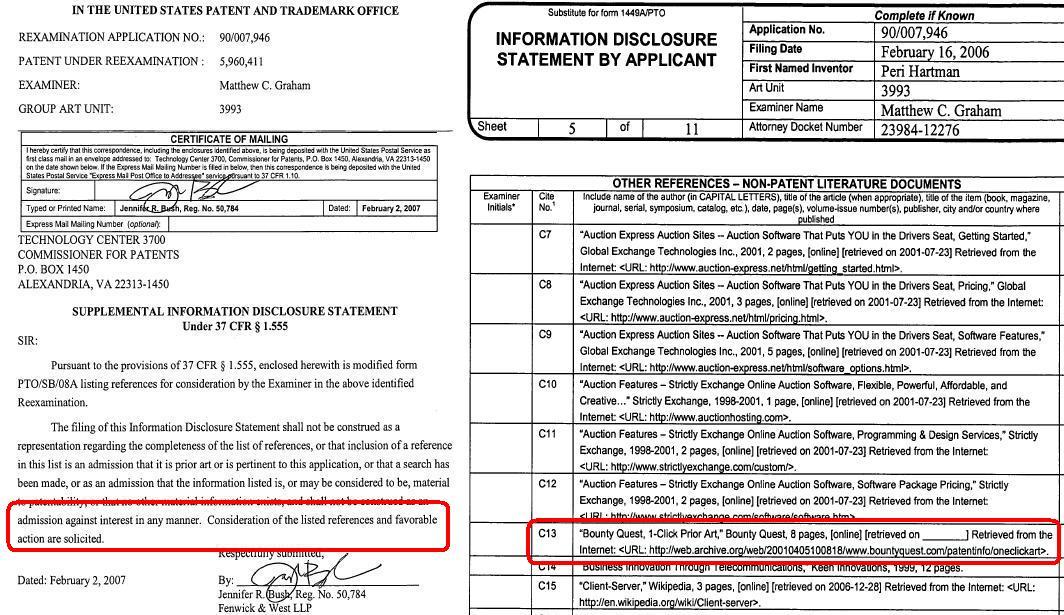
theodp writes "As some predicted, lawyers for Amazon.com have recently submitted 1-Click prior art solicited by Tim O'Reilly under the auspices of Jeff Bezos' patent reform effort to the USPTO, soliciting a 'favorable action' that would help bulletproof the patent. Last June, an Amazon lobbyist referred to deficiencies with the same prior art as he tried to convince Congress that 1-Click was novel, prompting Rep. Howard Berman to call BS." -
Congress Tackles Patent Reform
nadamsieee writes "Wired's Luke O'Brian recently reported about Congress' latest attempt to reform the patent system. In the article O'Brian tells of how 'witnesses at Thursday's hearing painted a bleak picture of that system. Adam Jaffe, a Brandeis University professor and author of a book on the subject, described the system as 'out of whack.' Instead of 'the engine of innovation,' the patent has become 'the sand in the gears,' he said, citing widespread fears of litigation. The House Oversight Committee website has more details. How would you fix the patent system?" -
Why You & Yahoo Should Like This Human Rights Law
Regular contributor Bennett Haselton has written in to say that "The Global Online Freedom Act, introduced last year during a firestorm of controversy over American companies cooperating with totalitarian governments in China and elsewhere, was introduced this month as the Global Online Freedom Act of 2007. When Chris Smith (R-NJ) first introduced the law in 2006, Yahoo was under fire for recently turning over information to Chinese authorities that led to the arrest of a political dissident, Microsoft was attacked for removing pages from MSN Spaces China at the behest of the government, Google was being criticized for removing political sites from search results displayed to China, and Cisco was accused of helping to enable Chinese filtering of the Web. All four corporations testified at a February 2006 House hearing during which Representative Tom Lantos summed up the mood of many of his colleagues by telling the companies, "I do not understand how your corporate leadership sleeps at night." The companies protested that they had no choice but to comply with local Chinese laws, but that they were troubled by their own actions, and -- in a rarity for individual tech companies, much less for a chorus -- they all invited the U.S. government to play a bigger role, while being vague about what the role should be."GOFA would create a U.S.-government-designated list of "Internet restricting countries" and would in most cases prohibit U.S.-based companies from censoring content or turning over users' information to the governments of those countries. Do these companies want GOFA to pass? And is GOFA a good law? I think, yes and yes, but the answers are more complicated than they seem.
With American "collaboration" less in the news, GOFA made less of a splash when it was re-introduced this year, but it is still the subject of spirited debate. Reporters Without Borders, Amnesty International, and other human rights groups have already signed a statement supporting the July 2006 version of the bill (nearly identical the 2007 version). But blogger-journalist Rebecca MacKinnon argues that by creating a government-maintained list of "Internet censoring countries", the law falls short of calling for support of free speech in all countries (the initial list, for example, includes Iran and China, but leaves out notorious human rights violator and net-censor Saudi Arabia). Danny O'Brien of the EFF backs this position as well, and also argues the organization's long-standing position that "code is speech" and that filtering software should not be subject to export regulations that are proposed in the law.
I agree with MacKinnon that instead of using a list of "Internet restricting countries", we should require the same standards of U.S. companies wherever they do business, or at least, stop playing silly games like leaving Saudi Arabia off of a list of human rights violators because Bush is friends with the ruling family. I agree with the EFF that filtering software should be considered First-Amendment-protected speech like encryption software, and not be included on an export-prohibited "munitions" list. And for reasons listed below, I think that the law won't stop censoring countries from blocking any speech they want. But even with all of these qualifications, I think the law would be a step in the right direction, if only for the rules prohibiting companies from turning over users' personal information to the governments of countries like China and Iran. It's painful to give a pass to countries like Germany that also censor political speech, but I think that the situation is so much worse in places like China that we should do what we can in the short term. And for reasons I'll get into, I think that Microsoft, Yahoo, Google and Cisco are secretly hoping that a law like GOFA does get passed -- even if they can't come out and say so.
First, what the law does not do: There is still nothing to stop a U.S. company from blocking or removing legal, political content at the request of a foreign government. Section 204 says only that American content-hosting companies and content-filtering companies have to provide the U.S. government with a list of sites that have been removed or blocked at the behest of a censoring country.
Section 205 does say that U.S. companies may not block or remove sites that are operated by the U.S. government, or by any entity that receives grants from the International Broadcasting Bureau to help defeat foreign censorship. Presumably that would include Peacefire, at least during the periods when we're under contract to the IBB to develop the Circumventor software (but before you start calling me Hallibennett, I'm not working for the IBB right now, and it was my own idea to write this). So the American government, while requiring schools to block us in the U.S., would actually be helping to get us un-blocked in China and Iran! But Section 205 only says that a U.S. business may not block or shut down such sites. As far as I can tell, that means if the Cisco engineer on site in China sets up their routers for them, the Cisco engineer can't put VOANews.com on the block list. But then the Chinese official can walk across the room and add it to the list himself, can't he? Which is almost certainly what they'll do, since the routers are in their country.
So, I think the regulations against Internet blocking will be easy for foreign governments to ignore. But where the law could make a difference is in the prohibition against turning over users' personal data to law enforcement in censoring countries. Section 201 says that servers located in a censoring country cannot contain personally identifiable user information (so that the local police cannot simply storm in and seize the data). Section 202 says that American companies can only turn information over to law enforcement of a censoring country if the information is needed "for legitimate foreign law enforcement purposes as determined by the Department of Justice". MacKinnon has criticized this aspect of the law as well -- "If Americans don't want the DOJ to have access to their user information, why should anybody else?" Very true. But, even at the lowest point of public confidence in the Department of Justice, I think most people living outside of fortified compounds stocked with beef jerky and gold bullion, can agree that the U.S. DoJ has more integrity and legitimacy than the government of China, and that such a rule would mean fewer Chinese dissidents going to jail.
What do the affected U.S. companies think of the law? Microsoft, Yahoo, and Cisco did not respond to requests for comment. A Google PR person replied to say, "We welcome intiatives that expand access to information and protect the rights of users across the globe. At the same time, we remain concerned that legislation in this area can have unintended consequences, so we intend to study any such proposals closely, and work with proponents and others to reach the right outcome." When I replied that the Global Online Freedom Act had been proposed more than a year ago and had been online in its current form since June 2006, presumably enough time to "study such a proposal closely" and take a position on it, he said they would stick with that statement for now. (In his e-mail, he actually put quote marks around the company's statement, which I thought was a nice dry touch.)
But past statements from the respective companies have indicated they would be amenable to such a law. Bill Gates, never one to be shy about criticizing government regulation that he disagreed with, was asked in a February 2006 interview with the London Times, "Should the US government establish guidelines to regulate how internet companies deal with censorship in countries like China?" and answered, "I think something like the Foreign Corrupt Practices Act has been a resounding success in terms of very clearly outlining what companies can't do and other rich countries largely went along with that." At the February 2006 house hearings to discuss American companies' cooperation with overseas censors, representatives from all companies indicated that they actually wanted the government to play a bigger role -- they were vague about what such a role would be, but this was only a month after the first draft of the Global Online Freedom Act had been proposed, the only such law on the table at the time.
At first this might seem paradoxical -- why would companies seem amenable to, even supportive of, laws that would restrict what they can do? But it actually makes sense if you consider their negotiating position with the Chinese government. Currently, the Chinese censors can tell Microsoft, Yahoo, and Google that they either have to either play by the Chinese rules or get out, and the censors know that the companies will comply (without even necessarily feeling guilty about it -- the companies can always say that the Chinese people are better off with a censored version of their services than no access at all).
But if the companies' hands are tied by U.S. law, then they can basically present the Chinese government with a take-it-or-leave-it deal: You can use our e-mail and messenger and blog services, just know that our government won't let us turn over users' personal information if you ever want it. The Chinese censors are presumably coming from the point of view that they'd rather have a controlled Internet, but that it's more important to reap the economic benefits of having the Internet in their country, even if some control is lost (after all, if they didn't believe that, they wouldn't have connected to the Internet in the first place). Hence it's not likely that they'd throw out Yahoo Mail and Google search and MSN Messenger when so many users depend on these and use them for business as well as personal use. (Even if there are Chinese-made alternatives, there would be the huge cost of switching everyone over, and no longer being able to use the old tools to communicate with American companies.) So a law controlling the actions of U.S. companies would very probably allow them to keep doing business in censored countries, while giving them an excuse not to turn over users' data.
But, that might not work if it looks like the companies pushed too hard for the law themselves. If the Chinese see Yahoo fighting tooth and nail to pass a law that restricts what information Yahoo can hand over to China, the Chinese censors could take that as a slap in the face, and punish Yahoo for defying them even after the law is passed that prohibits Yahoo from cooperating. "Oh, you can't give us that information because of the law? This law right here that you lobbied for?"
So, when the general counsel of Yahoo says, "Ultimately, the greatest leverage lies with the U.S. government"; when the Vice President of Google tells Congress, "And certainly also, finally, there is a role for government. We do need your help, and you can help us"; when the associate general counsel of Microsoft testifies, "It is, therefore, the responsibility of governments, with the active leadership of the United States, to seek to reduce or reconcile these differences", I think what we're hearing are subtly encoded messages saying, "Pass this law, or something like it; we just can't look like we wanted it to pass." So, Congress should give them what they want, even if they can't ask for it directly. And at the same time they would be helping users in censored countries all around the world, before the next one gets sent to jail because an American company turned over their information.
-
Why You & Yahoo Should Like This Human Rights Law
Regular contributor Bennett Haselton has written in to say that "The Global Online Freedom Act, introduced last year during a firestorm of controversy over American companies cooperating with totalitarian governments in China and elsewhere, was introduced this month as the Global Online Freedom Act of 2007. When Chris Smith (R-NJ) first introduced the law in 2006, Yahoo was under fire for recently turning over information to Chinese authorities that led to the arrest of a political dissident, Microsoft was attacked for removing pages from MSN Spaces China at the behest of the government, Google was being criticized for removing political sites from search results displayed to China, and Cisco was accused of helping to enable Chinese filtering of the Web. All four corporations testified at a February 2006 House hearing during which Representative Tom Lantos summed up the mood of many of his colleagues by telling the companies, "I do not understand how your corporate leadership sleeps at night." The companies protested that they had no choice but to comply with local Chinese laws, but that they were troubled by their own actions, and -- in a rarity for individual tech companies, much less for a chorus -- they all invited the U.S. government to play a bigger role, while being vague about what the role should be."GOFA would create a U.S.-government-designated list of "Internet restricting countries" and would in most cases prohibit U.S.-based companies from censoring content or turning over users' information to the governments of those countries. Do these companies want GOFA to pass? And is GOFA a good law? I think, yes and yes, but the answers are more complicated than they seem.
With American "collaboration" less in the news, GOFA made less of a splash when it was re-introduced this year, but it is still the subject of spirited debate. Reporters Without Borders, Amnesty International, and other human rights groups have already signed a statement supporting the July 2006 version of the bill (nearly identical the 2007 version). But blogger-journalist Rebecca MacKinnon argues that by creating a government-maintained list of "Internet censoring countries", the law falls short of calling for support of free speech in all countries (the initial list, for example, includes Iran and China, but leaves out notorious human rights violator and net-censor Saudi Arabia). Danny O'Brien of the EFF backs this position as well, and also argues the organization's long-standing position that "code is speech" and that filtering software should not be subject to export regulations that are proposed in the law.
I agree with MacKinnon that instead of using a list of "Internet restricting countries", we should require the same standards of U.S. companies wherever they do business, or at least, stop playing silly games like leaving Saudi Arabia off of a list of human rights violators because Bush is friends with the ruling family. I agree with the EFF that filtering software should be considered First-Amendment-protected speech like encryption software, and not be included on an export-prohibited "munitions" list. And for reasons listed below, I think that the law won't stop censoring countries from blocking any speech they want. But even with all of these qualifications, I think the law would be a step in the right direction, if only for the rules prohibiting companies from turning over users' personal information to the governments of countries like China and Iran. It's painful to give a pass to countries like Germany that also censor political speech, but I think that the situation is so much worse in places like China that we should do what we can in the short term. And for reasons I'll get into, I think that Microsoft, Yahoo, Google and Cisco are secretly hoping that a law like GOFA does get passed -- even if they can't come out and say so.
First, what the law does not do: There is still nothing to stop a U.S. company from blocking or removing legal, political content at the request of a foreign government. Section 204 says only that American content-hosting companies and content-filtering companies have to provide the U.S. government with a list of sites that have been removed or blocked at the behest of a censoring country.
Section 205 does say that U.S. companies may not block or remove sites that are operated by the U.S. government, or by any entity that receives grants from the International Broadcasting Bureau to help defeat foreign censorship. Presumably that would include Peacefire, at least during the periods when we're under contract to the IBB to develop the Circumventor software (but before you start calling me Hallibennett, I'm not working for the IBB right now, and it was my own idea to write this). So the American government, while requiring schools to block us in the U.S., would actually be helping to get us un-blocked in China and Iran! But Section 205 only says that a U.S. business may not block or shut down such sites. As far as I can tell, that means if the Cisco engineer on site in China sets up their routers for them, the Cisco engineer can't put VOANews.com on the block list. But then the Chinese official can walk across the room and add it to the list himself, can't he? Which is almost certainly what they'll do, since the routers are in their country.
So, I think the regulations against Internet blocking will be easy for foreign governments to ignore. But where the law could make a difference is in the prohibition against turning over users' personal data to law enforcement in censoring countries. Section 201 says that servers located in a censoring country cannot contain personally identifiable user information (so that the local police cannot simply storm in and seize the data). Section 202 says that American companies can only turn information over to law enforcement of a censoring country if the information is needed "for legitimate foreign law enforcement purposes as determined by the Department of Justice". MacKinnon has criticized this aspect of the law as well -- "If Americans don't want the DOJ to have access to their user information, why should anybody else?" Very true. But, even at the lowest point of public confidence in the Department of Justice, I think most people living outside of fortified compounds stocked with beef jerky and gold bullion, can agree that the U.S. DoJ has more integrity and legitimacy than the government of China, and that such a rule would mean fewer Chinese dissidents going to jail.
What do the affected U.S. companies think of the law? Microsoft, Yahoo, and Cisco did not respond to requests for comment. A Google PR person replied to say, "We welcome intiatives that expand access to information and protect the rights of users across the globe. At the same time, we remain concerned that legislation in this area can have unintended consequences, so we intend to study any such proposals closely, and work with proponents and others to reach the right outcome." When I replied that the Global Online Freedom Act had been proposed more than a year ago and had been online in its current form since June 2006, presumably enough time to "study such a proposal closely" and take a position on it, he said they would stick with that statement for now. (In his e-mail, he actually put quote marks around the company's statement, which I thought was a nice dry touch.)
But past statements from the respective companies have indicated they would be amenable to such a law. Bill Gates, never one to be shy about criticizing government regulation that he disagreed with, was asked in a February 2006 interview with the London Times, "Should the US government establish guidelines to regulate how internet companies deal with censorship in countries like China?" and answered, "I think something like the Foreign Corrupt Practices Act has been a resounding success in terms of very clearly outlining what companies can't do and other rich countries largely went along with that." At the February 2006 house hearings to discuss American companies' cooperation with overseas censors, representatives from all companies indicated that they actually wanted the government to play a bigger role -- they were vague about what such a role would be, but this was only a month after the first draft of the Global Online Freedom Act had been proposed, the only such law on the table at the time.
At first this might seem paradoxical -- why would companies seem amenable to, even supportive of, laws that would restrict what they can do? But it actually makes sense if you consider their negotiating position with the Chinese government. Currently, the Chinese censors can tell Microsoft, Yahoo, and Google that they either have to either play by the Chinese rules or get out, and the censors know that the companies will comply (without even necessarily feeling guilty about it -- the companies can always say that the Chinese people are better off with a censored version of their services than no access at all).
But if the companies' hands are tied by U.S. law, then they can basically present the Chinese government with a take-it-or-leave-it deal: You can use our e-mail and messenger and blog services, just know that our government won't let us turn over users' personal information if you ever want it. The Chinese censors are presumably coming from the point of view that they'd rather have a controlled Internet, but that it's more important to reap the economic benefits of having the Internet in their country, even if some control is lost (after all, if they didn't believe that, they wouldn't have connected to the Internet in the first place). Hence it's not likely that they'd throw out Yahoo Mail and Google search and MSN Messenger when so many users depend on these and use them for business as well as personal use. (Even if there are Chinese-made alternatives, there would be the huge cost of switching everyone over, and no longer being able to use the old tools to communicate with American companies.) So a law controlling the actions of U.S. companies would very probably allow them to keep doing business in censored countries, while giving them an excuse not to turn over users' data.
But, that might not work if it looks like the companies pushed too hard for the law themselves. If the Chinese see Yahoo fighting tooth and nail to pass a law that restricts what information Yahoo can hand over to China, the Chinese censors could take that as a slap in the face, and punish Yahoo for defying them even after the law is passed that prohibits Yahoo from cooperating. "Oh, you can't give us that information because of the law? This law right here that you lobbied for?"
So, when the general counsel of Yahoo says, "Ultimately, the greatest leverage lies with the U.S. government"; when the Vice President of Google tells Congress, "And certainly also, finally, there is a role for government. We do need your help, and you can help us"; when the associate general counsel of Microsoft testifies, "It is, therefore, the responsibility of governments, with the active leadership of the United States, to seek to reduce or reconcile these differences", I think what we're hearing are subtly encoded messages saying, "Pass this law, or something like it; we just can't look like we wanted it to pass." So, Congress should give them what they want, even if they can't ask for it directly. And at the same time they would be helping users in censored countries all around the world, before the next one gets sent to jail because an American company turned over their information.
-
Why You & Yahoo Should Like This Human Rights Law
Regular contributor Bennett Haselton has written in to say that "The Global Online Freedom Act, introduced last year during a firestorm of controversy over American companies cooperating with totalitarian governments in China and elsewhere, was introduced this month as the Global Online Freedom Act of 2007. When Chris Smith (R-NJ) first introduced the law in 2006, Yahoo was under fire for recently turning over information to Chinese authorities that led to the arrest of a political dissident, Microsoft was attacked for removing pages from MSN Spaces China at the behest of the government, Google was being criticized for removing political sites from search results displayed to China, and Cisco was accused of helping to enable Chinese filtering of the Web. All four corporations testified at a February 2006 House hearing during which Representative Tom Lantos summed up the mood of many of his colleagues by telling the companies, "I do not understand how your corporate leadership sleeps at night." The companies protested that they had no choice but to comply with local Chinese laws, but that they were troubled by their own actions, and -- in a rarity for individual tech companies, much less for a chorus -- they all invited the U.S. government to play a bigger role, while being vague about what the role should be."GOFA would create a U.S.-government-designated list of "Internet restricting countries" and would in most cases prohibit U.S.-based companies from censoring content or turning over users' information to the governments of those countries. Do these companies want GOFA to pass? And is GOFA a good law? I think, yes and yes, but the answers are more complicated than they seem.
With American "collaboration" less in the news, GOFA made less of a splash when it was re-introduced this year, but it is still the subject of spirited debate. Reporters Without Borders, Amnesty International, and other human rights groups have already signed a statement supporting the July 2006 version of the bill (nearly identical the 2007 version). But blogger-journalist Rebecca MacKinnon argues that by creating a government-maintained list of "Internet censoring countries", the law falls short of calling for support of free speech in all countries (the initial list, for example, includes Iran and China, but leaves out notorious human rights violator and net-censor Saudi Arabia). Danny O'Brien of the EFF backs this position as well, and also argues the organization's long-standing position that "code is speech" and that filtering software should not be subject to export regulations that are proposed in the law.
I agree with MacKinnon that instead of using a list of "Internet restricting countries", we should require the same standards of U.S. companies wherever they do business, or at least, stop playing silly games like leaving Saudi Arabia off of a list of human rights violators because Bush is friends with the ruling family. I agree with the EFF that filtering software should be considered First-Amendment-protected speech like encryption software, and not be included on an export-prohibited "munitions" list. And for reasons listed below, I think that the law won't stop censoring countries from blocking any speech they want. But even with all of these qualifications, I think the law would be a step in the right direction, if only for the rules prohibiting companies from turning over users' personal information to the governments of countries like China and Iran. It's painful to give a pass to countries like Germany that also censor political speech, but I think that the situation is so much worse in places like China that we should do what we can in the short term. And for reasons I'll get into, I think that Microsoft, Yahoo, Google and Cisco are secretly hoping that a law like GOFA does get passed -- even if they can't come out and say so.
First, what the law does not do: There is still nothing to stop a U.S. company from blocking or removing legal, political content at the request of a foreign government. Section 204 says only that American content-hosting companies and content-filtering companies have to provide the U.S. government with a list of sites that have been removed or blocked at the behest of a censoring country.
Section 205 does say that U.S. companies may not block or remove sites that are operated by the U.S. government, or by any entity that receives grants from the International Broadcasting Bureau to help defeat foreign censorship. Presumably that would include Peacefire, at least during the periods when we're under contract to the IBB to develop the Circumventor software (but before you start calling me Hallibennett, I'm not working for the IBB right now, and it was my own idea to write this). So the American government, while requiring schools to block us in the U.S., would actually be helping to get us un-blocked in China and Iran! But Section 205 only says that a U.S. business may not block or shut down such sites. As far as I can tell, that means if the Cisco engineer on site in China sets up their routers for them, the Cisco engineer can't put VOANews.com on the block list. But then the Chinese official can walk across the room and add it to the list himself, can't he? Which is almost certainly what they'll do, since the routers are in their country.
So, I think the regulations against Internet blocking will be easy for foreign governments to ignore. But where the law could make a difference is in the prohibition against turning over users' personal data to law enforcement in censoring countries. Section 201 says that servers located in a censoring country cannot contain personally identifiable user information (so that the local police cannot simply storm in and seize the data). Section 202 says that American companies can only turn information over to law enforcement of a censoring country if the information is needed "for legitimate foreign law enforcement purposes as determined by the Department of Justice". MacKinnon has criticized this aspect of the law as well -- "If Americans don't want the DOJ to have access to their user information, why should anybody else?" Very true. But, even at the lowest point of public confidence in the Department of Justice, I think most people living outside of fortified compounds stocked with beef jerky and gold bullion, can agree that the U.S. DoJ has more integrity and legitimacy than the government of China, and that such a rule would mean fewer Chinese dissidents going to jail.
What do the affected U.S. companies think of the law? Microsoft, Yahoo, and Cisco did not respond to requests for comment. A Google PR person replied to say, "We welcome intiatives that expand access to information and protect the rights of users across the globe. At the same time, we remain concerned that legislation in this area can have unintended consequences, so we intend to study any such proposals closely, and work with proponents and others to reach the right outcome." When I replied that the Global Online Freedom Act had been proposed more than a year ago and had been online in its current form since June 2006, presumably enough time to "study such a proposal closely" and take a position on it, he said they would stick with that statement for now. (In his e-mail, he actually put quote marks around the company's statement, which I thought was a nice dry touch.)
But past statements from the respective companies have indicated they would be amenable to such a law. Bill Gates, never one to be shy about criticizing government regulation that he disagreed with, was asked in a February 2006 interview with the London Times, "Should the US government establish guidelines to regulate how internet companies deal with censorship in countries like China?" and answered, "I think something like the Foreign Corrupt Practices Act has been a resounding success in terms of very clearly outlining what companies can't do and other rich countries largely went along with that." At the February 2006 house hearings to discuss American companies' cooperation with overseas censors, representatives from all companies indicated that they actually wanted the government to play a bigger role -- they were vague about what such a role would be, but this was only a month after the first draft of the Global Online Freedom Act had been proposed, the only such law on the table at the time.
At first this might seem paradoxical -- why would companies seem amenable to, even supportive of, laws that would restrict what they can do? But it actually makes sense if you consider their negotiating position with the Chinese government. Currently, the Chinese censors can tell Microsoft, Yahoo, and Google that they either have to either play by the Chinese rules or get out, and the censors know that the companies will comply (without even necessarily feeling guilty about it -- the companies can always say that the Chinese people are better off with a censored version of their services than no access at all).
But if the companies' hands are tied by U.S. law, then they can basically present the Chinese government with a take-it-or-leave-it deal: You can use our e-mail and messenger and blog services, just know that our government won't let us turn over users' personal information if you ever want it. The Chinese censors are presumably coming from the point of view that they'd rather have a controlled Internet, but that it's more important to reap the economic benefits of having the Internet in their country, even if some control is lost (after all, if they didn't believe that, they wouldn't have connected to the Internet in the first place). Hence it's not likely that they'd throw out Yahoo Mail and Google search and MSN Messenger when so many users depend on these and use them for business as well as personal use. (Even if there are Chinese-made alternatives, there would be the huge cost of switching everyone over, and no longer being able to use the old tools to communicate with American companies.) So a law controlling the actions of U.S. companies would very probably allow them to keep doing business in censored countries, while giving them an excuse not to turn over users' data.
But, that might not work if it looks like the companies pushed too hard for the law themselves. If the Chinese see Yahoo fighting tooth and nail to pass a law that restricts what information Yahoo can hand over to China, the Chinese censors could take that as a slap in the face, and punish Yahoo for defying them even after the law is passed that prohibits Yahoo from cooperating. "Oh, you can't give us that information because of the law? This law right here that you lobbied for?"
So, when the general counsel of Yahoo says, "Ultimately, the greatest leverage lies with the U.S. government"; when the Vice President of Google tells Congress, "And certainly also, finally, there is a role for government. We do need your help, and you can help us"; when the associate general counsel of Microsoft testifies, "It is, therefore, the responsibility of governments, with the active leadership of the United States, to seek to reduce or reconcile these differences", I think what we're hearing are subtly encoded messages saying, "Pass this law, or something like it; we just can't look like we wanted it to pass." So, Congress should give them what they want, even if they can't ask for it directly. And at the same time they would be helping users in censored countries all around the world, before the next one gets sent to jail because an American company turned over their information.
-
Cleanfeed Canada - What Would It Accomplish?
Bennett Haselton has another article on offer for us today, this time looking at the implications of a Canadian initiative to protect children online. Bennet writes: "Cybertip.ca, a Canadian clearinghouse for providing information to law enforcement about online child luring and child pornography, has announced that a group of major ISPs will begin blocking access to URLs on Cybertip's list of known child pornography sites. A Cybertip spokesperson says that the list fluctuates between 500 and 800 sites at any given time." Read on for the rest of his analysis. The system is named after a similar filtering system used by service provider BT in the UK. It is also reminiscent of a law passed in Pennsylvania in 2002 requiring ISPs to block URLs on a list of known child pornography sites; the law was struck down in 2004 on First Amendment grounds. Although child pornography is of course not protected by the First Amendment, the law was struck down partly because the ISPs were blocking entire servers and IP address ranges, hundreds of thousands of non-child-pornography sites were also being blocked.
Under the implementation of the Cleanfeed system, representatives from Sasktel, Bell Canada, and Telus claim that only exact URLs will be filtered, not sites hosted at the same IP address. (Although conventional Internet filtering programs sold to parents and schools have also made the same claims, only to turn out to be filtering sites by IP address after all, so we'll have to wait until the filtering is implemented before we know for sure.) The other difference of course is that the Cleanfeed system is not the law, so there's nothing to "strike down" in court. Cybertip did acknowledge that this means customers can get around the filtering for now by switching to a non-participating service provider, although they are encouraging more providers to sign up. Cybertip declined to say whether any providers had simply refused to participate. But of course it's much easier than that to get around the filter, since filter circumvention sites like Anonymouse and StupidCensorship will not be blocked.
So, if it's that easy to circumvent, does it do any good? Even respected Canadian academic and columnist Michael Geist, hardly a friend of censorship in other forms, has spoken out in favor of the plan. I'm going to go out on a limb and say that it doesn't accomplish anything meaningful, and may set a horrible precedent that could make it much easier to block other content in the future.
First of all, it seems that it obviously won't stop anyone who is deliberately looking for child porn. Empirically there's no way to tell -- we don't whether systems like Cleanfeed in the UK have prevented people from accessing child pornography on purpose. Even if the providers are counting the number of blocked accesses to known child porn sites, nobody knows what people have been looking at instead through proxy sites like Anonymouse. All we can do is ask, logically, whether it is likely to work. I think purely logical arguments are frustrating when there is no empirical data to act as a referee, but let's face it, users are not going to self-report on their success at finding child pornography, and there's no way to see what users are accessing through encrypted circumvention sites. Logic is all we have.
So, consider people who are deliberately looking for child pornography. Such people are likely to be resourceful to begin with (since real child porn -- remember, non-sexual pictures of naked children do not count -- is vastly less common than regular porn; Cybertip claims after all that they "only" have about 800 sites on their list, compared to millions of regular porn sites). Virtually all such people would be aware of circumvention sites like Anonymouse, or of peer-to-peer networks, which Cybertip says they have no plans to block. So nothing is blocked from people who want to get around the filter.
The only scenario where the filters could make a difference is the case where someone accidentally accesses a child porn site. Now when I first read the Cybertip press release announcing that the filter would aim to stop "accidental" exposure to child porn, I thought that was just a tactfully sarcastic way of referring to the people who get caught accessing child porn and claim it was just a mistake. But Cybertip.ca claims they've received over 10,000 reports since January 2005 from people who accessed child porn by accident. Even though that only works out to about 15 per day, I have to concede in those cases it almost certainly was a bona fide mistake, for the simple reason that nobody would voluntarily report accessing a child pornography URL that they visited on purpose. But even so, there's the question: What have you accomplished by blocking accidental exposure?
I would argue that the harm done by child pornography is to the minors coerced into the production of it, not to the people who view it. (This, by the way, corresponds with current U.S. jurisprudence; the U.S. Supreme Court ruled in 2002 that a law banning fake child porn was unconstitutional, even when the viewer can't tell the difference.) Obviously you prevent the most damage by stopping child porn at the production stage, but if it's too late for that, you can try to stop people from obtaining it willfully. This lowers the demand and decreases the incentive for people to produce more in the future.
But how would it lower demand if you block people from accessing it accidentally? If those people weren't going to proceed to buy or download more pictures anyway, then they're not fueling the demand. You can block them from accessing the pictures, but the pictures are still out there, and the people who really are fueling the demand can still access them.
So it seems that by blocking someone from accidentally viewing child porn, all you've really accomplished is to avoid offending their sensibilities. Now I don't mean that mockingly, I'm certainly not disagreeing with anyone whose sensibilities are offended by child porn. But there are lots of graphic pictures on the Internet that could offend someone's sensibilities, which are outside of Cleanfeed's mandate. Consider a photo of a 16-year-old having sex, versus a photo of an adult woman fellating a horse; even though the former is illegal to possess and the latter isn't, I think most people would be more grossed out by the second one. (I would even argue that there was more harm to the participants in the making of the second one, and in this case the law's priorities are a bit screwed up. Poor horse!)
So, why block 1% of the content that would offend someone's sensibilities, when 99% of the content that would still offend that person would still be out there? The fact that the 1% is illegal doesn't answer the question; even if it's illegal, you don't have to block it, so what have you accomplished if you do?
Possibly law enforcement is sick of people using the "I accidentally clicked on it" excuse when they get caught accessing child pornography, and wants to remove that as a defense. But couldn't someone just as easily claim that they "accidentally" accessed child pornography through a circumvention site like Anonymouse? They could claim that they thought they were accessing a regular porn site, they were using a circumventor to protect their privacy, and they didn't know that the site carried child porn and didn't find out until they'd already accessed it. So it doesn't seem like the filtering would remove the "accidental" defense.
So, I don't think the filtering accomplishes much at all, but it could set a very bad precedent once the filters are in place. Once Internet users have accepted the precedent that ISPs should block content that is "probably" illegal, what's to stop organizations and lawmakers from demanding that ISPs block access to overseas sites that violate copyright, for example, as the RIAA did in 2002? The technical means will already be in place, and more importantly, people will have gotten used to the idea that legally "questionable" content should be blocked. And with lobbyists claiming that 90% of content on peer-to-peer networks violates copyright laws, wouldn't it follow logically to block peer-to-peer traffic as well?
In a legislative climate where lawmakers have proposed everything from jail time for p2p developers to letting the RIAA hack people's PCs for distributing copyrighted files, we should resist any kind of content-based blocking that would let them get their foot in the door. That includes even well-intentioned efforts like Cleanfeed.
-
Congressmen Rated On Tech-Friendliness
Uncle Dick writes "CNET has released the results of a study ranking every US Representative and Senator on a scale rating their relative friendliness towards various technology and internet related issues. Republicans and Democrats fare similarly in both houses of Congress, although CNET gives the edge to the GOP. Big Winner? Ron Paul (R-TX). 2004 Presidential candidate John Kerry (D-MA) does not fare so well." -
Politicians Target Social Sites For Restrictions
cnet-declan writes "Politicians are looking for reasons to convince citizens to vote in November, and polls say suburban parents are worried about the internet. Wednesday top House Republicans announced a bill to make 'social' Web sites unreachable from schools and libraries. The bill is intended to go after MySpace, but the actual text of the legislation covers sites that let users 'create profiles' and have a 'forum' for conversations -- which would include Slashdot and many blog sites. House Speaker Dennis Hastert claims it's necessary to stop 'dangerous predators' out here on the Interweb." -
The Looming Battle Over Online Gambling
Kadin2048 writes "According to an recent Ars Technica article, the US is headed on a 'collision course' with the WTO over off-shore Internet gambling, if a bill currently in the House of Representatives passes. The 'Internet Gambling Prohibition Act,' (PDF) which updates the 'Wire Act' to prohibit Internet gambling regardless of whether the servers are located in the US or outside of it, is in direct contravention of a WTO ruling. Proponents of the bill claim that it was narrowly defeated in previous incarnations due to the influence of disgraced lobbyist Jack Abramoff. However it seems as though some of Abramoff's biggest clients -- brick and mortar casinos -- are really the big winners from passage of this bill, since it does not prohibit gambling in person, only online." -
Vint Cerf Speaking Out on Internet Neutrality
penciling_in writes "CircleID has reported on a U.S. congress hearing held on November 9th, where "significant focus was projected on 'network neutrality' and a new telecommunications bill affecting the Internet. 'This bill could fundamentally alter the fabulously successful end-to-end Internet,' says Alan Davidson in a related post on Google blog." Vint Cerf was not able to testify because of the Presidential Medal of Freedom award ceremony at the White House, but submitted a letter: "The remarkable social impact and economic success of the Internet is in many ways directly attributable to the architectural characteristics that were part of its design. The Internet was designed with no gatekeepers over new content or services. The Internet is based on a layered, end-to-end model that allows people at each level of the network to innovate free of any central control. By placing intelligence at the edges rather than control in the middle of the network, the Internet has created a platform for innovation. This has led to an explosion of offerings - from VOIP to 802.11x wi-fi to blogging - that might never have evolved had central control of the network been required by design." CircleID post includes full text of the letter." -
Talking Software Patents with a Politician?
agent dero asks: "I'm currently trying to land an hour or two of my local representative to the House of Representatives so I can talk about software patents, amongst other things. I'm looking for the best way to describe the pitfalls of Software Patents to somebody who hasn't the slightest clue what Open Source is, let alone how software patents will hurt it. How can a computer geek relate the evil in patenting algorithms to a non-computer geek to where it will have an effective impact?" -
Patent Reform Bill Introduced in U.S. House
kanad wrote to mention a ZDNet article covering the introduction of the Patent Reform Act of 2005 to the U.S. House of Representatives. From the article: "Probably the most sweeping change would be the creation of a process to challenge patents after they are granted by the Patent and Trademark Office. 'Opposition requests' can be filed up to nine months after a patent is awarded or six months after a legal notice alleging infringement is sent out. The bill is supported by the USPTO and Microsoft who have been recently asking for patent reforms ." More details of the bill are available at the Congressman's website." -
House Passes Spyware Bills
stinerman writes "Today the house passed two bills aimed at stopping spyware / adware and unauthorized use of computers. H.R. 29 makes it 'unlawful for any person who is not the owner or authorized user of a protected computer to engage in deceptive acts or practices'. H.R. 744 (I-SPY Act) prohibits accessing a protected system via code copied on to the system to, among other things, disseminate personal information. Both bills sailed through the house and are expected to be passed by the Senate." -
House Passes Spyware Bills
stinerman writes "Today the house passed two bills aimed at stopping spyware / adware and unauthorized use of computers. H.R. 29 makes it 'unlawful for any person who is not the owner or authorized user of a protected computer to engage in deceptive acts or practices'. H.R. 744 (I-SPY Act) prohibits accessing a protected system via code copied on to the system to, among other things, disseminate personal information. Both bills sailed through the house and are expected to be passed by the Senate." -
Effects of China's Software Policy on World Economy?
guptaparesh asks: "The Chinese government is currently engaged in a comprehensive overhaul of its procurement policies and regulations. These regulations would ban non-Chinese firms from selling software to the Chinese government. Given that how much trade all the countries in the world are engaged in with China, isn't this a unfair trade move by the Chinese government?" A better question would be how this might affect the worldwide economy, particularly that of the U.S. and China. What benefits and drawbacks may China see as a result of this new policy? What steps might the U.S. take to attempt to counter it? -
Starting a Political Career with Open Source?
byronmiller desires to get to the root of the following issue: "I have chosen to run for office to represent the people of the 16th district of Pennsylvania. I am looking for software and solutions to help manage a grass roots and budget friendly campaign. What applications are available for everything from district management/contact management solutions to online fund raising and campaign management solutions? We are already rolling out staff PC's running Suse 9.2, OpenOffice.org and of course Firefox. Are there any collaboration suites and mail systems that we can use for calendaring, notes, email and conferencing? Anyone build a campaign using open source technology or is Politics still only putting money where your mouth is? Technology is a major initiative of my campaign and i'm very interested in what political software and civic solutions are available - especially experience and reviews of such." -
House Approves Electronic ID Cards
chrisaj5 writes "ZDNet News reports that the Real ID Act of 2005 has been passed by the House, by a 251-161 margin. It stipulates that driver's licenses must include a digital photograph, anticounterfeiting features and undefined machine-readable technology." From the article: "Another portion of the bill says that states would be required to link their DMV databases if they wished to receive federal funds. Among the information that must be shared: All data fields printed on drivers' licenses and identification cards, and complete drivers' histories, including motor vehicle violations, suspensions and points on licenses." -
Programmer Built Vote-Rigging Demo for Florida Politician
Syre writes "therawstory reports that a programmer named Clinton Curtis says in a sworn affidavit (mirror) that he developed prototype vote-rigging software at the request of then-Florida state representative Tom Feeney. The affidavit has been turned over to the House Judiciary Committee, of which Feeney is now a member. Should we call for inspection and disassembly of all the voting machine code to see if it contains any of these secret vote tampering functions he was asked to include in his prototype?" A follow-up interview is available. A point to emphasize: he's not making any claims of actual fraud occurring in the Florida elections. -
Programmer Built Vote-Rigging Demo for Florida Politician
Syre writes "therawstory reports that a programmer named Clinton Curtis says in a sworn affidavit (mirror) that he developed prototype vote-rigging software at the request of then-Florida state representative Tom Feeney. The affidavit has been turned over to the House Judiciary Committee, of which Feeney is now a member. Should we call for inspection and disassembly of all the voting machine code to see if it contains any of these secret vote tampering functions he was asked to include in his prototype?" A follow-up interview is available. A point to emphasize: he's not making any claims of actual fraud occurring in the Florida elections. -
Programmer Built Vote-Rigging Demo for Florida Politician
Syre writes "therawstory reports that a programmer named Clinton Curtis says in a sworn affidavit (mirror) that he developed prototype vote-rigging software at the request of then-Florida state representative Tom Feeney. The affidavit has been turned over to the House Judiciary Committee, of which Feeney is now a member. Should we call for inspection and disassembly of all the voting machine code to see if it contains any of these secret vote tampering functions he was asked to include in his prototype?" A follow-up interview is available. A point to emphasize: he's not making any claims of actual fraud occurring in the Florida elections. -
President Bush's Money For Space Cometh
citanon writes " The Washington Post reports that House Majority Leader Tom DeLay has delivered, via the omnibus spending bill passed Nov. 20, the President's full budgetary request of $16.2 billion dollars for NASA as a part of his Vision for Space Exploration. Despite earlier reports that NASA's budget will be cut, DeLay, whose congressional district now includes the Johnson Space Center, was able to deliver the full budgetary request without any debate. NASA now has "enough money to forge ahead on a plan that would reshape U.S. space policy for decades to come." Despite this early victory, questions regarding the full cost of the program remain unresolved. It is also unclear whether the NASA bureaucracy will be able to rise to the challenges posed in the initiative and which current projects will suffer as a consequence." -
President Bush's Money For Space Cometh
citanon writes " The Washington Post reports that House Majority Leader Tom DeLay has delivered, via the omnibus spending bill passed Nov. 20, the President's full budgetary request of $16.2 billion dollars for NASA as a part of his Vision for Space Exploration. Despite earlier reports that NASA's budget will be cut, DeLay, whose congressional district now includes the Johnson Space Center, was able to deliver the full budgetary request without any debate. NASA now has "enough money to forge ahead on a plan that would reshape U.S. space policy for decades to come." Despite this early victory, questions regarding the full cost of the program remain unresolved. It is also unclear whether the NASA bureaucracy will be able to rise to the challenges posed in the initiative and which current projects will suffer as a consequence." -
Political Cybersquatting Or Free Speech?
Although plenty of people have purchased politically linked domain names as a form of protest in the past, now they're being used as part of organized campaigns. In Maryland's 8th district Congressional race, Republican candidate Charles R. Floyd purchased three domain names (VanHollen2004.com/net/org) that one might think would represent Democrat incumbent Rep. Chris Van Hollen. Instead, these sites carry criticism and a bit of mockery. Floyd says Van Hollen should've registered these domain names himself, and previously used the same tactic in the primary. Is this cybersquatting, or is it a fair expression of political speech? -
NASA Prize Program Releases Workshop Report
colonist writes "NASA's prize competitions program, Centennial Challenges, held its first workshop June 15-16, 2004 to brainstorm ideas, define rules and set prize amounts. The post-workshop report (PDF) is available. New ideas for challenges should be sent to <ccideas@hq.nasa.gov>. The Centennial Challenges program is supported by the X Prize Foundation, the Aldridge Commission and some members of Congress, but not all." -
Boucher's DMCRA To Get A Hearing On May 12
Mr. Firewall writes "It's been a long road since Slashdot first carried the story that Rep. Rick Boucher (D-Va.) was speaking out about the DMCA's trampling of fair-use rights. Well, his bill (HR 107) gets a hearing this Wednesday and the multi-billion-dollar music and movie industries have called out their Big Guns to stop it. This morning an urgent message from the Professional Photographers of America arrived in my inbox characterizing Boucher's bill as 'A bill that would make it impossible for photographers to protect their work' and other lies (apparently, the RIAA and MPAA have recruited the PPA into their Axis of Evil). The alert finishes by saying that 'a strong grassroots effort combined with [our] recent lobbying efforts should be enough to keep this harmful bill locked in the subcommittee ... until Congress adjourns.' Let's give these folks a little taste of the slashdot effect and do a little 'grassroots' contacting of congresscritters ourselves." Of course, you can decide only for yourself what your thoughts are on the bill. -
US Congress Committee Talking About Privacy
rm007 writes "The US House of Representatives Judicial Committee's Subcommittee on Commercial and Administrative Law is holding hearings on the Privacy Officer for the Department of Homeland Security and approved the Defense of Privacy Act. The DHS Privacy Officer hearings are to examine how well the incumbent, Nuala O'Connor Kelly, is doing and whether the statute creating the position sufficiently addresses concerns about the handling of personally identifiable information. This should be worth watching. Wired News has an article that covers both of these as does GovExec.com, a newsletter for senior Federal employees." -
US Congress Committee Talking About Privacy
rm007 writes "The US House of Representatives Judicial Committee's Subcommittee on Commercial and Administrative Law is holding hearings on the Privacy Officer for the Department of Homeland Security and approved the Defense of Privacy Act. The DHS Privacy Officer hearings are to examine how well the incumbent, Nuala O'Connor Kelly, is doing and whether the statute creating the position sufficiently addresses concerns about the handling of personally identifiable information. This should be worth watching. Wired News has an article that covers both of these as does GovExec.com, a newsletter for senior Federal employees." -
Congress Eyes Whois Crackdown
Decius6i5 writes "The Washington Post is reporting on a Congressional hearing in which it was proposed that putting false or misleading information in your DNS whois record should be a federal crime. Texas Representative Lamar Smith is quoted as saying 'The Government must play a greater role in punishing those who conceal their identities online.' The article claims 'Smith and Berman drafted the bill after receiving complaints from the entertainment and software industries that much of their material is made available for free on Web sites whose owners are impossible to track down because their domain name registrations often contain made-up names.' Its funny, I don't recall the RIAA having any trouble tracking down P2P users whose IP addresses didn't have any DNS names associated with them at all. This isn't the first time the issue has been raised in Congress but apparently Congress hasn't gotten any more clued after several hearings." -
Electronic Voting in the News
heymarcel writes "After a negative review of the Diebold voting machines by the State Gaming Control Board, it looks like Nevada has gone with a competitor for the upcoming election. And Secretary of State Dean Heller is requiring paper receipts. According to the Associated Press story, Nevada is the first state to do so." There's another story about Nevada voting machines as well. zapf writes "It appears that the major e-Voting machine vendors have banded together to form the 'Election Technology Council.'" Reader SemperUbi writes: "Demand for a voter-verified audit trail is really gaining momentum these days. The Voter Verification Act, introduced yesterday by Senator Bob Graham (D-Florida), would require a voter-verified paper audit trail, ban the use of 'undisclosed' software and wireless communications for voting machines, and require mandatory surprise recounts -- all in time for the November 2004 election. Rep. Holt's HR2239 in the House requires much the same thing. Resistance to both bills may focus on the aggressive timetable, but the effort is worth it -- as Warren Slocum once said, democracy ain't cheap. Take that, Diebold!" And finally, a Maryland newspaper dredges up an internal Diebold email that recommends gouging Maryland if the state wants paper printouts for its Diebold voting system. -
U.S. Agencies Earn "D" For Computer Security
Fighting.Cephalopod writes "For the fourth year in a row, most federal agencies have received low grades for failing to protect their computer networks from hackers and other cyberterrorists, according to a computer security report card issued today by the House Government Reform Subcommittee on Technology." Other readers point out coverage of the report at ZDnet, Reuters (via Forbes), The Washington Post, and ComputerWorld." As mr. don't points out, the agencies receiving an actual failing grade are "the U.S. Department of Justice, as well as the departments of Energy, Health and Human Services, Interior, Agriculture, Housing and Urban Development, and State." -
Diebold Folds In DMCA E-Voting Lawsuit
sunbird writes "Diebold has filed a responsive pleading (PDF) in the lawsuit brought by the Electronic Frontier Foundation to challenge Diebold's practice of using the DMCA to suppress discussion of the critical flaws with electronic voting. Diebold states that it has "decided to withdraw its existing DMCA notifications and not to issue any further ones . . . ." Other recent developments include: this transcript of the court hearing on EFF's application for a preliminary injunction and Dennis Kucinich's linking to Diebold memos from his webpage at the U.S. House of Representatives. Stay tuned- the judge has scheduled a status conference for this Monday in the case." -
Who Is An ISP?
happynut writes "Last Friday there was an article about the new anti-spam U.S. legislation that might become law. Within this bill, the only non-government party that can sue for damages is an 'Internet Access Service' (Page 44, line 1 (Sec 7(g)), and Page 8 line 15 (Sec 3(11)) of the bill). Some reports have treated 'Internet Access Service' as the same as an ISP. But if you follow down the definition listed in Sec 3(11) (see 47 USC Sec 231(e)(4)), it defines an Internet Access Service as: '(4) Internet access service -- The term 'Internet access service' means a service that enables users to access content, information, electronic mail, or other services offered over the Internet, and may also include access to proprietary content, information, and other services as part of a package of services offered to consumers. Such term does not include telecommunications services.' My question is: isn't this definition so broad as to cover all of us who run a mail server? It doesn't mention commercial, or for money, or to the public; it just says 'as part of a package of services offered to consumers.'" -
US House, Senate Agree on Anti-Spam Bill
Folic_Acid writes "Rep. Billy Tauzin, chairman of the House Energy and Commerce committee, has announced that the House and the Senate have reached a deal to both pass an anti-spam bill, the first ever federal anti-spam law in the United States. Specifically, the law contains: opt-out, authority for the FTC to set up a "Do-Not-SPAM" registry, criminal charges for fraudulent spam, including five years in prison, statutory damages of $2 million for violations, tripled to $6 million for intentional violations, unlimited damages for fraud and abuse." News.com has a copy of the bill and a story. -
The Case for the Moon
apsmith writes "Continuing the flurry of recent hearings on the future of humans in space, a Senate committee on Thursday heard testimony in favor of a return to the Moon. Former senator and moon-walker Harrison Schmitt and physicist David Criswell see the lunar surface as an immense energy resource, just waiting to be tapped. Astronomer Roger Angel sees the lunar south pole as the ideal astronomical observatory, with locations for telescopes 100 times better than anything we've done so far. And geologist Paul Spudis sees a lot of unfinished business on the Moon, to develop it as the "feedstock of an industrial space infrastructure." TransOrbital also sent written testimony." -
The Case for the Moon
apsmith writes "Continuing the flurry of recent hearings on the future of humans in space, a Senate committee on Thursday heard testimony in favor of a return to the Moon. Former senator and moon-walker Harrison Schmitt and physicist David Criswell see the lunar surface as an immense energy resource, just waiting to be tapped. Astronomer Roger Angel sees the lunar south pole as the ideal astronomical observatory, with locations for telescopes 100 times better than anything we've done so far. And geologist Paul Spudis sees a lot of unfinished business on the Moon, to develop it as the "feedstock of an industrial space infrastructure." TransOrbital also sent written testimony." -
House Asks NASA to Postpone Space Plane
PipianJ writes "The House Science Committee has requested NASA to postpone the orbital space plane program (official letter (pdf)), thanks to lingering concern about the safety of the existing space program. On the other hand, isn't one of the ideas behind the orbital space plane program the fact that our current space program is getting more unsafe through the use of 20-year-old equipment?" The Senate is also getting into the act. -
Valenti to Step Down; Tauzin May Head MPAA
The Importance of writes "The New York Post is reporting that Jack Valenti is stepping down as head of the MPAA, probably by the end of the year. Rep. Billy Tauzin (R - LA) will be taking over. After 37 years as head of the MPAA, at least Valenti is going out on a high note, with most of Hollywood ticked off at him for the screener ban. bIPlog comments on Valenti's apparent agelessness." The Post article quotes Tauzin's office as denying that such an offer has even been made, but acknowledging that one might be in the works. -
New U.S. Sales Tax Regime For Internet Sellers?
morganew writes "As reported last week on Slashdot, States are pushing for new sales tax rules that would force Internet sellers to collect taxes for up to 7500 jurisdictions. Legislation has been introduced. The House Judiciary Committee held hearings today; here's CNet news on the bill, and here's a report (PDF link) on what it could mean to internet sellers." -
States Fight Internet Tax Ban, Cite VoIP Concern
PetiePooo writes "From an article at PCWorld: The Multistate Tax Commission is fighting a bill which makes the moratorium on internet taxes permanent. Their complaint is that it could be interpreted to include VoIP telephony such as Packet8 and Vonage, and they would lose that lucrative tax base as people switch from incumbent providers. The House has already approved the bill. When will the politicians figure out that VoIP is a going to end up as a product, not a service? Voice will be just another form of data. Here's another related article." -
H.R. 3057: To the Asteroids, Moon and Mars
apsmith writes "Democrats have just introduced the Space Exploration Act of 2003 to the U.S. House of Representatives; the author is Nick Lampson of Texas, with 26 co-sponsors. The bill sets a vision and goals for the future of NASA, beyond the Low Earth Orbit of the Space Station and Shuttle, outlining a series of incremental steps for human spaceflight. These include development of reusable spacecraft for carrying people around in the Earth-Moon vicinity, including to the nearby Lagrange points; sending people to an Earth-crossing asteroid; establishing a lunar base, and sending people to Mars with a base on a Martian moon by 2024." -
Politicizing Science
grape jelly writes "A new website has been created by Rep. Harry A. Waxman, of California, by the name of Politics and Science that accuses the current administration of intentionally manipulating scientific data in order to further its ideology. The site was created as a result of a congressional report (pdf) request by Rep. Waxman, available on his site. A NYTimes article is also available about the report with a response from the administration." -
Politicizing Science
grape jelly writes "A new website has been created by Rep. Harry A. Waxman, of California, by the name of Politics and Science that accuses the current administration of intentionally manipulating scientific data in order to further its ideology. The site was created as a result of a congressional report (pdf) request by Rep. Waxman, available on his site. A NYTimes article is also available about the report with a response from the administration."