 Slashdot Mirror
USPTO Examiner Rejected 1-Click Claims As "Obvious"
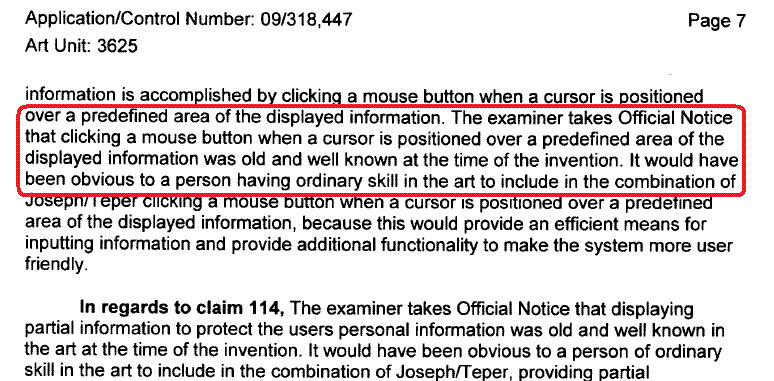
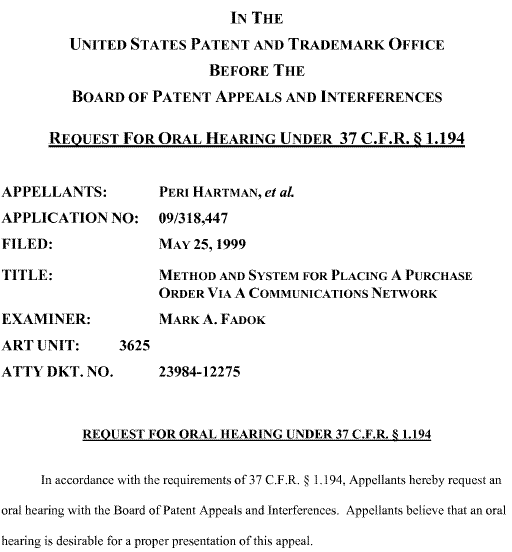
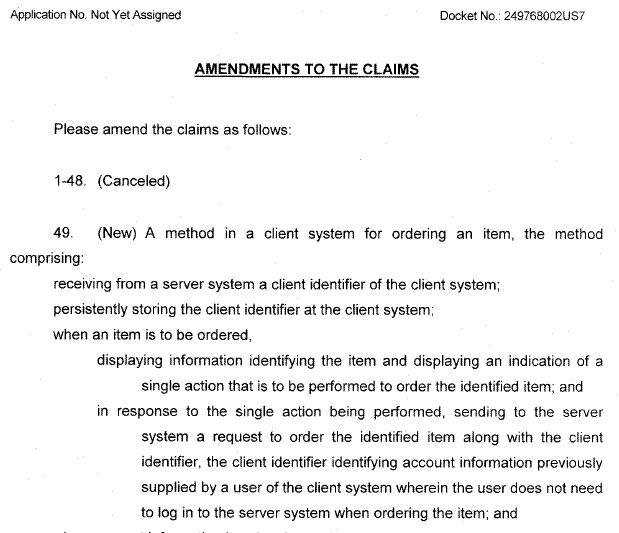
theodp writes "Faced with a duly unimpressed USPTO examiner who rejected its new 1-Click patent claims as 'obvious' and 'old and well known,' Amazon has taken the unusual step of requesting an Oral Appeal to plead its case. And in what might be interpreted by some as an old-fashioned stalling tactic, the e-tailer has also canceled and refiled its 1-Click claims in a continuation application. As it touted the novelty of 1-Click to Congress last spring, Amazon kept the examiner's rejection under its hat, insisting that 'still no [1-Click] prior art has surfaced.' The Judiciary Committee hearing this testimony included Rick Boucher (VA) and Howard Berman (CA), both recipients of campaign contributions from a PAC funded by 1-Click inventor Jeff Bezos, other Amazon execs, and their families."
Probably 99% of patents where computers do work that could be done tediously and manually should be shot down.
'still no [1-Click] prior art has surfaced.'
How can something surface when you're actively trying to drown it?
The theory of relativity doesn't work right in Arkansas.
Back in '95 or '96. We all thought it was so plainly obvious. In fact, the key thing that makes one-click shopping possible, the browser cookie, was put into the browser specifically for the purpose of associating a browser/session with stored data on the back end (payment/shipping details, purchase list.) The reason nobody did it is because engineers thought it was a BAD IDEA. Forcing people to enter their credit card and billing address details was a form of SECURITY. Being able to purchase things with one click was just too easy. Someone could come up to your computer and ring up a bunch of charges. Keeping payment details for thousands of customers on your computer was deemed too large a risk. It wasn't until the Marketeers at Amazon thought this was a good idea that it came about.
However, I think the fact that the cookie support was already in the browser is proof that the claims of the patent were obvious.
"No prior art" is being waved about as being the only significant aspect, and they are hoping no-one realizes the patent was rejected due to being obvious (or, not non-obvious).
As prior art is the usual counter-argument to patents, since it can be clearly proven to someone without expertise in the field, it seems unusual that one has actually been rejected due to being obvious. And since people are so used to hearing about prior art being the significant factor, it may sway a few people.
If something is SO obvious that any moron can come up with it, it deserves no patent.
Patents exist so investition in research and development can be reimbused. If you have no expense for research and development, you deserve no patent.
We used to have a Bill of Rights. Now, with the rights gone, all we have left is the bill.
Expect more applications to get section 103 "obviousness" rejections, in the wake of KSR v. Teleflex.
This post expresses my opinion, not that of my employer. And yes, IAAL.
Click to buy was in everything that had pre-login, remember when you went to the travel agent and she'd ordered you a holiday? Do you think she entered her details each time?!
Remember Minitel where you were billed on your credit card when you clicked buy?
It was obvious, and it was done.
Nothing Mentioned here is out of the ordinary. All applications are rejected at least once...if it is not rejected your council has done something terribly wrong and drawn narrow-scope claims that will not yield any protection or competitive advantage. Cancellation and continuation are standard strategy as well. It would be more interesting to find that they were given a divisional; implying validity.
/. community riding on the back of an old ski-lift ticket system as prior art.
I thought the one-click patent was brought to its knees by the
-A
That jab at Boucher is probably unfounded. He's definitely concerned about "IP" laws run amok, contributions notwithstanding.
I've had enough abrasive sigs. Kittens are cute and fuzzy.
"Oral appeal" sounds so...slutty!
I never understood why they call these things "oral." "Oral report," "oral appeal."
Shouldn't it be "vocal?"
Go to the PTO web site here
Type serial number 09318447
Single click on "search".
Single click on "image file wrapper".
If someone braver than me wants to host the PDF, feel free.
Amazon tried the same trick at the EPO (see IPKat post here), and got the application kicked out.
http://en.wikipedia.org/wiki/Stellar_Crisis .. this game is from 1993, and you can buy in-game things with only one click.
DONE
One-click has been around as long as bartenders have been extending credit to known customers, but I suppose you can't see prior art rising when its obscured by a head of foam.
Davis http://davis.foulger.net
Most folks like to confirm a purchase rather than have one click buy something; it protects against simple mistakes and allows them a chance to back out if the terms aren't what they were expecting.
It's a simple thing to work around; just add an "are you sure?" prompt and you've bypassed this patent. Given the obvious nature of the patent and the limited profit potential - why put so much time and money into defending it?
I'm sure Mr. Bezos isn't a stupid person. But sometimes I've got to wonder...
I don't like it one bit but this rejection will be overturned. The judges look at the record as a whole to determine if the examiner made a prima facie (on the face) case for obviousness. He does quite a bit of saying "it's obvious" with no reasons. The appeals board will have no choice but to tell the examiner to try again with a different strategy.
Well before the dawn of the Internet people had accounts set up with suppliers and all the needed to do was phone them up (ie: connect to the website), ask them if they had the product (ie: search) and then say: "I'll take it". The supplier would know where to ship it and where to get the money from.
If that isn't so close to one click shopping it would invalidate the patent, then I don't know what is...
"If I got a penny for every time someone bought something online..."
> it's also unclear how Amazon plans to make even one thin dime from this patent.
Software patents are damaging because they hamper competition. Using the monopoly granted by the patent office, Amazon can forbid other retailers to implement a one-click-buy system, thereby denying the public of the usefulness of cookies (regardless of how good we think keeping all of a client's info in the server is).
http://barrapunto.com/ - News for nerds, en español
This is quite amazing, how can Bezos recover from this? He talks a good game on patent reform but this places him top of the list of scoundrels in abuse of the system. It's amazing he can look himself in the mirror.
Mr. Examiner,
I'd like to introduce you to our spokeslawyer, Heidi. She is ready to meet with you for her oral appeal.
1) If you don't get a patent, will you fail to implement 1-click?
2) If you implement 1-click without patent, can you keep it secret?
3) If you can't keep it secret, what is the public getting for their promise not to take your idea?
Other questions to ask:
a) Will you continue to use 1-click even without patent protection?
b) Will you continue to have copyright on your implementation of 1-click?
c) Will you continue to make money without 1-click protected?
d) Will this be more profit than you would make if you hadn't gotten patent protection?
D) is quite important: if this is true but a patent is still wanted, then all Amazon want is the money from a patent application being licensed. If an acceptable reason for a patent is "I want to be able to get moenyt from licening the patent", then there is no reason to deny patents on ANYTHING. Patent the addition algorithm. Patent E=mc2 and license it to the nuclear industry. Hey, without this, the patenter cannot get money from patent licensees and that is damaging their profitabiliy!
Actually the idea is (or at least should be) that patent should be awarded to those ideas that will require some amount of research to re-search it. If an idea is so obvious that you (being an expert in the field) don't need to spend a few months searching for it then there is no case for patenting it.
Obviously a person hitting on an idea just by a stroke of genius is still covered because another expert in the same field without the stroke of genius would still need to spend a few months of effort to find it.
One click is an interesting case. It is certainly the kind of thing someody would consider in streamlining the checkout process.
The thing that makes it interesting is that it has dubious utility.
The one click patent is not quite as dreadful as the "do X which has been done forever but over a wireless network" patents, but it shares features with them. It's really the Internet which gave this trivial idea any life at all.
It is class of problem one click represents that is the problem: business patents. One click removes one tool that rightly belongs in the business method toolbox although not the most important and useful, by any means. In aggregate this reduces business competitiveness.
Post may contain irony: discontinue use if experiencing mood swings, nausea or elevated blood pressure.
In much the same way that script kiddies and east european phishers all know how to hack PCs. All of corporate America knows how to hack congress.
Most hacks require only simple tools: PACs, straight contibutions, that important meeting with the lobbyist that needed to be in the lobby of a Hawian hotel.
Some hacks require more subtle tools: "Where was I gonna site that factory - remind me?", "You know if you ever get tired of congress and want a real job.", "I have absolutly no control over the editors of my newspaper/TV station if they print bad things about you thats tough."
It happens so regularly it doesnt even raise eyebrows anymore. So Bezos will probably lose his patents until congress changes the law so he can get them back.
Wouldnt it be much more efficient and simpler to introduce a "pay per vote" system. Represenitives could auction of votes on e-bay, and, the house seat themselves could be auctioned by the higest bidder. (This is a varation on tax farming which served to Ottoman empire well for 600 years).
The sad thing is that while all this malarky is going on Wolfowitz and Bolten are lecturing the rest of the world about the evils of corruption.
Old COBOL programmers never die. They just code in C.
Corporations have never determined the direction of the patent system. Corporations are legally and ethically bound to pursue business practices that are in the interests of shareholders. When the software patent genie was let out of the bottle in the 1980s, software companies had absolutely no option except to pursue their own patents vigorously.
Amazon has never done the wrong thing by pursuing the "one-click" patent. Patents, especially software patents, are interpreted very narrowly. What sounds to a layman as a "patent on online sales" (for example) turns out to be much more specific in print, and more importantly has been interpreted very narrowly by Federal courts. You can't patent the process of online sales, but you can patent a detail of it. When a court sets out to determine the validity of such a detail, it doesn't examine it in the context of "is it a logical implementation of a larger, obvious system." The court sets out to determine whether it is a detail that someone else has used. Basically, as the law has been interpreted for the past two decades, whether something has already been patented is the greatest determining factor on whether it can be patented. That isn't how a layperson reads the law, and in fact it is probably contrary to the intent of the law. But that's how it is.
The US Supreme Court has indicated an interest in changing the interpretation of software and process patents so that courts must interpret patents and patent applications in a way that sounds more in the spirit of the law. I don't think most conventional companies oppose this, because the expense and uncertainty involved in patent applications, cross-licensing, and God forbid, litigation, is considerable. Patent holding firms are probably distressed about it, but I think most people perceive patent holding companies as an aberration.
The fact that Amazon has its "one-click" patent means that Amazon was doing the right thing as far as the system is concerned. It also means that the system is counterintuitive and, a majority of people probably think, out of whack with the original intent of US patent law.
"I remember hearing about the 1 click patent. Back in '95 or '96. We all thought it was so plainly obvious."
So, basically, Amazon has had 11 years of patent protection by delaying final action on the patent application? I've heard that Amazon has been vigorously defending its "property", and scaring away people who implement the same thing without realizing it is the object of litigation.
At a time of unprecedented corruption in the U.S. government, Jeff Bezos is vigorously trying to corrupt the government. I guess billionaires believe the world should revolve around them.
Note that no sensible person would use the 1-click feature, for reasons discussed in several comments here. What Amazon wants, effectively, is people who are not sensible about money. And why? Because Jeff Bezos is not happy with the billions he already has.
Adversarial behavior eventually destroys those who engage in it. Consider Bill Gates and his depression, for example.
Somehow I guess the IT geeks that write the patents forget that they got their ideas as 5 year olds watching the Jetsons and seeing
them buy stuff on a 200inch plasma screen using voice recognition to the virtual shopping channel.
A TV show can be prior art as it showcases the concept and idea perfectly so that even a 5 year old can understand it let alone a CEO earning $6m dollars.
Liberty freedom are no1, not dicks in suits.
Get your head out of your ass for a moment.
Just because something is legal and possible does NOT make it 'right'. If it was found that it was legal to kill people by some method, does that make it right for everyone to kill everyone they can by that method? Too extreme? How about a corporation that takes advantage of the tax system to pay as almost no taxes, so that everyone else has to pay their share? How about police that run reds lights in their cars because it's legal for them to, even when they don't have the need? How about a teacher that hands out religious pamphlets right outside the school grounds? How about someone standing outside a playground and screaming at the children?
I bet I just hit on the sensibilities of most of the people that read this. There's plenty of examples of things that are totally legal, but not 'right' in any way.
Amazon may be within their rights to attempt to patent this, but that does not mean they are 'doing the right thing' in any way shape or form. Amazon should be considering their customers in this. If it angers your customers, it's probably not a good idea. Since any global online retailer's goal is to have the whole world as customers, they should be thinking about everyone.
"If you make people think they're thinking, they'll love you; But if you really make them think, they'll hate you." - DM
98% of people(I just made that up...) who use one click have no idea of whether there is a trojan running on their computer; putting one click on top of the risk of getting credit card details intercepted by malware isn't that big a deal.
You would also do well not to make so many deep assumptions about people you simply don't know. I'm pretty sure anybody who is still busting ass after they have $100 million is not doing it for greed, they are doing it because it's what they have fun doing, and it's what they are extremely good at.
Nerd rage is the funniest rage.
Is "1-click purchasing" even a software patent? I would think that it would be considered a business process patent. A "software design to implement 1-click purchasing" would be a software patent (and would be easily avoidable by developing a different software design to implement 1-click purchasing; the beauty of software is there's a million different ways to do anything).
Support Right To Repair Legislation.
...when something is OBVIOUS.
We're using the mainstream media method now of ignoring party affiliation when casting Democrats in a bad light, eh?
Do you have ESP?
I know I'm simplifying this a bit but isn't one-click just failure to implement a shopping cart in an online store. That's the reason it's obvious. It's just taking payment and shipping info before rather than after the purchase. Hardly worth a patent.
because you would say "braver than I am".
Err, no it shouldn't. Saying "A is braver than B" is perfectly grammatical. "A is braver than B is" is reduntant, and generally frowned upon. Following "than" in the former case should be an indirect pronoun, in this case "me".
Your grammar-nazi status has been hereby revoked. Heil Fowler!
Get YOUR head out of your ass.
.. if you will .. you are in charge of taking the LARGEST e-tailer on line, and maintaining its profitability. .. imagine you DON'T try to protect this asset, and invest hundreds of millions in advertising to promote your new .. speedier service. Three months later, your competition do exactly the same thing, and your investors are looking to replace you.
.. and you haven't LIVED until you have looked at a *TWO* meg text file .. containing the ENTIRE genetic sequence of a particular gene.
.. what your telling me, is that its not ok if amazon tries to protect itself and its 'assets' by playing within the rules of the system. But it *IS* ok for a biotech company to patent a *HUMAN GENE STRUCTURE* ?
.. if you want to pick a fight about how the patent system can be abused, amazon is a layman's choice of example.
Imagine
Your guys came up with this neat one-click idea. Now
What Amazon did in the early 90's is *NO* different than what chemical research compainies and bio-tech are doing now.
I work closely with the patents and applications issued/filed each week
So
lol
--Ne auderis delere orbem rigidum meum, non erravi pernicose!
Nice try, but you seem to be confused. There's quite a bit wrong with your post. Let's start with these:
I never said what 'biotech companies' do is 'right' either. Are you that brainwashed that YOU think it's okay?
Why would a company invest millions of advertising dollars in an obvious idea that can be copied in a week?
Your last line seems to suggest that if I don't work at the patent office, I have no business talking about the patent system. Just because you have NO idea about anything but the job you currently do, don't assume everyone else is as narrow-minded.
"If you make people think they're thinking, they'll love you; But if you really make them think, they'll hate you." - DM
Apparently Microsoft is in agreement with the patent.
Their IE7 browser now requires 3 clicks to do anything, if tabs are open.
How about refunding license payments if this falls through? That'd be cool. Say, you've filed a patent and started charging people licensing fees based on the patent that's not yet granted. The patent is rejected. Shouldn't you refund the licensing fees? Can we do this for all patents, so that there's penalty for filing shitty, obvious patents, or patents where prior art exists?
Machines are different because you have to not only design and build them but also develop mass production processes, and that takes time and money. Business methods have to succeed or fail on their own merits, or we don't have capitalism anymore.
"A is braver than B is" may or may not be frowned upon, but it certainly isn't strictly incorrect. Of course, neither is "A is braver than B".
butter the donkey
>Following "than" in the former case should be an indirect pronoun, in this case "me".
>Your grammar-nazi status has been hereby revoked. Heil Fowler!
Uh, your grammar-nazi status is hereby revoked: what the hell is an "indirect pronoun"?
I was going for both. Sometimes insightful works better when packaged in a little humor.
Your example should not result in a new patent, so long as the original patent is written well. A tape drive is an electronic storage technology. A disc drive is another. I can detail the invention using a tape drive, but the tape drive should always be regarded as an example of an electronic storage technology and my claims should always be encompassing enough to cover any other electronic (or other) storage technologies that might be substituted at the same location in the invention.
I have some awareness of this, I have five patents, including some fairly widely cited ones.
Obviousness, as a general criterion in patenting, covers this kind of substitution. Both Amazon and the bartender are merchants. A storage technology is used for both the bartenders tab (the bartenders memory or, more commonly, paper records) and Amazon (a relational database, although they will have written this aspect of the claim more generally).
I picked the example for its humor, but but there are lots of other examples, including examples of patents that make specific claims about how one might do the one click that make no claims about the obvious implication that a billing will be made against an existing account. One great example is speed-dial, a common feature of telephones that has collected several thousand related patents. None that I can see do anything but try to improve on the functionality of speed dialing. None that I can see attempt to extend the primary use of speed dial (making a phone call by pressing just one or two buttons) to an obvious implication of the invention, that the same act would add the resulting phone call to your telephone bill. Amazon's one click patent does.
Amazon's patent for one click met the criteria for obviousness before the Supreme Court changed the definition. The only way it stands a chance now is if Congress changes patent law in a manner that removes obviousness as a barrier to patents. Amazon may be able to patent a specific method of a making a purchase with one click (much as some early speed dial patents do, with reference to specific registers on a chip), but that method cannot reasonably extended into its obvious implication (billing) and can almost certainly be worked around (one of the reasons there several thousand speed dial patents).
Davis http://davis.foulger.net
What about OFFROAD? Eventually the game becomes a button-pushing fest between rounds when everyone dumps all their money into Nitro.
I think that my general problem in this particular case goes as such:
If mearely by hearing that said e-tailer hs this new feature, a programmer who is of average skill can then go and replicate the functionality with no other information, then it seems to me that the patented process is coming very close to failing the "non-obvious" standard.
The Digital Sorceress
The point is that such a patent would give Amazon the right to sue any other merchant who is deemed by Amazon to infringe on their patent. Because "1 click" is so simple and obvious, any vendor who uses a simple and obvious method for submitting web orders would be open to harrassment by Amazon. In effect, Amazon could argue that "Vendor x has a simple and obvious method for ordering stuff, and this infringes on our patent. We demand that Vendor X immediately design a complicated and obfuscated way of submitting orders via their web page".
It's sad that a business which has done so much to advance web commerce should believe it must resort to such tactics.
Great men are almost always bad men--Lord Acton's Corollary
Right, because there's money involved, the corporations in question are released from any ethical obligations whatsoever.
If Ron Popeil can patent a paper-clip into the In-The-Egg-Scrambler, you'd damn well better believe I expect equal protection for a gabillion-lines of engineering the schematics of which, rather than scarcely filling a cocktail napkin, would fill an encyclopedia.
Hell, since hammers and nails are all just clever extensions of smelting, I suppose the only valid patent out there should be awarded to some damned caveman who figured out which rocks to throw into his campfire.
Get your head out of your ass for a moment.
Just because something is legal and possible does NOT make it 'right'. If it was found that it was legal to kill people by some method, does that make it right for everyone to kill everyone they can by that method? Too extreme? How about a corporation that takes advantage of the tax system to pay as almost no taxes, so that everyone else has to pay their share? How about police that run reds lights in their cars because it's legal for them to, even when they don't have the need? How about a teacher that hands out religious pamphlets right outside the school grounds? How about someone standing outside a playground and screaming at the children?
I bet I just hit on the sensibilities of most of the people that read this. There's plenty of examples of things that are totally legal, but not 'right' in any way.
Amazon may be within their rights to attempt to patent this, but that does not mean they are 'doing the right thing' in any way shape or form. Amazon should be considering their customers in this. If it angers your customers, it's probably not a good idea. Since any global online retailer's goal is to have the whole world as customers, they should be thinking about everyone.
Well, excuse me.
As a practical matter, the percentage of Amazon's customers who care about, or even know of, the one-click patent is miniscule. The world cares that a bunch of nerds on Slashdot and a couple of other forums whine about it? And in what way has that patent harmed Amazon's customers? After all, if you're an Amazon customer, you have a One Click button! So I don't know where you're coming from there.
I don't see any moral or ethical problems with the one-click patent. I don't know where you're coming from there either. One company has a monopoly on one-click ordering. Big deal. If you printed out a top-down list of the world's moral and ethical concerns on fanfold paper and stretched it out into space, you'd walk halfway to the moon before you saw "One Click patent."
Where political contributions are concerned, once a company becomes large enough, it winds up contributing to all kinds of political interests, often ones that are apparently completely contradictory in intent. Some companies spend more, some spend less.
Anyway, what you are stubbornly overlooking is this: Amazon abandoning the one-click patent will change nothing about the patent system.
People really need to read this article about freedom of speech in software, patents: http://www.philsalin.com/patents.html He said it so well, and I believe it can assist in bringing down this idiotic system.
Hmmm... negative spin + democrat == censor affiliation
Actually, anyone who's given implementation even a little thought will realize it's anything but nontrivial.
The Judiciary Committee hearing this testimony included Rick Boucher (VA) and Howard Berman (CA), both recipients of campaign contributions from a PAC funded by 1-Click inventor Jeff Bezos, other Amazon execs, and their families.
The article summary is misleading. Rick Boucher has sponsored both DMCA reform and Net neutrality legislation. (The net neutrality legislation, BTW, comes in spite of the fact one of his #3 largest contributer ($14K) is AT&T). Hell, we even interviewed him on slashdot! Doesn't anyone have a memory? He's one of the "better guys".
And for the record, Amazon isn't wholly evil either. They're heavy users of OSS and favor policies like net neutrality. Maybe, just maybe, they sent him money for that reason? (For the record, the amount was a whopping $2.5K out of $933K in 2006.)
Isn't the fact that Boucher gave us net neutrality, the DMCRA, and was interviewed on slashdot more relevant than a piddly campaign contribution from Amazon?
-- Political fascism requires a Fuhrer.
How did you not get MODed Troll for ThoughtCrime?
That's funny. One-Click is "_put_it_on_my_tab_ on the Internet".
---
One of my elementary school friends lived near a small park with a neighborhood store. One day, coming home from school, we stopped in and I was surprised to learn he could buy candy just by uttering the mystical phrase:
"put it on my tab"
Totally novel to me at the time. Of course, I was only 10.
Now, if the old store were still there, you would probably be required to enable Cookies and Java Script before the shopkeeper would even recognize you had an account.
By your reasoning, one could argue all patents should be shot down. Everything is describable by formulae. Everything is energy, what we call matter is a type of bound energy particles that can be released, if by nothing else, their anti-particle. Everything else is just a formula -- we just don't know the formula yet. But if we say all formulae are unpatentable, then what is patentable.
A drug company develops a new drug -- it is just a "formula". By your logic, why should they be able to own a "formula"?
Conversely, I would agree that way too many patents are given in software for what amounts to "basic math". They simply write a formula describing a physical-world event (that itself is describable via formulae) and call it new? Pah! Things like reverse auctions, or "sell-it-now" pricing -- those shouldn't be patentable. They are not "inventions".
A new and unheard of way to calculate a square-root that reduces square-root computations by Order N^0.5 might be something I'd call patentable. It would be a new "invention" -- a new way to do something old. However, I'm not sure the patent term for software should be the same as for physical products since the software life cycle is much shorter, but if someone does research into a new way to factor numbers, and comes up with a new method, why is that not an invention?
A gear is a working model of a physical device performing a function, even if it has never been built.
A device is not infinitely reproducible, thus it incours productions costs, which is one of the reasons patents were invented: to give an incentive to the inventors to recoup the production costs of producing their invention in indtustrial, commercial terms.
A piece of software is nothing but an idea. A set of instructions. Speech in its purest sense. We all have ideas all the time. They cost nothing to produce or reproduce as such, and thus should not be patentable for that reason.
The manifestation of an idea in form of a document is protected amply by copyright. If you want to distribute your idea copyright grants you exclusivity on the copies. What is frankly unnaceptable is stopping other people having similar ideas expressed in different terms being punished. It is a quasi fascist practice if you ask me.
Software not being more that one way of expressing ideas should not be patentable on the basis in which you would not patent all novels about Nazis or the sonata muscial form.
IANAL but write like a drunk one.
Thanks for describing a database input method.
Honestly...
IANAL but write like a drunk one.
Why are corporations allowed to donate at all?
They can't vote, so there must be a string attached to the "gift".
IANAL but write like a drunk one.
Sorry, forgot a word. Indirect object pronoun, I meant to say.
Q: "Why would a company invest millions of advertising dollars in an obvious idea that can be copied in a week?"
A: Because it has been patented.
Even though I think you were attempting to make an "obvious" statement in the form of a question.