Slashdot Mirror
Domain: hp.com
Stories and comments across the archive that link to hp.com.
Comments · 2,470
-
Re:Another point they missed
Interestingly enough, Darl McBride and Co. have killed one of the top ten closed-source Unix vendors, strengthened the Linux market, and helped bring about major improvements in how Open Source people document their code contributions. If his goal was destroying Open Source in favor of Closed Source, he achieved pretty much the opposite.
Sun, IBM, HP, and Apple (who all sell Unix on Intel-powered hardware (although HP's Intel hardware of choice is Itanium)) are likely not at all upset that SCO is no longer going to be trying to bill themselves as the premier Intel-compatible Unix. All of these companies of course also sell or have sold Unix on other hardware (Sparc, Power, PA-RISC, Alpha, PowerPC, Motorola 68k to name a few). Sun and IBM are two fairly strong supporters of Linux, too, although they both tout their proprietary Unix platforms as well. HP has business relationships and/or offers support for Red Hat, Oracle, Novell's Suse, Red Flag, Mandriva, and Debian.
SGI used to have IRIX, but they are phasing it out in favor of Linux (but Windows still survives on some SGI lines). SGI, being the class act it is, offers support for existing IRIX customers until at least 2013 (or the company's long-rumored folding, whichever comes first -- they actually came back from Chapter 11). RHEL and SLES are both available, supported options on Altix. SLES seems to be preferred.
It appears most of the closed-source Unix companies know the value Linux can offer. If they're not moving from closed-source solutions to Linux, then they're making it clear that Linux is an option. It's interesting that many of the companies willing to go in big for Linux sell something besides operating systems. Hardware, databases, visualization software, and directory software seem like good compliments to an OS, and vendors selling those items are just who is embracing Linux. Even Apple, who hasn't done much to embrace Linux, isn't adversarial to it. Parallels (third-party, of course) and Boot Camp (Apple) both can give access to any of the x86 or x86-64 Linux distros on the newer Macs, while PowerPC Macs dual-boot with Linux just fine. -
Another sandboxing/capability-based project
HP Labs hacked some sandboxing into Windows (PDF, sorry) including a few capability-based ideas, e.g. the only way for an application to write outside its temp directory is if the user grants a capability implicitly via the open file dialog.
-
Re:FTFAHow many other people ship software that is barely half-done and filled with known bugs
... many of which seem to be marked as either WILL-NOT-FIX or FEATURE-NOT-BUG? Wow, MS really has an issue status named FEATURE-NOT-BUG? And you've seen this? Can you post a screenshot?
(yes, I know, but the best way to respond to nonsense is with more nonsense) Now, of those, how many are shipping this garbage by forcing it to be installed on nearly ever new PC sold, and doing everything in their power to prevent anyone from getting a copy of the older/functional version? Yeah, cause its so hard to find computers shipping with XP. Or maybe OEM versions of XP is what you prefer?
Not how every one of those from Lenovo, Dell, and HP offers XP as a standard option? In fact, in past month, we've shipped XP machines straight from Dell to a number of clients. These issues are largely intentionally designed into the platform. To mis-quote an old favorite: Never attribute to malice what can be attributed to incompetence. There may be fundamental problems in the code, maybe not. But, like Gutmann, you seem to be just making up these problems, assuming them to be true, and then making pronouncements and judgements based on these made-up theories. -
Re:It could be server software
Have HP and IBM begun to sell Linux on their consumer hardware? I don't see any here, at least not on the side nav where you can filter by OS.
Who knows why ATI opened their spec. Maybe they want free labor, maybe they're trying to win geek favor (you know, those with purchasing power in their companies). -
Linux printers
A whole slew of audio, video, modeling, graphics, typesetting and printing (as in not your rgb inkjet) and media applications?
Just wanted to point out that if you're using a printer from HP you should be fine. Other vendors that take money to be incompatible, maybe not.
I guess the market will decide whether it's more profitable to be compatible. HP has over 1000 open source printer drivers available right now.
-
Re:Gamers Changing the world...
Oooh look 150 million operations... That would be the combined trading for Dell, Microsoft, IBM, and YHOO. How many stocks are there on the NASDAQ? Hmm, several *thousand* Then you need to add options, futures, and a few other instruments.
I'm sorta curious where you got your numbers. From what I could find with a quick search Nasdaq handles about 550,000 trades per day total. Granted that covers over a billion shares moved each day, but the number of transactions seems to be about one third of EVE Online. On top that the trades seem to be between 5,500 or so listings, moved by 7000+ brokers. That would seem to be easier to streamline than the actions of 30,000 players interacting with however many tens of thousands of EVE environmental items there are. http://h20223.www2.hp.com/NonStopComputing/downloads/Nasdaq.pdf -
Re:NTP Isn't Accurate
You do realize all those times are in milliseconds, right? So, the largest difference between your computer and one of the servers is 27 milliseconds, and the leading "-" in front of the hostname means it isn't even being used for synchronization. Also, either you didn't let it settle for a while, or your local computer clock is inaccurate, because you are still polling once a minute. A "healthy" computer clock will lower the poll frequency significantly if the local and estimated net clocks don't jitter much. I did have one machine with a clock that just sucked, so I had to make sure it was a client of another machine which could act as the timekeeper on my home network, and make sure it polled the timekeeper often.
Personally, I don't use the pool, and instead find some stable servers near to my ISP. But you really can't argue against the NTP pool as a default setup, since it works everywhere. So, if it bothers you, find some closer servers or convince your ISP to run a time server (many are already doing so). In both cities I've lived in, I was able to find an open stratum-1 server with a ~20ms delay (Thank you GPS). -
Re:Video conferencing no use?
Halo is a bit like that, looks pretty interesting. The company I do work for is going to set up a few of these in their offices around the world.
-
People like their OS preinstalled.
That way they don't have the chicken/egg problem of how to download and burn the installation disc.
HP is very GNU/Linux savvy. They have a Linux landing page. They certify six different distributions. Their Insight Diagnostics are actually a custom Linux distro for performing system diagnostics and repair on their systems. HP supports open source software, and has for a long time. They support organizations such as the Free Software Foundation, Open Source Software Institute, and the Linux Foundation. The home of the Linux kernel, kernel.org runs on donated HP servers.
They often sponsor community events like the Linux Kernel Developer Summit, the Debian Conference, the International Free Software Forum, GNOME User and Developer European Conference, the Desktop Linux Summit, the Libre Graphics Meeting, and LinuxWorld. HP has not only supported Open Source projects, they have over 100 of their own. They have over 1,000 open source printer drivers. It's nice knowing you can plug in the HP printer and it will just go. Once upon a time printer drivers in Linux were a severe pain point.
So if you're considering buying a PC with Linux on it, apparently you could do worse than go with the HP one. (Full disclosure - I don't work for HP and I don't sell their stuff, but I do work in the business so of course I deal with their stuff somewhat. My opinions are my own, YMMV, yadda yadda.)
Now that Microsoft has decided to sell PCs it's natural for other PC sellers to consider their options. Every Windows + Office sale is a profit center Microsoft can use to subsidize their attack on the PC market much like they're funding their attack on the game console market. If you're a company that is already in the business of selling PCs, subsidizing your competitor is a very bad idea -- especially if the competitor can offer themselves considerable discounts on software.
-
People like their OS preinstalled.
That way they don't have the chicken/egg problem of how to download and burn the installation disc.
HP is very GNU/Linux savvy. They have a Linux landing page. They certify six different distributions. Their Insight Diagnostics are actually a custom Linux distro for performing system diagnostics and repair on their systems. HP supports open source software, and has for a long time. They support organizations such as the Free Software Foundation, Open Source Software Institute, and the Linux Foundation. The home of the Linux kernel, kernel.org runs on donated HP servers.
They often sponsor community events like the Linux Kernel Developer Summit, the Debian Conference, the International Free Software Forum, GNOME User and Developer European Conference, the Desktop Linux Summit, the Libre Graphics Meeting, and LinuxWorld. HP has not only supported Open Source projects, they have over 100 of their own. They have over 1,000 open source printer drivers. It's nice knowing you can plug in the HP printer and it will just go. Once upon a time printer drivers in Linux were a severe pain point.
So if you're considering buying a PC with Linux on it, apparently you could do worse than go with the HP one. (Full disclosure - I don't work for HP and I don't sell their stuff, but I do work in the business so of course I deal with their stuff somewhat. My opinions are my own, YMMV, yadda yadda.)
Now that Microsoft has decided to sell PCs it's natural for other PC sellers to consider their options. Every Windows + Office sale is a profit center Microsoft can use to subsidize their attack on the PC market much like they're funding their attack on the game console market. If you're a company that is already in the business of selling PCs, subsidizing your competitor is a very bad idea -- especially if the competitor can offer themselves considerable discounts on software.
-
People like their OS preinstalled.
That way they don't have the chicken/egg problem of how to download and burn the installation disc.
HP is very GNU/Linux savvy. They have a Linux landing page. They certify six different distributions. Their Insight Diagnostics are actually a custom Linux distro for performing system diagnostics and repair on their systems. HP supports open source software, and has for a long time. They support organizations such as the Free Software Foundation, Open Source Software Institute, and the Linux Foundation. The home of the Linux kernel, kernel.org runs on donated HP servers.
They often sponsor community events like the Linux Kernel Developer Summit, the Debian Conference, the International Free Software Forum, GNOME User and Developer European Conference, the Desktop Linux Summit, the Libre Graphics Meeting, and LinuxWorld. HP has not only supported Open Source projects, they have over 100 of their own. They have over 1,000 open source printer drivers. It's nice knowing you can plug in the HP printer and it will just go. Once upon a time printer drivers in Linux were a severe pain point.
So if you're considering buying a PC with Linux on it, apparently you could do worse than go with the HP one. (Full disclosure - I don't work for HP and I don't sell their stuff, but I do work in the business so of course I deal with their stuff somewhat. My opinions are my own, YMMV, yadda yadda.)
Now that Microsoft has decided to sell PCs it's natural for other PC sellers to consider their options. Every Windows + Office sale is a profit center Microsoft can use to subsidize their attack on the PC market much like they're funding their attack on the game console market. If you're a company that is already in the business of selling PCs, subsidizing your competitor is a very bad idea -- especially if the competitor can offer themselves considerable discounts on software.
-
People like their OS preinstalled.
That way they don't have the chicken/egg problem of how to download and burn the installation disc.
HP is very GNU/Linux savvy. They have a Linux landing page. They certify six different distributions. Their Insight Diagnostics are actually a custom Linux distro for performing system diagnostics and repair on their systems. HP supports open source software, and has for a long time. They support organizations such as the Free Software Foundation, Open Source Software Institute, and the Linux Foundation. The home of the Linux kernel, kernel.org runs on donated HP servers.
They often sponsor community events like the Linux Kernel Developer Summit, the Debian Conference, the International Free Software Forum, GNOME User and Developer European Conference, the Desktop Linux Summit, the Libre Graphics Meeting, and LinuxWorld. HP has not only supported Open Source projects, they have over 100 of their own. They have over 1,000 open source printer drivers. It's nice knowing you can plug in the HP printer and it will just go. Once upon a time printer drivers in Linux were a severe pain point.
So if you're considering buying a PC with Linux on it, apparently you could do worse than go with the HP one. (Full disclosure - I don't work for HP and I don't sell their stuff, but I do work in the business so of course I deal with their stuff somewhat. My opinions are my own, YMMV, yadda yadda.)
Now that Microsoft has decided to sell PCs it's natural for other PC sellers to consider their options. Every Windows + Office sale is a profit center Microsoft can use to subsidize their attack on the PC market much like they're funding their attack on the game console market. If you're a company that is already in the business of selling PCs, subsidizing your competitor is a very bad idea -- especially if the competitor can offer themselves considerable discounts on software.
-
People like their OS preinstalled.
That way they don't have the chicken/egg problem of how to download and burn the installation disc.
HP is very GNU/Linux savvy. They have a Linux landing page. They certify six different distributions. Their Insight Diagnostics are actually a custom Linux distro for performing system diagnostics and repair on their systems. HP supports open source software, and has for a long time. They support organizations such as the Free Software Foundation, Open Source Software Institute, and the Linux Foundation. The home of the Linux kernel, kernel.org runs on donated HP servers.
They often sponsor community events like the Linux Kernel Developer Summit, the Debian Conference, the International Free Software Forum, GNOME User and Developer European Conference, the Desktop Linux Summit, the Libre Graphics Meeting, and LinuxWorld. HP has not only supported Open Source projects, they have over 100 of their own. They have over 1,000 open source printer drivers. It's nice knowing you can plug in the HP printer and it will just go. Once upon a time printer drivers in Linux were a severe pain point.
So if you're considering buying a PC with Linux on it, apparently you could do worse than go with the HP one. (Full disclosure - I don't work for HP and I don't sell their stuff, but I do work in the business so of course I deal with their stuff somewhat. My opinions are my own, YMMV, yadda yadda.)
Now that Microsoft has decided to sell PCs it's natural for other PC sellers to consider their options. Every Windows + Office sale is a profit center Microsoft can use to subsidize their attack on the PC market much like they're funding their attack on the game console market. If you're a company that is already in the business of selling PCs, subsidizing your competitor is a very bad idea -- especially if the competitor can offer themselves considerable discounts on software.
-
Re:Low Price difference
What are you referring too?
My HP has firewire, it has a very nice screen, and the battery lasts the average amount (the same as my friends macbook). And it does cost a fraction of the price of a macbook . . . as an example see: http://www.shopping.hp.com/webapp/shopping/compute r_can_series.do?storeName=computer_store&category= notebooks&a1=Usage&v1=Entertainment&series_name=dv 6000t_series
I think the key is that other laptops go on SERIOUS sales, whereas macbooks generally do not. I would never buy a laptop at full price, and all price comparisons that state full prices to compare apple laptops seem to forget this point.
Not to mention if you get a intel based board from HP it works flawlessly in ubuntu . . . everything, even the remote, is autodetected and works (I am not saying linux is as easy to use as OS X [I don't know], but hey, it is nice when it works out of the box). -
Re:dear gateway haters
http://www.shopping.hp.com/webapp/shopping/comput
e r_can_series.do?storeName=computer_store&category= notebooks&a1=Usage&v1=Travel%2Fmobility&series_nam e=tx1000z_series Tablet PC by HP who's features are better then many much more expensive tablets. 1280x800 resolution (most tablets are still! at 1024x768) descrete NVIDIA graphics card instead of integrated and a bunch of other things, for 950$ -
What is High Availability to you?
"What is high availability to you?" That is the question HP posed in a Service Guard class I was in once. It's a valid question though. I work with mission critical hospital systems in health care and deal with high availability on a medical hosting service. This means in my particular environment, we need 24/7 operation with minimum or no downtime (
Linux HA Project
IBM HACMP (High Availability Clustered Multi-processing)
HP Service Guard for Linux (also available on HPUX)
Oracle RAC (Real Applications Cluster)
Those are some ares to start with. If you are doing Oracle, you can create a GRID compute environment which will allow for true clustering and load balancing with Oracle in a shared environment with SAN. Once thing to keep in mind is that a SAN is required for most clustering. RedHat also offers the GFS filesystem which is a true proven clusted filesystem. There is another called GPFS which has been used cross platform as well, but required licensing.
When it comes to redundant hardware for HA, make sure you support the minimum requirements for heartbeat paths depending on what clustering solution you want. If you use HACMP or Service Guard, you will likely use a SAN HB and at least 1 redundant network path. Also when using a SAN, use multiple HBAs to provide reduncancy with a multi-path software such as dm-multipath (Linux), Securepath (UNIX), HDLM (Unix), MPIO (IBM UNIX), SDD (IBM UNIX). There are plenty of documents on how to do HA under various environments. I recommend looking at some of the IBM redbooks on HACMP and on Clustering. They also have redbooks for Oracle tuning on Linux with POWER, which will give you an idea about how to do Linux Oracle clusters. If you can create a Oracle Metalink account, you can find out some of the tuning and detailed info about Oracle clusters.
I am sure there are others I am missing, but that covers the base for most clusters. The only other thing is finding a persistent messaging platform (like IBM Websphere MQ - MQ Series) to handle message passing in applications. IPC is good under UNIX for programming, but not as good with clusters, security, or transaction guarantees.
The only other thing to remember is cost. HA environments do incur costs higher than small unreliable environments. Things like mirrored drives, redundant HBAs, redundant power supplies and power feeds, redundant NICs, etc. People worry about petty things like how likely drives will fail, etc. If you architect your environment properly and build your clusters, you build around that. RAID 5 on your SAN, redundant cards, fault tolerant hardware, better reporting mechanisms (HP and IBM integrate daemons on all their OS's to report potential hardware failures with mid-range to high end servers). Look at what your SLA is and what you have provide and then look for the best, most reliable hardware and software to fit in your budget to provide that. Not everyone can buy millions in hardware and software to run a true mission critical environment. -
Re:Read the following document.
> 1: First of all _drop_ Java. (when are people going to learn... *sigh*)
Sounds like something a 14 year old teenybopper stuck in his mom's basement might say. Dude, where have you been the last 10 years. Java PWNS the server side.
> 2: Read http://h30163.www3.hp.com/NTL/view/?id=090015ea800 98885&p=880-8bf/090015ea80098885/TPCONTNT.pdf&toc= y
Thanks for sending us to some BS terms of use page...loser.
> 3: Use asynchronous IO
Uh, dude, that'll be built into the app server in most cases.
> 4: If at all possible, stay away from threads.
All enterprise apps are multi-threaded you fool. Threading though, is best left to the container, not to business logic developers.
Please, do us a favor, and stay FAR, FAR, FAR away from enterprise computing. -
Read the following document.
1: First of all _drop_ Java. (when are people going to learn... *sigh*)
2: Read http://h30163.www3.hp.com/NTL/view/?id=090015ea800 98885&p=880-8bf/090015ea80098885/TPCONTNT.pdf&toc= y
3: Use asynchronous IO
4: If at all possible, stay away from threads. -
Re:people who call Google evil
Nope, I just went to HP's site and looked at the cheapest system I could find. Windows was included, no additional charge. It's free. Just like Search. (just because Search isn't listed on a Bill of Materials, does not mean that your dollars aren't paying for it.)
-
Re:Another nail in the server coffin for HP
-
Re:Those are all based on Hz.So, uh, what non-Hz/telecom or non-marketing based ones again?
- Tape drives - tape capacities are universally quoted in base-10.
- Hard disk sectors
- While the payload is often a power of two, the actual sector on the disk consists of many more bits - error correction, addressing, etc, that do not sum up to a power of two.
- Most 'enterprise grade' raid systems (HP, EMC, Netapp, etc) use drives with sector payload sizes of 520 bytes, not 512.
- Total capacities of 'enterprise grade" raid systems.
- Flash drives of all forms - contrary to your claim, a 2GB compact flash drive is typically 2*10^9 bytes.
-
Re:C++ needed improvements several years ago.
Again, I'm not an expert in this area, but it seems to me that Dr. Stroustrup tends to define his leadership narrowly and concern himself with programming constructs rather than larger issues such as extension, standardization, and certification of libraries, for example. About C++ garbage collection he says, partly: "See
You left out his quip about how C# and Java leave twice as many resources open at run time and something about sloppy programing. A run time GC is not something I believe is needed in C++. If you want that, write it in Java and live with the associated bloat. Or pull in someones library that does the same thing. An example: http://www.hpl.hp.com/personal/Hans_Boehm/gc/
What all programmers can't seem to get through their heads is that it takes years to become "proficient" at any language. Once proficient you then understand why things were done the way they were done. Most critics of C++ wish they had learned it or perhaps spent 1 month with it and thought they were experts at critique.
What mystifies me is the masses often get sucked into propriety closed languages/tools like VB, NET, C# (C-Pound) and others. Trouble is, by the time they actually get proficient the vendor will change the API. To a lesser extent this applies to Perl, Ruby, PHP etc also. And off you are wasting time on relearn tools. Which is why I decided early on to learn C right down to the bootstrap code early on. And later learned C++. Not an easy road, but I spend now spend far less time learning tools and much more time punching performance code.
Call me nuts if you will, but I like C/C++. And suspect, like Dr. Stroustrup does, they have been predicting the 2 year demise in C++ for 12 years and it is still with us. Sun likes Java because it sells big servers to run that bloat ware. Who is kidding who?
-
Re:Ask, and ye shall receive
Yeah, I think you're a rude idiot. Here are other compatible and fully supported configurations from major vendors: http://h71028.www7.hp.com/enterprise/cache/492635
- 0-0-0-121.html http://www.redbooks.ibm.com/redpieces/abstracts/re dp4269.html Please think and search before posting such drivel. -
Re:Does anybody run OpenSolaris on non-Sun hardwar
HP: http://h71028.www7.hp.com/enterprise/cache/492635
- 0-0-0-121.html?jumpid=reg_R1002_USEN
EBS supporting IBM x86: http://www.theregister.co.uk/2006/09/07/sun_ibm_eb s/
OF course, you can always check Sun's HCL, to see whose systems they will support...
http://www.sun.com/bigadmin/hcl/ -
Re:They could make the iMac more expandable
If you're doing something to your Macs that makes you upgrade, you're supposed to buy a $350 Windows machine anyway. The iMac G4 I'm posting from has lasted 4 years, doesn't show signs of slowing down, and is running Tiger on 256MB of memory. I don't think it's slow; on the other hand, I don't do much with it, and my only comparison is with one of HP's desktops that's 18 months old, has twice the RAM, two 3GHz Pentium 4s as opposed to a solo 1GHz G4, and generally, newer components.
(For anyone who really cares, here are the tech specs for the HP, and here they are for the iMac. Compare them as you will.) -
Re:Yes it is the Year of Linux.
I thought HP sold computers with linux installed... but I just realized I was wrong
They only sell linux certified (whatever that means) computers http://h71028.www7.hp.com/enterprise/cache/317386- 0-0-0-121.html.
But hey, that's a step at least. -
Re:WellThe really interesting thing about having Linux per-installed is that they can't include binary-blobs that link to the kernel (e.g. ATi and nVidia drivers).
I was given an HP laptop (NC6400) with SLED 10 preinstalled, and it had the free ATI driver by default. One of the config options was to switch on 3D acceleration, and that ran a script to change to the binary driver.
-
Re:DifferentiationWho will HP pick? Madriva or Fedora maybe. There are no maybe's about it. HP has already picked Debian for support and has made a lot of money off it.
They have in-house Debian expertise. It would be crazy for them to support anything else.
Their strategy could easily look like :
1. Debian Stable for their servers.
2. Debian Testing / Unstable (or even Sidux) for any laptops they may decide to sell later.
In terms of not-going-away-ness, Debian is the only game in town. It has the sheer size (15,000+ packages), long history, a reputation for stable really meaning stable (and not some half-baked approximation that so many other distros throw out in their frenzied rush to be out of the door) and a prickly opposition to anything that limits freedom (according to its narrowest definitions), and yet giving users the choice to use non-free repositories if they so wish. It is ideal for any vendor that wishes to make sure its products are not encumbered by any real (as opposed to Microsoft's FUD level) IP issues - just make sure
Barring Slackware, which is a one man show, and Redhat, which is a one company show, Debian is the only distro with a track record that inspires real confidence. You can make it as stable and old (Stable) or as bleeding edge (Unstable + Experimental) as you want. Its not surprising that HP has already embraced it. I would not be surprised if HP announced the availability of Debian Testing for home users and Debian Stable + Backports for enterprise users before the year is out.
If there were ever an operating system armageddon, where operating systems began falling by the wayside, Debian would be the very last to go. -
You're full of shit. Nasdaq doesn't run on Windows
Bullshit astroturfing.
Nasdaq doesn't do trades using Windows Server2k and SQLServer2005 - the trades are handled by HP servers running NonStop operating system RVU G06.24 or later and OpenView. Its been that way since 1982. Note the date on the link - March 21st, 2005.
http://www.hp.com/hpinfo/newsroom/press/2005/0503
2 1c.htmlSince 1982, HP NonStop systems have run the core applications for the NASDAQ trading floor, which includes the buying and selling of shares electronically for large-scale institutional customers. Today, NASDAQ serves a market that is growing at a projected rate of 35 percent a year, with online trading and a robust economy continuing to fuel an explosion of investor participation. HP's Adaptive Enterprise strategy is helping NASDAQ continue to adapt to a changing business environment and ensure every trade is executed efficiently regardless of transaction volumes.
-
Re:The Specs, summarized
Thanks for the correction!
I knew of course that the base was portable since I've used it that way several times, and even the QuickSpecs call it Mobile Expansion Unit. I just didn't realize (because I've never used one of them) that docking stations are much more stationary devices which are probably not supposed to be carried around while attached to the laptop. I don't think I've ever seen the MEU called "Slice" anywhere, so that's an interesting piece of trivia.
If you, or anyone you know were involved in the M300 development, I think you guys did a pretty good job, since I'm still using one -
Re:MS made big mistake with XP
HP want you to buy a new printer, I remember the same thing happening when XP was launched with multi function devices
But Laserjets should be ok with Vista because the driver is just a text file, and they are -
http://h20000.www2.hp.com/bizsupport/TechSupport/D ocument.jsp?objectID=c00808536
Actually, it looks like my OfficeJet is supported too -
http://h10025.www1.hp.com/ewfrf/wc/softwareCategor y?product=311255&lc=en&cc=us&dlc=en&lang=en&cc=us& I1.y=0&I1.x=0 -
Re:MS made big mistake with XP
HP want you to buy a new printer, I remember the same thing happening when XP was launched with multi function devices
But Laserjets should be ok with Vista because the driver is just a text file, and they are -
http://h20000.www2.hp.com/bizsupport/TechSupport/D ocument.jsp?objectID=c00808536
Actually, it looks like my OfficeJet is supported too -
http://h10025.www1.hp.com/ewfrf/wc/softwareCategor y?product=311255&lc=en&cc=us&dlc=en&lang=en&cc=us& I1.y=0&I1.x=0 -
I already got one for $100 ... sortof...
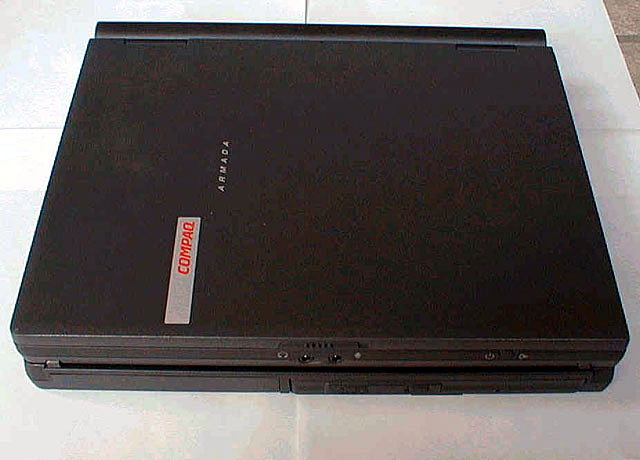
A Compaq Armada M300. I got it used for $100 more than a year ago. No optical drive built-in, but it came with a docking station that does have one. 20Gb of storage, fair keyboard, PIII 500Mhz. Quiet, light, runs Win2k and Linux just fine (haven't tried XP on it), and adequately fast for many ordinary tasks. The only awkward part has been the 802.11g PCMCIA card sticking out, and finding a replacement battery (the ones that came with it were dead), but for the price it was a great deal even with those two extras.
This new machine looks like it will give my old one a run for its money. -
Re:$450 gets you a decent laptop
The $450 BestBuy laptop will not be a lightweight 10" machine though. The cheapest LifeBook P7230 which costs ~$1,600 w/ rebates, and it has a 1.2 Ghz Core Solo, 1 Gig of RAM and an Intel GFX chip. The only thing it has significantly more of is the HDD, but then it's not a solid state thingie.
Looking at the Eee's specs, it's significantly better than the old Compaq Armada M300 I currently have. My M300 was originally equipped with a 6GB hard drive, so the 8GB or 16GB models would actually be an improvement, if I hadn't upgraded it with an 80GB Seagate drive
Despite my excitement, whether the 10" Eee is a rip off or not depends on the needs and expectations of the user. I almost always carry my M300 with me, and I mainly use it for web surfing, some office tasks, light coding work and some gaming. This is exactly what I'd want the Eee to do, and I'm sure it'll handle these tasks just fine (by gaming I meant an occasional game of Starcraft or Doom deathmatch). If, on the other hand, the laptop will always remain on the table at home, and is expected to run Vista, then yeah, an additional $100 will get you a much more suitable machine.
Ok... I now see that there are quite a few replies already, but I'll still post this in case I covered something that hasn't been mentioned yet. -
Re:You're not very smart, are you?
According to this, it actually sounds like the functionality is almost exactly the same as Microsoft's Windows 2003 implementation. Do you have any better references that might explain how Files-11 is different or better? Google seems to not be my friend in this case.
-
Re:Not good enough
BS on the calculators. I'm an engineer, and a good RPN calculator is my wingman...Meanwhile I have a job I'm being paid to do, and I can't spend my days calculating tables of thousands of numbers by hand...
I take it you didn't notice the part where I said: *...in business I can understand the need for speed. In school either do it in your head or write it down.*
Maybe a set of reading glasses is in order, or Command(Mac) Control(PC) and + to make the font a little bigger
I just have to baby my HP-28S until I retire.
Makes me wonder what kind of calculator they used to build the Hoover Dam, or Empire State Building(which they built pretty fast BTW, even by today's standards), or the Golden Gate Bridge, or to launch Sputnik or Mercury. Maybe their trick was to use big rooms full of people. I know it's a bit gimmicky looking, but would this not be suitable, in case you have to put off retirement for a while longer? And can't these damn computers design themselves yet? Or are those 10 million gates just for another Gameboy? Sorry. Kinda slipped. Just makin' fun. Everybody, drinks on the house... Now go home and get your effin' No.2 -
Re:SAN? Huh?
Are you proposing that a single SAN storage net span multiple (remote) physical locations?
It's pretty common - at a previous job, all of the disk arrays at three main sites kept themselves in sync using SRDF over a metro area network. The intent was, that even if one site was completely destroyed, the survivors could quickly return to work without losing any data.
HP has a nice overview of building systems which can failover between widely distributed nodes called Designing Disaster Tolerant High Availability Clusters. It's a bit old, and is focused on ServiceGuard, but is still interesting. -
Re:SAN? Huh?
Are you proposing that a single SAN storage net span multiple (remote) physical locations?
It's pretty common - at a previous job, all of the disk arrays at three main sites kept themselves in sync using SRDF over a metro area network. The intent was, that even if one site was completely destroyed, the survivors could quickly return to work without losing any data.
HP has a nice overview of building systems which can failover between widely distributed nodes called Designing Disaster Tolerant High Availability Clusters. It's a bit old, and is focused on ServiceGuard, but is still interesting. -
Re:GC does eliminate bugs
Pointer arithmetic and forging is impossible, so objects cannot override each others' memory. This kind of bug creates cryptic problems that are pretty hard to debug, as they are not easily contained in a single component.
This is true of many garbage-collected languages (e.g. Java), but it is not a property of garbage collection per se. For example, there are garbage-collection libraries for C, but they do not prevent you from doing pointer arithmetic or creating pointers to any addresses you wish. The difference is that C has a native pointer type and pointer dereferencing, whereas Java does not -- a language design issue unrelated to garbage collection. It makes Java safer, but less suitable for the sort of precise low-level programming C excels at. A language with only object references and no pointers could be designed to require manual memory management rather than performing GC; it's just very uncommon.
-
Re:Vista Numbers Suggest Poor AdoptionAssuming that the average person buys a new PC every 4 years (actual stats suggest the refresh rates are faster than this) and gets Vista with a new PC, Vista penetration should be at about 11% right now
1
Vista entered the [consumer] market January 31st.
You were expecting an 11% share in less than six months?To put this in perspective:
Vista 3.0% in June Up From 0.0% in January 2007
Linux 3.4% in June Up From 2.7% in January 2004 OS Platform Stats2
The Vista system sold in January was a warmed-over XP box. Not a "new" PC at all.
"Destined-For Vista" systems like HP's Vista Premium TouchSmart PC and the Vista Ultimate DX10 Pavilion Laptop with HD-DVD and 340 GB HDD began reaching the market only late this spring.
3
Vista missed the prime Back-to-School and Christmas shopping seasons in 2006. This year OEM Vista will be on the shelves with Windows Home Server which went gold {RTM] about a week or so back.
-
Re:Please excuse the drool
My Armada M300 (which I still use) has a cylindrical battery which attaches to the rear of the laptop, covering the rear ports. When the lid is closed, it might, very remotely, look like (part) of the hinge. Here's the HP/Compaq page with an illustration, and a here's a photo with the docking station and the battery visible. It's also possible to replace either the floppy or the CDROM in the docking station with a battery, but I was never able to find one.
-
Re:Pleasantly surprised!
However, I thought that the compiler took care of destroying pointers when variables went out of scope? Aren't destructors implicit clean up calls? I'm fairly sure that Borland 16-bit Turbo C++ did this, back in the day.
Um, no. AFAIK, C++ has no implicit garbage collection. There are plenty of libraries that do garbage collection...most are essentially replacements for malloc.
But anyway, this is about dangling pointers -- pointers that point to essentially nothing (really, to some 'random' address), either before or after use, not necessarily pointers that haven't been destroyed. -
Re:You can have my desktopMany of the things people are wanting to use computers at home for require more than can be loaded on a laptop, even with adding peripheral harddrives for added storage. I'm not doing the things you mentioned, but is it really more than something like this can handle? Talking about common users, here. Personally I'm going to stick with desktops until I need something I can carry with me, because I already have a monitor I like and a desktop is cheaper. But it seems to me that if you're not doing anything unusually demanding, there's a laptop for you.
-
Re:I don't get itAnd threading and scheduling in particular are highly efficient and mature in Linux.
When you speak about "mature" scheduling in Linux, are you referring to the scheduler that was written completely from scratch in 62 hours three months ago, or the one that was written completely from scratch five years ago and described as...[involving] numerous strange computations involving a number of magic constants; it is difficult to understand, much less improve. --Linux Weekly News
Just wondering. -
Re:I for one welcome our Democratic
It sounds mostly like you are simply ignorant of what this program looks like.
To continue putting your blind trust in this boondoggle into perspective regardless of whatever you may believe in the root causes of my paranoia:
A generic sign of a crime is when, for example, certain stocks are sold off prior to bad news being announced in an unusual way.
The NYSE alone (remember, there's a handful of exchanges, and Nasdaq commonly harps about how it's bigger) processes 9 billion transactions a day. Back in 2002, and it only goes up.
So, 9,000,000,000 transactions. What's a 1% false positive rate mean? 9 million transactions a day flagged as illegal for NYSE alone. Hoo boy, we're going to have to hire a lot more investigators to go over this stuff. But let's say this system is actually far more accurate, with only a 0.001% false positive rate. That's a far more manageable 90,000 false positives from NYSE alone. A staff of 60 highly trained agents will have almost a whole minute each to decide whether or not that given trade was illegal before the next one comes in. -
Re:Features that you can't even buy anymore
-
Vista is Not Selling.
This statement looks like Dell spreading is FUD to cover their tracks for another upcoming quarter where they will have poor financial results. They can then blame "slow adaptation of Vista" as a reason for slow hardware sales.
But Vista sales are slow. That would be the reason Dell switched back to selling XP and started selling GNU/Linux. Catering to AMD and GNU/Linux on servers is how HP stole the PC crown, and that's why Michael Dell is back in charge. The WinTel thing is over.
-
HP has been doing something simila for a while
While it is a good first step that Dell is selling Ubuntu machines, and not charging you (as much) for a license that you aren't even purchasing, HP has been doing this for quite a while though they don't seem to get much press for it.
If you look at hp laptops and desktops in their "business" section many of them will list "FreeDOS" as an available os, or if they have a "Configure PC" link under the model often times it means you can choose between Windows and FreeDOS in the configuration options. One difference may be that if you get a FreeDOS pc from HP, format the drive and put Linux on it HP probably isn't going to give you any software support whereas maby Dell (or Canonical?) offers some level of support included in their price. Though if you are willing to forgo softwate technical support and just want hardware warranty coverage (for example if you are a large institution purchasing many computers is bulk) you can get a larger discount for non-windows machines from HP than Dell. The price varies but for most of their business notebooks and desktops the difference between a model with Windows XP/Vista and that same model with FreeDOS is usually $75-$150
Hopefully Dell's apparent success in selling Ubuntu desktops (and the publicity that has come with it) will push HP into doing something similar, I am a bit surprised Dell beat them to the punch on this one considering HP has:
been encouraging the use of Debian on the server end for a while
http://h20331.www2.hp.com/services/cache/442406-0- 0-0-121.html
Already provides good driver support for Linux with regard to printers
http://hplip.sourceforge.net/
And the current "Linux CTO" is a former Debian project leader
http://en.wikipedia.org/wiki/Bdale_Garbee
I would expect to see more announcements like this in the near future from the OEMs. Whatever argument the OEMs still had against selling desktop Linux and thereby irritating Microsoft was recently dealt a significant blow by Microsoft's announcement that they would begin selling their own machines http://hardware.slashdot.org/article.pl?sid=07/06/ 28/181204
which from the OEMs perspective has changed Microsoft from an annoying element that everyone has to deal with and who gets a cut of their profit, to a company that is now moving towards being a direct competitor. -
Re:A decade?"latency doesn't seem to matter at all" It might not matter much on your desktop, I can assure you it matters quite a lot on plenty of servers. People don't buy things like this for nothing. It's less important when all your performance-critical data fits in memory, but that's not always feasable.
Also, Raptors are 10kRPM disks, and still trade off density for latency at a level most high performance drives do not. "Perhaps we'll have hard drives with four platters internally RAID1-ed" This crops up from time to time, and I'm yet to quite grasp the thinking behind it. How exactly do you manage the "Independent" part when you put it all inside a single drive? Oh, I know.. make your "drive" an enclosure for two or more smaller ones. Hmmm... -
Re:Home users get to buy XP again.
It just so happens that today I successfully 'Downgraded' Vista Home Basic that came pre-installed on an HP Pavilion pv9000 to Windows XP Media Center 2005.
Here was the scenario:
Vista kept crashing constantly when connected to a WPA protected wifi, but worked ok with WEP or no security.
No driver support for the existing (perfectly working) HP Photosmart 1215
No driver support for the existing (also perfectly working) HP Scanjet 5470c
I called 1-800-Microso and after getting lost in their phone menu I hit 0 and was connected to someone with a strange accent. I proceeded to tell the rep my intention of exchanging the Vista product key for MCE and that Vista absolutely doesn't work in the environment I need it to.
I wish I would have recorded the 35 minute conversation. It was like pulling teeth and many of his responses were laughable. But my persistence, and having the correct answers to his scripted questions to force his script into a loop many times got me what I wanted. For example, I was told that it was impossible to remove Vista from the laptop. I explained I knew what hard drives were and how to delete partitions. I was then told that my media could not successfully install on this laptop because the product key has already been used. I explained that is the reason for my call (this generated many loops). He seemed annoyed and asked me for the tiny numbers on inner ring of the CD, then to put in the disc to prove that it won't install (perhaps thinking that I wouldn't) I said it's booting the XP setup now. Should I install it? He says go ahead. He needed me to repeat every action and step during this process, I had to tell him what % the coping process was on constantly. But after wiping out my partition and getting the installation to the product information screen he read me off a new XP MCE 2005 key.
My suggestion to anyone that wants to try this, is keep your cool. Know that they are following a script and that you can easily put them in to loop and actually make them think. Stay within the bounds of the script until you achieve your result. You can get annoyed, but don't get angry.
Also, this particular laptop has the Conexant HD audio in which no XP driver is offered by HP (or Toshiba) I did find this post to a forum about a similar problem with a Toshiba very helpful.
It is interesting to report that XP MCE runs so much faster and reliably that Vista on this PC.