Slashdot Mirror
Domain: hp.com
Stories and comments across the archive that link to hp.com.
Comments · 2,470
-
Re:Couple more questions...Acording to a brochure on the web, the RG-1000 has a jack that can be used to connect to an existing ethernet.
Support for the Orinoco DS-11 cards (also sold as the Cabletron/Eterasys RoamAbout 802 is included as the wvlan_cs driver in the standard Linux PCMCIA package. Information about this driver is contained in the Linux Wireless LAN Howto. The wvlan_cs driver is opensource. There is also a driver based on a binary library provided by Lucent/Enterasys.
I have used both the open source driver and the binary driver. The binary driver is supposed to be more stable and full featured, although my laptop has crashed while using the binary driver and I have had no problems with the open source driver.
If you use the open source driver, make sure you use at least version 3.1.18 of the PCMCIA package to be compatible with the latest firmware in the cards.
-
Still gotta love HP's approachMost corporations do state their objective to be maximizing shareholder value through maximization of profit. Having a monomaniacal goal like this is the problem. It doesn't have to be this way, though. When I worked for HP, I was particularlly struck and proud of their corporate objectives because Profit Maximization is not a corporate goal of HP, but rather the "prime directive" is:
To achieve sufficient profit to finance our company growth and to provide the resources we need to achieve our other corporate objectives.
Those other objectives are listed on their web site (in descending order of precedence: Customer, Fields of Interest, Growth, Our People, Management, Citizenship), and they are right and good objectives from both a business and social perspective. The thing is the priority order (fulfill the ones above before you address the next one) and the inclusiveness of the first objective (you must consider all the others - they are the point: it isn't just money). Pure genius.
Perhaps regulation could be in the form of requiring corporate chartered objectives to be more in the spirit of HP's! With teeth, of course. E.g. if you want to deduct any losses on your corporate taxes, you must have inclusive corporte objectives and demonstrate you adherence to them. I wouldn't have problems with that kind of social responsibility for my company.
-
Re:learn http, idiot
Apparently you have not heard of HTTP 0.9.
In the future, please reserve use of insults to for those who are less knowledgeable than yourself.
-
Re: Re: Short answer: not anytime soon
the built-in hash routines are algorithmically superior. (i.e. I don't think they have a worst-case of Order-n-squared...)
Close. Hash lookup takes a constant amount of time, O(1), as explained in Uri Guttman's and Larry Rosler's article A Fresh Look at Efficient Perl Sorting. For more information on algorithmic efficiency of Perl's builtins, see Shift, Pop, Unshift, and Push with Impunity!.
-
Cooltown
This is one of a whole pile of data convergence applications now appearing. HP have Cooltown, a somewhat similar (although much broader) concept.
If you want to build your own version of CueCat, a look at the Handle Servers concept gives you most of the infrastructure almost straight out of the box.
-
Re:What exactly does this mean?
Even my favorite product that they make, the HP Procurve 4000M switches, is fairly lame in some respects; In order to increase the number of VLANs on the box, you must restart the switch. I bet Cisco's laughing about that one all day every day.
The HP 4000M Switches have supported hot reconfiguration of VLANs since software version V07. If you still can't dynamically reconfigure VLANs on your 4000M download software version V07.27 from here. You should barely ever have to reboot a 4000m unless you are just enabling VLANs for the first time or you hotswap an 8 port card with a transciver card. -
JetDirect supported in Solaris
I installed support for a JetDirect Printer at work. Windows wouldn't even see it without the JetDirect software. There is a version of the JetDirect software for Solaris:
ftp://ftp.hp.com/pub/networ king/software/ja242en.readme.unx
So if asked real nice maybe they would port it to Linux.
If you want something, ask those who can provide.
If you won't ask, don't complain. -
Re:SMB over TCP/IP
Um, I think CIFS/9000 is based on Samba, see the link here.
-
Re:SMB over TCP/IP
It's most likely *NOT* samba that they're using. HP has(had) a product called CIFS/9000 that provides smb services for HP-UX systems. Most likely they have ported this code and added the code from their JetDirect stuff and possibly their SNMP utilities. This would give them a solution that they are in control of, on an open source platform.
This is only my speculation, as HP did not follow the route that sgi went, when it hired on the main developer of samba (who has since left). Also, unlike sgi, HP did not make public statements about its support of samba, as it already had an SMB/CIFS suite.
Time will tell though, I can't afford, nor do I need one of these.
-- Len
-
Straight from the horse's mouth
As a sort of joke, I send HP tech support and email: "Please send me the linux drivers for the HP2100." Here's the response:
Hewlett-Packard does not write Linux drivers for the HP LaserJet 2100. Your Linux provider is responsible for providing these drivers. The HP LaserJet 2100 is backward compatible with most older HP LaserJet drivers. You should be able to run the HP LaserJet 2100 using another Hewlett-Packard LaserJet driver provided by Linux.
Also, check out HP's "policy" on win2k drivers: http://w ww.hp.com/cposupport/information_storage/support_d oc/lpg40837.html. CD Burners ship with win9x, NT drivers. You pay us $25+shipping for the win2k drivers. -
Operator error.Hmm. I'd say "operator error". I just read the specs from HP, and indeed "Linux" is not listed as a client OS. However, I suspect that this is an omission in the specs than an indication that they don't really run "lpd" on the machine.
It's pretty clear. They took the cheapest hardware they could find, put Linux on it and are selling it. It would cost EFFORT to make it not work with Linux as a client OS, as that's standard. My bet is they just use lpd (Confirmed!), and it would cost effort to prevent it from working.... Hmm. Disproved here.
Roger.
-
Operator error.Hmm. I'd say "operator error". I just read the specs from HP, and indeed "Linux" is not listed as a client OS. However, I suspect that this is an omission in the specs than an indication that they don't really run "lpd" on the machine.
It's pretty clear. They took the cheapest hardware they could find, put Linux on it and are selling it. It would cost EFFORT to make it not work with Linux as a client OS, as that's standard. My bet is they just use lpd (Confirmed!), and it would cost effort to prevent it from working.... Hmm. Disproved here.
Roger.
-
Re:Without wishing to defend MS...I don't think this is a sinister MS plot to allow greedy lap-dog corporate friends of microsoft to use their orbital mind control lasers on me, but I do think this is one in a long string of fundamental archetectural designs by microsoft that while trying to adopt Sun's slogan "The network is the computer" ignore that there are rather seedy parts of that global computer. Internet users *need* process level sandboxing, strong authentication, fine grained access control, and that sort of thing. MS has decided, based on the highly skilled recommendations of their "moron estimator" that talking paperclips are more important. To be brutally honest to the UNIX crowd, they haven't done much better. Most commercial UNIXen install horibly insecurely by default--again part of the "who cares, it will be behind a firewall anyway" mentality. We have said "UNIX is secure because it has strong user-level access control", but single-user workstations need process level access control, to deal with the huge volume of untrusted code on the internet. There are some people working on better systems for free UNIX systems to perform those tasks, but they are a hell of a long way from prime-time.
Much work has gone into making server systems secure. Most UNIX systems, and even NT can be relatively easily set up as a moderately secure web server. FreeBSD's jail() is a nice touch for secure virtual servers, and more esoteric systems like HP's virtual vault can give you more peace of mind yet (I am not convinced it is more secure than a properly configured Linux/BSD machine, but many bosses won't listen to that). However, client side security is a joke at best, and a catastrophy more often.
-
And You Thought I Was Kidding
Prepare to witness the most concerted and massive engineering effort -- both social and technical -- ever undertaken by mankind: The digital equivalent of damming the ocean.
I wrote about this on Slashdot almost a year ago, in the vague hope it might become a featured article: The music and movie industies are working very hard to prevent you from using your lawfully-obtained material in any way they don't want. To that end, they have formed the Copy Protection Technical Working Group (CPTWG), which is working hand-in-hand with a ton of high-tech companies to bring pervasive copy protection measures to your PC.
I saved my original screed on the subject, and it's reproduced below, with appropriate updates. Bottom Line: Do not let them sneak this garbage past you or your friends. If you find that a product contains copy protection, don't buy it, and encourage others to do likewise.
____________________
Recent stories on Slashdot have told of the ongoing "tennis match" between digital content providers versus consumers and technically skilled people. The recent cracking of DVD's Content Scrambling System (CSS) lent ammunition to the opinion held by computing professionals and users that copy protection systems are doomed to fail. The effort has been likened to building a dam against the ocean; a foolish and useless exercise. In Slashdot discussion fora, the point has often been raised, "If you can perceive it, you can copy it. What are they going to do, encrypt the bits all the way to the speaker/electron gun?" If the Copy Protection Technical Working Group gets its way, that is precisely what's going to happen.
I received a piece of email spam today, which actually turned out to be useful (probably the only time that's ever happened anywhere). It directed me to a flat panel display industry group. Among others, one of the links pointed to the California Display Network, which had a link pointing to technical info on flat panel technology. Since I currently earn my living writing graphics card and display drivers, I clicked through to see what I could learn.
I found an entry for an overview of digital visual interfaces, provided by Silicon Image. As I reviewed the headings of the slides, one entry stopped me cold: Conten t Protection Status. Content protection? In a flat panel?? Yup: "Implementation of DVI content protection is suitable for PCs and monitors." [emphasis mine]
Thus began an evening of link clicking and Google searches to find out what this off-handed remark could mean. The slide made mention of the 'CPTWG'. This is the Copy Protection Technical Working Group, a consortium of content providers (movie companies), consumer electronics manufacturers, and players in the IT industry. This is the same group that developed CSS for DVD players.
One paragraph from the above page is particularly disturbing:
CPTWG has focused until now only on "casual piracy [sic]", characterized as what a grandmother can do in her home with her DVD. Piracy [sic] requiring even the level of expertise (and equipment) of her grandson, who might be an EE student, has been excluded from consideration. There is a growing awareness that a broader content protection effort may be necessary.
The most recent meeting of the CPTWG was yesterday, 8 December, 1999. Their meeting announcements may be found here. It costs $100 to attend. According to the site, their last meeting was on 11 April 2000. It's not clear if additional meetings have been held at regular intervals.
The attendance roster from the April meeting (RTF file) lists a very interesting, and possibly worrying, mix of organizations. A partial list of representatives included:
- MPAA (Motion Picture Association of America),
- AFMA (American Film Marketing Association),
- Sony Pictures Entertainment,
- Universal Studios,
- Warner Bros.,
- Disney,
- Paramount,
- CEMA (Consumer Electronics Manufacturers Association),
- MEI (parent company to Panasonic), makers of consumer electronics,
- Pioneer, makers of consumer electronics,
- JVC, makers of consumer electronics,
- Philips, makers of consumer electronics and VLSI components (including video encoders),
- Sony, makers of consumer electronics, computers, and displays,
- Toshiba, makers of consumer electronics, computers, flat panels, disk drives, digital cameras, copiers, and laser printers,
- NEC, makers of computers, displays, printers, and telecomm equipment,
- Hewlett Packard, makers of computers, printers, and testing/measuring equipment (oscilloscopes, logic analyzers, etc.),
- Quantum, makers of disk drives,
- IBM, makers of computers, disk drives, and bunches of other stuff,
- Compaq, makers of computers,
- Apple Computer, makers of computers,
- ATI Technologies, makers of PC graphics cards,
- Dolby Labs, creators and licensors of audio enhancement technologies,
- Intel, makers of microprocessors, motherboard controllers, and graphics and peripheral chips,
- Microsoft, software market monopolists,
- Dow Chemical (I have no idea why they're here),
- DVD-CCA, licensors of CSS, and currently in court trying to prevent the spread of DeCSS,
- A number of law firms.
If you download the roster and read closely, you'll see every major piece of your computer represented. There is no doubt that at least one part of your computer -- your CPU, your RAM, your disk drive, your graphics card, your monitor -- is manufactured by one of these companies.
If you look further still, you'll see there are no consumer advocacy groups listed.
What are they all working toward? Quite simply, to prevent you from using your lawfully obtained digital material in any way they don't want.
Here's one example of how they'll do it: If you've visited Fry's or CompUSA recently, you'll notice that full-size flat panel displays are starting to appear. Currently, most of these displays are based on the old VGA analog signals, which are converted into the digital signals needed by the panels. The Digital Display Working Group is working on a new connector and signalling standard called Digital Visual Interface (DVI) that will allow computer displays to go all-digital. You won't need a DAC on the video card; the digital signals will be fed straight through to the display. Image fidelity will be much higher, since there won't be any intervening DAC/ADC conversions. Version 1.0 of the standard has been published and is available for download (PDF format). The DVI spec currently does not stipulate copy protection measures. However, plans are in the works to incorporate it.
Intel is one of the primary contributors to this effort. On Intel's developer site, they have some papers on copy protection for IEEE 1394 (Firewire) digital streams. In two separate articles, 1394-based Digital Content Protection: an Intel Proposal, and Content Protection for IEEE 1394 Serial Buses (the latter being a Powerpoint presentation masquerading as a PDF file), Intel outlines its proposal for protecting digital content over Firewire. By using cryptographic authentication techniques, a device offering digital content will "handshake" with other devices on the bus to assure that digital data is only received by, "compliant devices." In a revised overview of the proposal, IDF Talk: Content Protection for the IEEE 1394 Bus, Intel offers concrete implementation details, including:
- DSS (Digital Signature Standard)
- Diffie-Hellman key exchange for device authentication,
- Blowfish cipher for content encryption, with a keylength of 32-128 bits,
- Digital watermarking techniques to declare "rights" (right to playback, right to copy, etc.) to the receiving device.
The full proposal (currently version 0.91), with lots of technical detail, is mirrored on CPTWG's site (the links to Intel's site don't work).
Intel's proposal also recommends that the copy protection system be field-upgradeable to thwart ongoing attacks, and that it should be possible to revoke (read: disable) a device determined to be "compromised." (The tone of the proposals is also interesting. It's previously been thought that, because of USB, Intel is hostile to IEEE 1394. Yet these proposals suggest that Intel's quite enthusiastic about 1394... Once copy protection is incorporated.)
Intel's proposal mentions only IEEE 1394. However, it also mentions that there's nothing preventing the technique being applied generally to any bi-directional link. So for all occurrences of '1394', substitute 'DVI', and you've got an idea of what to look forward to in your new digital monitor. And your new DVD player. And your new HDTV set. And your new USB speakers.
Intel goes even further in their paper, A Framework for DVD-Audio Content Protection. In it, the author suggests that DVD-Audio recorders permanently remember the IRSC (International Standard Recording Code) of every song the device is asked to copy, so that it may only be copied once, period. They go on to suggest that the recorder could have a modem built-in to authorize (read: purchase) the ability to make additional copies.
In short, through this industry consortium, Hollywood proposes to exert control over every link in the digital chain, from the digital camera, to the disk drive, to the CPU, to the graphics card, to your display. They will decide what rights you have. Even if a court decides Fair Use includes multiple copies for personal use (such as assembling a video montage), it won't matter. Your computer will still refuse to make the copies (and probably fink on you, as well).
This coordinated effort is ostensibly to combat unsanctioned copying (which the industry chronically refers to incorrectly as 'theft' and 'piracy'). However, no one has ever been able to provably quantify the value of unrealized sales due to such copying. All dollar estimates that have been published are just that: estimates, based on idealized extrapolations of what-if scenarios. Moreover, although the industry claims to "lose" billions every year, they continue to post record profits. Finally, despite the proliferation of CDR drives and the Internet, most unrealized sales are the result of organized mass counterfeiting rings, not casual copying. None of the proposed methods I've seen appear to thwart mass counterfeiting at all. So clearly there's some other reason for all this.
The thing that puzzles me most is why the computer and consumer electronics industries haven't told Hollywood to take a hike. Intel's copy protection proposals state, in bold letters, "No content protection = No Hollywood content." This belief is taken as axiomatic by all the players, and appears to be the driving force behind the entire effort. This belief is also false.
Audio on CDs are recorded as plaintext, and the music industry continues to earn rapacious profits. Even the with the advent of CDRs, no music industry executive in his right mind would suggest dropping CD sales and going strictly with cassettes and vinyl. If nothing else, the manufacturing costs for CDs are lower than those for cassettes and vinyl. Likewise, DVDs are tremendously cheaper to produce than videotapes. Videotape duplication is a labor-intensive process; DVDs can be stamped out automatically. The savings in cost-of-goods alone would more than balance against any unrealized sales from casual copying. Corporate shareholders, always mindful of the bottom line, will also demand that the studios move to the cheaper, higher-quality process, copy protected or not.
The fact is that the computer and electronics firms are in the driver's seat, and are free to dictate how the new digital formats will work. Hollywood will use whatever format becomes popular, whether it has copy protection or not. They may grumble about it, but they'll use it. The economics afford them little choice.
We are only now beginning to explore the social and ethical consequences of a Star Trek-like universe where everything can be infinitely duplcated at zero cost. We have no idea where things will end up. But now is not the time to start erecting electronic walls and imposing artificial scarcity. The ignoble and richly-deserved death of DIVX showed -- fairly unequivocally, I thought -- that consumers want to make free, fair use of their digital media, without interference from outside. I believe its death reinforces the future toward which we've been pushing for centuries: Increased abundance at reduced cost. We can only hope that the lesson of DIVX will be repeated until it is learned.
Schwab
-
Re:Linux's relative growth
I can't seem to find any pricing information on OpenMail. It sounds promising, but I don't know if it will end up being cost-effective, and HP is very careful about not listing price information on their site.
Also, it's not open sourced. From the site:
So will you be opening up the source code to OpenMail?
No, but we plan to open source our OMGUI client.
Still, it's something to check out. Thanks for the heads up. -
Re:Revelation- why the X box "rox"
Hmm. As I sit here thinking about your post, I have to respectfully disagree. The razor-blade analogy works for some things. For example, I would not be surprised if in a few years, HP starts giving away all their consumer-level printers free, and charges $50.00 for ink cartridges. However, this process usually works best when there aren't existing, cheaper-in-the-long-run alternatives.
In the case of the X-Box, the odds are extremely good that anyone buying one in 2001 will have a home PC of some sort. The major selling point for consoles has, and will always be the actual availability of game titles that either play better or are otherwise unavailable for PCs. I just don't see people buying non-game "applications" if they already have a PC, and it already does non-game applications better and easier.
Of course, MS can still make a killing using the usual game-titles-royalties model if they come up with enough good titles in what will be a fairly well saturated market by that point (c.f. PSX2, Dreamcast and Dolphin, amongst others). We'll have to wait and see on that one. -
Re:Pretty Print
Check out the stats on HPs 49G. It has the option to display in 'textbook mode', much like the TI-89/92. Of course the advantage will always be to the company who has access to (and uses) the latest greatest technology.
-
HP calculators vs. TI calculatorsLong before I had a computer (other than a Mac II), a friend pointed a TI-86 out to me. That was my first calculator "experience." He would put games on it for me. I wouldn't play them much but, I enjoyed having them on there for others to play and etc. After that, I got a computer and was able to put the games on there myself. Soon after, I bought a TI-89. I was shocked at what people could do with it and knew I had to learn how to do that for myself. I spent about a full summer learning the Motorola 68000 assembler language. Then, some one pointed out #hp48 to me on Efnet on IRC. People in there pointed out the HP-49G to me. I read HP's information on there web-page and knew then and there that I HAD to have it! I saved up some money and bought myself one (same price as my TI-89 too). I have since then also bought a TI-83+ and TI92+ and still use my HP-49G more than all of my TI calculators combined!
Why the HP calculators are better than TI's:
Let's see, where to start. I'll start with this:
HP uses the most out of there limited hardware.
Use there own home-made processor (for the graphing calcultors as of yet)
An incredible amount of assembler support for us coders
There (HP) OS is written in Saturn assembler while TI's OS for there 89 and 92+ is written in C
Need I list any others?
This is just a small list that I could think of off the top of my head. HP calculators are more geared towards higher educated individuals but, it can also be used for people in lower educated areas (it has a +, -, *, / sign doesn't it?). I remember there being an article here on Slashdot about which brand to buy. I would highly recommend an HP-48G or 49G. Since they will be able to use that for the rest of there lives, just about. If your buying calculators for games, the buy a TI-86. If you want the mathematical capabilities out of the calculator, buy an HP-49G.
I found out about this calculator a couple months ago and the price was ranged at about $250 in american dollars. If I wasn't already putting money aside for a video card, I would start putting money aside for this upcoming calculator. Something's got to give...
For the best HP calculator games/apps, try out hpcalc.org.
Have a nice day, -
Re:Quote...
5 years ago sure. But that's becoming less and less true. Hp has a research system called Dynamo that does this. Code run through dynamo runs faster than code natively optimized. Granted dynamo is a research system, and transforms PA-8000 binary code into PA-8000 binary code, but the techniques they used in principle could transform an arbitrary instruction set into another one. Ars Technica has a good article with some performance numbers here.
-
Re:Key interview questionYou hiring?
an 'outsider' got into the 'old way' of doing things, and turned it on it's ear.
I think you're right. Actually, there were lots of different influences, and our journey out of the dark ages has taken a long time. The torn jeans have been around for decades, but the pool table is new, and from what I gather, not every location has one.
-
Re:Plex86 vs. VMWareWrong!, Plex86 will only feature x86 virtualisation, emulating an x86 on an x86 would be silly. [My emphasis]
Things aren't that simple... emulation can actually be faster than native code do to real-time optimization possibilities. I already posted a message to this extent so I'll just quote it here, but think about the Crusoe, java (esp the improved JIT in jdk 1.3), and the like - emulation really is possible to do quickly.
I think the whole concept of emulation/VM is something to be embraced and which could _really_ revolutionize the computing model. So as opposed to encapsulating already native code to sneakily let it think it's running as a base system, go ahead and really change it, emulate it - don't just "bracket" it.
Why? Currently, we're essentially writing compilers for a non-existing platform. The x86 platform as originally seen has long been "dead", what we're seeing now is chips that convert this "universal" language into their own microops and then execute them. The internal structure of a P3 / Athlon has a large section dedicated to this very task. But what if we could throw all that away, and make a chip that simply crunches numbers as good as current technology allows? We have the making of a darn fast chip. If I had to make a completely uninformed guess, we could well stuff two "Athlons" (if we can still call them that) on the same die if the whole x86 ISA is dropped.
In comes the virtual machine... we simply convert the bytecode into native code and run. Sort of like java does it - but better, as we have a chip that can run faster and possibly more efficiently.
Guess what? Sun is already doing just that with MAJC. The point is, Plex86 should not try to run code natively at all. It simply happens to have a bytecode that's identical to the native code. This gives us an architechture that is far longer-lived than something that can run legacy x86 systems on x86 systems. This might be portable to newer things as well.
Proof that this sort of thing is possible is incarnate in the Transmeta Crusoe chip. Of course, they chose to have a chip that is really power efficient, but imagine a a chip that is to speed what Crusoe is to power - Yummy.
I've heard objections that speed gains in the architecture might be outweighed by speed losses in the transformation. This is not true. The optimizations that a run-time VM can do are quite astounding - it can not only decide to unroll loops when necessary, but to expand a frequent multiplication by a memory adress into constant bitshifts, it could dynamically choose what to place into registers far more wisely that a traditional compiler can, look ahead and do IO access before the program needs to... I am no expert, but there's obvious potential here.
And here again, there are some innovative people at work, just look at HP's Dynamo - which takes native code and does real time optimizations (actually it does more than this, and is an interesting read. Transmeta wasn't the first. One of the interesting things is that actual optimized native code can still run faster under dynamo than simply natively. Obviously, this isn't the case for all programs, but its certainly not the case that Emulation/VM-ing is by definition slower than native execution. And realize, we're talking about an architecture (originally PA-RISC but porting activities are ongoing I believe) that wasn't even designed for this sort of activity. A CPU with this in mind could well do even better.
So my conclusion is that we shouldn't emulate VMware, we should, well emulate. Weird as it may sound, emulation is the future.
--EMN
-
Re:Congradulations in order -- running DOS!I think that the success they have had to date is truly not to be derided. But I also here see another Open Source project that could be breaking more interesting ground - as, unfortunately, many.
I'm sure there are enough people around here that have differing opinions about open source, but to head off discussion in that direction, it's merely an impression I have and I'm possibly wrong. I've never contributed a line of code - something I hope to change.
I think the whole concept of emulation/VM is something to be embraced and which could _really_ revolutionize the computing model. So as opposed to encapsulating already native code to sneakily let it think it's running as a base system, go ahead and really change it, emulate it - don't just "bracket" it.
Why? Currently, we're essentially writing compilers for a non-existing platform. The x86 platform as originally seen has long been "dead", what we're seeing now is chips that convert this "universal" language into their own microops and then execute them. The internal structure of a P3 / Athlon has a large section dedicated to this very task. But what if we could throw all that away, and make a chip that simply crunches numbers as good as current technology allows? We have the making of a darn fast chip. If I had to make a completely uninformed guess, we could well stuff two "Athlons" (if we can still call them that) on the same die if the whole x86 ISA is dropped.
In comes the virtual machine... we simply convert the bytecode into native code and run. Sort of like java does it - but better, as we have a chip that can run faster and possibly more efficiently.
Guess what? Sun is already doing just that with MAJC. The point is, Plex86 should not try to run code natively at all. It simply happens to have a bytecode that's identical to the native code. This gives us an architechture that is far longer-lived than something that can run legacy x86 systems on x86 systems. This might be portable to newer things as well.
Proof that this sort of thing is possible is incarnate in the Transmeta Crusoe chip. Of course, they chose to have a chip that is really power efficient, but imagine a a chip that is to speed what Crusoe is to power - Yummy.
I've heard objections that speed gains in the architecture might be outweighed by speed losses in the transformation. This is not true. The optimizations that a run-time VM can do are quite astounding - it can not only decide to unroll loops when necessary, but to expand a frequent multiplication by a memory adress into constant bitshifts, it could dynamically choose what to place into registers far more wisely that a traditional compiler can, look ahead and do IO access before the program needs to... I am no expert, but there's obvious potential here.
And here again, there are some innovative people at work, just look at HP's Dynamo - which takes native code and does real time optimizations (actually it does more than this, and is an interesting read. Transmeta wasn't the first. One of the interesting things is that actual optimized native code can still run faster under dynamo than simply natively. Obviously, this isn't the case for all programs, but its certainly not the case that Emulation/VM-ing is by definition slower than native execution. And realize, we're talking about an architecture (originally PA-RISC but porting activities are ongoing I believe) that wasn't even designed for this sort of activity. A CPU with this in mind could well do even better.
So my conclusion is that we shouldn't emulate VMware, we should, well emulate. Weird as it may sound, emulation is the future.
--EMN
-
Use a Trusted OS.
Script kiddies don't have enough bandwidth to DoS a major provider, so they use rootkits to crack systems and then use the cracked system as a launchpad for their DDoS attacks, right? Well, maybe a solution is for companies to use a Trusted OS like Argus PitBull, Trusted BSD, (admittedly incomplete) OB1, Trusted Solaris, HP's virtual vault, or find a better match for yourself.
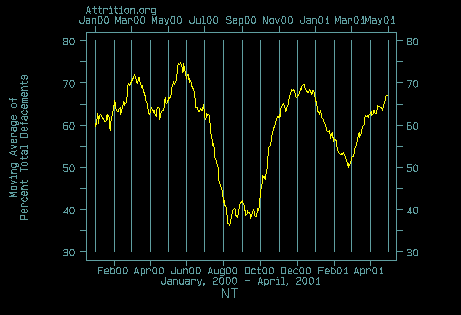
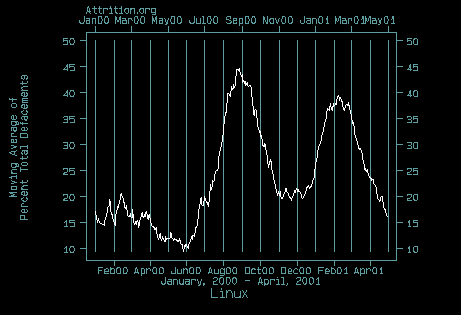
Why people use WinNT as a server platform is beyond me. Something like 65% of web-site defacements listed at Attrition.org are WinNT based. That's insane. Linux is something like 20%. I was very surprised at HOW MANY sites are hacked. The internet's infrastructure needs to be improved, sure. But how about securing your system properly?! Argus has even announced a Linux port for their products; it's the only TOS that I've seen even mention Linux. And, maybe someone should push the Linux Kernel developers to finish implementing the Capabilities and ACL stuff that at least partially exists in the kernel (or in patches); this would allow application coders to write non-suid programs that would still have some of the root capabilities (just the ones they need).
I'm not saying that the sys admins are to blame. These decisions are generally not simple technical ones. However, everyone needs to be educated about the products that are available to protect themselves and others (in the case of DDoS's). If you're a sys admin, educate yourself and pass it on to your boss. They may not get it, but you should at least try.
Just my $0.02.
$ flames > -
Re:This is funny
This port would be better served for BeOS, where the latency for multimedia operations is much lower (and much more predictible).
I suspect if they already have an Irix flavor, accomplishing a "red hat" port would be a simpler undertaking than reworking it for BeOS, assuming that they could find developers experienced in porting apps to BeOS. I don't have a lot of experience with Irix, but wouldn't porting an app from Irix to Linux be fairly trivial. I suspect that the majority of the business cost would be in marketing and packaging, rather than development.
The market may also play into their decision to port to Red Hat, rather than BeOS. SGI platforms have a fairly good adoption rate in entertainment/media production & HP and other vendors are releasing Linux boxen for content creation to compete with SGI. Is it possible that this port is an attempt at breaking into this market? -
Re:How 'bout a Linux one?Actually, it's debatable whether a frontend from anything other than the x86 would realize any significant performance gains from code morphing.
x86 gets a big boost because of register allocation. All that ugly spill code produced because of the register-limited architecture gets translated into register moves (or eliminated entirely). Unless code for a PPC, MIPS etc. was compiled assuming a lot more than 32 register (which it can't, due to the instruction format), there won't be much gain here.
Unless Transmeta adds partial evaluation/specialization a la DyC or Tempo, I don't think the benefit of code morphing on, say, a PPC will overcome the cost. I suppose they could do something like Dynamo and implement a software trace cache.
One interesting avenue of research would be to compile to a virtual ISA that included lots of registers and other fancy hardware structures the compiler could use. Taking advantage of new compiler innovations would then be a matter of designing a new ISA and writing the code morpher. Not having to re-do the silicon would be a big savings.
--
-
Re:ok, Good & Bad "features"
Combining pointers/gc. Are they INSANE?
Not really. The use of pointers in a language doesn't necessarily mean you can't also use garbage collection. Heck, there are garbage collectors out there for C. You can find one of them here. I've used it before and it seems to work fairly well.
Just my thoughts on the subject.
-j -
Re:PT Barnum explained
The program I wrote is using Boehm's Conservative Garbage Collector.
Check it out - right here
An alternative is to run the program on the computer owned by PT Barnum himself. It has infinite memory and he will let you see it for a nickel.
-
HP Digital SenderI briefly looked into a network scanner from HP - the Digital Sender 9100c.
The device plugs into the network, and after entering some network info, is ready to go. I'm not sure what platforms the admin software runs on, but it includes a copy of Circulate with it. It will scan up to 15 ppm (if I remember correctly) and save the result as a pdf. You can then 'Circulate' it to make is searchable. You can also hook it into certain internet fax providers, as well as tie it into Domino DBs, and other potentially useful things.
I'm not sure if this is ideal for your situation, but I thought I would throw it out there. You can get one on loan for a couple of months, so it might be worth a shot.
-
Ars should have also mentioned the following
One thing that Ars fails to mention is that Dynamo only achieves performance at or below todays very advanced profiling compilers. Look at the graphs in the short form of the Dynamo paper: Dynamo Paper(short)
Dynamo also ignores a very important aspect of dynamic optimization/translation; the values of variables through each execution of the trace cache (i.e. exploiting common values of loop counters, function parameters, etc). A lot of researchers feel that this is the future of dynamic recompilation/optimization.
For a look at something more atune to value specific optimizations look at DyC
There are some links there to other dynamic compilation/translation sites too.
Don't forget that the research in this field is very new. There are countless possibilities to use runtime information to make a program go faster. People are trying to discover quick techniques for capturing this info and cheap, beneficial optimizations/transformations to apply. -
Links to Intel and HP pages for this
For anyone who wants the actual links. There's a press release here that contains links to the download pages on both the Intel and HP sites. The Intel link takes a bit of searching to find otherwise. HP puts a link to this press release prominently on their main page.
-
Available already?
This is the top highlight on the HP site right now, and there seem to be a few download links at the HP Software Depot and the Intel Developer site. I am not going to have time to download and play with this myself just yet, so I look forward to seeing comments from people who try it out.
-
Available already?
This is the top highlight on the HP site right now, and there seem to be a few download links at the HP Software Depot and the Intel Developer site. I am not going to have time to download and play with this myself just yet, so I look forward to seeing comments from people who try it out.
-
HP's already there, man.
-
It's a good company...Disclaimer: I don't work for HP, but I do work with HP...
They are the only company that I know that will offer a trade in on old equipment. For a while on their large format printers/plotters, they would even accept competitor products, such as Calcomp and Epson, as trade ins!
They always have been willing to make the customer happy. Good to see they aren't trying to cover up, and admit when they are wrong.
-
Re:Can Java be made to run faster...
Seeing is believing. By the way I don't really think it's true, Java simply lacks the ability to express some things. For example when using containers in Java you always have to cast (and check the type), in C++ you may use templates which avoids this cast. If you add garbage collection to C++ (which can be done) Java is (nearly) a subset of C++ so I don't see where Java has advantages; you could even use bytecode und JIT for C++ if you meant to do so (can't find the link but someone made a proof-of-concept compiler to the JVM).
The main advantage of Java is a well defined class library (especially the GUI) which is missing from C++ but that's a different matter, the _language_ Java is nothing special (in my opinion at least) -
heads-up for Jornada owners
So, false advertising, eh? Will the FTC handle slapping HP a penalty or will a class action lawsuit be necessary?
If you look here it appears that 12-bit color is not that much worse than 16-bit. Still, 65,536 colors does beat 4,096 colors. I wonder how much difference it makes on a small handheld screen anyway?
The spec page now says it's a "240 x 320 pixels LCD rich color display". -
Re:Cool, but why?
Even if it isn't, this would still be very valuable to WebTV users, who usually don't have a computer(or at least in concept), and therefore they can't print stuff off the the internet.
Um...most (all? I can't remember) WebTV boxes have a parallel port. IIRC from when I sold the things @ a certain consumer-electronics retailer that will remain unnamed
HP even made a printer specifically for use with WebTV, the DeskJet 670TV.
-
Re:I Don't Think So
I will never buy an HP product. [...] They have sabotaged Sun and Linux at every chance.
I could give a rats ass about Sun; in my opinion, they are the biggest detractor of Linux besides Microsoft.
If HP is against Linux, then explain this:
http://www.internetsolutions.enterprise.hp.com/lin ux/products/index.html -
OpenMail - HOWTO stop ILOVEYOU virus/worm/trojanThe thread discussing this is at http://openmail.hp.co m/HyperNews/A8_ExtAll/get/ompub/638.html
richi.
-
Better get started...
I'm sure that if the LOCKSS system works out well the librarians and archivists will still complain.
They are just the type who will complain about anything. I mean, they get to sit all day and stare at shelves of smelly old books, and they have nothing better to do than complain.
Personally, I think that if they really want to do something they should all get themselves some really reliable laser printer, and get started on making those electronic archives permanent. -
ARM in Palm and Wince!
Wow... looks like ARM has captured the majority of the handheld market. Wince devices use the StrongARM processors as well. Is ARM the next Intel??
-rt- -
Re:Battery Life?
The Casio (product specs) gets about 6 hours of battery life.
The Compaq (product specs) gets about 12 hours (*cough*-bullshit-*cough).
The HP (product specs) gets about 8 hours.
Not even close to 3 months of battery life on my Palm Pro. Oh, yeah and it fulfills all my mobile needs. =8^p
-
It's cool, I wonder how it compares with...MS Pocket PC. I've been trying all day to get this story below submitted. Might as well put it somewhere where people can see it.
Microsoft unveiled the Pocket PC today. Products being available by its partners include: HP Jornada, Compaq iPaq H3600, Casio Cassiopei a E-105 and Symbol PPT 2700. Microsoft's touting it as being better than Palm. Here's a list of features, significant among them: Microsoft Reader (for reading e-books), Windows Media Player (for playing music), Pocket Streets (a map program), Pocket Internet Explorer, and office productivity tools like Outlook, Word, and Excel.
FWIW though, Japanese make good appliance-type gadgets, and you can count on them to deliver good quality end-user products (witness the game consoles). Only problem is if some terrorists decide to use a Sharp Zaurus in their Missile Guidance System.
-
Already done!
HP has made one already. It's the Jornada 820. It has a "High-performance 32-bit StrongArm RISC CPU running at 190MHz".
Have a look at it here. -
Jornada
You mean like one of these? It's a little underpowered, but they claim 15 hours of battery life.
-
HP at least tries to help the environment.As you may or may not be aware, Hewlett-Packard tries to protect the environment from something rather nasty -- toner. They've teamed to up pay for spent toner cartridges to be sent back to them at no cost to you. They have a section on their website where they talk about their environmental policy.
I finally used up my first toner cartridge last year and they made it trivial for me to send it back to them for recycling.
They also talk about other facets of their philanthropic image on their website, but I've never had any personal involvement, so YMMV.
-
HP at least tries to help the environment.As you may or may not be aware, Hewlett-Packard tries to protect the environment from something rather nasty -- toner. They've teamed to up pay for spent toner cartridges to be sent back to them at no cost to you. They have a section on their website where they talk about their environmental policy.
I finally used up my first toner cartridge last year and they made it trivial for me to send it back to them for recycling.
They also talk about other facets of their philanthropic image on their website, but I've never had any personal involvement, so YMMV.
-
HP at least tries to help the environment.As you may or may not be aware, Hewlett-Packard tries to protect the environment from something rather nasty -- toner. They've teamed to up pay for spent toner cartridges to be sent back to them at no cost to you. They have a section on their website where they talk about their environmental policy.
I finally used up my first toner cartridge last year and they made it trivial for me to send it back to them for recycling.
They also talk about other facets of their philanthropic image on their website, but I've never had any personal involvement, so YMMV.
-
Re:Bandwidth congestionFirst, there is a great deal of useful info about wireless networking here:
http://www.hpl.hp.com/persona l/Jean_Tourrilhes/Linux/
Second, having many wireless nodes in a small region is fine. IEEE 802.11 works similar to Ethernet, all nodes must contend for access to the medium before they can transmit. That's how it's possible to handle hundreds of wireless nodes, like you mention above. Of course, bandwidth to each node is reduced, but transmission still works. Base stations help a great deal, because they act as arbiters; i.e. they can poll stations in range in a round-robin order, and thus avoid collisions between two nodes who try to send at the same time.
There is a point against the "over-clocked" 802.11 nodes: they may interfere with ad-hoc nodes on adjacent channels. Although most documentation talks about 11 separate DS channels, in practice nodes which are less than five channels apart can still interfere if they are physically very close. However, most of the range-extender antennas seem to be directional, so it may not be a big problem.
--ac
-
Re:Wireless links
I'd add the wireless Linux resources page at http://www.hpl.hp.com/persona l/Jean_Torrilhes/Linux/.