Slashdot Mirror
Domain: ieee802.org
Stories and comments across the archive that link to ieee802.org.
Comments · 63
-
Re:Not surprising
I've dealt with dozens of lightning strikes here in lightning prone South Florida.
Direct lightning strikes usually take out a Enet port on the switch and whatever is connected to the other end PC/laptop enet port.Lost my laptop PCI cardbus bus devices, 1Gb enet, Wifi, memory card reader and a switch port on the other end.
Usually extra grounding, and multiple layers of surge suppressors/chokes protects my electronics.Note: The ethernet spec, includes isolation requirements in the several Kilo Volt range. Thus something like this won't do much damage. You'll need something more like a HV stun weapon to do some real damage.
-
Re:RAID
But very interesting is they announce support for 2.5 Gbps ethernet. That's like a little suprise, a workaround to the semi-failure of 10G gaining traction.
It can do 100 meters over CAT5e, from this old pdf http://www.ieee802.org/3/minut...So, if it comes to fruition maybe 2.5 Gb does the trick and it could end up as a desktop/laptop standard (besides cooling, putting a controller on PCIe 1x 2.0 would be a no-brainer)
-
Re:Its all about the noise?
Ethernet packets do not have error correction, just error detection.
Wrong - Gigabit ethernet (over copper) does have a form of error correction.
-
Re:Spectrum?
http://www.ieee802.org/3/bn/public/oct12/dai_01b_1012.pdf
DOCSIS3.0 can pull off QAM256 with only 19.97SNR because of CDMA. -
Re:Uh, I get this with lacp
Not unless they changed something recently. Read http://www.ieee802.org/3/hssg/public/apr07/frazier_01_0407.pdf LACP requires that any conversation goes over only a single link at a time. Out of order packets can do some rather nasty things to tcp connections and adding buffers to correct that does nasty things to voip / other latency sensitive bits. Sure linux boxes have some non standard modes that might work if you sitting one switch away but that's not conforming to the LACP spec. They also do not scale as they require keeping state of every session running through them. What networking gear are you using?
-
Re:Sad
Looks like the story got mixed up somewhere. Gameboy inspired FireWire, per this presentation: http://www.ieee802.org/802_tutorials/04-July/1394HistoryAndMarket.pdf
-
Re:And of course
What kind of output will your home antenna need to reach back to a tower that's 50 miles away?
Four watts, according to this IEEE presentation (PDF). Page seven shows that the intended use is with a range of 10-30km, four watts from both ends (though other documents indicate that outside of the US the base stations may be allowed up to 100 watts). The 100km range quoted in this article is listed as "exceptionally, under favorable conditions". The customer end would also be using a directional antenna mounted at minimum 10 meters above the ground, so basically this is comparable with legal home CB operation. Almost any amateur radio operator in similar frequencies and a large number of CB operators (though illegally in their case) run many times this level of power.
-
Re:Finally
Actually what they're talking about is ONE base station covering a radius of 62 miles (pi r squared = 12,000 sq miles). The 22 MB/S is based on use of one 6 Mhz tv channel and that's a TOTAL for all user traffic and overhead on the channel. Some channel hopping is possible but it is doubtful that people would want antenna covering the whole tv spectrum (great big UHF/VHF antenna). Antennas made for a portion of the spectrum could provide better gain and in some cases much smaller size. Clients would have an outdoor directional antenna and GPS. Range would usually be best at the lowest frequencies (channel 2 is 54-60 MHz) But the antenna for that would be pretty large. The upper UHF frequencies can do pretty well if line of sight. Coverage at a distance would be spotty otherwise.
Let's hope the signals occasionally getting reflected off of airplanes doesn't cause too much grief for tv reception.
PDF overview of standard
http://www.ieee802.org/22/Technology/22-10-0073-03-0000-802-22-overview-and-core-technologies.pdf -
Re:Power over ethernet!
compared to USB the RJ45 connector isn't sooo bad.
according to the USB 3 specs the standard connector has to survive at least 1500 cycles, this presentation shows no problems with RJ45/PoE for at least 800 connection cycles (no idea if min. cycles are part of any RJ spec).
-
IEEE 802.15.6 Body Area Network Standard
The IEEE 802.15.6 task group on body area networks has been standardizing a communication protocol for similar sensor applications, but emphasizing long battery life rather than high data rates.
-
Oh, and ...
Those interested in this LED-based technology can check out the IEEE 802.15.7 Visible Light Communication Task Group. Members of the Fraunhofer Institute are regular contributors to the standard.
-
Small correction
The official name of 802 is the IEEE 802 "LAN/MAN Standards Committee," not the other way around.
-
Also coming up this year...
... is the 20th Anniversary of the 802.11 Working Group itself. The Working Group held its first meeting September 10-14, 1990, in Oshawa, Ontario, Canada.
-
IEEE 802.15.6, too
There's also IEEE 802.15.6, "a [developing] communication standard optimized for low power devices and operation on, in or around the human body (but not limited to humans) to serve a variety of applications including medical, consumer electronics / personal entertainment
Companies interested in making on-body patches and plasters for medical applications are quite active in this group.
-
1588v2 aka Precision Time Protocol Version 2
I believe that precision millisecond stock trading globally is the real reason behind the IEEE 1588v2 precision time protocol. The cisco 9000 enterprise switch supports it. Support has been lacking in smaller switches. The only other group using PTPv2 is the cell phone industry.
The interesting part of PTPv2 for me is that it is used in the 802.1AS protocol ( http://www.ieee802.org/1/pages/802.1as.html ) which is one of the foundations of Audio Video Bridging (AVB) http://www.ieee802.org/1/pages/avbridges.html - Which allows for real time low latency low jitter media streams transported via ethernet with guaranteed bandwidth.
Just yesterday I was joking with friends: Forget about stealing the rounded pennies from bank accounts, criminals could re-program the PTPv2 implementation in switches to steal milliseconds of time during trading!
Anyways, back on the original question, no, network speed is not so crucial once all of your packets are properly timestamped.
--jeffk++
-
1588v2 aka Precision Time Protocol Version 2
I believe that precision millisecond stock trading globally is the real reason behind the IEEE 1588v2 precision time protocol. The cisco 9000 enterprise switch supports it. Support has been lacking in smaller switches. The only other group using PTPv2 is the cell phone industry.
The interesting part of PTPv2 for me is that it is used in the 802.1AS protocol ( http://www.ieee802.org/1/pages/802.1as.html ) which is one of the foundations of Audio Video Bridging (AVB) http://www.ieee802.org/1/pages/avbridges.html - Which allows for real time low latency low jitter media streams transported via ethernet with guaranteed bandwidth.
Just yesterday I was joking with friends: Forget about stealing the rounded pennies from bank accounts, criminals could re-program the PTPv2 implementation in switches to steal milliseconds of time during trading!
Anyways, back on the original question, no, network speed is not so crucial once all of your packets are properly timestamped.
--jeffk++
-
Re:Please make IEEE-1588 a standard part of 1TbE
An open letter to any hardware vendor considering making chips for these higher speed protocols:
Please add the timestamp counters needed to support IEEE-1588 Precise Timing Protocol. These counters don't add much in the way of complexity when added to the NIC, but they are VERY complex to add after the fact.
Being able to synchronize the clocks of 2 hosts to 5nS or less may seem esoteric right now, but for these sorts of transfer speeds, you are going to have a significant number of users (Test and Measurement folks like me, scientists at places like CERN and FermiLab, grid computing) who will need that kind of time sync.
http://www.ieee802.org/1/pages/802.1as.html
There you go.
-
Nothing to see here, move along...
This is non-news.
There is no single "Smart Grid" device technology. At present there are many proprietary solutions from many different vendors, each using different communication protocols, computer hardware and firmware, and security methods. Each one of these vendors has its products in a very, very small fraction of the utility meters in the nation, most of which, of course, have no Smart technology at all. So the fact that these guys found one architecture vulnerable to a particular stack-overflow attack is bad for the vendor(s) that use it, but not indicative of an approacing nationwide catastrophe.
Smart Grid system standards are under development, however, and those doing the development are exceedingly aware of the need for high security. The IEEE, for example, recently started a Smart Grid standardization effort, P2030, and the IEEE 802.15.4g Smart Utility Neighborhood Task Group effort is already underway. Since the utilities lose revenue -- potentially all revenue, plus destruction of capital assets -- if their equipment is cracked, they are very much a part of these standard development activities, and security is of constant concern. (There will undoubtedly be an industry consortium tasked with reviewing implementations of these standards.)
-
Sorry to break this to you...
...but if your wireless mics really are in the TV bands, and really aren't Part 15 devices, then they're Part 74, Subpart H devices, which do require a license. There are no other options. You're one of many who've been sold a bill of goods by unscrupulous manufacturers of these microphones which, by law, can only be licensed to television stations, broadcast networks, cable television systems, motion picture producers, television program producers, and Multipoint Multichannel Distribution System (MMDS) licensees (Title 47 USC, 74.832). See this for a pretty good, if slightly dated, FAQ on what's required to license a wireless microphone in the US.
These microphones typically will be offered no protection against interference from whitespace protocols like the IEEE 802.22 standard. Note that the IEEE 802.22 group is also in the final stages of standardizing a beacon protocol, IEEE 802.22.1 [pdf]. This beacon is to be present whenever the (licensed) wireless microphone is in operation, and produces a signal easier to detect (at a greater range) than the microphone itself, so that cognitive white space secondary users can more reliably determine that that television channel is occupied and move elsewhere. This system avoids interference to the wireless microphone by the secondary user.
-
Re:SAN over Ethernet has real promise, but...
Fibre Channel over Ethernet has real promise, but these new requirements are a real stumbling block.
Something to note is that the Ethernet in FCoE is really not the same Ethernet we use today. The acronym really confuses things. The article offers some better names for the new Ethernet standard, "Converged Enhanced Ethernet (CEE)", "Data Center Ethernet (DCE)." It really is the convergence of Fibre Channel and Ethernet, NOT Fibre Channel glued to the back of Ether. Think of it more like a gigantic leap for Ethernet (and IP/TCP eventually, as functionality is pushed down a few layers), not so much a downgrade of Fibre. Also, this mostly applies to 10Gig Ether, which is already pretty damned different from previous forms of Ethernet.
These are the new Ethernet standards.
I think it's necessary to explain all this because while most posters don't know dick about storage and think existing Ethernet is good enough for everything, a good number of them might also be SAN admins that shrug it off without knowing that the "Ethernet" in the acronym has changed. HBA's aren't going anywhere, they will just be running more IP traffic now =) Also, if iSCSI is still around (gag me with a spoon if it is) it will at least have a better foundation to stand on. Damn I really hope FCoE ends its misery though.
-
Read all the gory details yourself
If you want all the gory details rather than a copy of a summary of a summary, here is a link to all the presentations at the meeting.
http://www.ieee802.org/3/hssg/public/july07/index. html
Read through the minutes (warning PDF) to get a summary.
Motion #4: Move that the HSSG adopt the following objectives in replacement of
existing HSSG objectives:
o Support full-duplex operation only
o Preserve the 802.3 / Ethernet frame format utilizing the 802.3 MAC
o Preserve minimum and maximum FrameSize of current 802.3 standard
o Support a BER better than or equal to 10-12 at the MAC/PLS service interface
o Provide appropriate support for OTN
o Support a MAC data rate of 40 Gb/s
o Provide Physical Layer specifications which support 40 Gb/s operation over:
- at least 100m on OM3 MMF
- at least 10m over a copper cable assembly
- at least 1m over a backplane
o Support a MAC data rate of 100 Gb/s
o Provide Physical Layer specifications which support 100 Gb/s operation over:
- at least 40km on SMF
- at least 10km on SMF
- at least 100m on OM3 MMF
- at least 10m over a copper cable assembly -
Read all the gory details yourself
If you want all the gory details rather than a copy of a summary of a summary, here is a link to all the presentations at the meeting.
http://www.ieee802.org/3/hssg/public/july07/index. html
Read through the minutes (warning PDF) to get a summary.
Motion #4: Move that the HSSG adopt the following objectives in replacement of
existing HSSG objectives:
o Support full-duplex operation only
o Preserve the 802.3 / Ethernet frame format utilizing the 802.3 MAC
o Preserve minimum and maximum FrameSize of current 802.3 standard
o Support a BER better than or equal to 10-12 at the MAC/PLS service interface
o Provide appropriate support for OTN
o Support a MAC data rate of 40 Gb/s
o Provide Physical Layer specifications which support 40 Gb/s operation over:
- at least 100m on OM3 MMF
- at least 10m over a copper cable assembly
- at least 1m over a backplane
o Support a MAC data rate of 100 Gb/s
o Provide Physical Layer specifications which support 100 Gb/s operation over:
- at least 40km on SMF
- at least 10km on SMF
- at least 100m on OM3 MMF
- at least 10m over a copper cable assembly -
Re:Is this like satellite internet?
This article is pretty lacking on facts. It's called 802.22, or WRAN (Wireless Regional Area Network). The AP's use GPS linked to an FCC database to determine which frequencies (between 54 and 862 MHz) are available. It sounds pretty promising, supposedly 25,000 simultaneous users over a 10 mile radius at 1.55 Mb. (another link)
-
Better Existing AlternativesCTCP is like that 'finger' protocol. Useless, alone. You eventually get poked from and into unexpected places.
To all home, business and corporate admins, you want control? Of which PC can connect to your LAN? Complete with OS versioning and all?
Best existing methods are in combo:- IEEE 802.1X (wlan_supplicant)
- VLAN (IEEE 802.1Q)
- IPSec (various IEEE RFCs)
- THEN finger protocol
Every protocol "enhancement" that came out of Redmond has been demonstrably disruptive and rarely beneficial to the general network community (i.e., evil bit in MIT Kerberos), not to mention, highly inefficient. This stems largely because Microsoft repeatedly failed to engage or brusquely abuse the power of various standards community without proper and sufficient in-depth review of the professional network standard community.
Vinton Cerf said it best.
"Be liberal in what you receive and conservative in what you send."
Use the standard, Luke.
-
Re:It's probably too late
Read up on the Network Effect:
http://en.wikipedia.org/wiki/Network_effect
It also happens to be a standard:
http://www.ieee802.org/15/pub/TG1.html
It doesn't matter so much whether this new system is better or even marginally cheaper. What matters is, the number of people and devices which support it. By being bluetooth compatible, device manufacturers are also compatible with almost every mobile phone, most PCs, earpieces, printers etc. -
Re:How about eliminating 802.11x
The IEEE 802.16x standard is for wireless MAN (Metropolitan Area Network) while the IEEE 802.11x is for wireless LAN. The 802.11G + MIMO combination currently available on the market offers bandwidth comparable to the 802.16x networks. Note that the 802.16x does not give long range and large bandwidth; it gives either long range or large bandwidth. This is the same for 802.11x. You get the highest promised data rates (e.g. 54Mbps for G, 108 Mbps for Super-G) at using the best modulation, but this can only be achieved when the SNR is high, that is, you are near to the access point.
802.16x is designed for MAN because it is able to efficiently handle a large number of subscriber stations. One of the main differences between 802.16x and 802.11x is that 802.16x utilizes TDMA/FDMA while 802.11x which uses CSMA/CA (sometimes with RTS/CTS). This gives the former the ability to scale in size. You can deploy a large network that supports 128 subscriber stations with 802.16x without significant performance hit but you can't deploy a 128-user 802.11a/b/g wireless LAN and expect everyone in the network to be satisfied with the network performance. This is due to the inefficiency of the CSMA/CA MAC protocol. -
802.1X
Thinking a bit more abstractly:
We're talking about limitation and control of L1/L2 network access, right?
When Wi-Fi came along, the same issue had to be solved. Part of 802.11i Wi-Fi security is use of IEEE 802.1X - a standard which was designed just for this purpose, even before wireless networks were around yet. So it's perfectly suited for wired networks as well. Use network equipment with Authenticator capabilities, install a Supplicant on your authorized clients, good to go. -
Not Really.
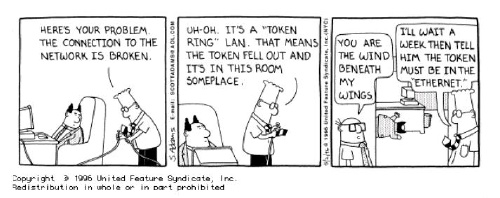
You're thinking of HSTR - and no, no one really uses it anymore. In looking around I was amazed to see that the working group even thought far enough ahead to start planning a gigabit spec. I havent seen a concentrator/MAU (right word?) in years, though. Any QoS features that were implemented in Token Ring are pretty much duplicated in 802.1p and other (proprietary) layer 2 QoS/CoS protocols.
Rings themselves are still used, just in other topologies. You may still see some FDDI here and there, and many cable companies use RPR/DTP/SRP to deliver digital cable and broadband access at the same time in their cores.
Either way, I'm sure the pointy haired boss doesn't miss it. -
Speculations away
My guess is they are about to release a network search agent, possibly coupled to a mobile wireless device. I'm imagining a handheld (Palm pilot-ish) coupled to a wireless Windows CE coupled with a Microsoft Terranova or similar map program for getting information while out in the field, coupled with Microsoft Search for finding information on the fly.
The star design (nodes radiating from a central node) implies a network configuration, where there is a central location that is retrieving data from external servers. The first portion "do you know what I can do" with pictures of circuitry also implies a hardware device capable of networking, but the multiple images (arrows) suggests a query. The "and where I can go" with pictures of cities and beaches implies a mobile device. "or how I can change your life" could really mean anything.
Of course, Origami is basically "folding paper", so the hardware itself could be a Digital Paper device coupled to a wireless 802.11g" device for on the go searches...
If that's not it, maybe I can patent the idea for a device like that before they get around to building one. -
Kinda, sorta, maybe...but this: "We can reuse and/or extend the probe/negotiation phase to provide additional power levels, let's say up to 150W (approximately 4A max)..."
definitely won't work. The power (actually current) limitation is due to the size of the wires and current carrying capacity of the "RJ-type" connectors which must be assumed. One cannot safely provide anywhere close to 150 W of power. There is a new specification in progress (802.3at, aka PoEPlus) to allow delivering more power, but the practical limits are on the order of 30 W using 2 pair, 45 W using all 4 pair.
-
802.16a Mesh Mode
I'm particularly interested in the mesh mode of 802.16a, where each 802.16a node is able to operate as both the subscriber and base station. This forms a wireless mesh network, and this is largely different from the usual point-to-multipoint mode. A wireless mesh enables wireless coverage to areas not reached by the base station but can be reached by the other client nodes.
There are a lot of publications on 802.16a at the IEEE 802.16 Task Group A. I find the tutorial presentation slides particularly helpful in explaining the 802.16a mesh mode, although it gets really technical towards the end.
Here's a good technical introduction to WiMAX.
I am doing performance studies on the WiMAX network. Please contact me if you are interested in sharing your views, tips and experiences of deploying a WiMAX network.
-
802.16a Mesh Mode
I'm particularly interested in the mesh mode of 802.16a, where each 802.16a node is able to operate as both the subscriber and base station. This forms a wireless mesh network, and this is largely different from the usual point-to-multipoint mode. A wireless mesh enables wireless coverage to areas not reached by the base station but can be reached by the other client nodes.
There are a lot of publications on 802.16a at the IEEE 802.16 Task Group A. I find the tutorial presentation slides particularly helpful in explaining the 802.16a mesh mode, although it gets really technical towards the end.
Here's a good technical introduction to WiMAX.
I am doing performance studies on the WiMAX network. Please contact me if you are interested in sharing your views, tips and experiences of deploying a WiMAX network.
-
This reminds me..
Wireless Regional Area Networks. IEEE is developing a standard for a cognitive radio-based PHY/MAC/air_interface for use by license-exempt devices on a non-interfering basis in spectrum that is allocated to the TV Broadcast Service.
-
IEEE 802.22
That would be unlicensed operation in the TV bands, now being standardized by IEEE 802.22, the newest 802 working group.
-
Power over ethernet exists
And so do APs that work with it. The PoE is 802.3af
-
Re:Maybe It Means Something
Let me know if I missed any
A few (note that this document was last updated in July 2003). Since then, three more task groups (802.11n, 802.11r and 802.11s) have been created. -
Re:Oooh, never thought of that.
...or you can just get an AP that supports Power over Ethernet.
-
Looks like it may be fraught with patents
Look at the Task Group's web page and note the security submissions from Certicom. In case you don't know, these are the mob who have extensive patents on elliptic-curve crypto. Guess what they are trying to push into the standard? Yet another standards body corrupted. Hopefully sanity will prevail and someone will force them to include RSA as another option.
-
Re:Split
From the very same page: "Data rates of 250 kbps, 40 kbps, and 20 kbps". The lowest rate is five to ten times faster than a dialup modem, which is enough for very-low-bitrate video, and a decent stream of still images, or a fairly decent-quality mono audio stream when compressed (or about telephone quality without compression.)
At its high end, it's nearly twice as fast as ISDN, which is commonly used for fairly decent-quality videoconferencing.
Using a mesh network one could spread the traffic out between nodes and attain fairly high data rates in many situations, even with modems slower than these.
-
Re:Oh this is silly
Hm. Apple PowerMac G5:
* HyperTransport
* PCI-X / AGP
* DDR SDRAM
* S-ATA
* Gigabit Ethernet
* IEEE 1394b a.k.a. Firewire 800
* USB 2.0
So, tell me, which of these, which will be the only interfaces that you can sanely use, is proprietary?
In the PC world, anything other than an Opteron machine can compare in specs. -
Re:Protocol faster than DSL?
yep, so's 10GBaseCX-4.
-
A little more than this may be needed.Addressing inter operator hotspot authentication and billing for 802.11 is one part of the solution. There is also network detection and selection to consider. There are other interfaces to consider (802.16e?). There is the issue of optimal interface selection to consider like with laptops (docked 802.3 -> undocked 802.11 -> outdoors 802.16).
To solve all this stuff you need things to be addressed at multiple layers.
That's why the IEEE has started 802.21.
-
WiFi roaming is reality already
Granted, without the billing (because they feel that internet access should be free for their community), but many Dutch universities and research institutions together with SURFnet (the National Research and Education Network) have developed a roaming solution already. Based on IEEE 802.1x, EAP-TTLS and RADIUS it allows for seemless roaming between the participants.
This WiFi roaming has recently been extended and now institutions in Portugal and Croatia are joining as wel. -
Re:Who will be securing these networks?
Exactly right. Security, in wireless sensor networks, means more than just encryption (for privacy), however. In many applications it's more important to have message integrity and sender authentication, meaning that the recipient is guaranteed that the message hasn't been altered, and that it was from who it says it was from. For example, having an encrypted message from a short-range wireless light switch is often of little utility; people around can see the light come on (perhaps through a window), so you're not really protecting anything. However, as the parent poster says, you really don't want some car of script kiddies driving through your neighborhood randomly turning lights on and off at 2 AM. The wireless lights need to know that the messages they receive are from their associated switches, not from some 3l33t d00dz; that's the function of message integrity and source authentication checking.
Recognizing the importance of these types of security, the IEEE 802.15.4 standard, available here, employs the Advanced Encryption Standard for encryption, message integrity, and sender authentication. The ZigBee Alliance specifies key transport protocols, key management, and other higher layer security functions.
-
Re:Not backwards-compatible
10GBASE-CX4 is being defined by 802.3ak, which is scheduled to be finalized in December.
-
Wireless Sensor Network Standards
I found the article's comment about the need for the NSF to motivate standards in wireless sensor networks to be strange, since the IEEE 802.15.4 standard is due to be published any day now (the final draft is alread for sale at the IEEE online store). The IEEE 802.15.4 standard is designed for low cost, very low power consumption wireless sensor networks; it has a raw over-the-air data rate of 250 kb/s, operates in the unlicensed 2.4 GHz ISM band, and can support peer-to-peer multihop (so-called "mesh") networks with device duty cycles below 3 ppm.
The IEEE 802.15.4 standard is being used by the ZigBee Alliance, an organization of more than 50 large and small companies, to establish networking and application profile interoperability standards, much like Wi-fi has done with IEEE 802.11. The ZigBee Alliance will have a session open to the public at its next meeting, in Berlin June 3.
The IEEE 1451.5 wireless sensor standard, which will standardize sensor discovery and data formatting, is at an earlier stage of development; proposals are now being presented.
With all this activity, it's not clear to me just what the NSF is expecting to standardize.
-
Re:Gibabit?
Actually, gibibit is proper. See the IEEE
-
Re:Old HatMesh networking in general is the future of wireless.
Is the protocol that enables mesh networking an open standard? The OpenAP project and the Mesh AP folks use 802.1d, or MAC bridges, to eliminate redundant hops.
-
Slashdot editors got duped again !!
The guys at IEEE had a bet that this story will be accepted on
From the IEEE webpage - "Welcome the birth of the IEEE's first wireless MAN standard for broadband wireless access...",
All IEEE standards shall be updated within five years of the date of
>publication. If the standard is not revised, reaffirmed, or withdrawn
>within five years, the Sponsor will be notified that it will be submitted
>to the Standards Board for administrative withdrawal.
-
Re:So when do I get fiber in my house?
Expense is a major misperception as the previous reply to this post points out. It's a hangover from the hippie era and mostly perpetuated by hippies-turned-engineers. Maybe not in 1967, but today, it costs more to put in marble countertops than to install fiber optic Ethernet To The Home (ETTH). Trenching costs are trivial. Local control freaks are not. They are completely obessed with their Right To Drive Cars Three Blocks to the store, and anything that might temporarily re-route that drive is dubbed Evil Corporate Destruction of their vital neighborhood streets. It's asphalt, for crying out loud! Well, they're my streets, too, and I vote: DIG THE HELL OUT OF THEM. The digging won't last forever, but the benefits will. That's the one best thing you can do to help speed Fiber To Your Door. Get in front of your local political bubble-heads and INSIST that they let companies bring the fiber to you.
If we have anything to do with it -- and we do -- companies like OnFiber will soon figure out that by working with Fortune 500 Residential Developers, they can branch out to new revenue generating opportunities and begin the migration to a rightly architected Residential Information Infrastructure (RII), starting in new housing developments. As deployments increase in number, costs drop even further and it's a vituous circle that will save the world and bring peace to Jerusalem. Well, at least it will make companies like Always-On very happy, whose addressable market it limited only by sufficient, reliable bandwidth.
While it might seem like Gigabit ETTH is overkill, by the time you do the math for sending Everything over Ethernet for a family of four, the scenario changes quickly. You have to think in terms of sending different HDTV streams for each of three TV's in the home, while one of the kids is playing a fully immersive version of Diablo 6 with a peer-to-peer interface that looks like this. One Gbps may not be enough when you factor in all of the bandwidth load balancing and congestion considerations. What we have to get the -- how shall I put it delicately -- theiving f-ing MBA idiots on Sand Hill and Wall Street to understand is that overprovisioning bandwidth does NOT necessarily create an economic surplus. They certainly didn't seem to think SONET was economic surplus.
There is no bandwidth surplus anymore than there were honest auditors at Worldcom. In fact, it's very likely the peers of those auditors who manufactured the Too Much Bandwidth propaganda in the first place. What there is, is SUFFICIENT bandwidth to begin growing at the edges
There you have it, the mystical Economic Recovery for Dummies. It's called the Ethernet First Mile. Remember, you read it first on