Slashdot Mirror
Domain: indiana.edu
Stories and comments across the archive that link to indiana.edu.
Stories · 72
-
Report: Up To 15% Of Twitter Accounts Are Bots (cbsnews.com)
A team of researchers claim they can identify Twitter account activity that's posted by bots through their new web portal -- "Bot or Not?" -- leveraging "more than a thousand features extracted from public data and meta-data." And it turns out there are a lot of bots. An anonymous reader writes: "A study released by the University of Southern California reports that roughly nine to 15 percent of Twitter accounts...are so-called bots controlled by software instead of humans," according to CBS News. "Twitter boasts 319 monthly active users meaning that this recent revelation equates to nearly 48 million bot accounts, according the university's high-end figure." CNBC adds that "The research could be troubling news for Twitter, which has struggled to grow its user base in the face of growing competition from Facebook, Instagram, Snapchat and others." In a 2014 SEC filing Twitter admitted that between 5 and 8% of their users were bots.
Twitter's response to this new report? "Many bot accounts are extremely beneficial, like those that automatically alert people of natural disasters ... or from customer service points of view." -
Education Chief Should Know About PLATO and the History of Online CS Education
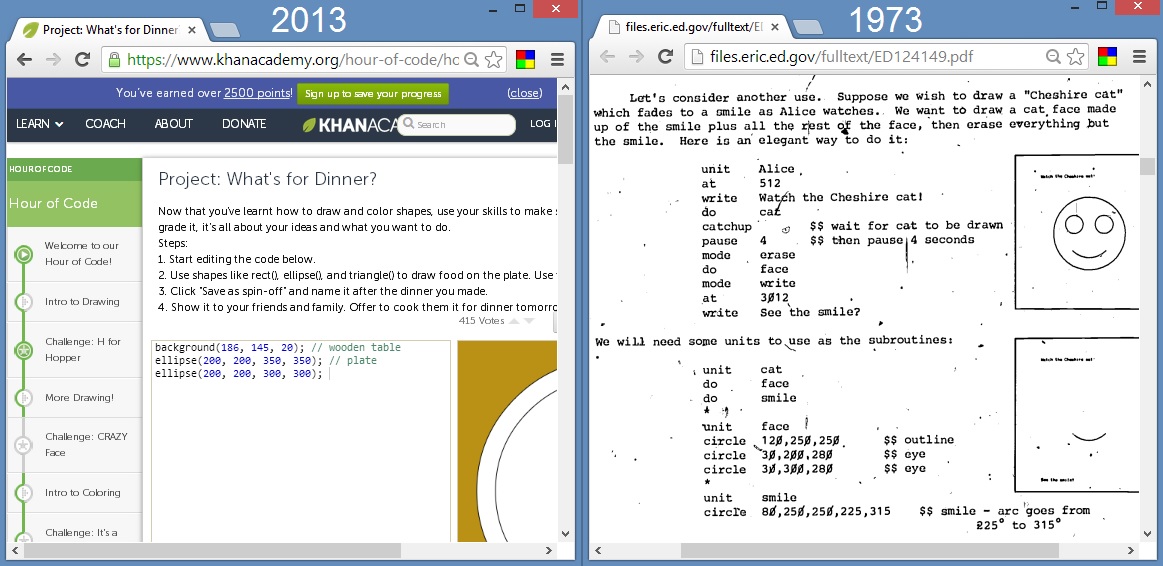
theodp writes Writing in Vanity Fair, U.S. Secretary of Education Arne Duncan marvels that his kids can learn to code online at their own pace thanks to "free" lessons from Khan Academy, which Duncan credits for "changing the way my kids learn" (Duncan calls out his kids' grade school for not offering coding). The 50-year-old Duncan, who complained last December that he "didn't have the opportunity to learn computer skills" while growing up attending the Univ. of Chicago Lab Schools and Yale, may be surprised to learn that the University of Illinois was teaching kids how to program online in the '70s with its PLATO system, and it didn't look all that different from what Khan Academy came up with for his kids 40 years later (Roger Ebert remarked in his 2011 TED Talk that seeing Khan Academy gave him a flashback to the PLATO system he reported on in the '60s). So, does it matter if the nation's education chief — who presides over a budget that includes $69 billion in discretionary spending — is clueless about The Hidden History of Ed-Tech? Some think so. "We can't move forward," Hack Education's Audrey Watters writes, "til we reconcile where we've been before." So, if Duncan doesn't want to shell out $200 to read a 40-year-old academic paper on the subject (that's a different problem!) to bring himself up to speed, he presumably can check out the free offerings at Ed.gov. A 1975 paper on Interactive Systems for Education, for instance, notes that 650 students were learning programming on PLATO during the Spring '75 semester, not bad considering that Khan Academy is boasting that it "helped over 2000 girls learn to code" in 2014 (after luring their teachers with funding from a $1,000,000 Google Award). Even young techies might be impressed by the extent of PLATO's circa-1975 online CS offerings, from lessons on data structures and numerical analysis to compilers, including BASIC, PL/I, SNOBOL, APL, and even good-old COBOL. -
Computer Scientists Say Meme Research Doesn't Threaten Free Speech
dcblogs (1096431) writes "In a letter to lawmakers Tuesday (PDF), five of the nation's top computing research organizations defended a research grant to study how information goes viral. The groups were responding to claims that the government-funded effort could help create a 1984-type surveillance state. The controversy arises over a nearly $1 million research grant to researchers at Indiana University to investigate "why some ideas cause viral explosions while others are quickly forgotten," particularly on Twitter. "We do not believe this work represents a threat to free speech or a suppression of any type of speech over the internet," the letter said. "The tools developed in the course of this research are capable of making no political judgments, no prognostications, and no editorial comments, nor do they provide any capability for exerting any control over the Twitter stream they analyze," they wrote. The controversy over Truthy may be just another sign of the ongoing deterioration between the science community and lawmakers over basic research funding as well as the science itself. -
3 Short Walking Breaks Can Reverse Harm From 3 Hours of Sitting
An anonymous reader writes: Medical researchers have been steadily building evidence that prolonged sitting is awful for your health. One major problem is that blood can pool in the legs of a seated person, causing arteries to start losing their ability to control the rate of blood flow. A new experimental study (abstract) has discovered it's quite easy to negate these detrimental health effects: all you need to do is take a leisurely, 5-minute walk for every hour you sit. "The researchers were able to demonstrate that during a three-hour period, the flow-mediated dilation, or the expansion of the arteries as a result of increased blood flow, of the main artery in the legs was impaired by as much as 50 percent after just one hour. The study participants who walked for five minutes for each hour of sitting saw their arterial function stay the same — it did not drop throughout the three-hour period. Thosar says it is likely that the increase in muscle activity and blood flow accounts for this." -
Indiana University Researchers Get $1 Million Grant To Study Memes
An anonymous reader writes with news that the NSF has just awarded a group of researchers a grant to study the life cycle of memes. "Indiana University is receiving nearly $1 million in federal grant money to investigate the genesis, spread, and demise of Internet memes. The grant from the National Science Foundation awards four Indiana researchers $919,917 to for a project called Truthy that will, as the grant's abstract explains, "explore why some ideas cause viral explosions while others are quickly forgotten." (And yes, in case you're wondering, the name was inspired by Stephen Colbert's neologism "truthiness.") The government-funded research is aimed at identifying which memes are organic and which ones are mere astroturf. "While the vast majority of memes arise in a perfectly organic manner, driven by the complex mechanisms of life on the Web, some are engineered by the shady machinery of high-profile congressional campaigns," Truthy's About page explains." -
One Billion Android Devices Open To Privilege Escalation
msm1267 (2804139) writes "The first deep look into the security of the Android patch installation process, specifically its Package Management Service (PMS), has revealed a weakness that puts potentially every Android device at risk for privilege escalation attacks. Researchers from Indiana University and Microsoft published a paper that describes a new set of Android vulnerabilities they call Pileup flaws, and also introduces a new scanner called SecUP that detects malicious apps already on a device lying in wait for elevated privileges. The vulnerability occurs in the way PMS handles updates to the myriad flavors of Android in circulation today. The researchers say PMS improperly vets apps on lower versions of Android that request OS or app privileges that may not exist on the older Android version, but are granted automatically once the system is updated.
The researchers said they found a half-dozen different Pileup flaws within Android's Package Management Service, and confirmed those vulnerabilities are present in all Android Open Source Project versions and more than 3,500 customized versions of Android developed by handset makers and carriers; more than one billion Android devices are likely impacted, they said." Handily enough, the original paper is not paywalled. -
Linux 3.12 Released, Linus Proposes Bug Fix-Only 4.0
An anonymous reader writes "Linus Torvalds announced the Linux 3.12 kernel release with a large number of improvements through many subsystems including new EXT4 file-system features, AMD Berlin APU support, a major CPUfreq governor improvement yielding impressive performance boosts for certain hardware/workloads, new drivers, and continued bug-fixing. Linus also took the opportunity to share possible plans for Linux 4.0. He's thinking of tagging Linux 4.0 following the Linux 3.19 release in about one year and is also considering the idea of Linux 4.0 being a release cycle with nothing but bug-fixes. Does Linux really need an entire two-month release cycle with nothing but bug-fixing? It's still to be decided by the kernel developers." -
The Linux Backdoor Attempt of 2003
Hugh Pickens DOT Com writes "Ed Felton writes about an incident, in 2003, in which someone tried to backdoor the Linux kernel. Back in 2003 Linux used BitKeeper to store the master copy of the Linux source code. If a developer wanted to propose a modification to the Linux code, they would submit their proposed change, and it would go through an organized approval process to decide whether the change would be accepted into the master code. But some people didn't like BitKeeper, so a second copy of the source code was kept in CVS. On November 5, 2003, Larry McAvoy noticed that there was a code change in the CVS copy that did not have a pointer to a record of approval. Investigation showed that the change had never been approved and, stranger yet, that this change did not appear in the primary BitKeeper repository at all. Further investigation determined that someone had apparently broken in electronically to the CVS server and inserted a small change to wait4: 'if ((options == (__WCLONE|__WALL)) && (current->uid = 0)) ...' A casual reading makes it look like innocuous error-checking code, but a careful reader would notice that, near the end of the first line, it said '= 0' rather than '== 0' so the effect of this code is to give root privileges to any piece of software that called wait4 in a particular way that is supposed to be invalid. In other words it's a classic backdoor. We don't know who it was that made the attempt—and we probably never will. But the attempt didn't work, because the Linux team was careful enough to notice that that this code was in the CVS repository without having gone through the normal approval process. 'Could this have been an NSA attack? Maybe. But there were many others who had the skill and motivation to carry out this attack,' writes Felton. 'Unless somebody confesses, or a smoking-gun document turns up, we'll never know.'" -
Linux 3.12 Merge Window Closes With Release of Linux 3.12-rc1
hypnosec writes "Linus Torvalds has released Linux 3.12-rc1, marking the first major development in over two weeks for the forthcoming successor of the Linux 3.11 kernel. Announcing the closure of the 3.12 merge window, Torvalds said in the release announcement that the window was fairly normal. Dissecting the updates, he noted that 73 percent of them are related to drivers, 12 percent related to architecture updates, and 6 percent related to file systems. ... Torvalds liked the 'scalability improvements that got merged this time around.' Torvalds also mentioned the tty layer locking getting resolved, and work on dentry refcount scalability." -
SSD Failure Temporarily Halts Linux 3.12 Kernel Work
jones_supa writes "The sudden death of a solid-state drive in Linus Torvalds' main workstation has led to the work on the 3.12 Linux kernel being temporarily suspended. Torvalds has not been able to recover anything from the drive. Subsystem maintainers who have outstanding pull requests may need to re-submit their requests in the coming days. If the SSD isn't recoverable he will finish out the Linux 3.12 merge window from a laptop." -
Linus Responds To RdRand Petition With Scorn
hypnosec writes "Linus Torvalds, in response to a petition on Change.org to remove RdRand from /dev/random, has lambasted the petitioner by called him ignorant for not understanding the code in the Linux Kernel. Kyle Condon from the UK raised a petition on Change.org to get Linus to remove RdRand from /dev/random in a bid 'to improve the overall security of the linux kernel.' In his response, Torvalds asked Condon and the supporters of the petition to gain an understanding of Linux drivers and cryptography, and then 'come back here and admit to the world that you were wrong.' Torvalds stressed that kernel maintainers knew what they were doing and the petitioner didn't. Torvalds, in a similar outburst just yesterday, hoped that 'ARM SoC hardware designers all die in some incredibly painful accident.' This came in response to a message from Kevin Hilman when he noted that there were quite a few conflicts in the ARM SoC pull request for Linux 3.12 which were a result of the platform changes conflicting with driver changes going in to the V4L tree." -
Linux 3.11 Released
hypnosec writes "Linus Torvalds has just announced the release of Linux 3.11 as anticipated. Torvalds notes that the final version doesn't bring in a lot more than what is already present in the rc7, but it does include fixes — most of them in networking, file systems, and audio." -
Linus Torvalds Celebrates 20 Years of Windows 3.11 With Linux 3.11-rc5 Launch
hypnosec writes "Linus Torvalds released Linux 3.11-rc5 yesterday wishing that it would have been a lovely coincidence if he were able to release final Linux 3.11 as on the exact same day 20 years ago Microsoft released Windows 3.11. 'Sadly, the numerology doesn't quite work out, and while releasing the final 3.11 today would be a lovely coincidence (Windows 3.11 was released twenty years ago today), it is not to be,' notes Torvalds in the release announcement." -
Linux 3.10 Officially Released
hypnosec writes with word that "The Linux 3.10 kernel has been officially released on Sunday evening which makes the 3.10-rc7 the last release candidate of the latest kernel which yields the biggest changes in years. Linus Torvalds was thinking of releasing another rc but, went against the idea and went ahead with official Linux 3.10 commit as anticipated last week. Torvalds notes in the announcement that releases since Linux 3.9 haven't been prone to problems and 3.10 is no different." -
Linus Torvalds Promises Profanity Over Linux 3.10-rc5
hypnosec writes "Linus Torvalds has released Linux 3.10-rc5, and he is certainly not happy with the changes merged last week. Rc5 is bigger than rc4 and has code scattered across its entire code base because it addresses many outstanding problems. In the release announcement, Torvalds noted, 'I wish I could say that things are calming down, but I'd be lying. rc5 is noticeably bigger than rc4, both in number of commits and in files changed (although rc4 actually had more lines changed, so there's that).' Torvalds has warned that he is going to start cursing again, and said, 'I'm going to call you guys out on, and try to come up with new ways to insult you, your mother, and your deceased pet hamster.'" -
Linux 3.10 Merge Windows Closes
hypnosec writes "Linus Torvalds has released the Linux 3.10-rc1 kernel marking the closure of the 3.10 merge window. The Linux 3.10-rc1 is the second biggest rc release in years and the closure of the merge windows means that the features expected out of the Linux 3.9 successor are chalked out. "So this is the biggest -rc1 in the last several years (perhaps ever) at least as far as counting commits go," Linus notes in the release announcement." -
Linux 3.9 Released
hypnosec writes "After a week's delay Linux 3.9 has finally been made available by Linus Torvalds. Last week Torvalds released the rc8 stating that he wasn't 'comfy' releasing the final version yet and that 'another week won't hurt.' Torvalds noted in this week's announcement that last week had been very quiet as there were not many commits and the ones which were there were 'really tiny' so he went ahead with the release of Linux 3.9." -
First Debian/Ubuntu Bootable ARM64 Images Released
An anonymous reader writes "With work done by ARM and Linaro, there is now a bootable image of Debian/Ubuntu that works for ARM64, the new 64-bit ARM architecture. There are still some caveats and work ahead, but Linux is once again the first platform that has software ready to run on a new architecture when released. This 64-bit ARM Linux support also includes the ability to run 32-bit ARM software side-by-side." You can grab a bootable rootfs, but there's no hardware to actually run it on now (the developers are using the free-as-in-beer simulator from ARM). Kernel support for the architecture was released around a year ago; this is more a tale of getting from a bootable kernel to a bootable operating system. -
Alcoholism Vaccine Makes Alcohol Intolerable To Drinkers
Hugh Pickens writes "Ariel Schwartz reports that researchers are working on an alcoholism vaccine that makes alcohol intolerable to anyone who drinks it. The vaccine builds on what happens naturally in certain people — about 20% of the Japanese, Chinese, and Korean population — with an alcohol intolerance mutation. Normally, the liver breaks down alcohol into an enzyme that's transformed into the compound acetaldehyde (responsible for that nasty hangover feeling), which in turn is degraded into another enzyme. The acetaldehyde doesn't usually have time to build up before it's broken down. But people with the alcohol intolerance mutation lack the ability to produce that second enzyme; acetaldehyde accumulates, and they feel terrible. Dr. Juan Asenjo and his colleagues have come up with a way to stop the synthesis of that second enzyme via a vaccine, mimicking the mutation that sometimes happens naturally. 'People have this mutation all over the world. It's like how some people can't drink milk,' says Asenjo. Addressing the physiological part of alcohol addiction is just one piece of the battle. Addictive tendencies could very well manifest in other ways; instead of alcohol, perhaps former addicts will move on to cigarettes. Asenjo admits as much: 'Addiction is a psychological disease, a social disease. Obviously this is only the biological part of it.'" -
New Secure Boot Patches Break Hibernation
hypnosec writes "Matthew Garrett published some patches today which break hibernate and kexec support on Linux when Secure Boot is used. The reason for disabling hibernation is that currently the Linux kernel doesn't have the capability of verifying the resume image when returning from hibernation, which compromises the Secure Boot trust model. The reason for disabling the kexec support while running in Secure Boot is that the kernel execution mechanism may be used to load a modified kernel thus bypassing the trust model of Secure Boot." Before arming your tactical nuclear flame cannon, note that mjg says "These patches break functionality that people rely on without providing any functional equivalent, so I'm not suggesting that they be merged as-is." Support for signed kexec should come eventually, but it looks like hibernation will require some clever hacking to support properly in a Restricted Boot environment. -
Linus Torvalds Delays Linux 3.7, Releases 3.7-rc8 Kernel Instead
hypnosec writes "The Linux 3.7 kernel has been delayed by one week as Linus Torvalds has released the Linux 3.7-rc8 instead. Because of some hiccups following the 'resurrection of a kswapd issue,' Torvalds wasn't comfortable releasing version 3.7 this week and instead went ahead with another release candidate. Torvalds revealed in his release announcement that because of this delay, the merge window for Linux 3.8 will close just around Christmas time." -
Book Review: The Logic of Chance
eldavojohn writes "The Logic of Chance: The Nature and Origin of Biological Evolution is a comprehensive snapshot of the latest research of biological evolution. The text is written by Eugene V. Koonin, an editor for a journal and researcher at NCBI. The book, although lacking in foundational knowledge and often foregoing explanation of research, presents a comprehensive and well-referenced view of modern evolutionary research. It is heavily laden with acronyms and jargon specific to biology and evolution. As a result, reading it requires either prior knowledge or a high tolerance for looking up these advanced topics with the reward of it being an extremely eye opening and enjoyable read worthy of your time." Keep reading for the rest of eldavojohn's review. The Logic of Chance: The Nature and Origin of Biological Evolution author Eugene V. Koonin pages 516 publisher FT Press Science rating 7/10 reviewer eldavojohn ISBN 978-0132542494 summary An outline of a fundamentally new evolutionary synthesis reflecting key advances in genomics, systems biology and biological physics. First off, my background is primarily in computer science although I took courses in bioinformatics in my undergrad and have maintained an interest in evolution since evolutionary and genetic algorithms were supposed to revolutionize computer science when I was in school. Unfortunately, my lack of biology caused the text to be extremely tedious (so much googling) for some chapters while my strong statistical background made other chapters very much enjoyable. For most readers this presents a large barrier of entry. When the author discusses neural networks being used to categorize prokaryotic genes, it may be insufficient to the reader to understand what that means. As a result, this book's audience is a relatively small set of people: 1) biology graduates with strong statistical knowledge or 2) someone willing to work very hard to understand advanced terms and concepts in both fields. Please proceed knowing that a biologist's review of this same book could very well sound entirely different from mine. Also, Koonin wastes very few words in this book, the text is dense and if you are unable to complete reading this review due to jargon there is a low chance you'll be able to tolerate it in the book. To sample some of this book, there is a short PDF containing chapter one or Google Books offering the first 147 pages at the time of this writing — you will see that this review barely scratches the surface of what is covered in this information-dense book.
Secondly, I will preface my review of the technical aspects of this book with my reason for giving it a score of 7 out of 10. The introduction to this book sets very lofty goals. One of them being the hope that this book does for evolution what A Brief History of Time did for physics. That is a seriously tall order and gave me correspondingly high hopes for this book. Koonin, unfortunately, is a very gifted writer and is unafraid of using exceedingly complex sentences such as this gem from page 117 (deliberately taken out of context):
"It has been known for years that a widespread form of global regulation in bacteria is mediated by cAMP, with the participation of diverse adenylate cyclases (a striking case of NOGD); numerous proteins containing cAMP sensors, such as the GAF domain; and the CRP, FNR, and other transcription regulators, also containing cAMP-binding domains."
That sentence is typical of Koonin's writing — lengthy and intricately peppered with many acronyms (only one of which had been described well enough for me earlier in the text). Of course, that paragraph comes with a reference to a paper (like almost all of the paragraphs in this book) from 2010 by Seshasayee so the reader is free to seek external resources if these sentences are daunting.
Considering all of this, I read A Brief History of Time in high school and, despite not having had a physics course yet, learned a lot from it. I attribute that, mostly, to the fact that the sentences are simple and straightforward. Not only that but A Brief History of Time did a great job of building upward from the foundational mechanics of physics while somehow remaining refreshingly brief. This is not the case in The Logic of Chance but I will rush to the book's defense somewhat on that charge. Prior to having read this book, I would have stated my desire that the text start from the basics and work its way up. After reading this book and understanding this field better than I ever have, I now agree that the subject matter of evolution would demand quite the epic tome to accomplish such a feat. I do hope to see future versions of this book with more concise and clear sentences as well as more fundamental concepts explained. If I could have begged Koonin to add one thing to this book, it would be a glossary in the back spanning many hundreds of pages for ignorant readers like myself. Right now this book is for graduate students and academia whereas A Brief History of Time could almost be consumed by anyone who made it through the public school system.
I also sympathize with Koonin's herculean task because modern evolutionary studies seem relatively young compared to other fields like particle physics. As a result, Koonin must (and does) concede in some sections that there still exists largely debated theories. These debates often concern things about which we may never know the absolute truth like the branching factor of a tree of evolution on Earth some indeterminable time ago. As more and more prokaryotes and eukaryotes are added to their statistical algorithms, this may become clearer and yield revelations like the genetic makeup of the last eukaryotic common ancestor (LECA) and free this text of many pages devoted to questions surrounding such origins of life. But for now Koonin must tediously cover all his bases to introduce such things to the reader.
The book starts off by establishing the fundamentals of evolution up until the consolidation of Modern Synthesis. This includes purifying selection, drift, draft, fitness landscapes, etc until Darwinian Evolution was combined with genetics. At this point, the substrate of evolution (the genome) lead to evolutionary genomics. In particular Koonin concentrates on the statistics applied at the molecular level including distance methods, maximum parsimony, maximum likelihood, Bayesian inference and a similar analysis of phylogenetic methods. Koonin establishes early on that evolutionary research can no longer rely merely on phenotypic effects but rather there is a vast array of concrete changes happening at a molecular level.
The book moves on into comparative genomics and discusses extensively the intricate differences between the genomes of viruses, bacteria, archaea and eukaryota. Koonin exhaustively compares these groups through statistics and lays a brief foundation of relationships between genes. From this point on the book is heavily infested with the terminology of homologous, orthologous and paralogous genes. In addition to those the author discusses In-/Out-paralogous, co-orthologous and groups of orthologous (COG) genes. For people unfamiliar with this world, bookmarking and referring to Box 3-1 on page 56 is strongly advised. For the layperson, I believe an expansion of such a graphic would be a great addition to this book. Inside this part, the book also covers a simple but often misunderstood core piece of evolution and that is that evolution has the basic elementary events at the level of gene and genome evolution: substitution, deletion/loss, insertion, recombination/HGT and duplication. Over and over on Slashdot, I see comments that indicate a confusion or perception of evolution being one big monolithic thing. Koonin obviously reads or even studies a lot of other academic fields and tries to explain "the gene universe" as a space-time where there are a few dense clusters of core genes represented in most genomes but most of that space-time is occupied by a huge number of increasingly sparse "nebulae" consisting of rare genes. The author says of this universe: "This organization of the gene universe is distinctly fractal--that is, it appears at all scales of evolutionary distances."
As if that wasn't enough to prove that a definitive phenome narrative (what I alluded to earlier as desired) would be a bad idea, the next section moves on to systems biology and a heavier statistical look at genomics. Beyond the gene status (present or not present) exist two classes of variables: intensive evolutionary variables and extensive phenomic variables. At this point, we're not even talking about tangible things like eye or hair color but rather the underlying mechanisms to those sorts of things like proteins and how they are folded. Everywhere Koonin uses italics, the reader should pay special attention as I found these to be the most interesting key points (example: "Highly expressed genes evolve slowly"). In defining the nature of the evolutionary process, the author covers important concepts like fitness graphs that contain multiple local maxima to demonstrate how non-optimal progressions can occur. Furthermore this section makes it clear that adaptation is not the be-all end-all of evolution. The extensive discussion of the quantifiable properties of genome architecture, functioning and evolution are defined more so by non-adaptive, stochastic processes. Here (and in many later sections) Koonin attempts to use metaphors like Jacob's tinkering and ratchets to help the reader understand these complex concepts but I felt that these metaphors were still so far abstracted that the text could use anything linking these processes to tangible observations in organisms. Again I cannot hold this as a flaw for, after reading the book, it's clear that such a request would be viewed as sophomoric and evidence that I am unable to progress past The Origin of the Species (this book's key objective).
Koonin then moves on to the prokaryotic world and examines their genes and operons while paying special attention to an odd case: cyanobacteria. Most importantly in the prokaryotic domain, extensive comparative genomics has revealed a concept called horizontal gene transfer (HGT). I was personally hoping that Koonin would seize upon this novel concept and its importance in bacterial antibiotic resistance and how bacteria can evolve to dissolve novel compounds. For better or for worse, Koonin sticks to the pure purpose of this book and extensively covers important HGT discoveries like the convergence of protein sequences in similar groups of bacteria and archaea. Some selfish genes rely so heavily on horizontal mobility that they are dubbed "mobilomes" and Koonin discusses their aspects extensively. Darwin's Tree of Life concept was a very small eukaryotic part of the big picture that Koonin tries to re-invent as the "Forest of Life" or "Web of Life" (considering HGT). A whole chapter is devoted to discussing its properties and graphically visualizing its structure based on extensive surveys and what we know today.
From there the author discusses the origins of eukaryotes, Last Eukaryotic Common Ancestor (LECA), the branching factor of its evolution, its relative distance to the point of symbiogenesis in proposed evolutionary trees and the many competing theories about that tree. This section of the book spends considerable time examining the inferred origins of basic eukaryotic cell functioning and also discusses at length the archaeal roots of elaborate systems with the exception of the mitochondrion. This chapter also looks at the perplexing features of introns in eukaryotic genes. Koonin then tackles the misconceptions and abuses of the word complexity in all aspects of evolution. He applies information theory to the genetic code and notes that "information (entropy) tells us very little about the meaningful information content or complexity of a genomic sequence." It is then suggested that a new way to compute entropy and complexity is to examine the alignment of orthologous sequences instead of single sequences. For people interested in information theory, chapter eight is the most fruitful where Koonin proposes a computable formula for biological (evolutionary) information density. Like Claude Shannon's ability to infer many important aspects of communication, Koonin's modifications allow us to calculate that perceptually complex organisms possess more "entropic" genomes while perceptually less complex organisms like bacteria have the tightly packed and information dense "informational" genomes. After establishing these studies in information theory, Koonin is able to argue that neutrality of mutations that are fixed during evolution is the null hypothesis for all molecular evolutionary theories. All of this aids the author in discussing why evolution progressed passed single celled organisms that already had 1,000 to 1,500 genes to larger sets of genes in multicelled organisms.
Chapter nine tackles the modalities of Darwinian, Larmarckian and Wrightean evolutionary theories. This chapter improves upon the simplistic triad of heredity-variance-selection that defines Modern Synthesis by showing that the relationship between population size and environmental stress determines which of the three modalities is expressed the most in evolution while at the same time observing the importance of entropy (noise) at all levels of transmission. Koonin shows that by combining very well known molecular mechanisms we can achieve a complex scenario like Jean-Bapteste Lamarck's proposed modality of evolution. The text gives viruses the same treatment which, despite my assumption that they would be easier to analyze, appear to have many of the same complexities that prokaryotes and eukaryotes have. Possibly even more so given the effects of the Red Queen Hypothesis and all of the counterdefense genomes in some viruses. Furthermore the cellular empire and virus empires have two-way exchanges of genes. The truth is we know very little about the virus world — considering its size and history — and the author postulates that viromes in unknown and unstudied viruses consist largely of uncharacterized "dark matter" (again, borrowing terms from cosmologists).
Koonin then approaches the next logical step backwards: the last universal common ancestor (LUCA). He starts by listing the arguments that cellular life indeed had a common ancestor and looks at competing theories (for example cell organization complexity versus genetic complexity leading to different models of varying degrees of cellularity). In chapter twelve, Koonin covers the topic that is often the hardest to imagine — the origin of life. This is interesting and particularly difficult because the translation system itself at some point evolved. Interestingly enough, these 60 protein-coding genes and ~40 structural RNA genes are the only complex ensemble of genes that are conserved across all extant cellular life forms. So, of course, the point in the evolutionary tree where this had developed is discussed as well as the Darwin-Eigen cycle. The latter requiring a system of a far greater complexity in order to be started. So the author begins examining the proposition that over time and due to their catalytic properties ribozymes lead to processive synthesis of peptides (long enough to be the first proteins). After discussing the eleven stages this would have to encompass, the author discusses the existing skepticism of models that try to explain how replication and transcription came about. This chapter also tackles geochemical and chemical propositions on the origin of life — something that has been discussed on Slashdot before. This research centers on networks of inorganic compartments consisting of catalytic surfaces with gradients of heat and acidity that could have supported primordial organic chemistry.
The book ends with a chapter devoted to reiterating topics as well as asking important questions like whether or not another biological evolution model is necessary/feasible as well as caution against logic like the progress fallacy or criticizing a concept like "the selfish gene" because it sounds "undignified." Though these are tempting arguments because of their simplicity, they have proven fruitless. A diagram on page 412 reminds us just how complex the flow of genetic material is between the virus empire and the cellular empire.
There are two appendices to this book and, perhaps because they use a softer language, they were much more accessible to me yet posed more questions than answers. Appendix A concentrates on the philosophy of postmodernism, the infeasibility of synthesis and the distrust of metanarratives. The author argues that any paradigm presented must include oversimplification and that we merely replace them with better metanarratives. It is also important to ask these questions about the current paradigms for without them we would never have come up with drift, draft and various neutral ratchets to improve old models. Koonin references Hawking and Mlodinow with the concept of model-dependent realism which stresses that scientists merely construct models that are in turn swapped out for better models given how well they explain data and predict the outcomes of experiments. Lastly Koonin refers to Popper's famous falsification paradigm and his subsequent position on how invaluable evolution is purely on the grounds that it arms us to model and understand specific experiments. The second appendix deals with roughly estimating the probability of life arising given inflationary cosmology. I know this back of the envelope math has become popular given recent discoveries of exoplanets in the news but I felt the few references to the "many worlds in one" model deserved to be placed in a separate book. Nevertheless, Koonin covers both the strong and weak forms of the anthropic principle and looks at the connotations they hold for evolution.
The references at the end of this book are extensive — 38 pages of two line references. It should probably be mentioned that Koonin's references to his own work consist of two of these pages although at no point did it sound like he was unfairly proffering his theories over others. At certain points I had to wonder whether or not I was reading a lightly adjusted abstract from a peer reviewed paper or a book. This is most evident in one of the figures of an appendix on page 437 that reads "This is a formulation of the 'weak' anthropic principle adopted for the context of this paper." Since it is a graphic and in the appendix, it's forgivable but caused me to wonder if the rest of the book couldn't be more seamlessly tied together with transitionary language for novices like myself. Amazingly, I found maybe one grammatical error and no typos in this book which was a refreshing experience for a first edition. Also, this is one of the best bound books I've had the pleasure of reading, its spine has held up to hours of laying it flat open while I googled for a better understanding. While $50 is pricey, the book is built to last and this $10 premium over the kindle edition is worth it if you must hold a physical copy of a book. It saddened me to be reminded that some states struggle with including the core concepts of Darwinian evolution anywhere in their K-12 curriculum. And should those students desire to break new ground in this modern field, texts like The Logic of Chance are that much further away from them.
You can purchase The Logic of Chance: The Nature and Origin of Biological Evolution from amazon.com. Slashdot welcomes readers' book reviews — to see your own review here, read the book review guidelines, then visit the submission page -
RMS On Header Files and Derivative Works
tomhudson writes "In this email from 2003, Richard Stallman says 'I've talked with our lawyer about one specific issue that you raised: that of using simple material from header files. Someone recently made the claim that including a header file always makes a derivative work. That's not the FSF's view. Our view is that just using structure definitions, typedefs, enumeration constants, macros with simple bodies, etc., is NOT enough to make a derivative work. It would take a substantial amount of code (coming from inline functions or macros with substantial bodies) to do that.' This should help end the recent FUD about the Android 'clean headers.'" -
Truthy Project Uncovers Political Astroturfing On Twitter
An anonymous reader writes with a follow-up to the launch of the Truthy Project we discussed last month. "Tens of thousands of tweets this election season have turned out to be automated messages generated by employees of political campaigns, Indiana University researchers have found. Quoting: 'In one case, a network of nine Twitter accounts, all created within 13 minutes of one another, sent out 929 messages in about two hours as replies to real account holders in the hopes that these users would retweet the messages. The fake accounts were probably controlled by a script that randomly picked a Twitter user to reply to, and a message and a Web link to include. Although Twitter shut the accounts down soon after, the messages still reached 61,732 users.'" -
The Science of Truthiness
E IS mC(Square) writes "Researchers at Indiana University have just launched Truthy.indiana.edu, which they humbly declare 'a sophisticated new Twitter-based research tool that combines data mining, social network analysis and crowdsourcing to uncover deceptive tactics and misinformation leading up to the Nov. 2 elections.' According to their FAQ, they define 'truthy' thus: 'A truthy meme relies on deceptive tactics to represent misinformation as fact. The Truthy system uses Truthy to refer to activities such as political smear campaigns, astroturfing, and other social pollution." -
The Science of Truthiness
E IS mC(Square) writes "Researchers at Indiana University have just launched Truthy.indiana.edu, which they humbly declare 'a sophisticated new Twitter-based research tool that combines data mining, social network analysis and crowdsourcing to uncover deceptive tactics and misinformation leading up to the Nov. 2 elections.' According to their FAQ, they define 'truthy' thus: 'A truthy meme relies on deceptive tactics to represent misinformation as fact. The Truthy system uses Truthy to refer to activities such as political smear campaigns, astroturfing, and other social pollution." -
The Scalability of Linus
Hugh Pickens writes "Katherine Noyes writes at LinuxInsider that it may be time for Linus Torvalds to share more of the responsibility for Linux that he's been shouldering. 'If Linux wants to keep up with the competition there is much work to do, more than even a man of Linus's skill [can] accomplish,' argues one user. The 'scalability of Linus' is the subject of a post by Jonathan Corbet wondering if there might there be a Linus scalability crunch point coming. 'The Linux kernel development process stands out in a number of ways; one of those is the fact that there is exactly one person who can commit code to the "official" repository,' Corbet writes. A problem with that scenario is the potential for repeats of what Corbet calls 'the famous "Linus burnout" episode of 1998' when everything stopped for a while until Linus rested a bit, came back, and started merging patches again. 'If Linus is to retain his central position in Linux kernel development, the community as a whole needs to ensure that the process scales and does not overwhelm him,' Corbet adds. But many don't agree. 'Don't be fooled that Linus has to scale — he has to work hard, but he is the team captain and doorman. He has thousands doing most of the work for him. He just has to open the door at the appropriate moment,' writes Robert Pogson, adding that Linus 'has had lots of practice and still has fire in his belly.'" -
Why Wikipedia Articles Vary So Much In Quality
Hugh Pickens writes "A new study shows that the patterns of collaboration among Wikipedia contributors directly affect the quality of an article. 'These collaboration patterns either help increase quality or are detrimental to data quality,' says Sudha Ram at the University of Arizona. Wikipedia has an internal quality rating system for entries, with featured articles at the top, followed by A, B, and C-level entries. Ram and graduate student Jun Liu randomly collected 400 articles at each quality level. 'We used data mining techniques and identified various patterns of collaboration based on the provenance or, more specifically, who does what to Wikipedia articles,' says Ram. The researchers identified seven specific roles that Wikipedia contributors play (PDF starting on page 175): Casual Contributor, Starter, Cleaner, Copy Editor, Content Justifier, Watchdog, and All-round Editor. Starters, for example, create sentences but seldom engage in other actions. Content justifiers create sentences and justify them with resources and links. The all-round contributors perform many different functions. 'We then clustered the articles based on these roles and examined the collaboration patterns within each cluster to see what kind of quality resulted,' says Ram. 'We found that all-round contributors dominated the best-quality entries. In the entries with the lowest quality, starters and casual contributors dominated.'" -
Futuristic Sex Robots Now Just "Sex Robots"
High-C writes "With apologies to Futuristic Sex Robotz, the future is here, and her name is Roxxxy. Truecompanion.com has revealed their answer to the Real Doll, and it looks nice. The site is short on details, pictures, pricing info, but wow." NOTE: some of the above links are not work-safe, for many values of work. I stopped by this exhibit today at the AVN Expo (not officially a part of CES, but by curious coincidence scheduled to coincide; the old saw that porn drives tech isn't without merit). Roxxxy, though, was rather unsexily posed on a couch, not moving a bit — downright creepy, in fact. -
Social Network Aggregation, Killer App in 2008?
blogdig writes "Managing scattered online Social Life on multiple Social Networking sites, I sense, will become a Killer App Category 2008. There are several startups now in the "Social Network Aggregation" space and this App Category should diversify and catch momentum in 2008. Some startups are focusing on identity consolidation, others on messaging consolidation and on tracking friends. Some like Profilefly offer consolidation of multiple things like Profiles, Contacts and Bookmarks....The need for users to be a member of not just one but multiple social networks can be understood through Barry Wellman's concept of 'networked individualism'..." Unfortunately the most important use of these applications won't be seen for some time. I refer of course to using my warlock to murder the ongoing stream of hot girls who want to be my friend on these sites. -
Academic Games Are No Fun
Ponca City, We Love You writes "Academics have been flocking to use virtual worlds and multiplayer games as ways to research everything from economics to epidemiology and turn these environments into educational tools. A game called Arden, the World of Shakespeare, funded with a $250,000 MacArthur Foundation grant and developed at Indiana University was supposed to test economic theories by manipulating the rules of the game. There's only one problem. "It's no fun, " says Edward Castronova, Arden's creator and an associate professor of telecommunications at the university. "You need puzzles and monsters," he says, "or people won't want to play ... Since what I really need is a world with lots of players in it for me to run experiments on, I decided I needed a completely different approach." Part of the problem is it costs a lot to build a new multiplayer game. While his grant was large for the field of humanities, it was a drop in the bucket compared with the roughly $75 million that goes into developing something on the scale of World of Warcraft. Castronova is releasing Arden to the public as is and says his experience should serve as a warning for other academics. "What we've really learned is, you've got to start with a game first," Castronova says. "You just have to." The new version is titled Arden II: London Burning." -
Hijacking Firefox Via Insecure Add-Ons
An anonymous reader writes "Many makers of extensions or add-ons for Firefox are introducing ways for bad guys to hijack the Web browser, new research suggests. A great many add-ons are updated over insecure (non https://) connections, providing an avenue for attackers to replace the extension with an evil update. Google's add-ons are particularly vulnerable, because they update automatically without notifying the user. From the story: '[I]f an attacker were to hijack a public Wi-Fi hot spot at a coffeehouse or bookstore — a fairly trivial attack given the myriad free, point-and-click hacking tools available today — he could also intercept this update process and replace a Firefox add-on with a malicious one.'" Here is security researcher Chris Soghoian's description of the vulnerability and a video of a simulated takeover. -
Tangible Impact of Censorship on Search Engines
An anonymous reader writes "NetworkWorld is reporting that Indiana University Informatics researchers have created a site that highlights the differences in query results provided by country-specific search engines. cenSEARCHip looks at engines like the versions of Google and Yahoo built to accommodate free-speech restrictions in China, Germany and France." -
Phishing for Credit
An anonymous reader writes "Two graduate students at Indiana University conducted a phishing study to determine how readily students will give up personal information if the phishing emails appear to come from close friends. Using only publicly available information, they sent out emails to students asking them to click a link that required username/password information. Needless to say, the study has generated lots of attention on campus. The student newspaper has the story and the researchers have created a blog where the participants can vent." -
Delayed Password Disclosure
ET_Fleshy writes "Markus Jakobsson has an interesting article discussing a promising new security protocol called "Delayed Password Disclosure" that can validate a computers authenticity before exchanging passwords/keys. While nothing is ever truly secure, this seems to show promise in protecting users from a wide variety of stealth attacks (pdf) used today, specifically man in the middle (pdf) attacks." -
Delayed Password Disclosure
ET_Fleshy writes "Markus Jakobsson has an interesting article discussing a promising new security protocol called "Delayed Password Disclosure" that can validate a computers authenticity before exchanging passwords/keys. While nothing is ever truly secure, this seems to show promise in protecting users from a wide variety of stealth attacks (pdf) used today, specifically man in the middle (pdf) attacks." -
XLiveCD: Cygwin and X For Windows On A Live CD
mallumax writes "OSnews is running a story on XliveCD which runs an X server (from X.org) from the CD using Cygwin. Also included are awk, sed, perl, vim, bash, grep, other text utilities, and most importantly an OpenSSH client. XliveCD is being developed by University Technology Services of Indiana University. Now you can carry Cygwin with you! I have been looking for something like this for a long time. Torrent link." -
XLiveCD: Cygwin and X For Windows On A Live CD
mallumax writes "OSnews is running a story on XliveCD which runs an X server (from X.org) from the CD using Cygwin. Also included are awk, sed, perl, vim, bash, grep, other text utilities, and most importantly an OpenSSH client. XliveCD is being developed by University Technology Services of Indiana University. Now you can carry Cygwin with you! I have been looking for something like this for a long time. Torrent link." -
XLiveCD: Cygwin and X For Windows On A Live CD
mallumax writes "OSnews is running a story on XliveCD which runs an X server (from X.org) from the CD using Cygwin. Also included are awk, sed, perl, vim, bash, grep, other text utilities, and most importantly an OpenSSH client. XliveCD is being developed by University Technology Services of Indiana University. Now you can carry Cygwin with you! I have been looking for something like this for a long time. Torrent link." -
Get Ready for For The 7th ICFP Programming Contest
nate writes "Convinced your favorite programming language provides unbeatable productivity? Convinced you and your friends are world-class programmers? If so, we're providing you the opportunity to prove it! We are pleased to announce the 7th ICFP Programming Contest to be held in conjunction with ICFP 2004. All programmers are invited to enter the contest, either individually or in teams; we especially encourage students to enter. You may use any programming language (or combination of languages) to show your skill." Read on below for the details."On Friday, 4 June at 12:00 Noon (EDT), we will publish a challenge task on the Web site and by e-mail to the contest mailing list. Teams will have 72 hours until Monday, 7 June 12:00 Noon (EDT) to implement a program to perform this task and submit it to the contest judges. We have designed the contest for direct, head-to-head comparison of language technology and programming skill. We have a range of prizes including cash awards and, of course, unlimited bragging rights for the winners.
Previous contests included: 2003, 2002, 2001, 2000, 1999 and 1998."
-
Solutions for University File Sharing?
bbulzibar asks: "Indiana University, like many other Universities, is struggling to deal with P2P file sharing. At a recent meeting, faculty, staff, and administration were convinced that 'the University is going to have to take some sort of action in the future [to eliminate illegal activity on the university's network].' With no student input, I can only imagine the worst happening (limiting data transfer, suing students, taking funds out of the student technology fee). What kind of a solution could be recommended by a proactive student in order to avoid an ugly 'solution' and loss of file sharing, yet reasonable enough that the University will accept it? IU has outlined 4 options at the meeting. Your thoughts?" -
Slashback: Unstranding, Xecurity, Spurning
Slashback tonight with words on the real-life security level of Mac OS X, the fate of stranded polar adventurer Jon Johanson, poetry for JenniCam, more on the Wright brothers & Co, and more. Read on for the details.Multi-player markets are a good thing. Indiana University seems to be one of the first big fish to publicly announce a license agreement with Progeny's Transition Service. This service provides updates for RedHat 7.2, 7.3, and 8.0 beyond January 1st 2004, and RedHat 9 after May 1, 2004. According to the press release, this will allow for 'a flexible migration path as the University considers various options regarding Linux distributions during the coming year.'"
But I thought MPlayer ... Simon Bysshe writes "In response to some complaints about the WMV encoding of the recent pro-gaming film 'Intel Extreme Edition Challenge' (featured here on Slashdot). Intel have requested that the film also be encoded as a DIVX file especially for Slashdot. This divx file can now be downloaded here."
More on (At Least) 100 Years Of Powered Human Flight relbs was one of many to submit word (as reported by MIT News) of a replica of the Wright brothers' Flyer perched above the Great Dome early yesterday morning, and relbs adds a link to additional photos, too.
They had better luck getting off the ground than did those trying to actually fly a Wright flyer: CrazyTalk writes "As a follow-on to the earlier story, the much-ballyhooed attempt to recreate the first flight of the Wright's literally fell flat."
Maltese Falcon writes with another candidate for First Powered Flight. "Or was it Gustave Weiskopf (aka Gustave Whitehead)? There are many claims that he flew up to 2 yrs before the Wright Bros. NPR's report yesterday seemed to imply almost paranoia as far as a conspiracy to why the NASM only recognizes the Wrights, but this link provides more info on why this could be true. Look here for another article."
Speaking of audacious pilots, jcenters writes "An earlier Slashdot story reported that Australian adventurer Jon Johanson was trapped in Antarctica, and scientists stationed there refused to sell him fuel. Reuters is reporting that Johanson has now obtained fuel from a British rival, but weather conditions are preventing his departure. Johanson hopes to leave by the end of the weekend."
BlameFate writes that "British adventurer, Polly Vacher has allowed Johanson to use her pre-stored fuel at the base after her expedition was forced to be cancelled. Fox News has the scoop. Choice quote from the head of NZ's Antarctic Research dept: 'Polly's trip was well organized and properly planned,' he said. 'It is ironic that she is now assisting a stranded pilot who embarked upon an ill-prepared and secret flight over the South Pole.'"
If something happens in Berkeley, does it count as a "real world" experience? codythefreak writes to deflect certain barbs lately directed at the security level of Mac OS X: "Working as a sysadmin at UC Berkeley's Residential Computing, since we serve more than 6,000 clients living in the dorms, we tend to know the major computing trends. There are 5,120 registered Windows XP machines in our system, and our staff have logged 2,452 duty logs to assist them (about one in two). On the other hand, there are 341 Mac OS X machines, and only 56 duty logs (about one in six). If we restrict these to virus and security related duty logs: Windows XP has 491 (about one in ten) and OS X has 2 (less than one in a hundred)!"
(See also this well-reasoned response to the recent OS X criticism.)
Was it the tail? Really, is the pointy tail a deal-breaker? Mister.de points out this Seattle Post-Intelligencer story which says "VMware Inc., a business-software maker that is being acquired by EMC Corp. for $635 million, turned down an offer last year from Microsoft Corp.
'"We were unable to come to terms, so they bought out our distant competitor, Connectix" Corp., said Diane Greene, VMware's chief executive officer and co-founder.'"
Alas, we hardly knew ye. dlc3007 writes "The Register has published the results of the JenniCam Poetry Competition. There is little funnier in the world than creative geeks pouring their hearts and souls into 'a haiku or limerick lamenting the demise of JenniCam.'" I can think of some things ...
Battlestar Galactica 2003: Series Highly Likely, Say Recent Rumors Cliff writes: "Syfy Portal reports that officials for the Sci-Fi channel are likely to announce that the new Battlestar Galactica will become a series, most likely to air as early as Summer of 2004. No official announcement has yet been made, but since the 'mini-series' is Sci-Fi channel's third highest rated program, it is assumed that such an announcement will be made before the end of 2003, if they are going to keep options on the major actors. Personally, I'm looking forward to the show, as long as they stay away from monkeys in robot-dog suits!"
-
Gentoo Package Accused of Violating DMCA
cshields2 writes "A recent post to the Gentoo mirrors mailing list passes along a DMCA violation claim that one of the mirror admins recieved. Supposively their bot saw the words "Pac" and "Man" in the filename INFMapPacks123FULL-MAN.zip and assumed it was an illegal copy of PAC-MAN. The file is actually for Unreal Tournament Infiltration. This is comical in one sense, but to be read by a hosting company who does not know any better can be frightening. Has anyone else ran into this with good (or even bad) outcomes?" -
Gentoo Package Accused of Violating DMCA
cshields2 writes "A recent post to the Gentoo mirrors mailing list passes along a DMCA violation claim that one of the mirror admins recieved. Supposively their bot saw the words "Pac" and "Man" in the filename INFMapPacks123FULL-MAN.zip and assumed it was an illegal copy of PAC-MAN. The file is actually for Unreal Tournament Infiltration. This is comical in one sense, but to be read by a hosting company who does not know any better can be frightening. Has anyone else ran into this with good (or even bad) outcomes?" -
Slashback: Texasocial, Networking, Attacks
Slashback this evening brings updates on social networks, Audioscrobbler, the Social Security-number security breach at the University of Texas at Austin, and more. Read on for the details.Why meet people in real life? Roland Piquepaille writes "I wrote [Saturday] a column about social-network mapping tools mentioned by Slashdot. Slashdot readers sent me many comments and e-mails about other visualization tools. Here are these new tools, in no particular order: email constellations, Apache Agora, NetVis Module, EtherApe, inGridX, NameBase's Proximity Search, Surf3D Pro and the dazzling KartOO. Finally, a reader talked about another kind of tools, the Visual Thesaurus. This web tool is not about social mapping, but it shows graphical connections between words. In this previous column, "The Visual Thesaurus: What Does it Show About Thanksgiving?," I already explored this very funny tool. Check this new story for more the details about all these tools."
Update: 03/19 00:34 GMT by T : Directly related: Josh Tyler writes "Related to a recent Slashdot posting on social networks is this paper on automatically discovering communities based on email data, just published by our group at HP Labs. We find that simple communication data is enough to identify communities, both formal and informal, and possibly even to identify the leaders of these groups."
Speaking of online community ... TGK writes "Audioscrobbler (which many of us visited the first time it was posted here) has a new site up, and most importantly, new plugins for XMMS and Winamp 3."
From the site, a capsule description of what Audioscrobbler does: "It grows to know what music you like by monitoring what songs you play on your computer. From this information you can discover other users that share some or all of your taste in music."
Feedback is always cool. An anonymous reader writes: "Sudhakar Govindavajhala, co-author of the paper referenced by the Saturday Slashdot article 'Using Memory Errors to Attack a Virtual Machine,' has responded to many of your [Slashdot readers'] questions and comments. His commentary is located at his Princeton CS website."
Another reason that Social Security isn't. GregAllen writes "Remember the recent case of SSN data theft at The University of Texas? A student has turned himself in. In his confession he says that he acted alone, and had no intention to disseminate the information. Maybe this will convince them to stop using SSNs for student IDs." Bonker also points out that "Salon is carrying an AP article that's a followup to the story a few days ago about the mass of Social Security Numbers stolen from University of Texas. Christopher Andrew Phillips is described as a 'fine young man who has never before been in trouble with the law'. Apparently he wrote a program 'to access a university Web site that tracks employees who attend training classes'. Whether or not this was done for illegitimate purposes remains to be seen. As a former UTA student, I'm glad my SSN is no longer in danger!"
What's the state of the device? An anonymous reader writes "N-Philes.com did another State of the GBA Industry Article and Roundtable. Here is the Industry Article, and here is the Roundtable"
Update: 03/19 00:34 GMT by T : And one more presroi writes "Just one week after even slashdot has noticed the new 2.2.24 linux kernel, Alan Cox has announced a new version due to a security issue found in 2.2 as well as in the 2.4 branch. I hope that we all were to lazy to upgrade from 2.2.X to .24 until now :)"
-
Radio Propagation and Unexpected Loss of Signal?
Steven Wallace asks: "I'm currently attending an Internet2 related meeting (Joint Techs) in Boulder Co at the NIST building (same building as the most accurate atomic clock). WWV, the radio station that broadcasts the current time on 2.5, 5, 10, & 15Mhz is just down the road in Fort Collins Co. They transmit with about 50,000 watts. Surprisingly I can't receive any of the WWV broadcasts while here in Boulder (I carry a sony shortwave radio with me). The locals tell me that Boulder is a dead spot. I would think I'd hear the thing in my filings given the proximity and power. Anyone care to explain the radio propagation physics that prevent me hearing WWV while at NIST?" -
TRON 20th Anniversary Edition DVD Reviewed
gevmage (Craig Steffen) writes with the review below of the new DVD boxed set of Tron, which he says is a "must-have for any science fiction fan." So whether Tron brings back fond memories, or only serves to show you what movies before your birth, read on for his take on the set. If you're not familiar with Tron at this late stage, beware of a few spoilers within.Review: TRON 20th Anniversary Collector's Edition, 2 Disc DVD set
January 15, 2002, issued a special edition DVD set of TRON. For those of you who have never seen the film, I mention some plot details revealed in the third of the film.
First, the film itself. It's a fantasy about a computer programmer who gets pulled inside the mainframe at the company where he used to work while trying to hack into the system to retrieve evidence that one of the execs stole programs from him. While inside the computer world (on the other side of the video game screen) he's forced to play the games that he's programmed, while trying to keep the computer world safe for democracy. It's an interesting plot premise, and who wouldn't want to go inside his computer and interact with programs as people?
The film is paced reasonably well, the script carries through but is kind of klunky in some places. The computer world scenes are visually stunning, and the DVD is an excellent transfer. If you have the means, I highly recommend watching it on a progressive-scan player. The original film was released in 6-track magnetic 70mm, and the sound track carries through very well. In addition to the back-lit animation for the "program" characters in the computer world, the film has 20 minutes plus of pure CG generated footage, unheard of at that time.
If you like the film at all, the special edition is definitely worth the extra money. Disney's standard DVDs are single-layer letter-box; this is two double-layer disks. The first disk has the film, on a THX certified "Enhanced for Widescreen TVs" presentation. The commentary track on the film is interesting and informative.
The second disc has all the extra material, and there's a huge amount of it. There's a 1 1/2 hour "making of" feature; also many hundreds of storyboards and photographs from the set for comparison. There are shorts talking about specific aspects of the production, and the usual previews, deleted scenes, publicity material, and lots of interviews with production and cast members.
An excellent presentation of an excellent film; a must-have for any science fiction fan.
Film Ratings:
Plot Originality: 8.5
Pacing: 7
Characterizations: 6.5
Dialog and Plot Coherence: 6
Visual Impression: 8.5
Geekness "Cool!" Factor: 8
Overall: 8
DVD Specific Ratings (Special Edition):
Film Transfer: 8.5
Sound Transfer: 7.5
Commentary Track: 7.5
Making Of Feature: 8
Other Additional Material: 8
Overall: 8
(All ratings are from 0 to 10 inclusive, 10 being better, with the ratings 2 through 8 encompassing 99% of all films.)
-
Open Spectrum: Free the Airwaves
akb writes: "Most of the RF spectrum in use is licensed for exclusive use. What do we get? Inefficient use through spectrum hoarding, political finagling to abuse the regulatory system to gain competitive advantage and access to the airwaves for only a few players. A good article over at CNET picks up on the example of 802.11b in using spread spectrum technology and unlicensed bands and proposes that model be applied to the rest of the spectrum. For the hardcore check out NYU law professor Yochai Benkler's writings, particularly this article (pdf) and Durga Satapathy's papers for the tech end of things." -
Serious Bug In 2.4.15/2.5.0
John Ineson writes: "There is a bug in the latest kernel releases, that causes fs corruption on umount. A lot of people have already been hit by this, so for now I suggest you hold fire on booting those new kernels. More dead-duck than greased-turkey. Two possible fixes are being discussed on linux-kernel." Colin Bayer adds links to a story at the Register and Al Viro's fix. Update: 11/25 00:39 GMT by T : Tarkie writes "Linux 2.4.16-pre1 is out, as detailed at NewsForge. If you've been having the filesystem corruptions, might be worth a try so that 2.4.16 can be out ASAP!" -
Pennsylvania Meteor Report
squiggy writes: "Turns out the scorched corn field in Pennsylvania, and the reports of car sized space rocks hitting the earth were a bit overthe top. Likely, the object was very small, disintegrated before impact, and anything that might have reached the ground intact would have been cold to the touch. The full story is here"