Slashdot Mirror
Domain: informit.com
Stories and comments across the archive that link to informit.com.
Comments · 253
-
Re:NY Times says
-
Re:It's hopeless
Almost everything you just described can be done with a Mac OS X Server box and Apple Remote Desktop. Macs support Active Directory. They also support remote installation of software, NetBoot and Network Install, and Network Home Directories.
About the only thing on your list that's missing is Exchange/Outlook.
-
Re:Stupid article.... no mention of session cookie
They previously were slashdotted on sessions at http://www.informit.com/articles/article.asp?p=60
3 037&seqNum=1&rl=1 -
Links for all consolesWhere are the "related stories" ?
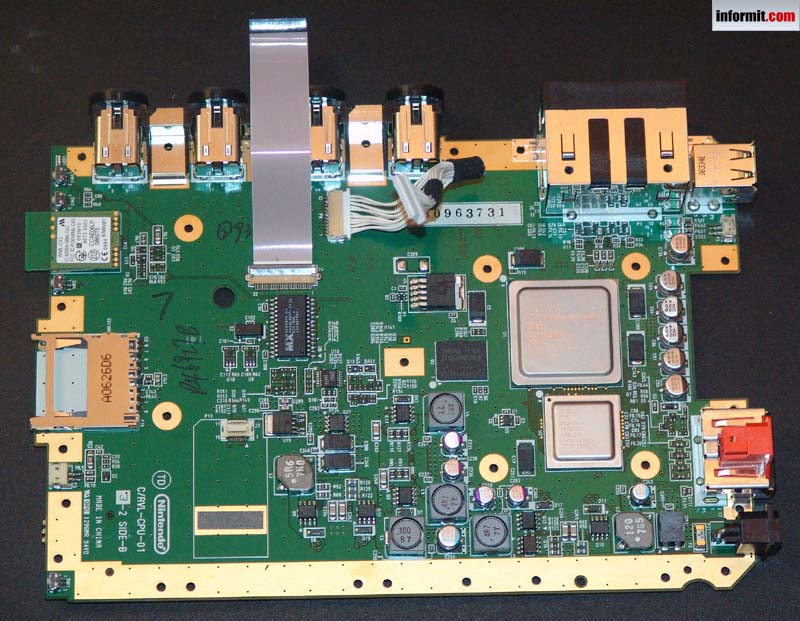
- Microsoft XBox 360 disassembled
- Sony Playstation 3 disassembled
- Nintendo Wii disassembled (OK, you already had that one
And for those who don't have time, motherboards photos : - Microsoft XBox 360 disassembled
-
Links for all consolesWhere are the "related stories" ?
- Microsoft XBox 360 disassembled
- Sony Playstation 3 disassembled
- Nintendo Wii disassembled (OK, you already had that one
And for those who don't have time, motherboards photos : - Microsoft XBox 360 disassembled
-
Look at the "revolutionary" technology
http://www.informit.com/content/images/art_fogie_
i nsidewii/elementLinks/wiifig26.jpg
Image from inside the motion sensor, i now see why it was codenamed the "revolution", i can imagine it took them many many years of research and development to come up with that! -
Re:The Only Winning Move
This article discusses how to design a game where a human has an intrinsic advantage over a computer player. (Forgot to press preview last time).
-
Memory "leak" (was: Re:The 9 Reasons)
5). Memory leak: I often run Firefoxes for a whole week long. Yes, you read that correctly. I often just leave important links open when I leave work, then I login back from home and continue useing it, then again tomorrow from work, and so on. After a week it often eats up around half a gigs of memory, true. But really, how many of you do such things ?
Sorry, I'm gonna rant now
What, a whole week? My computer (running Ubuntu 6.06LTS) is up all the time. Basically it goes down when there's a power cut. Current uptime is 55 days (reflects the fact that I moved house 55 days ago). X hasn't been restarted in all that time.
Why does Firefox need so much memory to display a few web pages? And why doesn't it at the very least return the memory when I, say, close all but one web page? I mean, I know C++ is an awful computing language to write anything in, and modern languages have garbage collectors, but still there's enough memory checking tools out there so they can catch these memory leaks by now.
Or is it a misguided attempt to "cache" stuff in memory, which is about the stupidist thing you can do given that today memory is very slow versus processors, so usually it's faster just to recompute what you need when it's needed. Typical C++ programmers wouldn't know that though - they're still reimplementing reference counting on every one of their classes, when a central, optimized garbage collector would be a lot faster.
/rant over
Rich.
-
Re:Or...
The Wall Street Journal has (had?) a "Dartboard" feature in which they did just this, then compared the picks to choices made by analysts. Depending on the time-frame you're looking at, just random choices seem to give the analysts a run for their money, as it were.
-
Also amazingly easy with ARD v. 2
Easy even with the older ARD v.2 - just send the unix command "softwareupdate -i -a" to the workstations in question, and they will automatically download and install all needed updates.
Best of all, schedule it to wake the workstations at 3:00 a.m., download and install the updates, restart the machines, and put them back to sleep or turn them off. Easy as pie with Apple Remote Desktop and scheduled scripting.
For more: http://macenterprise.org/content/view/117/140/
http://www.informit.com/articles/article.asp?p=445 094&seqNum=4&rl=1 -
Re:Cool hack, but who cares...
So what, this is still only brute force attacks.
What about vulnerabilities, according to:
http://www.informit.com/articles/article.asp?p=369 221&rl=1
- One flaw allowed an attacker to cause a denial-of-service attack, if the attacker could bypass several other layers of protection.
-A second flaw exists in the method with which WPA initializes its encryption scheme. Consequently, it's actually easier to crack WPA than it is to crack WEP.
Now, IS WPA more secure than WEP?
Is it possible to have Secure WIFI network without the big WPA2-Enterprise? (Certificate from cisco and such?) -
Re:Encryption level?
FYI that is not particularly secure (read the sections under wireless packet sniffers).
After that you can use SMAC to spoof the MAC sddress of your card. -
Re:What has changed? What should we change?
Erlang is a good example of a language designed for concurrency. It has process creation and message passing primitives in the language, and scales incredibly well (I've used it for deploying code on a large SMP box and a cluster).
-
Single Page Version of the Article
Here's a print view of the article so that you don't have to keep moving through the pages. Despite that annoyance, it was a good article. I wish there had been more concrete examples though.
-
Boycott Google ;-)
Friends, remember that Google is the America hating empire.
This new wave of innovation probably uses Linux (created by a European communist) with a sordid history. No doubt this is part of an insiduous plot to destroy the valuable patents of The Sco Group.
Their so-called "inventions" have already led to a huge upturn in hacking, eponymously named "Google Hacking". All true patriots must support tougher sentences for such evil terrorists. -
Re:How about Word?
How do you turn on automatic word wrapping in a tabular block?
You define the column as a p, followed by the width in braces; for example, p{1.25in}.
Lamport's LaTeX: A Document Preparation Manual still has one of the best summaries of basic LaTeX commands. For math, Gratzer's Math into LaTeX is an excellent book. Kopka and Daly's Guide to LaTeX is also well spoken of.
Gratzer also has a new book, The LaTeX Book , in preparation.
And, of course, there's lots of free documentation, as well.
-
Re:How about Word?
How do you turn on automatic word wrapping in a tabular block?
You define the column as a p, followed by the width in braces; for example, p{1.25in}.
Lamport's LaTeX: A Document Preparation Manual still has one of the best summaries of basic LaTeX commands. For math, Gratzer's Math into LaTeX is an excellent book. Kopka and Daly's Guide to LaTeX is also well spoken of.
Gratzer also has a new book, The LaTeX Book , in preparation.
And, of course, there's lots of free documentation, as well.
-
Re: C++ is bad? Move to Java or C# !Majority of native-language development is still done in C++.
I agree with Animats that C++ si full of security holes - the lack of checks is what gives C++ the 'native speed'.
But after some years of dealing with C++ memory leaks, buffer overflows, smart pointers going dumb, incomprehensible templates,
code which compiles but does nothing (see below), you want change. More C++ rants here and here.
And now Bjarne Stroustrup wants to create another version C++09? That's just wrong.
My suggestion: Think about moving.
Move to Java via http://jazillian.com/trial.html,
or translate your code to C# on code2code.net.
Disclaimer: code2code is my web site.
PS. Example of code that compiles with GCC and microsoft's CL.EXE but never does what it seems to do -
It never calls fct2():int fct1();
int fct2();
int main()
{
int x = fct1(), fct2();
} -
Re:back to school
Perhaps at private universities. Don't count on it at state schools.
I work at a small(er) state university in the midwest. University management (in part driven by IT managers without IT backgrounds) decided it was time to replace all of our in-house systems with an ERP (name has six letters). This implementation has all the classic marks of a death march - time, staffing and resources substantially below needed levels and expectations/complexity well above what the time/staffing/resources can support. Add to this the that the IT staff was thrown at this new environment (unix and oracle) after years on mainframe/3270 development, and were tasked with OJT as they had to learn SQL AS they implemented. Also, IT management has this "big reorg" scheme coming out the next couple of weeks that few people have confidence will do anything but shuffle people, tasks, job descriptions or money
Add to this a poisonous labor atmosphere (TWO bargaining units were on concurrent strike last summer) and an early retirement buyout that is leading to major brain-drain on this project (two key people have retired, one is about to, and one has resigned), and a lack of user confidence and/or buy-in. We're circling the drain.
Dilbert cartoon posts show up regularly in the break room along with comments appended about how it fits a current project, the ERP implementation, management, etc.
I take little consolation in hearing that the sister institution 45 minutes up the road is doing like we are, but slower, and maybe with some hope there. Same ERP, incidentally, and some of the death march aspects seem to be driven by that vendor's implementation process.
Doug -
LOL - You Effing N00B!!!!
Security is not a problem - WPA is a piece of cake to set up and (as yet) unbroken.
LOL!!! You fucking n00b!!! WPA was cracked over a year ago and it is even easier to crack than WEP. Here are detailed instructions for cracking WPA. I'll refrain from posting the video demonstration of the crack. You're just too ignorant to realize that you have been pwned from the beginning. Thanks for letting me send 1.52 jiggazillion spam emails from your open (I mean Goatse, wide-ass open) network. -
Re:dont really understand the problem.
Exactly. If you essentially have only one authentication to get into ALL your machines, then anything compromised includes your entire network.
It's interesting that this site is sponsored by Microsoft:
http://www.informit.com/ -
Re:Oh, but we know...
Oh, but we know that Microsoft will be on top of the game. For sure. Absolutely. Windows 2050 will be THE safest, THE most secure version of Windows yet.
I was really surprised to see someone arguing that Windows does kernel security really well, and that the problem is that people don't want a detailed permissions control system so at all levels they enable everything. But they've provided a good security architecture as far as thread control goes -- it's just that coders down the line are ignoring it.
Of course, how many of those 'down-the-line coders' are at Microsoft itself? -
Re:Only OpenBSD supported my wireless cardSee this article:
In OpenBSD, the UNIX manual pages are considered authoritative. If a program or function call does not behave exactly as the manual describes, this is considered a bug. This is reflected in the development process, which does not allow any code that result in a user-visible change to be committed to the tree without an accompanying update to the documentation.
So if something in the base install does not work as documented, report it. Bug reporting instructions are here. -
Re:Not to disagree with you...
This article, covering the release of 3.9 includes some discussion of the ways in which users of other operating systems benefit from the continued health of the OpenBSD project, including the views of one of the OpenBSD devs.
-
Re:Just use a modern language
Try this article on C++ and 64 bit coding..
http://www.informit.com/guides/content.asp?g=cplus plus&seqNum=201&rl=1 -
yes, you are the only one...Actually, I spent $99 on a Palm Zire 31 a few months ago. On it are 108 e-books (for SF readers, Baen Books sells their SF in Palm format e-books) as well, a few digital tracks, images, and the notes I take. I'm sure I'll fill up the other 900 megs on the SD card sooner or later.
As for which is most useful for me, it's a tossup between the ability to stick an entire library in my pocket and the ability to take notes that not only do I not have to decipher afterwards, but sync them straight into my Linux box. Unfortunately, Informit hasn't published my how-to article yet, all I can say is to check the site every few days, it should be out Real Soon Now.
Plus, of course, if it is one of those middle-of-the-night inspirations, I don't have to turn on a light and look for a pen and paper, just grab the PDA and start writing on the display with my fingernail. Try and do that with a 'smart' cellphone.
-
Start Reading From the Description
Start reading from the description of what actually happened, that is the interesting part of the article.
-
Re:Ten things they should fixNot really. His complaint actually seems to be there are places where an admin prompt is needed, but no such prompt is offered. This is true in WinXP as well. Only
It does seems somewhat in contradiction to his Nagging dialogue box complaint, although I will agree that too many prompts are an annoyance. The first time I tried WinXP, I immediately googled how to turn off balloon dialogues via the registry... there is no checkbox or control panel setting for this. XP's balloons are far far more annoying than any OSX dialogue prompt, at least those are in response to user action.
I haven't tried OSX, but I wish the rough edges in Windows were this smooth.
-
Re:Ten things they should fix
Erm, do you agree with this one? (Granted, this is something from the original article and not "Ten More...", but still.) I suppose if he's asking for admin login prompts whenever there's a permissions issue, that's not a bad idea, but he almost seems to be recommending the painfully insane "run everyone as admin" option.
-
Ten things they should fix
somebody made a list about ten things that don't work as well as they should (and as a mac admin I agree) : Ten More Things I Hate About Mac OS X
-
Re:Obvious
-
Re:Obvious
-
Re:IT'S NOT A WORM!
Actually it is a worm. Virus infects files. Worms spreads copies of itself. Hence: mass-mailing worm is correct. Network worms are typically the ones that exploit a software vulnerability to spread, IM, P2P and email worms don't. http://www.informit.com/guides/printerfriendly.as
p ?g=security&seqNum=23 -
Re:Just Work (TM)
Security on a home netowrk doesn't really interest me.
I know - thats why I'm posting this from your home PC.
I'd like to be able to "just share" the files without setting up users etc, etc.
Just post your requirements here I'll set them up for you... after all I don't want your home net to be locked down
Seriously - just because you would like software to be shipped insecure (and easy) by default doesn't mean that it should be. Have a look at this guide - Samba-3: A Simple Anonymous Read-Write Server -
C++ detractors unified
What I find amazing about the group of C++ detractors as a whole is how rarely I comprehend the claims put forward about the vaguely defined desirable language ~C++.
I think "you don't pay for what you don't use" is a fundamental design flaw of the language.
What is the precise claim here? That the entire language niche of pay-as-you-play languages should have remained empty? That C++ was the wrong language to occupy this niche? That there is a finite set of everyone-pays-all-the-time features that could have been added to C++ without compromising the language's scope or applicability? That any two people asked to write down such a list would produce a non-empty intersection?
Pay-as-you-play enables compositionality: the very idea that libraries like Boost can exist and be 90% as effective as if those same features had been designed into the language. It's the 10% that Boost doesn't achieve that gets folded back into the core language.
One guy was ranting that the true test of cohones is what the designer removes from the language, while another long post was devoted to a laundry list of "how could this language not have all these kitchen sinks so late in the day?" Which is it? You can't have minimalism in all places all of the time. Minimalism to the compiler vendor is a different beast than minimalism to the end user.
Ada had generics in 1983. Yada yada yada. What do you get when you start with a clean slate in 1995?
Does it thrill Marc Andreessen?
http://news.com.com/Andreessen+PHP+succeeding+wher e+Java+isnt/2100-1012_3-5903187.html
"Java is much more programmer-friendly than C or C++, or was for a few years there until they made just as complicated. It's become arguably even harder to learn than C++," Andreessen said. And the mantle of simplicity is being passed on: "PHP is such is an easier environment to develop in than Java."
Does it thrill Miguel de Icaza?
http://www.builderau.com.au/program/work/0,3902465 0,39129961,00.htm
The problem with J2EE really is that it became very, very academic and the complexity of all these perfectly designed systems in schools does not necessarily map when you have deadlines and all kinds of other things.
http://www.informit.com/guides/content.asp?g=cplus plus&seqNum=200&rl=1
When Java designers decided to disallow operator overloading, they cited C++ as an example of the inherent woes of this feature. As usual, they got it wrong, which is why operator overloading is slowly but surely creeping into Java just as generics recently did.
Does it thrill Sun insiders?
http://idevnews.com/CaseStudies.asp?ID=170
Peter Yared, former CTO for Sun J2EE app server unit says Java/J2EE may lose out to Open Source technologies in the future, as IT managers are architects get tired of the time and cost of building in Java.
The sad fact is that few of the C++ detractors out there could do any better than Java, and Java didn't hit its own sweet spot any better than C++ mapped to its own misbegotten design criteria. -
Placements will get worse
Companies are already looking to place products in reruns of older shows, going as far as to insert digial products. Video-technology company Princeton Video Image has for years used digital imaging to insert virtual first-down lines (with corporate logos) in football games and completely photorealistic but nonexistent "signs" behind home plate at baseball games. Now it wants to move into reruns, with technology that can seamlessly insert 3-D objects into video footage-a Pepsi on a desktop, a Lexus at a curbside, a box of Tide on a countertop-where there was nothing before. PVI is negotiating to do placements in reruns of Law & Order and hopes to strike deals with other syndicators and even first-run shows. "You could sell a box of cereal in the kitchen one [airing]," says PVI vice president Paul Slagle, "and dish soap in the next." PVI's Holy Grail: customizing insertions using interactive-TV technology-which is still distant and speculative-that would store viewer information (demographic details, even interactive purchases) as Web browsers do. Your TV would figure, Slagle says, "whether you're riper for a Cadillac or a Saturn." http://www.time.com/time/pacific/magazine/2001062
5 /tv.html
Also the whole Tivo increasing product placemnet is nothing new. Here are a few articles from as far back as 2001:
http://www.cnn.com/2003/SHOWBIZ/TV/02/18/apontv.ad s.everywhere.ap/
http://webserve.govst.edu/users/ghrank/Advertising /Pitch/1-hi/product_placing.htm
http://www.business2.com/b2/web/articles/0,17863,5 29039,00.html
http://www.informit.com/articles/article.asp?p=176 457&seqNum=2
http://www.commondreams.org/headlines05/0124-02.ht m
And here is Buisness Week's product placment hall of fame from 1998: http://www.businessweek.com/1998/25/b3583062.htm -
Re:Linux will never progress very far
Back when it was designed there was no such thing as fast links... and the slow links we have now are faster than the fastest links they had then.
X works over slow lines... it just needs very very very low lancty, read this to see why it sucks.
it is time we work on something better. -
Here's one with FreeBSD
It's not a study, but here's an article that talks about Windows vs. Linux. vs. FreeBSD in a datacenter situation.
-
Re:Legal issues?
-
Re:Why Imaging? I Second Unattended
I have also used the unattended project extensively at a hosting company with around approx 5,000 servers.
I simply PXE booted the box, and on the menu I had something like this
1) Install RHEL3
2) Install FC3
3) Install W2K
4) Install W2K3
Select the # and whala. Your OS choice installed! (Of course I also had options in the PXE boot menu for custom installs for all the OS's) unattended can also use mysql/CSV to keep a list of various software packages to install on machines based on the MAC address.
Works over serial console/LOM cards, and if your doing that I hightly recommend enabling EMS/SAC (out of band) on Windows, it's like having a crippled console! It lets you do simple things, like change IP, reboot the server, and load a command prompt. Supposedly SAC is always available even if the box BSOD's.
Unattended is a really great project, unfortunately it has a little bit of a learning curve to get it 100% right.
EMS/SAC http://www.informit.com/articles/article.asp?p=174 352&seqNum=3&rl=1
Unattended http://unattended.sourceforge.net/ -
Re:Money in support??The problem with the grandparent poster is that it did not adequately explain what is meant by `support.' If `support' is defined as meaning answering telephones and helping customers do things, then this is not a good thing to be funding development. If `support' means adding new features, fixing bugs, and general customisation, then it sounds like exactly what you are qualified for.
Most off-the-shelf software doesn't fit the needs of the customers 100%. With proprietary software, customisation (support) has to be done via things like VBA. With F/OSS, it can be done by adding features directly to the code base. Whether you get paid by a single customer wanting a new feature, or a consortium of customers wanting a feature (but individually willing to pay less) depends on the business model you adopt.
See here for a more detailed explanation.
-
What does the legal dept say about MS Windows?
Funny but true. However, a lot of "IT" stuff falls between the cracks. Ongoing security problems aside, take for example, Windows XP >=SP1 and 2000 >= SP3, which grant remote admin rights to MS or its designated representative (or whoever can figure out how to crack or social engineer that same level of access). Those are full admin rights and are not only the ability to mess with programs and configurations, but also to rummage around in data files and their contents.The maintenance staff (e.g. sysadmins) write it off saying that's a problem for the legal dept and the legal dept dismisses it as "an IT issue". And all the while neither group is addressing the problem, people outside your business have access to your businesses data. It's not just businesses which would have legal issues with a system designed to give third party access to company data, university researchers often collaborate closely with industry and sign very serious non-disclosure agreements assuring explicitly that the contents (and sometimes even the nature) of the research will not be disclosed by outsiders.
Isn't third party access, whether spyware or not, implicitly condoned already? If it weren't then legal departments all over would be making a big deal about remote access. I suppose it's more likely, however, that no one in a position of authority actually reads either the licensing agreement or the functional specifications, assuming either are actually available.
-
Re:This sort of thing...
Here are some press releases from the DOJ on some cases
http://www.usdoj.gov/criminal/cybercrime/thornton. htm
http://www.usdoj.gov/criminal/cybercrime/thornton. htm
http://www.informit.com/articles/article.asp?p=169 520&rl=1
I agree with your second point, but common usage says otherwise. The term copyright theft has a public usage and definition which is different from the legal terms used. You can see examples of it usage in everything from media to the organization fighting for thier IP rights even to the organization fighting the previous groups. -
Re:Anyone who saysYou, sir, are ignorant. Being about to choose a CMYK color in the color picker means nothing; the GIMP converts those values into the RGB colorspace when you use them in an image. Look in the menus: Image > Mode. You will see RGB, Grayscale, and Indexed. CMYK is not an option.
No one said the GIMP doesn't have layers; the grandparent said that it doesn't have layer effects, which is most certainly true.
-
Re:Too badAnd in order to make a GUI test, it's hard to think of the logistics. How exactly is it wrong if a control is one pixel down, or if it doesn't use the right layout
The parent is referring to a GUI to run the tests, not a test to test a GUI.
-
Ruby resources
Heh, well, no offense but, people that use to reply like you haven't tried Ruby, or don't understand it. Otherwise you would be in love with it already.
We cannot compare PHP and Ruby. It's like comparing BASIC and Perl, you get the idea. Remember when you discovered Perl and all its magic? Well, that's what happens when you get into Ruby. It's a true object oriented and dynamic language ready for real applications.
This might or not make sense to you. It depends on the use you are giving to your language of choice. If you write one-liners in Perl, you might not feel motivated to move to Ruby. If you are writing templates in PHP for your web applications and you're doing fine, you might not need Ruby either.
You see the light
Ok, I have fallen again in the "I love Ruby so much" that gets you so bored. So, here is some homework for you (some very nice presentations and small articles):
Ruby: A transparent, object-oriented programming language
10 Things Every Java Programmer Should Know About Ruby
The Ruby Programming Language (by Matz, Ruby's author)
Thirty-seven reasons I love Ruby
Blocks and closures in Ruby -
Re:Google Hacking?
Johnny Long did a mini guide to hacking google.
-
Re:6 words (and a comma): APK REPLY #4
Perhaps you can live without those apps, others cannot.
E.G.-> Active Directory & others like it (e.g. NDS on Novell) are excellent features!
Makes administration on HUGE networks much simpler!
E.G.=> By comparison to older NT-model domains? I will take NDS style or AD style mgt. anytime... I am sure most network techs/admins WILL agree here on that account!
I also cite the fact that systrace is an opening into an OS you claim is impenetrable first of all:
You seem to have missed the fact an attacker could leverage systrace vulnerabilities on OpenBSD to this day, or you refuse to admit your OS of choice is open to attack though you SAID it's "impenetrable":
http://www.informit.com/articles/article.asp?p=363 731&seqNum=7&rl=1 [informit.com]
"Second, system calls have no exclusive or. For example, an application might be permitted to open a file or a device, but not both.
This weakness could ultimately be leveraged by an attacker who seeks to do more than a program was intended to do."
Now, THAT? Is an "admission of failure" via evasion & selective quoting... lol, I am getting that last laff here & I know it. So will anyone else reading this! Folks here can read you know!
And you brush aside the fact that OpenBSD does not run as much software, right there in your list above (and that's only a fraction of what is possible) which users use to do various tasks &/or jobs!
Plus, OpenBSD doesn't run a fraction of what Windows Server 2003 can in peripheral hardwares!
I guess in your world, horses & buggies are still superior to HumVees for example... lol!
APK
P.S.=> I think that, due to your viewpoint vs. my own (I suppose yours has merit in your point of view but I hope you can say the same of my own)? We will "have to agree to disagree" etc./et all... apk -
Re:highly anticipated?
My metric?
Is that OpenBSD runs less peripheral hardwares and softwares by FAR vs. Windows Server 2003 and thus, it does less. Newsflash: An operating system is a platform upon which end users get tasks done. If they use various hardwares (peripherals) to do so and Windows Server 2003 does the job, & OpenBSD doesn't with said hardwares?
Which is the superior OS??
The one that runs less of those said peripheral hardwares (OpenBSD, and it sure is "open" alright & not 'impenetrable' as I showed how systrace could be exploited STILL in it) OR the OS that runs more in the way of hardwares out there (Windwos Server 2003) for jobs end users do?
After all - an OS? Is a platform, that's all, upon which end-users do jobs on for work... with softwares as well for said tasks & there's NO QUESTION Windows Server 2003 provides more of that as well.
You seem to think that horses & buggies are better than HumVees then I take it?
Apparently, hardware makers don't see OpenBSD as a viable platform. Thus, they don't build drivers for it... no monetary incentive probably!
APK
P.S.=> You missed the fact an attacker could leverage systrace vulnerabilities on OpenBSD to this day:
http://www.informit.com/articles/article.asp?p=363 731&seqNum=7&rl=1 [informit.com]
"Second, system calls have no exclusive or. For example, an application might be permitted to open a file or a device, but not both. This weakness could ultimately be leveraged by an attacker who seeks to do more than a program was intended to do."
So much for your touting an less versatile (with peripheral hardware & software out there) as superior, and for touting OpenBSD as impenetrable... More holes like that come out ALL the time too, & for ALL Os'...
In fact, in ths quote from you, after I had to point out a zillion holes in your supposedly IMPENETRABLE and no need to secure it at all OS, OpenBSD!
---
"but you are right, nothing is 100%"
---
Damn right I am, because my man, I truly DO KNOW that no OS is currently perfectly secure, & so do you... which is why I could not understand your first reply to me! I was showing others how to make Windows more secure, & you busted on me for it! apk -
Re:6 words (and a comma): APK REPLY
"some of us call that a feature" - DrSkwid (118965) on Monday July 11, @11:30AM
Most won't! I know I wouldn't & neither would the 90% of the world's computers running Windows based Os either: versatility is why! You also said:
"Give it up, or I'll go Plan9 on you" - DrSkwid (118965) on Monday July 11, @11:30AM
Well, then I'd go DOS on you! LOL... since you think that having less versatility is a feature!
(Horses & buggies vs. automobiles anyone?)
Hell, And? You JUST DID basically give up man!
First, You're avoiding points I made:
Especially saying being limited as OpenBSD is by comparison to Windows Server 2003, is a feature?
Yea right! (sarcasm)
Newflash - Operating Systems? They're platforms for hardwares & softwares, for jobs or purposes the end user has. Being less functional or less ubiquitous/versatile is NOT a feature, it's an inferiority. In essence, you're saying "a cripple makes a better sprinter"... great logic that! NOT!
OpenBSD's a limited OS by comparison to Windows Server 2003 featureset-wise and moreso in WIndows' wealth of surrounding softwares and hardwares it runs! OpenBSD's truly LIMITED, & thus? Not as good.
Heck, I don't even HAVE to argue this anymore with you:
You also only now (only after I point out a truckload of them) also already admitted there's holes in OpenBSD, especially remote ones!
Though I point out others which you avoided, you admitted this:
"but you are right, nothing is 100%" - DrSkwid (118965) on Monday July 11, @11:30AM
OpenBSD has holes/vulnerabilities, ones I pointed out that existed both in the past AND presently:
---
http://www.informit.com/articles/article.asp?p=363 731&seqNum=7&rl=1
"Despite its many features, systrace has a number of limitations that bear mentioning. First, it lacks a facility to specify that you can permit once for a system call, such as binding to a socket. This can allow an attacker to recycle a system call, potentially at elevated privilege.
Second, system calls have no exclusive or. For example, an application might be permitted to open a file or a device, but not both. This weakness could ultimately be leveraged by an attacker who seeks to do more than a program was intended to do.
Lastly, the parent process has no control over spawned processes. For example, if you allow
---
More come out ALL the time too, & for ALL Os'...
In fact, in ths quote from you, after I had to point out a zillion holes in your supposedly IMPENETRABLE and no need to secure it at all OS, OpenBSD!
---
"but you are right, nothing is 100%"
---
Damn right I am, because my man, I truly DO KNOW that no OS is currently perfectly secure, & so do you... which is why I could not understand your first reply to me! I was showing others how to make Windows more secure, & you busted on me for it!
In fact, In reply to that from you? I also pointed out several exploits that are currently STILL there on OpenBSD that are ways, or potential ways into it. And, if I could NOT get in, or got impatient? I'd just freeze the damn thing dead.
You asked for "metrics" in your other reply?
http://slashdot.org/comments.pl?sid=155314&op=Repl y&threshold=-1&commentsort=0&tid=201&mode=thread&p id=13033258
Date: Jan 28, 2005.