Slashdot Mirror
Domain: irtc.org
Stories and comments across the archive that link to irtc.org.
Comments · 50
-
Renderfarm
Well, I wouldn't do this for money, because I'm not that kind of guy... but I'd burn a bunch of ClusterKNOPPIX CDs / DVDs (or whatever the useful equivalent is nowadays) and have them work on cranking out HD videos of winners of the past Internet Raytracing Competitions from the past decade or so.
-
Re:AND...it doesn't produce realistic images!
Really? And that's from 2000. Check out their more recent galleries for some realistic (and some not so realistic) images.
-
Re:Commoditization of ArtRight. Any clod with photoshop can retouch a photograph that very few will be able to tell was photoshopped - and also will be able to convey a message. Movies? Not a problem, the same clod can retouch Star Wars into Star Wars - The Special Edition over a long weekend. Oh, wait...
Outsourcing your work to a team of digital artists to polish up your vision is not my idea of artistry. There's some respect to be paid for the director who, apart from adding sound effects and rearranging scenes, is directly responsible for what's on the developed film.
In my mind, there's a world of difference between Lucas being behind the camera and shooting/directing the same scene in Star Wars over and over again until it's visually perfect and him shooting a scene of Ewan McGregor in front of a green screen and dumping the rest on the ILM team. I view the former as a complete art form on Lucas's part, while the latter isn't.
That doesn't mean that those who do the digital work aren't artists in their own right. I've followed the IRTC for years, and the good scenes are indeed works of art.
Another example. While I appreciate the digital eye candy of Star Wars: 1-3, I don't think they hold a candle to the *artwork* of Episodes 4-6. One example I always trot out is the asteroid flight/fight scenes in Empire vs Clones. The flight of the Millennium Falcon through the asteroids in Empire made me sway in my seat when I watched it on the big screen as a kid. The scene with Obi-Wan and Fett in Clones had nowhere near the same impact, though it may have been visually more "clean".
And of course being twenty years older and having been jaded by twenty years of ever more sophisticated SFX and CGI has nothing to do with it. Again, your glasses have a distinct rose tint.
No, the fact that the asteroids and ships, while not "real" in Empire, were physical objects being filmed had more to do with it. For whatever reason, my brain was faked out enough by real photos of real objects, but it was not by a similar CG scene.
-
Who uses this stuff?-IRTC
"The question is, is there really anybody out there who needs to do this and doesn't have their own hardware? "
http://www.irtc.org/
Next question? -
POVRay
I wonder how long it would take for someone to port the POVRay engine to Sun's grid? At $1 per CPU/hour, this could be a boon for amatuer 3D graphics designers and the Internet Ray Tracing competitors. Use low res renders during testing, then pay Sun $25 to get your high quality result back in 20 minutes rather than the next day. Could be a lot of fun.
Can anyone think of other good uses for the average (or not so average) home user? Perhaps new image compression formats that rely on Sun's Grid to get the best compression/quality tradeoffs through brute-force power? -
Thanks!!!
Thanks. After the second message where someone said this was Matrix, I looked closer. That category icon I always thought was a red-and-blue pacifier was actually Morpheus' magic beans!
-
Re:Also of interest....
And where's the International Raytracing Competition? They have animations as well and often source code is provided with the image.
-
Re:Interesting...
Irrigation?
I think you meant this IRTC. -
Better
I always liked this better http://www.irtc.org/ It has a little more than POVRay, but its MOSTLY POVRay
-
Raytracing at its best
-
Raytracing at its best
-
Thank goodness
-
Re:But your honor...
Uhh... if the only copy of their data is a website somewhere, then they're idiots (albeit Real Men). So the feds have confiscated their backups; restore from the originals (or, in the case of web-sourced data, mirrors that they should regularly / continuously take). There's no excuse for relying on a provider for anything more than connectivity; if you need more than that (in terms of security, for example) you ought to be your own provider.
-
Re:POV-Ray is for the Hardcore!
-
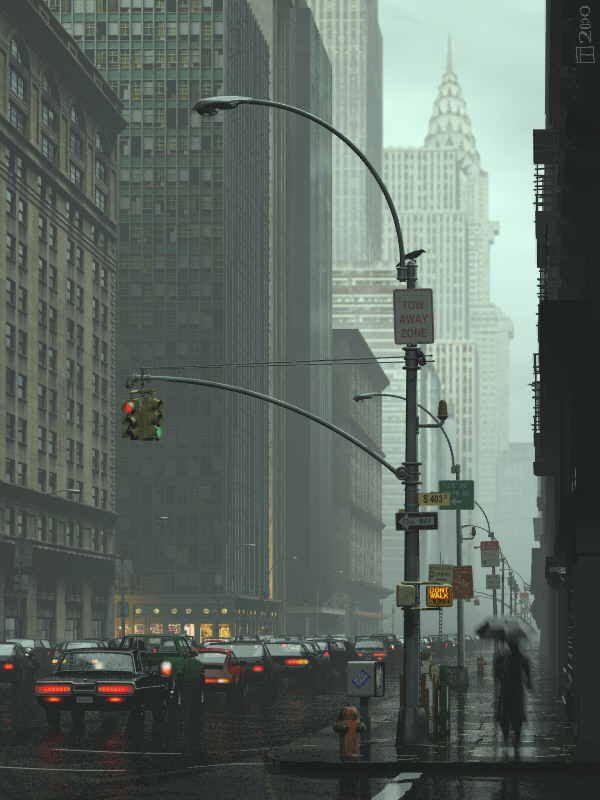
Not photo-free, though.Ive seen this image. It's great. I never saw accusations of the entire image being a photograph, the comments were more like
"What city did you take this photograph in? (:"
The author, however, describes the process here, and you soon realize that many photographs were as texture maps to make it.
Not that any of this diminishes the artistic and technical ability of the author to 'put it all together' and produce an excellent image. If I could be so talented.
...The first building on the left is derived from pictures I took from a real one in New York. It is pure CSG (with some help of my windows macro), textured with an image map painted directly on an orthographic view of the model. The second building on the left is made of a CSG frame textured with 30 different small image maps of windows and wall panes (scanned from a photo)...
...The street lamps and traffic lights are a mix of CSG constructs and sPatch models. The shapes, sizes and proportions were (clumsily) derived from several detailed photos. The "Don't walk" image is a photo of the real thing. The signs are photos of real NYC signs, heavily retouched and sometimes
rewritten... -
Not photo-free, though.Ive seen this image. It's great. I never saw accusations of the entire image being a photograph, the comments were more like
"What city did you take this photograph in? (:"
The author, however, describes the process here, and you soon realize that many photographs were as texture maps to make it.
Not that any of this diminishes the artistic and technical ability of the author to 'put it all together' and produce an excellent image. If I could be so talented.
...The first building on the left is derived from pictures I took from a real one in New York. It is pure CSG (with some help of my windows macro), textured with an image map painted directly on an orthographic view of the model. The second building on the left is made of a CSG frame textured with 30 different small image maps of windows and wall panes (scanned from a photo)...
...The street lamps and traffic lights are a mix of CSG constructs and sPatch models. The shapes, sizes and proportions were (clumsily) derived from several detailed photos. The "Don't walk" image is a photo of the real thing. The signs are photos of real NYC signs, heavily retouched and sometimes
rewritten... -
Also check out...
Also check out http://www.irtc.org/.
Internet Ray Tracing Competition -
Re:"Pro" comparisonI think POV-Ray produces great output, however I would imagine that for professionals, it is probably not very good from the standpoint that, compared to commercial ray tracers, the time that must be invested to obtain a given output is probably much greater, typically, than for a commercial package. Still, images like this and this and even this inspire me to still tinker around with it.
Heck, POV-Ray was what inspired me (way back) to upgrade from that 386DX-33 to the 486DX2-66 with a 2 meg Diamond Viper VESA card so I could display 800x600 in 24 bit(!)
-
Re:"Pro" comparisonI think POV-Ray produces great output, however I would imagine that for professionals, it is probably not very good from the standpoint that, compared to commercial ray tracers, the time that must be invested to obtain a given output is probably much greater, typically, than for a commercial package. Still, images like this and this and even this inspire me to still tinker around with it.
Heck, POV-Ray was what inspired me (way back) to upgrade from that 386DX-33 to the 486DX2-66 with a 2 meg Diamond Viper VESA card so I could display 800x600 in 24 bit(!)
-
Re:"Pro" comparisonI think POV-Ray produces great output, however I would imagine that for professionals, it is probably not very good from the standpoint that, compared to commercial ray tracers, the time that must be invested to obtain a given output is probably much greater, typically, than for a commercial package. Still, images like this and this and even this inspire me to still tinker around with it.
Heck, POV-Ray was what inspired me (way back) to upgrade from that 386DX-33 to the 486DX2-66 with a 2 meg Diamond Viper VESA card so I could display 800x600 in 24 bit(!)
-
IRTCAlso, for those of you who want to see some examples of some quality (and not so quality) raytracing work, a lot of it down in POV Ray, check out the Internet Ray Tracing Competition over at www.irtc.org.
-
ObIRTC plug
No discussion of the excellent POV-Ray renderer would be complete without a mention of The Internet Ray-Tracing Competition, which is graciously sponsored by a member of the POV-Ray team. While POV-Ray would certainly exist without the IRTC, it is questionable whether the reverse is true.
On a personal note, I'd like to echo all of the positive comments about POV-Ray. Around 1988, I began writing my own ray-tracer, in Modula-2 of all things. But then I ran across POV-Ray on a BBS, and realized that I'd spend the rest of my life eating their dust and sniffing their butt fumes, so I dropped mine and have never regretted it. POV-Ray stands out among its kin--not perfect by any means, but excellent nevertheless.
-
Re:Great, for a free package
POV-Ray might not be suitable for, say, modelling, animating and rendering feature films
Actually... check out IRTC and the animation competition. I'm completely amazed by what one person can do with POVRay. Believe it or not, POVRay often makes animation *simple* because you can program it. -
Re:Soon...
No.
20 computers running.
You have one computer.
log(20)/log(2) * 1.5 yrs = ~6.5 yrs
A bit longer, if you want a full 75 fps (or 60, if we're all using LCDs in 7 years).
Plus, technically Moore's law relates to transistor count, not processing power.
I'm interested in when we can do this in a game in real-time. l(2hrs*3600secs/hr*60fps)/l(2) * 1.5yrs = 28 years before we see this in real-time (though that's using Pov-Ray, which could probably be sped up a lot if it's made into a game engine rather than a general purpose graphics architecture. -
Re:Help?
Someone put a lot of computers together to make a powerful distributed system that is capable of rendering Quake using ray-tracing.
Here is an example of a (not real time) raytraced image (one that doesn't use radiosity -- just straight raytracing). In theory, given enough CPU power, they could pull this off.
Ray-tracing uses a method of 3d rendering that is currently beyond dedicated 3d hardware and must be done in software.
The main benefits of ray-tracing from a quality perspective are:
* True, accurate shadows from *everything* (most games, even stuff like Neverwinter Nights have hackish shadow engines that don't realistically display what lighting would look like in real life. These are calculated in real-time, not the precalculated shadows that you'll see in, say, Quake, where the light sources never move. You could throw a flickering lantern across a bar with bottles falling down and have all the bottles cast their own shadows.
* Advanced lighting. Currently, real-time 3d engines are very limited in the types of light they can produce -- generally, only spherical point sources of light.
* Refraction. You can have glass, ooze, or water truly refract light and distort images, not just use some sorta-lame effect to vaguely approximate it. Think of looking through a glass lens or a window in an old house.
* Volumetric fog (where you have "clumps" or "clouds" of fog, rather than just a global constant flag fog covering everything). Quake 3 had some rather (IMHO) impressive hacks to emulate volumetric fog -- ray tracing allows *true* volumetric fog -- people vanishing in swirling clouds of fog and mist and the like, not just a straight visibility dropoff.
* Reflections (there are a lot of hacks to approximate this off with existing 3d engines), but raytracers are *made* for this sort of thing.
* True curved and arbitrarily-shaped surfaces.
* Light projections (with shadowing and all that). They show a bit of this in the demo -- you could have, say, two people having a swordfight in a theater and the picture washing over them, or a scene in a church, with dusty light from the stained glass windows washing over the characters.
Basic ray-tracing does have some flaws. The shadows are sharp and hard -- sharper and harder than in real life. There are hacks to do soft shadows, but there isn't a particularly good an efficient way to pull them off.
It's hard to deal with things like laser beams or light beams coming out of a prism in ray-tracing. You need to do forward raytracing/photon mapping for this, which I suspect that they aren't doing.
Ray tracers tend to look a bit "eerie", for lack of a better word. They tend to leave shadowed areas very dark -- in real life, light will bounce around in corners and things a bit (even surfaces that don't look "reflective" to us will do so). So if I shine a flashlight, a raytracer will show a perfectly accurate cone of light (unlike existing 3d engines) that will spill properly over all surfaces. However, that cone of light will be a *cone* -- normally, when I shine a flashlight in a room, it lights up the entire side to some degree because of light bouncing off of objects.
There are some really nice things about ray tracers. They tend to parallelize really well, so you can theoretically put lots of computers together to do renders (as these folks did), or have lots of chips in parallel to theoretically make a custom piece of hardware. -
Re:Sure, it *seems* like a good idea...
Makes me think of this little movie..
-
Re:Matrix reloaded AVIs ain't what you think
I guess I'll just go the theater to see it.
I wouldn't bother if I were you. The movie sucked. It wasn't nearly as good as the first one. It looks like the marketing people decided what to put in it. "Let's put in some porn, but we'll have to downgrade it so we can get an R rating. Then we'll add some karate moves and special effects, and we're done!"
In fact, just watch a porn movie, a kung-fu movie, and some computer generated images. You'll be much more satisfied.
-
Obligatory POV-Ray Reference!
Check this animation out from an old IRTC round.
http://www.irtc.org/ftp/pub/anims/2000-07-15/h20fa ll.mpg
(setting up a BT would nice for this so IRTC.ORG doesn't get bandwidth destroyed. I'd do it, but I should be really studying for final exams
Notes
http://www.irtc.org/ftp/pub/anims/2000-07-15/h20fa ll.txt
Comments
http://www.irtc.org/ftp/pub/anims/2000-07-15/comme nts/h20fall.comments
From here
http://www.irtc.org/anims/2000-07-15.html
All credit for the animation goes to Joe Wise. -
Obligatory POV-Ray Reference!
Check this animation out from an old IRTC round.
http://www.irtc.org/ftp/pub/anims/2000-07-15/h20fa ll.mpg
(setting up a BT would nice for this so IRTC.ORG doesn't get bandwidth destroyed. I'd do it, but I should be really studying for final exams
Notes
http://www.irtc.org/ftp/pub/anims/2000-07-15/h20fa ll.txt
Comments
http://www.irtc.org/ftp/pub/anims/2000-07-15/comme nts/h20fall.comments
From here
http://www.irtc.org/anims/2000-07-15.html
All credit for the animation goes to Joe Wise. -
Obligatory POV-Ray Reference!
Check this animation out from an old IRTC round.
http://www.irtc.org/ftp/pub/anims/2000-07-15/h20fa ll.mpg
(setting up a BT would nice for this so IRTC.ORG doesn't get bandwidth destroyed. I'd do it, but I should be really studying for final exams
Notes
http://www.irtc.org/ftp/pub/anims/2000-07-15/h20fa ll.txt
Comments
http://www.irtc.org/ftp/pub/anims/2000-07-15/comme nts/h20fall.comments
From here
http://www.irtc.org/anims/2000-07-15.html
All credit for the animation goes to Joe Wise. -
Obligatory POV-Ray Reference!
Check this animation out from an old IRTC round.
http://www.irtc.org/ftp/pub/anims/2000-07-15/h20fa ll.mpg
(setting up a BT would nice for this so IRTC.ORG doesn't get bandwidth destroyed. I'd do it, but I should be really studying for final exams
Notes
http://www.irtc.org/ftp/pub/anims/2000-07-15/h20fa ll.txt
Comments
http://www.irtc.org/ftp/pub/anims/2000-07-15/comme nts/h20fall.comments
From here
http://www.irtc.org/anims/2000-07-15.html
All credit for the animation goes to Joe Wise. -
Re:Forgive me if I disagree with CarmackWe haven't really reached the finish line until CG can effectively fool us into thinking we are looking at a photograph.
Well, in a few places, we have. Check out the Internet Ray Tracing Competition - some of those images certainly could have fooled me.
-
Re:POV-Ray
POV-Ray has a deathly slow renderer though.
I'm a big fan of POV-Ray, I've been using it since about a year after DKB-Trace. I started on a 386sx 40mhz, with 4mb of ram, so pretty much anything now seems 'fast' comparatively. It is pretty painfully slow if you're not used to it, though. Then again, it is free, has a lot of features (now), and nothing beats using the equation for a sphere when rendering a sphere....screw 18 billion triangles! It's really disgusting when you see an otherwise good render and notice that every curve is made up of discrete angles....ugh. As with many renderers, it's very easy to put the 'quality' options up way too high and spend an abnormally long time on a render. I admit, though, that I've spend 4+ days on renders with lots of AA and glass CSG objects...for a 1024x576 image. (Granted, on a 400mhz p2)If you're interested in comparing some renderers, check out the Internet Raytracing Competition (IRTC)
POV-Ray is good for a number of things, though I would recommend using a modeller if you plan on rendering anything 'organic'. (Defining bezier patches by hand, while possible, is not reccommended.) Animation support has come a little further lately, though mainly you're going to be rendering a number of stills with some computations in the scripts varying based on a clock value which gets passed in.
Oh, and here's one big advantage -- the source code is freely available! Hack to your hearts delight, just follow the rules if you plan to distribute. Binaries are available for a number of platforms, and the generic UNIX source should be fairly easy to compile. Note: If you're using IRIX, check out SGI's freeware site for a binary. I've had fairly good luck compiling it on Solaris, but I don't have the dev libraries for Irix so I use the precompiled version.
If anyone does end up using POV, please at least give a thought to donating a couple of bucks to them, I'm sure they could use it.
-
Re:povray's still the best
Really?
Looks
pretty good to me.
Sure, it's hard to compare a ray tracer and a scanline renderer, but with enough patience you can do amzingly beautiful things. -
Golf balls?
-
Golf balls?
-
Re:Let's see your ray traces
Go to www.irtc.org, where they have an ongoing raytracing competition. Not all of it is Povray, but alot of it is.
-
The submitter must never have seen POVray
While 3D hardware cards do a fine job of rendering with various textures, lighting,etc., they still in no match the subtle effects that are available in software renderers. The wonderful freeware renderer POVRAY knows or simulates about incidence-of-refraction, all sorts of shadows, media such as fog and fire and so on. Plus the ability to anti-alias
-
not near the same quality
The graph on that linked page seems very objective.
Cg quality is no where near to close the quality of modern ray traced images and movies. When Cg can produce an image like this , then maybe things will change. -
OT, but.. POV-Ray!I know this is off-topic, but I just thought I'd mention it. I just started playing with POV-Ray this summer, and I've discovered that it's a lot of fun! For those that don't know, POV-Ray is a freeware raytracer that's been around for years and years. This is in my opinion a truly incredible piece of free software. Here's why I think I love it so much: everything is programmed! It has a built-in macro scripting language. This is a Very Cool Thing. For the average Joe this is probably a major drawback, as GUI-oriented modelling makes many things far easier. Also, POV is a raytracer, which is generally not fast enough to render long animations (most people use scanline renderers, I believe). Anyway. I have no artistic talent. I can't draw to save my life. But I can (arguably
For those that want it, there's a popular (shareware? I've never used it) graphical system for Windows called Moray. It apparently allows you to graphically setup your scene, and it generates the POV source for you to tweak as you see fit.
I've started working on entries for the Internet Ray Tracing Competition, it's been a lot of fun. The current topic is "Fantasy and Mystic", and is due August 31st. Some of the work done is simply *incredible* (check out Gilles Tran, freaking awesome). Come on you Fantasy and Sci Fi folks, you'll love it. (And you're not required to use POV-Ray for the IRTC, btw, but it's sponsored by the great folks who bring us POV.) Go browse the IRTC galleries, some of the winners are truly stunning.
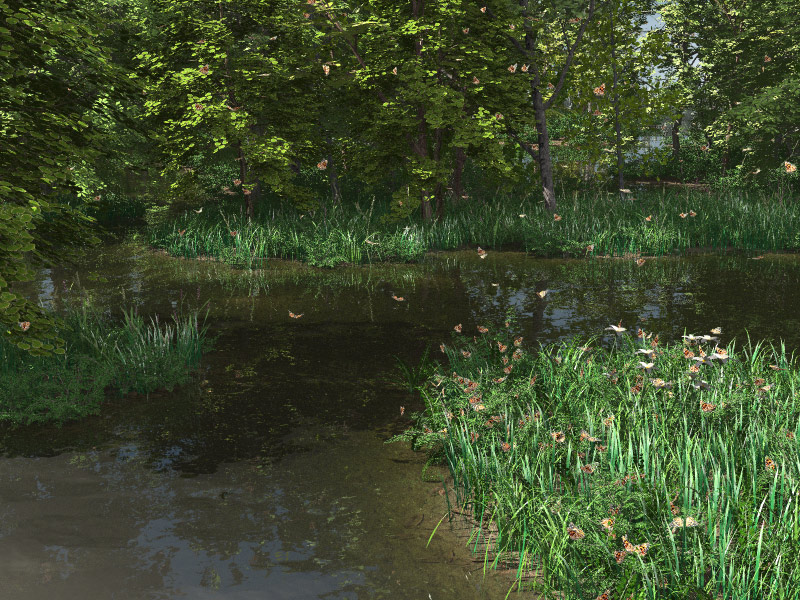
And lastly, for those interested, here's my first submission to the IRTC contest (topic: "Insects and Spiders"), it's called Pond Life
Seriously! Everybody go check it out! No, it's not as easy as lots of other packages. But I must say this is the most fulfilling programming I have ever done. (Probably because my robots don't work yet.
-
Internet Movie ProjectAs far as collaborative, web-based artwork, the Internet Movie Project has been going on for a while now. There is also the IRTC Group Image Project which is a collaborative, web-based art endeavor.
Of course, in both of these cases, the projects are not being done blindly; everybody who contributes has some idea of the bigger picture (pun may or may be intended; it's early yet).
-
Re:Not "art", eh? Tell me THIS ain't art!
As close to art as photography.
Check this out. -
Try telling the IRTC that
I'd wager that the folks who contribute to the Internet Ray Tracing Competition feel that what they do is fine art. Sure looks like art to me.
-
Various animationsBingo is probably one of the best short animations I've ever seen. The link will lead to a 24MB download; well worth it.
405 is also very well done; it was somebody's personal project that turned out to be extremely succssful. They also provide materials that could be useful in a teaching environment.
Flay is a Lightwave-specific site, but they post animations (including 405, above) as they are discovered.
The Internet Raytracing Competition has numerous animations...some of them appeal to you.
-
Go to www.povray.orgCheck out the gallery and hall of fame at http://www.povray.org. The contests at http://www.irtc.org/ have still and animation examples. There is some truly amazing work at these two sites. As someone who actually raytraced all the frames for a 30 second 640x480 movie running at 30fps (back in 1995), I have the utmost respect for the artistic and technical talent possessed by the submitters of these works. If nothing else, it's something pretty to look at.
-
Re:Offtopic, I know, but ...How do you even get started doing 3D stuff? Both still images and animated 3D? I'm looking for cost-free stuff that isn't cripware to get started. I have a very strong math/physics background, so I have no problem describing equations of motion, but I haven't the faintest as to how to get started.
It depends. If you want to program still and animated 3D graphics, then you have quite a few choices. Here are a (tiny) subset of the ones I know:
- Here is a series of accessible tutorials on the mathematics and implementation of 3d graphics
- OpenGL is the API of choice for most platforms. Simple, clear and easy to understand. It does assume that you know what the basics are though.
- Mesa is a free workalike implementation of OpenGL for most platforms. Reading the source to the included demos is a good way to start learning.
- Python is a very good language with OpenGL bindings with which to start messing around. If C and C++ seem too tedious just for experimenting then try PyOpenGL. Python itself can be learned in a weekend after which the GL module is there to play around with.
If you're not interested in programming - just modelling and creating then check out:
- Povray - a flexible raytracer
- Blender - a modelling, animation and sequence editing suite
- Some examples of what is possible
All of these tools and references are free and work on Windows and Linux alike.
Also, how prohibitive is the hardware for this kind of thing?
All you need is a resonable midrange PC and a decent accelerator. A hardware-accelerated graphics card on your platform is a must to view complex 3D graphics at any kind of framerate. Vendors with good Linux support include include Ati, nVidia, Matrox and 3Dfx.
-
Re:what to sell? (the rest of my host)
Typo, the last paragraph of my post got mangled. It should say:
I've seen this sort of thing tried by a few people, mostly selling CD-ROMs like irtc.org or cdrom.com, I've never actually bought one though, so perhaps this model doesn't work so well. For me, the issue is often price. I'm usually not willing to pay US$25 for what's on the CD, even with the donation. OTOH, I often check the 'give $5 to debian' box
when ordering from cheapbytes. -
what to sell?
I like the suggestion of a 'click here to donate' button, and this is perhaps more like 'street performers' work. In my town it doesn't seem very lucrative (simple begging often seems to get better money) but the vastly larger audience available online might make all the difference.
Another point I rarely see mentioned is the value of physical objects. Perhaps I'm being retro here, but much of what I'm willing to pay money for is the physical medium the content comes on. The CD with liner notes, the nicely bound volume. I don't want everything that way, and I agree that selling content doesn't work very well. However, producing and distributing media costs money and it makes sense to me to pay for them. This is a lot like the model behind commercial linux distributions, but I rarely hear it applied to artistic works.
This means no intellectual property, you can release the content freely, but feed back a little bit of the purchase price for distributed media to the artist . copyleft runs sort of like this. Publish on demand could help with this (and to some extent solve the problem of how to serialize a novel) by letting the publisher collect orders in batches and then fire off a run. This should scale well with the popularity of the work. CDs are a case where the technology is better developed: lots up to 100 or so can be done with with CD burners, 500-10000 with short run pressings.
There is the worry that another publisher will take the released content and undersell without supporting the author. This is quite likely to happen, but there are couteracting forces: If we've decided that a material object is what we're charging money for we can compete on the basis of quality, design and packaging. Even if the content is freely distributable, the cover doesn't have to be. People can buy the 'official' version because it's recommended by the author, because it donates to a cause they believe in, because it has better cover art/liner notes. Some will go with the cheaper edition, but who's to say that's bad. Is it really worse than the current system of giving most of the profit to the retailer and the publisher (as distinct from the author)?
I've seen this sort of thing tried by a few people, mostly selling CD-ROMs like irtc.org or cdrom.comcheapbytes. -
Great, but...
These contests are great. I have absolutely no talent in this area, but I love seeing what other people can produce with contests like this and www.irtc.org and so on, but what disappoints me most is that the images produced are always so small! 800x600 doesn't due many of these creations justice. I'd much rather see these contests run at 1600x1200, or at least 1280x1024. I'd even donate CPU cycles for something like that!
-
MPEG encoders for Unix
Check out the animation "FAQ" at the Internet Ray Tracing Competition. It has a table listing two MPEG-1 encoders. There is also at least one free MPEG-2 encoder that runs under Linux, though I don't know where to find it. Check around on www.mpeg.org for links-to-links. Most of the code is pretty raw, but works okay.