Slashdot Mirror
Domain: jhu.edu
Stories and comments across the archive that link to jhu.edu.
Stories · 51
-
A New Definition Would Add 102 Planets To Our Solar System -- Including Pluto (washingtonpost.com)
The Grim Reefer quotes a report from The Washington Post: Is Pluto a planet? It's not a question scientists ask in polite company. "It's like religion and politics," said Kirby Runyon, a planetary scientist at Johns Hopkins University. "People get worked up over it. I've gotten worked up over it." For years, astronomers, planetary scientists and other space researchers have fought about what to call the small, icy world at the edge of our solar system. Is it a planet, as scientists believed for nearly seven decades? Or must a planet be something bigger, something more dominant, as was decided by vote at the International Astronomical Union (IAU) in 2006? The issue can bring conversations to a screeching halt, or turn them into shouting matches. "Sometimes," Runyon said, "it's just easier not to bring it up." But Runyon will ignore his own advice this week when he attends the annual Lunar and Planetary Science Conference in Houston. In a giant exhibit hall crowded with his colleagues, he's attempting to reignite the debate about Pluto's status with an audacious new definition for planet -- one that includes not just Pluto, but several of its neighbors, objects in the asteroid belt, and a number of moons. By his count, 102 new planets could be added to our solar system under the new criteria. USA Today reports: "In the mind of the public, the word 'planet' carries a significance lacking in other words used to describe planetary bodies," the proposal states. "In the decade following the supposed 'demotion' of Pluto by the International Astronomical Union, many members of the public, in our experience, assume that alleged 'non-planets' cease to be interesting enough to warrant scientific exploration." -
Neuroscientists Have Isolated The Part Of The Brain That Controls Free Will (extremetech.com)
An anonymous reader quotes a report from ExtremeTech: Free will might have been the province of philosophers until now, but we've cracked the problem with an fMRI. Neuroscientists from Johns Hopkins report in the journal Attention, Perception, & Psychophysics that they were able to see both what happens in a human brain the moment a free choice is made, and what happens during the lead-up to that decision -- how activity in the brain changes during the deliberation over whether to act. The team devised a novel way to track a participant's focus without using cues or commands, avoiding a Schrodinger's-like dilemma of altering the process of choice by calling attention to it. Participants took positions in MRI scanners, and then were left alone to watch a split screen as rapid streams of colorful numbers and letters scrolled past on both sides. They were asked just to pay attention to one side for a while, then to the other side. When to switch sides, and for how long to look, was entirely up to them. Over the duration of the experiment, the participants glanced back and forth, switching sides dozens of times. In terms of connectivity in the brain, the actual process of switching attention from one side to the other was tightly linked with activity in the parietal lobe, which is sort of the top back quadrant of the brain. Activity during the period of deliberation before a choice took place in the frontal cortex, which engages in reasoning and plans movement. Deliberation also lit up the basal ganglia, important parts of the deep brain that handle motor control, including the initiation of motion. Participants' frontal-lobe activity began earlier than it would have if participants had been cued to shift attention, which demonstrates that the brain was planning a voluntary action rather than merely following an order. A report from Fast Company details how technology is making doctors feel like glorified data-entry clerks. -
Why Scientists Love 'Lord of the Rings'
HughPickens.com writes: Julie Beck writes in The Atlantic that though science and fantasy seem to be polar opposites, a Venn diagram of "scientists" and "Lord of the Rings fans" have a large overlap which could (lovingly!) be labeled "nerds." Several animal species have been named after characters from the books, including wasps, crocodiles, and even a dinosaur named after Sauron, "Given Tolkien's passion for nomenclature, his coinage, over decades, of enormous numbers of euphonious names—not to mention scientists' fondness for Tolkien—it is perhaps inevitable that Tolkien has been accorded formal taxonomic commemoration like no other author," writes Henry Gee. Other disciplines aren't left out of the fun—there's a geologically interesting region in Australia called the "Mordor Alkaline Igneous Complex," a pair of asteroids named "Tolkien" and "Bilbo," and a crater on Mercury also named "Tolkien."
"It has been documented that Middle-Earth caught the attention of students and practitioners of science from the early days of Tolkien fandom. For example, in the 1960s, the Tolkien Society members were said to mainly consist of 'students, teachers, scientists, or psychologists,'" writes Kristine Larsen, an astronomy professor at Central Connecticut State University, in her paper "SAURON, Mount Doom, and Elvish Moths: The Influence of Tolkien on Modern Science." "When you have scientists who are fans of pop culture, they're going to see the science in it," says Larson. "It's just such an intricate universe. It's so geeky. You can delve into it. There's the languages of it, the geography of it, and the lineages. It's very detail oriented, and scientists in general like things that have depth and detail." Larson has also written papers on using Tolkien as a teaching tool, and discusses with her astronomy students, for example, the likelihood that the heavenly body Borgil, which appears in the first book of the trilogy, can be identified as the star Aldebaran. "I use this as a hook to get students interested in science," says Larson. "I'm also interested in recovering all the science that Tolkien quietly wove into Middle Earth because there's science in there that the casual reader has not recognized." -
Why Scientists Love 'Lord of the Rings'
HughPickens.com writes: Julie Beck writes in The Atlantic that though science and fantasy seem to be polar opposites, a Venn diagram of "scientists" and "Lord of the Rings fans" have a large overlap which could (lovingly!) be labeled "nerds." Several animal species have been named after characters from the books, including wasps, crocodiles, and even a dinosaur named after Sauron, "Given Tolkien's passion for nomenclature, his coinage, over decades, of enormous numbers of euphonious names—not to mention scientists' fondness for Tolkien—it is perhaps inevitable that Tolkien has been accorded formal taxonomic commemoration like no other author," writes Henry Gee. Other disciplines aren't left out of the fun—there's a geologically interesting region in Australia called the "Mordor Alkaline Igneous Complex," a pair of asteroids named "Tolkien" and "Bilbo," and a crater on Mercury also named "Tolkien."
"It has been documented that Middle-Earth caught the attention of students and practitioners of science from the early days of Tolkien fandom. For example, in the 1960s, the Tolkien Society members were said to mainly consist of 'students, teachers, scientists, or psychologists,'" writes Kristine Larsen, an astronomy professor at Central Connecticut State University, in her paper "SAURON, Mount Doom, and Elvish Moths: The Influence of Tolkien on Modern Science." "When you have scientists who are fans of pop culture, they're going to see the science in it," says Larson. "It's just such an intricate universe. It's so geeky. You can delve into it. There's the languages of it, the geography of it, and the lineages. It's very detail oriented, and scientists in general like things that have depth and detail." Larson has also written papers on using Tolkien as a teaching tool, and discusses with her astronomy students, for example, the likelihood that the heavenly body Borgil, which appears in the first book of the trilogy, can be identified as the star Aldebaran. "I use this as a hook to get students interested in science," says Larson. "I'm also interested in recovering all the science that Tolkien quietly wove into Middle Earth because there's science in there that the casual reader has not recognized." -
Why Every Cardiac Patient Needs a Virtual Heart
the_newsbeagle writes: In the latest high-tech approach to personalized medicine, cardiologists can now create a computer model of an individual patient's heart and use that simulation to make a treatment plan. In this new field of computational medicine, doctors use a patient's MRI scans to make a model showing that patient's unique anatomy and pattern of heart disease. They can then experiment on that virtual organ in ways they simply can't with a flesh-and-blood heart. Proponents say this tech can "improve therapies, minimize the invasiveness of diagnostic procedures, and reduce health-care costs" in cardiology. -
U.S. Drone Attack Strategy Against Al-Qaeda May Be Wrong
An anonymous reader writes "A new study (abstract) in the journal Informational Security evaluates the U.S. military's strategy for killing off al-Qaeda's leadership using remote drone strikes. The study argues that the strategy is ineffective, calling into question both the military's rationale for doing so and the allocation of defense funds to run it. Essentially, there are two different types of terrorist organizations: those held together by a small number of charismatic leaders, and those who have developed their own bureaucracy, almost like a business. 'Companies don't fall apart when they lose their CEO or CFO; other people are being trained to do that job and there are institutional mechanisms preserving the knowledge the CEO brought to the table. Also, rules create clear lines of succession, so destabilizing struggles over who gets to take over the group's leadership become less likely.'
Intelligence on al-Qaeda indicates it's more of a bureaucratic group — unsurprising, since terrorist organizations that have been around for a while tend to evolve that way. Since the drone attacks started, there has been no significant correlation between successful strikes and a reduction in al-Qaeda attacks. 'The case for the drone program, at its heart, is that killing significant numbers of underlings AND a small number of high-level leaders is severely weakening the group's operating ability. Jordan's study suggests that al-Qaeda just isn't the kind of group that can be beaten that way.'" -
How a MacBook Camera Can Spy Without Lighting Up
New submitter ttyler writes "It turns out a MacBook's built-in camera can be activated without turning on the green LED. An earlier report suggested the FBI could activate a device's camera without having the light turn on, and there was a case in the news where a woman had nude pictures taken of her without her knowledge. The new research out of Johns Hopkins University confirms both situations are possible. All it takes are a few tweaks to the camera's firmware." -
Google Uses Reputation To Detect Malicious Downloads
CowboyRobot writes "Using data about Web sites, IP addresses and domains, researchers find that they can detect 99 percent of malicious executables downloaded by users, outperforming antivirus and URL-reputation services. The system, known as Content-Agnostic Malware Protection or CAMP, triages up to 70 percent of executable files on a user's system, sending attributes of the remaining files that are not known to be benign or malicious to an online service for analysis, according to a paper (pdf) presented at the Network and Distributed System Security Symposium (NDSS) in February. While the system uses a blacklist and whitelist on the user's computer to initially detect known good or bad files, the CAMP service utilizes a number of other characteristics, including the download URL, the Internet address of the server providing the download, the referrer URL, and any certificates attached to the download." -
Milky Way Is Surrounded By Halo of Hot Gas
New submitter kelk1 writes "If the size and mass of this gas halo is confirmed, it also could be an explanation for what is known as the 'missing baryon' problem for the galaxy [...] a census of the baryons present in stars and gas in our galaxy and nearby galaxies shows at least half the baryons are unaccounted for [...] Although there are uncertainties, the work by Gupta and colleagues provides the best evidence yet that the galaxy's missing baryons have been hiding in a halo of million-kelvin gas that envelopes the galaxy." -
Christmas Always On Sunday? Researchers Propose New Calendar
An anonymous reader writes "Researchers at Johns Hopkins University have discovered a way to make time stand still — at least when it comes to the yearly calendar. Using computer programs and mathematical formulas, an astrophysicist and an economist have created a new calendar in which each new 12-month period is identical to the one which came before, and remains that way from one year to the next in perpetuity." -
Christmas Always On Sunday? Researchers Propose New Calendar
An anonymous reader writes "Researchers at Johns Hopkins University have discovered a way to make time stand still — at least when it comes to the yearly calendar. Using computer programs and mathematical formulas, an astrophysicist and an economist have created a new calendar in which each new 12-month period is identical to the one which came before, and remains that way from one year to the next in perpetuity." -
MRI Magnets Cause Nystagmus
Hitting the main page for the first time, tibit writes "In an interesting twist on 'it's so old it's new again,' Johns Hopkins researchers led by Dale Roberts found what must have been causing much confusion for doctors the world over: strong external magnetic fields can stimulate the semicircular canals, causing vertigo and nystagmus (pendular eye motion). It's a textbook case of the Lorentz force in action: our angular rate gyros, the semicircular canals in the middle ear, filled with endolymph, have a ionic current flowing across. In a magnetic field, the current produces a force that pushes the lymph along the channel, causing stimulation of the cupula — a pressure sensor at the end of the channel. This is interpreted by the brain as rotation of the head in space, and causes a nystagmus that's supposed to stabilize the image on the retina. Of course, the subject is laying down and not spinning in space, and the mismatch between inertial measurements coming from the ear and the real situation causes vertigo." -
Microsoft Seeks Do-Let-The-Bed-Bugs-Bite Patent
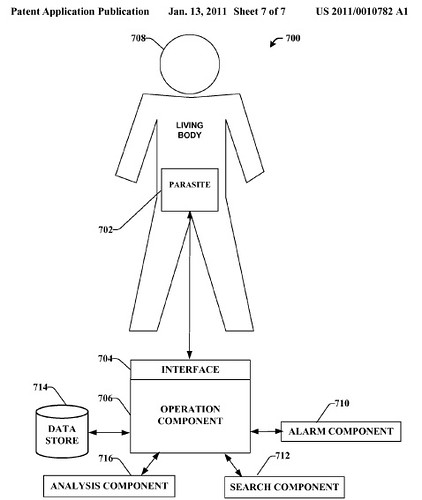
theodp writes "In its just-published patent application for Adapting Parasites to Combat Disease, Microsoft lays out plans to unleash 'altered parasitic organisms' on humans, including mosquitoes, fleas, ticks, bed bugs, leeches, pinworms, tapeworms, hookworms, heart worms, roundworms, lice (head, body, and pubic), and the like. 'Irradiated mosquitoes can be used to deliver damaged Plasmodium to individuals,' explains Microsoft. 'Instead of contracting malaria, an individual receiving the damaged Plasmodium develops an immune response that renders the individual resistant to contracting malaria.' Don't worry about runaway breeding, advises Microsoft — 'a termination feature [that] can include programmed death' makes this impossible. As David Spade might say, I liked this movie the first time I saw it — when it was called Jurassic Park." -
English Shell Code Could Make Security Harder
An anonymous reader writes to tell us that finding malicious code might have just become a little harder. Last week at the ACM Conference on Computer and Communications Security, security researchers Joshua Mason, Sam Small, Fabian Monrose, and Greg MacManus presented a method they developed to generate English shell code [PDF]. Using content from Wikipedia and other public works to train their engine, they convert arbitrary x86 shell code into sentences that read like spam, but are natively executable. "In this paper we revisit the assumption that shell code need be fundamentally different in structure than non-executable data. Specifically, we elucidate how one can use natural language generation techniques to produce shell code that is superficially similar to English prose. We argue that this new development poses significant challenges for in-line payload-based inspection (and emulation) as a defensive measure, and also highlights the need for designing more efficient techniques for preventing shell code injection attacks altogether." -
US Colleges Say Hiring US Students a Bad Deal
theodp writes "Many US colleges and universities have notices posted on their websites informing US companies that they're tax chumps if they hire students who are US citizens. 'In fact, a company may save money by hiring international students because the majority of them are exempt from Social Security (FICA) and Medicare tax requirements,' advises the taxpayer-supported University of Pittsburgh (pdf) as it makes the case against hiring its own US students. You'll find identical pitches made by the University of Delaware, the University of Cincinnati, Kansas State University, the University of Southern California, the University of Wisconsin, Iowa State University, and other public colleges and universities. The same message is also echoed by private schools, such as John Hopkins University, Brown University, Rollins College and Loyola University Chicago." -
A Visual Expedition Inside the Linux File Systems
RazvanM writes "This is an attempt to visualize the relationships among the Linux File Systems through the lens of the external symbols their kernel modules use. We took an initial look a few months back but this time the scope is much broader. This analysis was done on 1377 kernel modules from 2.6.0 to 2.6.29, but there is also a small dip into the BSD world. The most thorough analysis was done on Daniel Phillips's tree, which contains the latest two disk-based file systems for Linux: tux3 and btrfs. The main techniques used to establish relationships among file systems are hierarchical clustering and phylogenetic trees. Also presented are a set of rankings based on various properties related to the evolution of the external symbols from one release to another, and complete timelines of the kernel releases for Linux, FreeBSD, NetBSD, and OpenBSD. In all there are 78 figures and 10 animations." -
A Visual Expedition Inside the Linux File Systems
RazvanM writes "This is an attempt to visualize the relationships among the Linux File Systems through the lens of the external symbols their kernel modules use. We took an initial look a few months back but this time the scope is much broader. This analysis was done on 1377 kernel modules from 2.6.0 to 2.6.29, but there is also a small dip into the BSD world. The most thorough analysis was done on Daniel Phillips's tree, which contains the latest two disk-based file systems for Linux: tux3 and btrfs. The main techniques used to establish relationships among file systems are hierarchical clustering and phylogenetic trees. Also presented are a set of rankings based on various properties related to the evolution of the external symbols from one release to another, and complete timelines of the kernel releases for Linux, FreeBSD, NetBSD, and OpenBSD. In all there are 78 figures and 10 animations." -
A Visual Expedition Inside the Linux File Systems
RazvanM writes "This is an attempt to visualize the relationships among the Linux File Systems through the lens of the external symbols their kernel modules use. We took an initial look a few months back but this time the scope is much broader. This analysis was done on 1377 kernel modules from 2.6.0 to 2.6.29, but there is also a small dip into the BSD world. The most thorough analysis was done on Daniel Phillips's tree, which contains the latest two disk-based file systems for Linux: tux3 and btrfs. The main techniques used to establish relationships among file systems are hierarchical clustering and phylogenetic trees. Also presented are a set of rankings based on various properties related to the evolution of the external symbols from one release to another, and complete timelines of the kernel releases for Linux, FreeBSD, NetBSD, and OpenBSD. In all there are 78 figures and 10 animations." -
A Visual Expedition Inside the Linux File Systems
RazvanM writes "This is an attempt to visualize the relationships among the Linux File Systems through the lens of the external symbols their kernel modules use. We took an initial look a few months back but this time the scope is much broader. This analysis was done on 1377 kernel modules from 2.6.0 to 2.6.29, but there is also a small dip into the BSD world. The most thorough analysis was done on Daniel Phillips's tree, which contains the latest two disk-based file systems for Linux: tux3 and btrfs. The main techniques used to establish relationships among file systems are hierarchical clustering and phylogenetic trees. Also presented are a set of rankings based on various properties related to the evolution of the external symbols from one release to another, and complete timelines of the kernel releases for Linux, FreeBSD, NetBSD, and OpenBSD. In all there are 78 figures and 10 animations." -
A Visual Expedition Inside the Linux File Systems
RazvanM writes "This is an attempt to visualize the relationships among the Linux File Systems through the lens of the external symbols their kernel modules use. We took an initial look a few months back but this time the scope is much broader. This analysis was done on 1377 kernel modules from 2.6.0 to 2.6.29, but there is also a small dip into the BSD world. The most thorough analysis was done on Daniel Phillips's tree, which contains the latest two disk-based file systems for Linux: tux3 and btrfs. The main techniques used to establish relationships among file systems are hierarchical clustering and phylogenetic trees. Also presented are a set of rankings based on various properties related to the evolution of the external symbols from one release to another, and complete timelines of the kernel releases for Linux, FreeBSD, NetBSD, and OpenBSD. In all there are 78 figures and 10 animations." -
A Visual Expedition Inside the Linux File Systems
RazvanM writes "This is an attempt to visualize the relationships among the Linux File Systems through the lens of the external symbols their kernel modules use. We took an initial look a few months back but this time the scope is much broader. This analysis was done on 1377 kernel modules from 2.6.0 to 2.6.29, but there is also a small dip into the BSD world. The most thorough analysis was done on Daniel Phillips's tree, which contains the latest two disk-based file systems for Linux: tux3 and btrfs. The main techniques used to establish relationships among file systems are hierarchical clustering and phylogenetic trees. Also presented are a set of rankings based on various properties related to the evolution of the external symbols from one release to another, and complete timelines of the kernel releases for Linux, FreeBSD, NetBSD, and OpenBSD. In all there are 78 figures and 10 animations." -
A Visual Expedition Inside the Linux File Systems
RazvanM writes "This is an attempt to visualize the relationships among the Linux File Systems through the lens of the external symbols their kernel modules use. We took an initial look a few months back but this time the scope is much broader. This analysis was done on 1377 kernel modules from 2.6.0 to 2.6.29, but there is also a small dip into the BSD world. The most thorough analysis was done on Daniel Phillips's tree, which contains the latest two disk-based file systems for Linux: tux3 and btrfs. The main techniques used to establish relationships among file systems are hierarchical clustering and phylogenetic trees. Also presented are a set of rankings based on various properties related to the evolution of the external symbols from one release to another, and complete timelines of the kernel releases for Linux, FreeBSD, NetBSD, and OpenBSD. In all there are 78 figures and 10 animations." -
Hubble Survey Finds Half of the Missing Matter
esocid sends along the news that scientists believe they have found about half the missing matter in the universe. The matter we can see is only about 1/8 of the total baryonic matter believed to exist (and only 1/200 the mass-energy of the visible universe). This missing matter is not to be confused with "dark matter," which is thought to be non-baryonic. The missing stuff has been found in the intergalactic medium that extends essentially throughout all of space, from just outside our galaxy to the most distant regions of space. "'We think we are seeing the strands of a web-like structure that forms the backbone of the universe,' Mike Shull of the University of Colorado explained. 'What we are confirming in detail is that intergalactic space, which intuitively might seem to be empty, is in fact the reservoir for most of the normal, baryonic matter in the universe.'" -
Ext3cow Versioning File System Released For 2.6
Zachary Peterson writes "Ext3cow, an open-source versioning file system based on ext3, has been released for the 2.6 Linux kernel. Ext3cow allows users to view their file system as it appeared at any point in time through a natural, time-shifting interface. This is can be very useful for revision control, intrusion detection, preventing data loss, and meeting the requirements of data retention legislation. See the link for kernel patches and details." -
The Hard Drive Turns 50
JHU writes "When the hard drive was first introduced on September 13, 1956, it required a humongous housing and 50 24-inch platters to store 1/2400 as much data as can be fit on today's largest capacity 1-inch hard drives. Back then, the small team at IBM's San Jose-based lab was seeking a way to replace tape with a storage mechanism that allowed for more-efficient random access to data. The question was, how to bring random-access storage to business computing?" -
Cryptology Research for High School Student?
John3 asks: "My daughter is enrolled in an Advanced Science Research (ASR) course, at the local high school. The students join the program in 10th grade, choose a research topic, and then locate a mentor to work with them on their topic until high school graduation. My daughter took a cryptology course this past summer, and now she has chosen cryptology for her ASR topic. Most HS students pick mainstream research fields (medicine, genetics), so her science teacher is a bit unsure of where my daughter might locate a cryptology research project appropriate for advanced high school students (especially one that doesn't require security clearance). I'm hoping my fellow Slashdot readers might know of current cryptology/cryptography research projects that offered opportunities for a high school student to participate." -
Instead of Revamping Hubble, Replace It
Neil Halelamien writes "Astronomy Magazine reports that an international team of astronomers has proposed an alternative to sending a robotic or human repair mission to the ailing Hubble Space Telescope. Their proposal is to build a new Hubble Origins Probe, reusing the Hubble design but using lighter and more cost-effective technologies. The probe would include instruments currently waiting to be installed on Hubble, as well as a Japanese-built imager which 'will allow scientists to map the heavens more than 20 times faster than even a refurbished Hubble Space Telescope could.' It would take an estimated 65 months and under $1 billion to build, less than the estimated cost of a service mission." -
FUSE Satellite in Safe Mode
MattHaffner writes "Yesterday, a status report from the Far Ultraviolet Spectroscopic Explorer (FUSE) operations center reports that the satellite is in 'safe mode' after losing (another) reaction wheel--the mechanisms used to point the spacecraft. FUSE had been operating with only two of three original wheels for about two years using a creative solution utilizing the earth's magnetic field. Losing a second wheel for good may mean a serious reduction in science, however. For those keeping track, this is the third major blow to UV astronomy in less than a year. The Cosmic Origins Spectrograph (COS) was due to be installed on the canceled SM4, and the Space Telescope Imaging Spectrograph (STIS), a major instrument on HST, failed in 2004 Aug. The infrared is well covered by current and upcoming NASA missions including the Spitzer Space Telescope, the James Webb Space Telescope (JWST), and SOFIA, but ultraviolet astronomy may have a serious dearth of instruments in the near future. While IR is useful for studying dusty environments, star formation, planetary system formation, and red-shifted galaxies, the UV is the best place to study the chemical composition and evolution of interstellar gas, stars, and galaxies since many of the more abundant elements have strong spectral signatures in that region of the spectrum." -
FUSE Satellite in Safe Mode
MattHaffner writes "Yesterday, a status report from the Far Ultraviolet Spectroscopic Explorer (FUSE) operations center reports that the satellite is in 'safe mode' after losing (another) reaction wheel--the mechanisms used to point the spacecraft. FUSE had been operating with only two of three original wheels for about two years using a creative solution utilizing the earth's magnetic field. Losing a second wheel for good may mean a serious reduction in science, however. For those keeping track, this is the third major blow to UV astronomy in less than a year. The Cosmic Origins Spectrograph (COS) was due to be installed on the canceled SM4, and the Space Telescope Imaging Spectrograph (STIS), a major instrument on HST, failed in 2004 Aug. The infrared is well covered by current and upcoming NASA missions including the Spitzer Space Telescope, the James Webb Space Telescope (JWST), and SOFIA, but ultraviolet astronomy may have a serious dearth of instruments in the near future. While IR is useful for studying dusty environments, star formation, planetary system formation, and red-shifted galaxies, the UV is the best place to study the chemical composition and evolution of interstellar gas, stars, and galaxies since many of the more abundant elements have strong spectral signatures in that region of the spectrum." -
New Calendar Proposal
belg4mit writes "An astronomy professor at Johns Hopkins is pushing for the adoption of a new, static, calendar. The press release is written better than his site but a little short on details. Interestingly he claims this should be easy to implement and points at the hoops coders must jump through for the Gregorian calendar." Nobody is taking my 10 hour day plan seriously either. -
New Calendar Proposal
belg4mit writes "An astronomy professor at Johns Hopkins is pushing for the adoption of a new, static, calendar. The press release is written better than his site but a little short on details. Interestingly he claims this should be easy to implement and points at the hoops coders must jump through for the Gregorian calendar." Nobody is taking my 10 hour day plan seriously either. -
Caffeine Withdrawal Recognized As Real
Ben Sullivan writes "What many Slashdotters have long known looks set to become official: Caffeine withdrawal is for real. New research at Johns Hopkins should result in it being included in the next edition of the DSM, and recognized by the World Health Organization." -
Firmware Upgrades Creating Doorstops?
Michael Droettboom asks: "I recently purchased a Linksys WMLS11B. Nice enough unit for the money. One gotcha, though: when upgrading the firmware (past its refundable date where I bought it), my machine crashed, turning the WMLS11B into a doorstop along with it. Linksys has offered to replace the unit, but I don't want it if the box is so easily corrupted. I have always been on a strict policy of updating firmware on all my devices, but was wondering if anyone else has had experience with devices so broken as to not recover from a broken upgrade?" -
E-Voting Expert Testifies
Christopher Soghoian writes "Johns Hopkins University professor Dr. Avi Rubin (of previous e-voting fame) yesterday testified before the Maryland House Ways and Means Committee. An article in the Baltimore Sun describes his testimony, as well as that of the director of the state elections board, Linda Lamone. Mrs. Lamone was highly critical of Dr Rubin's testimony, stating that he was doing 'a great disservice to democracy. They're telling the public: Don't trust them, don't trust the voting equipment.' This begs the question: Is it better for security researchers to avoid publicly criticizing e-voting flaws? Is public faith in the system more important than overall system security?" -
Virginia Begins to Worry About Voting Machines
nonsecurity writes "Remember the unheeded stories about possible fraud with new electronic voting machines? Well it seems that someone is finally now taking notice. The Commonwealth of Virginia has been ready to take the leap with electronic voting machines, which many experts say are wide open to potential voting fraud. Like other jurisdictions, Virginia had been shrugging off the concerns. But the Washington Post is is now reporting that Johns Hopkins Computer Scientists have been studying the issue and have found that the machines might be easily hacked and election result tampering is a very real concern. And apparently Virginia is listening. With next year's elections promising to be full of fireworks, it's good to see that people are finally taking notice of the issue." -
Dark Energy Confirmed
bill_mcgonigle writes "By correlating the results of the Sloan Digital Sky Survey and the Wilkinson Microwave Anisotropy Probe, astronomers have confirmed the existence of dark energy. While gravity attracts, dark energy repels, so by comparing the positions of millions of galaxies and their red-shifts with the temperature map of the early universe, evidence was found for dark energy on the scale of 100 million light years. "Dark energy, whatever it is, is something that is not attracted by gravity" said David Spergel, a Princeton University cosmologist and a member of the WMAP science team. "We are finding that most of the stuff in our universe is abnormal in that it is gravitationally repulsive rather than gravitationally attractive," said Albert Stebbins of the Fermi National Accelerator Laboratory. The universe is expanding at an accelerating rate, a switch that happened about 6.3 billion years ago, before which the expansion was decelerating." -
Daily Digital Updates for Archaeology Site at Luxor
Linuxathome writes "Professor Betsy Bryan of Johns Hopkins University will be conducting an expedition to Luxor, Egypt. Starting January 4, 2003, digital pictures (by photographer Jay VanRensselaer) and daily updates will be provided by the team as announced by the group's website and by the NY Times (scroll to the bottom). According to the NY Times blurb, the site under investigation is an ancient temple. For the Egyptologist or archaeologist in you, you can live vicariously through their work without getting sand in your shoes." -
Justifying the Common Criteria Security Evaluation
lewko writes "Microsoft has just received a Common Criteria certification for Windows 2000 at Evaluation Assurance Level (EAL) 4. Security experts have been saying for years that the the security of the Windows family of products is hopelessly inadequate. Now there is a rigorous government certification confirming this. What does it all mean? This paper suggests that Microsoft spent millions of dollars producing documentation that shows that Windows 2000 meets an inadequate set of requirements, and that you can have reasonably strong confidence that this is the case. Microsoft bashing aside, the process in evaluating a security product is relevant to anyone considering the deployment of technology into their environment." The EROS operating systems he mentions looks interesting - of course, it also looked interesting three years ago. -
Negative CTE material
florescent_beige writes "An article on Yahoo talks about zirconium tungstate (ZrW2O8), a material that has a negative coefficient of thermal expansion over a wide range of temperatures. Being non-toxic, it has applications in dentistry, as well as metallurgy and optics. Johns Hopkins physicyst Collin Broholm describes the physics behind the behaviour." -
OpenCM Alpha6 Released
Jonathan S. Shapiro writes: "The new OpenCM Configuration Management system has just released it's first external alpha (0.1.0alpha6) over at opencm.org -- brought to you by the same folks who are working on the EROS operating system. Being a 0.1 alpha release, it shouldn't be used for prime time development yet, but it's definitely ready for a first look. We've been using it internally for OpenCM development for a while, and we have officially moved EROS development over. It looks like most of what needs to be done toward a first release is cosmetic at this point. Alpha6 has been tested on RedHat 7.3. Porting and cleanup are underway for solaris and (soon) *BSD. People seem to be excited about this -- especially the OpenBSD folks. While you are over at the web site, have a look at the two papers on OpenCM from this year's USENIX and USENIX Security conference." -
Dirt Cheap High School Theater Sound?
Mainframe asks: "I am a student at a small (550 student) private school in Connecticut. I'm trying to bring theater here to a more professional level on a budget that is for all intents and purposes $0. I'm the sound tech, and at the moment we have a reluctantly two channel system with an amplifier and an 8 channel mixer. No CD player, no effects boxes, although everything is rack-mounted. Is there any software package that would make it simpler for me to run a show off of a computer? I need something that would allow me to play sound effects, mix in ambient sound, and perhaps even act as an effects processor for reverb, delay, etc through sound in/out. Right now I have an iBook running OSX doing effects, but it's hacked together using iTunes and a spectacular piece of software called Playthrough FX. OS is not an issue, since we have a robust IT department, so getting a PC with Windows, Linux, Unix, or a Mac with OS9 or X is not a problem." -
Slashback: Bnetd, Salmon, Towers
Slashback tonight with more on Lord of the Rings (The Two Towers, specifically), various ongoing court battles, the true color of the universe, and more. Read on for the details.All I'm certain of is my true love's hair. CompaniaHill writes: "As previously reported on /., first they though it was turquoise. Then they found an error in their early calculations, and announced it was really beige. But doubts lingered, and color experts pointed out that an objective color as viewed from the theoretical blackness of space would appear different when viewed on Earth in typical daylight. So adjustments were made, and calculations were revised and rechecked by color scientists Michael Brill of McClendon Automation Inc. and Mark Fairchild of the Munsell Color Science Laboratories. And now, at last, Ivan Baldry and Karl Glazebrook, astronomers at Johns Hopkins University, using spectral data from the 2dF Galaxy Redshift Survey, have announced the final result: The universe is decidedly salmon. Really."
The milestones are getting closer together. Dare Obasanjo writes: "Xindice (http://xml.apache.org/xindice), the Apache native XML database has finally reached version 1.0. Xindice used to be called dbXML and was mentioned in my article on XML and databases."
Three From the Courts TheFrood writes: "It looks as though the battle between Blizzard and bnetd (as reported in previous stories here(1), here(2), and here(3))is heating up. Vivendi has sent another letter to the EFF, which has wasted no time responding."
ElitusPrime writes with an update in the strange case of Ken Hamidi, the Intel employee whose mass-mail to Intel employees brought charges of trespassing. Now the California Supreme Court may take another look at the case. Says ElitusPrime: "If this guy is put in jail, I can think of more then a few other spammers that need to go up the creek with him..."
In a very different case, pagan26 writes: "It seem that DMCA will have its day in court. With ElmcoSoft."
Well, at least you can trust their word, right? Masem writes: "According to MSNBC, the developers of the spyware program WinWhatWhere will no longer have their install program trample the bits of anti-spyware programs, after word broke that this behavior was occurring. However, no word has been made by a similar spyware program developed by SpectreSoft that does similar damage."
I will fork out to see this, happily. Pingsmoth writes "It looks like the faithful fans of Peter Jackson and Tolkien will be able to catch a glimpse of The Two Towers this Saturday. Lordoftherings.net is reporting, through a video of Peter Jackson, that a preview (read: not a trailer) of The Two Towers will be shown in theatres this Saturday, presumably attached to The Fellowship of the Ring. Maybe at the end? At any rate, it looks like I'll be seeing the film at least seven times now, and it's a good thing I got a morning shift tomorrow." For a more colorful description of this 4-minute tease, check out Ain't it Cool News' version.
-
Universe Beige, not Turquoise
ChazeFroy writes: "The universe is actually beige, not turquoise. Researchers at John Hopkins University initially reported it was turquoise, but the software they used contained a flaw that implemented a non-standard white index to arrive at the mint chocolate chip green color." The other color was much nicer than this beige. -
Universe Beige, not Turquoise
ChazeFroy writes: "The universe is actually beige, not turquoise. Researchers at John Hopkins University initially reported it was turquoise, but the software they used contained a flaw that implemented a non-standard white index to arrive at the mint chocolate chip green color." The other color was much nicer than this beige. -
Hack in Space
MelloDawg writes: "From the press release: NASA's Far Ultraviolet Spectroscopic Explorer (FUSE) spacecraft, which some had given up for dead in December after critical guidance components failed, was returned to full operations when the team developed an innovative new guidance system. The system uses a complex new set of procedures that lets controllers use electromagnets in the satellite to push and pull on the Earth's magnetic field. Details of the mission are online." -
Black Holes May Promote Stellar Birth
Porfiry writes: "The unusually high rates of star births seen in some galaxies may be linked to voracious black holes at the center of those galaxies, according to a new analysis of astronomical data by researchers at Johns Hopkins University. The new results suggest that galaxies with rapid rates of star formation and galaxies with active black holes, long considered separate phenomena, are actually links in a single set of evolutionary processes that shape the development of galaxies." -
Black Holes May Promote Stellar Birth
Porfiry writes: "The unusually high rates of star births seen in some galaxies may be linked to voracious black holes at the center of those galaxies, according to a new analysis of astronomical data by researchers at Johns Hopkins University. The new results suggest that galaxies with rapid rates of star formation and galaxies with active black holes, long considered separate phenomena, are actually links in a single set of evolutionary processes that shape the development of galaxies." -
Dirt Cheap Telescopes With Liquid Mercury
Decibel writes "Scientists at the University of British Columbia have built a 6 meter telescope that uses a plate filled with mercury for its primary mirror. At a cost of $1 million, this technology makes it possible for many research teams to have continuous access to a telescope, rather than sharing with many other researchers. On a somewhat related note, the top 10 images taken by the only company that provides commercial satellite images at 1 meter resolution have been released to the public. Included are pics of the Olympic Park in Sydney, the Hollywood sign, Hoover Dam, and the Great Pyramids of Egypt. I don't know how they determined that these were the top 10, but they're certainly worth a look."Personal addendum by jamie .
Summer 1983: I was at a cool kids' summer camp learning about astronomy. I was 12. A friend and I came up with the idea of spinning mercury into mirrors. We didn't know much about optics or physics and had no idea if it would work, but we presented the idea to the Very Smart guest speaker the next day.
He thought about it for a second, and shot us down: he didn't think it would focus properly because the surface would be a catenary, not parabolic.
I would just like to take this opportunity to say: in your face, dude.
Mercury mirrors do not, however, make good replacements for general-purpose telescopes. They only point straight up; they'll never do long exposures or see anything outside their latitude. I'm a little surprised the article doesn't emphasize this.
(On the off-chance my "co-inventor" Bill Hall, from Kalamazoo, Michigan is reading this: drop me a line, Bill.)
-
mod_backhand -- Apache load-balancing module
your jesus writes "mod_backhand is a drop-in load balancer Apache module that was released by CNDS (under a BSD-style license -- source available). We are looking for people who want to play with it, use it, love it, or just plain send it through the rigorous testing. This project has the potential to replace some of the most expensive load balancing appliances out there with JBOAS (Just a Bunch of Apache Servers).
What do y'all think?" -
IDCT Approximation: Worth a Patent?
Between 1804 and 1807 Jean Fourier discovered the Fourier Transform: a means of transforming any function into its frequency components. He initially used it to study the propagation of heat in solids. Since then the Fourier transform has found a myriad of applications such as the JPEG, MPEG and MP3 formats... It's even been used to multiply polynomials. The main computational cost of the Fourier transform are the N^2 multiplications it requires. In 1903 Runge noticed that the number of multiplications required could be reduced to N.log(N) by using trigonometric symmetries. In 1965 this was applied in computers by Cooley and Tukey: the fast Fourier transform became popular. Since computers represent numbers in binary, multiplications and divisions by powers of 2 are commonly implemented by shifting bits left and right. Multiplications by constants are easily optimized using the same trick. In 1999 Trac Tran of Johns Hopkins University found an approximation to the DCT which causes very little error, yet uses only 13 shifts and 31 additions for N=8. Given the recursive nature of the FFT, this transform could be used as part of an FFT with N>8. Apparently, he has applied for a patent for this approximation. Do you think this is worth a patent? Do you know of prior art?