Slashdot Mirror
Domain: lmco.com
Stories and comments across the archive that link to lmco.com.
Comments · 31
-
Consulting
Many consulting and defense firms have been hiring tech workers non-stop for a long time now. Especially in the D.C. Metro area.
-
TAO/ACE Orb SCTP Benchmarks
Interestingly, I had just run across these yesterday--note these used OpenSS7 implementation and call out issues w/LKSCTP mentioned in other posts:
http://www.atl.external.lmco.com/projects/QoS/docu ments/DOA2003_97_Thaker.pdf
Seems the funding for the TAO SCIOP implmementation came from the US Navy:
http://www.omg.org/news/meetings/workshops/RT_2003 _Manual/Presentations/5-4_Thaker_etal.pdf -
Great - Lockheed Martin. Now there is an idea
Great. Now we can be sure that the only way to read any of these documents will be with IE 4.0 since they will prohibit even the sound of the word open source (sorry PDF. See clause 11) and given that they are a defense contractor you can bet they will lock in to some proprietary SW version that is 4 versions older than what is current.
-
Re:Private enterprise brings different priorities
I'm inclined to think that a private company would not have come up with a re-entry shield that is composed of hundreds of ceramic tiles, all of which have to be inspected pre and post launch.
No private company would have anything to do with those tiles!
-
Where to go from here
I'm not sure of exact performance differences between SRBs and LRBs.
There are many differences. Solid rocket motors have lower specific impulse (thrust*time for a given amount of fuel), cannot be throttled, and require the entire fuel storage area to be a combustion chamber; they make up for this by being relatively simple and have fewer (though more dangerous) failure modes. Liquid motors have typically higher specific impulse, can be designed to be throttled, and mostly use relatively light, low-pressure tankage (some are "pressure fed", but no heavy boosters today use this design). The cost is that they have many more parts to manufacture, more moving parts and more failure modes.Won't this take more time?
The administration has decided to fly Shuttle until the ISS is complete. This seems silly to me; it ought to be a fairly simple matter to build multiple copies of new ISS modules and use some as test payloads (inside a shroud) for a Shuttle-derived heavy-lift booster. Being able to put 5 modules into orbit with one launch would drastically hasten the completion of the ISS.I'm sure the NASA which put Apollo on the moon could have put together a vehicle built from Shuttle engines at least as fast as the Saturn 1B was cobbled together. If it took 4 years to go to first flight, I'd be surprised. (It would not be flying people, so you could risk a lot more on the first flight. Or you could fly a couple modules and use the balance of the mass-budget to loft a few tons of food and some big honkin' tanks of oxygen and water. If a Shuttle got stuck at the ISS after that, they'd have the supplies to wait for a good long time.)
I doubt it. The biggest liquid motor that I know of that is still in production is the Russian RD-180; as used on the Atlas III it has a thrust of 860 klbs. The SRB has 3.3 million pounds of thrust at sea level, so you'd need approximately four RD-180's to replace one SRB and the 660-ton vehicle would need more than 50 of them. This looks like a recipe for death by complexity. Even if you could build F1's again, you would need about 29 of them to loft that 660-ton vehicle. This calls for another solution.(Goodness knows what you'd do for the boosters to get the thing off the ground; clustering so many solid rockets would have a very high probability of failure.)
LRBs possibly?Long ago, someone put forth a proposal for what they called a Big Dumb Booster. The concept was to build tanks out of steel plate, fill them with diesel oil fuel and nitric acid oxidizer, and pressurize them with steam (no turbopumps). The affair would have been built in a shipyard rather than an aerospace factory, launched from the ocean and recovered by impact into the water (I have no idea how it was supposed to avoid damage from this). No turbopumps means no pumps to fail; if I am not mistaken the combination of nitric acid and diesel will self-ignite (or you spike the first slug of fuel with UDMH, I'm not sure which), so you just open the valves and go. The simplicity of the affair makes it look like it would scale very well. If you were seriously going to make a booster to put 660 tons into LEO, this sounds about like the ticket for the first stage; they would be too dumb to fail easily and cheap enough that you could afford to lose (or discard) them regularly.
Doing a quick Google search for "big dumb booster" I found this history which happens to mention the 550-ton-to-orbit Sea Dragon. I can't seem to find any reference to the concept I remember, so I might have it wrong.
-
We once hacked...
an old launch pad (boy, the anchor bolt refurb on that UT was a BASTARD, nevermind any of the rest of it), into a fairly useful facility, but the new new rocket was a piece of shit and they finally decided to just blow the whole damned facility to hell and be done with it, but we sure had some fun there with it for a while.
-
It's already been done in 1985... and scrapped...
I remember something that Lockeed had done a ways back called ERIS. It was a manned space fighter. I don't know if it's real or not but it stands a pretty good chance of it (seeing they have claimed a few launches. Found a couple of links about it here and here. Looks like it started back in 1985... It had two test launches and actually shot down a few things (for the gun crowd out there the 'muzzle velocity' was 44,000 fps). The tech went into cruise missles, ICBM's and missle defense programs.
-
Skunk works?
I believe that "Skunk Works" is a trademark of the Lockheed Martin Corporation.
The Skunk Works is the plant that built the U-2, the first jet fighter (don't know the name), the Blackbird (AKA SR-70, SR-71, etc), F-22, F-35 (the new joint strike fighter), the stealth fighter, and others that are probably still classified.
The Boeing version is called the Phantom Works, which is their high end idea plant which created Boeing's JSF entry (which lost to the Lockheed version, but that isn't important).
Just my little input of random facts.
-CPM -
Re:Yay!
-
Re:Well..
might as well have a Senator Lockheed-Martin.
Disclaimer: I work for Lockheed.
I don't understand your point... surely Lockheed has proposals and products that compete with the shuttle, but they also have thier fingers in the shuttle as well. they handle the external tanks, where I work we do the data processing computers, they do the thermal protection, they support shuttle missions, provide other shuttle support services, and do other shuttle related work.
So yeah, they'll probably gain when NASA moves to the next-gen space exploration system. But they're by no means missing out on the shuttle action as it stands now. The thing about Lockheed is that they are very diverse... they handle IT for government sites (pentagon, bases, etc), they do package distribution for the US & UK post office, we do traditional rockets, they do air traffic control, airplanes, avionics, missiles, support services of all sorts - the list goes on an on. Go to the main Lockheed homepage and look at the list of products & capabilities. So you can't pull one proposal or project that Lockheed has, and say that they want the shuttle to die because of that.
The politics here are a hell of a lot more complicated than $14,000 in campaign contributions. I don't understand them all, to be sure... but neither do you. -
Re:Well..
might as well have a Senator Lockheed-Martin.
Disclaimer: I work for Lockheed.
I don't understand your point... surely Lockheed has proposals and products that compete with the shuttle, but they also have thier fingers in the shuttle as well. they handle the external tanks, where I work we do the data processing computers, they do the thermal protection, they support shuttle missions, provide other shuttle support services, and do other shuttle related work.
So yeah, they'll probably gain when NASA moves to the next-gen space exploration system. But they're by no means missing out on the shuttle action as it stands now. The thing about Lockheed is that they are very diverse... they handle IT for government sites (pentagon, bases, etc), they do package distribution for the US & UK post office, we do traditional rockets, they do air traffic control, airplanes, avionics, missiles, support services of all sorts - the list goes on an on. Go to the main Lockheed homepage and look at the list of products & capabilities. So you can't pull one proposal or project that Lockheed has, and say that they want the shuttle to die because of that.
The politics here are a hell of a lot more complicated than $14,000 in campaign contributions. I don't understand them all, to be sure... but neither do you. -
Re:Well..
might as well have a Senator Lockheed-Martin.
Disclaimer: I work for Lockheed.
I don't understand your point... surely Lockheed has proposals and products that compete with the shuttle, but they also have thier fingers in the shuttle as well. they handle the external tanks, where I work we do the data processing computers, they do the thermal protection, they support shuttle missions, provide other shuttle support services, and do other shuttle related work.
So yeah, they'll probably gain when NASA moves to the next-gen space exploration system. But they're by no means missing out on the shuttle action as it stands now. The thing about Lockheed is that they are very diverse... they handle IT for government sites (pentagon, bases, etc), they do package distribution for the US & UK post office, we do traditional rockets, they do air traffic control, airplanes, avionics, missiles, support services of all sorts - the list goes on an on. Go to the main Lockheed homepage and look at the list of products & capabilities. So you can't pull one proposal or project that Lockheed has, and say that they want the shuttle to die because of that.
The politics here are a hell of a lot more complicated than $14,000 in campaign contributions. I don't understand them all, to be sure... but neither do you. -
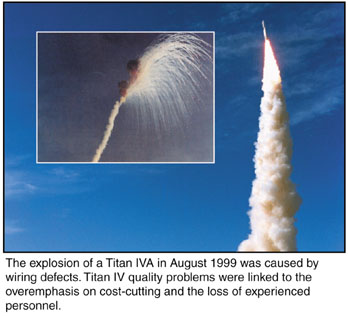
What about the Titan IV-B? Better than shuttle.
The space shuttle is the only heavy freighter and the only means of putting a new ISS component in space.
Titan IV-B, LEO payload capacity 47,800 pounds.
And at an estimated cost of only 350-450M, it's somewhat cheaper than the shuttle. With a better than >95% estimated success rate, it's also probably safer than our current shuttle fleet.
Even better, the upgraded IV-Bs have a LEO payload capacity roughly equal to that of the shuttle. (~48,000 lbs-LEO)
And, they're unmanned and not expected to be re-used. It goes boom, no astronauts go boom with it, and it's not like you were expecting to get the rocket back. Oh, and it can loft a good bit more to GEO than the shuttle can. -
Re:The future? Just like the past should be...
indigo asserts:
[Bounty for private space flight] not worth it to any single company right now. Only boeing has the resources,
Not true, first off, if such bounties were available, companies (or consoritums of companies) will be coming out of the woodwork to try for them. Secondly, there are companies other than Boeing there right now that are in a position to start working on this, big ones like Lockheed Martin, to little ones like Scaled Composites and XCOR. A bounty for successful milestones would make VC funds more accessible to companies with good ideas.
The problem I see with this is: a bounty for successful milestones would also make VC funds more accessible to companies with bad ideas. Companies working with a focus on the bottom line cut corners; in space travel, corners cut cost lives. Seven astronauts who knew the risks was bad enough; I don't want to see some moron going up on a half designed rocket, having a guidance failure and crashing in a crowded city center, taking out people who were just trying to go to work. -
Re:Cost and reliability
The Atlas V has a similar throw weight, but uses a Russian designed motor. Commercial space is a tough field right now: There are a lot of competitive products for as many payloads... Who knows, maybe they'll drag out the spaceplane one more time.
-
Re:Too lateIt is interesting to note the hype generated about this "cutting edge technology", when countries other then the US (namely the former soviets and the Israeli) have had similar (if not much more advanced, in the case of the Israeli) tech for over 10 years now.
Also, not that the Helmet Mounted Sight in question is Israeli developed technology - Elbit, which is supplying the technology for the helmet, is one of the two biggest defence contractors in Israel, and also helped with the develpoment of the 15 years old Python 4 AAM which will still out perform, out range and out shoot the "futuristic" AIM-9X which will only be fully delpoyed by 2004 by the best estimates. (for a nice view of the Python 4's capability, check out this video. take a close look at the first sequence showing an actual missile shot, and the path the missile travels).
-
Re:How's it compare to Sea Shadow?
-
Re:How's it compare to Sea Shadow?
-
Re:How's it compare to Sea Shadow?
-
Re:How's it compare to Sea Shadow?
-
Cheap launches / First Athena Launch
It doesn't cost too much to get into space, if you've got something small. For cost a US "educational facility" $1500. under the Get Away Special (GAS-CAN) program. But that's not what those people are doing...
Instead, they are on the Athena 1 rocket... I used to work for Defense Systems (bought by CTA, bought by Orbital... you know the drill), and my satellite -- GemStar -- was the first to go on this model rocket. The price of the rocket was many times more than our vehicle, and we played the usual space chicken game (where they threaten to launch a slab of concrete and then when we're ready, all of the sudden they weren't really ready). Finally, launch day, and we're watching the video and it goes up and and up... and after about a minute it's going at an amazing speed, and then all of the sudden makes a 90 degree turn. The thing is going so fast that the thrust of the rocket doesn't even affect its direction. The range officer blew it up. Oh well. When I was with DSI we also made bouys -- the joke was that we should just upload the bouy software to the satellites because they always seem to end up in the ocean anyway.
The reason for the failure was that the guidance control loop had some undamped and unintended oscillations.. and there was only a limitied amount of hydrolic fluid on board to control the position of the thrusters. Once the fluid was expended (it was just squirted out after being used), there was no more directional control.
After our flight, they changed the name of the rocket from the LMLV-1 to the Athena to distance the second rocket from this first failure. Ironically, the second one failed too. -
Cheap launches / First Athena Launch
It doesn't cost too much to get into space, if you've got something small. For cost a US "educational facility" $1500. under the Get Away Special (GAS-CAN) program. But that's not what those people are doing...
Instead, they are on the Athena 1 rocket... I used to work for Defense Systems (bought by CTA, bought by Orbital... you know the drill), and my satellite -- GemStar -- was the first to go on this model rocket. The price of the rocket was many times more than our vehicle, and we played the usual space chicken game (where they threaten to launch a slab of concrete and then when we're ready, all of the sudden they weren't really ready). Finally, launch day, and we're watching the video and it goes up and and up... and after about a minute it's going at an amazing speed, and then all of the sudden makes a 90 degree turn. The thing is going so fast that the thrust of the rocket doesn't even affect its direction. The range officer blew it up. Oh well. When I was with DSI we also made bouys -- the joke was that we should just upload the bouy software to the satellites because they always seem to end up in the ocean anyway.
The reason for the failure was that the guidance control loop had some undamped and unintended oscillations.. and there was only a limitied amount of hydrolic fluid on board to control the position of the thrusters. Once the fluid was expended (it was just squirted out after being used), there was no more directional control.
After our flight, they changed the name of the rocket from the LMLV-1 to the Athena to distance the second rocket from this first failure. Ironically, the second one failed too. -
Nice, Shiny, New BuildingsAnd here Yahoo is putting up these nice, shiny, new buildings here in Sunnyvale. I work at Lockheed Martin Space Systems. Formerly Lockheed Missiles & Space, after the merger with Martin-Marietta we found ourselves with this enormous plant in a new corporate culture that simply did not conceive of plants this size. So parcels of land began to get sold off, and one of them was bought by Yahoo. One of their new buildings sits on the former site of our old Employee Recreation facility. (Which buildings, incidentally, despite the current power crunch and the fact that they are as yet completely unoccupied, have all functioning lights on 24/7.) They're right across the street from VA Linux's old offices.
They're boring as hell, with lots of turquoise panels, and look like they were designed by the same guy who did the Juniper Networks buildings down the street -- which also sit on former Lockheed-Martin land. But they sit next to Lockheed-Martin buildings which were all constructed with overhead money from government contracts, so they look real good by comparison.
I think this is all a ploy by our management, which must be cleverer than it looks, to get some nice new buildings for free, or even with a small profit. Sell the cute little
-
Mission critical
Don't worry. If you don't know what mission critical really means, it probably doesn't apply to you. It is usually used as a government/military expression meaning "If it fails, people will die." As in, it is critical for the mission to continue. And besides, as I learned at a contractor, no free software will ever be used in mission critical applications because they need someone to point the finger at if/when it doesn't work.
I did like the summary of every review of x.x kernel, though.
I had a feeling you were going to say that. -
Already in the works elsewhere
This article doesn't really have much detail on their project, but I know that Lockheed Martin has been working on a whole vehicle for delivering things into "outer space".
It's called the X-33 Reusable Launch Vehicle (RLV) and information is available here. This page is slightly out of date, but it has more technical detail than that article.
Jesus may love you, but I think you're garbage wrapped in skin. -
US develop Passive Coherent Location systemsUS company Lockheed Martin develops Passive Coherent Location systems to detect stealth rainshowers, meteorites and space shuttles. Ah, and incidentally enemy stealth planes, sorry about that.
Read more: at Lockheed Martin, about Silent Sentry, about a shuttle launch and about information dating back over a year - this all comes very sudden and suprising to the US defense, completely new and previously unknown technology.
© Copyright 1999 Kristian Köhntopp -
US develop Passive Coherent Location systemsUS company Lockheed Martin develops Passive Coherent Location systems to detect stealth rainshowers, meteorites and space shuttles. Ah, and incidentally enemy stealth planes, sorry about that.
Read more: at Lockheed Martin, about Silent Sentry, about a shuttle launch and about information dating back over a year - this all comes very sudden and suprising to the US defense, completely new and previously unknown technology.
© Copyright 1999 Kristian Köhntopp -
Passive Detection Networks.
This technology has been around for quite a while. Lockheed Martin has a passive detection system which isn't even completely classified anymore. One of the great things about this tech is that it can do much more than detect anti-stealth aircraft. It can also detect thing flying at very low altitude, which would normally be below radar. Imagine how much low altidute drug traffic can be stopped with a network of silent sentry sites in the Gulf of Mexico.
Many other countries are rumored to have this technology including the Czech Republic and Turkey. When you consider that these places are not the most tech advanced places in the world, it should come as no surpise that we decided to take out all broadcasting capability in Yugoslavia. I'm sure that China having this ability is no shock to the people running the show. What they probably worry about on a daily basis however is when will Iraqi get it. Sooner or later someone will sell it to them and it will get much tougher to bomb them as we are now. -
Lockheed Selling Similar System
-
Silent Sentry
Lockheed-Martin has a web page for their Silent Sentry system. Not much in the way of technical description but it can't be that secret if they put it on the web.
-
Re:SCUD missiles @ Gulf
As it stands no country, that I am aware of, currently has the capability to "shoot down" a missle of any type with any viable accuracy. The only defense to missle attack at this point is a missle which detonates in close proximity to the inbound missle showering it with shrapnel, thus disabling the inbound missle.
The folks at Lockheed Martin are working on something called the Airborne Laser. It uses a very intense beam of light to shoot down missiles from inside a 747. It has a range of somewhere around 400 km, I believe.
Very, very cool stuff.
---
chahast at pangaea dot dhs dot org