Slashdot Mirror
Domain: louisville.edu
Stories and comments across the archive that link to louisville.edu.
Comments · 31
-
Re:*sigh*
I think there's a bit of a difference between having "good English skills" and spending four or more years of your life taking classes about it
I think there is (unsurprisingly) a lot of misunderstanding among the CS crowd about what an English major actually studies. I was not one myself (journalism and Russian language double-major), but from what I understood from my English major friends in college, it's not poring over obscure grammar rules for four years. It's actually more of a degree in writing and communications, learning how to structure and present information in essay form. It's also studying the various kinds of writing out there for different purposes - ranging from artistic to practical - and learning about how other writers have communicated in the past (literature) and what can be learned from them and applied to written communications today.
You can find an example of typical English 300-level courses here or 400-level courses here. English gets a bad name because there are many unfocused students who pick it as a major because they can't think of anything else to do, but for someone who's serious about it, it can be very intellectually engaging and useful.
-
Re:Internet history repeating (1996 Hasbro vs IEG)
Recall that trademaks on Candy were among the first intellectual property debates involving the entire internet: Hasbro vs. Internet Entertainment Group "CANDYLAND Case"
That appears to be over "Candy Land", not "Candy". I doubt anyone would care if "Candy Crush" was trademarked. Here, the sole word "Candy" has been trademarked in conjunction with video games as a whole, and could conceivably be used against Hasbro if Hasbro came out with a Candy Land video game. King doesn't seem to care what kind of game it is, just that the word "Candy" appears in the title.
-
Internet history repeating (1996 Hasbro vs IEG)Recall that trademaks on Candy were among the first intellectual property debates involving the entire internet: Hasbro vs. Internet Entertainment Group "CANDYLAND Case"
Hasbro vs. Internet Entertainment Group "CANDYLAND Case" 1996 U.S. Dist. LEXIS 11626 (W.D.Wa. 1996) HASBRO, INC., Plaintiff, v. INTERNET ENTERTAINMENT GROUP, LTD., et al., Defendants. 1996 U.S. Dist. LEXIS 11626 (W.D. Wa. 1996)
-
Re:Not privacySounds like we need to talk about what privacy really is. A good definition of privacy is "control of your personal information" (probably from This paper.) Of course, keeping personal information entirely secret is the best means of control, but in the modern world, complete secrecy is getting more and more impractical. So what else could we do?
One option I've heard is a property right, such as ownership (similar to copyright) of personal information. Joe "owns" his name &* address, and he'll loan a copy to Time Magazine for the purpose of delivering the periodical he has paid for. Any other use of Joe's information by Time Magazine is a violation, unless Joe & Time have come to some other agreement. This is very similar to copyright, so let's just call it personal copyright.
Copyright might be too blunt an instrument though, because remedies mostly involve (expensive) civil suits. A number of European governments passed legislation called Fair Information Practices. These laws basically say that personal information can only be used for the purpose for which it was given, and cannot be repurposed without consent of the person involved. Probably the governments involved have given themselves a loophole for national security, but I haven't investigated the details. This option reduces the cost to the individual, and makes it the job of the government to enforce the law. I see this as a benefit, though some may not.
Writing Fair Information Practices into law would probably explode the business models of the currently most successful tech companies in the USA, so maybe there's a way to ease into the laws and allow the tech companies time to adjust their business methods...
-
Re:No you don't.
Doesn't matter what Google gets out of the deal. What matters is if the meals are being considered a business expense, in which case neither Google nor the employee are paying a tax on it.
How would you feel if the benefit being received was the exclusive use of a $4.5 million dollar apartment in the city and the employee receiving the benefit were the CEO? Would you think that that is part of their compensation? The IRS does. How is a business regularly, routinely and as a matter of standard practice providing a meal to an employee different?
http://louisville.edu/finance/payroll/ubm-info/taxable-income-and-employee-compensation-1.html
-
Re:Absolute zero
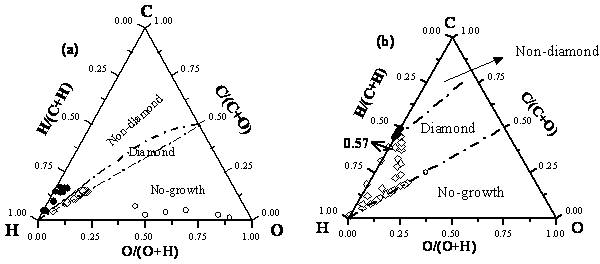
There are two ways of making artificial diamonds.
High pressure and temperature using a very large press. This is the method that is probably more expensive. Here the carbon is squeezed into the crystal structure.
Chemical vapor deposition. This is really easy and cheap to do. All the Mach5 razors are coated in a thin layer of diamond. Here the crystal structure is grown. All it requires is the correct ratios of gases.
-
Re:As long as it's explicit.Well a few seconds on Google and:
Federal legislation related to the American Opportunity Tax Credit requires that all postsecondary institutions report student SSNs to the Internal Revenue Service. This IRS requirement makes it necessary for colleges to collect the social security number of every student. A student may refuse to disclose his or her SSN to the College, but the IRS is then authorized to fine the student in the amount of $50.
-
Re:Bombs....
China would need to get rid of its enormous dollar holdings first, reduce state interference with business, consistently create and enforce the laws of the land, and sell off the massive investments it has in Chinese corporations. Frankly, I think US economic policy has been disastrous. But Chinese economic policy is surprisingly bad too. Demographics-wise China isn't that much better than the US. The US will close with China's population lead from the current factor of 4.4 smaller to something like 3.4 in 2050 (according to this estimate). My take is that despite China's edge in raw population, the US could maintain its lead, if it would fix a lot of the economic inefficiencies. For example, just about everything that's getting bailed out probably should be going through bankruptcy court as well.
-
Re:"In Soviet America"? Please.The University of Louisville is a state supported research university located in Kentucky's largest metropolitan area.
I like the angle you took, but it has way too many thickets in it:
So what research is the State paying for at this particular sports game, exactly?
There is a difference between State "supported" and state "owned". I get a huge tax deduction each year for the interest on my house mortgage, on energy-saving measures I perform on the home, my home office space, etc etc. In short, the State supports my housing in a small indirect way - same way the State (ditto) supports college sports programs in indirect ways. Does that now give any journalist/blogger the right to come into my house at whim and broadcast/blog on whatever occurs in it? If the dog doesn't get him (okay, okay - Dachshunds aren't exactly man-eaters), I'd certainly have more than the right to throw the schmuck off my property.
Unless stated otherwise in the grant paperwork as a condition of acceptance, money given to a college's labs doesn't automatically give the State the perfect right to dominate rules on the sports program.
-
Re:"In Soviet America"? Please.First, let's get this out of the way: this is the NCAA, not the government.
No, it's not the NCAA. It's the University of Louisville:
-
Re:"In Soviet America"? Please.First, let's get this out of the way: this is the NCAA, not the government.
No, it's not the NCAA. It's the University of Louisville:
-
Name Comflict
So how would that problem be solved with the name change. I know a middle initial wouldn't solve that. Would we have to just battle to the death and call it good? It would really just be killing two birds with one stone. First, you'd be practicing Darwinism (population control and promoting the best fit members to continue society) and secondly, you would keep yourself from being confused with another one of your "impersonators" But then again...I wouldn't mind being confused with a Physicist, but maybe I would mind in other cases...he just throws out facts and peddles wares, them's none the coolest!
-
A wealth of guides already available
Not sure why the release of this particular set of plans is news, really. There are a ton of guides for DIY projectors, that go from simple fresnel based systems, through LCD + overhead projector, all the way to building the whole thing yourself.
FYI, see:
- Building a Home Theater (a guide and study of my own experience)
- Operation: Big Screen, using an OHP
- Inventgeek's guide
- Building an LCD projector from the ground up
-
This is college we're talking about.For those who read the article, the discussion was undergraduate engineering courses. It is significantly different from teaching middle school or high school, to which your comments might apply.
1. Pay teachers very well so they are in say the top 5% of all wage earners. This will attract the highly skilled and educated back into teaching.
Universities don't work like that. Money == Grants. Money != Students. There is little incentive for tenured professors to teach students, as it takes time away from they can write grant proposals, to get multimillion dollar grants. Think about it -- if you have someone doing consulting, they might make $200/hr. Is a college going to pay anywhere near that scale, and not charge rates where students are in debt for the rest of their life?2. Send teachers to school during school holidays to further their own knowledge. Pay them for this. This ensures teachers are constantly updating their knowledge instead of driving taxi's during the school breaks.
College teachers sure as hell aren't driving taxis. They're writing grant proposals if they're tenured, or they're doing their other job (which may be that $200+/hr consulting, if they're an adjunct).3. Don't let your local community decide what should be taught in schools. Curriculum should be decided by a national panel made up of leaders in each field of study. Education should be a national issue, not one decided based on local beliefs no matter how "intelligent" those beliefs are.
They don't decide. ABET certifies engineering curriculum. (I'd personally like to see a way for students to file grievences to ABET, but I doubt that will ever happen). Colleges in general are certified by large regions. In the case of where I live, it's handled by Middle States4. Provide options for traineeships in traditional trades (e.g. electrical, plumbing etc) for the non-academic students. This will help remove disruptive elements from classes allowing those who want to study or have the aptitude to study to do so in peace. (not that you don't need to study to become a plumber and such, but I'm sure you all know what I mean)
Schools don't get to set their curriculum however they want5. Properly fund the schools and get rid of the Coke/Chip machines. I know the sugary drinks and food taste great, but they don't help you sit still and concentrate. (A new slogan perhaps?
Universities have money. At least enough for the amount of waste I've seen.6. Ban the teaching of religion on any and all school grounds. AND ENFORCE IT!!! Religion has it's place in society, but not in schools!
Again -- that should only apply to public middle school/high schools. It has nothing to do with universities, where you can elect which classes you're taking. (even state schools might have a Jewish Studies program or the like. And let's not forget schools like CUA or BYU.
Oh -- and for the record, I'm currently in graduate school at a public university, and I got my undergrad from a private university (or more accurately, a real estate company who was obligated to teach classes), where I also worked for 7 years, and saw an amazing amount of graft. (and before someone claims this is libel, the fed agreed) -
The evolution of intelligent designPerhaps the core argument of intelligent design derives from the idea of The Great Chain of Being, (more at: http://www.louisville.edu/a-s/english/haymarket/j
a sonz/zahrchain.html. The idea was best summed up by Arthur Oncken Lovejoy in his seminal book, The Great Chain of Being: A Study of the History of an Idea, while the book investigates the concept from Plato, through the neoplatonists, and on through history, I think the argument as applied to intelligent design centers around the idea of our species as being more perfect than other "more lowly", species. This argument was used to legitimize slavery, as Africans were seen to be subhuman; there is, of course, the obvious connection with Nazism and the idea of a super race.Stephen Jay Gould in his book The Structure of Evolutionary Theory, 1400 hundred pages of Gould at his best, forwarded an argument that goes to the heart of the idea of intelligent design when he described evolution as a random walk, wherein the idea of contingency, might preclude the evolution of our species were the "tape" of evolution to be played over again. The idea of intelligent design is founded on hubris and chavunism. As a Christian belief there is an interesting tie in with 42, ancient numerology and the Greek idea of Logos. There is also a tie in to the patriarchical aspects of Christianity, the subjugation of women and a strange development of Christianity as a spritually, homosexual system of belief, but that would be another post.
cheers
-
Erector SetsThey're plastic these days.
Sadly, I suspect that the metal sets would no longer be considered safe for kids anymore. *shrug* Which makes sense from a pure safety perspective, as I know we banged ourselves up repeatedly making weapons out of the pieces in addition to scrapes from burrs on the pieces and a few cases of hair or skin getting caught in the open workings of the motor. *wry grin* And then there was that incident where I got thrown across the patio by an electric shock. But in retrospect, yanking the cord out of the outlet when on a rain-soacked patio was not the brightest of moves for all that I had good intentions. (My little sister, Eileen, was reaching for the plug. Her being a toddler, I knew she wouldn't remove it safely, so I did so. Ouch...)
-
Re:Better, cheaper paperIt's cheaper
Currently, paper made with industrial hemp fiber is significantly more expensive than paper made with wood. Hemp paper pulp can cost up to $2,000 a ton versus $500 a ton for wood paper pulp. Still, there are a handful of economically feasible uses for industrial hemp paper, particularly because it would probably be feasible to produce hemp pulp at a cost well below $2,000 a ton. http://www.louisville.edu/org/sun/sustain/article
s Perhaps with large capital investment in new plants, economy of scale in mass production, and refinement in the process, hemp fiber will be only slightly more expensive than wood fiber. I do work in the paper industry and know first hand the fear of possible plant closures due to the tight margins industry wide. If hemp looked promising as a low cost fiber source we, and every other manufacturer, would be raising a stink heard nationwide to get access.
uses less chemicals than paper made from wood
The process chemicals and energy from the spent liquor are recovered. http://europa.eu.int/comm/energy_transp
o rt/atlas/htmlu/ppblg.htmlHemp could save some chemical usage when it comes to wet strength additives, but that is a fairly small percentage of the whole system. The majority of chemical additives required for wood fiber paper would still be required for paper with hemp fiber.
If hemp is going to use a mechanical fiber preparation system instead of a closed loop liquor system, prepare to bite the bullet for some major energy costs.
Don't think our friends at Dow Chemical didn't know this when they lobbied to make marijuana illegal.
Dow chemical does manufacture some chemicals used in the papermaking industry (coating polymers, defoamers, biocides primarily), but is far from being one of the major players in that market. I reckon using Eka as the conspiracy name does not carry the same demonizing weight.
One acre of annually grown hemp may spare up to four acres of forest from the current practice of clear-cutting
The only clear cutting that is used to supply fiber to the paper industry comes from stands of ten year old poplars on tree farms getting the whack. The other primary wood fiber sources are waste chips and sawdust from lumber mills and post consumer (recycled) fiber. The percent of virgin, natural forest fiber used in paper manufacturing is in the low single digits.
Compared to wood, fewer chemicals are required to convert low-lignin tree-free fibers to pulp
Actually we are kinda fond of the lignin in the wood fiber. That lignin is the energy source recovered in the boilers that recycle the pulping chemicals, produce steam used throughout the plant, and generate enough electricity that we actually sell back to the market.
Less bleaching results in less dioxin
Dioxin is a ghost from the past in the paper industry. Very few mills still use elemental chlorine in the bleaching process. Quite a few still use chlorine-dioxide, but even these are giving way to newer bleaching plants based on newer technologies with zero dioxin byproducts.
-
Re:The Few, The Proud, The Famously Banned
Also Huck Finn.
-
E-mail Dr. Atlas
I urge everyone who is concerned about the free and open exchange of scientific information to e-mail Dr. Atlas. This is a bad trend to start. Once we do start censoring ourselves, it's much easier to continue doing so.
-
old myth, new studyThe article mentions reports to this effect dating back to at least Plutarch. Modern scholarship, however, found no scientific evidence for it. (The article mentions 1892 French excavations, 1904 A. P. Oppe, 1948 Oxford Classical Dictionary, 1950 Pierre Amandry).
Your 1980 English teacher might possibly even have read E. R. Dodds' The Greeks and the Irrational (1951) which, in addition to dismissing the vapor account as myth, gives a good statement of why it is irrelevant to trying to understand such phenomena:
As to the famous "vapours" to which the Pythia's inspiration was once confidently ascribed, they are a Hellenistic invention, as Wilamowitz was, I think, the first to point out [65]. Plutarch, who knew the facts, saw the difficulty of the vapour theory, and seems finally to have rejected it altogether; but like the Stoic philosophers, nineteenth-century scholars seized with relief on a nice solid materialist explanation. French excavations showed that there are to-day no vapours, and no chasm from which vapours could once have come [66]. Explanations of this type are really quite needless; if one or two living scholars still cling to them [67], it is only because they ignore the evidence of anthropology and abnormal psychology.
E. R. Dodds The Greeks and the Irrational, III: The Blessings of Madness, pp.73-4The evidence supporting the "myth" is (relatively) new. Quite fascinating how geologist and author de Boer discovered the fissure in 1981 but, having read Plutarch, assumed it was already known and only in 1995 learned that it was not known to modern science while discussing it with archaeologist John R. Hale under the influence of some wine (which is when they resolved to team up and do a thourough investigation).
As an admirer of Dodds' scholarship, I also can't resist noting that of the 311 pages of the book, 129 comprise the 1099 annotations (three of which appeared in the citation above). Not quite hyperlinks, but enough in quantity and quality for me to judge him the Knuth of his field.
-
Louisville is GREAT
I'm also a software developer born-and-raised and currently living in Louisville, KY. Businesses and people across the USA need to stop thinking of Louisville as a "hick town"--I wildly assure you that IT IS NOT. As a former resident of upstate NY, Charlotte, NC and the SF bay area, I attest that Louisville is a modern city with very upstanding people and lots of things to do for a city its size (and it isn't so small -- 1 million in the metro area!).
Louisville has vibrant arts, sports, architecture, politics, business, attractions and nightspots and a very fun two-week festival in April/May surrounding the Kentucky Derby (including "Thunder Over Louisville", the nation's largest air power and fireworks show). And if that isn't enough, the University of Louisville includes a very good school of engineering.
Of course, the most important aspect of Louisville is her people, among the friendliest you'll ever run into.
-
Re:This is getting out of hand.
Okay, well put. For those interested, here is The Right to Privacy by Justice Brandei from 1890.
All I can say is, I disagree. IMO, privacy is a luxury and not a right, something that has to be a active investment by someone. I believe the existing laws against tresspassing (for protection of 'privacy' in one's home) and against libel (for protection of truthfulness of acquired media) are enough. But I guess I have to convince the Supreme Court of that.
Anm -
Re:Maybe for "carpal tunnel syndrome"
Tendonitis is far more common, in my experience -- I'd like to have seen that discussed in this context.
Agreed. I was recently diagnosed with DeQuervain's Tenosynovitis, a painful inflamation of the tendons that move the thumb and its tendon sheath. In my case, it started without apparent reason as a general soreness around the bone that sticks out as a bump at the base of the thumb, combined with nasty sharp pains with certain movements of my hand. My first thought was "Carpal Tunnel Syndrome?" since a friend in the IT industry had been diagnosed with this. As you say, CTS is "the flu" of hand injuries.
A word of warning: After my doctor told me what I had I, naturally I checked the web to find out more about it. Many of the pages (but not this one) describe "Finkelstein's test" along the lines of: "form a fist with the thumb inside, then move sharply outwards." DON'T TRY THIS AT HOME! - I did, and was in extreme pain for some time afterwards (and made some rather pointed remarks about Finkelstein's parentage...) I also made the overall problem several times worse that it was and set the healing back at least a week. As the link above explains, this description is wrong and can cause pain even in normal hands. The correct test as described in the link is what my doctor used.
"Curiosity killed the cat." -
Re:Basketball EDUThe slogan "America's Next Great University" is the slogan for University of Kentucky?
Here at the University of Louisville we have the (advertising) slogan "Dare to be Great". This has sparked parodies such as "Dare to be Stupid".
Some how those parodies don't have the irony of "America's Next Great University". It brings a message of "Eeehh, we are not so great yet. But by the time you graduate, we will really kick ass!"
Besides, we have Pitino now. So I don't think that UK deserves basketball.edu. Although we might get pitino.edu and rename the school to University of Pitino.
-
Re:Python....and python edu-sigThere is a fairly-active mailing list on using Python in education at python.org/sigs/edu-sig. Jeffrey Elkner, author of the article mentioned in the intro to this topic, is a participant there. You will find lots of other resources and very helpful folks.
My son discovered the DOS command prompt a while back, and taught himself to write
Python is great. I found it while looking for a modern day version of Logo, introduced him to it, and away he went. (Yes, I know Logo still exists in more modern form, but the educational system support for it is no longer there, nor is it easy or cheap to find.)
Since NO ONE in his school was providing any help, we reached out to our local PC Users Group as well as to the SLUG on the local University campus. Both groups have been terrific, but the SLUG guys (almost all are guys) have gone above and beyond. Check out any local installfest and I am sure you will find the same kind of enthusiasm when they recognize a junior "one of their own" in your proto-programmer.
By the way, I picked up a copy of Compton Learning's Programming Made Easy, which purports to teach something called "Truck", Basic, C, and Java. Don't waste a penny on it. Beyond Truck, it is mostly multiple choice questions about what various bits of the language would look like. It does a bit of introduction to basic concepts, and not much beyond. It will turn off most kids in about five minutes. (It is aimed at ages 16 and up. I am "up", and it is sure not aimed at me.)
I have an idea. Let's start a revolution. Have each LUG adopt a local school. Have people gather up basement doorstoppers (say, old 486s), sponsor an installfest (have a ready source of old spare parts, and teach anyone interested (students, parents, teachers) how to get started in Linux. (A network card and connection will get around the old peripherals problem. Or use one of the tiny Linux distributions.) And/or do the same thing for Python. Agree to provide support. Meet one night a month in the school pc lab. There are bound to be a handful of kids who would be interested, in any school, and some of their parents. This could be done for little more than the investment of time. Let the wild rumpus begin!
-
A brief history of privacy and an opinion
A long time ago, common law recognized it as a crime if I drew my fist back and punched you in the nose. That crime is called battery. (Note, IANAL, nor do I play one on TV.)
But at first, merely drawing my fist back (or nocking an arrow, drawing a dagger, etc) was not considered a crime. Later law decided that if I act in a way towards you that would put a reasonable person in fear of harm, then I have committed the crime of assault. Note the introduction of the "legal value of sensations."
But these two laws still only relate to physical harm. What if I tell lies about you in the marketplace, and ruin your reputation and ability to earn a living? To fix this bug, new law was developed to define the crime of libel. Over the years, libel was even extended to cover the general notion of a reputation, though it can still be hard to prove non-financial harm. Note the introduction of an informational crime.
But what if I can harm you by telling the truth about you? Maybe by revealing some medical information, or something about a minor crime you committed as a kid, or an embarrassing thing you once bought, or publishing your private diary, etc.
Well, society is still struggling with that one. The modern notion of privacy was articulated by Warren and Brandeis who saw civil society protecting a fundamental "right to be let alone" and occasionally acknowledging that additional components of that right were in need of protection.
Thus the right to privacy derives from a trend over many hundreds of years of common law. Obviously, your privacy can be invaded by either governments, corporations, or individuals. The question is: what forms of protection do you need against which actors?
The web site referred to, privacilla.org, is funded by a group of economic libertarian organizations. In general, these people see a need for governmental protection against physical and financial harm. But they're not too big on recognition of other forms of harm. So their arguments assume that financial harm is the major thing to protect against, and that it can be traded off against financial benefit.
Personally, I can see other harms to the individual and society, especially in an information intensive society, and these harms don't seem to interest the economic libertarians. For example, some sexual and religious and political activities and affiliations become very unpopular in society from time to time. If people live under the constant threat that their affiliations and predilictions might be exposed, many will simply be too fearful to exercise their supposed freedoms.
Personally, I want to extend peoples' freedom to think and do, not restrict it, and I think laws that define and recognize an individual's right to privacy are an excellent step in that direction. I think an ideal model for such laws is the Fair Information Practices:
1. There must be no personal data record-keeping systems whose very existence is secret.
2. There must be a way for an individual to find out what information about him is on record and how it is used.
3. There must be a way for an individual to correct or amend a record of identifiable information about him.
4. There must be a way for an individual to prevent information about him that was obtained for one purpose from being used or made available for other purposes without his consent.
5. Any organization creating, maintaining, using, or disseminating records of identifiable personal data must guarantee the reliability of the data for their intended use and must take precautions to prevent misuse of the data.
These principles were incorporated into U.S. law in the Privacy Act of 1974, which required the Federal government to obey them. they were also adopted in 1980 in a treaty by the Council of Europe and have become law governing both governments and private organizations in European Union countries.
So the Fair Information Practices Priciples aren't exactly new and untested. I think the next thing we should do in the U.S. is pass laws requiring that corporations and state governments also follow the Fair Information Practices. Thanks for listening.
Lee Campbell
Often in error, never in doubt! -
"Mispriced"Finally, at any given time, despite our best efforts, a small number of the more than 4.7 million items on our site may be mispriced.
Marketing to PR: you mean our price discrimination still isn't perfect on some of our items? How are we supposed to max^H^H^Heliminate deadweight loss if we aren't charging each customer the right price?
--
-
Re:Goal of a ProgrammerActually, i have done an intership (actually, a cooperative position through the University of Louisville Business School. I personally think that the co-op system is one the BEST ideas for anyone, in ANY education. Those folks I know in the Arts & Sciences school don't have ANYTHING like it, so they don't know what to do with their degree afterward. Then they look at me, without a degree, but with 6 months of professional experience under my belt. Now, i'm working full time as an analyst/designer and i don't even have my degree yet, but thanks to that previous experience (coupled with a great program at UofL), i got the job. The one thing i have found out is that (at least in a small a market as Louisville is), is that the IT sector is tightly networked. My co-op position at Aperture helped me get the job here, since a lot of folks here had either known of Aperture or worked there themselves.
How has the industry been unfriendly to you, as a female? Myself, i'm male, but i would say that the companies i have worked with have been (at least in the IT depts.) at *least* 40% female. Me, being a systems analyst, I find that most times women do a better job! There are more women in the CIS (Computer Information Systems) program at UofL than ever. I think it is close to being 50/50, in fact.
The money is nice, sure, but I really think of it as icing on the cake. I ENJOY what i do. I guess my goal, as a programmer/analyst is the same as anyone in any field. To take the time and experiences that i had early, and translate that into something fulfilling. Even if that means i'm doing pro-bono work for charity. I could really give a damn about the money, but if i'm enjoying what i'm doing (and eating, too...) and using my skills to create something, then i'm happy.
Ham on rye, hold the mayo please. -
HI I AM DAVID DUCHOVNY AND IS NOT FIND THIS ENTERTI AM DAVID DUCHOVNY NOW.
IS NOT FIND THIS ENTERTAINING BECAUSE I AM DAVID DUCHOVNY AND YOU ARE NOT.
THEREFORE
IS IT SO FUNNY HAHAHA THAT WE WAS LOESING MY SHOW AND PEOPLE ARE MAKING THE JOKES OF ME?!!?!?! I THINK --- NOT!!!!!!!!!!!!!!!!!!!!!!!!!!!!!!!!!!!!!!!!!!!!!!
! !!!!!!!!!!!!!!!!!!!!!!!!!!!!MY SHOW IS 31337 AND PEOEPL WILL WATCHH BECAUAS THEY ARE NOT KNOWING WHAT WILL HAPPEN NEXT AND EXACTLY.
AND I AM NOT CMGERS01@ATHENA.LOUISVILLE.EDU BECAUSE I A MDAVID DUCHOVNY SO DO NOT OF THE EMAILING ME FOR THERE7777777777
YES
P.S. I AM DAVID DUCHOVNY AND I USE THEM MICROSOFT 200 OS FOR MY THE MACHINE BECAUSE I AM A BIG BIY AND MOMMY LOVES ME.
-
Realvideo of the season premier (pirate)
Apparently someone got a hold of the pre sale network affiliate copy of the season premier for next season, and encoded it in real video... you can get it at the following address:
pirate copy of 1999 season premier
Obviously there's no telling how long this will be available before fox shuts it down, so get it quick.
SPOILERS
Mulder suspects UFO involvement
Sculley cannot believe it
Their boss dissaproves of their investigation
the "cancer man" sayse some ominous stuff
I don't want to ruin it, so watch it now!!
-
Your Side Note...Yeah, the new Geoshitties agreement has to do with their recent acquisition by, Yahoo I think?
With regards to the topic at hand, I can't believe people are on this board bitching and moaning about Harvard, AN EDUCATIONAL INSTITUTION, protecting it's own ass from being sued by someone using the bandwidth they DONATED. Packet Storm should be greatful that Harvard is giving their data back...
However, I am not saying Packet Storm didn't get screwed over by whomever made those calls to Harvard... those people who made the calls are to blame, not Harvard. Harvard should be thanked for how they handled it.
and no, i don't attend harvard, i attend U of L
------------------------------------------
Reveal your Source, Unleash the Power. (tm)