Slashdot Mirror
Domain: mac-history.net
Stories and comments across the archive that link to mac-history.net.
Comments · 12
-
Re:SamePhone
Apple copied everything good from Xerox Parc.
No, they PAID for the privilege. Essentially, a "Licensing" deal.
And they MUCH improved upon Xerox' clumsy first attempts at a workable GUI.
Here: Get your history straight, and stop embarrassing yourself in public:
-
Re:I guess they should have....
Stolen that Keyboard Design from Xerox as well
I'm sure you'd want a Laptop with the Lisa's Keyboard!
-
Re:Seems to be a trend
You're crazy and this is crazy talk. Microsoft started working on Windows 1.0 in 1981, before the Mac ever shipped.
Honestly, I have no idea when work on Windows 1.0 started, but 1981 seems too early. Microsoft didn't even acquire the rights to QDOS utill July 1981, and didn't announce Windows 1.0 until November, 1983 and didn't release it until November, 1985
Microsoft fearing Apple was not in any way a factor. In 1981 the standard Apple computer was an Apple II with Microsoft BASIC and there was no adversarial relationship between the two companies, let alone fear.
You're right, it wasn't fear, but greed that motivated Bill Gates in 1982, at least according to Jeff Raikes. That doesn't really change the point that without Microsoft working on software development for the new MacOS, they might not have developed Windows, in the above article Jeff Raikes attributes Bill Gates' conversion to believing in GUIs specifically to exposure to the MacOS. Interestingly, in 1985, Bill Gates encouraged Apple to license the MacOS so it could be run on IBM PCs, but Apple refused. So six months later, Microsoft released Windows 1.0. Which is another interesting what-if scenario... What if Apple had done what Bill Gates asked and built and released a MacOS for PCs in 1985? Would there be no Windows?
The MacOS code wouldn't run on standard x86 hardware, and was a mix of Pascal and 68000 assembler. The MacOS code didn't have support for the crazy graphics cards people were running on x86 hardware in the late 80's. Windows 1.x was able to run on an 8088 chip, on top of DOS, so it was full of hacks to deal with the insane memory architecture needed for that. In short, even if Microsoft had stolen the code somehow, it wouldn't have done them any good; and I flatly don't believe that Microsoft stole any code.
Frankly, those seem like problems that can be solved, and the point wasn't that they stole the entire code base and ran it as is.
Apple never accused them of stealing code, and Apple was never shy.
Microsoft pre-empted the lawsuit, they told then CEO John Scully if he tried to sue they would stop development of Word and Excel for the Mac. Apple needed both of those applications because they were losing market share already. Then, to permanently stop any lawsuits over it, Microsoft offered to licence some of the Mac technologies.
Microsoft management decided to run with the product that the customers liked. They negotiated a "divorce" with IBM where IBM kept OS/2. The only "sabotage" Microsoft committed was to stop working on OS/2. If you want to claim otherwise, please provide some proof.
Here's one, I'm sure I could find others.
Microsoft helped write the OS/2 code. I'm sure they had plenty of copies of it. IBM never accused them of doing anything improper with their access to the code. And we have the same problem as with your idea that Microsoft stole Mac OS code: the OS/2 code is nothing like the Windows code.
I'm not seeing your point. At this point in the hypothetical situation, there is no Windows, so the amount of similarity between code that Microsoft doesn't have and OS/2 is hardly a concern. I'm not saying that Microsoft did try to steal OS/2, I'm saying they might have tried, if things were different.
Apple's niche now is to sell products that look nice and work well together, and lately they have been forgetting to make them work well together.
You have my total agreement on the rest of this.
Thanks for the input.
-
Re:Cash on hand
Just like MS, Apple stole their entire UI idea from Palo Alto.
Nope. They PAID for that, then took it FAR beyond what Xerox PARC even ENVISIONED.
They have stolen countless software app ideas over the years from devs.
And if you have written more than 10 lines of code in your life, so have you, me, and EVERY other Developer. Next!
Ipod. Stolen. Then refined with a better interface.
So NOT "Stolen". Refined. So, as another Poster said, Porsche "stole" the CAR from "Ford", right?
Ipad. Stolen. Then reality distortion field'ed into being 'revolutionary'.
Stolen? From WHAT, exactly??? Those POS "Slabs" that ran Windows for about 45 minutes and weight 10 pounds? See Porsche, above.
Iphoney. Stolen. Then reality distortion field'ed into being 'revolutionary'.
Again, Really? Who STOLE from WHO, again?
MB Air. Stolen. Then reality distortion field'ed into being 'revolutionary'.
Stolen? Again, from WHO? If you count "Netbooks" as "Prior Art" for the MBA, you might as well count the horse and buggy "prior art" for the Tesla.
Apple TC. Stolen. Then reality distortion field'ed into being 'revolutionary'.
TC? Time Capsule? How does that even make the list? It is nothing more than an obvious marriage of a WiFi Router and a Hard Drive for Time Machine Backups of several machines in the same household. But it isn't "Stolen".
Apple Watch. Stolen. Then they tried but failed to make it into being 'revolutionary'.
Everybody and his dog was more or less simultaneously working on Smart Watches. Apple's is cooler than most, because of the infrastructure it shares. But I don't think that anyone particularly "Stole" stuff from anyone else. There are only so many ways to do a SmartWatch. That's why they are ALL so similar. But seriously, STOLE???
-
Re: Not the first time...
I don't think they ever intended to port QuickDraw to the 6809. Raskin wanted a bitmapped machine, but it was Bud Tribble who saw what Bill Atkinson was doing with LisaGraf (later QuickDraw) and persuaded Burrell Smith to do a 68k Mac board. I don't think they had any graphics routines for the Mac at that point; they were still drawing stuff by hand in assembly.
Some of that comports with what I have read, too; but I swear I read the bit about no one wanting to port Atkinson's LisaGraf to the 6809 somewhere. Hang on while I try to dredge that up....
OK, I give up. It does seem that the decision to switch to the 68k was made long before QuckDraw was even an issue, and was made for different reasons (but I still know I read the other thing somewhere!)...
But I DID find a great article on the Mac's development that I never ran into before (part I of the article is linked near the top). I share it here for you of anyone else interested in Mac history. One of the more interesting things in the article, at least to me, was that it was obvious from some of Jobs' statements that he read a much better grasp of hardware design issues than I ever thought. -
Re:MenuChoice and HAM (1992)
Except Apple never paid Xerox a dime.
You're right. It was an all-stock deal.
Here is the most complete telling of the story, in the words of those who were actually there, that I have ever seen. If you're really interested in the facts.
So, my counter-question to those who still insist that Apple somehow ripped-off Xerox PARC, is: "If Apple ripped off Xerox, did Xerox rip off SRI and Doug Englebert?" -
Credit where it's properly due
Even though Apple has made a fortune leading the public to believe otherwise, Jobs didn't design or make the changes to Apple's products himself; engineers like Wozniak, Hertzfeld and Ive did. (He has patents on record, but they're not for any of Apple's actual products.) Likewise, *his* choices were what almost destroyed Apple, and would have if John Sculley hadn't worked hard to limit the damage he could do. (Some good articles: Showdown at Apple, this Forbes article. The "Father of the Macintosh," Andy Hertzfeld, also wrote an article on the events leading up to it.)
Jobs' genius was actually in presenting items to their best effect and persuading people — intuitively knowing just what to say, how to say it, what appearance or impression to give, how to use his charisma, and so forth. That's why it was his original job with Wozniak: one Steve created the product, the other found buyers & investors. Apple, which had little left to lose by the mid-90s, thus hired Jobs so he could play the role of the long-lost genius behind Apple who had returned to "save" it, somebody that they could use as the face of the company for the public to latch onto.
Apple isn't innovating any less than before: they were already bouncing between phone & tablet prior to Jobs' death. It just seems to be doing more poorly now because — well, much as "Dumbo" was led to believe he could fly due to a magic feather and that he'd fail without it, Apple led its iDevice-era fans to believe that Jobs exerted some magical force on the company that produced near-miraculous tech, and that it will fail without him. You're just now seeing the company from the outside perspective of people that were never affected by Apple's/Jobs' tactics — very much like the Apple II-era/Woz fans (including me) came to in the early 1990s.
FWIW I don't have anything in particular against Jobs, but it drives me batty when a company or individual is given a great deal of credit for other peoples' work. Give him credit for his incredible talent at persuasion & salesmanship, and for the role that trait played in directing the industry — but let the unsung engineers, artistic designers, etc. behind the actual products have their due as well.
-
Re:Not really
The protagonist in breaking bad was a normal upright person who turned "bad" after he was diagnosed with cancer and tried to use his knowledge to support his family in the event he would die. Apple was an arrogant bully from the get go, they just hadn't had the chance to show it when they were smaller.
Yeah, I guess that Wozniak and Jobs were planning their evil empire when they were GIVING AWAY Apple 1 schematics to the Hombrew Computer Club.
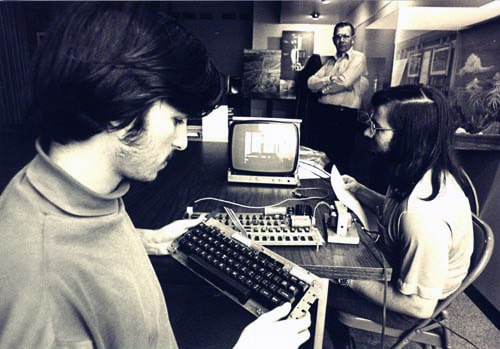
Do these guys look like evil geniuses bent on world domination, or closer to Stallmanesque neckbeards playing with their new toy?
Go hate somewhere else, you waste-of-skin-and-bandwidth. -
Re:Walk it back
Apple exchanged access to PARC's ideas for rights on 100,000 shares of Apple stock. That's some distance from stealing, particularly given the whole world's most valuable company thing recently.
-
Re:Yawn.
IBM licensed MS DOS (no GUI) from Microsoft. Since Microsoft didn't have DOS at the time Bill Gates subsequently purchased QDOS from Seattle Computer Products and modified it for IBM.
Apple and Microsoft as well as Steve Jobs and Bill Gates worked side by side in the early years. Apple contracted Microsoft for all kinds of projects including MAC OS. -
Re:and what about xerox's stuff?
Xerox received shares in exchange for rights to use intellectual property from PARC. The urban myth that it was stolen, is a lie.
False, as a number of other posters have pointed out. Apple did not receive rights to anything from Xerox - they only got a tour and a demo.
Also, Xerox wasn't given any shares in Apple, they were given an opportunity to buy shares.
http://vectronicsappleworld.com/macintosh/creation.html
http://www.fool.com/news/foth/2000/foth000918.htm
(captcha: contrite)
-
Re:Microsoft, I said NO!
It's not like I made it up, you know. It's been pretty well documented and Bill Gates has even signed documents attesting to the fact. Microsoft also paid Apple for copyright infringement in 1998. Here's one good article on it that you might be interested in checking out.