Slashdot Mirror
Domain: machinima.com
Stories and comments across the archive that link to machinima.com.
Stories · 27
-
The Making of the South Park WoW Episode
Via GameSetWatch, an interview with South Park Producer Frank Agnone, Tech Supervisor J. J. Franzen, and Director of Animation Eric Stough. The discussion, on the Machinima.com site, goes into a lot of detail on how the South Park WoW episode was made, their rationale for doing it, and the amount of assistance they received from Blizzard. From the article: "Q: How long did it take to capture, puppeteer, and edit all the WOW footage? JJ: Uhm... A really really long time. We decided early on to treat the in-game capture sessions as regular film shoots. Our 'set' ended up being the lobby of the studio we produce South Park in. We rented 12 PCs, set up a bunch of folding tables, and were basically good to go. I decided that it would be best to capture on a Mac, since we would be able to capture directly to a quicktime file, which would make getting the captured footage onto the editing system a lot quicker. So, I hauled my shiny new MacPro out into the lobby and spent the next two weeks in a much bigger, if less private, new office. We had 5 'shoot' days, the first on the 20th of Sept. which lasted about 3-5 hours. The next was on the 26th of Sept. which also lasted about 4-5 hours., and then we shot almost every other day up to the last few days of production Monday and Tuesday were full days, with the last day going from 10am Tuesday morning to around 3am Wednesday morning the 3rd of Oct,, the day the episode aired." -
Holiday Gaming Potpourri
Illness and Holidays conspire to keep even the best intentioned reviewers from their goals, and so today you're going to get a potpourri of gaming goodness. November was a big month for games, but most of the attention went to Microsoft's new console. Three titles in particular stand out for creativity, for fun, for addictiveness, and for their lack of 360ness. Some of them have been out for a little while now, but if you're looking for recent releases to put under the tree and either can't afford or can't find a 360 to gift, these titles may be just what you're looking for. Read on for my impressions of Soul Calibur III, The Movies, and Civilization IV.- Title: Soul Calibur III
- Developer/Publisher: Namco
- System:PS2
- Score:8/10
It could be argued that 1999 was the finest year in gaming. Half-Life, Everquest, and a little console called the Dreamcast all made themselves known that year to an unsuspecting gaming public. The Dreamcast introduced the world to Soul Calibur, the sequel to Soul Edge and arguably the finest casual fighting game ever made. Soul Calibur III follows in its footsteps with familiar fighting action, beautiful presentation, and some new twists on the old formula.
Soul Calibur III (SC3), like 2003's Soul Calibur II, is more evolution on the core fighting game than revolution. A PS2 exclusive this time around, the goal seems to have been to introduce players to new styles of gameplay without mucking with the extremely popular fighting system. Feints, devastating combos, and block attacks have all been added to the game, adding an element of strategy while continuing to be a perfectly serviceable button-masher. Block attacks are particularly effective, allowing a blocking character who times it right to open up an attacker for a harsh retaliatory strike. The combat may feel a little stale to someone who's been playing Soul Calibur II for two years straight, but there's enough variety to remind fans of the series why the original worked so well. New characters have been added, and while some older characters may seem to be absent most of them are unlockable through story mode play. Both new and old characters have some highly varied fighting techniques, and certain characters that in the past operated quite similarly (such as Mi-na and Kilik) now have more differentiation in their attacks and movement.For the first time, Soul Calibur III does not have a cousin sitting in arcades, and so there is no real 'arcade mode' available. You can still fight a string of enemies through a quick-play option, but the primary single-player game is story mode. As in previous games, story mode puts you in the shoes of a wandering warrior on a quest out in the world. Each character has their own personal demon to slay or gewgaw to retrieve, and as you complete stories you'll gain access to unlockable content like characters and costumes. Cutscenes now have a Resident Evil 4 element to them, with interaction moments requiring you to hit buttons to influence a scene's outcome. These interactions aren't vital; if you fail likely the worst that will happen is you'll start battle down a little bit of health. They do add some interest to what would otherwise be traditionally incomprehensible story elements.
SC3 also incorporates a brand new game mode that attempts to add a real-time strategy twist to the Soul Calibur mode. Chronicles of the Sword allows you to take control of a character you design, and put her through a grand adventure of her own. Unlike the story mode, there are elements of tactical movement and an almost RPG-like atmosphere to the gameplay. Unfortunately, the series' weak storytelling elements make this mode fall flat. Generic opponents (like 'Thief' or 'Warrior'), uninspiring and lengthy text-based storytelling, and simple strategy add up to a play mode that is better in concept than in execution. Character creation, too, sounds more interesting than it really is. There are a number of options, but all of them are somewhat plain and any resulting avatar won't hold a candle to the quality of the main cast of characters.
Soul Calibur III's confinement to the PS2 has also resulted in generationally adequate graphics and no online support. SC3 looks good, to be sure, but it looks as I expected it to be. Nothing surprised me about the graphical presentation or the audio environment at all. The game is probably the best looking fighting game on the PlayStation 2, though, so it's hard to fault it for hardware limitations. Sony's on-the-fence attitude about online participation has resulted in yet another title that is inexcusably offline. Given broadband penetration numbers nowadays, it's mind-boggling to me that this solid fighting game doesn't allow me the option of challenging friends online.
In the end, online or not, Soul Calibur III upholds the good name of the series with complex and well-tested fighting, a memorable cast of characters, and a unique storytelling voice. Anyone looking for a title complex enough to challenge the gamer in their life but approachable enough for the button-masher will be well pleased by what this title has to offer.
- Title: The Movies
- Developer: Lionhead Studios
- Publisher:Activision
- System: PC
- Score: 6/10
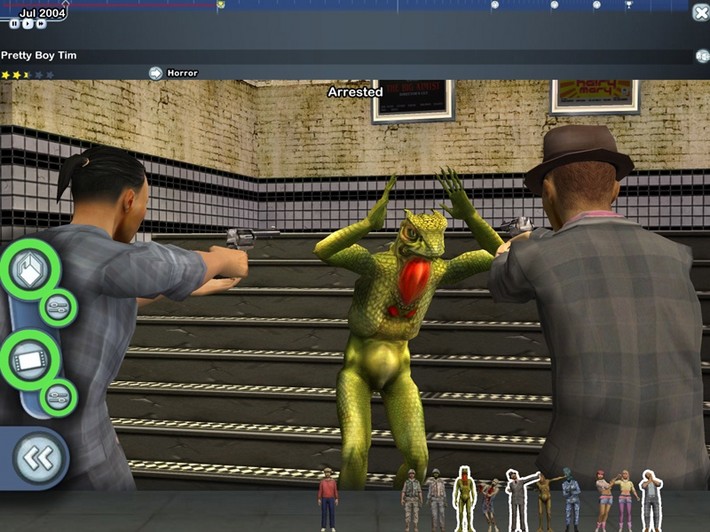
Peter Molyneux's Lionhead Studios has become the industry name in sandbox-style gameplay. They turn from the heady power of a deity to the reality-controlling whims of the director in The Movies, and manage to come up with at least half of an interesting game.
The Movies is actually two titles wrapped up together in the same packaging. One title is a strategy game, where you fill the role of studio lead creating your own movie production company. Like with other strategy titles you purchase buildings, train mooks, and attempt to gather resources. In this case, mooks are hired to fulfill roles on the lot and your resources are gained by releasing films. The core of this aspect of the game is polished and attractive. The game does a fair amount of hand-holding, making sure that you understand what's involved in a film's production and forcing you to learn what it takes to keep the studio running before it sets you loose in the world. The title passes through several eras of film-making, and audience tastes vary with the times. This forces you, as studio lead, to pick and choose movie genres with care because not every genre will be popular in any given decade.The actual process of making the movie is straightforward. You purchase or create a script, assign actors and a director, add a crew, and build sets. Once all the elements are in place the film's production is carried out by the game, allowing you to see to the studio. The only catch is that once you have a few movies under your belt, actors and directors have a tendency to flake out. You'll have to make efforts to keep them happy before they turn to sometimes embarrassing and destructive forms of entertainment, like pills and booze. The in-game timeline and character moods are what keeps the player thinking, always coming up with new ways to please the audience and their employees. Unfortunately, while these elements are the most interesting to think about they won't be what you spend most of your time doing. The strategy element of The Movies mostly centers around maintaining and expansion of the studio itself. If you can keep your actors and directors mostly happy, everything else runs almost on auto. As long as you keep building the latest sets, keep them looking nice, and pay for the newest building options, you'll be able to churn out good-looking shlock that the movie-going public will pay big bucks to see. Frustratingly realistic, isn't it?
The second game wrapped inside The Movies is much more interesting. As part of the strategy game you are allowed the opportunity to make your own scripts. In the script-creation mode you gain access to a sort of mini-video editing suite which offers up facial animations, moods, and actions. Using the suite you can put these all together, specify sets, change the lighting, add subtitles, and even (with a mic) dialogue. It's a powerful creative tool, and there have already been a number of notable machinima titles released by The Movies directors. Machinima.com has an entire The Movies channel for you to check out recent offerings. Some of them are quite profound despite the sometimes crude direction. A protest film made with the game about the French riots has received international media attention, a strong endorsement of the storytelling power of this title.
The problem is that, no matter how much effort you put into a title with the suite the game has no way of knowing whether it's actually good or not. The in-game audience judges it by artificial standards, and even something that could move a person to tears could get panned by the fickle virtual public. This results in a deep discontinuity between the strategy side and the sandbox side of the game. Despite the power of the suite there is no good in-game reason to expend effort with your own scripts. It's a better idea just to pay a lot for a pre-generated script, and concentrate your efforts on ensuring the studio can shoot it.
The Movies, then, is a powerful tool for creating original content wrapped inside a fairly mediocre strategy title. There are some clever elements to running your own studio, and if you're enamored with the movie industry you'll almost certainly get a kick out of the day-to-day activities you'll be monitoring. Otherwise, the strategy game is nothing more than a distraction from the real power of The Movies: the sandbox script creation mode. If you're looking for a powerful set of tools to express yourself, it's hard to recommend against The Movies for its sheer variety and flexibility. Take a pass on this one if all you're looking for is a strategy game, though.
- Title: Civilization IV
- Developer: Firaxis
- Publisher: 2K Games
- System:PC
- Score: 9/10
The addictive spawn of Firaxis Studios strikes again. I spent the better part of my days in college trying desperately to make the AI in Civilization III submit under my benevolent boot of order. That struggle began again with the release of Civilization IV (Civ IV). Civ IV is a turn-based strategy game, and the latest chapter in possibly one of the most popular franchises in the genre. Previous titles are often cited as all-time favorite PC titles, and the series (along with designer Sid Meier) has become an industry standard. Civ IV, then, has big shoes to fill. Luckily, it does so admirably. While Civ III was a refinement of the gameplay offered in Civ II, the fourth installment in the series makes some fundamental changes to the gameplay that results in a faster-paced game that still captures the epic feel of nation against nation combat.
The basics from previous games remain the same. Your goal in Civilization is to take a foundling nation-state and grow it into a world-girding superpower. Along the way you'll engage in diplomacy, develop technologies, and probably involve your country in some 'aggressive negotiation'. You begin by choosing which culture you'll be running. Each culture has an iconic leader, whose role you take on when interacting with other cultures. Every leader has a pair of characteristics which, to a degree, influence how your culture develops. Leaders are notable historical figures from the real-world culture, allowing you the chance to step into the shoes of Abraham Lincoln or Ghengis Khan, as you choose. There are many nations to choose from, far more than originally shipped with Civ III, and you're likely to find at least one culture in the game that will strike a cord.
Once you've chosen your culture you'll place your first city and begin your campaign to rule the world. You have several options on how exactly to go about that lofty goal. Cultural supremacy is a perfectly valid option. Unlike other strategy titles, focusing your energies away from combat is not a sure-fire way to lose. The Cultural win is far more quantified than it has been in the past. Every city produces a number of culture points each turn. These culture points can be increased by building new elements for the city. Features such as theatres, aqueducts, and courts all affect the happiness of the citizenry and the cultural sophistication of the city. Cities have an area of control, a swath of land around the settlement from which your cultural force is projected. By increasing the cultural output of a city, you increase the sphere of control. If an enemy city abuts that sphere of control, and your culture is impressive enough, they may abandon their original culture in favour of your more appealing nation-state. Cultural warfare was possible in previous games, but is transformed into a far more valid option via an important changeup in international relations. Border are no longer crossable by opposing units unless you agree to an open borders pact. While this can be frustrating if a nation is strategically placed, cutting you off from a portion of a continent, this means that the only way a nation can enter your lands without that pact is by declaring war. While this is sometimes not a deterrent to the occasionally bullying AI, at least you'll know they're coming.Besides city features, religious affiliation is a factor in cultural dominance and the chance that a city could be swayed to your cause. Religions are a new feature in Civ IV, tied to technological developments, that open up another avenues for commonality between cities and cultures. Advancement up the tech tree opens up numerous city additions, military units, movement options, and seven religious movements. Though they're not a required part of the cultural strategy, one common religion can smooth the wheels of diplomacy and encourage your cities to act together. Alternatively, if you encourage several religions throughout your nation and develop the right technology, religious tolerance can be a boon as well.
While the faster pace offered by Civ IV isn't immediately obvious, advancing up the tech tree will quickly make you realize that Firaxis has stepped up the pace in this latest installment. The initial epoch of horse-riding, writing, and the alphabet flies by much more quickly than in previous titles. As much as I enjoyed eight hour marathons playing through one game in college, it's extremely gratifying to be able to tackle the world in a shorter timespan. While normal mode was fast enough for me, with a game lasting about three or four hours, there is an even faster mode available that could see you king of the world in as little as an hour. For traditionalists, there is an 'epic' mode that allows you the sedate pace of previous titles.
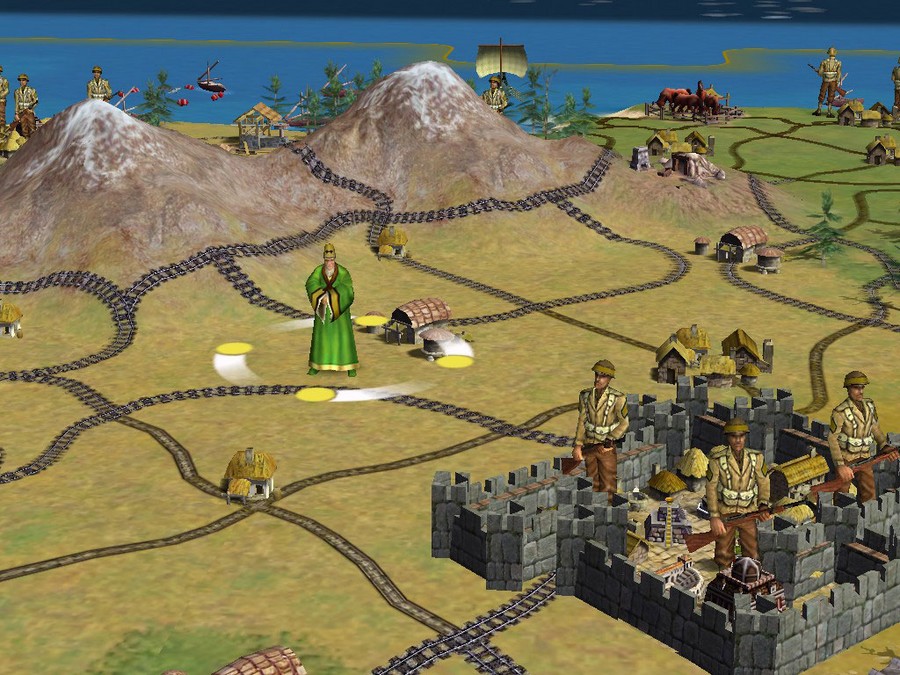
Epic would be an apt way to describe combat in Civilization IV, which has been streamlined and tweaked considerably from the third installment of the game. Military units, which previously had a somewhat murky relationship with one another, are now more clearly marked by their relative strength. Despite the inherent comedy, a spear-wielder can no longer take out a tank as more advanced military units are levels of magnitude stronger than their older counterparts. The mid-game is a frantic rush to gain gunpowder, as swordsmen will lose to musket-wielders in almost every encounter. Refreshingly, the AI has also been reeducated. Not only is it more varied in its tactics, but you are no longer subject to degenerate gameplay sometimes seen in previous titles. There are a number of ways to advance troops now, with each unit usually having more than one option to upgrade to a modern fighting force. In addition to upgrades, seasoned units have promotion possibilities open up. This allows for individually more powerful units within your overall army. Units of all types have been given a tweak, as workers now come equipped with a bevy of tools for improving your nation's infrastructure. Besides roads and irrigation, workers can deploy several types of mines, farmlands, and other civic improvements. A new type of unit has also been added to the game, the great leader. Great leaders come in several different flavours, and each are expendable to gain a useful cultural element. Some leaders create a powerful building within the city that houses them, while others allow you a free technological innovation. While leaders don't appear often they're a welcome rarity to spice up gameplay.The most obvious change to Civilization IV is in the graphical presentation. While Civ III offered a semi-3D look, Civ IV is a true 3D experience. You can scroll in to get as close to the action as you like, or pull far back to get a good sense of the overall scope of your empire. Units and cities are handsomely displayed, with a surprising amount of personality offered up in the little characters that help you run your empire. Combat is much more emotive than in previous games, and you'll have no misunderstandings who is winning and who is losing when the bodies start hitting the dirt. The audio environment is outstanding, with an evocative soundtrack that draws heavily on African rhythms and nationalistic tempos. New tech advances are made just a little more exciting, too, by the addition of the vocal talents of Leonard Nimoy. When he tells you that you've developed a monarchy, you feel good about it.
Civilization IV is a triumphant return for the venerable series. With several careful decision they've breathed new life into this extraordinarily addictive game setting. 'One-more-turn' syndrome is a true danger when you get deep into a confrontation, and easily matches the draw of previous titles. Multiplayer is finally a viable option outside of play-by-email, thanks to the faster pace and variable speeds. Graphical improvements make the user experience more palatable while combat and diplomacy streamlining makes for more understandable moment-to-moment play. If you're at all interested in turn-based strategy titles, you will not be disappointed by Sid Meier's latest offering.
-
MMOG Machinima
An Anonymous Reader wrote in to tell us about a Massively Multiplayer Machinima series entitled A Galaxy Far Away, made in Star Wars Galaxies. MMOGs are increasingly seeing use in Machinima productions and music videos, in works such as SWG's Fallen, WoW's Shutup and Dance, Dark Age of Camelot's Remember, and City of Heroes' Justice. -
MMOG Machinima
An Anonymous Reader wrote in to tell us about a Massively Multiplayer Machinima series entitled A Galaxy Far Away, made in Star Wars Galaxies. MMOGs are increasingly seeing use in Machinima productions and music videos, in works such as SWG's Fallen, WoW's Shutup and Dance, Dark Age of Camelot's Remember, and City of Heroes' Justice. -
Best Tools for Machinima?
wrinkledshirt asks: "As a former Creative Writing major with a huge interest in film, I've been thinking about trying to get into Machinima (com, org, and wiki sites -- basically, using game engines to make movies). Probably the most famous use of it for the Slashdot crowd right now is Red vs Blue, which makes use of Halo, but up until recently, most of the other options have involved FPS game engines, which would require a huge investment in time so as to create non-FPS-genre content for non-FPS-genre movies. Now that Sims 2 is here with its video-recording feature (and the promise of more contemporary realism in the expansion packs) and with Pete Molnyeux's The Movies coming out in 2005, is it possible that an amateur writer could make the Machinimatic movies of his or her dreams? Plus, what would the best tools be? What machine would you need? Would any single game engine help you create your own Citizen Kane?" -
First All-Artificial Feature Film Released
Hugh "Nomad" Hancock writes "Machinima.com have just released the DVD version of Killer Robot, award-winning filmmaker Peter Rasmussen's buddy movie about two mining robots who set out to protect their "meat-sack" masters from a master mining robot gone insane. The twist here is not only that it's Machinima, made in 3D Game Studio, but that even the actor's voices are computer-generated using programs like Festival, making this possibly the world's first all-artificial movie." -
First All-Artificial Feature Film Released
Hugh "Nomad" Hancock writes "Machinima.com have just released the DVD version of Killer Robot, award-winning filmmaker Peter Rasmussen's buddy movie about two mining robots who set out to protect their "meat-sack" masters from a master mining robot gone insane. The twist here is not only that it's Machinima, made in 3D Game Studio, but that even the actor's voices are computer-generated using programs like Festival, making this possibly the world's first all-artificial movie." -
First All-Artificial Feature Film Released
Hugh "Nomad" Hancock writes "Machinima.com have just released the DVD version of Killer Robot, award-winning filmmaker Peter Rasmussen's buddy movie about two mining robots who set out to protect their "meat-sack" masters from a master mining robot gone insane. The twist here is not only that it's Machinima, made in 3D Game Studio, but that even the actor's voices are computer-generated using programs like Festival, making this possibly the world's first all-artificial movie." -
Epic Announces Unreal Contest Machinima Finalists
ILL Robinson writes "Epic Games has annnouced the finalists to the Machinima competition of their Make Something Unreal Contest. Some of the finalists are definitely worth a look -- my current faves being The Tournament by Friedrich Kirshner, The Showdown by Accelerated Pictures, and Lucky Man by James Hamer-Morton. Epic has also announced that they're pushing back the deadline on the Machinima category to Phase 4 so that the filmmakers have more time to polish their works. Congrats to the latest round of finalists!" -
Quake-Based 'Anna' Machinima Publically Released
TheNomad writes "Made in Fountainhead Entertainment's Quake III-based tool, Machinimation, 'Anna' is a real-time generated machinima showing the story of a single flower's life, from birth to - well, I won't spoil it for you. There's a showcase of the film over at Machinima.com, and they also have a download page, as well as a FilePlanet mirror." We've recently run an interview with Katherine Anna Kang, Fountainhead boss and ex-id software employee, and also discussed the 2003 Machinima Film Festival Awards, in which 'Anna' won several awards. -
Quake-Based 'Anna' Machinima Publically Released
TheNomad writes "Made in Fountainhead Entertainment's Quake III-based tool, Machinimation, 'Anna' is a real-time generated machinima showing the story of a single flower's life, from birth to - well, I won't spoil it for you. There's a showcase of the film over at Machinima.com, and they also have a download page, as well as a FilePlanet mirror." We've recently run an interview with Katherine Anna Kang, Fountainhead boss and ex-id software employee, and also discussed the 2003 Machinima Film Festival Awards, in which 'Anna' won several awards. -
Perfecting Stand-Up Comedy Using Quake?
TheNomad writes "Many of you probably know about Machinima, most easily described as 'filmmaking within a real-time, 3D virtual environment', but did you realise that some people are taking it a stage further, and performing improvised Machinima comedy live, using Quake II? There's an interview with the ILL Clan on Machinima.com, talking about their live Machinima work, of which the latest part is called 'Larry & Lenny on the Campaign Trail'." -
Perfecting Stand-Up Comedy Using Quake?
TheNomad writes "Many of you probably know about Machinima, most easily described as 'filmmaking within a real-time, 3D virtual environment', but did you realise that some people are taking it a stage further, and performing improvised Machinima comedy live, using Quake II? There's an interview with the ILL Clan on Machinima.com, talking about their live Machinima work, of which the latest part is called 'Larry & Lenny on the Campaign Trail'." -
Fountainhead Boss On Machinima Perils
Thanks to Machinima.com for their interview with Fountainhead Entertainment boss Katherine Anna Kang, in which the ex-id software biz person discusses their "independent production company that specializes in documentaries and animation... our specialty is Machinima" - that is, "filmmaking within a real-time, 3D virtual environment", often involving videogame engines. Kang laments: "I'm sad that Machinima isn't as popular as I thought it would be by today... the one thing that worries me is that Machinima will be seen as a hobby and not taken seriously, and that very much annoys me." She also mentions: "We may open-source an academic version of [in-house movie tool] Machinimation in the very near future." -
Red vs Blue Sweeps Machinima Awards
TheNomad writes "The Machinima Film Festival 2003 is over, and the results from the awards are in. Red Vs Blue swept the awards with 3 awards for "Best Independent Film", "Best Writing" and "Best Picture". Katherine Anna Kang's firm Fountainhead did very well too, with wins for "Best Direction", "Best Commercial Machinima", "Best Technical Achievement" and "Best Visual Design". Most of the films are available now, and there is a whole bunch of coverage of the event (with pictures) over at Machinima.com." -
Red vs Blue Sweeps Machinima Awards
TheNomad writes "The Machinima Film Festival 2003 is over, and the results from the awards are in. Red Vs Blue swept the awards with 3 awards for "Best Independent Film", "Best Writing" and "Best Picture". Katherine Anna Kang's firm Fountainhead did very well too, with wins for "Best Direction", "Best Commercial Machinima", "Best Technical Achievement" and "Best Visual Design". Most of the films are available now, and there is a whole bunch of coverage of the event (with pictures) over at Machinima.com." -
Red vs Blue Sweeps Machinima Awards
TheNomad writes "The Machinima Film Festival 2003 is over, and the results from the awards are in. Red Vs Blue swept the awards with 3 awards for "Best Independent Film", "Best Writing" and "Best Picture". Katherine Anna Kang's firm Fountainhead did very well too, with wins for "Best Direction", "Best Commercial Machinima", "Best Technical Achievement" and "Best Visual Design". Most of the films are available now, and there is a whole bunch of coverage of the event (with pictures) over at Machinima.com." -
Edinburgh Games Festival - FightBox, Fable, More..
TheNomad writes "This past Monday, the first ever Edinburgh International Games Festival was held. In the middle of the massive Edinburgh Festival cultural season, this is an interesting development for games and gaming. There's a review of the event over at Machinima.com, including details on Peter Molyneux's demo of Fable, the BBC's TV series/game, Fightbox, and other cool stuff." FightBox, a TV show which is "...a gladiatorial arena-style competition between virtual characters, created by members of an online community who compete... to get a chance of appearing on the show itself", is particularly interesting. -
Edinburgh Games Festival - FightBox, Fable, More..
TheNomad writes "This past Monday, the first ever Edinburgh International Games Festival was held. In the middle of the massive Edinburgh Festival cultural season, this is an interesting development for games and gaming. There's a review of the event over at Machinima.com, including details on Peter Molyneux's demo of Fable, the BBC's TV series/game, Fightbox, and other cool stuff." FightBox, a TV show which is "...a gladiatorial arena-style competition between virtual characters, created by members of an online community who compete... to get a chance of appearing on the show itself", is particularly interesting. -
On-line Documentary on Machinima
Hugh "Nomad" Hancock writes "Over at Machinima.com we've released "Artery: Machinima", a 22-minute broadcast TV program on the Machinima movement- film-making in real-time 3D. Originally broadcast on Scottish TV station STV, this documentary includes interviews with Uwe Girlich, the guy who got the whole thing started, sci-fi writer Charlie Stross, who is working with the Machinima group Strange Company, award-winning film director Peter Rasmussen, and Machinima makers including the Ill Clan (Hardly Workin'), Strange Company (Eschaton) and Nanoflix. Plus, lots of swords!" There's also a BitTorrent link to the documentary, courtesy GameTab. -
On-line Documentary on Machinima
Hugh "Nomad" Hancock writes "Over at Machinima.com we've released "Artery: Machinima", a 22-minute broadcast TV program on the Machinima movement- film-making in real-time 3D. Originally broadcast on Scottish TV station STV, this documentary includes interviews with Uwe Girlich, the guy who got the whole thing started, sci-fi writer Charlie Stross, who is working with the Machinima group Strange Company, award-winning film director Peter Rasmussen, and Machinima makers including the Ill Clan (Hardly Workin'), Strange Company (Eschaton) and Nanoflix. Plus, lots of swords!" There's also a BitTorrent link to the documentary, courtesy GameTab. -
Machinima Invade Hollywood's Turf?
Thanks to Wired News for posting an article discussing the rise of machinima, which are "animated movies.. utilizing the [real-time] 3-D graphics engines of games like Quake or Unreal." The article cites prominent machinima such as Jake Hughes' Anachronox: The Movie and the machinima-created music video for Zero 7's 'In The Waiting Line', and according to Bill Rehbock of Nvidia, "..machinima methods, in addition to providing a hobby for aspiring filmmakers, are starting to be used in the creative industries far more than is apparent. For example, George Lucas' Industrial Light and Magic is using the Unreal engine to storyboard Star Wars movies." There's also a significant cash prize for machinima makers as part of Epic's Make Something Unreal competition we mentioned a few weeks back. -
Red Vs. Blue - A Halo Fan Flick
Universal Nerd writes "Red vs. Blue are the folks with a great sense of humor who gave us the Apple Switch spoof, Mac Gamer, a while ago. They're now releasing a new movie called The Blood Gulch Chronicles, a series of episodes created using in-game footage from Halo. Well worth a look and a laugh." The fifth and latest episode came out yesterday, and this is some of the best and funniest machinima I've seen in a long time. Update: 05/05 19:43 GMT by S : Here's a BitTorrent link, thanks to Gametab. -
Anachronox Movie Finished
Sim9 writes "Recently, Anachronox: The Movie released its final episode. The movie is based on the PC game, and is actually rendered using the Quake II engine! (Note that the official mirror is usually full, so also try: Fileplanet, The Archive, AusGamers, and Fileshack. Enjoy!" Update: 04/12 04:58 GMT by T : You can also find BitTorrent files at f.scarywater.net. -
Machinima Festival and News
Hugh Hancock writes: "Machinima (real-time 3D film-making in game engines, what used to be called 'Quake Movies') has a bit of a grab-bag day today -- the New York Times (registration, blah) is running an article on it, prompted by the announcement of the first Machinima-only film festival, sponsored by NVidia!" -
Improv Animation as an Art Form?
Dean Siren asks: "When will mainstream moviemakers, such as Lucasfilm, finally replace their render farms and Renderman with a GPU (Geforce or Radeon) and Cg based renderer? Would the savings in equipment cost and rendering time be worth the learning curve? Is anyone developing such an app? We've had the tech for years with video games, but the art form hasn't really been tried. Is anyone working on this now?" An interesting thought, and it puts an interesting spin on the old computers-will-replace-actors argument. It also means good planning ahead of time, since there will be no "post-production" stage where you can clean up the mistakes, and perform the minute adjustments needed to make things just right. Do you think such an art form will ever catch on in Hollywood, or will small shops have to be the ones to pioneer this before others follow suit?"There's a forum called Machinima whose main idea is that not only should the final rendering of a movie be generated in real time, but so should the animation, implying that computer animation should be performed, maybe even improvised, live by motion captured voice actors. Accomplishing this goal would require replacing not only Renderman but Maya and Softimage as well. A developer named Strange Company took the challenge and started writing an app in this direction called Lithtech Film Producer (interview here). They even made easy porting a high priority. But they soon realized that they were tiny and the project was huge so they quit. But the idea of improv animation is full of potential."
-
Slashback: Unenforceability, Conflagration, Cans
This is Slashback for the evening. Please be advised, through the following items, about ... how to turn that extra Pentium into a firewall running iptables; the state of the Symantec patent on software updates (uughh!); more on can satellites, and more.a filtration system for your 2.4 goldfish Jay Beale points to this followup to his "Why iptables rocks" article of a few weeks ago: "It fulfills my promise to show how to actually build a home/SOHO firewall with Linux 2.4's iptables aka Netfilter. It contains the full code, explained piece by piece, to build a working firewall with 2.4, including all kinds of cool packet mangling for load balancing, redirecting stuff to transparent proxies, or avoiding nmap stealth scans ..."
Out of embarrassment, perhaps? An unnamed correspondent points out this bit of news regarding Symantec's patent on software updates. The upshot is, without pointing out that updating software incrementally is not a patent likely to win them a lot of favor from the industry they have simply decided not to enforce it. Smart move.
Not yet in the can, or the cube either Casey Ho of San Jose's Leland High wrote with some interesting information for those interested in tiny amateur satellites; Leland is one of the handful of schools whose students are designing experimental payloads for inclusion on an upcoming launch.
[We] are focusing on making a CubeSat. Leland High school officially has one satellite to launch, and there are four teams now competing to make a design that will be approved by CalPoly technicians. My own group will attempt to broadcast a powerful long term signal using only a small satellite. The project is not easy since there are a lot of scientific guidelines we must meet. We are discussing how to create a reliable circuit and transmitter that will function in extreme temperatures, vacuum, radiation, and most importantly, after an extra powerful rocket launch. The requirements are available here.
Machinima makes the grade ILL Robinson writes: "Wanted you guys to know that our Quake II-based machinima film, Hardly Workin', received top honors at Showtime Networks' Alternative Media Festival - alt.sho.com. In an awards ceremony on February 8th at MTV Studios, Showtime awarded The ILL Clan with awards in both Best Experimental Short as well as Best of SHO for the festival. Using Machinima (films created with a PC game that can be modified with users' assets), The ILL Clan's film gained notice from the festival's judges - citing Hardly Workin' as a short with a high degree of innovation, design & creativity. We're pretty excited to receive the recognition, all the way from fans of ours who had been following us from the beginning and now, from a top-tier cable TV network. Cruise on over to our site for the official announcement, or to Machinima.com for more machinima works. And thanks also to the Slashdot readers, as they helped spread the word of what Machinima is all about."For some of you posters out there, sorry, no living organisms or explosives are allowed on the satellites. ;)"
Congatulations!