Slashdot Mirror
Domain: microsoft.com
Stories and comments across the archive that link to microsoft.com.
Stories · 1,971
-
Microsoft Modifies Open-Source Code, Blows Hole In Windows Defender (theregister.co.uk)
An anonymous reader quotes a report from The Register: A remote-code execution vulnerability in Windows Defender -- a flaw that can be exploited by malicious .rar files to run malware on PCs -- has been traced back to an open-source archiving tool Microsoft adopted for its own use. The bug, CVE-2018-0986, was patched on Tuesday in the latest version of the Microsoft Malware Protection Engine (1.1.14700.5) in Windows Defender, Security Essentials, Exchange Server, Forefront Endpoint Protection, and Intune Endpoint Protection. This update should be installed, or may have been automatically installed already on your device. The vulnerability can be leveraged by an attacker to achieve remote code execution on a victim's machine simply by getting the mark to download -- via a webpage or email or similar -- a specially crafted .rar file while the anti-malware engine's scanning feature is on. In many cases, this analysis set to happen automatically.
When the malware engine scans the malicious archive, it triggers a memory corruption bug that leads to the execution of evil code smuggled within the file with powerful LocalSystem rights, granting total control over the computer. The screwup was discovered and reported to Microsoft by legendary security researcher Halvar Flake, now working for Google. Flake was able to trace the vulnerability back to an older version of unrar, an open-source archiving utility used to unpack .rar archives. Apparently, Microsoft forked that version of unrar and incorporated the component into its operating system's antivirus engine. That forked code was then modified so that all signed integer variables were converted to unsigned variables, causing knock-on problems with mathematical comparisons. This in turn left the software vulnerable to memory corruption errors, which can crash the antivirus package or allow malicious code to potentially execute. -
Microsoft Modifies Open-Source Code, Blows Hole In Windows Defender (theregister.co.uk)
An anonymous reader quotes a report from The Register: A remote-code execution vulnerability in Windows Defender -- a flaw that can be exploited by malicious .rar files to run malware on PCs -- has been traced back to an open-source archiving tool Microsoft adopted for its own use. The bug, CVE-2018-0986, was patched on Tuesday in the latest version of the Microsoft Malware Protection Engine (1.1.14700.5) in Windows Defender, Security Essentials, Exchange Server, Forefront Endpoint Protection, and Intune Endpoint Protection. This update should be installed, or may have been automatically installed already on your device. The vulnerability can be leveraged by an attacker to achieve remote code execution on a victim's machine simply by getting the mark to download -- via a webpage or email or similar -- a specially crafted .rar file while the anti-malware engine's scanning feature is on. In many cases, this analysis set to happen automatically.
When the malware engine scans the malicious archive, it triggers a memory corruption bug that leads to the execution of evil code smuggled within the file with powerful LocalSystem rights, granting total control over the computer. The screwup was discovered and reported to Microsoft by legendary security researcher Halvar Flake, now working for Google. Flake was able to trace the vulnerability back to an older version of unrar, an open-source archiving utility used to unpack .rar archives. Apparently, Microsoft forked that version of unrar and incorporated the component into its operating system's antivirus engine. That forked code was then modified so that all signed integer variables were converted to unsigned variables, causing knock-on problems with mathematical comparisons. This in turn left the software vulnerable to memory corruption errors, which can crash the antivirus package or allow malicious code to potentially execute. -
Microsoft Touts Breakthrough In Making Chatbots More Conversational (windowscentral.com)
In a blog post today, Microsoft said that it has created what it believes is the "first technological breakthrough" toward making conversations with chatbots more like speaking to another person. Windows Central reports: Microsoft says that it has figured out how to make chatbots talk and listen at the same time, allowing them to operate in "full duplex," to use telecommunications jargon. The company says this allows chatbots or assistants to have a flowing conversation with humans, much more akin to how people talk to one another. That stands in contrast to how digital assistants and bots currently work, where only one side can talk at any given time. The technology is already up and running in Xiaolce, Microsoft's AI chatbot currently operating in China. Using "full duplex voice sense," as Microsoft calls it, Xiaolce can more quickly predict what the person it is speaking to will say. "That helps her make decisions about both how and when to respond to someone who is chatting with her, a skill set that is very natural to people but not yet common in chatbots," Microsoft says. Another bonus of the breakthrough is that people interacting with chatbots don't have to use a "wake word" every time they speak during a conversation. -
Microsoft Email Privacy Case No Longer Needed, Says The US (cnn.com)
An anonymous reader quotes CNN: The U.S. Department of Justice is asking the Supreme Court to abandon its case against Microsoft over international data privacy. A new law signed by President Donald Trump last week answers the legal question at the heart of Microsoft's case, the DOJ says. So the case "is now moot," the department said in a court filing posted Saturday.
Microsoft's legal battle began in 2013, when it refused to hand over emails stored on a server in Ireland to US officials who were investigating drug trafficking. Microsoft argued at the time that sharing data stored abroad could violate international treaties and policies, and there was no law on the books to provide any clarity. That changed with the The Cloud Act, which was tucked into the spending bill that Trump signed March 23. The act establishes a legal pathway for the United States to form agreements with other nations that make it easier for law enforcement to collect data stored on foreign soil... Microsoft cheered the new law, saying the Cloud Act provides the legal clarity the company sought.
The ACLU's legislative counsel argues that the new act hurts privacy and human rights, "at a time when human rights activists, dissidents and journalists around the world face unprecedented attacks."
"Would even a well-intentioned technology company, particularly a small one, have the expertise and resources to competently assess the risk that a foreign order may pose to a particular human rights activist?" -
Microsoft To Ban 'Offensive Language' From Skype, Xbox, Office and Other Services (csoonline.com)
According to Microsoft's new Terms of Services agreement, you could get banned for "offensive language," resulting in the termination of your Gold Membership and/or any Microsoft account balances. The changes go into effect on May 1. CSO Online reports: [I]f you and a significant other are getting hot and heavy via Skype, you better watch your language and any nudity because that, too, can get you banned. The ban hammer could also fall if Cortana is listening at the wrong moment or if documents and files hosted on Microsoft services violate Microsoft's amended terms. But how would Microsoft even know if you had truly been "offensive?" Well, that part falls under Code of Conduct Enforcement, which states, "When investigating alleged violations of these Terms, Microsoft reserves the right to review Your Content in order to resolve the issue." Microsoft did add, "However, we cannot monitor the entire Services and make no attempt to do so." I'm not sure that will make you feel better, as another portion states that Microsoft "may also block delivery of a communication (like email, file sharing or instant message) to or from the Services in an effort to enforce these Terms or we may remove or refuse to publish Your Content for any reason." -
Microsoft To Ban 'Offensive Language' From Skype, Xbox, Office and Other Services (csoonline.com)
According to Microsoft's new Terms of Services agreement, you could get banned for "offensive language," resulting in the termination of your Gold Membership and/or any Microsoft account balances. The changes go into effect on May 1. CSO Online reports: [I]f you and a significant other are getting hot and heavy via Skype, you better watch your language and any nudity because that, too, can get you banned. The ban hammer could also fall if Cortana is listening at the wrong moment or if documents and files hosted on Microsoft services violate Microsoft's amended terms. But how would Microsoft even know if you had truly been "offensive?" Well, that part falls under Code of Conduct Enforcement, which states, "When investigating alleged violations of these Terms, Microsoft reserves the right to review Your Content in order to resolve the issue." Microsoft did add, "However, we cannot monitor the entire Services and make no attempt to do so." I'm not sure that will make you feel better, as another portion states that Microsoft "may also block delivery of a communication (like email, file sharing or instant message) to or from the Services in an effort to enforce these Terms or we may remove or refuse to publish Your Content for any reason." -
One Startup is Using Phone Calls and Other Inexpensive Means To Save TB Patients (microsoft.com)
Tuberculosis (TB) is one of most common causes of death globally. In 2016 alone, more than 10.4 million people fell sick to TB and 1.7 million TB-related deaths were reported. The WHO says India, in particular, and developing markets, in general, lead the count for the occurrence of TB in the world even as the local authorities provide free and effective medications to anyone who is ill. From a report: "One of the biggest barriers to recovery from TB is medication adherence," explains Microsoft Researcher Bill Thies, who is also the Chairman and Co-founder of Everwell Health Solutions, a Bangalore-based healthcare start-up. "Patients have to take daily drugs for a full six months, or else they do not fully recover, and are at risk of developing drug resistance. While medication adherence might sound like a simple problem, it turns out to be an enormously complex and heavily studied multi-disciplinary problem. If patients start feeling better after a few weeks, how can we convince them to take toxic drugs for another five months -- especially if patients have little or no understanding of germs and antibiotic resistance?"
The popular recommended practice to ensure medication adherence is Directly Observed Treatment or DOTS, which involves the patients going to a healthcare centre where they ingest the medication in front of a health worker. As it was implemented at the start of their work, patients needed to visit the centre three times per week for the first two months and once a week for the remaining four months. The system involves an unnecessary burden on the patients, who are typically from low-income groups -- every visit means travel expense and loss of work. There are ways to ensure that a patient has taken medication on time -- we have things like smart pills, and you can send texts to people to remind them about the pills -- but in places like India, these solutions are beyond the reach of people. So in 2013, Thies and his colleagues, along with Microsoft Research Program Manager and TEM collaborator, started a project called 99DOTS to explore if any low-cost tech solution could be employed. They did find one, and it involves making a "missed call" to people. Here's the fascinating story of what happened next. -
One Startup is Using Phone Calls and Other Inexpensive Means To Save TB Patients (microsoft.com)
Tuberculosis (TB) is one of most common causes of death globally. In 2016 alone, more than 10.4 million people fell sick to TB and 1.7 million TB-related deaths were reported. The WHO says India, in particular, and developing markets, in general, lead the count for the occurrence of TB in the world even as the local authorities provide free and effective medications to anyone who is ill. From a report: "One of the biggest barriers to recovery from TB is medication adherence," explains Microsoft Researcher Bill Thies, who is also the Chairman and Co-founder of Everwell Health Solutions, a Bangalore-based healthcare start-up. "Patients have to take daily drugs for a full six months, or else they do not fully recover, and are at risk of developing drug resistance. While medication adherence might sound like a simple problem, it turns out to be an enormously complex and heavily studied multi-disciplinary problem. If patients start feeling better after a few weeks, how can we convince them to take toxic drugs for another five months -- especially if patients have little or no understanding of germs and antibiotic resistance?"
The popular recommended practice to ensure medication adherence is Directly Observed Treatment or DOTS, which involves the patients going to a healthcare centre where they ingest the medication in front of a health worker. As it was implemented at the start of their work, patients needed to visit the centre three times per week for the first two months and once a week for the remaining four months. The system involves an unnecessary burden on the patients, who are typically from low-income groups -- every visit means travel expense and loss of work. There are ways to ensure that a patient has taken medication on time -- we have things like smart pills, and you can send texts to people to remind them about the pills -- but in places like India, these solutions are beyond the reach of people. So in 2013, Thies and his colleagues, along with Microsoft Research Program Manager and TEM collaborator, started a project called 99DOTS to explore if any low-cost tech solution could be employed. They did find one, and it involves making a "missed call" to people. Here's the fascinating story of what happened next. -
Microsoft Announces Breakthrough In Chinese-To-English Machine Translation (techcrunch.com)
A team of Microsoft researchers announced on Wednesday they've created the first machine translation system that's capable of translating news articles from Chinese to English with the same accuracy as a person. "The company says it's tested the system repeatedly on a sample of around 2,000 sentences from various online newspapers, comparing the result to a person's translation in the process -- and even hiring outside bilingual language consultants to further verify the machine's accuracy," reports TechCrunch. From the report: The sample set, called newstest2017, was released just last fall at the research conference WMT17. Deep neural networks, a method of training A.I. systems, allowed the researchers to create more fluent and natural-sounding translations that take into account broader context that the prior approaches, called statistical machine translation. Microsoft's researchers also added their own training methods to the system to improve its accuracy -- things they equate to how people go over their own work time and again to make sure it's right.
The researchers said they used methods including dual learning for fact-checking translations; deliberation networks, to repeat translations and refine them; and new techniques like joint training, to iteratively boost English-to-Chinese and Chinese-to-English translation systems; and agreement regularization, which can generate translations by reading sentences both left-to-right and right-to-left. Zhou said the techniques used to achieve the milestone won't be limited to machine translations. The researchers caution the system has not yet been tested on real-time news stories, and there are other challenges that still lie ahead before the technology could be commercialized into Microsoft's products. You can play around with the new translation system here. -
Microsoft Announces Breakthrough In Chinese-To-English Machine Translation (techcrunch.com)
A team of Microsoft researchers announced on Wednesday they've created the first machine translation system that's capable of translating news articles from Chinese to English with the same accuracy as a person. "The company says it's tested the system repeatedly on a sample of around 2,000 sentences from various online newspapers, comparing the result to a person's translation in the process -- and even hiring outside bilingual language consultants to further verify the machine's accuracy," reports TechCrunch. From the report: The sample set, called newstest2017, was released just last fall at the research conference WMT17. Deep neural networks, a method of training A.I. systems, allowed the researchers to create more fluent and natural-sounding translations that take into account broader context that the prior approaches, called statistical machine translation. Microsoft's researchers also added their own training methods to the system to improve its accuracy -- things they equate to how people go over their own work time and again to make sure it's right.
The researchers said they used methods including dual learning for fact-checking translations; deliberation networks, to repeat translations and refine them; and new techniques like joint training, to iteratively boost English-to-Chinese and Chinese-to-English translation systems; and agreement regularization, which can generate translations by reading sentences both left-to-right and right-to-left. Zhou said the techniques used to achieve the milestone won't be limited to machine translations. The researchers caution the system has not yet been tested on real-time news stories, and there are other challenges that still lie ahead before the technology could be commercialized into Microsoft's products. You can play around with the new translation system here. -
Microsoft Announces Breakthrough In Chinese-To-English Machine Translation (techcrunch.com)
A team of Microsoft researchers announced on Wednesday they've created the first machine translation system that's capable of translating news articles from Chinese to English with the same accuracy as a person. "The company says it's tested the system repeatedly on a sample of around 2,000 sentences from various online newspapers, comparing the result to a person's translation in the process -- and even hiring outside bilingual language consultants to further verify the machine's accuracy," reports TechCrunch. From the report: The sample set, called newstest2017, was released just last fall at the research conference WMT17. Deep neural networks, a method of training A.I. systems, allowed the researchers to create more fluent and natural-sounding translations that take into account broader context that the prior approaches, called statistical machine translation. Microsoft's researchers also added their own training methods to the system to improve its accuracy -- things they equate to how people go over their own work time and again to make sure it's right.
The researchers said they used methods including dual learning for fact-checking translations; deliberation networks, to repeat translations and refine them; and new techniques like joint training, to iteratively boost English-to-Chinese and Chinese-to-English translation systems; and agreement regularization, which can generate translations by reading sentences both left-to-right and right-to-left. Zhou said the techniques used to achieve the milestone won't be limited to machine translations. The researchers caution the system has not yet been tested on real-time news stories, and there are other challenges that still lie ahead before the technology could be commercialized into Microsoft's products. You can play around with the new translation system here. -
Microsoft Announces Breakthrough In Chinese-To-English Machine Translation (techcrunch.com)
A team of Microsoft researchers announced on Wednesday they've created the first machine translation system that's capable of translating news articles from Chinese to English with the same accuracy as a person. "The company says it's tested the system repeatedly on a sample of around 2,000 sentences from various online newspapers, comparing the result to a person's translation in the process -- and even hiring outside bilingual language consultants to further verify the machine's accuracy," reports TechCrunch. From the report: The sample set, called newstest2017, was released just last fall at the research conference WMT17. Deep neural networks, a method of training A.I. systems, allowed the researchers to create more fluent and natural-sounding translations that take into account broader context that the prior approaches, called statistical machine translation. Microsoft's researchers also added their own training methods to the system to improve its accuracy -- things they equate to how people go over their own work time and again to make sure it's right.
The researchers said they used methods including dual learning for fact-checking translations; deliberation networks, to repeat translations and refine them; and new techniques like joint training, to iteratively boost English-to-Chinese and Chinese-to-English translation systems; and agreement regularization, which can generate translations by reading sentences both left-to-right and right-to-left. Zhou said the techniques used to achieve the milestone won't be limited to machine translations. The researchers caution the system has not yet been tested on real-time news stories, and there are other challenges that still lie ahead before the technology could be commercialized into Microsoft's products. You can play around with the new translation system here. -
Microsoft Announces Breakthrough In Chinese-To-English Machine Translation (techcrunch.com)
A team of Microsoft researchers announced on Wednesday they've created the first machine translation system that's capable of translating news articles from Chinese to English with the same accuracy as a person. "The company says it's tested the system repeatedly on a sample of around 2,000 sentences from various online newspapers, comparing the result to a person's translation in the process -- and even hiring outside bilingual language consultants to further verify the machine's accuracy," reports TechCrunch. From the report: The sample set, called newstest2017, was released just last fall at the research conference WMT17. Deep neural networks, a method of training A.I. systems, allowed the researchers to create more fluent and natural-sounding translations that take into account broader context that the prior approaches, called statistical machine translation. Microsoft's researchers also added their own training methods to the system to improve its accuracy -- things they equate to how people go over their own work time and again to make sure it's right.
The researchers said they used methods including dual learning for fact-checking translations; deliberation networks, to repeat translations and refine them; and new techniques like joint training, to iteratively boost English-to-Chinese and Chinese-to-English translation systems; and agreement regularization, which can generate translations by reading sentences both left-to-right and right-to-left. Zhou said the techniques used to achieve the milestone won't be limited to machine translations. The researchers caution the system has not yet been tested on real-time news stories, and there are other challenges that still lie ahead before the technology could be commercialized into Microsoft's products. You can play around with the new translation system here. -
Microsoft Announces Breakthrough In Chinese-To-English Machine Translation (techcrunch.com)
A team of Microsoft researchers announced on Wednesday they've created the first machine translation system that's capable of translating news articles from Chinese to English with the same accuracy as a person. "The company says it's tested the system repeatedly on a sample of around 2,000 sentences from various online newspapers, comparing the result to a person's translation in the process -- and even hiring outside bilingual language consultants to further verify the machine's accuracy," reports TechCrunch. From the report: The sample set, called newstest2017, was released just last fall at the research conference WMT17. Deep neural networks, a method of training A.I. systems, allowed the researchers to create more fluent and natural-sounding translations that take into account broader context that the prior approaches, called statistical machine translation. Microsoft's researchers also added their own training methods to the system to improve its accuracy -- things they equate to how people go over their own work time and again to make sure it's right.
The researchers said they used methods including dual learning for fact-checking translations; deliberation networks, to repeat translations and refine them; and new techniques like joint training, to iteratively boost English-to-Chinese and Chinese-to-English translation systems; and agreement regularization, which can generate translations by reading sentences both left-to-right and right-to-left. Zhou said the techniques used to achieve the milestone won't be limited to machine translations. The researchers caution the system has not yet been tested on real-time news stories, and there are other challenges that still lie ahead before the technology could be commercialized into Microsoft's products. You can play around with the new translation system here. -
Kali Linux For WSL Now Available in the Windows Store (microsoft.com)
You can now download and install Kali Linux via the Windows Store. From a blog post on MSDN: Our community expressed great interest in bringing Kali Linux to WSL in response to a blog post on Kali Linux on WSL. We are happy to officially introduce Kali Linux on WSL. -
Microsoft Starts Selling Lumia Windows Phones Again (theverge.com)
After removing its Lumia devices back in June, Microsoft has started selling them again at the company's online retail store. According to Windows Latest, Microsoft U.S. Store is selling the Lumia 950 for $399, Lumia 950 XL for $499, Lumia 550 and Lumia 650 for $139 and $199 respectively. From the report: A Microsoft Store sales agent confirmed to us that Lumia phones are back in the store on February 4 after a long gap. "They are recently back this early February. Specifically, on February 4th 2018," Microsoft sales team told us. Rumor had it that Microsoft wanted to sell as many Lumias as possible until stores ran out of stock, but it looks like the plans have changed or the company is selling the remaining stock which they recently discovered. -
Microsoft Starts Selling Lumia Windows Phones Again (theverge.com)
After removing its Lumia devices back in June, Microsoft has started selling them again at the company's online retail store. According to Windows Latest, Microsoft U.S. Store is selling the Lumia 950 for $399, Lumia 950 XL for $499, Lumia 550 and Lumia 650 for $139 and $199 respectively. From the report: A Microsoft Store sales agent confirmed to us that Lumia phones are back in the store on February 4 after a long gap. "They are recently back this early February. Specifically, on February 4th 2018," Microsoft sales team told us. Rumor had it that Microsoft wanted to sell as many Lumias as possible until stores ran out of stock, but it looks like the plans have changed or the company is selling the remaining stock which they recently discovered. -
Microsoft Starts Selling Lumia Windows Phones Again (theverge.com)
After removing its Lumia devices back in June, Microsoft has started selling them again at the company's online retail store. According to Windows Latest, Microsoft U.S. Store is selling the Lumia 950 for $399, Lumia 950 XL for $499, Lumia 550 and Lumia 650 for $139 and $199 respectively. From the report: A Microsoft Store sales agent confirmed to us that Lumia phones are back in the store on February 4 after a long gap. "They are recently back this early February. Specifically, on February 4th 2018," Microsoft sales team told us. Rumor had it that Microsoft wanted to sell as many Lumias as possible until stores ran out of stock, but it looks like the plans have changed or the company is selling the remaining stock which they recently discovered. -
Microsoft Starts Selling Lumia Windows Phones Again (theverge.com)
After removing its Lumia devices back in June, Microsoft has started selling them again at the company's online retail store. According to Windows Latest, Microsoft U.S. Store is selling the Lumia 950 for $399, Lumia 950 XL for $499, Lumia 550 and Lumia 650 for $139 and $199 respectively. From the report: A Microsoft Store sales agent confirmed to us that Lumia phones are back in the store on February 4 after a long gap. "They are recently back this early February. Specifically, on February 4th 2018," Microsoft sales team told us. Rumor had it that Microsoft wanted to sell as many Lumias as possible until stores ran out of stock, but it looks like the plans have changed or the company is selling the remaining stock which they recently discovered. -
Microsoft Issues Windows Out-of-Band Update That Disables Spectre Mitigations (bleepingcomputer.com)
An anonymous reader quotes BleepingComputer: Microsoft has issued on Saturday an emergency out-of-band Windows update that disables patches for the Spectre Variant 2 bug (CVE-2017-5715). The update -- KB4078130 -- targets Windows 7 (SP1), Windows 8.1, all versions of Windows 10, and all supported Windows Server distributions. Microsoft shipped mitigations for the Meltdown and Spectre bugs on January 3. The company said it decided to disable mitigations for the Spectre Variant 2 bug after Intel publicly admitted that the microcode updates it developed for this bug caused "higher than expected reboots and other unpredictable system behavior" that led to "data loss or corruption."
HP, Dell, and Red Hat took previous steps during the past week.
"We are also offering a new option -- available for advanced users on impacted devices -- to manually disable and enable the mitigation against Spectre Variant 2 (CVE 2017-5715) independently via registry setting changes..." Microsoft writes.
"We recommend Windows customers, when appropriate, reenable the mitigation against CVE-2017-5715 when Intel reports that this unpredictable system behavior has been resolved for your device. " -
Microsoft Fights Search Warrants for Overseas Emails in the Supreme Court (microsoft.com)
Microsoft's Chief Legal Officer writes about "the landmark Microsoft case that will decide whether the U.S. government can use a search warrant to force a company to seize a customer's private emails stored in Ireland and import them to the United States." On Thursday, 289 different groups and individuals from 37 countries signed 23 different legal briefs supporting Microsoft's position that Congress never gave law enforcement the power to ignore treaties and breach Ireland's sovereignty in this way. How could it? The government relies on a law that was enacted in 1986, before anyone conceived of cloud computing... When the U.S. government requires a tech company to execute a warrant for emails stored overseas, the provider must search a foreign datacenter and make a copy abroad, and then import that copy to the United States. This creates a complex issue with huge international consequences. It shouldn't be resolved by taking the law to a place it was never intended to go...
The U.S. Department of Justice's attempt to seize foreign customers' emails from other countries ignores borders, treaties and international law, as well as the laws those countries have in place to protect the privacy of their own citizens... It's also a path that will lead to the doorsteps of American homes by putting the privacy of U.S. citizens' emails at risk. If the U.S. government obtains the power to search and seize foreign citizens' private communications physically stored in other countries, it will invite other governments to do the same thing. If we ignore other countries' laws, how can we demand that they respect our laws?
Amicus briefs supporting Microsoft have been filed in the U.S. Supreme Court by Ireland, France, and the European Commission and European privacy regulators. Microsoft even notes that on this issue, "Fox News agreed with the American Civil Liberties Union." -
Microsoft Fights Search Warrants for Overseas Emails in the Supreme Court (microsoft.com)
Microsoft's Chief Legal Officer writes about "the landmark Microsoft case that will decide whether the U.S. government can use a search warrant to force a company to seize a customer's private emails stored in Ireland and import them to the United States." On Thursday, 289 different groups and individuals from 37 countries signed 23 different legal briefs supporting Microsoft's position that Congress never gave law enforcement the power to ignore treaties and breach Ireland's sovereignty in this way. How could it? The government relies on a law that was enacted in 1986, before anyone conceived of cloud computing... When the U.S. government requires a tech company to execute a warrant for emails stored overseas, the provider must search a foreign datacenter and make a copy abroad, and then import that copy to the United States. This creates a complex issue with huge international consequences. It shouldn't be resolved by taking the law to a place it was never intended to go...
The U.S. Department of Justice's attempt to seize foreign customers' emails from other countries ignores borders, treaties and international law, as well as the laws those countries have in place to protect the privacy of their own citizens... It's also a path that will lead to the doorsteps of American homes by putting the privacy of U.S. citizens' emails at risk. If the U.S. government obtains the power to search and seize foreign citizens' private communications physically stored in other countries, it will invite other governments to do the same thing. If we ignore other countries' laws, how can we demand that they respect our laws?
Amicus briefs supporting Microsoft have been filed in the U.S. Supreme Court by Ireland, France, and the European Commission and European privacy regulators. Microsoft even notes that on this issue, "Fox News agreed with the American Civil Liberties Union." -
Microsoft Puts Minecraft Boss In Charge of Xbox Games (theverge.com)
Microsoft is promoting its Minecraft boss to the head of the company's games studios. "Matt Booty's new role sees him oversee Microsoft Studios, second only to Microsoft's games chief Phil Spencer," reports The Verge. "Microsoft CEO Satya Nadella previously promoted Phil Spencer from head of Xbox to a new role overseeing all games, associated hardware, and game strategy." From the report: Spencer reports directly to Nadella, with Booty now reporting directly to Spencer. GamesBeat reports that Booty's new role will see Microsoft devoting more resources to its games business. Booty will be looking after Microsoft's relationships with 343 Industries, The Coalition, Mojang, Rare, Turn 10 Studios, and Global Publishing. Booty first joined Microsoft back in 2010, and helped launch games for Windows phones. He's also helped develop Xbox Live Arcade, and oversaw Minecraft maker Mojang after Microsoft acquired the company for $2.5 billion back in 2014. -
Microsoft Details Performance Impact of Spectre and Meltdown Mitigations on Windows Systems (microsoft.com)
Microsoft's Windows chief Terry Myerson on Tuesday outlined how Spectre and Meltdown firmware updates may affect PC performance. From a blog post: With Windows 10 on newer silicon (2016-era PCs with Skylake, Kabylake or newer CPU), benchmarks show single-digit slowdowns, but we don't expect most users to notice a change because these percentages are reflected in milliseconds.
With Windows 10 on older silicon (2015-era PCs with Haswell or older CPU), some benchmarks show more significant slowdowns, and we expect that some users will notice a decrease in system performance. With Windows 8 and Windows 7 on older silicon (2015-era PCs with Haswell or older CPU), we expect most users to notice a decrease in system performance.
Windows Server on any silicon, especially in any IO-intensive application, shows a more significant performance impact when you enable the mitigations to isolate untrusted code within a Windows Server instance. This is why you want to be careful to evaluate the risk of untrusted code for each Windows Server instance, and balance the security versus performance tradeoff for your environment.
For context, on newer CPUs such as on Skylake and beyond, Intel has refined the instructions used to disable branch speculation to be more specific to indirect branches, reducing the overall performance penalty of the Spectre mitigation. Older versions of Windows have a larger performance impact because Windows 7 and Windows 8 have more user-kernel transitions because of legacy design decisions, such as all font rendering taking place in the kernel. -
Microsoft Disables Word DDE Feature To Prevent Further Malware Attacks (bleepingcomputer.com)
An anonymous reader writes: As part of the December 2017 Patch Tuesday, Microsoft has shipped an Office update that disables the DDE feature in Word applications, after several malware campaigns have abused this feature to install malware. DDE stands for Dynamic Data Exchange, and this is an Office feature that allows an Office application to load data from other Office applications. For example, a Word file can update a table by pulling data from an Excel file every time the Word file is opened. DDE is an old feature, which Microsoft has superseded via the newer Object Linking and Embedding (OLE) toolkit, but DDE is still supported by Office applications.
The December Patch Tuesday disables DDE only in Word, but not Excel or Outlook. The reason is that several cybercrime and spam groups have jumped on this technique, which is much more effective at running malicious code when compared to macros or OLE objects, as it requires minimal interaction with a UI popup that many users do not associate with malware. For Outlook and Excel, Microsoft has published instructions on how users can disable DDE on their own, if they don't want this feature enabled. -
Microsoft Releases Free Preview of Its Quantum Development Kit (zdnet.com)
Microsoft is releasing a free preview version of its Quantum Development Kit. "The kit includes the Q# programming language and compiler and a local quantum computing simulator, and is fully integrated with Visual Studio," reports ZDNet. "There's also an Azure-based simulator that allows developers to simulate more than 40 logical qubits of computing power, plus documentation libraries, and sample programs, officials said in their December 11 announcement." From the report: Quantum computers are designed to process in parallel, thus enabling new types of applications across a variety of workloads. They are designed to harness the physics of subatomic particles to provide a different way to store data and solve problems compared to conventional computers, as my ZDNet colleague Tony Baer explains. The result is that quantum computers could solve certain high-performance-computing problems more efficiently. Microsoft officials have said applications that developers create for use with the quantum simulator ultimately will work on a quantum computer, which Microsoft is in the process of developing. Microsoft's goal is to build out a full quantum computing system, including both the quantum computing hardware and the related full software stack. -
Microsoft Releases Free Preview of Its Quantum Development Kit (zdnet.com)
Microsoft is releasing a free preview version of its Quantum Development Kit. "The kit includes the Q# programming language and compiler and a local quantum computing simulator, and is fully integrated with Visual Studio," reports ZDNet. "There's also an Azure-based simulator that allows developers to simulate more than 40 logical qubits of computing power, plus documentation libraries, and sample programs, officials said in their December 11 announcement." From the report: Quantum computers are designed to process in parallel, thus enabling new types of applications across a variety of workloads. They are designed to harness the physics of subatomic particles to provide a different way to store data and solve problems compared to conventional computers, as my ZDNet colleague Tony Baer explains. The result is that quantum computers could solve certain high-performance-computing problems more efficiently. Microsoft officials have said applications that developers create for use with the quantum simulator ultimately will work on a quantum computer, which Microsoft is in the process of developing. Microsoft's goal is to build out a full quantum computing system, including both the quantum computing hardware and the related full software stack. -
'Process Doppelganging' Attack Bypasses Most Security Products, Works On All Windows Versions (bleepingcomputer.com)
An anonymous reader quotes a report from Bleeping Computer: Yesterday, at the Black Hat Europe 2017 security conference in London, two security researchers from cyber-security firm enSilo have described a new code injection technique called "Process Doppelganging." This new attack works on all Windows versions and researchers say it bypasses most of today's major security products. Process Doppelganging is somewhat similar to another technique called "Process Hollowing," but with a twist, as it utilizes the Windows mechanism of NTFS Transactions.
"The goal of the technique is to allow a malware to run arbitrary code (including code that is known to be malicious) in the context of a legitimate process on the target machine," Tal Liberman & Eugene Kogan, the two enSilo researchers who discovered the attack told Bleeping Computer. "Very similar to process hollowing but with a novel twist. The challenge is doing it without using suspicious process and memory operations such as SuspendProcess, NtUnmapViewOfSection. In order to achieve this goal we leverage NTFS transactions. We overwrite a legitimate file in the context of a transaction. We then create a section from the modified file (in the context of the transaction) and create a process out of it. It appears that scanning the file while it's in transaction is not possible by the vendors we checked so far (some even hang) and since we rollback the transaction, our activity leaves no trace behind." The good news is that "there are a lot of technical challenges" in making Process Doppelganging work, and attackers need to know "a lot of undocumented details on process creation." The bad news is that the attack "cannot be patched since it exploits fundamental features and the core design of the process loading mechanism in Windows." More research on the attack will be published on the Black Hat website in the following days. -
Should Teachers Get $100 For Steering Kids To Google's 'Hour of Code' Lesson?
Tomorrow's "Hour of Code" kick-off event features Melinda Gates, Facebook COO Sheryl Sandberg, YouTube CEO Susan Wojcicki, and "multiple state governors," reports theodp -- who has some concerns. With Microsoft boasting that nearly 70 million of its Minecraft Hour of Code sessions have been launched, and tech companies pushing coding and their products into classrooms, it's probably no surprise that the 2017 Hour of Code -- organized by tech-bankrolled Code.org -- seems to have presented a too-hard-to-resist branding opportunity for Google, Microsoft, Apple and Amazon.
And, in what might evoke memories of Dollars for Doctors, some teachers will even be rewarded for steering their kids to Google's Hour of Code lesson. "Thanks to our friends at Google," explains crowdfunding website DonorsChoose.org, "4th-8th grade public school teachers who engage their students in a 'Create your own Google logo' Hour of Code activity can earn a $100 DonorsChoose.org gift code -- and have the opportunity to receive one of five other grand prizes (including $5,000 in DonorsChoose.org credits for your school!)." -
Microsoft: We're Razing Our Redmond Campus To Build a Mini City (zdnet.com)
Armand Winter shares a report from ZDNet: Microsoft president Brad Smith said the company will spend $150 million in transport infrastructure, public spaces, sports fields and green space. It expects the project will create 2,500 construction and development jobs. Microsoft's renovation budget is modest compared with the $5 billion Apple spent on its new spaceship headquarters in Cupertino, while Microsoft's Washington neighbor and cloud rival, Amazon, will spend $5 billion on a second North American headquarters, which will offer space for 50,000 people. "We are not only creating a world-class work environment to help retain and attract the best and brightest global talent, but also building a campus that our neighbors can enjoy, and that we can build in a fiscally smart way with low environmental impact," said Smith in a blog post. -
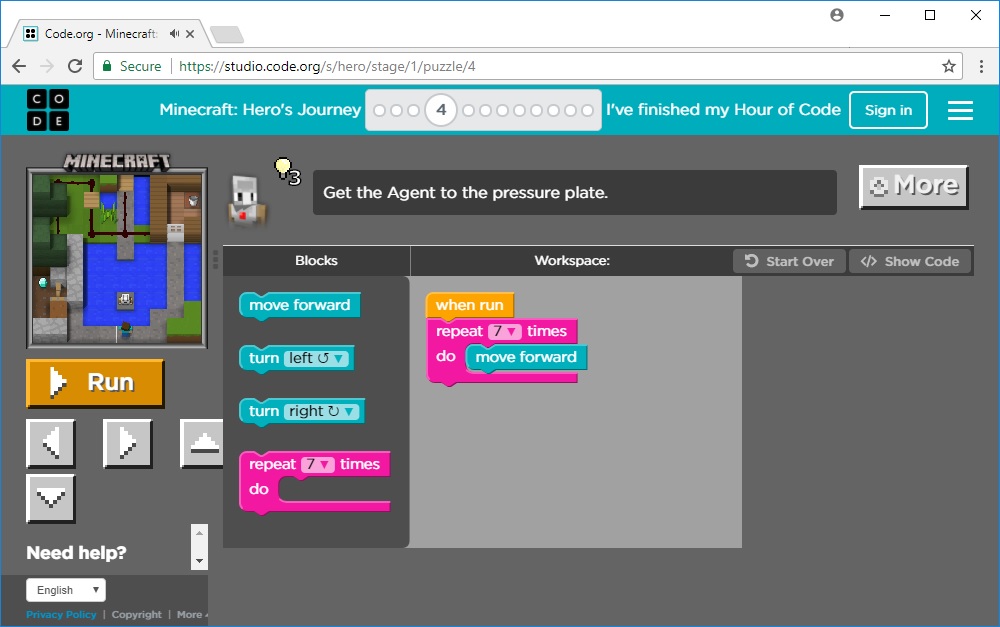
Microsoft Debuts Minecraft-Themed Coding Tutorial
theodp writes: In a few weeks, writes Microsoft Corporate VP Mary Snapp, "millions of kids and others will participate in an Hour of Code, a global call to action to spend an hour learning the basics of coding. Today, it's my privilege to announce that Microsoft has released a new Minecraft tutorial for Hour of Code, called Hero's Journey." The release of the new Code.org-touted flagship Hour of Code tutorial -- the third since Microsoft purchased Minecraft Maker Mojang for $2.5B in 2014 -- comes as Microsoft celebrates Minecraft: Education Edition reaching a milestone of 2 million users.
Microsoft boasts that nearly 70 million of its Minecraft Hour of Code sessions have been launched to-date, which is certainly impressive from an infomercial or brand awareness standpoint. But does [adding a Scratch block to] move a Minecraft character forward 7 times on an $800 Microsoft Surface offer all that much more educational value than, say, moving a peg forward 5 times on a $10.99 Pop-O-Matic Trouble board game? -
Microsoft Debuts Minecraft-Themed Coding Tutorial
theodp writes: In a few weeks, writes Microsoft Corporate VP Mary Snapp, "millions of kids and others will participate in an Hour of Code, a global call to action to spend an hour learning the basics of coding. Today, it's my privilege to announce that Microsoft has released a new Minecraft tutorial for Hour of Code, called Hero's Journey." The release of the new Code.org-touted flagship Hour of Code tutorial -- the third since Microsoft purchased Minecraft Maker Mojang for $2.5B in 2014 -- comes as Microsoft celebrates Minecraft: Education Edition reaching a milestone of 2 million users.
Microsoft boasts that nearly 70 million of its Minecraft Hour of Code sessions have been launched to-date, which is certainly impressive from an infomercial or brand awareness standpoint. But does [adding a Scratch block to] move a Minecraft character forward 7 times on an $800 Microsoft Surface offer all that much more educational value than, say, moving a peg forward 5 times on a $10.99 Pop-O-Matic Trouble board game? -
Microsoft Debuts Minecraft-Themed Coding Tutorial
theodp writes: In a few weeks, writes Microsoft Corporate VP Mary Snapp, "millions of kids and others will participate in an Hour of Code, a global call to action to spend an hour learning the basics of coding. Today, it's my privilege to announce that Microsoft has released a new Minecraft tutorial for Hour of Code, called Hero's Journey." The release of the new Code.org-touted flagship Hour of Code tutorial -- the third since Microsoft purchased Minecraft Maker Mojang for $2.5B in 2014 -- comes as Microsoft celebrates Minecraft: Education Edition reaching a milestone of 2 million users.
Microsoft boasts that nearly 70 million of its Minecraft Hour of Code sessions have been launched to-date, which is certainly impressive from an infomercial or brand awareness standpoint. But does [adding a Scratch block to] move a Minecraft character forward 7 times on an $800 Microsoft Surface offer all that much more educational value than, say, moving a peg forward 5 times on a $10.99 Pop-O-Matic Trouble board game? -
Farmers In India Are Using AI To Increase Crop Yields (microsoft.com)
Reader joshtops shares an incredible story about how thousands of farmers in India are making use of AI and other technologies provided by Microsoft to ensure that they plow the field and sow the seeds at the right time. Prior to this, they were relying on their traditional instincts, which many of them say, had failed them in the recent years. From the story: The fields had been freshly plowed. The furrows ran straight and deep. Yet, thousands of farmers across Indian states of Andhra Pradesh (AP) and Karnataka waited to get a text message before they sowed the seeds. The SMS, which was delivered in Telugu and Kannada, their native languages, told them when to sow their groundnut crops. In a few dozen villages in Telengana, Maharashtra and Madhya Pradesh, farmers are receiving automated voice calls that tell them whether their cotton crops are at risk of a pest attack, based on weather conditions and crop stage. Meanwhile in Karnataka, the state government can get price forecasts for essential commodities such as tur (split red gram) three months in advance for planning for the Minimum Support Price (MSP). Welcome to digital agriculture, where technologies such as Artificial Intelligence (AI), Cloud Machine Learning, Satellite Imagery and advanced analytics are empowering small-holder farmers to increase their income through higher crop yield and greater price control. "Sowing date as such is very critical to ensure that farmers harvest a good crop. And if it fails, it results in loss as a lot of costs are incurred for seeds, as well as the fertilizer applications," says Dr. Suhas P. Wani, Director, Asia Region, of the International Crop Research Institute for the Semi-Arid Tropics (ICRISAT), a non-profit, non-political organization that conducts agricultural research for development in Asia and sub-Saharan Africa with a wide array of partners throughout the world. Microsoft in collaboration with ICRISAT, developed an AI Sowing App powered by Microsoft Cortana Intelligence Suite including Machine Learning and Power BI. The app sends sowing advisories to participating farmers on the optimal date to sow. The best part -- the farmers don't need to install any sensors in their fields or incur any capital expenditure. All they need is a feature phone capable of receiving text messages. -
Microsoft Releases Standards For Highly Secure Windows 10 Devices (bleepingcomputer.com)
An anonymous reader writes from a report via BleepingComputer: Yesterday, Microsoft released new standards that consumers should follow in order to have a highly secure Windows 10 device. These standards include the type of hardware that should be included with Windows 10 systems and the minimum firmware features. The hardware standards are broken up into 6 categories, which are minimum specs for processor generation, processor architecture, virtualization, trusted platform modules (TPM), platform boot verification, and RAM. Similarly, firmware features should support at least UEFI 2.4 or later, Secure Boot, Secure MOR 2 or later, and support the Windows UEFI Firmware Capsule Update specification. -
Microsoft Chastises Google Over Chrome Security (pcmag.com)
An anonymous reader quotes PCMag: In a Wednesday blog post, Redmond examined Google's browser security and took the opportunity to throw some shade at Chrome's security philosophy, while also touting the benefits of its own Edge browser. The post, written by Microsoft security team member Jordan Rabet, noted that Google's Chrome browser uses "sandboxing" and isolation techniques designed to contain any malicious code. Nevertheless, Microsoft still managed to find a security hole in Chrome that could be used to execute malicious code on the browser.
The bug involved a Javascript engine in Chrome. Microsoft notified Google about the problem, which was patched last month. The company even received a $7,500 reward for finding the flaw. However, Microsoft made sure to point out that its own Edge browser was protected from the same kind of security threat. It also criticized Google for the way it handled the patching process. Prior to the patch's official rollout, the source code for the fix was made public on GitHub, a software collaboration site that hosts computer code. That meant attentive hackers could have learned about the vulnerability before the patch was pushed out to customers, Microsoft claimed. "In this specific case, the stable channel of Chrome remained vulnerable for nearly a month," the blog post said. "That is more than enough time for an attacker to exploit it."
In the past Google has also disclosed vulnerabilities found in Microsoft products -- including Edge. -
Microsoft Employees Can Now Work In Treehouses (cnbc.com)
Microsoft's campus now features three outdoor treehouses for its employees. An anonymous reader quotes CNBC: More than 12 feet off the ground, the treehouses feature charred-wood walls, skylights, at least one gas fireplace, Wi-Fi and hidden electrical outlets. Employees can even grab a bite at an outdoor extension of the indoor cafeteria. The "more Hobbit than HQ" treehouses are designed by Pete Nelson of the TV show "Treehouse Masters" and are part of Microsoft's growing "outdoor districts..." The company touts the professional benefits of working in nature -- greater creativity, focus and happiness -- but honestly, the treehouses are just plain cool.
Microsoft touts a Harvard physician who believes nature "stimulates reward neurons in your brain. It turns off the stress response, which means you have lower cortisol levels, lower heart rate and blood pressure, and improved immune response." There's a short video on the "Working at Microsoft" channel on YouTube, but I'm curious what Slashdot readers think about working outdoors. Or, in a tree... -
Microsoft Brings Edge To Android and IOS (venturebeat.com)
An anonymous reader writes: If you want more proof that Microsoft is embracing Android and iOS, boy, do we have it for you today. The company has launched Edge for iOS in preview, promised Edge for Android is coming soon, and launched Microsoft Launcher for Android in public preview. Edge for iOS preview is available via Apple's TestFlight and is limited, per Apple's rules, to 10,000 users. Microsoft is inviting Windows Insiders in the U.S. to sign up here. Android users can also sign up at that same link -- the preview will hit the Google Play Store in the coming weeks. Microsoft is hoping to release Edge for Android and iOS out of preview "later this year." The Microsoft Launcher is available in preview for English users in the United States on Google Play. Microsoft promises to bring it to other markets "over time" and launch it out of preview "later this year," as well. -
Microsoft Shutters Groove Music, Will Move Users To Spotify (techcrunch.com)
Microsoft announced today that it will soon shutter both its Groove Music Pass streaming service and the ability to purchase songs and albums in the Windows Store. The biggest surprise isn't that the service never took off, it's that Microsoft has partnered with Spotify to move all its Groove Music Pass customers over to Spotify. TechCrunch reports: Starting December 31, the Groove Music app will lose its features for streaming, purchasing and downloading music. Microsoft promises that moving to Spotify will be pretty seamless and that virtually all the songs and playlists that Groove users created over the years will transfer to the new service. Windows Insiders will be able to test this out with the next update, which is scheduled to roll out next week. Users will have until at least January 31, 2018 to make the move, though. For the most part, Spotify offers a superset of Groove's music catalog, so except for a few edge cases, there's no reason to believe that moving to Spotify would be a great loss for Groove Music Pass customers. And because Spotify is available on Windows Phone, too, even the few users still left on Microsoft's failed mobile platform won't miss out. As for Groove Music itself, Microsoft says the actual app won't go away anytime soon. It'll still be available for playing back and managing music that's stored locally. -
Microsoft Shutters Groove Music, Will Move Users To Spotify (techcrunch.com)
Microsoft announced today that it will soon shutter both its Groove Music Pass streaming service and the ability to purchase songs and albums in the Windows Store. The biggest surprise isn't that the service never took off, it's that Microsoft has partnered with Spotify to move all its Groove Music Pass customers over to Spotify. TechCrunch reports: Starting December 31, the Groove Music app will lose its features for streaming, purchasing and downloading music. Microsoft promises that moving to Spotify will be pretty seamless and that virtually all the songs and playlists that Groove users created over the years will transfer to the new service. Windows Insiders will be able to test this out with the next update, which is scheduled to roll out next week. Users will have until at least January 31, 2018 to make the move, though. For the most part, Spotify offers a superset of Groove's music catalog, so except for a few edge cases, there's no reason to believe that moving to Spotify would be a great loss for Groove Music Pass customers. And because Spotify is available on Windows Phone, too, even the few users still left on Microsoft's failed mobile platform won't miss out. As for Groove Music itself, Microsoft says the actual app won't go away anytime soon. It'll still be available for playing back and managing music that's stored locally. -
Microsoft and Facebook Just Built a 4,000-Mile Cable Across the Pacfic Ocean (popularmechanics.com)
An anonymous reader quotes Popular Mechanics: Microsoft, Facebook and global telecommunication infrastructure company Telxius have completed the Marea subsea cable, the world's most technologically advanced undersea cable. The Marea crosses the Atlantic Ocean over 17,000 feet below the ocean's surface, connecting Virginia Beach with Bilbao, Spain. Over 4,000 miles (6,600 kilometers) long and weighing nearly 10.25 million pounds (4.65 million kilograms), the Marea can transmit up to 160 terabits of data per second, which Microsoft notes is "more than 16 million times faster than the average home internet connection, making it capable of streaming 71 million high-definition videos simultaneously."
The undersea cable -- about 1.5 times the diameter of a garden hose -- contains eight pairs of fiber optic cables encircled by copper, a protective layer of hard plastic, and then waterproof coating. Its 4,000-mile route had to avoid everything from earthquake zones to active volcanoes.
Cables under the Atlantic Ocean carry 55% more data than cables under the Pacific, Microsoft writes, adding that "the project highlights the increasing role of private companies in building the infrastructure of the future." -
Researchers Catch Microsoft Zero-Day Used To Install Government Spyware (vice.com)
An anonymous reader quotes a report from Motherboard: Government hackers were using a previously-unknown vulnerability in Microsoft's .NET Framework, a development platform for building apps, to hack targets and infect them with spyware, according to security firm FireEye. The firm revealed the espionage campaign on Tuesday, on the same day Microsoft patched the vulnerability. According to FireEye, the bug, which until today was a zero-day, was being used by a customer of FinFisher, a company that sells surveillance and hacking technologies to governments around the world. The hackers sent a malicious Word RTF document to a "Russian speaker," according to Ben Read, FireEye's manager of cyber espionage research. The document was programmed to take advantage of the recently-patched vulnerability to install FinSpy, spyware designed by FinFisher. The spyware masqueraded as an image file called "left.jpg," according to FireEye. -
Ask Slashdot: What Can You Do With An Old Windows Phone?
Slashdot reader unixisc writes: While it's always been well known that Windows phones in the market have floundered, one saving grace has always been that one could at least use it for the barest minimum of apps, even if updates have stopped... Aside from a door stop or a hand me down to someone who'll use it like a dumb phone, what are your suggested uses for this phone? A music player (if the songs are on an SD card)? Games? As far as phones go, I have what I need, so for this, anything it's good for?
The original submission suggests problems connecting to wi-ifi -- something partially corroborated by complaints at Windows Central -- though Microsoft's site says they're still supporting wifi connections.
Slashdot reader thegreatbob suggested "shuffleboard puck" -- then added, "Snark aside, if you're into writing custom applications and such for them, there's probably a bootloader/root solution for you out there."
Leave your own best suggestions in the comments. What can you do with an old Windows Phone? -
Microsoft Claims PowerShell Now More Secure (wired.com)
An anonymous reader quotes Wired: Last year, well over a third of the incidents assessed by security firm Carbon Black and its partners involved some sort of PowerShell component. But as network defenders catch on to Microsoft's recent release of additional PowerShell protections, the attack sequences that exploit PowerShell are finding some long-overdue resistance... PowerShell 5.0, released last year, added a full suite of expanded logging tools... While it's no panacea, and doesn't keep attackers out, the renewed focus on logging aids flagging and detection. It's a baseline step that helps remediation and response after an attack is over, or if it persists long-term... And PowerShell's recent defense improvements go beyond logs. The framework also recently added "constrained language mode," to create even more control over what commands PowerShell users can execute... The security industry at large has also made strides to determine what baseline normal activity for PowerShell looks like, since deviations could indicate malicious behavior.
Lee Holmes, Microsoft's principal software design engineer for PowerShell, says they've been "laser-focused on security since the very first version," adding that they're now moving towards a more enlightened approach.
"You can focus harder on protecting against breaches and defense in depth, but the enlightened approach is to assume breach and build the muscle on detection and remediation -- make sure that you're really thinking about security end-to-end in a holistic manner." -
Microsoft .NET Core 2.0 For Linux Released; Redhat Will Bundle Microsoft's .NET (zdnet.com)
Billly Gates writes: Microsoft recently released Visual Studio 15.3 for Windows and Visual Studio 7.1 for Mac with .NET core 2.0. In addition to porting Microsoft Code and SQL Server to Linux, they have ported .NET. Redhat will bundle .NET in their software offerings instead of relying on Mono. .NET core is Microsoft's open-source .NET platform which is not based off Mono and available for Linux, Mac, and Windows here. -
Microsoft .NET Core 2.0 For Linux Released; Redhat Will Bundle Microsoft's .NET (zdnet.com)
Billly Gates writes: Microsoft recently released Visual Studio 15.3 for Windows and Visual Studio 7.1 for Mac with .NET core 2.0. In addition to porting Microsoft Code and SQL Server to Linux, they have ported .NET. Redhat will bundle .NET in their software offerings instead of relying on Mono. .NET core is Microsoft's open-source .NET platform which is not based off Mono and available for Linux, Mac, and Windows here. -
Microsoft Avoids Washington State Taxes, Gives Nevada Schoolkid A Surface Laptop (seattletimes.com)
theodp writes: The Official Microsoft Blog hopes a letter from a Nevada middle schooler advising Microsoft President Brad Smith to "keep up the good work running that company" will "inspire you like it did us." Penned as part of a math teacher's assignment to write letters to the businesses that they like, Microsoft says the letter prompted Smith to visit the Nevada school to meet 7th-grader Sky Yi in person as part of the company's effort to draw attention to the importance of math and encourage students and teachers who are passionate about STEM (science, technology, engineering and math) education. In an accompanying video of the surprise meeting, Smith presents Yi with a new Surface Laptop that comes with Windows 10 S, a version of the OS that has been streamlined with schools in mind. "Not bad for a little letter," the Microsoft exec says.
Speaking of Microsoft, Nevada, and education, Bing Maps coincidentally shows the school Smith visited is just a 43-minute drive from the software giant's Reno-based Americas Operations Center. According to the Seattle Times, routing sales through the Reno software-licensing office helps Microsoft minimize its tax bills (NV doesn't tax business income) to the detriment, some say, of Washington State public schools.
Microsoft's state and local taxes will drop to just $30 million for the last year (from an average of $214 milion over the previous 14 years) according to the Seattle Times. "A Microsoft spokesman said the decline in 2017 was caused by the company's deferring taxes on some income to future years and the winding down of the company's smartphone business." -
Microsoft Avoids Washington State Taxes, Gives Nevada Schoolkid A Surface Laptop (seattletimes.com)
theodp writes: The Official Microsoft Blog hopes a letter from a Nevada middle schooler advising Microsoft President Brad Smith to "keep up the good work running that company" will "inspire you like it did us." Penned as part of a math teacher's assignment to write letters to the businesses that they like, Microsoft says the letter prompted Smith to visit the Nevada school to meet 7th-grader Sky Yi in person as part of the company's effort to draw attention to the importance of math and encourage students and teachers who are passionate about STEM (science, technology, engineering and math) education. In an accompanying video of the surprise meeting, Smith presents Yi with a new Surface Laptop that comes with Windows 10 S, a version of the OS that has been streamlined with schools in mind. "Not bad for a little letter," the Microsoft exec says.
Speaking of Microsoft, Nevada, and education, Bing Maps coincidentally shows the school Smith visited is just a 43-minute drive from the software giant's Reno-based Americas Operations Center. According to the Seattle Times, routing sales through the Reno software-licensing office helps Microsoft minimize its tax bills (NV doesn't tax business income) to the detriment, some say, of Washington State public schools.
Microsoft's state and local taxes will drop to just $30 million for the last year (from an average of $214 milion over the previous 14 years) according to the Seattle Times. "A Microsoft spokesman said the decline in 2017 was caused by the company's deferring taxes on some income to future years and the winding down of the company's smartphone business." -
Microsoft's Windows Phone Keyboard For the iPhone Is Dead (theverge.com)
Microsoft's Word Flow keyboard for the iPhone had one unique feature when it launched more than a year ago: a one-handed mode that could be used with either your left or right thumb. Now, according to a support note spotted by Windows Central, it appears Microsoft is consolidating and removing the keyboard from the App Store, encouraging users to download SwiftKey instead. The Verge reports: Microsoft has tested out a number of iOS keyboards, and it now appears the company is focusing solely on SwiftKey after acquiring the app last year. We haven't seen any major additions to SwitftKey since Microsoft acquired it, apart from a separate Swiftmoji emoji predictor in July last year. Microsoft's SwiftKey keyboard now competes against the likes of Google's Gboard keyboard and various other iOS and Android keyboards. Have you been using Word Flow on your iPhone? If so, what has your experience been with the application? Do you plan on switching to Gboard or another third-party keyboard now that Word Flow is no longer supported? -
Microsoft Further Pledges Linux Loyalty, Joins Cloud Native Computing Foundation (betanews.com)
BrianFagioli quotes BetaNews: Today, Microsoft further pledges its loyalty to Linux and open source by becoming a platinum member of the Cloud Native Computing Foundation. If you aren't familiar, the CNCF is a part of the well-respected Linux Foundation (of which Microsoft is also a member). With the Windows-maker increasingly focusing its efforts on the cloud -- and profiting from it -- this seems like a match made in heaven. In fact, Dan Kohn, Executive Director of the foundation says, "We are honored to have Microsoft, widely recognized as one of the most important enterprise technology and cloud providers in the world, join CNCF as a platinum member."
"CNCF is a part of the Linux Foundation, which helps govern for a wide range of cloud-oriented open source projects, such as Kubernetes, Prometheus, OpenTracing, Fluentd, Linkerd, containerd, Helm, gRPC, and many others," says John Gossman Azure Architect, Microsoft. "Since we joined the Linux Foundation last year, and now have decided to expand that relationship to CNCF membership as a natural next step to invest in open source communities and code at multiple levels, especially in the area of containers."
The announcement notes that Microsoft has already been contributing code to the Kubernetes project, "as well as running Kubernetes as part of the Azure Container Service."