Slashdot Mirror
Domain: mit.edu
Stories and comments across the archive that link to mit.edu.
Comments · 7,673
-
Scratch
My research group at the MIT Media Lab developed Scratch. I just got a chance to read this thread, and thought I'd provide a little background on the project...
Scratch is deeply influenced by Logo, but aims to go beyond it in (at least) three ways:
- it uses drag-and-drop graphical programming so that kids can focus on core computational ideas (like iteration, conditionals, variables) and logical thinking, not obscure syntax
- it supports media-manipulation activities (integrating images, sound, music), so that kids can create projects they really care about
- it supports online sharing of projects, so that kids can see other people's projects (for ideas and inspiration) and share their own projects (for motivation and feedback)
I'd encourage you to check out the Scratch website to download the software and see what other people are creating with Scratch. There's already a great variety of projects created by the Scratch community, including strategy games http://scratch.mit.edu/projects/bmarcell/1137, science simulations http://scratch.mit.edu/projects/jay/495, paint programs http://scratch.mit.edu/projects/fab_programmer123
/ 4645, and animated stories http://scratch.mit.edu/projects/vally/1224. If you have suggestions, please share them on the Forums on the Scratch website. Thanks. -
Scratch
My research group at the MIT Media Lab developed Scratch. I just got a chance to read this thread, and thought I'd provide a little background on the project...
Scratch is deeply influenced by Logo, but aims to go beyond it in (at least) three ways:
- it uses drag-and-drop graphical programming so that kids can focus on core computational ideas (like iteration, conditionals, variables) and logical thinking, not obscure syntax
- it supports media-manipulation activities (integrating images, sound, music), so that kids can create projects they really care about
- it supports online sharing of projects, so that kids can see other people's projects (for ideas and inspiration) and share their own projects (for motivation and feedback)
I'd encourage you to check out the Scratch website to download the software and see what other people are creating with Scratch. There's already a great variety of projects created by the Scratch community, including strategy games http://scratch.mit.edu/projects/bmarcell/1137, science simulations http://scratch.mit.edu/projects/jay/495, paint programs http://scratch.mit.edu/projects/fab_programmer123
/ 4645, and animated stories http://scratch.mit.edu/projects/vally/1224. If you have suggestions, please share them on the Forums on the Scratch website. Thanks. -
Scratch
My research group at the MIT Media Lab developed Scratch. I just got a chance to read this thread, and thought I'd provide a little background on the project...
Scratch is deeply influenced by Logo, but aims to go beyond it in (at least) three ways:
- it uses drag-and-drop graphical programming so that kids can focus on core computational ideas (like iteration, conditionals, variables) and logical thinking, not obscure syntax
- it supports media-manipulation activities (integrating images, sound, music), so that kids can create projects they really care about
- it supports online sharing of projects, so that kids can see other people's projects (for ideas and inspiration) and share their own projects (for motivation and feedback)
I'd encourage you to check out the Scratch website to download the software and see what other people are creating with Scratch. There's already a great variety of projects created by the Scratch community, including strategy games http://scratch.mit.edu/projects/bmarcell/1137, science simulations http://scratch.mit.edu/projects/jay/495, paint programs http://scratch.mit.edu/projects/fab_programmer123
/ 4645, and animated stories http://scratch.mit.edu/projects/vally/1224. If you have suggestions, please share them on the Forums on the Scratch website. Thanks. -
Scratch
My research group at the MIT Media Lab developed Scratch. I just got a chance to read this thread, and thought I'd provide a little background on the project...
Scratch is deeply influenced by Logo, but aims to go beyond it in (at least) three ways:
- it uses drag-and-drop graphical programming so that kids can focus on core computational ideas (like iteration, conditionals, variables) and logical thinking, not obscure syntax
- it supports media-manipulation activities (integrating images, sound, music), so that kids can create projects they really care about
- it supports online sharing of projects, so that kids can see other people's projects (for ideas and inspiration) and share their own projects (for motivation and feedback)
I'd encourage you to check out the Scratch website to download the software and see what other people are creating with Scratch. There's already a great variety of projects created by the Scratch community, including strategy games http://scratch.mit.edu/projects/bmarcell/1137, science simulations http://scratch.mit.edu/projects/jay/495, paint programs http://scratch.mit.edu/projects/fab_programmer123
/ 4645, and animated stories http://scratch.mit.edu/projects/vally/1224. If you have suggestions, please share them on the Forums on the Scratch website. Thanks. -
Scratch
My research group at the MIT Media Lab developed Scratch. I just got a chance to read this thread, and thought I'd provide a little background on the project...
Scratch is deeply influenced by Logo, but aims to go beyond it in (at least) three ways:
- it uses drag-and-drop graphical programming so that kids can focus on core computational ideas (like iteration, conditionals, variables) and logical thinking, not obscure syntax
- it supports media-manipulation activities (integrating images, sound, music), so that kids can create projects they really care about
- it supports online sharing of projects, so that kids can see other people's projects (for ideas and inspiration) and share their own projects (for motivation and feedback)
I'd encourage you to check out the Scratch website to download the software and see what other people are creating with Scratch. There's already a great variety of projects created by the Scratch community, including strategy games http://scratch.mit.edu/projects/bmarcell/1137, science simulations http://scratch.mit.edu/projects/jay/495, paint programs http://scratch.mit.edu/projects/fab_programmer123
/ 4645, and animated stories http://scratch.mit.edu/projects/vally/1224. If you have suggestions, please share them on the Forums on the Scratch website. Thanks. -
Re:OK that's really cool but
Well sorry if there's people around that are actually curious. I bet people like you said the same thing to the Wright brothers...
On the other hand, this is really old news, as people before me pointed out. You could at least have mentioned The international Genetically Engineered Machine competition http://parts.mit.edu/wiki/index.php/Main_Page you yourself have been reporting about. -
Re:so, what this article is saying is...
-
Re:N95? or MIT Oxygen's H21
I actually thought he described a vision more in line with the Project Oxygen H21 http://www.oxygen.lcs.mit.edu/H21.html, which proposes a hand-held device that can download software to transform itself from (A) mobile phone to (B) audio player to (C) multi-mode input device (speech, text, handwriting) while retaining the identification and authentication software and data for a particular user.
-
Re:You still don't understand computability theoryThis is fun and all, but you're equivocating so fast my head is spinning. I'm not equivocating at all. I'm sorry if you don't find the term "resource" appropriate. Both computability theory and complexity theory (which together broadly constitute "theory of computation") can be thought of in terms of what functions machines of various sorts can compute, or, equivalently, what formal languages they recognize. As well as in many other equivalent terms. Also, believe it or not, there are some models of computation which are universal even though they only use finite resources! I have no idea what you're talking about. Is the statement not clear enough, or do you simply disbelieve it? There are many notions of computation. For example, there is nondeterministic computation. Of course, a nondeterministic Turing machine still cannot compute all recursive functions using only a (say) polynomially-bounded tape length. However, there are generalizations of Turing machines which can! Whether such machines are "reasonable" is a matter of interpretation. See
http://www.cs.duke.edu/~reif/paper/games/bounds/pu b.bounds.pdf
or
http://www.swiss.ai.mit.edu/~bob/hearn-thesis-fina l.pdf -
Re:I am scared of global warming fanatics
(Please ignore previous post - accidental hit of submit instead of preview)
However, if I have to choose between siding with scientists from MIT or Oxford - or "scientists" that got project grants or paid jobs because they mentioned "Global Warming" in their project name - guess what I'll choose... This whole silly thing reminds me of Y2K panic.
FYI, your heroes at MIT/ Oxford seem to agree with global warming and are trying to educate you, but perhaps the real problem is that you don't understand it.
-
Re:I am scared of global warming fanatics
However, if I have to choose between siding with scientists from MIT or Oxford - or "scientists" that got project grants or paid jobs because they mentioned "Global Warming" in their project name - guess what I'll choose... This whole silly thing reminds me of Y2K panic.
FYI, your heroes at MIT/ Oxford seem to agree with global warming and are trying to educate you, but
perhaps the real problem is that you don't understand it.
-
Heh
So, like 27 people link to the playpen balls comic, but no one mentions that someone actually baked him a cake shaped like the internet - a deliciously(!) multi-layered reference to XKCD?
-
Re:That's a hack? Not a prank?
MIT is famous for it's elaborate student pranks. They call them hacks. For example, turning a hallway(or was it building?) into a Super Mario level, and other great ones. See: http://hacks.mit.edu/
-
Re:one of my favs,
Daayum! Look at those things! Nice to see there's some tits at MIT!
-
References
The playpen balls were a reference to one of xkcd's more popular comics, Grownups. The message on the playpen balls was a reference to some of xkcd's comics "My hobby...".
-
Some notes
- It was LSC, the Lecture Series Committee, not LCS, the Lab for Computer Science (now known as CSAIL) that invited him. They're a student group that shows movies and sponsors talks like this.
- /. linked to the second page of photos; The first, which isn't entirely obviously linked from the linked page, has some excellent photos of the balls falling from the hatch.
-
Re:Wow!
Learn your history, n00b.
-
Re:Except on the really bright ones.
He's right about aluminum foil hats. Here's the research to back it up. I don't believe I've seen any scientific studies of pointy felt hats, but anecdotal evidence seems plentiful...
-
Logo
what happened to logo?
The MIT Teacher Education Program is doing something along the same lines with a version of Logo: StarLogo TNG; they've also released educational material centered around the older (2D, no "graphical programming") version of StarLogo which is now an open source project. -
Logo
what happened to logo?
The MIT Teacher Education Program is doing something along the same lines with a version of Logo: StarLogo TNG; they've also released educational material centered around the older (2D, no "graphical programming") version of StarLogo which is now an open source project. -
Re:I still like logo
Drag and drop seems nice, but it is a significant abstraction from real programming.
It doesn't have to be all that distant from raw code. Another MIT project (StarLogo TNG) uses drag and drop that has a pretty much 1:1 relationship to raw code, but is presumably less intimidating and certainly less dependent on typing and memorizing syntax rules, since the blocks both visually indicate syntax and won't link-up in improper ways. Scratch seems similar, though this is the first time I've looked at it and I haven't played around with it.
Really, I don't see how "drag and drop" is inherently any further from "real programming" than using a modern IDE with automatic code completion, automatic closing of blocks, code generation, GUI builders, etc., is. -
from scratch...
Hmmm, http://scratch.mit.edu/ is now slashdotted.
I guess they have to build their webserver from scratch now! -
Further reading
Probably relevant articles:
Apple Inc. v. Microsoft Corp., 35 F.3d 1435 (9th Cir. 1994), aka the "Look and Feel case" on Wikipedia, and the actual ruling by the 9th Circuit Court of Appeals.
The MIT AI Lab has a fairly good introduction to the basis for the current U.S. software IP system, including what elements are typically protected by copyright and which by patents. (Basically: "Expression" = copyright; "idea/implementation" = patent, "concept" = (hopefully) neither.) -
Re:No FSF owned software has been challenged
If it's so obvious, (pardon my french) how the fuck come it's patented? Non-obviety is a necessary (but not sufficient) requirement for patentability.
Because it was original at the time, and the author's may have been the only people in the world with a prototype system. A good explanation is at:
Debunking software patents -
Re:Efficiency?
For a solar tower you..
Convection tower performance is very poor and the convection tower portion of the SHPEGS system accounts for less than 10% of the system output. It is still clean renewable power, but the convection tower wind turbine output is trivial. The chimney is there to allow a large volume of air to move across the heat exchangers efficiently and the wind turbine takes a slight advantage of the effect, but it isn't significant.I wonder how this would be for growing winter crops as well
The thermal storage would be deep enough to not interact with the surface or shallow groundwater. The Drake Landing project has some information. This is another research document on thermal storage.
There is a lot of potential for integrating bio-methane which requires a very constant temperature as well as this Solar Hydrogen from methane production system. Algae farming also has a potential integration with the solar thermal storage.
Thanks. I'm looking for a number though.
I don't mean to avoid the efficiency question. Again, in an arid location with the majority of electrical usage for AC, Solar PV or Solar Thermal is simpler and probably more suitable. The cost/m2 of collectors is substantially cheaper in a thermal system, so I'm not sure what you are comparing. Marginal and poor land that isn't suitable for crop production or the roof of a Walmart isn't the cost factor, the solar collector is. The MIT group was able to get 1kW from 14m2 of trough collectors on a straight thermal system and the SHPEGS additions should improve on that.
There are also 2 heat sources in the SHPEGS system, solar and hot summer air along with two power generation systems, thermal and the wind turbine. In theory, the absorption system should improve not degrade the straight solar thermal system, so I would expect something better than 10% efficiency on the solar portion if you include the additional heat from the air. The conversion efficiency of the heat being extracted from the air is difficult to calculate. The energy cost is the energy going into the solution pump to pressurize the aqueous ammonia and there isn't the same direct cost in the volume of air being moved, in fact the more air that is moved the better the output of the wind turbine portion.
I used 5% thermal to electrical efficiency for the calculations to be conservative, and generally 10% is used for binary geothermal plants.If you are comparing Solar PV, you need to account for battery cost and cut all the numbers by at least 50% to account for the daytime only output. Regardless of what is used for electrical storage, there are 3 months of the winter in Canada and the northern US where Solar PV isn't going to put out anything substantial and seasonal electrical storage isn't feasible.
The Toronto Exhibition Palace Live Solar PV Stats page has some historical data on Solar PV in winter in Canada. -
Re:Developing World Application
This is a very interesting project by a group of MIT grads that implemented a very cheap solar thermal system out of salvage automotive components (power steering pump, alternator, etc) for low cost deployment in developing countries.
The SHPEGS additions to this type of system (thermal storage, convection tower) could also be implemented cheaply from common materials and salvage parts. -
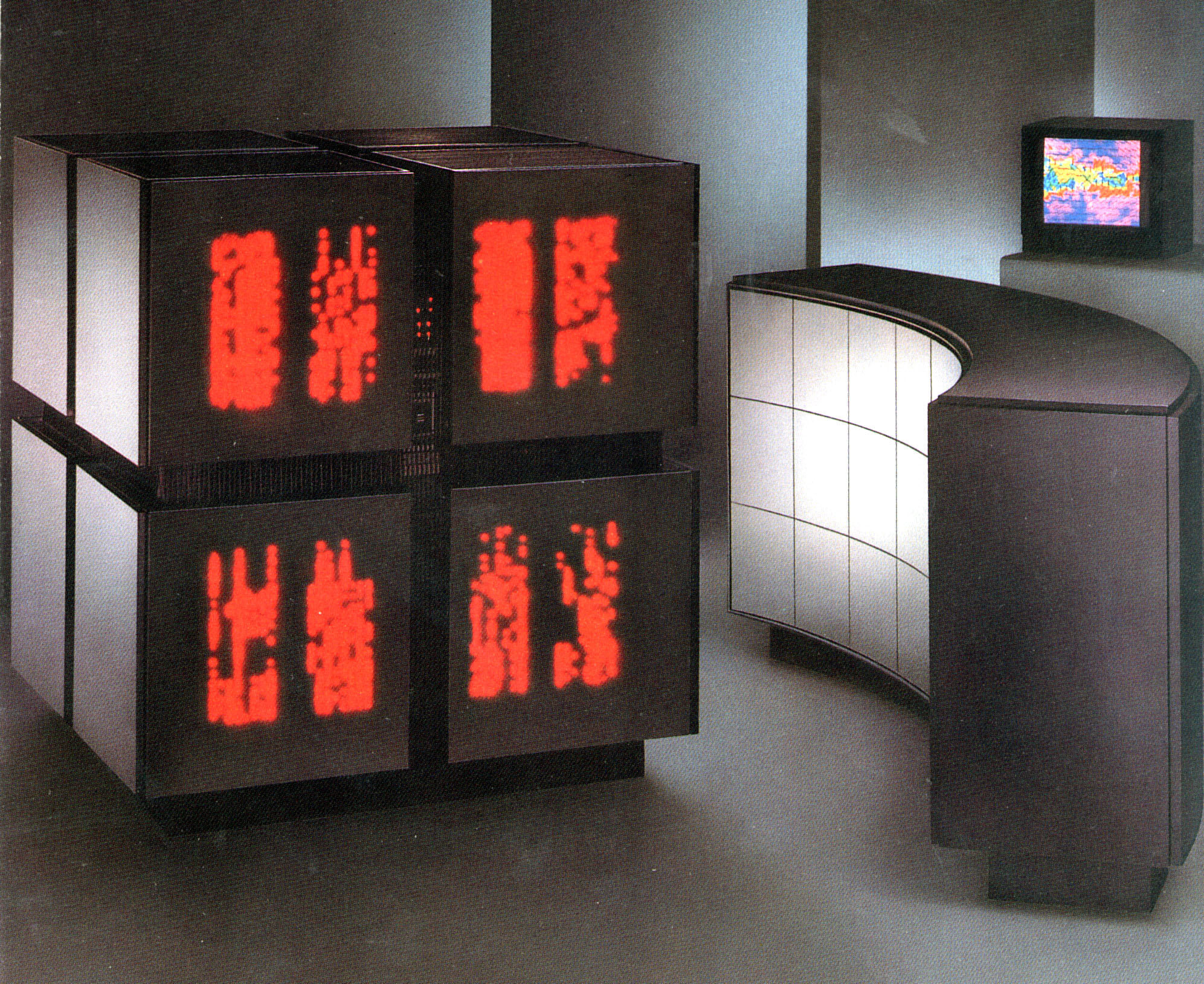
Good lord! get that man a
Connection Machine 5 stat!
-
Re:Wow...
The movie industry were inspired by the Connection Machine series of supercomputers. Every processor
in the computer had a LED that lit up when it was in use, and since there were thousands of processors,
there were thousands and thousands of lights.
Very large image -
Untrue generalization
I, for one, am an avowed linux fanboi. I have been almost as long as Linux has been around. I liked it then for a lot of reasons that would not be meaningful for you. I like it now much more because it's simply better than Windows.
I do know about pxe booting. I usually use pxelinux and tftpd for that -- usually with ghost for imaging, whatever OS is called for for thin client. Yes, I can use many of the various other ways to do the same thing, including Windows RIS. A tool's a tool. You use what works today and keep your eyes open for better tools tomorrow.
I don't know much about Kereberos except that it's an open standard with a reference implementation available for many platforms from MIT. What I don't know is how this pertains to general technical proficiency or Windows. That dealing with K is not my corner of the computer world does not mean I am ignorant -- my company has specialists that handle that. The IT world is broad and nobody can be everything. I do servers too, quite a lot of them and I dare say in more depth than most.
I do and have worked in environments where you need to manage 20,000 desktops. The stuff I get paid to do on the desktop involves Windows almost exclusively. Dealing with the SVCHOST.EXE bug caused by Windows' patches for the past few months has been quite profitable. Am I happy about making my living helping my customers overcome their crippled architecture instead of helping them activate their potential? In a word, no.
I'm telling you this so you can understand -- Supporting Windows is where my money comes from today and I am quite proficient at it. The world is what it is, and a guy's got to make a living. That doesn't mean I have to be a fan of this pathetically insecure, ridiculously unreliable system with its impossibly arcane interface. I know better stuff is available, and I am confident eventually the better stuff will prevail. Between now and then I have to tread the fine line between the straight answer (you know, linux and mac users don't have this "spyware/virus/shutdown/whatever" problem) and the political one (a hardware firewall, software firewall, patch management system, license management system, ready backup, manually type hyperlinks only to known good sites policy... might mitigate the problem until those dastardly bad guys find another 0-day remote admin exploit).
When the day comes, that Intel AMT 2.0 technology we're talking about over in the opinion center will be quite handy for eradicating Windows from the face of your enterprise overnight. Use it to update the desktops in a pilot project and then once you've got the migration details set up you can command all the clients in the enterprise to download whatever version of linux you choose, no-touch, from a single console, with the requisite per-site, per-client and per-user customizations. The benefits are obvious to anyone who isn't clue immune. On that fine day a lot of MCSEs are going to be out of work -- but not me.
-
Cambridge already has a Muni Wi-Fi system FROM MIT
Cambridge and MIT are already building a FREE public access Wi-Fi system called roofnet.
They started long
http://pdos.csail.mit.edu/roofnet/doku.php
Interestingly harvard has stated plans to join roofnet.
http://www.boston.com/business/technology/articles /2006/02/02/cambridge_mit_plan_citywide_wifi/
The notion that a few weather sensors spead out over a tiny tiny tiny land area the size of cambridge MA somheow represents something significant is pathetic. That someone actually expended the effort and column space to put this in an IT Journal aimed at corporate officer level management, (CIO's) is simply incredible.
" By Ben Ames" Watch this name folks. He's bound to produce more boners in the future. -
Re:Oy vey gevault.
http://ocean.mit.edu/~cwunsch/papersonline/channe
l 4response
Partial Response to the London Channel 4 Film "The Great Global Warming Swindle"
Carl Wunsch 11 March 2007
I believe that climate change is real, a major threat, and almost
surely has a major human-induced component.
When approached by WAGTV, on behalf of Channel 4, known to me as
one of the main UK independent broadcasters, I was led to
believe that I would be given an opportunity to explain why I,
like some others, find the statements at both extremes of the
global change debate distasteful. I am, after all a teacher, and
this seemed like a good opportunity to explain why, for example,
I thought more attention should be paid to sea level rise, which
is ongoing and unstoppable and carries a real threat of acceleration,
than to the unsupportable claims that the
ocean circulation was undergoing shutdown (Nature, December 2005).
In the part of the "Swindle" film where I am describing the
fact that the ocean tends to expel carbon dioxide where it is warm,
and to absorb it where it is cold, my intent was to explain that
warming the ocean could be dangerous---because it is such a gigantic
reservoir of carbon. By its placement in the film,
it appears that I am saying that since carbon dioxide exists in the
ocean in such large quantities, human influence must not be
very important --- diametrically opposite to the point I was making---
which is that global warming is both real and threatening in many
different ways, some unexpected.
What we now have is an out-and-out propaganda piece, in which
there is not even a gesture toward balance or explanation of why
many of the extended inferences drawn in the film are not widely
accepted by the scientific community. There are so many examples,
it's hard to know where to begin, so I will cite only one:
a speaker asserts, as is true, that carbon dioxide is only
a small fraction of the atmospheric mass. The viewer is left to
infer that means it couldn't really matter. But even a beginning
meteorology student could tell you that the relative masses of gases
are irrelevant to their effects on radiative balance. A director
not intending to produce pure propaganda would have tried to eliminate that
piece of disinformation.
At a minimum, I ask that the film should never be seen again publicly
with my participation included. Channel 4 surely owes an apology to
its viewers, and perhaps WAGTV owes something to Channel 4. I will be
taking advice as to whether I should proceed to make some more formal protest. -
Re:Dire straits?
I feel Mark Shuttleworth's heart is in the right place, and much good will come out of various initiatives he is involved in, but I'm thinking specifically of this project of his:
"The SchoolTool Project"
http://www.schooltool.org/
From there: "SchoolTool is a project to develop a common global school administration infrastructure that is freely available under an Open Source license. SchoolTool encompasses three sub-projects:
* SchoolTool Calendar and SchoolBell are calendar and resource management tools for schools available as part of the Edubuntu Linux distribution.
* A SchoolTool student information system is being developed and tested in collaboration with schools in Lithuania and Belgium during the 2006 - 2007 school year
* CanDo is a SchoolTool-based skills tracking program developed by Virginia students and teachers to track which skills students are acquiring in their classes and at what level of competency."
So that software is definitely intended to be applicable in the USA.
I think the "Hole in the Wall" approach pioneered by Sugata Mitra has a lot to recommend itself as an approach to help kids in poor areas. From:
http://www.greenstar.org/butterflies/Hole-in-the-W all.htm
"Sugata Mitra has a PhD in physics and heads research efforts at New Delhi's NIIT, a fast-growing software and education company with sales of more than $200 million and a market cap over $2 billion. But Mitra's passion is computer-based education, specifically for India's poor. He believes that children, even terribly poor kids with little education, can quickly teach themselves the rudiments of computer literacy. The key, he contends, is for teachers and other adults to give them free rein, so their natural curiosity takes over and they teach themselves. He calls the concept "minimally invasive education."
To test his ideas, Mitra 13 months ago launched something he calls "the hole in the wall experiment." He took a PC connected to a high-speed data connection and imbedded it in a concrete wall next to NIIT's headquarters in the south end of New Delhi. The wall separates the company's grounds from a garbage-strewn empty lot used by the poor as a public bathroom. Mitra simply left the computer on, connected to the Internet, and allowed any passerby to play with it. He monitored activity on the PC using a remote computer and a video camera mounted in a nearby tree.
What he discovered was that the most avid users of the machine were ghetto kids aged 6 to 12, most of whom have only the most rudimentary education and little knowledge of English. Yet within days, the kids had taught themselves to draw on the computer and to browse the Net. Some of the other things they learned, Mitra says, astonished him."
Also of great potential for learning is the "Fab Lab" idea:
http://fab.cba.mit.edu/about/
From there: "Fab Labs are the educational outreach component for the Center for Bits and Atoms (CBA) at the Massachusetts Institute of Technology. -
Having used the CC license myself...
I'm not sure if its easy to ensure that the people that use the licensed material (depending on the license you chose) is used the correct way. I was using CC to license the drawings that i made with the Draw software at the Openstudio website from MIT, now out of service (they say for the moment), and people were using my drawings how ever they wanted (changing them even tho i had restricted that option and then posting them under their names like they made them in the first place). I really don't care much if they do, but the license wasn't of much use it seemed.
-
I have a better idea...From TFA, House Judiciary Committee member Lamar Smith is quoted as saying:
"Universities have a moral and legal obligation to ensure students do not use campus computers for illegal downloading. These schools do not give away their intellectual property for free, and they should not expect musicians to do so."
So the solution to the problem is either (1) for the universities to act as enforcers of copyright law, or (2) for them to begin giving away their "intellectual property" for free...
I personally think they should go for option (2). I mean, many universities are already going that route. For example, MIT course material is being made avaiable via Open CourseWare. Also, many academics are pushing for open access to all academic publications.
So, really, given that universities are supposed to be (and frequently are) institutions dedicated to dissemination of information, free speech, intellectual progress, and radical ideas... isn't it entirely consistent with the ethos (even their mandate) to not act as enforcers of copyright law? (Note: I'm not claiming that the universities have to actively encourage copyright infringement, merely suggesting that it is not their role in society to enforce those laws, even on their own campuses.) -
Prior Artoh come on.. Conditional breakpoints have been around atleast since the mid eighties.. for example watcom's wd (watcom debugger) detailed here for QNX/DOS etc.
Seriously America needs to put a stop to software patents, it's damaging your software industry as Knuth puts very well in his letter to the PTO here
-
Re:UAC == *TERRIBLE* Security Idea!
Rants like this always make me wonder if the person complaining has actually used Vista and UAC. Just to double-check, I launched my Control Panel on my Vista machine, and sure enough, no prompts.
Secondly, "UAC" refers to 2 components:
1) The Cancel/Allow prompts that are so infamous (thanks Apple)
-and-
2) The underlying components that handle poorly written apps that expect normal users to modify data in %programfiles%\vendorname or HKLM\Software\VendorName. This is an excellent design and might be unique (I'm not sure if it's patent-worthy, however). Copying that data and masking its presence under the user's profile is smart. It's an overdue band-aid for all of those "developers" (laughingly) who don't have a clue (because they run all their apps as admin).
And on the note of #2, it's the user-friendliness that got MS into the mess in the first place. Windows was the "easier" OS to use, administer, and develop upon, so their marketing campaigns of the 90s claimed. The *nix OSes of the world clearly weren't. [Thanks to Ubuntu for closing the gap, but don't stop while you have the momentum!] If the *nix OSes were easy to use, they'd have all the GED/college dropout/drunk/high developers using big point-and-click compilers to build the next business critical app. And guess what, they'd be expecting *nix users to be ROOT or Sudoers, or whatever
Security is mostly a social problem. In this case, it's the stupid app developers' faults. UAC may be duct tape and sudo may be welding, but until *nix gets "welding for dummies" in the hands of future developers, UAC will be a great addition to any enterprise environment.
And to you other AC author: why are you running ANY system as admin/root? You wouldn't see those Cancel/Allow dialogs if you had the forethought to run with least privilege (read the link, yep that's right, 1975 and you still haven't figured that out!). -
Re:No, that only applies in a democratic country
Banter aside, I'll make the argument simple for you.
1. A leader of a country conducting a war of aggression against another has committed a crime against humanity.
2. George Bush has conducted a war of aggression against another country.
C. George Bush has committed a crime against humanity.
We are looking at 600,000 dead between 2002-2006 as the result. Not to mention the thousands of maimed and dead U.S. soldiers. If the 600,000 people that died were people that lived in the U.S., would you be talking about bicycle chains then?
-
Geek Passion Re:My only problem is that...Once interest happens, time will follow. Try robotics - it's a way to get into hardware with a purpose. It is like it was with PCs in the late 1970s, there are hobbyists, hackers, companies, and Microsoft too! http//robotics.microsoft.com
Once you decide you want a robot, you'll need a board with a processor. These are systems that have good documentation, and some even claim some degree of "openness" in publishing schematics and encouraging you to build your boards yourself.
- MIT's Gogoboard (PIC microcontroller based 30-40 to build plus PC board)
http://padthai.media.mit.edu:8080/cocoon/gogosite
/ home.xsp?lang=en - CMU's $400 TerkBot (FPGA and ARM) http://www.terk.ri.cmu.edu/recipes/index.php
- (I'm sure Stanford has something here too - I just don't know what it is)
- ARM7 boards with Ethernet for around $100 - Aleph1 claims some openness, but their site is down
- FPGA 'education' boards for $100-$150 w/ VGA and PC features http://www.digilentinc.com/
- MIT's Gogoboard (PIC microcontroller based 30-40 to build plus PC board)
http://padthai.media.mit.edu:8080/cocoon/gogosite
-
Re:fovnder
Right, still no indication of the originally stated full professorship though
not much help either. This indicates that he did continue to teach, as does this,
but not what his title was. There are full (tenured) professors, associate professors, assistant
professors, visiting scientists and lecturers. All may teach, but they are not equivalent. However
this book, poorly written though it may be, does seem to indicate he held some title
of professorship. Which I suppose will have to do, as it's not clear the same distinctions
were made then. -
Re:fovnder
Right, still no indication of the originally stated full professorship though
not much help either. This indicates that he did continue to teach, as does this,
but not what his title was. There are full (tenured) professors, associate professors, assistant
professors, visiting scientists and lecturers. All may teach, but they are not equivalent. However
this book, poorly written though it may be, does seem to indicate he held some title
of professorship. Which I suppose will have to do, as it's not clear the same distinctions
were made then. -
fovnder
-
Re:Why this is good for everyone
There are definately several scenarios where price discrimination enhances total welfare, see:
http://web.mit.edu/14.271/www/hio-pdic.pdf -
Jones's Husband?
This article is a bit inaccurate; Jones first took a job as a secretary, not "to lead the recruitment of women at the university." What's more interesting is that her husband has strong ties to MIT, and runs part of the Lincoln Labs - MIT's defense research branch. [Source: MIT Student Newspaper]
I wonder how much he played into her hiring and promotion... -
Additional Reporting
from The Tech, the student newspaper: http://www-tech.mit.edu/V127/N21/jones.html
-
Re:Frequencies
Actually, if you have a large enough number of properly-designed APs blanketing the area, VoIP might be what you want. I can confirm that Skype works seamlessly both from an actual laptop (of course) and a Windows Mobile device.
In fact, my school is transitioning to VoIP everywhere, for both (non-emergency) landlines and Institute-issued wireless phones. -
I have not won anything but hope.
Speaking to those of you who have expressed distasteful feelings here, try to remember that there is such a thing as "winning gracefully," "being a good sport" or whatever you wish to call it.
The most disrespectful sentiment is that his death is some sort of victory. It's not because the bad policies and laws he fostered and believed in are still here. His passing brings some hope of change and that is what we celebrate.
This isn't the time to debate them [unAmerican laws].
On the contrary, now is the perfect time to reflect on the man and his beliefs and what he accomplished. What better time will there ever be?
He believed in digital restrictions until at least 2004 and probably went to his grave without understanding the real social cost of such control. To this day, I'm forced to chose between digital freedom and participation in popular culture. There is no middle ground because people like him considered you and me an insignificant minority who should use other options. Rights don't work like that. You can't violate people's rights because few people would bother to exercise them. While many of the things he said have been repudiated for 20 years, the logic he used never changed and he continued to say things we all hate. Those things hurt all of us every day.
The passing of generations is often the only way real change happens. Mr. Valenti was a product of a different time. His loyalties reflect those times but his intransigence is timeless. The run away success of the VCR was helpful to those he professed loyalty toward, and his opposition was harmful to them. It is surprising that he never learned the lesson. We can all feel sad for his family but we can also look at the world as a place that's a little less hostile.
-
Before just crying "greed!", read this
I'm sure some people already have as it's quite old a paper, but those who simply attribute all these problems to greed should understand it's just not so simple. Read The Broadband Incentive Problem white paper from MIT. After that, read a bit more on the current situation.
-
Re:Better support for concurrency in Languages
A lot of this is due to the fact that most popular languages right now do not support concurrency very well. Most common languages are stateful, and state and concurrency are rather antithetical to one another. The solution is to gradually evolve toward languages that solve this either by forsaking state (Haskell, Erlang) or by using something like transaction memory for encapsulating state in a way that is easy to deal with (Haskell's STM, Fortress (I think), maybe some others).
Concurrency is not that hard to do well in the right setting.
And before anyone claims that Haskell and Erlang are impractical, there are many examples of "real world" programs written in them.
A few nice, and very useful ones are Yaws (for erlang) and Darcs (for Haskell). There are many others (even quake clones), which I won't bother listing, but people can find them easily if they look.
Regarding concurrency, and its ease of use in these languages, I'm taking a machine learning class at the moment where most of the problems are computationally intensive, and could stand for improvement by making use of multiple cores. I do all of my assignments in Haskell, and not only are my solutions often shorter than those of my classmates (and they often work fine the first time they compile), but it's usually trivial to allow my application to scale nicely to as many cores as I can throw at it. It's worth mentioning, by the way, that most algorithms given in these classes are given under the assumption that people are using imperative languages, and even then, it's still easy. It takes a while to learn how to approach problems differently without mutable state, yes, but it's not as hard as some people make it out to be. I think it has more to do with the fact that people just don't like to learn anything new unless they absolutely are forced to do so, which is a pity.
By the way, there is a nice presentation from Tim Sweeney on what he would like future programming languages to look like, and there's a lot in there about functional programming, concurrency, and expressive (re: dependent) types.
-
Re:Ruby as a first language?
Why not? It is an acceptable LISP after all.
Combine the approaches of try ruby! and the Purple Book, and you can't really go wrong.
Now all we have to do is wait for such a book. Finished with pickaxe flavoring. -
Donald Knuth puts it well..In his letter to the PTO
I just hope the EU manages to keep software patents away..