Slashdot Mirror
Domain: multpl.com
Stories and comments across the archive that link to multpl.com.
Comments · 29
-
Re:Benefits not shared with workforce
Despite all of the people claiming the middle class is being destroyed, real median income has been slowly rising.
If the distribution of wealth wasn't so skewed in favor of the rich, median income should be dramatically rising instead of slowly rising. Compare it to GDP, which has more than doubled since 1990.
-
Re:Benefits not shared with workforce
No, but assuming that the productivity of other job positions around that person also improved about 50 times, the real value of their labor increased as a result of everything else being less expensive to produce. The amount of dollars you earn is utterly irrelevant when you fail to consider what you can purchase with them. Despite all of the people claiming the middle class is being destroyed, real median income has been slowly rising.
Automation is never going to significantly improve the wages of the people employing it in and of itself. The only possible way that can happen is if they are the only ones in possession of the improvements and no one else is capable of replicating those techniques and the workers can't be replaced by someone else who will accept less pay. As soon as anyone else figures out how to get the same improvements, competition drives prices back down. There's additional money to be made in the short term while that process occurs, but a rank and file worker isn't going to become extremely wealthy unless they own their own their own business.
Some people like to call this process a race to the bottom, but they only look at it from the perspective of the people racing downward. Everyone who's not involved in that particular race is the beneficiary of less expensive goods and services. As all industries undergo this continually (everyone is busy running in their own separate race) it produces more wealth. You can grumble that it isn't equally shared, but it's largely inconsequential. -
Re:It will probably conntinue
Here is one listing that shows most of the unemployment and GDP. here is the rest Obama inherited -2.5 growth rate from the GOP for the first year and across the entire 8 years, had a 1.3% growth rate.
However, if we get rid of the first year (belonging to the GOP) and add in 2017 (which is really O's), then America had a growth rate of 1.9%. More importantly, O finished at 2.47, while Trump's first real year, was 3.0. Not much of a difference.
Then we have unemployment rate:
GOP gave him a 9.9 % unemployment Rate, while Mediocre Obama gave the GOP a 4.1%. And gee, trump brought it down to 3.9%.
I will take Obama's economy any day over Trump's, though I will say that I back Trump's trade war. -
Lies, damn lies and statistics
Except that manufacturing jobs in the US have been on the rise since 2010...
Except that's ignoring the economic crash that started in 2008 and got worse in 2009. Your own link shows that manufacturing jobs are down in 2018 by over a million from where they were ten years ago. And when you take population increases into account, manufacturing jobs have kept shrinking as a sector of the economy, even as new jobs are "added".
-
Re:Complete nonsense
Bank interest rates are never going to be above inflation
Bullshit.
-
Re:For every abuser
lgw misleadingly stated:
If you want to see corporate profits (after salary and taxes and COGS and so on), here's a guide: http://www.multpl.com/ Corporate profits are about 4% of the market value of corporations right now. You can see the history for the past 150 years or so at the link.
Uh - so you're conflating profit with S&P market capitalization estimates?
I don' theeng so, Quickstraw.
Corporate profits have little to do with market cap. (Well, okay, they contribute to investment algorithm decision-making. But that's beside the point.) The lack of any reasonable alternative investment avenue (Have you looked at bond prices lately? Or real estate anywhere but San Francisco or Manhattan - where you'll be competing against Chinese investors determined to find a place to offshore their profits? And don't get me started on the commodities market.) is much more important to that figure. So is the "irrational exuberance" in the title of the book the link you provided refers to as its source.
Corporate profits are enormous - and larger now than ever before. They're also protected by walls of special-interest tax exemptions, exclusions, and credits, ably aided by "Hollywood accounting" practices (which definitely aren't confined to Hollywood). Plus, there's the much-used strategy of transferring corporate headquarters and/or "ownership" to offshore tax havens, where profits booked aren't included in S&P's estimations.
And so on, and so forth, tra-la-la.
I suspect you know all this, but it doesn't serve your argument, so you cite the market-cap-vs-declared-profits comparison, instead, hoping no one here will be sophisticated enough to call your bluff.
You may consider it called
(Posting as AC only so as not to undo prior upmods in this thread.)
--
Check out my novel
-
Re:For every abuser
Look at corporate profits compared to wages and tell me no one cares about the employers.
If you want to see corporate profits (after salary and taxes and COGS and so on), here's a guide: http://www.multpl.com/ Corporate profits are about 4% of the market value of corporations right now. You can see the history for the past 150 years or so at the link.
The total value of all publicly traded US corporations is about equal to GDP. The total salary of all US employees (corporate and otherwise) is about equal to GDP.
So:
* Corporate profits (all US corps): about 4% of GDP
* Total wages (all US workers): about 100% of GDP
* About half of the jobs in the US are corporate, so corporate wages are about 12x corporate profits.So, there we go with actual numbers comparing wages to corporate profits. Not sure what your point was.
-
Re:Fearmongering. We're not actually loosing peopl
> The results put the U.S. further away from a viable replacement rate -- the standard for a generation being able to replicate its numbers.
http://www.multpl.com/united-s...
Amazing. How could that be? It's almost like we are importing huge numbers of people.
-
Fearmongering. We're not actually loosing people
> The results put the U.S. further away from a viable replacement rate -- the standard for a generation being able to replicate its numbers.
-
Re:6 million construction workers would disagreehttp://www.multpl.com/united-s...
Jan 1, 2018 326.97 million
Jul 1, 1939 130.88 million growth 2.5 times
It looks like population growth was a little slower than the growth in construction labor. However, I don't believe growth in population is directly linked to growth in employment in a particular field. For example, my father moved machinery for living. He always had about six people working for him. He was able to keep increasing his revenue because by using mechanical accessed, forklifts, cranes etc., he was able to take on more, bigger and more profitable projects. If he didn't have these mechanical assists, he would've needed to of employed two or three times the number of people to keep up with the same workload.
Another, admittedly anecdotal, story in the same vein is that with telephone operators. Back in the early days of telephones, you required a human to establish connection between two telephones. Because of the growth in phone adoption, the demand for operators was so large that it was predicted that everyone would need to be a phone operator. Obviously that didn't happen, mechanical switches were invented and now almost 9000 people are employed as telephone operators. A far cry from the entire population of the United States.
We have many examples of how technology eliminates jobs and we also have many examples of how the dislocation caused by those technology changes (old jobs go away, new jobs are created) take at least a generation or two to work its way to the system as the people working the old jobs die off and the new crop of babies grow up and start working. A great example of this dislocation is in the photography industry. Kodak employed a quarter million people in the Rochester area. Now it's about 6000. Companies like Instagram have taken over the chunks of the photography industry and they employee maybe 20 or 30 people. What's the future for that quarter million people that used to work for Kodak?
If the pattern holds, AI will eliminate at least half of the current jobs, it will create some new ones but these jobs won't do current potential employees any good, those jobs will be filled by the kids currently in grade school. The question is now what do we do with these people that can't work because their jobs don't exist and no one is willing to spend the money on retraining them to new jobs or, if they are retrained, be willing to hire them even though they are Olds?
-
Re:As a German, ...
Make sure the jobs are safe
I'll just leave this here.
-
Re:They don't want to get tax reform petitions
US population went from 229 million in 1981 to 244 million in 1988.That is a ~7% growth. Add that to inflation, and you're at 41%. Yet the GDP grew by 62%. How can that happen, unless GDP and wealth is more than just inflation and people, that it is not a static thing?
In fact, if increases in the US Federal budget was held at just inflation plus population growth, we would grow out of the deficit in a matter of a few years, and out of debt in a few decades. The GDP tends to grow faster - typically by a factor of 2. Hauser's Law would basically ensure we'd have revenue growth faster than inflation plus population, which means decreasing deficits and ultimately surpluses.
-
Re: Let me guess..
"ALL MONEY IS SPENT, and by spending that money, the economy expands."
I agree with most of what you wrote but even this basic assumption appears untrue. We've injected a crapton of capital over the last 8 years through QE into the markets. But productivity and employment haven't exactly skyrocketed. Indeed, the data would suggest that investment capital alone doesn't cause economic expansion. From my portfolio, that capital seems to have gone towards:
1. Tech startup speculation. The number of people hired is fairly small compared to the trillions of QE.
2. Financial gambling. The market for trading derivatives is turning more profit than ever. Some financial "analysts" get hired, but again, the number is fairly small.
3. Shuffled around in equities trading. Stock prices inflate but companies aren't making the equivalent amount of money.For reference, here's the price to earnings ratio of the S&P500 companies:
http://www.multpl.com/Notice something? The median is ~15 and we're at 25+. That means the price of the company's stock (basically traders betting money with each other) is increasing faster than how much business the company actually has (consumer buying stuff).
That doesn't lead to productivity or employment increase, because that money, while indeed invested, isn't all invested in things that increase production (and thus employment) nor increases consumption (which higher employment and wages would).
The conclusion is, not all investments are equal. And other catalysts are required for capital injection to increase productivity.
-
Re: no comments?
??? There was a short recession 1989-1990. Then it slowly recovered. Staggering a bit in 1992 and then took off.
The media was calling Bush 41 out of touch; that the economy was staggering. Bush was saying that the economy was getting stronger. As soon as Clinton won (see link in earlier post) the media started calling it the Clinton Recovery.
Whatever happened after has nothing to do with the 1992 election.
Re the claim: there wasn't a recession in the late 90s. It was a boom time.
See chart: http://www.multpl.com/us-gdp-g... -
Re:Whaaa! We don't want those jobs.
3% rise in 35 years, or an amazing 0.1% a year. This while the US adjusted GDP has grown by 4.3% annually - 43x faster than wages. That $10 trillion extra annual revenue clearly hasn't gone to the people actually doing the work.
-
Re:Obviously, a failed time travel mission
I have had a drink or two too many to reasonably explain the correlation between stock prices and candidate success, but let me try, anyway, as I get another beverage. And, of course, this is all just my opinion.
Here goes. The Treasury bill is considered one of the safest investments. Money is incredibly safe in a treasury bill, and there will be some return on that investment. Investors will put money into other investments with higher risk, expecting higher return on that money. So, if an investor is going to get x percent return on a treasury bill, that investor would only invest in another stock if they were to get x+y percent return on a stock investment, where y is the additional return they would expect before investing in that stock.
So, let's say the 1-year treasury bill has a 1 percent return, and the investor wants a 3% cushion to invest elsewhere. That means that the investor is looking for a 4 percent return on investment (ROI) annually. So, if the stock has an expected ROI of 4%, it is a break-even risk-wise with a treasury bill, and a $100 stock with a $4 ROI is an equivalent risk to the theoretical investor.
Next, let's assume that the economy improves, so that treasury bills are paying 2%. That same stock with the same risk would now have to have an ROI of 5% for the investor to buy that stock. If the stock is expected to have the same dollar return, it is now worth only $80. The return on investment would be the same, but when the risk is compared to the risk of a treasury bill, the value is less. So, the improving economy results in a lower stock price due to the preceding dismal economy.
As treasury bill rates are tied to the economy, eventually stock prices will fall in line and returns will increase when the economy has completely finished recovering, and treasury bill rates reflect a healthy economy.
The other possibility would be that after the election, investors don't see any opportunities worth the risk, investments go to overseas stocks, and all of my few yards of fertile land become dedicated to growing food.
I could have this wrong, and I hope any economists that see errors corrects me
-
Re: Income inequality has *RISEN* under Obama?!?!?
The US also had a heavy-handed progressive tax system from FDR until Reagan (at one point the top bracket was taxed at 91%), and we did pretty well. Over time, however, we have made cut after cut in the upper tax bracket and especially capital gains such that the system is now effectively regressive.
Odd that rather than increasing GDP growth year over year like trickle-down economics might tell us, in fact, our GDP growth in the last few years is lower than it was during the 90+% tax years.
-
Re:A Rover?
America isn't poorer than it was before, the funding could be had.. but I don't think most folks would want to make any sacrifices in order to free up money to fund truly large space programs.
As I mentioned, people making those sacrifices would do the opposite of what you're trying to achieve. If they did, that would mean that consumer spending goes down, and if consumer spending goes down, less people are making money, and if less people are making money, the government has reduced tax revenue. Remember, what people produce in America counts as GDP, and people don't produce if nobody buys.
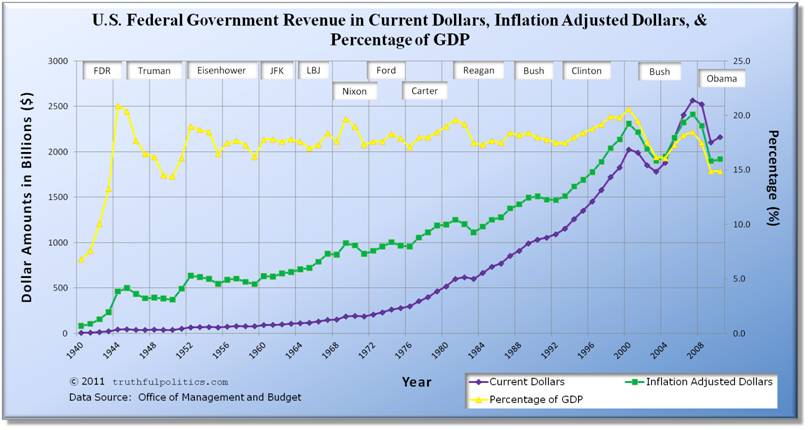
Having said that, while it's true that the government today is taking in slightly less as a percentage of GDP, you've got to consider that the GDP is much greater now than it was in the late 60's, even after you adjust for inflation. In fact if you just adjust government revenue for inflation, then in terms of real dollars the government has twice the revenue today than it had in 1968, as you can see here:
http://www.truthfulpolitics.co...
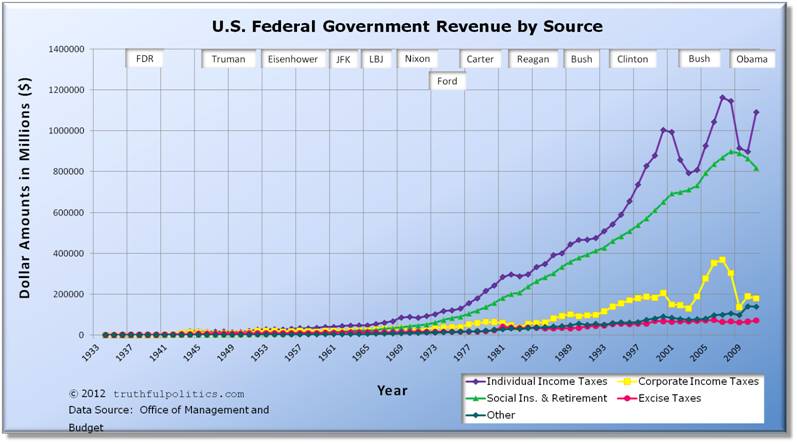
And also if you look here, the government makes by far the most amount of its money from personal income taxes, which are heavily influenced by consumer spending:
http://www.truthfulpolitics.co...
And you know the biggest reason why we have a bigger GDP (and thus more government revenue) than we did back then? It's because we have better technology that makes us better producers. And before somebody argues anything about our population growing, I've got you covered there too:
http://www.multpl.com/us-real-...
Notice the GDP per capita (that is, GDP per person) has only risen since the 60's, and boy has it risen by a LOT. And again, that's due to individual people having better technology, which includes little things such as smartphones and other creature comforts that the OP was lamenting.
-
Re:Which of course has nothing to do with...
By what measure are you saying that?
GDP adjusted for inflation contradicts your position.
Look at this graph:
http://www.multpl.com/us-gdp-i...*looks sadly at poster*
I'm afraid you've been brain washed.
*tears up a little bit*
I want you to know I feel for you and it isn't your fault. Some people can't protect themselves from this sort of gaslighting.
You need a very strong mental constitution to be able to digest, filter, and process that shit we're fed on a regular basis into useful information.
Today, the average Russian earns about 25 percent what the average American earns. Their per person adjusted earning power is lower than Slovakia.
SLOVAKIA out performs modern Russia.
And we can go through all the other communist failed states which is redundant because communism does nothing but fail. You'll find nothing but a pitiful record of disappointment.
I can't have a discussion that is logical with someone if they believe in a fantasy world.
You are entitled to your own opinions. You are not entitled to your own facts. The only remnants of communism left are some cultural marxists hiding like rats between the walls in our liberal arts departments. And their days are numbered as well because rather then being subtle they're just creating one social media and political disaster after another.
In another 50 years or so they'll be largely purged from places that cause us any trouble... and what remains will be sort of a cute harmless throwback that no one takes seriously.
-
Tragedy of the Commons Writ Large
... You can't have a business without customers, you can't have customers if people don't have money, and they can't get money without wages or social security...
What we have here is the situation when corporate power, and the power of the financial elite, takes over all aspects of government policy. It transforms the entire consumer market based economy into the Tragedy of the Commons.
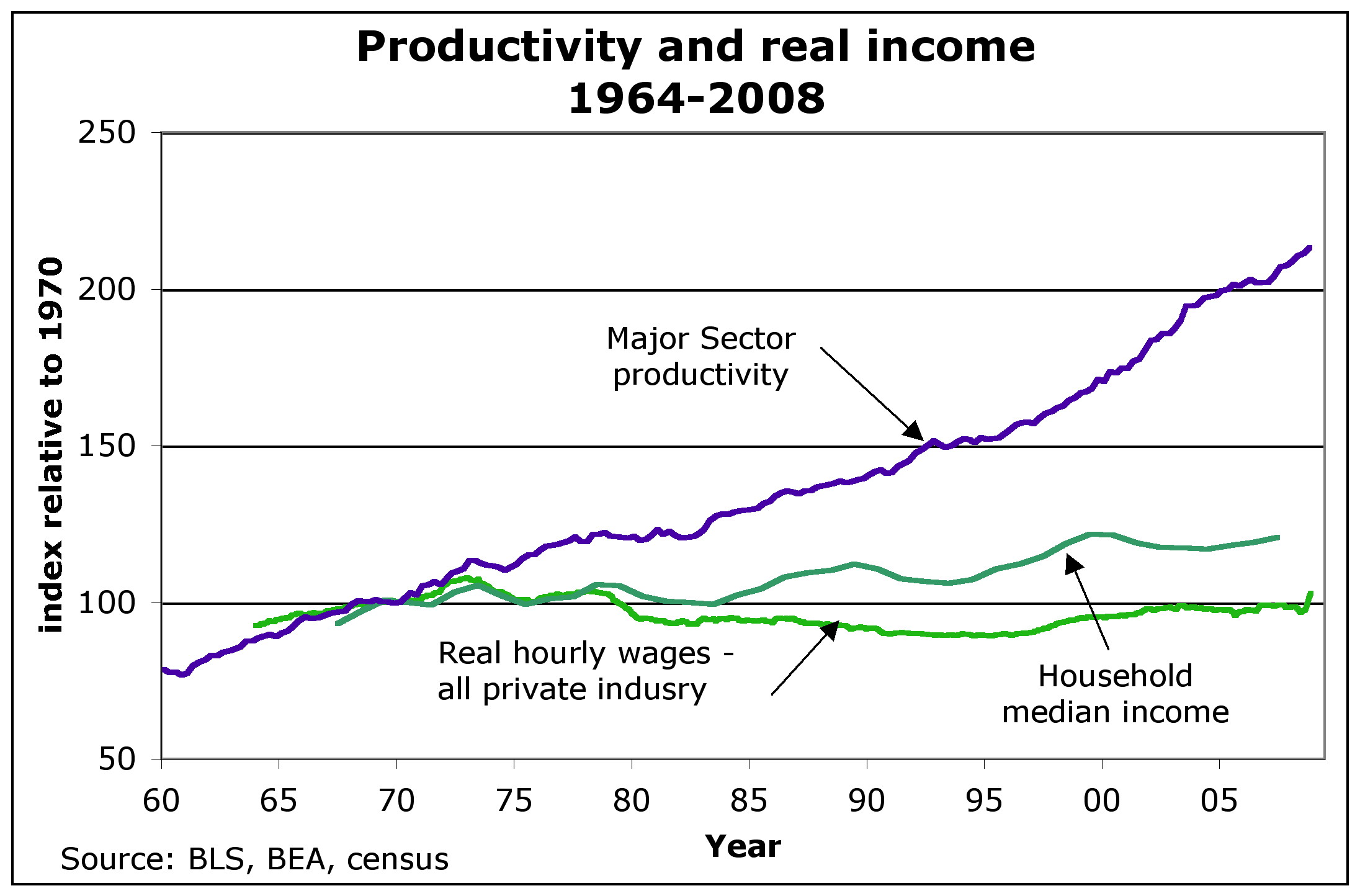
Every corporation aims to to fatten its bottom line, stock price, and C-Suite compensation package by reducing the wages of its labor force. It is a rational micro-decision, just as grazing as many sheep as possible on the commons is rational for the individual farmer, but it destroys in the long run the basis of the whole economy - a nation full of consumers with lots of money to spend on products. The majority of the increases in corporate profitability, and the source of the exploding CEO paychecks, over the last quarter century have come from holding wage payouts flat (or reducing them. Increased productivity stopped being linked to worker compensation a full 45 years ago, an entire working lifetime. As the proportion of wages that make up the economy fall to the lowest level since the Great Depression the engine that drives the growth of the U.S. economy is running out of fuel, now an anemic 2.38%, compared to the long term mean of 4.41%.
But hey, the CEOs are happy!
-
Re:Parent of University Frosh Twins: "Thank You"
Or we could, you know, just restore the massive State and Federal funding
Where's this money coming from? Tax increases have a cost too.
Further, I don't think people get that the massive funding in question just wasn't that massive or that different from today. Recall that college costs have increased for decades at a far greater rate than the US economy has. What was ample funding forty years ago just doesn't come close today.
From the above link, education costs increased by a factor of six in a 26 year period from 1985 to 2011. In that time, nominal GDP (not adjusted for inflation to compare apples to apples) didn't even increase by a factor of 4 (4.35 trillion dollars to 16.16 trillion dollars).
So it's not just a matter of just maintaining historical levels of spending, which probably has been done for most states, but to increase spending as a fraction of the overall economy by 60%. -
Re:okay.
Yes, and population total in 1900 was 76 million compared with 1963 which was ~190 million people. So our population almost tripled and the accidents doubled.
Gotta provide source of course!Nope, streets were most definitely not safer then. There is also the reality that most incidents were not even reported in those earlier years.
-
Re:Most interesting part...
This information really isn't all that helpful. From this Wikipedia graph, it would appear that, over thirty years, median household income has increased from $46K to $52K in the past thirty years, an average increase of $200/year, which seems pretty stagnant. (By comparison, from this table, GDP in 2009 dollars increased from 7.4 trillion to about 16 trillion over the last thirty years. In comparison, median household incomes have been falling behind fast.)
-
Re:As opposed to the shining example of US democra
17.8% of the U.S. population voted for George W. Bush in 2000 [0]. 21.0% of the U.S. population voted for Barak Obama in 2012. [1]
Seems to me not very far off from the abstract's note that "15% of all Crimeans voted" to secede. If it's legitimate in the US, why not elsewhere?
[0] Yes, Al Gore did better by winning 18.1%.
[1] Percentages calculated mainly using Wikipedia's numbers, which admittedly are not a primary source, but I'll guess are probably "close enough" to make my point: https://en.wikipedia.org/wiki/... https://en.wikipedia.org/wiki/... https://en.wikipedia.org/wiki/... http://www.multpl.com/united-s... (for 2012 population)
You assume that every citizen of the US is eligible to vote. Some are underage, some are ineligible due to being in prison. If you look at the correct numbers, you get:
Eligible voting population: 221,925,820
Total votes for Obama: 65,915,796
Percent of population voting for Obama in 2012: 29.7% -
Re: Makers and takers
M1 changes are meaningless. They are NOT inflation. Inflation in 1947 was 18.13%, according to BLS ( http://www.multpl.com/inflatio... ).
The highest inflation after that was 13.91% in 1980, it was not a hyperinflation by any stretch. And I lived through an _actual_ period of hyperinflation after the USSR breakup. -
Re:Good luck with that!
It's not too far off though
http://www.multpl.com/s-p-500-price/
Most dramatic drop is black friday era, about 350 -> 75
with gold
http://inflationdata.com/Inflation/images/charts/Gold/Gold_inflation_chart.htm
Highest to lowest is about 1800 -> 400.
Also, looking at the two together, in recent past gold has been more volatile than S and P.
Overall, S&P goes up, and gold stays steady, but both are fairly volatile in the last 30 years ( S&P going 500 - 1400 gold going 250 - 1400, but gold looking ready to crash hard based on recent history, or slowly devalue on older data (1930s)).
-
Re:keep dreaming
'American leadership in space will continue for at least the next half-century because we
- aha, keep dreaming.
The US bond crisis is coming, followed immediately by the currency crisis.
The people who actually buy bonds seem to disagree with you there...
-
Re:sure
It takes all of five seconds: Apple's P/E ratio has been 18-20 for a while now. This morning it's 19.57. It's stock price has risen a lot in the last few years, but it has also been making and selling products like mad, and making huge amounts of profit (not just revenue) in the process.
If we're talking about P/E, let's make some comparisons:
Ford 9.42
MS 11.47
Acer 13.18
IBM 14.24
Medtronic 14.25
Pfizer 18.74
Google 23.96
Verizon 40.67
Netflix 79.48
So, in short, there's a wide range of P/E ratios among viable (and profitable) companies. Apple's P/E puts it a bit on the high end, but not wildly so. It is relatively cheap compared to, say, the P/E of the entire S&P 500. P/E is just one contributor that guides whether to buy or sell a stock.
Where you might be able to make an argument is that most of the established companies, particularly those with P/Es at or below AAPL's, pay out dividends, and that's one main way investors make money off them. The yield is typically 1-2% per year, so you'd still be waiting decades to earn back an investment through dividends alone.
Apple doesn't pay a dividend, and never has, so the only way to make money on it is to buy low and sell high. If you'd snagged it years ago, before the introduction of the iPhone, for instance, then sold today, you'll have made a boatload, several times what you put in. And that isn't a Ponzi scheme: you owned a share of a profitable company, and that company grew because it generated new business and made money doing so. The potential for making that money by riding a company's growth is a contributor to P/E. Apple has a good track record of breaking into new business and expanding, so its P/E is a bit higher. Ford is unlikely to capture a brand new and rapidly growing market sector, so its P/E is lower. -
Re:Great future
The S&P 500 isn't wildly out of line with historical behavior:
I'd rather have bought in 1985 than in 1998 though.
I guess the thing to do is to make sure that stocks are not your only investment for retirement (I'm just under 30, think my stock exposure is too high and regularly converse with people in their 50's who are more aggressively invested in stocks than I am). Another important thing to do is to have disability insurance (this is a great hedge against your future earned income rapidly disappearing).