Slashdot Mirror
Domain: nasa.gov
Stories and comments across the archive that link to nasa.gov.
Comments · 16,365
-
Re:Flops not useful?
Because the climate simulation model they use does a LOT of inter-process communication. Each piece of the calculation depends on what's going on around it.
Ever see footage of manual calculation rooms NASA used to have*? Imagine if every one of the calculations those people were doing depended on the previous calculation they did, AND all of the previous calculations of their eight nearest neighbors.Now you know why that atmospheric model has a benchmark rated in "century/months" - the number of centuries of "model"-time that can be calculated per month of "wall clock"-time.
That they're working toward a century per day is pretty amazing, especially when they're also tightening the resolution down from 20 sq. km. to under 5 sq. km. by 6+ levels of atmosphere.* - http://www.jpl.nasa.gov/news/features.cfm?feature=1327
Note: I used to work in the same division of NCAR as Rich Loft. Brilliant guy.
-
Re:Two mysteries linked by Rossby waves
Here are some pics and analysis that don't require $60 / year to read.
-
Let's hope the motors hold out.
Opportunity saw its first electrical spike in one of its motors recently - the same problem that has basically crippled Spirit.
This was described (8 paragraphs down) in this press release. That's why they got out of Victoria Crater post haste.
Of course, the terrain in Meridiani Planum is much more navigable than Gustav Crater, so even if they do lose a motor, they may still be able to make progress.
-
Re:That's Cheap!
There simply isn't that much demand "sending small unmanned craft to do [unspecified] things".
You mean like these?
As far-fetched as it may be for you, unmanned craft are used for research (HST anyone?), communication, weather, navigation, electronic reconnaissance and remote-imaging (amongst other things). -
Re:That's Cheap!
There simply isn't that much demand (or foreseeable need for) "sending small unmanned craft to do [unspecified] things"
Seems like there's a pretty good market to me. -
Re:No I didn't Read TFA
Sir Arthur C. Clarke, when asked about when the space elevator would be constructed, he said something like:
Probably about 50 years after everybody quits laughing.
link.
Don't shut the idea, the idea is pretty good, yet the implementation is going to be tricky, with a space elevator, sending a kg. into space will be way more cheap than what is cost nonadays.
-
Let there be more projects
I agree, tech support on campuses today can quickly become anachronistic; that is, if they are not have the requisite intellectual curiosity or do not have the cajones to spearhead new technologies like cloud computing (for distributed mathematical modeling), online E2E voting (for student elections), Educational MMORPGs and a list of other systems being developed now ready for deployment to the student population ASAP. You should have programmers on staff that can help contribute or partner with your CS department for folk that can contribute to these wonderful OS projects. It is important for you to realize that if you do not participate you are accepting other institutions philosophies of style, privacy and security that may be incompatible with yours or be forced to pay some contractor to customize it for you. You would be surprised how useful you will become when you start asking people not only what they want help with today but attempt to understand their needs well enough to plan ahead for what they will be clamoring for tommorow.
Stop playing WOW in the server room and start reading journals about UI Design, Human Computer interface and cybernetics for more advanced theory. Why should you study these journals instead of just reading the old faithful IT pulp mag, this website or some other "tech website"? Because you need to not only see what is coming down the consumer pipeline in a couple of months or be beta testing a new whiz bang software package; you need to understand where all this interaction is heading and how you can get ahead of the curve technologically by enmeshing your department in the active process of problem solving individual and institutional scale issues by being able to posit your own design philosophy coherently into the future and apply it cogently and adaptively as variables change.
-
Re:Unbeknownst to many
-
Re:Enforcing the license?
I hate to be a lame AOL'er, but "me too" where me is all the people I work with: software is GPL, try to encourage people to cite (or in many cases just put a quick mention in the acknowledgements) any appropriate papers when publishing.
A (marginally) interesting counter-example is healpix, code used by astronomers for all sky maps (especially of CMB data, its original use case). It was originally released with such a citation clause, which caused much annoyance among people who wanted to use the code for little things, as well as make it difficult (impossible) to incorporate into existing astronomical software which is Free (GPL'ed etc.). Cooler heads prevailed, and the restriction has since been rescinded, although they still request attribution in the same manner as they had required before.
-
Re:no high resolution photos
-
Beautiful pic
http://mediaarchive.ksc.nasa.gov/detail.cfm?mediaid=37485
evokes the feeling that it's just a viewport into actual field with 100s of shuttles ready to launch, as a sign of civilian space travel gone mainstream:) -
But not the first time...
STS-35 and STS-41 (yes, that long ago) were two shuttle missions that had its shuttles out on pads at the same time as well. Pictars:
http://www.ksc.nasa.gov/mirrors/images/images/pao/STS41/10064404.jpg
http://www.ksc.nasa.gov/mirrors/images/images/pao/STS41/10064405.jpgSadly they did not launch together.. now that'd be quite the sight.
Anyway, I'm hoping to see lots and lots of awesome imagery of this setup, as it will indeed most likely be the last time we'll be able to see this again outside of Hollywood.
-
But not the first time...
STS-35 and STS-41 (yes, that long ago) were two shuttle missions that had its shuttles out on pads at the same time as well. Pictars:
http://www.ksc.nasa.gov/mirrors/images/images/pao/STS41/10064404.jpg
http://www.ksc.nasa.gov/mirrors/images/images/pao/STS41/10064405.jpgSadly they did not launch together.. now that'd be quite the sight.
Anyway, I'm hoping to see lots and lots of awesome imagery of this setup, as it will indeed most likely be the last time we'll be able to see this again outside of Hollywood.
-
Re:what is it going to do ?
I was wondering though does the ISS have more than one place to dock a shuttle? Or do they have to somehow undock the damaged craft after the crew disembark and then dock the rescue craft? Or does the whole rescue process happen while both craft are undocked and the crew do a cool space dive between shuttles?
The damaged orbiter is undocked first by remote control from the ground. The crew needs to install a cable to allow the command to open the docking system hooks (which is normally a push button the crew performs on the aft flight deck) to be sent from the ground.
If you really want to see everything in excruciating detail, this NASA pdf has it...
http://www.nasa.gov/pdf/153444main_CSCS_Resource_%20Book.pdf -
Re:Direct link
And here's the link to the NASA source which skips the "registration required" Boston Times. Sorry, New York Globe. No, wait, Boston Globe. I always get those two confused since they're (literally) the same damned paper.
AC so as NOT to karma whore.
-
Looks like ARES.
No, not that one. This one.
Oh, wait, scratch that. It will look completely different and won't use any previous research. I mean they already spent some money to come up with a new acronym, so why not go all the way?
-
Why choose just one?
China is spending millions on space suits and America is spending millions on bailing out big corporations. Strange how that works, huh?
Now, now. What makes you think the modern US government chose only one of those two options?
We're currently spending $183 million on design work for the next generation of space suits for the Constellation program, with an option for future contracts for $260-300 million. That covers 4 suits for moon walkers and 6 suits for people headed to the ISS. (ref)
(Oh, and the Chinese are considering bailing out Lehman brothers, so they're getting in on that action too, I guess.)
-
I'd like the patent...
...on Teflon... that could be lucrative... Okay, I'm going to drool over MAVEN
-
Re:Fujifilm 5000S
sorry, since NASA is funded by other vendor, they are so commited they even (name places as an ad (click to the picture showing Olympus Mons). Fuji won't simply make with such a cheap offer.
-
Where's the news?
So now even NASA is into rehashing old news. Dust devils were filmed by the Spirit rover in 2005: http://marsrovers.jpl.nasa.gov/gallery/press/spirit/20050819a.html
-
The rovers have seen this as well
-
The rovers have seen this as well
-
Re:Fujifilm 5000S
Um, spend a little time at this gallery or this one or this one or this one for gigabytes of very sharp, gorgeous imagery - some of it in extremely high resolution.
-
Re:Fujifilm 5000S
Um, spend a little time at this gallery or this one or this one or this one for gigabytes of very sharp, gorgeous imagery - some of it in extremely high resolution.
-
Lots of Color
There are plenty of color pictures from this mission and other current Mars missions on NASA's site and on the Phoenix team's site and on many amateur sites.
-
Re:What's the point?
Actually, Delay-tolerant Networking has applications that go beyond just space. One prime example is acoustic networks for oceanic monitoring - http://ieeexplore.ieee.org/iel5/4302188/4302189/04302341.pdf has a nice paper about the application. Also, battlefield communications where there may be intermittent connectivity benefits from DTN.
Anyway, the reason for getting direct IP connectivity to space probes is to reduce the overhead: If you can just say wget http://www.jpl.nasa.gov/mars/opportunity/todayspic.jpg to access Oppy's camera instead of having to go through various hoops it makes everyones work easier. Combine this with dynamic and automatic routing (for example, for solar oppositions)..So yes, mostly the benefits are for scientists and engineers in space projects.
-
Re:They ought to divert Ares funding to these guys
The wikipedia article on the Shuttle solid rocket boosters discusses the proposed re-use of Shuttle components (segmented solid rockets with O-rings in this case) in the Ares program. The article itself has references to external sources where this re-use is discussed. The NASA press release also mentions the re-use:
"This vehicle will be carried into space by Ares I, which uses a single five-segment solid rocket booster, a derivative of the space shuttle's solid rocket booster, for the first stage."
While it just my opinion, a proposal to re-use substantial parts from the Shuttle program exactly or almost exactly the same as their current configuration does not strike me as "learning the lessons" (or at least not the right ones) from the Shuttle program.
-
Re:State run media?
I believe the moon mission had a 5 minute (about) delay. The difference was this delay was because of the ol' laws of physics.
Nope. Just about 1 1/4 secs. The most part of the 10-12 sec delay had to do with the doppler shift and color conversion process. AW&ST, p18-20, 26 May 1969. PDF I suppose, technically, that is the laws of physics governing that, though.
-
Re:Overlap is not the issue; just ask Griffin.
Griffin only addressed the conflicts for the Vehicle Assembly Building, and Michoud Assembly facility. He makes no mention of the Orion/Constellation problem for the Crawlerway (its too heavy for the road) and no mention of the Launch Pad, Crawler itself, or the Gantries that hold the stack in place, fuel the rockets, etc. It looks like they will continue to use Launch Pad 39A for shuttles, and 39B for Constellation. http://www.nasa.gov/mission_pages/constellation/main/Constellationfacilities.html I think the link above handles all my concerns except the launch pad and crawlerway problems with the heavly load of Ares V. This and all other issues can certainly be addressed under Griffin's scenario where extra money is made available to extend the Shuttle program.
-
Re:She will.
Scientists can't predict the climate accurately for the upcoming weekend.
Hardly surprising, given that there's no such thing.
Over short timescales like that it's referred to by those in the know as "weather".
-
Re:PETA?
I suggest you protect them just as you have protected stray dogs and cats.
Best of all there's no need to drive to a dumpster to uh...dispose of the ones that...died of natural causes...yeah.
Save the tardigrades PETA! Look at their sad little faces!
http://nai.nasa.gov/newsletter/05092003/tar_Heterotardigrade-Echiniscus-Head.jpg
-
Re:An astronaut by any other name...
As NASA has defined it, only US space-going individuals may claim the title "astronaut."
Well if that's the case, then I guess Canada must have a serious foreign policy spat on the horizon: http://www.google.com/search?q=canadian+astronaut
And the ESA
http://www.google.com/search?q=esa+astronaut
In fact, the NASA mission summary for STS-124 refers to "Japan Aerospace Exploration Agency (JAXA) astronaut Akihiko Hoshide": http://www.nasa.gov/mission_pages/shuttle/shuttlemissions/sts124/main/index.html
- RG>
-
Solar Probe PlusIt's worth a note that another upcoming NASA mission, Solar Probe Plus, will actually probe the corona, not just look at it.
-
j-track 3d
The subject sums it up, but I'm getting a little pissed at technology that is developed at NASA (World Wind) is just getting co-opted by Google (Google Earth) with no respect paid to the initial innovators.
J-Track 3D has been around for years doing this exact same function of plotting satellite trajectories including ground trace and additional information if you click on the satellite.
Just because you do it using Google doesn't mean that it's new, cool, innovative or news worthy.
http://science.nasa.gov/Realtime/jtrack/3d/JTrack3d.html
There is also J-Track which on Windows, with its "active desktop" feature, can be set as your background/wallpaper to always be tracking weather and satellites.
-
And also....
-
Re:Interferometry
Yes, but in astronomy virtual telescope generally means a computer compilation of various sky surveys, so you can type in a coordinate and see what is there. This is totally different, VLBI provides a real telescopic view, just synthesized by interferometry.
As an analogy, Google Earth is a virtual spy satellite. An orbiting synthetic aperture radar is a real spy satellite, just with a synthesized image.
-
Space Interferometry Mission (SIM)
If you had an array of Hubble sized telescopes in space and could put them whatever distance you'd like from each other, what sort of results could you get?
That is basically the Space Interferometry Mission (SIM), which alas has had funding troubles recently. The component telescopes are not the size of the Hubble, but the idea is exactly as you suggest. One thing you could do with this is detect Earth sized planets in a solar system like ours out to a reasonable distance.
-
Re:How is Global Warming still a controversy?
There is scientific evidence to suggest that as the climate is (naturally) warming, more CO2 is being released from the seas - if anything, this particular research has been covered up in favour of the politically-motivated idea that man *must* be the cause of Global Warming.
Wow. You couldn't be more wrong. Any scientist anywhere will tell you that the ocean is a carbon sink - absorbing CO2. Only after the Ocean gets warmer does it release CO2.
The point is that the Ocean wouldn't being emitting CO2 if it wasn't absorbing so much of it from man made sources in the first place. As you mention An Inconvient Truth, its this absorbtion that is wrecking havok among coral reefs and creating huge storms.
In essence, man-made CO2 is partly absorbed by the ocean, heating it and making it acidic, and then released back into the atmosphere with whatever CO2 wasn't absorbed. It is still man-made CO2, it just went through the ocean first.
Al Gore, while he mentioned a number of previous Ice Ages, noted that the CO2 levels directly related to temperature, and that at no time in 650,000 years did CO2 levels ever go higher than 300 ppmv (parts per million by volume). The historical high is 280 ppmv.
In 1960, there was a concentration of 315 ppmv. Today we sit at 385 ppmv. There is no projection that it will slow down or decrease, but rather increase much more. By 2010 we expect to break 400 ppmv. But who needs words when you have a graph?
Oh, and whenever these articles get opened up for discussion, why is the fact that ice is getting thicker in many areas of the North and South pole conveniently overlooked?
Where's those facts? I dare you to link them. But you wont, because they don't exist.
The only dispute is over the "average ice density" in the Arctic, but no one disputes the reduction of ice of the caps, or Arctic Shrinkage. The before and after pictures are shocking.
As for Antarctica, both NASA and the British Antarctic Survey (BAS) disagree with you.
Politically, there is a strong case for promoting MMGW which would stop the development of the Third World, thus ensuring that Third World imports into rich countries remain cheap, thus keeping the populations of the rich countries fat, dumb & happy. And because the Third World countries remain poor, more people live in poverty and die younger from diseases that are curable. In actuality, MMGW is an *anti-Green* viewpoint.
I personally love this part. A conspiracy theory that portrays Big Business and the Rich as the minds behind global warming. Yes, they are the ones who will profit by stopping the development of third world countries.
Yes, its not like Big Business would want to maximize their profit margin by cutting out as much environmental regulation as possible and decrease overheads so they exploit countries better. And its not like they have been buying scientists and congressmen trying to lobby against global warming at all by calling it a hoax! No, those were other people...
Do you listen to yourself?
As for developed countries and population, they tend to limit themselves without regulation; the U.S. average family now has 1.9 children as compared to a generation ago where they average was 4 to 5 kids.
Please, read a book or accredited source, not just typical zealous conservative rhetoric.
-
Re:About weather changes and global warming...It is theorized that the Earth is about 4.5 billion years old, so there could be cycles of weather pattern which may be involved which we have no real clue about. Let's face it, on a cosmic scale, we've not been around for very long, like.. a blip in time really in comparison to our planet's age.
So, in light of this
Just a few articles about the recent LACK of sunspots:
- Sun : One Month Without Sunspot
- First month without sunspots in a century
- What's Wrong with the Sun?
- Sun Makes History: First Spotless Month in a Century
If you read these articles, you'll realize that the sun plays a larger part in our climate than we do. In addition, check out the "mini-ice ages" after each of the periods
It may appear that the whole "global warming" hysteria is about to come to an end
I'm NOT saying that man doesn't play a trival part, but realistically, we don't matter that much on a global scale.
Just listen to George Carlin
-
Re:Climate Science
Awesome, so given the past performance of the London Stock Exchange, you could predict it's future performance?
The unpredictability of the stock market doesn't somehow imply that nothing in science can be predicted.
Even assuming that the data you have is perfect, it doesn't mean the result of a simulation is going to be perfect.
Nobody claimed that proxy measurements are perfect. Hell, thermometers aren't perfect. And what simulation?
In the case of your proxy data for global(???) temperature...is it at all possible that other factors affect the growth rate of coral?
Of course it is. That's why they went out and measured coral growth under a bunch of different conditions to quantify how much such factors may contribute.
Or that maybe just maybe fluctuations in the rate of deposition of sediment may have a looser correlation with temperature fluctuations than you think??
Sediment deposition rates are not temperature proxies. (Or at least, I've never heard of anyone using them that way.) If anything, they're used for dating, not temperature. And usually not for that, unless you can count explicit layers; typically, dating of sediments is done by isotopic analysis of their contents.
but I would have thought that just collating more and more "probably correct" data points doesn't necessarily make them more accurate,
It will reduce the random error and leave any systematic error unchanged, so it will make them more accurate but only up to a point. To reduce the systematic error you have to come up with better calibration methods, or compare to independent sources.
especially when you're plugging them into a simulation...
Proxy data is rarely derived by simulation; it usually comes from just fitting a statistical regression. Something like the second figure here. There is some scatter in the data, and therefore uncertainty, but it's not totally unpredictable either.
-
Re:resolution for satellite like digital cams?
recently, there were 'multiple exposure' (roughly) algorithms being used to 'look thru' the heat, pollution and general waviness of the sky
Yeah, I noticed the lucky imaging article right after I clicked submit. Come to think of it, I've seen such compositing in action in a couple APOD pictures - specifically this solar eclipse picture and this Milky Way lake reflection picture. I don't think those photographers were trying to eliminate atmospheric effects in those particular shots, but they sure did turn out well.
and even *with* diffraction, you can overcome it with sharpening.
A lot of astronomers are already leery of things like lossy image compression - they don't want to find that their new discovery was really just some image processing artifact. Although, I can understand wanting to make a picture as sharp as possible to show to the general public afterwards.
-
Re:resolution for satellite like digital cams?
recently, there were 'multiple exposure' (roughly) algorithms being used to 'look thru' the heat, pollution and general waviness of the sky
Yeah, I noticed the lucky imaging article right after I clicked submit. Come to think of it, I've seen such compositing in action in a couple APOD pictures - specifically this solar eclipse picture and this Milky Way lake reflection picture. I don't think those photographers were trying to eliminate atmospheric effects in those particular shots, but they sure did turn out well.
and even *with* diffraction, you can overcome it with sharpening.
A lot of astronomers are already leery of things like lossy image compression - they don't want to find that their new discovery was really just some image processing artifact. Although, I can understand wanting to make a picture as sharp as possible to show to the general public afterwards.
-
Re:resolution for satellite like digital cams?
recently, there were 'multiple exposure' (roughly) algorithms being used to 'look thru' the heat, pollution and general waviness of the sky
Yeah, I noticed the lucky imaging article right after I clicked submit. Come to think of it, I've seen such compositing in action in a couple APOD pictures - specifically this solar eclipse picture and this Milky Way lake reflection picture. I don't think those photographers were trying to eliminate atmospheric effects in those particular shots, but they sure did turn out well.
and even *with* diffraction, you can overcome it with sharpening.
A lot of astronomers are already leery of things like lossy image compression - they don't want to find that their new discovery was really just some image processing artifact. Although, I can understand wanting to make a picture as sharp as possible to show to the general public afterwards.
-
Photograph selection.
"Refreshingly, they've decided to include a many of the behind-the-scenes techies and the equipment they steward, rather than just the launch vehicles and crew."
If you rely on Big Media for your news and information, you deserve what you get. The photographs in the Globe article all come straight from the NASA and are available on the web to anyone who makes the effort to see them. (NASA has been doing this for years now, and has quite a bit of historical photographs available as well.)
Try these websites:- The Kennedy Space Center STS-125 gallery.
- The Johnson Space Center STS-125 gallery.
- The NASA Human Spaceflight STS-125 gallery.
- The Goddard Spaceflight Center Servicing Mission 4 gallery.
-
Photograph selection.
"Refreshingly, they've decided to include a many of the behind-the-scenes techies and the equipment they steward, rather than just the launch vehicles and crew."
If you rely on Big Media for your news and information, you deserve what you get. The photographs in the Globe article all come straight from the NASA and are available on the web to anyone who makes the effort to see them. (NASA has been doing this for years now, and has quite a bit of historical photographs available as well.)
Try these websites:- The Kennedy Space Center STS-125 gallery.
- The Johnson Space Center STS-125 gallery.
- The NASA Human Spaceflight STS-125 gallery.
- The Goddard Spaceflight Center Servicing Mission 4 gallery.
-
Photograph selection.
"Refreshingly, they've decided to include a many of the behind-the-scenes techies and the equipment they steward, rather than just the launch vehicles and crew."
If you rely on Big Media for your news and information, you deserve what you get. The photographs in the Globe article all come straight from the NASA and are available on the web to anyone who makes the effort to see them. (NASA has been doing this for years now, and has quite a bit of historical photographs available as well.)
Try these websites:- The Kennedy Space Center STS-125 gallery.
- The Johnson Space Center STS-125 gallery.
- The NASA Human Spaceflight STS-125 gallery.
- The Goddard Spaceflight Center Servicing Mission 4 gallery.
-
Photograph selection.
"Refreshingly, they've decided to include a many of the behind-the-scenes techies and the equipment they steward, rather than just the launch vehicles and crew."
If you rely on Big Media for your news and information, you deserve what you get. The photographs in the Globe article all come straight from the NASA and are available on the web to anyone who makes the effort to see them. (NASA has been doing this for years now, and has quite a bit of historical photographs available as well.)
Try these websites:- The Kennedy Space Center STS-125 gallery.
- The Johnson Space Center STS-125 gallery.
- The NASA Human Spaceflight STS-125 gallery.
- The Goddard Spaceflight Center Servicing Mission 4 gallery.
-
Re:Sunspots down... temperature down?
Actually there's an increasingly vocal group of scientists that are saying that the CO2 is a symptom, not the cause. As the earth warms it causes the ocean currents to change, and CO2 rich water from the bottom of the oceans and seas gets churned up to the surface which causes more CO2 than usual to be released into the atmosphere.
I don't fully understand how it works, I am not a scientist, and this is way oversimplified, but that's the gist of their argument. Man's contribution is miniscule compared to the CO2 released by the natural processes of the ocean, which increase in activity when at the peak of a global warming cycle (also evidenced by increased hurricane and typhoon activity) resulting in more CO2 in the atmosphere.
Of course these guys, NASA, NOAA, the atmosphere and the sun are all paid off by George Bush to cooperate to make Al Gore look bad.
It's a republican propaganda campaign, of course.
insert values("tongue firmly in cheek") into tbl_discussion;
select asbestos, underwear from tbl_closet;All joking aside, the deforestation of the earth isn't helping to reduce this CO2 as fast as past planetary climate cycles, so if you can find the time, plant some trees. This is what people should be doing if they want to make a positive contribution to the earth. It's a hell of a lot more effective than buying and selling carbon credits and jawing to everyone (in the guise of "raising awareness") about faulty science, which are make believe contributions and counterproductive.
As much as the SOHO data is relieving, this is downright scary:
http://earthobservatory.nasa.gov/Newsroom/NasaNews/2005/2005091320344.html-Viz
-
Re:Does this mean less solar output?
I found this tidbit pretty damn interesting
FTA:
"Earth of course is a big heat sink, so it takes awhile to catch up to any changes that originate on the sun, but temperature drops indicated by 4 global temperature metrics (UAH, RSS and to a lesser degree HadCrit and GISS) show a significant and sharp cooling in 2007 and 2008 that has not rebounded.In the 20 years since "global warming" started life as a public issue with Dr. James Hansen's testimony before congress in June 1988, we are actually cooler."In the early 80's we were in a trough that was bottoming out and people were running around like they are now saying we're headed for an ice age, by 88 it was coming back up again prompting Hansen's sky-is-falling testimony. Here we are in 2008.
I withhold my own comments about the humans-causing-global-warming-and-cooling hysteria. Well, dammit, I can't. IT'S JUNK SCIENCE AND I TOLD YOU SO (and have been flamed for it). I'd lay a buck down on a bet that Mars, Jupiter etc have also started cooling off again, and it will be evident within 5 years.
I only know about SOHO because I've been watching SOHO for a long time (my dad works for a NASA contractor and helps to run the test chambers and fabricate test rigs which tested the satellite at Goddard before it went up). I had this as my screenshot the day it was published:
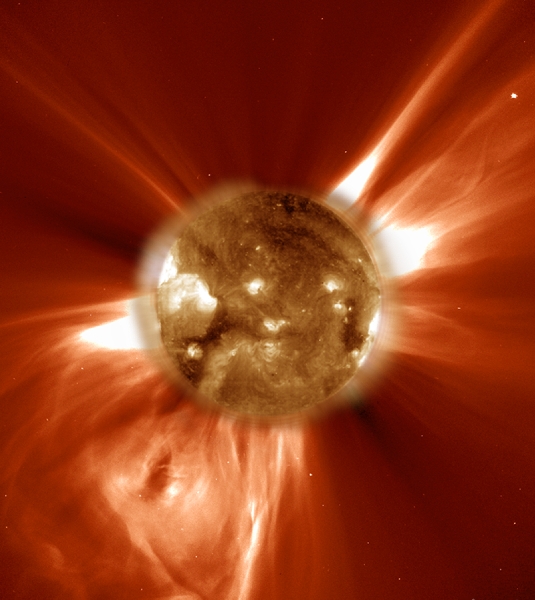
http://sohowww.nascom.nasa.gov/gallery/images/large/c2eitcomp_prev.jpgYou might say I'm a space case and huge NASA fan. Real data trumps incomplete computer models any day of the week and that's what NASA enables the collection of, real data. One day we may just figure out *why* the sun warms and cools. We already know it does.
I'll be glad when this BS has been put to rest so we can move on and solve some real problems. Ok, the earth warms and cools on a cycle and has for billions of years. NEXT!!!
-Viz
-
Re:Politics in Science
Now why might this have happened? Why do papers predicting a period of low solar activity fail to be published (see the full articles)?
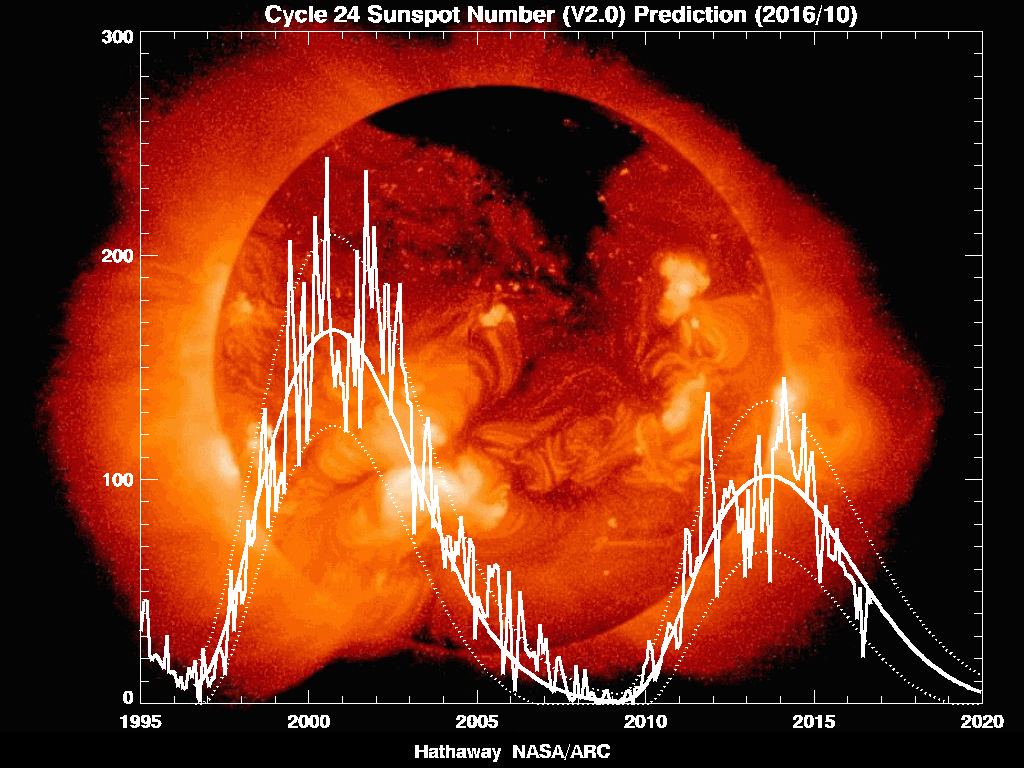
Sun spot cycles we a well known phenomenon.
The low point of the cycle has been predicted for 2007-2008 for the last 20 years!
This graph is one such prediction that you say has been suppressed.