Slashdot Mirror
Domain: nasa.gov
Stories and comments across the archive that link to nasa.gov.
Comments · 16,365
-
Re:I think
Thankfully the URL is easy to remember... just like images.google.com.
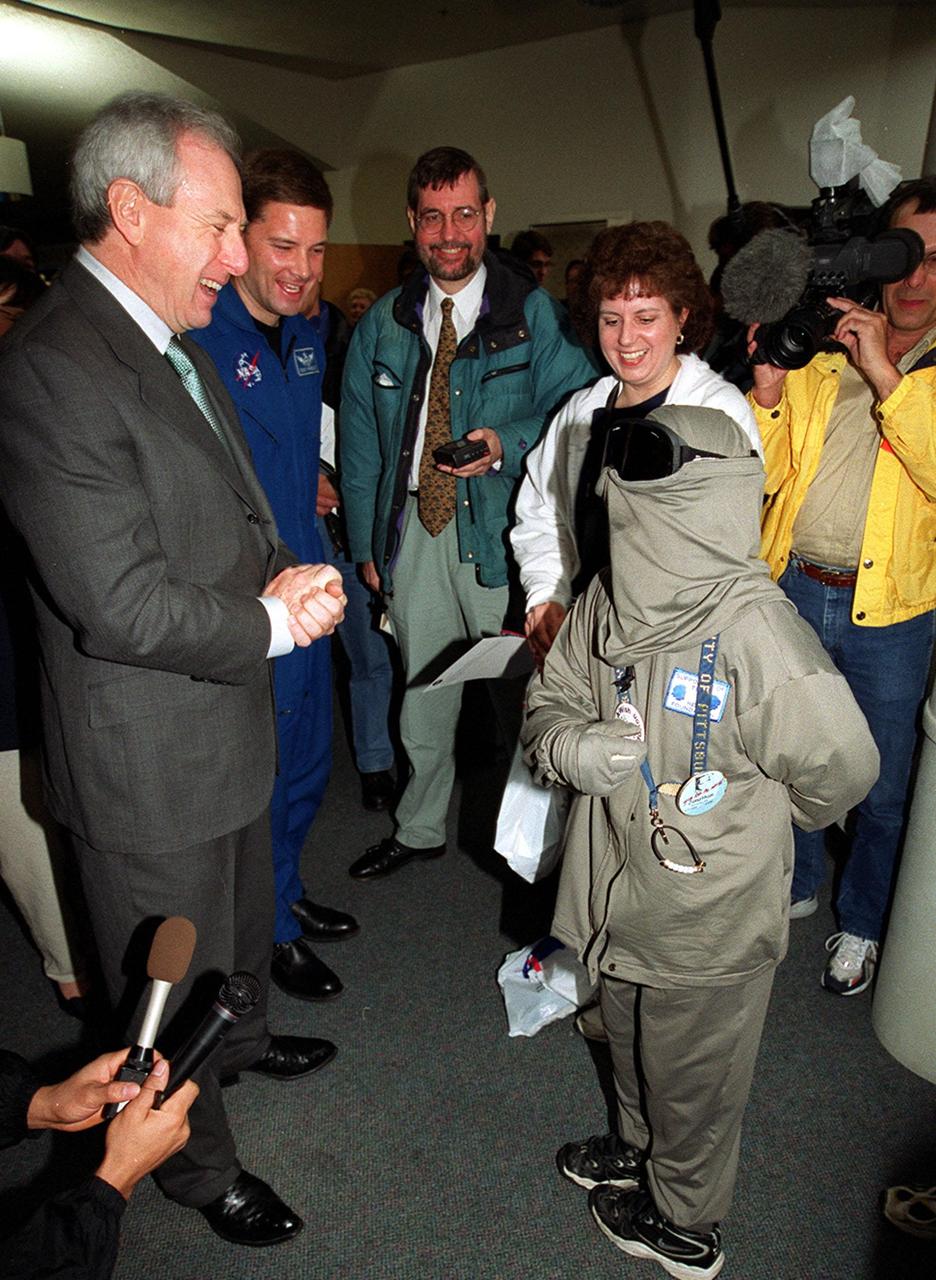
It's kind of amusing searching for keywords that you wouldn't expect to show up on a NASA image search. For example, I found a Native-American juggling hoops, old ladies line dancing at a farmers' market, kids dressed as Men in Black dancing underneath the Shuttle Endeavour, people using the primary mirror of James Webb to take selfies, actress Nichelle Nichols (Uhura) singing, NASA's hip-hop dance team Forces In Motion (travels around middle schools teaching Newton's laws), James Ingram singing "I believe I can fly" in front of Bill Nye, NASA administrator Dan Goldin laughing with (hopefully not at) a "bubble boy" in a protective suit, enough frames of someone testing out a spacesuit to make a stop-motion dance video, and a bunch of other unexpected weirdness.
-
Re:I think
Thankfully the URL is easy to remember... just like images.google.com.
It's kind of amusing searching for keywords that you wouldn't expect to show up on a NASA image search. For example, I found a Native-American juggling hoops, old ladies line dancing at a farmers' market, kids dressed as Men in Black dancing underneath the Shuttle Endeavour, people using the primary mirror of James Webb to take selfies, actress Nichelle Nichols (Uhura) singing, NASA's hip-hop dance team Forces In Motion (travels around middle schools teaching Newton's laws), James Ingram singing "I believe I can fly" in front of Bill Nye, NASA administrator Dan Goldin laughing with (hopefully not at) a "bubble boy" in a protective suit, enough frames of someone testing out a spacesuit to make a stop-motion dance video, and a bunch of other unexpected weirdness.
-
Re:I think
Thankfully the URL is easy to remember... just like images.google.com.
It's kind of amusing searching for keywords that you wouldn't expect to show up on a NASA image search. For example, I found a Native-American juggling hoops, old ladies line dancing at a farmers' market, kids dressed as Men in Black dancing underneath the Shuttle Endeavour, people using the primary mirror of James Webb to take selfies, actress Nichelle Nichols (Uhura) singing, NASA's hip-hop dance team Forces In Motion (travels around middle schools teaching Newton's laws), James Ingram singing "I believe I can fly" in front of Bill Nye, NASA administrator Dan Goldin laughing with (hopefully not at) a "bubble boy" in a protective suit, enough frames of someone testing out a spacesuit to make a stop-motion dance video, and a bunch of other unexpected weirdness.
-
Re:I think
Thankfully the URL is easy to remember... just like images.google.com.
It's kind of amusing searching for keywords that you wouldn't expect to show up on a NASA image search. For example, I found a Native-American juggling hoops, old ladies line dancing at a farmers' market, kids dressed as Men in Black dancing underneath the Shuttle Endeavour, people using the primary mirror of James Webb to take selfies, actress Nichelle Nichols (Uhura) singing, NASA's hip-hop dance team Forces In Motion (travels around middle schools teaching Newton's laws), James Ingram singing "I believe I can fly" in front of Bill Nye, NASA administrator Dan Goldin laughing with (hopefully not at) a "bubble boy" in a protective suit, enough frames of someone testing out a spacesuit to make a stop-motion dance video, and a bunch of other unexpected weirdness.
-
Re:I think
Thankfully the URL is easy to remember... just like images.google.com.
It's kind of amusing searching for keywords that you wouldn't expect to show up on a NASA image search. For example, I found a Native-American juggling hoops, old ladies line dancing at a farmers' market, kids dressed as Men in Black dancing underneath the Shuttle Endeavour, people using the primary mirror of James Webb to take selfies, actress Nichelle Nichols (Uhura) singing, NASA's hip-hop dance team Forces In Motion (travels around middle schools teaching Newton's laws), James Ingram singing "I believe I can fly" in front of Bill Nye, NASA administrator Dan Goldin laughing with (hopefully not at) a "bubble boy" in a protective suit, enough frames of someone testing out a spacesuit to make a stop-motion dance video, and a bunch of other unexpected weirdness.
-
Re:I think
Thankfully the URL is easy to remember... just like images.google.com.
It's kind of amusing searching for keywords that you wouldn't expect to show up on a NASA image search. For example, I found a Native-American juggling hoops, old ladies line dancing at a farmers' market, kids dressed as Men in Black dancing underneath the Shuttle Endeavour, people using the primary mirror of James Webb to take selfies, actress Nichelle Nichols (Uhura) singing, NASA's hip-hop dance team Forces In Motion (travels around middle schools teaching Newton's laws), James Ingram singing "I believe I can fly" in front of Bill Nye, NASA administrator Dan Goldin laughing with (hopefully not at) a "bubble boy" in a protective suit, enough frames of someone testing out a spacesuit to make a stop-motion dance video, and a bunch of other unexpected weirdness.
-
Re:I think
Thankfully the URL is easy to remember... just like images.google.com.
It's kind of amusing searching for keywords that you wouldn't expect to show up on a NASA image search. For example, I found a Native-American juggling hoops, old ladies line dancing at a farmers' market, kids dressed as Men in Black dancing underneath the Shuttle Endeavour, people using the primary mirror of James Webb to take selfies, actress Nichelle Nichols (Uhura) singing, NASA's hip-hop dance team Forces In Motion (travels around middle schools teaching Newton's laws), James Ingram singing "I believe I can fly" in front of Bill Nye, NASA administrator Dan Goldin laughing with (hopefully not at) a "bubble boy" in a protective suit, enough frames of someone testing out a spacesuit to make a stop-motion dance video, and a bunch of other unexpected weirdness.
-
Re:I think
Thankfully the URL is easy to remember... just like images.google.com.
It's kind of amusing searching for keywords that you wouldn't expect to show up on a NASA image search. For example, I found a Native-American juggling hoops, old ladies line dancing at a farmers' market, kids dressed as Men in Black dancing underneath the Shuttle Endeavour, people using the primary mirror of James Webb to take selfies, actress Nichelle Nichols (Uhura) singing, NASA's hip-hop dance team Forces In Motion (travels around middle schools teaching Newton's laws), James Ingram singing "I believe I can fly" in front of Bill Nye, NASA administrator Dan Goldin laughing with (hopefully not at) a "bubble boy" in a protective suit, enough frames of someone testing out a spacesuit to make a stop-motion dance video, and a bunch of other unexpected weirdness.
-
Re:Any photos of the entire Earth?
Because the name of it isn't "Lunar Lander", it's called the LM.
-
Re:Again?
Probable reason: Trump's budget removes funding for NASA's education programs. Maybe he thinks Star Trek can pick up the slack again?
-
Re:Again?
Probable reason: Trump's budget removes funding for NASA's education programs. Maybe he thinks Star Trek can pick up the slack again?
-
Re:Can't blame NASA
I'm anyone but someone to defend SLS, but this report seems rather flimsy. It seems that they're calling anything that NASA does in-house "overhead". That's not really a fair measure. A rocket is not just its physical construction; there's a huge amount of cost in research, design, testing, and support infrastructure - in the case of SLS, particularly the Exploration Ground Systems (EGS). Part of the problem however is that every time NASA builds something new, they're rarely allowed to shut it down. Including major projects with contractors. Congress keeps mandating this inefficiency, when what NASA really needs is the freedom to put large amounts of infrastructure to the axe when it can't contribute toward competitive costs, and reallocate the funds as is needed. So long as they face mandates to keep everything open (both internal, and with specific production lines run by particular suppliers), they shouldn't be criticized for their high costs - congress should.
I really think NASA would fare better if it went back more to the NACA model - a research and support organization for other players, maintaining the common infrastructure and R&D used by others - with the addition of a scientific exploration program. NASA shouldn't be making anything that a private business case can be built for (for example, rockets reaching LEO / GEO), but they should be running the DSN, range support, creating a market for private industry to continually expand/improve its capabilities, nurturing startups to increase competition, and extensively working to bring more advanced technologies (that the market couldn't afford to sink money into due to the risk) from theory into real world - not trying to make "workhorses", but proof-of-concept systems that others will run with if merit and maturity can be demonstrated.
In short:
If there's a business model for it: private industry
If it's too risky or long-term for business: NASA proof-of-concept
If its a common need for multiple businesses in the field: NASA permanent infrastructure -
Re:Just needs a little nudge.
That's a really interesting idea but what is this "O3" and "H3" you are talking about?
I think you're confusing "O3" with the right most term in FeTiO3, which is ilmenite, a very common rock on the moon (take a look at: https://spacemath.gsfc.nasa.go...). The "O3" is simply three oxygen atoms in each molecule of ilmenite.
As for "H3", how about "He3", which is an isotope of helium with only one neutron instead of the more common He4 which has two. This has been an important part of the dream/fantasy that lunar He3 can be burned with deuterium in a clean fusion reaction.
-
"But you cannot get negative energy"
Well, that may not be entirely true. The Casimir effect and Hawking radiation are both potential examples of "negative energy". Hawking radiation is still entirely theoretical, and the few (I think maybe singular) experiment that actually measured Casimir forces (as described here makes no mention of negative energy. And, of course, this experiment was not designed to detect anything like this; especially seeing as Hawking radiation would only be right outside the event horizon of a black hole.
Harold White, working with NASA, theorizes that the Casimer effect may be able to produce the type of negative energy required to create a working Alcubierre warp drive but it's all still highly theoretical. Well, mostly theoretical but there have been some tantalizing results from a few experiments. -
Re:Why not use the NASA article instead?
Article found here: https://www.nasa.gov/feature/g...
You must be new here. People often don't read the summary, much less the linked article.
-
Fucking SCIENCE, amirite?? Holy WOW!!!
Every one of these sentences translates to "You have no idea what this means and neither do we, but we really, really need the clicks so we're going to hype this shit up like NASA just made first contact."
"it’ll make the hair on the back of your neck stand up. It’s chaos wielded on a mind-crushing scale."
"Holy. WOW."
"a distance vast enough to shrink even the mightiest galaxy to a smear of light."
"But wait. Did I say “central”? Yeah, not so much. It appears to be significantly offset from the galaxy’s core, by about 40,000 light years. That’s a long haul."
"the astronomers who investigated this object came up with a scenario that, frankly, gives me the willies."
"That’s why I get the heebie-jeebies about stuff like this. Cripes!"
"Imagine something that can toss around an object a billion times the mass of the Sun at speeds thousands of times faster than a rifle bullet!"
"Why do I love science? That’s why."Meanwhile in real-scientist land...
"When I first saw this, I thought we were seeing something very peculiar," said team leader Marco Chiaberge
-
Why not use the NASA article instead?
Article found here: https://www.nasa.gov/feature/g...
-
Adjustments [Re:Revised headline]
You do know that all of the adjustments to data are documented, and the source code is public, right? https://data.giss.nasa.gov/gis...
You do know that all of the previous data is still archived, and you can look at it, right? https://data.giss.nasa.gov/gis...
You do know that the much-vaunted changes are small, and make no difference to the ultimate conclusion, right? http://berkeleyearth.org/under...
You do know that many different groups have looked at the data independently and gotten the same result, right? https://www.skepticalscience.c...
-
Adjustments [Re:Revised headline]
You do know that all of the adjustments to data are documented, and the source code is public, right? https://data.giss.nasa.gov/gis...
You do know that all of the previous data is still archived, and you can look at it, right? https://data.giss.nasa.gov/gis...
You do know that the much-vaunted changes are small, and make no difference to the ultimate conclusion, right? http://berkeleyearth.org/under...
You do know that many different groups have looked at the data independently and gotten the same result, right? https://www.skepticalscience.c...
-
Once is happenstance, twice is coincidence...
Climate != Weather.... Weather != Climate.... Just because it's warmer today or this year, doesn't mean the climate is doing the same thing. If it keeps happening for a few years in a row, THEN one might be able to start making that argument
Correct. One warm year is weather. Two warm years is happenstance. A series of warm years, globally averaged, though, and you start thinking it's climate. A series of warm years is what has been happening.
https://weather.com/news/climate/news/august-2016-global-temperature-record
https://www.theguardian.com/environment/climate-consensus-97-per-cent/2017/jan/23/were-now-breaking-global-temperature-records-once-every-three-years
https://www.ft.com/content/9962f3c0-dda2-11e6-86ac-f253db7791c6
https://www.nasa.gov/sites/def... -
Re:Making NASA Great Again
Uh, I hate to break it to you, but the NASA budget during the Apollo years averaged over 3% of the federal budget from '63 to '69, and peaked at almost 4.5%.
NASA might have been doing other things besides Apollo, but from '64 to '70 Apollo was over 50% of NASA's budget, peaking at 70% in 1967. If we want to have that kind of space program again, but with Mars as the destination, it's going to cost a lot more than has been allocated.
-
Re:percentages
Globally almost 100% man-made is accurate because natural climate variations simply aren't that fast enough to be a big contributor.
I disagree. If one looks at recent global temperature, one sees significant variation. For example, the five year temperature anomaly average for 1954 is less than a tenth of a degree higher than the start of the graph at 1880. (about -0.13 C versus -0.2 C). But there was a low of -0.4 C and a high of 0.1 C in that same period separated by a little more than three decades.
That indicates to me significant variation in an important climate parameter. -
Re:It's not 3.14. It's 3.141592653589793238462643.
what's the difference between three significant digits and 25 in the face of infinity?
-
Already have it
Most, if not all astronauts have military backgrounds. Mostly due to requirement #2 " At least 1,000 hours pilot-in-command time in jet aircraft. Flight test experience is highly desirable." see: https://www.nasa.gov/audience/...
It is true they do not have "access to the doctor of his choice", all former military have access to VA benefits for life.
Which is more than can be said for 99% of US born citizens. -
Link to NASA press release
https://www.nasa.gov/feature/j...
The NASA link has more technical details than the CNN link in the summary above.
-
Re: Render
Here is a better link with the originals and a link to katrillions of raw images.
It is not a better link; it requires javascript to even see it.
-
Re:Render
Also, people are generally used to images of the outer planets and their moons being poor quality
No. I remember the Voyagers pictures quite well, taken 40 years ago...
-
Re: RenderSaturn's 9.5 au from the sun, so gets 1/9.5^2 = ~1.1% the light we do. It's dark out there. This makes for low quality photos.
Here is a better link with the originals and a link to katrillions of raw images.
-
Re:in fact its cold as hell
You also have bring soil with you to grow anything on mars, because its soil full of carcinogens.
So the most economical way to get french fries on mars is probably send them from earth. -
Re:Ridiculous taxes and exemptions will do that
https://www.nasa.gov/feature/g...
Plants do it for free .
Looks like your calculator doesn't work. -
Re:Positive feedback
90% of rocks, bigger than 1 kilometer in diameter and floating around Earth, should be enough for everyone.
-
Re:Positive feedback
90% of rocks, bigger than 1 kilometer in diameter and floating around Earth, should be enough for everyone.
-
Re:Real or Fake News?
Your head receives less than 10^-12W at 850MHz from the sun [1]. Your phone delivers probably 0.5W. So if you scaled the sun to match microwave radiation levels, then no, you'd be fried in a millisecond. B-)
[1] http://ipnpr.jpl.nasa.gov/prog... fig.1 at 1MHz bandwidth.
-
Similar to what was found on Mars?
When I RTFA and saw the reference to hematite, I wondered if this is similar to possible evidence of life found on Mars: http://mars.nasa.gov/mer/scien...
Any biologists out there care to explain if this is similar or different?
If this is similar, does this provide a clue as to how life starts to evolve on a planet?
-
Moon- not perfect, but has possibilities
Part of the problem with the moon is that it's just not a great place for ISRU. Volatiles are rare.
That was the old, Apollo-era thinking. The newer thinking is that once you get away from the equatorial regions, volatiles aren't so rare. In the high latitudes, you have hydrated minerals (seen by Chadrayaan), and in the actual polar craters, ice (as seen by Lunar Prospector, LCROSS, etc.).
We've never even sampled any moon that aren't depleted in volatiles, although there's some data to suggest that various volatiles might be scattered in permanently shaded areas
Exactly. The problem with Apollo era sampling was that they never got more than about 20 degrees from the equator.
...
Of course, I prefer Venus to Mars, but that's neither here nor there
Hey, we're thinking along parallel lines!!
https://ntrs.nasa.gov/archive/nasa/casi.ntrs.nasa.gov/20030022668.pdf
-
Re:While we are torquing about it
The coders in this place mostly won't know about bending moments but it's a good concept to look up to get an idea as to why it was so insane to strap the shuttle onto the side of a rocket instead of on top. NASA did incredibly well to get it to fly at all.
Dunno if you recall, but Columbia came close to breaking off the stack in the first launch.
Now all that being said, if you ever have the chance to get to KSC, their Atlantis Shuttle display and the entrance to is is breathtaking and stunning. I was left speechless for a good ten seconds, and I'm not rendered speechless easily. You could tell who the engineering types were, and it added to the moment the shuttle that was actually supposed to be there.
-
Re:Echo-chamber fake newsYup. And that's just the tip of the clusterfuck iceberg. Anyone who is interested should read Feynman's appendix in its entirity, which he insisted should be added to the Roger's Commission report on threat of having his name removed from the whole thing.
He believed that NASA's delusional bureaucracy was ultimately to blame and it needed to be torn down entirely and rebuilt. The other members of the commission disagreed, which is pretty much why two decades later the crew of the Columbia died. Sadly, a narrative of organizational incompetence is extremely hard to keep alive in the mainstream media, so in the minds of most people they're still just random tragedies... an unavoidable price of space flight.
Two other things worth noting about Feynman's assessment: he was strongly impressed by the software systems of the Shuttle, considering it to be much more robust than the hardware (not the sort of thing one often hears these days), and the coda to his appendix is, of course, a timeless one worth quoting:For a successful technology, reality must take precedence over public relations, for nature cannot be fooled.
-
mouthwash, perfume, or aftershave
Thought the reason that these were not allowed in space was that the fumes from them cannot easily be removed from the atmosphere. It's not like they can open a window, and air out the fumes. This is a problem with all things that are brought up into space.
-
Re:Too bad we don't have 1977 technologies anymore
Voyager 1 still took the most impressive close-up photographs of Jupiter
What about the Cassini photos? It took amazing images of Jupiter and Saturn.
In their shortsightedness, they will say these aren't of great scientific value. A more sophisticated mind understands that the scientific importance of these images was enormous, because it inspire hundreds, if not thousands, to do science as their calling.
Ahem, NASA put a visible light camera on Juno specifically for "public science and outreach and to increase public engagement".
-
Re:Too bad we don't have 1977 technologies anymore
I know your post will get a lot of hate, but there's truth to it: Voyager 1 still took the most impressive close-up photographs of Jupiter. Shit like this http://voyager.jpl.nasa.gov/im...
And the images Voyager took of Saturn are pretty epic, too: http://voyager.jpl.nasa.gov/ga...In their shortsightedness, they will say these aren't of great scientific value. A more sophisticated mind understands that the scientific importance of these images was enormous, because it inspire hundreds, if not thousands, to do science as their calling.
-
Re:Too bad we don't have 1977 technologies anymore
I know your post will get a lot of hate, but there's truth to it: Voyager 1 still took the most impressive close-up photographs of Jupiter. Shit like this http://voyager.jpl.nasa.gov/im...
And the images Voyager took of Saturn are pretty epic, too: http://voyager.jpl.nasa.gov/ga...In their shortsightedness, they will say these aren't of great scientific value. A more sophisticated mind understands that the scientific importance of these images was enormous, because it inspire hundreds, if not thousands, to do science as their calling.
-
Last I heard it has been growing
-
Re:Trump's Fault
https://www.nasa.gov/topics/ea...
No, strike that. Always fucking was. Labeling the political movement toward the combat of said phenomenon from "Global Warming" to "Climate Change" was invented by Republican Frank Luntz to give Republicans a way to refer to the "controversy" without acknowledging the painfully descriptive label.
https://www.theguardian.com/en... -
Re:Stonehenge, without the stones?
Civilization is old. The cultures lasted for centuries, developing in complexity, myths and legends. There is evidence that humans were tracking the moon 30,000 years ago. It's hard to know for sure from those ancient artifacts, but certainly by the time writing was invented 5000 years ago, we can read that humans long before had begun tracking the moon and looked at the stars.
-
Re:Is it really that hard?
Naively scale it to do 270x the work, that's eating 3.2 cubic meters of probe volume in order to keep the inside down to a blazing 100*C. Our 2-meter-diameter probe, with 250mm of aerogel shell, only has 1.7 cubic meters of internal volume.
Uh, the radiator is bolted to the outside of the sphere. The components on the inside are considerably smaller than the radiator on the outside. Think CPU water cooling rig. The water block is quite small in volume compared to the radiator.
You neglected the really useful calculation: the Carnot efficiency. Let's see if there's a little more room on the back of the envelope.
Carnot efficiency is given by: (TH-TC)/TH*100% so for Venus at 470K and room temperature at 298K, we get an efficiency of 36%. So in order to reject, say, 600 watts of heat from the interior of the probe (your 500W of ambient leakage plus 100W of equipment), our refrigerator is going to suck up somewhere north of 1.7kW of power. (It will be more, because Carnot efficiency is the theoretical perfect efficiency, which can't actually be built.) How close we can get to the ideal depends quite heavily on the properties of the working fluid and the pressures inside the system. Outrageous by space probe standards, but not actually completely bonkers.
Using the same General Purpose Heat Source modules used in the Curiosity rover, we'll need 111 modules, totaling 67kg of plutonium-238. NASA has 35kg left for civil use (and an unspecified amount earmarked for military use (classified)). Houston, we have a problem...
Running the numbers in a reverse Rankine Cycle to calculate a more practical efficiency is left as an exercise for the reader.
-
Re:Why?
https://eclipse.gsfc.nasa.gov/...
This occurs completely in the USA.
-
Re: Confused?
Venus is absolutely not uninhabitable.
And as for science, knowing whether Venus is the fate of Earth, or how to determine whether an exoplanet would be a second Earth or a second Venus, is a lot bigger of a question than anything Mars can answer. Venus is not only our closest neighbor and almost the same size, but once had oceans like Earth. And her atmosphere appears locked into this vicious cycle, where she's hot because her CO2 isn't stored as carbonates, but she can't form carbonates because she's too hot. And even if you want to dismiss that as an indirect side effect of water loss due to devolatilization due to a lack of a magnetic field (and ignoring the question of "why" the latter is), that's not the only thing Venus is cautionary about. 500 million years ago it appears that the entire planet, or nearly so, was resurfaced by volcanism. Can such a thing happen here? We can't say so because we have no clue why it happened.
Venus once was another Earth. We want to know what went wrong. It's hard to model the Earth when Venus doesn't work with our models.
-
Re:Water boils in a vacuum
Your explanation has nothing to do with thermodynamics, but alas
Here: http://nssdc.gsfc.nasa.gov/pla...
We kniw since nearly ten years, that there is water ice on the moon. -
Re:Unfortunately emissions do not know borders
If we could just build a huge wall around Europe up into space and avoid having all the US, Chinese, Russian coal and and such emissions out of our nice clean air.
You are so out of touch with reality. Europe's massive deforestation and desertification over the last few centuries means that it is strongly dependent on the Americas for carbon capture. And European air quality sucks https://www.nasa.gov/topics/ea... As you can see from that map, that pollution is home-made; it doesn't come from the US, China, or Russia.
So, go ahead and build that wall, then suffocate in your own pollution and filth.
-
Re:Isn't this just virtue signaling at this point?
That graph only goes to 2004. The 2016 temperature was 0.44 C higher than 2004. https://data.giss.nasa.gov/gis...