Slashdot Mirror
Domain: nasa.gov
Stories and comments across the archive that link to nasa.gov.
Comments · 16,365
-
Re:What's also rarer.
What's also rarer is that OUR moon has a face on it. I don't see any other planets having moons with faces on them.
When Io has volcanic plums on opposite sides, it looks like Princess Leia (at least the hair part). And, I thought I saw Elvis in a pose on Ganymede. Then there's my favorite: The finger of God (although not a moon). -
Re:What's also rarer.
We could have had a That's no moon for a Moon.
-
Re:Rob Peter to pay Paul
Extinction implies we are all going to die. There is nothing we can do about it and there is nothing Hollywood can do to make their fantasies a reality in the amount of time necessary to do something before the extinction. So if we cannot do anything, they why worry?
Actually, there are lot of things we can do to avert asteroid impact.
And the earlier we see the threat the more effective our defense will be. That's why Arecibo and programs such as Near-Earth Asteroid Tracking are important.
Why not worry about the now and something you can do something about?
Asteroid impact is something we can do something about, so why not worry about it now (especially when considered how comparatively cheap it is)?
-
Re:Rob Peter to pay Paul
Actually the probability of a major asteroid strike is 100% certain. Since the solar system is mostly disk-like, our orbit intersects with quite a lot of objects. Eventually the phase of the orbits will line up and there is a collision. The only question is when, so we might estimate that the probability is fairly low of a significant impact over the next 100 years, but over the next million years, that probability is significant.
For more information: http://neo.jpl.nasa.gov/risk/ -
Re:South.
Actually, there are wobbles and other weirdness associated with the motion of the earth through its orbit, such that the sun is not actually at due south at the same time each day. See an explanation of analemma.
-
Re:Military budgetI take issue with this statement, because I know for a fact that the UK has the best military in the world.
Without getting into a, "my country can kick your country's ass debate," I will say that the UK military has come a long way since the days that they were wearing bright red coats and getting their ass kicked in north america,...
Back to the topic, I have to say that NASA has done quite well with their "meager" little budget. They got quite a bargain on these two cars,... Of course, if NASA did have the same budget as the military, we'd probably be on Pluto by now,... -
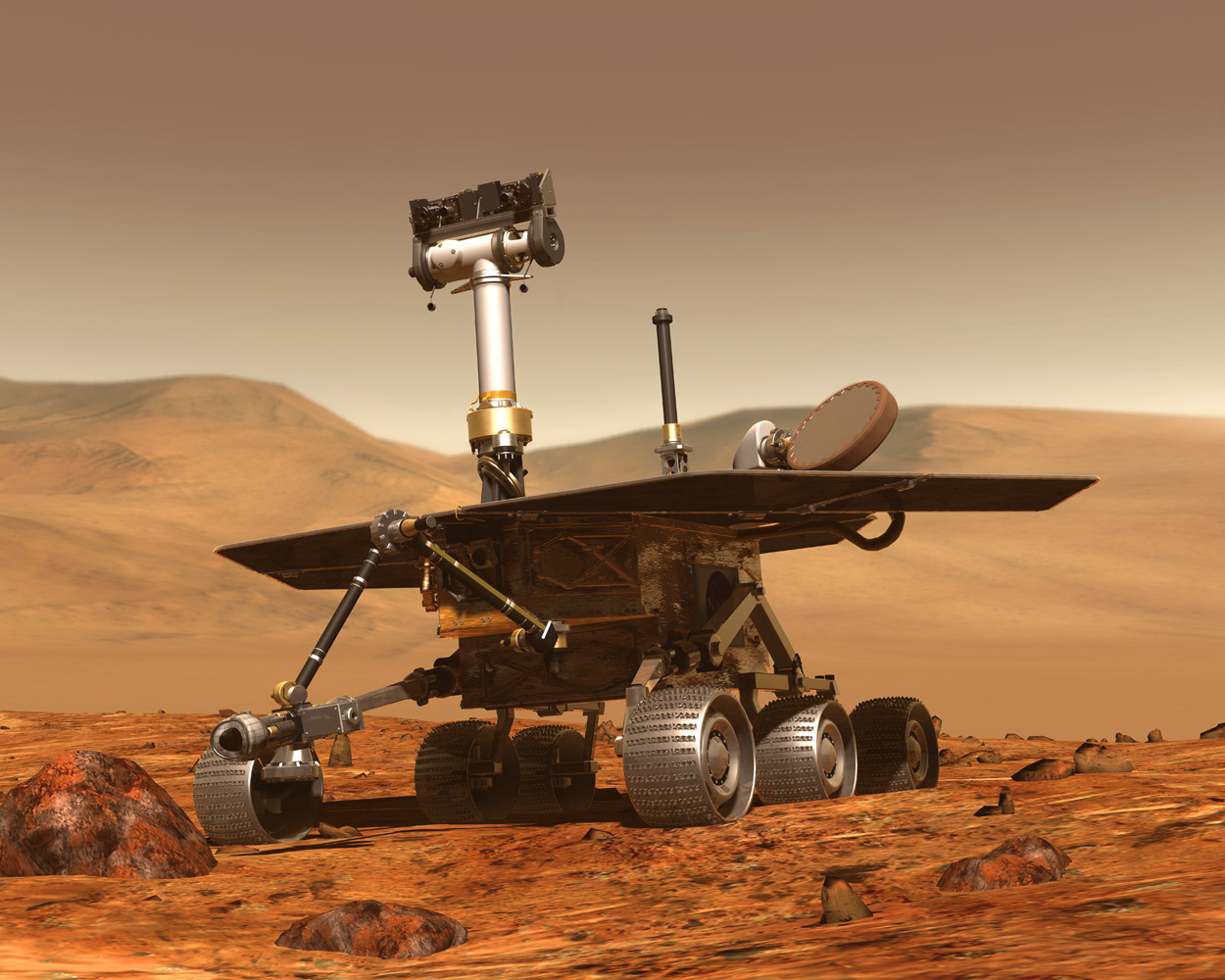
Re:Women Drivers?
Are there any female drivers
Three: Ashley Stroupe, Tara Estlin, and Julie Townsend.
Incidentally, they're all terrific speakers as well; if you get a chance to go to one of their talks, don't miss it.
Also, an unofficial trainee for the MER rover-driver role is Sharon Laubach, who also worked on the first-ever Mars rover, Sojourner (the Mars Pathfinder rover). Sharon's doing this unofficially because officially she's our boss, but she's awesome at it and loves doing it, so we give her a turn now and then.and if there are, do they do their makeup in the rear view mirror while driving? (ducking and running for cover)
Ahem. Ask them in person sometime, and see what happens.
Luckily for you, they all have good senses of humor, so you're reasonably likely to escape with your life. Bear in mind that Julie does karate, though. -
Re:Women Drivers?
Are there any female drivers
Three: Ashley Stroupe, Tara Estlin, and Julie Townsend.
Incidentally, they're all terrific speakers as well; if you get a chance to go to one of their talks, don't miss it.
Also, an unofficial trainee for the MER rover-driver role is Sharon Laubach, who also worked on the first-ever Mars rover, Sojourner (the Mars Pathfinder rover). Sharon's doing this unofficially because officially she's our boss, but she's awesome at it and loves doing it, so we give her a turn now and then.and if there are, do they do their makeup in the rear view mirror while driving? (ducking and running for cover)
Ahem. Ask them in person sometime, and see what happens.
Luckily for you, they all have good senses of humor, so you're reasonably likely to escape with your life. Bear in mind that Julie does karate, though. -
Re:Women Drivers?
Are there any female drivers
Three: Ashley Stroupe, Tara Estlin, and Julie Townsend.
Incidentally, they're all terrific speakers as well; if you get a chance to go to one of their talks, don't miss it.
Also, an unofficial trainee for the MER rover-driver role is Sharon Laubach, who also worked on the first-ever Mars rover, Sojourner (the Mars Pathfinder rover). Sharon's doing this unofficially because officially she's our boss, but she's awesome at it and loves doing it, so we give her a turn now and then.and if there are, do they do their makeup in the rear view mirror while driving? (ducking and running for cover)
Ahem. Ask them in person sometime, and see what happens.
Luckily for you, they all have good senses of humor, so you're reasonably likely to escape with your life. Bear in mind that Julie does karate, though. -
Re:Women Drivers?
Are there any female drivers
Three: Ashley Stroupe, Tara Estlin, and Julie Townsend.
Incidentally, they're all terrific speakers as well; if you get a chance to go to one of their talks, don't miss it.
Also, an unofficial trainee for the MER rover-driver role is Sharon Laubach, who also worked on the first-ever Mars rover, Sojourner (the Mars Pathfinder rover). Sharon's doing this unofficially because officially she's our boss, but she's awesome at it and loves doing it, so we give her a turn now and then.and if there are, do they do their makeup in the rear view mirror while driving? (ducking and running for cover)
Ahem. Ask them in person sometime, and see what happens.
Luckily for you, they all have good senses of humor, so you're reasonably likely to escape with your life. Bear in mind that Julie does karate, though. -
Re:Women Drivers?
Are there any female drivers
Three: Ashley Stroupe, Tara Estlin, and Julie Townsend.
Incidentally, they're all terrific speakers as well; if you get a chance to go to one of their talks, don't miss it.
Also, an unofficial trainee for the MER rover-driver role is Sharon Laubach, who also worked on the first-ever Mars rover, Sojourner (the Mars Pathfinder rover). Sharon's doing this unofficially because officially she's our boss, but she's awesome at it and loves doing it, so we give her a turn now and then.and if there are, do they do their makeup in the rear view mirror while driving? (ducking and running for cover)
Ahem. Ask them in person sometime, and see what happens.
Luckily for you, they all have good senses of humor, so you're reasonably likely to escape with your life. Bear in mind that Julie does karate, though. -
Re:Why 14?
Why do you need 14 drivers for 2 rovers?
We have at least two rover drivers per rover per day, so in theory, we could get by with as few as four -- as long as nobody takes vacation or gets sick. However, almost all of the rover drivers are part-timers on MER; for career and funding reasons, most people want to have multiple irons in the fire, so we tend to work on more than one project. (And that includes me, though I sometimes wish it didn't. In addition to being the rover driver team lead on MER, I work on ATHLETE and Mars Science Laboratory, and I worked on Phoenix until recently. ATHLETE and MSL are awfully cool rovers, but even so, I miss the days when I worked full-time on MER.)Also, about a third of the people included in that count don't actually work on MER any more, though they're sometimes called in to consult on tricky days or for anomaly investigations.
-
Re:Why 14?
Why do you need 14 drivers for 2 rovers?
We have at least two rover drivers per rover per day, so in theory, we could get by with as few as four -- as long as nobody takes vacation or gets sick. However, almost all of the rover drivers are part-timers on MER; for career and funding reasons, most people want to have multiple irons in the fire, so we tend to work on more than one project. (And that includes me, though I sometimes wish it didn't. In addition to being the rover driver team lead on MER, I work on ATHLETE and Mars Science Laboratory, and I worked on Phoenix until recently. ATHLETE and MSL are awfully cool rovers, but even so, I miss the days when I worked full-time on MER.)Also, about a third of the people included in that count don't actually work on MER any more, though they're sometimes called in to consult on tricky days or for anomaly investigations.
-
Re:Why 14?
Why do you need 14 drivers for 2 rovers?
We have at least two rover drivers per rover per day, so in theory, we could get by with as few as four -- as long as nobody takes vacation or gets sick. However, almost all of the rover drivers are part-timers on MER; for career and funding reasons, most people want to have multiple irons in the fire, so we tend to work on more than one project. (And that includes me, though I sometimes wish it didn't. In addition to being the rover driver team lead on MER, I work on ATHLETE and Mars Science Laboratory, and I worked on Phoenix until recently. ATHLETE and MSL are awfully cool rovers, but even so, I miss the days when I worked full-time on MER.)Also, about a third of the people included in that count don't actually work on MER any more, though they're sometimes called in to consult on tricky days or for anomaly investigations.
-
Re:Women Drivers?
Unfortunately there are no rear view mirrors on the rover. And yes, they are good looking.
Yes, we know the rovers are, but what about the women drivers?
-
Re:Multi-million euro?
Mars Rover and MER in your response are the same thing. The Space.com article is very out of date, and they had some cost overruns after that which pushed the mission to $820 million, which included I believe the first year of operations and science. I believe NASA has spent another couple hundred million on operations and science due to the extensions...a lot of money, but a lot less than equivalent new missions.
Also, the Mars Science Laboratory currently being built for a launch in 2009 is looking to cost around $1.8 billion USD (a little over a billion Euros, IIRC). It will be nuclear-powered, land completely ready to go instead of in those nifty airbags the MER's came in on, and is roughly the size of a Volkswagen (which is why the airbags won't work). It's supposed to last about 2 years, so if it runs the way the MER's have, NASA will still be trying to kill it off 20 years from now (just kidding...that's ridiculously unlikely).
MSL also ran into budget issues, and has increased in cost several times over the last couple of years, so NASA recently cancelled two rather fascinating instruments to keep the cost down. The first was the descent imager, which I'm not sure how much scientific value it would've had, but the time-lapse video of the descent would have been fascinating. The other was the ChemCam, a marvelous laser and spectrometer combo that would allow scientists to analyze the chemical composition of rocks from up to 40 feet away. However, the descent imager on the Mars Phoenix Lander currently en route turned out to have a fatal flaw, so the operations budget for that got switched to the construction budget for the MSL. Also, the Chemcam team realized that it had come down to defeaturing the Chemcam or not flying it all, and went with the former option to get back in budget. They got some extra money that was saved because Mars Phoenix launched on time. Unfortunately, the sweet zoom capability of the mast camera was cut out and not re-instated. -
Re:Apollo
Your math is correct, but they're not really taking pictures of distant planets so much as observing the stars they're going about and watching for a wobble. From that with a bunch of math they can reverse estimate the size of the planet and its period, and in turn hopefully watch for changes as the planet passes in front of the star to guesstimate its characteristics. Two years till Kepler!
-
Is fission not considered "burning fuel"?Nuclear power is very clean compared to any power source that burns fuel. If you are going to toss around inexact language like "is very clean" I don't think you can afford to be picky about what it means to "burn fuel".
As Nikky Telsa said in 1915, "No matter what we attempt to do, no matter to what fields we turn our efforts, we are dependent on power. We have to evolve means of obtaining energy from stores which are forever inexhaustible, to perfect methods which do not imply consumption and waste of any material whatever. If we use fuel to get our power, we are living on our capital and exhausting it rapidly. This method is barbarous and wantonly wasteful and will have to be stopped in the interest of coming generations."
If it uses up a limited resource, it's "burning fuel", at least metaphorically, and therefore lame. Screw that. Let's figure out how to tap into the vast power represented by the titanic spinning mass we live on, or the even more titanic mass that shines in our skies, instead of perpetuating the cycle of digging stuff up stuff until it we use it all up. Those experiments with dangling wires from the shuttle are a step in the right direction. -
Re:Not in HD
More shots from the sequence scanned at approx 2400x2400 resolution.
-
Here's some real HD...
... from 1968 (Apollo 8)!
http://history.nasa.gov/ap08fj/photos/b/as08-14-2383.jpg
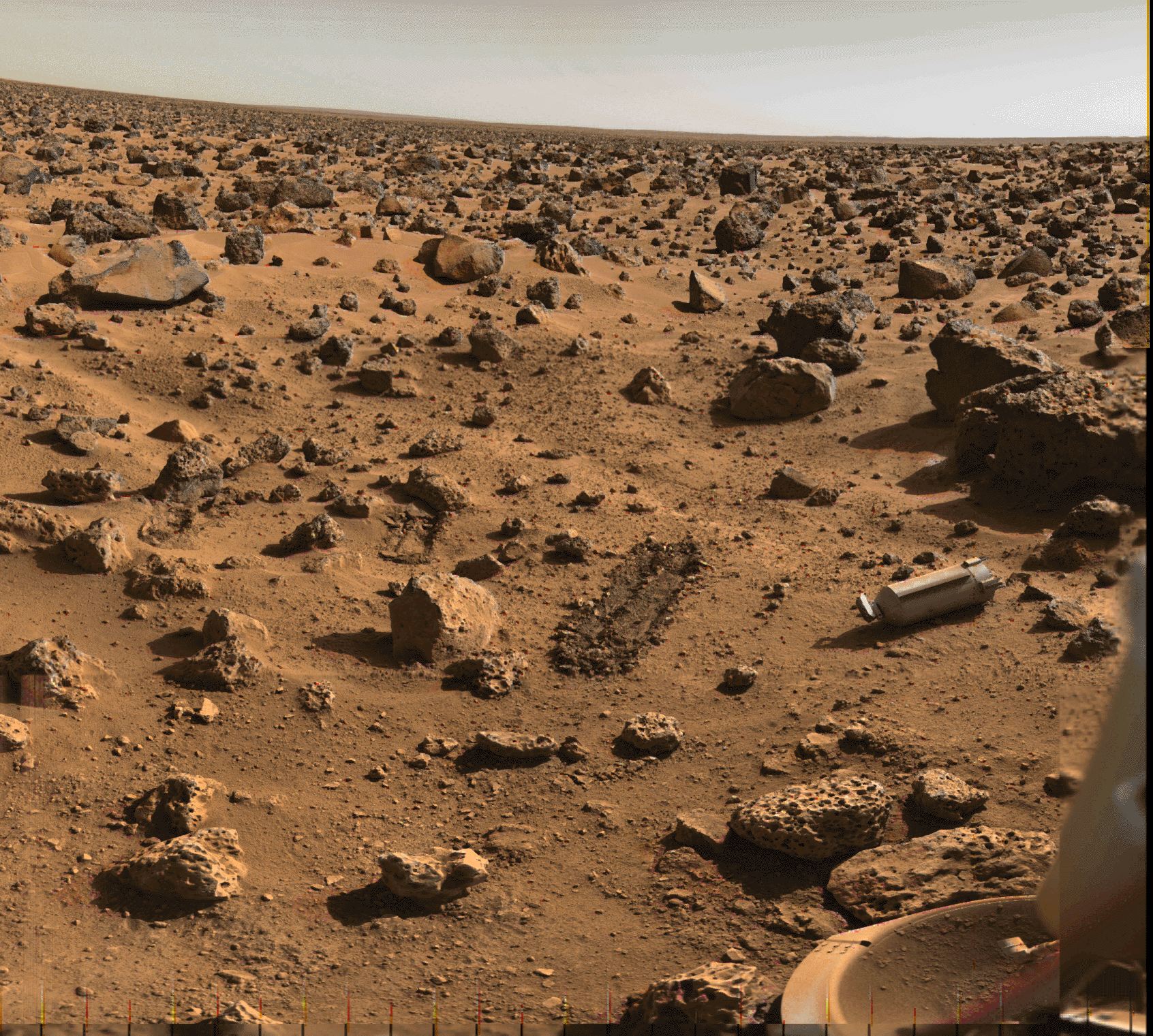
http://apod.nasa.gov/apod/image/mars_surface_vik2_big.jpg
http://oursun.open.ac.uk/images/jupiterp_cassini_full.jpg
What makes this new "first HD camera in space" so special (yes, I know the Apollo images are shot on film, but Viking and Voyager had video cameras)? -
Here's some real HD...
... from 1968 (Apollo 8)!
http://history.nasa.gov/ap08fj/photos/b/as08-14-2383.jpg
http://apod.nasa.gov/apod/image/mars_surface_vik2_big.jpg
http://oursun.open.ac.uk/images/jupiterp_cassini_full.jpg
What makes this new "first HD camera in space" so special (yes, I know the Apollo images are shot on film, but Viking and Voyager had video cameras)? -
Re:Not in HD
For comparison, the original.
http://dayton.hq.nasa.gov/IMAGES/LARGE/GPN-2001-000009.jpg
The older image appears to be higher resolution. -
Re:Not in HD
For comparison, the original.
http://dayton.hq.nasa.gov/IMAGES/LARGE/GPN-2001-000009.jpg
The older image appears to be higher resolution. -
Re:i've always said
Mars lacks...water? Really? Given the body of research which indicates it has permafrost, I think you may want to check your facts.
-
Thermal balance of Venus is well understoodI'm sorry, but this essay about Velikovsky basically misunderstands the nature of our measurements of Venus. The thermal balance of Venus is well understood. The part where you mention "four probes landed on Venus" is the start of where you start to misunderstand how well the planet is understood. In fact, twelve probes landed on Venus; an additional five probes have entered and measured the atmosphere. The high temperature of Venus is a straightforward effect of the thick carbon dioxide atmosphere. You can calculate it to a decent first approximation simply by understanding the adiabatic lapse rate. The temperature of Venus at the altitude in the atmosphere where it has the same atmospheric pressure as Earth is, in fact, very similar to that of Earth; adibatic lapse means that the atmosphere gets cooler with altitude (i.e., hotter as you go lower)-- the adibatic lapse on Venus is about 10 degrees (C) per kilometer (roughly comparable to Earth). Internal heat is not needed.
I do not have the time or patience to go through the many many many measurements of the thermal parameters of the Venus atmosphere and explain your misconceptions, however, orbiting probes as well as infrared and radiotelescope measurements from Earth have very well confirmed that Venus is very close to thermal equilibrium. It is not correct that there is a large internal heat source contributing significantly to the surface temperature.
-
Venus' landscape is awesome
Wouldn't the rover just beam back "It's hot and everything's melted" over and over lol. If I remember correctly, there's no significant features to even study. You can't have mountains and ancient, dried up rivers and caves when everything's that hot. Mars is far more interesting.
It's hot and nothing is melted. On earth the melting point of rock is lowered by the amount of water they contain. Water acts as a flux. On Venus where the climate is intensely hot and dry, crustal rocks melt at a very high temperature and are very strong. They create some pretty wild landforms (scarps, cliffs...) as a result.
This or this don't seem so boring to me. The Maxwell Montes are higher than the Himalayas. With adiababic cooling their tops will be hundreds of degrees cooler than the planetary mean. Also, with all of the volcanism and mobile lava flows you can expect there to be some amazing lava rivers and lava tube caves.
-
Re:flag
The "'55 Science Paper Retracted to Thwart Creationists" thread is old and closed to new posts. Replying here.
You insist that everyone should blindly accept an old earth
Absolutely not! This whole discussion I have been talking about opening eyes, this whole discussion I have been saying there is massive proof everywhere.
Take a look at this page. You can literally see the summer/winter snow cycles in the arctic ice layers. An additional point not mentioned in that article is that each summer a fine dusting layer of pollen and dust blows in from the rest of globe.
The arctic ice pack has more than 100,000 summer/winter cycles.
The arctic ice pack has more than 100,000 yearly layers, the ice pack is more than 100,000 years old, the earth is more than 100,000 years old.
You agree that the Young Earth Creationists are wrong in trying to explain away the Grand Canyon as being carved by Noah's flood. You try to explain it away as some sort of collapsed underground tunnel. Setting aside the fact that you are making out trained expert geologists to all be blind as bats and mindbogglingly stupid, the Grand Canyon walls are littered with fossils. The Grand Canyon was carved down into the rock after the rock formed with embedded fossils. Geologists are not stupid. The Grand Canyon in every aspect bears the evidence of millions of years of slow erosion and weathering of solid rock.
As I mentioned in an earlier post, there are bodies of water that show distinct summer/winter cycle sediment layers, tens of thousands of years of visible countable layers.
We discussed mountains. Last post you offered the "correction" that you meant they didn't grow like developing organisms. However that has absolutely no material bearing on what you said, or my reply to it. You said mountains had to have been created tall like that, which was wrong, and you implied that science didn't know how mountains were formed, which was wrong too. In fact mountains too prove Old Earth. I explained how mountain growth works, and the the rock layers in earth show millions of years of buckling and folding and uplift.
The Egyptian civilization written history is continuous going back more than 5000 years, blowing a hole straight through any Young Earth Flood timeline, and there's a hell of a lot more than 1,000 years of pre-written human civilization prior to the start of written Egyptian history.
Carbon-14 smoothly dates history back to about 60,000 years ago, and a variety of other radioactive isotopes carry that timeline smoothly back through millions of years.
You keep assuming science doesn't know anything, and assuming that science has nothing to back up what it does know. There is a vast realm of science of which you are unfamiliar. You don't even need to be a scientist or take any college science classes. I doubt there's much I've said here that hasn't already aired on Discovery Channel or one of the other pop-sci cable TV channels. All it takes to know that the Earth is Old are open eyes. It's unfortunate that some highschools don't bother covering some of this stuff, but any scientifically inquisitive highschool kid could seen all of this and more on cable TV. If we really wanted to slog through it, and if it would make a difference, I could supply a link every single day for the next YEAR documenting different things that show the Earth is Old.
if you look at what is written in the Bible, it is explicitly contradictory to many writings in the Old and New Testament.
Your argument does not differ in the least from the unanimous conclusion of the committee that deemed Galileo's ideas "philosophically and formally heretical inasmuch as it expressly contradicts the doctrine of the Holy Scripture in many passages, both in their literal meaning and according to the general interpretation of the Holy Fathers and the doctors of theology."
They fou -
Re:And this is news why?
>While technically true it would have no bearing.
Exactly why doesn't this have any bearing? Isn't it the small things that generates bigger rewards. Isn't Recycling movement based on this? Isn't micro-loan banks like Grameen Bank, another example? Also, NASA own programs need money (see below).
What is the issue here is the question of is this a wise and responsible use of NASA's budget within its mandate? Its your taxpayer's money so its a valid question. "It doesn't matter" is an answer only government contractor sales people love to hear.
The argument that its such a small amount of money doesn't really hold up because for that $4 million NASA could have created 2-4 more Centennial Challenges.
http://centennialchallenges.nasa.gov/ -
Re:money for "scientific knowledge"
I've been to one, most of the party attendees are not upper management. It's part of the Space Flight Awareness award program. To quote the site:
SFA Honoree
This award is one of the highest presented to NASA and industry and is for first-level management and below. This award is presented to employees for their dedication to quality work and flight safety. To qualify, the individuals must have contributed beyond their normal work requirements to achieve significant impact on attaining a particular human space flight program goal; contributed to a major cost savings; been instrumental in developing modification to hardware, software, or materials that increase reliability, efficiency, or performance; assisted in operational improvements; or been a key player in developing a beneficial process improvement. -
Re:rockets vs shuttleShuttle carries 26.8 tons into LEO. NASA was budgetted $368 million per launch in 2001, but it actually takes about $450 million.
The Ariane 5G can lift 17.6 tons into LEO for a cost of about $165 million
While not mentioned in TFA, the Soyuz 3 would be able to put 17.8 tons into LEO. If they can get the price comparable to the Ariane, they'll have a winner.
Your numbers for the Space Shuttle are misleading in comparison to the others. The Shuttle Cargo Bay can carry 22.7 tons. The orbiter itself weighs about 70 tons. Thus the total mass you are putting up can be up to around 100 tons. If you wanted to do a fair comparison (for example with the Soyuz launch vehicle) you would have noted that the Soyuz Spacecraft weighs around 15 tons without additional cargo.
Don't count the Russians out of the race just yet. -
Re:rockets vs shuttleShuttle carries 26.8 tons into LEO. NASA was budgetted $368 million per launch in 2001, but it actually takes about $450 million.
The Ariane 5G can lift 17.6 tons into LEO for a cost of about $165 million
While not mentioned in TFA, the Soyuz 3 would be able to put 17.8 tons into LEO. If they can get the price comparable to the Ariane, they'll have a winner.
Don't count the Russians out of the race just yet.
-
Re:Hmmm....
There is no 'hardcore' surveillance going on. These are weather and climatology satellites. They're using AVHRR and MODIS data to model when conditions are ripe for insect outbreaks that can carry malaria. The best resolution in the study appears to be 250 meters, so it isn't capable of picking out individual houses, let alone spying on people.
It's sent to the DoD because they have a centralized database that combines these 14 satellites, coregisters them with each other, and turns them into one product. The DoD is making scientific research much easier, here, by letting researchers access this combined database. That's why it's newsworthy. -
something similar has done before
Live tropical sea surface temperature on the web http://svs.gsfc.nasa.gov/vis/a000000/a003300/a003376/
El nino linked to deadly disease http://www.spacedaily.com/news/pacific-02a.html -
Been there, done that.
JPL's been working on it too for a while now... and with similar datarates, and a ground acquisition plan to boot.
http://lasers.jpl.nasa.gov/PAGES/pubs.html#ocd
But, yes, a laser link indeed is desirable. Sure, we can still contact Voyager with radio telescopes, but even from the Mars rovers, notice how it takes so long to get from Mars to grainy B&W picture back on Earth?
Sending back live video feeds and more full colour images sets the data rate bar much, much higher. Getting this much data back quickly is limited by the frequency of the radio waves/light. Laser light has an over 1,000 times shorter wavelength than Ka band radio telescopes can manage (that's what NASA uses now to talk to the Mars probes), which increases the potential amount of data that can be sent in a given timeframe by essentially that amount.
In addition, because laser light is focused so narrowly, it wastes much less energy than a radio antenna which must spray a good portion of space with radio waves in order to hit Earth. Imagine focusing your mag-light in the dark... the narrower the focus, the brighter the beam gets, because more energy is packed into less space. The challenge though, is that you have to aim much more precisely at Earth to compensate for that more focused beam.
Here's a great overview of JPL's long-term vision:
http://lasers.jpl.nasa.gov/PAPERS/REVIEW/overview.pdf -
Been there, done that.
JPL's been working on it too for a while now... and with similar datarates, and a ground acquisition plan to boot.
http://lasers.jpl.nasa.gov/PAGES/pubs.html#ocd
But, yes, a laser link indeed is desirable. Sure, we can still contact Voyager with radio telescopes, but even from the Mars rovers, notice how it takes so long to get from Mars to grainy B&W picture back on Earth?
Sending back live video feeds and more full colour images sets the data rate bar much, much higher. Getting this much data back quickly is limited by the frequency of the radio waves/light. Laser light has an over 1,000 times shorter wavelength than Ka band radio telescopes can manage (that's what NASA uses now to talk to the Mars probes), which increases the potential amount of data that can be sent in a given timeframe by essentially that amount.
In addition, because laser light is focused so narrowly, it wastes much less energy than a radio antenna which must spray a good portion of space with radio waves in order to hit Earth. Imagine focusing your mag-light in the dark... the narrower the focus, the brighter the beam gets, because more energy is packed into less space. The challenge though, is that you have to aim much more precisely at Earth to compensate for that more focused beam.
Here's a great overview of JPL's long-term vision:
http://lasers.jpl.nasa.gov/PAPERS/REVIEW/overview.pdf -
What about birth indeed!
There would be much bigger issues to worry about than nationality!
http://lis.arc.nasa.gov/lis/Experiment_App/C1514_3.html
http://research.hq.nasa.gov/Spaceline_WEB/SpaceLine/nasa/pdf/Space_Flight_Studies_Explor.pdf -
What about birth indeed!
There would be much bigger issues to worry about than nationality!
http://lis.arc.nasa.gov/lis/Experiment_App/C1514_3.html
http://research.hq.nasa.gov/Spaceline_WEB/SpaceLine/nasa/pdf/Space_Flight_Studies_Explor.pdf -
Re:Sites running Plone
I believe NASA's JPL is Zope (maybe Plone?) as well.
-
Re:Never saw this cominghttp://voyager.jpl.nasa.gov/spacecraft/index.html:
"Uplink communications is via S-band (16-bits/sec command rate) while an X-band transmitter provides downlink telemetry at 160 bits/sec normally and 1.4 kbps for playback of high-rate plasma wave data. All data are transmitted from and received at the spacecraft via the 3.7 meter high-gain antenna (HGA)."
-
Re:Aiming will be a major problem
The retroreflector isn't easy to hit, and they actually get back only one photon every few seconds. This would not yield much bandwidth for communications.
-
Re:Speed
The last paragraph of the press release explains. The distance chosen was about the distance to the L1 and L2 Lagrangian Points around the Earth. These are candidate locations for the next generation James Webb Space Telescope (also at wikipedia). For that application, high data bandwidth is extremely useful.
Very likely, if something like this were incorporated into the Webb design, it would be augmented with traditional radio for tracking, telemetry, and as a backup to the laser link for bulk data transfer. -
Re:Never saw this coming
Correction:
Voyager is 15 billion kilometres not miles as stated (about 9 billion miles)
http://voyager.jpl.nasa.gov/mission/weekly-reports/index.htm -
Re:Carbon credits = lameHere are the population densities (pop/sq km) for a few countries: US 31, Sweden 20, Finland 15.5, Norway: 12 and Iceland 2.9
Why didn't you bring up Canada like all the rest of people that bring up these idiotic figures. Despite the overall population density for those countries, 80% of the population lives in a mostly contiguous 20% of the land area. This is not the case for the US. The US doesn't have a few densely populated areas and vast sparsely populated areas. At best it has a number of scattered sparsely populated areas surrounded by densely populated areas.
-
Re:It really is rocket science...
I'm not sure I understand the point of the criticism. I'm merely highlighting that space flight is tough business and risky business. Perhaps you misunderstood or are reading too much into my post? It's not definitive or exhaustive; Merely illustrative.
As for your specific criticisms:
Apollo 12 actually was one of the less dangerous ones in my list. The resulting data dropout almost prompted an in-flight abort, but some quick-thinking engineers recognized the symptoms and rebooted the computer. The vehicle was performing fine. The STS-1 thermal damage is true, although the threat of structural failure at the location it occurred like on STS-117 is believed to be small. There is an official STS-1 Anomaly Report you can verify the damage from. On STS-51F, one engine shut-down due to bad data. Another quick-thinking engineer preempted a similar anomaly from shutting down a second engine, which would have prevented the Abort-to-orbit they took. One source (unverified) says they wouldn't have had enough thrust to do Trans-oceanic abort at that point and would have ditched in the Atlantic. -
Re:Flying through its own downwash = bad.
So... I'll pull rank back - my degree *is* in aeronautical engineering. Lift is generated by an airfoil by the pressure differential between the upper and lower surfaces of the wing. The pressure differential is caused by the higher velocity of the air molecules over the curved upper surface of the wing as compared to the lower surface. A symmetrical, uncambered airfoil at zero angle of attack generates *zero* lift because the velocity above & below the wing (and therefore the pressures) are identical. That relationship between mass flow and pressure differential *is* the Bernoulli principle. Now, a pressure differential does result in a net force - that's the lift being generated. There is also a downward deflection of the airflow that results from a airfoil when it is cambered or at a positive angle of attack. However, "downwash" is exactly what the other poster described - it is the result of air spilling from the upper to the lower surface at the tip of the wing causing a vortex at each wingtip. The wingtip vortices create the "downwash" effect that causes problems for airplanes that fly too closely behind large planes. http://www.grc.nasa.gov/WWW/K-12/airplane/downwash.html
-
Re:they forgot to put oil?
Even on rough vacuum systems here on good old terra firma, you learn that in a vacuum system, damn near everything evaporates. Even the special 3M vacuum grease evaporates, just that it does it slowly. Throw in some pretty damn low temps when you're not facing the sun and you've got even more problems trying to get stuff to work. Than again, the folks at NASA do have the experience and the equipment to test stuff like this http://www.nasa.gov/mission_pages/constellation/orion/vacuum_chamber.html.
-
Fucking in zero G's
-
Fucking in zero G's
-
Re:not too much...
The station will have 6 crewmembers in 2009, after most of the lab modules have been installed.
http://www.nasa.gov/mission_pages/station/structure/iss_manifest.html
Kinda pointless to have more than 3 people up there if they don't have a place to work. -
Re:pics or it didn't happen
Does hurriedly photoshopped mspaint-style art count, or do you want genuine blurry photographic evidence http://www.nasa.gov/images/content/194195main_A-ssc2007-17a1-330.jpg?