Slashdot Mirror
Domain: nasa.gov
Stories and comments across the archive that link to nasa.gov.
Comments · 16,365
-
NASA SATS program
In modern commercial aviation pilots do only usually fly for about 15 minutes or so (takeoff and landing), and the rest of the time they are doing visual checks, instrument checks, and nav checks.
As far as a telemetry network in which you describe, NASA is already working on this:
http://sats.nasa.gov/ -
Re:North Korea is dark
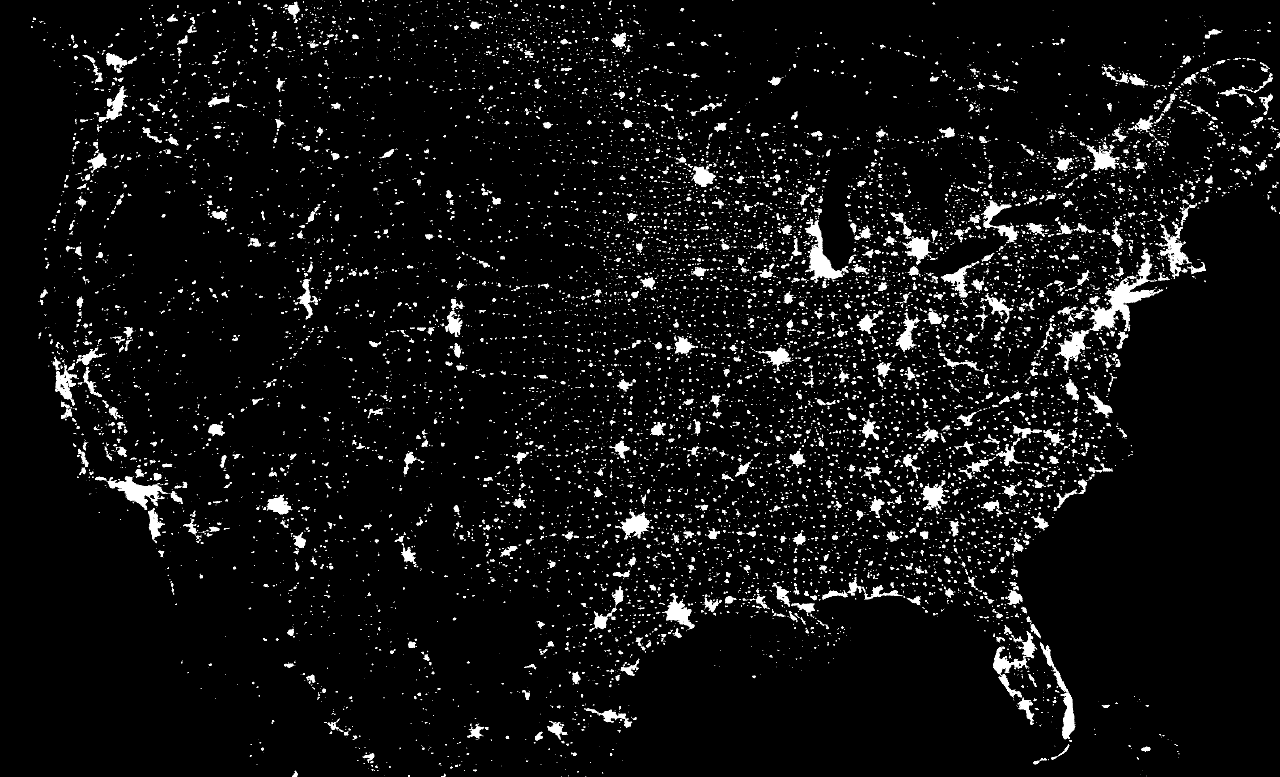
Even the bad parts of Flint are pretty well lit. http://antwrp.gsfc.nasa.gov/apod/image/usanight_d
m sp_big.gif -
Re:Random questions and comments
If the model were making valid predictions (the same model, that is), you could parade an endless list: our model predicted this climate change in this region, and this increase this this kind of weather activity. No, not the past. I mean, predict it *now* and see if it bears out in the future. But obviously, you aren't getting that, or it would be used ad infinitum to shut up global warming skeptics.
Or, you could make accurate predictions, and some skeptics might claim (i.e. lie) that you didn't. -
Re:Have they factored in....
Moderately intellegent people sometimes overlook the basics. Mars Climate Orbiter
-
Why did they even start the project?
Why did a project like this even get started? Was it the "OMG Google" factor?
Didn't they know that we already have World Wind which is Free as in Freedom and Beer and also OSI compliantly licensed? -
Re:High school understanding of the eye is wrong
This reference is to NASA explaining just why you can't read text by moonlight. I should have included it earlier. http://science.nasa.gov/headlines/y2006/28sep_str
a ngemoonlight.htm
Color, as a phenomena, exists (as you point out in a neurilogical manner). You are right to point out that there is no "redness" floating around attached to objects. I'm not sure, however, how this is relavent to anything that I said.
I also assumed you were talking about early human evolution, not mammalian evolution as a whole. It seems hard enough to speculate about early human evolution, much less speculate about the evolution of mammals. This of course doesn't mean it's impossible, I just didn't expect anyone to be doing it so I filled in your argument with what I assumed you were talking about. Slip up in my interpretation of your meaning, I apologize. -
Re:High school understanding of the eye is wrong
This experiment is not valid unless you do it in the complete absence of artificial light. It takes very little artificial light to activate your cones, so little in fact that I would suggest being tens of miles away from the nearest active light-source.
I should have included references, since contradicting "common-sense" views often requires more substantial argument than mere lecture.
Here is NASA explaining just why you can't read by moonlight:
http://science.nasa.gov/headlines/y2006/28sep_stra ngemoonlight.htm -
Re:So who the fuck cares
That's a common misconception.
At least a misconception that NASA also publishes.
Quote: "If we put a thermometer in darkest space, with absolutely nothing around, it would first have to cool off. This might take a very very long time. Once it cooled off, it would read 2.7 Kelvin. This is because of the "3 degree microwave background radiation." No matter where you go, you cannot escape it -- it is always there."
CC. -
Re:Arctic
And even then you didn't link properly...
http://www.gsfc.nasa.gov/topstory/20020820southsea ice.html -
Where to find real women scientists and engineers
I agree that this list is insulting. It sure makes me feel like all of those years I spent in graduate school working on my Ph.D. in physics were a total waste. I've been involved in a lot of public outreach projects aimed at improving the visibility of women scientists, but apparently these public outreach programs have not had any effect on the perceptions of the general public.
The person who came up with the CNET list certainly didn't try very hard at all. If they really were interested in creating a list of women who have contributed to mathematics and science, there are a lot of organizations and web sites where they could have found better information. For example:
The Women of NASA
The Society of Women Engineers
The Association of Women in Science
The Committee on Women in Science and Engineering at the National Academies of Science
And of course, there are also many Women in Science and Engineering (WISE) Programs at colleges and universities throughout the United States.
People always wonder why more women do not pursue careers in science and engineering. The persistence of the misconception that only men can be successful in science and engineering, as well as stupid garbage like this list, are definitely not helping. Reading the CNET list made me feel as though women's contributions to science are completely unappreciated. On the other hand, reading some of the Slashdot comments mentioning prominent women who should have been on the list, gives me a little bit of hope that things can change.
-
Margaret Hamilton
Margaret Hamilton. In charge of the NASA Apollo Flight Software from 1963-72. Coined the term "software engineering". Created the field of high-reliability software. "No software bug was ever found on any manned space flight Apollo mission."
Good-looking, too; I met her once.
-
NASA World Wind integration?
It would be great (read *great*) if they would integrate this new virtual world work with their existing NASA World Wind.
-
I'd nominate
The gorgeous Anousheh Ansari, the first female space tourist, Skepchick Rebecca Watson, and Mae Jemison. I'm sure I could think of many others.
-
Re:Voyager is going to keep its record...
That's because Voyager is nuclear powered. Good luck getting the masses to approve shooting up another nuclear power package.
That's the prevalent meme - but the reality is that space based nuclear power has gotten steadily less controversial. The Mars Science Laboratory Rover will almost certainly be nuclear powered - and the proposal to do so has drawn nary a peep. -
Re:Voyager is going to keep its record...
That's because Voyager is nuclear powered. Good luck getting the masses to approve shooting up another nuclear power package.
New Horizons, another nuclear powered spacecraft, was launched to Pluto earlier this year.
You dumb fuck. -
Re:Voyager is going to keep its record...
I agree - that those craft are still even alive is a wonder. Still, considering how old they are, how far away, and how run down their power sources are, does NASA still get anything from them? Are they actually still working in any appreciable way?
Curious to know (not just nit-picking semantics), I decided to go to the JPL mission page. Voyager 1 passed the 100 AU mark this summer, that's about 12 light-hours. Although it's signal is very weak, we can still talk to it a bit. According to this blurb, "Flight controllers believe both spacecraft will continue to operate and send back valuable data until at least the year 2020."
Looks like we're still on track for V-GER to become sentient and return to earth in a few centuries. -
Re:Voyager is going to keep its record...
I agree - that those craft are still even alive is a wonder. Still, considering how old they are, how far away, and how run down their power sources are, does NASA still get anything from them? Are they actually still working in any appreciable way?
Curious to know (not just nit-picking semantics), I decided to go to the JPL mission page. Voyager 1 passed the 100 AU mark this summer, that's about 12 light-hours. Although it's signal is very weak, we can still talk to it a bit. According to this blurb, "Flight controllers believe both spacecraft will continue to operate and send back valuable data until at least the year 2020."
Looks like we're still on track for V-GER to become sentient and return to earth in a few centuries. -
Difference between classification and naming...
A major reason behind the "uproar" about Pluto's "demotion" is the lack of separation between common and scientific classification of solar system objects. It only makes sense that as scientists and astronomers learn more about the objects in space their classifications will change and evolve accordingly. Unfortunately the scientific ontology blends with our common-use terms, thus creating emotional debate over a question of taxonomy.
Here's a great article by NASA's Chief Historian (who actually voted for the new planet definition: http://www.nasa.gov/mission_pages/exploration/whyw eexplore/Why_We_23_prt.htm -
Re:What's wrong with this definition?
Any liquid in space will be roughly spherical under its own gravity. Congratulations constellation urinous: you're now a collection of planets.
Earth only has a "more-or-less circular orbit" right now, but it's not always that way, so we wouldn't be on a planet anymore.
I'm not sure what you mean by "orbital path isn't shared," but that would seem to discount binary planets, among other things. -
"rotating earth" as seen from Galileo probei saw the movie, and kind of liked it, even though i think i didn't really learn anything new (most information can be taken from +5 slashdot posts over the last year or so). I highly recommend taking people that are maybe not very interested in the whole topic to see this movie though. It can really be quite a shocker for people that don't read the science part of the newspaper everyday.
Apart from that, i really loed the video taken from the galileo spacecraft where you can see earth rotating in space, and looked it up on the net, for your convenience:
-
Re:Why is this so hard?
Here's why:
http://www.2dplay.com/orbit/orbit.swf
Basically, you can have an item in a multi-star system -- is it in a stable orbit around one of them, or is it just doing a few loop-de-loops on its way through? Can it orbit 2, 3,r s/980122c.html With multiple star systems with large interstellar distances, its orbit could be millions of years -- by which time the stars have changed relative position, in which case 'stable orbit' loses its meaning. Where do you draw they line between 'planet in complex orbit' and 'floating rock interfering in a multi-star system' ? The folks who want a dynamical component to the definition are wrong on this one, I think. -
Re:Need all the help they can get.I know that NASA does not do the greatest marketing in the world, but your initial statement With the exception of the Mars rovers, most of NASA's recent history has been riddled with failures, mistakes and oversights is incorrect. Following this is a sampling of recent NASA successes.
- Aura (atmospheric science) - launched in 2004 http://aura.gsfc.nasa.gov/
- CALIPSO (atmospheric science) - launched in 2006 http://www-calipso.larc.nasa.gov/
- Gravity Probe B (relativity experiment) - launched in 2004 http://einstein.stanford.edu/
- Hubble Space Telescope Advanced Camera for Surveys (space science) - launched in 2002 on servicing mission 3B http://sm3b.gsfc.nasa.gov/
- Spitzer Space Telescope (space science) - launched in 2003 http://www.spitzer.caltech.edu/
- Swift (space science) - launched in 2004 http://swift.gsfc.nasa.gov/
-
Re:Need all the help they can get.I know that NASA does not do the greatest marketing in the world, but your initial statement With the exception of the Mars rovers, most of NASA's recent history has been riddled with failures, mistakes and oversights is incorrect. Following this is a sampling of recent NASA successes.
- Aura (atmospheric science) - launched in 2004 http://aura.gsfc.nasa.gov/
- CALIPSO (atmospheric science) - launched in 2006 http://www-calipso.larc.nasa.gov/
- Gravity Probe B (relativity experiment) - launched in 2004 http://einstein.stanford.edu/
- Hubble Space Telescope Advanced Camera for Surveys (space science) - launched in 2002 on servicing mission 3B http://sm3b.gsfc.nasa.gov/
- Spitzer Space Telescope (space science) - launched in 2003 http://www.spitzer.caltech.edu/
- Swift (space science) - launched in 2004 http://swift.gsfc.nasa.gov/
-
Re:Need all the help they can get.I know that NASA does not do the greatest marketing in the world, but your initial statement With the exception of the Mars rovers, most of NASA's recent history has been riddled with failures, mistakes and oversights is incorrect. Following this is a sampling of recent NASA successes.
- Aura (atmospheric science) - launched in 2004 http://aura.gsfc.nasa.gov/
- CALIPSO (atmospheric science) - launched in 2006 http://www-calipso.larc.nasa.gov/
- Gravity Probe B (relativity experiment) - launched in 2004 http://einstein.stanford.edu/
- Hubble Space Telescope Advanced Camera for Surveys (space science) - launched in 2002 on servicing mission 3B http://sm3b.gsfc.nasa.gov/
- Spitzer Space Telescope (space science) - launched in 2003 http://www.spitzer.caltech.edu/
- Swift (space science) - launched in 2004 http://swift.gsfc.nasa.gov/
-
Re:Need all the help they can get.I know that NASA does not do the greatest marketing in the world, but your initial statement With the exception of the Mars rovers, most of NASA's recent history has been riddled with failures, mistakes and oversights is incorrect. Following this is a sampling of recent NASA successes.
- Aura (atmospheric science) - launched in 2004 http://aura.gsfc.nasa.gov/
- CALIPSO (atmospheric science) - launched in 2006 http://www-calipso.larc.nasa.gov/
- Gravity Probe B (relativity experiment) - launched in 2004 http://einstein.stanford.edu/
- Hubble Space Telescope Advanced Camera for Surveys (space science) - launched in 2002 on servicing mission 3B http://sm3b.gsfc.nasa.gov/
- Spitzer Space Telescope (space science) - launched in 2003 http://www.spitzer.caltech.edu/
- Swift (space science) - launched in 2004 http://swift.gsfc.nasa.gov/
-
Re:Contradiction
You can ask the same question about the electromagnetic field of a charged black hole, too: the photons in the electromagnetic field travel at the speed of light, so how can they get out?
Static fields are mediated by virtual particles (gravitons, photons, or whatever). Virtual particles can travel in any way conceivable: faster than light, backward in time (equivalent to antiparticles), or whatnot. But we can never catch them doing it, because virtual particles can't be measured — that's why they're called "virtual".
On the other hand, real gravitons and photons do have limitations on their motion: they must travel at the speed of light in vacuum. But real particles do not give rise to static fields; black holes don't have to shoot out particles we can measure in a detector merely to exert a gravitational or electromagnetic force. Rather, real particles give rise to changes in fields, i.e. waves. So black holes cannot radiate electromagnetic waves (light), gravitational waves, etc.
(A technicality: if you drop something into a black hole, the location of its horizon distorts, and gravitational waves can be emitted, essentially from arbitrarily close to the horizon. Incidentally, this temporary distortion does not allow objects from inside the horizon to escape.)
See also this FAQ. -
Not too shabby for an 11-year old satellite
For info on the Rossi X-ray Timing Explorer satellite and instruments and the scientists and teams which made these observations possible, see http://heasarc.nasa.gov/docs/xte/XTE.html.
-
Re:Not this again?
http://earthobservatory.nasa.gov/Library/GlobalCl
o uds/
Your point being?
Partical? -
Re:Look for...
Yes, some NASA money goes to big companies. But a lot more NASA money goes to universities and small bleeding-edge tech startups. NASA is a research institution on a tight budget - if something is or will be available in the free market, why pay research dollars for it? That's the whole idea behind NASA's Centennial Challenges:
http://exploration.nasa.gov/centennialchallenge/cc _index.html
Just to put things in perpective: two months in Iraq costs about the same as funding NASA for a year. -
Re:NASA planning to save the Earth
You mean the 1999 AN10 that is virtually impossible to collide with earth?
No currently known object has the Torino scale rating greater than 0. See http://neo.jpl.nasa.gov/risk/ -
Re:NASA planning to save the Earth
You mean the 1999 AN10 that is virtually impossible to collide with earth?
No currently known object has the Torino scale rating greater than 0. See http://neo.jpl.nasa.gov/risk/ -
Re:NASA planning to save the Earth
You mean the 1999 AN10 that is virtually impossible to collide with earth?
No currently known object has the Torino scale rating greater than 0. See http://neo.jpl.nasa.gov/risk/ -
NASA TV
NASA will broadcast its 6th annual live Leonids webcast on NASA TV. The server is usually slowed to a crawl for the night but video will be put up the next day for sure.
http://www.nasa.gov/multimedia/nasatv/ -
So let me get this straight, more ice = warming?
These days you get any freaky weather event, and it gets blamed on global warming. Even when it doesn't make sense.
Surely, more ice making it further north would, if anything, be supporting evidence for datasets that show the oceans are getting cooler? You might also note that some data sets suggest that the global warming trend is not present in the Southern Hemisphere.
There is some evidence that the icecaps melting around the edges, but getting thicker in the middle. Perhaps that's because the Sun's output is a huge factor to global warming, and there are no sunspots this year?
-
Re:Bad idea in lots of ways
Where's the innovation?
State run companies *DO NOT INNOVATE*.
So, who did all the things NASA has done before NASA, exactally? What do you want them to innovate? It's not sci-fi, you know it's real life.
I hate to tell you this, but space is bleeding edge. Simply getting there requires knowledge, technology and materials never developed before.
Christ, browse to NASA's webpage and look at a few current and proposedmissions. Or, look at the science secion in Barns & Noble. 90% of what we know about the outer solar system is thanks to Voyager. A whole lot of what we know about deep space is thanks to Hubble.
If it were not for NASA's equipment and research (by them and others) we might still be pouring CFC's into the atmosphere. So, there, NASA has gotten you less skin cancer.
Baby steps. We'd better learn how to get off this rock, one way or another, cause it's not gonna last forever. -
Re:Bad idea in lots of ways
Where's the innovation?
State run companies *DO NOT INNOVATE*.
So, who did all the things NASA has done before NASA, exactally? What do you want them to innovate? It's not sci-fi, you know it's real life.
I hate to tell you this, but space is bleeding edge. Simply getting there requires knowledge, technology and materials never developed before.
Christ, browse to NASA's webpage and look at a few current and proposedmissions. Or, look at the science secion in Barns & Noble. 90% of what we know about the outer solar system is thanks to Voyager. A whole lot of what we know about deep space is thanks to Hubble.
If it were not for NASA's equipment and research (by them and others) we might still be pouring CFC's into the atmosphere. So, there, NASA has gotten you less skin cancer.
Baby steps. We'd better learn how to get off this rock, one way or another, cause it's not gonna last forever. -
Re:How low can we go?Well acutally OSHA requires air to have at least 19% oxygen so 101.4 kPa X
Potential space habitat and EMU atmospheric pressures range from the Earth sea-level value of 101.4 kPa (14.7 psia) to as low as approximately 25.5 kPa (3.7 psia), and potential oxygen concentrations range from approximately 20 percent up to 100 percent. Atmos Pres
to see what it would be like to breathe on Mars without a pressure suit, try exhaling through a hose exiting in water 8.3 feet deep. -
Re:How low can we go?
I've wondered that, too. I ran across this paper that may help:
-
Re:A festival of confusion
Regarding the Antarctic ice sheet: the article was from 2002.
More recently (March 2006): NASA Mission Detects Significant Antarctic Ice Mass Loss. "The researchers found Antarctica's ice sheet decreased by 152 (plus or minus 80) cubic kilometers of ice annually between April 2002 and August 2005."
Personally, what I find most convincing is graphs of current and historical CO2 levels.
-
Re:Unfullfilled predictionsThe [ozone] hole is larger this year than ever before, btw.
Tied for largest. Also second lowest year in terms total ozone concentration in the hole.
There's noise in the data. It is shrinking.
http://ozonewatch.gsfc.nasa.gov/ has details.
And nice use of sparklines.
-
I don't see it.
Here's a picture of Earth from space:
http://www.nasa.gov/mission_pages/cassini/multimed ia/pia08324.html
I can't see the logo. I think they need to get a refund from the sign shop. -
Second logo visible from space..
Wouldn't the first logo visible from space be this?
-
Re:Georges Moonbat. Great choice there.
"all us laymen can do is evaluate the credibility of the proponents for each side" You can start by figuring out the blatant lies in Monckton's piece of crap article.
-
Re:Global Hubris
The oceans are not saturated with CO2, buddy. The oceans were roughly at equilibrium with the atmosphere before atmospheric CO2 increased. The driving force is into the ocean. People actually measure this stuff. Find me valid research that shows a global (not regional- global) net flux of CO2 from the ocean to the atmosphere and I'll buy you beer for a year.
Here's a decent page at NASA:Prior to the Industrial Revolution, the annual uptake and release of carbon dioxide by the land and the ocean had been on average just about balanced. In more recent history, atmospheric concentrations have increased by 80 ppm (parts per million) over the past 150 years. However, only about half of the carbon released through fossil fuel combustion in this time has remained in the atmosphere, the rest being sequestered the ocean
Evidence for solar output as a driver for current warming is weak (but at least plausible). Please stop the idle speculation; there is a rich body of knowledge here.
I did write my M.S. thesis on oceanic carbonate chemistry, so you'll have to do better than 'If water gets warmer, it absorbs less CO2.'. Yes, solubility decreases with temperature, but that's a completely irrelevant factoid. -
Re:Georges Moonbat. Great choice there.
Oops I screwed up the Arrhenius link. Just Google for him.
-
Re:tinfoil hats
No, but garbage bags can. Come on...this was solved years ago. What's the problem?
-
Re:Randomly dump their trash would be stupid
A rocket is not a closed combustion chamber. You are not trying to burn wet waste in an oven, you are generating hot gases -- by burning some hypergolic mix or some solid propellant. Different things.
Amazingly little is known about how a standing fire (as opposed to a burning jet of gases) behaves in low gravity. See for example http://microgravity.grc.nasa.gov/fcarchive/combus
t ion/papers/Sacksteder/Solid_Surface_Combustion.htm . Thus, any process requiring a standing fire in low grav is not a practical method (yet). And of course, you don't want to waste fuel on burning waste.A solar sail could safely deorbit junk at minimal cost.
Or you could just leave it float around until it drags down to a low orbit... Not sure about the low cost. Solar sails are still highly experimental.
-
Re:Randomly dump their trash would be stupid
In order to deorbit something, you need a very considerable amount of thrust, with an engine and propellant brought up from Earth at enormous cost.
Actually, all you need is a ribbon.
-
Re:Randomly dump their trash would be stupid
They could pack their trash and, with minimal thrust, send it on a quick reentry path in which it will burn in higher atmosphere a few days or weeks later.
Exactly, there is no reason not to incinerate their trash. I can't believe this is 2006, people have been going into space for more than 40 years now, and they still are throwing trash overboard even though they know the danger. Stupid, stupid, stupid. -
Re:No CMMI comments? Are there real developers her
The NASA Software Engineering Requirements for your review.