Slashdot Mirror
Domain: nasa.gov
Stories and comments across the archive that link to nasa.gov.
Comments · 16,365
-
Re:A good first step...
This is a good first step, but is it too late? Don't they have a new deep space telescope on the books already?
James Webb Space Telescope, scheduled for launch in 2013, if everything goes as planned. It won't. -
Re:Save even more money, ditch the project
Yeah, I'm glad that Wired has insight into issues that NASA hasn't considered. Thanks for the info.
I did a quick search on nasa.gov for 'lunar dust' and got a whole page of hits. As you would've too, if you'd cared to investigate before posting yet another hollow, shoot-from-the-hip reply.
It turns out that NASA has thought quite a lot about the problem.
From the latter:
Although simple dust mitigation measures were sufficient to mitigate some of the problems (i.e., loss of traction), it was found that these measures were ineffective to mitigate many of the more serious problems (i.e., clogging, abrasion, dimished heat rejection). The severity of the dust problems were consistently underestimated by ground tests, indicating a need to develop better simulation facitilities and procedures.
-
Re:Save even more money, ditch the project
Yeah, I'm glad that Wired has insight into issues that NASA hasn't considered. Thanks for the info.
I did a quick search on nasa.gov for 'lunar dust' and got a whole page of hits. As you would've too, if you'd cared to investigate before posting yet another hollow, shoot-from-the-hip reply.
It turns out that NASA has thought quite a lot about the problem.
From the latter:
Although simple dust mitigation measures were sufficient to mitigate some of the problems (i.e., loss of traction), it was found that these measures were ineffective to mitigate many of the more serious problems (i.e., clogging, abrasion, dimished heat rejection). The severity of the dust problems were consistently underestimated by ground tests, indicating a need to develop better simulation facitilities and procedures.
-
Re:Save even more money, ditch the project
Yeah, I'm glad that Wired has insight into issues that NASA hasn't considered. Thanks for the info.
I did a quick search on nasa.gov for 'lunar dust' and got a whole page of hits. As you would've too, if you'd cared to investigate before posting yet another hollow, shoot-from-the-hip reply.
It turns out that NASA has thought quite a lot about the problem.
From the latter:
Although simple dust mitigation measures were sufficient to mitigate some of the problems (i.e., loss of traction), it was found that these measures were ineffective to mitigate many of the more serious problems (i.e., clogging, abrasion, dimished heat rejection). The severity of the dust problems were consistently underestimated by ground tests, indicating a need to develop better simulation facitilities and procedures.
-
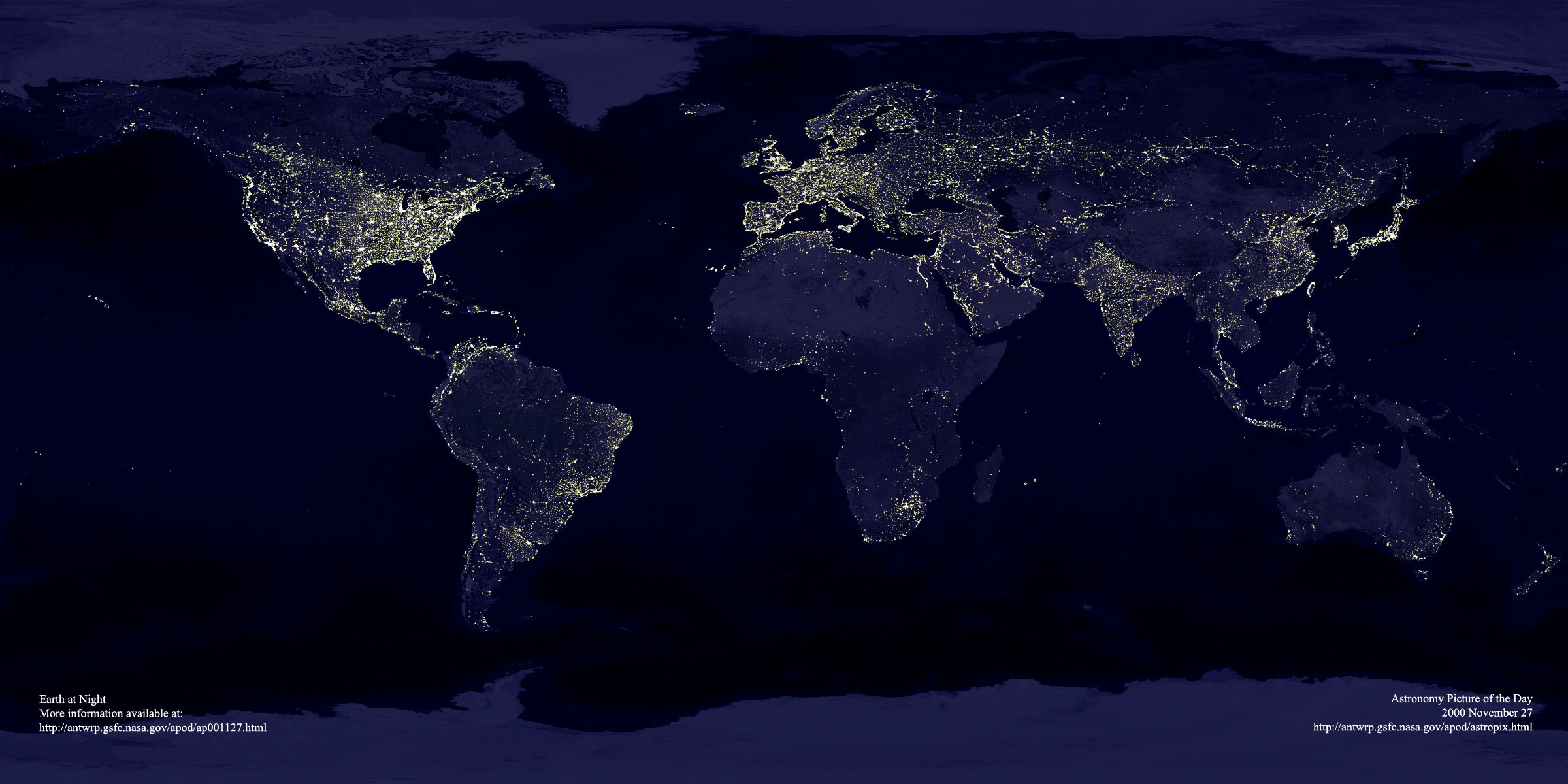
Biggest single image I could find: 450 MegapixelsHere is an image of earth at night courtesy of NASA, only 5.9 MiB. Really cool to zoom in on, you can make out lots of stuff. I wouldn't recommend clicking this link unless you have a ton of ram. Best to save and view in photoshop.
-
Weather layers for Google Earth
Ok, I must admit, the way they represent it in Second Life is interesting. Symbolic, not realistic, but sometimes symbolization is simply more efficient than realism.
US weather radar layers for Google Earth.
3D pseudo-real-time global clouds layer for Google Earth.
And while we're at it, weather radar data for Canada.
Oh yeah.. you can't use GE at work (as clearly specified in the license), so use the great (and open source) NASA World Wind instead. -
Re:Failed physics? (no)
>The platters have (per platter) a much smaller edge, so they're going to get less friction from the air.
Not failed physics... this is a flawed analysis.
There are a few different types of drag (I am an aerospace engineer). The relevant one in this case is caused by the surface of the platter, not the edge. Remember, the edge is really acting as if it were stationary - it's not moving the disc laterally thru the air, so the edge is irrelevant. Instead, the disk surface moving past the air drags some of the air with it - this is sometimes referred to as surface drag, or skin friction. No matter how smooth the surface is, moving it thru a "fluid" (such as air) causes shear in the fluid - the fluid closest to the surface is motionless, and the speed builds up as you move out away from the skin. This is called a "boundary layer". This layer can be smooth-flowing ("laminar flow") or rough (turbulent). Smoother skin means laminar flow. But there's STILL drag, no matter how smooth the surface.
Here's a good illustration: http://wright.nasa.gov/airplane/Images/boundlay.gi f
So making thinner disks and using more of them means MORE drag, not less.
Actually in this case, however, the motor can be sized DOWN, despite higher operating drag, because the largest power usage comes from spinning up the disc package - and a set of lighter disks will require less power to spin up. Very little power is actually used to keep it spinning, despite the drag. -
Re:Real Al Gore quote kiddies...Actually - I've found it a pretty weak debunking. While it is true that he never said he "invented" the internet, he did say he "took the initiative in creating the internet". While his congressional record is noteworthy on funding the early net, he was clearly trying to imply that he "created" the internet.
I am detecting a pattern here though... Al Gore seems to find a good idea in progress, champion it, and (at least awkwardly) take some type of credit for it... in this case he is a bit behind the X-prize foundation and NASA with its COTS Program and Centennial Challenges. (I'll leave out his recent championing of Global Warming since he has a pretty well established environmental record)
-
Re:James Webb Space Telescope
http://www.jwst.nasa.gov/ lists the launch date as 2013. Yikes! Even still, with the cost overruns that will almost for sure happen you would think saving money now may be in everybody's best interest. Perhaps Hubble has outlived its usefulness. We can get by with our ground based observatories until then, finetune our cosmological understanding between now and then with CERN et. al, and in 7 years have that bad boy up in space with its 6.5m mirror and put Hubble to shame.
-
already done
Hubble's replacement is the James Webb Telescope, and has been in the works for a long time. Slated for launch in 2013, it will have a 6.5 meter primary mirror (Hubble's is 2.4 meters), be optimized for the near-infrared (so it can see through dust clouds, and further back in time and/or farther away), and orbit at the second Lagrange point about a million miles from Earth, instead of right around Earth like Hubble. That means it won't be bothered by light from the Earth, so it can see far dimmer things, and also that it can point steadily without having to compensate for its rapid orbital motion, unlike Hubble.
Hubble is certainly very nice for crowd-pleasing photos, and it's done valuable science, but I think the astrophysics community is a lot more interested in JWST. Near IR astronomy seems much more fruitful in terms of actual science than visible, is my impression. Considering a Shuttle mission costs something like $250 million, it is not clear that the money is best spent prolonging the aging Hubble's lifetime another few years. Bear in mind the Shuttle fleet is to be grounded in 2010 anyway, so there can be no more servicing missions, and Hubble's hardware is beginning to wear out. -
already done
Hubble's replacement is the James Webb Telescope, and has been in the works for a long time. Slated for launch in 2013, it will have a 6.5 meter primary mirror (Hubble's is 2.4 meters), be optimized for the near-infrared (so it can see through dust clouds, and further back in time and/or farther away), and orbit at the second Lagrange point about a million miles from Earth, instead of right around Earth like Hubble. That means it won't be bothered by light from the Earth, so it can see far dimmer things, and also that it can point steadily without having to compensate for its rapid orbital motion, unlike Hubble.
Hubble is certainly very nice for crowd-pleasing photos, and it's done valuable science, but I think the astrophysics community is a lot more interested in JWST. Near IR astronomy seems much more fruitful in terms of actual science than visible, is my impression. Considering a Shuttle mission costs something like $250 million, it is not clear that the money is best spent prolonging the aging Hubble's lifetime another few years. Bear in mind the Shuttle fleet is to be grounded in 2010 anyway, so there can be no more servicing missions, and Hubble's hardware is beginning to wear out. -
Logical thinking is great, but ...
If you don't know all of the details, it's impossible to draw an accurate conclusion.
First, NASA has different classes of missions, such as the Discovery Programs, which are intended to be lower cost, and more science focused. (I think STEREO falls under this, but I'm not sure). The cost is claimed to be $500mil, not the 'billions' that you claimed. Yes, it's still a lot, but not all of it comes from the US.
As for the 'movie' aspect -- the satellites will be able to generate 3D movies, but it's not what you think -- only for a limited time will the satellites be at an angular seperation that's similar to the human eyes trying to look at something. For the other times, it's still useful to the scientists, but not the general public looking for pretty movies.
So
As for what NASA's been doing -- just read their website. (and there's lots of other breakthroughs that aren't even hard science -- technology to perform better science, etc.) -
Logical thinking is great, but ...
If you don't know all of the details, it's impossible to draw an accurate conclusion.
First, NASA has different classes of missions, such as the Discovery Programs, which are intended to be lower cost, and more science focused. (I think STEREO falls under this, but I'm not sure). The cost is claimed to be $500mil, not the 'billions' that you claimed. Yes, it's still a lot, but not all of it comes from the US.
As for the 'movie' aspect -- the satellites will be able to generate 3D movies, but it's not what you think -- only for a limited time will the satellites be at an angular seperation that's similar to the human eyes trying to look at something. For the other times, it's still useful to the scientists, but not the general public looking for pretty movies.
So
As for what NASA's been doing -- just read their website. (and there's lots of other breakthroughs that aren't even hard science -- technology to perform better science, etc.) -
Logical thinking is great, but ...
If you don't know all of the details, it's impossible to draw an accurate conclusion.
First, NASA has different classes of missions, such as the Discovery Programs, which are intended to be lower cost, and more science focused. (I think STEREO falls under this, but I'm not sure). The cost is claimed to be $500mil, not the 'billions' that you claimed. Yes, it's still a lot, but not all of it comes from the US.
As for the 'movie' aspect -- the satellites will be able to generate 3D movies, but it's not what you think -- only for a limited time will the satellites be at an angular seperation that's similar to the human eyes trying to look at something. For the other times, it's still useful to the scientists, but not the general public looking for pretty movies.
So
As for what NASA's been doing -- just read their website. (and there's lots of other breakthroughs that aren't even hard science -- technology to perform better science, etc.) -
Re:Nearly identical?
As I understand it, the main difference is the coupling ring, as they're stacked together for transport, and only one has the rocket attached to it. See http://www.nasa.gov/mission_pages/stereo/multimed
i a/stereo_stacked.html .
Now, as one is to the effective 'right' of the earth (Ahead), and one effectively 'left' (Behind), I don't know if the instruments are placed differently in relation to the antenna to communicate w/ earth, or if they just have one flipped over. -
Re:'Detailed Panorama'?
The color calibration target that is on the corner of the rover (designed by a group including Bill Nye the Science Guy, if I recall) helps the scientists recreate the colors that entered the camera lens accurately, or to recreate the colors of the materials when ignoring the differences in Martian lighting conditions.
Not quite. From a NASA story about the image:This is an approximately true-color, red-green-blue composite panorama generated from images taken through the Pancam's 600-nanometer, 530-nanometer and 480-nanometer filters. This "natural color" view is the rover team's best estimate of what the scene would look like if we were there and able to see it with our own eyes.
Those images are combined from three separate color channels or known frequency therefore no calibration is needed. In other words, they did not take a grey-scale image and add false color to make it appear true color but took three separate grey-scale images of known wavelength and combined them.
And for what it's worth, the wikipedia article on color vision says the three types of cones in our eyes are most sensitive to 420 nm, 534 nm, and 564 nm. -
I'll see your OMG......and raise you a Really Frakkin' Big. (387MB TIFF >>>>>>>> 87MB JPG)
Also, this isn't the final image; just a preview in honor of Spirit's 1000th sol. Another panorama picture will be released that includes the rover deck.
-
Raw Pictures
For the curious, the links to Spirit's and Opportunity's "raw pictures" are here http://marsrovers.nasa.gov/gallery/all/ ---Alex
-
Re:'Detailed Panorama'?
-
Re:'Detailed Panorama'?
-
Re:'Detailed Panorama'?
-
Re:'Detailed Panorama'?
-
Re:'Detailed Panorama'?
-
Re:'Detailed Panorama'?
-
Re:'Detailed Panorama'?
-
Re:'Detailed Panorama'?
-
Re:'Detailed Panorama'?
-
'Detailed Panorama'?
TFA has some tiny images that barely pass as thumbnails. You can get the actual 'detailed panoramas' from NASA directly.
-
Re:While it is great...
Why not read up a bit:
http://www.nasa.gov/mission_pages/stereo/mission/i ndex.html
http://secchi.nrl.navy.mil/
For example, this mission could be important for understanding how to protect humans out in the solar system. -
Re:While it is great...
Your tax dollars also pay for the publication of volumes of information available at NASA's website.
Here is some very relevant information on the science instraments attached to the STEREO probe.
You'll notice that each of the vehicle's instruments has it's own page, and some pretty good information on what it is supposed to do and why. It sounds pretty relevent to me. NASA's website is pretty great actually. You paid for it, go check it out. -
Re:planned holds
google is your friend:
From http://www.nasa.gov/multimedia/podcasting/115_askm ission_leinbach_transcript.html
"Barrett: Why are there holds in the countdown and what is happening in the firing room during those holds?
Leinbach: Well the holds were put in -- designed in the countdowns from the very beginning of the manned spaceflight program. And they are intended to be points in the countdown where the team can take a breather, essentially. There's not supposed to be much work going on during a hold. Again, it's a point where if work leading up to that built-in hold has run behind schedule for some reason, we can continue to work into the hold and then take the hold itself and then when we pick up the clock again, get back into work. So, really they are points in the timeline that allow catch-up time and also time for the team to take a breather and think about what's coming up next in the count. The last built-in hold we have is at T minus 9 minutes and for the current missions those are 40 minute long holds so that we can make sure that the vehicle is ready to pick up the clock at T minus 9 minutes and counting, because for 9 minutes on down is when the vehicle really starts to come to life. And so we want the team to be focused having just taken a short break as it were. We don't leave the control room, but we look forward to what's about to happen and we concentrate on our jobs. And so, it's really a time of reflection. It's a time to catch your breath and to think about what we're about to go do." -
Re:planned holds
I believe that a planned hold is usually expected to take a certian amount of time, but the launch controllers can't be sure of that. So a hold can run for an arbitrary amount of time and thus you can't add it to the countdown.
I can't find any webpages that explain this explicitly, but looking at NASA's Countdown 101, this explanation seems to make sense. -
Re:planned holds
There isn't much information on the NASA website about built-in holds (that I could find) but a bit of an explanation can be found here: Countdown Clock & Time to Liftoff
"Sometime built-in holds are included to allow synchronization with other countdown clocks (for example, a payload countdown). Other built-in holds allow people to take a break. The built-in holds vary significantly from day-launch missions to night-launch missions."
"The shuttle countdown clock typically starts counting at about 43 hours." -
Re:A Space Stereo?
http://science.nasa.gov/headlines/y2003/09sep_bla
c kholesounds.htm Oh wait I've been trolled...damn. -
Re:It's obviously the best solution
It's obviously best to simply give up and leave, rather than actually stand up and do something about changing your country.
This has been my position for a long time: you fucked it up, you fix it. Kindly refrain from exporting your problems to other countries. We have our own problems, thank you, and we do not need yours.
Whenever I visit other countries I always try to get an idea of what it might be like to live there. This includes a trip to the supermarket, which can be most illuminating.
My results range from "I like it here and would like to get to know it better" (e.g. France, Australia) to "Not even on a bet!" (U.S.A.). After a day to pick up the accent I pass for a native in England. In total I've been to 10 countries, and they have all been interesting.
I'm planning a trip to Russia in 2008, and am looking forward to it. Brushing up on my Russian, with sometimes interesting results in the shower in the morning ("Ya prodolzhayu prostiye dvizhen'ya..." Oops. Blush.)
...laura, proudly Canadian
-
Link to the Raw Data
Thank you, thank you, thank you. You summarized rather nicely the sometimes rancorous debate between Dr. Gilbert Levin and other scientists. Dr. Levin maintains to this day that the Viking Labeled Release Experiment did in fact detect life. The raw data as well as a useful experimenters notebook from the Viking LR experiment can be found here.
-
I was there too!
Indeed, seeing this first hand was quite interesting (I was there both days, and spent some time in neighboring Truth or Consequences, Aguirre Springs Recreation Area, and White Sands National Monument). I was really impressed with the high school space elevator team, as their device made it all the way up without much of a problem. I wish I was able to get more videos of the Tripoli rockets firing, as those were really neat. I was a bit under-whelmed by the lunar lander challenge though, if only because of the lack of teams competing and the problems encountered. But I suppose that is the nature of experimentation!
-
Re: Record Ozone Hole
Even more interesting (time lapse video):
http://svs.gsfc.nasa.gov/vis/a000000/a003200/a0032 64/ -
Re:Your questions answered
2. CFCs have nothing whatsoever to do with stratospheric ozone.
Is that so?
Even though a Nobel Prize was given for the supposed link between CFCs and ozone depletion, no-one has ever explained how CFC molecules which are much heavier than air, can rise up in the stratosphere, travel all of the way to Antarctica before being broken down into chlorine and fluorine and reacting the O3
They aren't so heavy that the wind can't take them up. Dust particles are much heavier than CFCs and seems to get into the stratosphere just fine (hint: the bit where it says "principally wind-blown dust"). -
Re: Record Ozone Hole
Speaking of records, it's quite enlightening to look at all the last three years worth of these images
ftp://toms.gsfc.nasa.gov/pub/omi/images/global/ -
Re:Your questions answered
Geezer Wrote:
CFCs are not found in the stratosphere any where on the planet, they're simply too heavy
That's flat-out wrong. For measurements of CFC (NOT Cl) in the statosphere see:
http://adsabs.harvard.edu/abs/1987P&SS...35..657B
http://umpgal.gsfc.nasa.gov/www_root/homepage/uars -science/CFC.html
for two easy examples.
Also see
http://www.physics.usyd.edu.au/~cairns/teaching/le cture16/node2.html
http://www.thespacerace.com/glossary/index.php?ter m=290
http://amsglossary.allenpress.com/glossary/search? id=homosphere1
where we read that the atmosphere is well-mixd below 100 km. (Stratosphere starts around 12 km). -
Re:Was Wondering...
Go here NASA's TOMS to get the story or A really cool movie
On this issue would anyone watching the movie please get their head on streight. If you will note there is a correspondingly intense increase in the ozone layer north of the "hole" where the atmospheric conditions that create the hole revert back to their normal state and as a result the inhabited areas of South America, Australia and New Zealand are actually more protected than usual. Now I am sure some idiot is going to flame me for coming up and pointing this out but the whole CFC story is a damned hoax. The film proves it. The whole issue is the polar vortex and is the result of temperatures at altitude going below -205 C. Once the atmosphere warms above this level the resulting situation is that the ozone reaction reverts back to operation and the missing ozone reappears with a vengance.
As to the whole CFC thing. This is pure physics stuff here. CFC 12 is one of the lightest CFC's. It is 5.5 times more dense than air. What is more CFC's were picked for the job, not because they were the most efficient, though they were highly effective. They were picked in the 1920's and 1930's for the job because the CFC's were inert, and they were immissible with air. This ment that they could be easily made to fall from the work area if they leaked and the only danger they presented to workers was asphyxiation. They were entirely non-toxic. Inside the machinery they didn't cause rust or breakdown and they were easily seperated from air. If somebody were to look at a bottle of the CFC's they would find warnings about the pooling of the gas in low areas. IT SINKS IN AIR!
For the geeks out there who haven't studied Archemedes Principal, that 5.5 times heavier than air coupled with the fact that it doesn't mix with air, produces the same effect when CFC's are dropped into the atmosphere as dropping a solid steel cannon ball into a lake. Since there are noted to be no large collections of cannon balls floating on lakes the obvious conclusion here is that CFC's are highly unlikely to float up to the high atmosphere and cause any problems. They can't do it. They fall out. In fact CFC leak detection even in presence of a spouting upwards leak with pressure (I have witnessed this in person) is difficult unless you go below the leak site. I have also watched parts washing with CFC's and there too the employees encountered no CFC's above the pan. The appearance of CFC's in the upper atmosphere is as likely as floating cannon balls. To use the Computer geek term NULL!
The appearance of chlorine in the upper atmosphere is not unusual though. The Sea is full of the stuff. (Salt) Meteors have a substantial content of the stuff. Volcanoes kick it out massively. If the appearance of chlorine in the atmosphere was a threat to life on the planet, the greatest threat would be the ocean itself. (again this is a NULL reality) I know it is a religion with some people that CFC's are a problem.
The eliminated refrigerants were replaced with highly reactive chlorine compounds which when properly labeled by their true chemical content would be either Phosgene Gas or some similar compound. These are truly dangerous to the staff who works with them. If they are not phosgene they burn easily and become it. This cause HCl gas to form on contact with water. Talk about your atmospheric chlorine! This gas is most able to go to the upper atmosphere!
The whole CFC thing was a myth kicked off by Dupont as their patents on CFC's ran out. They wanted to kick CFC's off the market and push in some new patented compounds so they could keep getting royalties. Acutally the real environmental damage is from the fact that the substitutes are not only dangerous, they use a lot more energy to do the same job. As a result they cause the use of more gasoline and more electricity. This results in massive increases in pollution.
No
-
Re:Was Wondering...
Go here NASA's TOMS to get the story or A really cool movie
On this issue would anyone watching the movie please get their head on streight. If you will note there is a correspondingly intense increase in the ozone layer north of the "hole" where the atmospheric conditions that create the hole revert back to their normal state and as a result the inhabited areas of South America, Australia and New Zealand are actually more protected than usual. Now I am sure some idiot is going to flame me for coming up and pointing this out but the whole CFC story is a damned hoax. The film proves it. The whole issue is the polar vortex and is the result of temperatures at altitude going below -205 C. Once the atmosphere warms above this level the resulting situation is that the ozone reaction reverts back to operation and the missing ozone reappears with a vengance.
As to the whole CFC thing. This is pure physics stuff here. CFC 12 is one of the lightest CFC's. It is 5.5 times more dense than air. What is more CFC's were picked for the job, not because they were the most efficient, though they were highly effective. They were picked in the 1920's and 1930's for the job because the CFC's were inert, and they were immissible with air. This ment that they could be easily made to fall from the work area if they leaked and the only danger they presented to workers was asphyxiation. They were entirely non-toxic. Inside the machinery they didn't cause rust or breakdown and they were easily seperated from air. If somebody were to look at a bottle of the CFC's they would find warnings about the pooling of the gas in low areas. IT SINKS IN AIR!
For the geeks out there who haven't studied Archemedes Principal, that 5.5 times heavier than air coupled with the fact that it doesn't mix with air, produces the same effect when CFC's are dropped into the atmosphere as dropping a solid steel cannon ball into a lake. Since there are noted to be no large collections of cannon balls floating on lakes the obvious conclusion here is that CFC's are highly unlikely to float up to the high atmosphere and cause any problems. They can't do it. They fall out. In fact CFC leak detection even in presence of a spouting upwards leak with pressure (I have witnessed this in person) is difficult unless you go below the leak site. I have also watched parts washing with CFC's and there too the employees encountered no CFC's above the pan. The appearance of CFC's in the upper atmosphere is as likely as floating cannon balls. To use the Computer geek term NULL!
The appearance of chlorine in the upper atmosphere is not unusual though. The Sea is full of the stuff. (Salt) Meteors have a substantial content of the stuff. Volcanoes kick it out massively. If the appearance of chlorine in the atmosphere was a threat to life on the planet, the greatest threat would be the ocean itself. (again this is a NULL reality) I know it is a religion with some people that CFC's are a problem.
The eliminated refrigerants were replaced with highly reactive chlorine compounds which when properly labeled by their true chemical content would be either Phosgene Gas or some similar compound. These are truly dangerous to the staff who works with them. If they are not phosgene they burn easily and become it. This cause HCl gas to form on contact with water. Talk about your atmospheric chlorine! This gas is most able to go to the upper atmosphere!
The whole CFC thing was a myth kicked off by Dupont as their patents on CFC's ran out. They wanted to kick CFC's off the market and push in some new patented compounds so they could keep getting royalties. Acutally the real environmental damage is from the fact that the substitutes are not only dangerous, they use a lot more energy to do the same job. As a result they cause the use of more gasoline and more electricity. This results in massive increases in pollution.
No
-
Uranium, ores, and bacteria
First, wow, not to be rude but "Is uranium naturally radioactive" is a grade 6 science fact. You might want to look into brushing up a bit on your Science 101, if only so you can be more confident of choices you make based on science (and recognizing when things aren't based on such.)
Next, there are, well really were, natural reactors. Wikipidia has a short entry on this, a great webpage on it from the US Dept. of Energy, here's also a picture from Astronomy Picture of the Day showing what it looks like in a mine today. The article that first brought this to wide attention is "A Natural Fission Reactor" by George A. Cowan in Scientific American, July 1976. (Pages 36 - 47) (apparently not available online, visit your local library to read this fascinating article for free.)
Uranium ores are found all over the planet. Australia has 40% of known Uranium ores and is the largest exporter, the US West has 7 active mines, and Canada has 3 very large mines for both domestic use and export. Uranium ores are not always deep in the ground, surface mines are common, indeed there are places, including in the US, where rocks & soil sufficiently "hot" (in terms of emitted radiation, they're generally not warm enough to discern by touch) to harm folks in long term exposure can be found laying around on the surface.
However rocks are a rare, purely local danger, radioactively contaminated water is much more common & dangerous, and also Radon gas. Indeed there are parts of the US, for example Massachusetts, where radon gas detectors are routinely recommended for residential basements.
Finally, the University of Manchester has been doing research* on using bacteria to bioremediate radioactive materials, in short to use biological processes to convert dangerous radioactive compounds into less dangerous (but still radioactive) ones. These biochemical processes can't convert elements, no lead-to-gold, but they can "lock up" materials into less chemically active, or insoluble, forms. Doubtless discovery of bacteria already evolved to take advantage of highly radioactive environments will be of great advantage to their research.
* This is to an archived version of the University of Manchester website, the current website doesn't seem to have as widely informative a page.
-
Mars Viking lander
Check out Mars Viking lander. It used a "nodding" mirror with a 12 pixel array for its camera. This link gives a very detailed discussion on the Viking camera. http://dragon.larc.nasa.gov/viscom/first_pictures
. html A rather large slide show document gives a very high level overview of different imaging devices used in space probes. http://www.mps.mpg.de/solar-system-school/lectures /space_instrumentation/11.ppt#281,1,Slide1 -
"Someday"?
this type of radar may someday be used on Mars to locate water in a future mission
What the (thin) article doesn't say is how this technology is different from, for example, the Italian MARSIS ground penetrating radar, operating on board of the ESA Mars Express probe since 2004, probing for water down to 5 km under the surface. Or the new Shallow Subsurface Radar now being deployed by the NASA Mars Reconnaissance Orbiter probe. -
what do you mean?
As far as I know, Hubble's replacement is doing just fine, on schedule and fully funded.
As for colliders -- the last time colliders were fully funded (around the time the SSC was cancelled, many years ago) -- we spent half our national research budget on high-energy physics. That's excessive. There are many, many other interesting fields of science, from molecular biology to condensed matter physics to mesoscale material science to climate modeling. I don't see why HEP, admittedly interesting as it is, has to grab the lion's share of our national research funding. I'm totally cool with diverting the $100 billion it would cost to (maybe) find the Higgs boson into nifty biotech or materials science until the physicists figure out how to find the bugger with a less expensive instrument. -
Don't Panic
According to Friday's update from NASA, everything on the ISS is fine and dandy. The station is operating on 3 of the gyro's which is A-OK because it can work on 2 if necessary.
The situation is being assessed but things continue to progress. Other "minor" problems include the fact that the Russian Oxygen generator has stopped working as well.
http://www.nasa.gov/home/hqnews/2006/oct/HQ_SS0604 4_station_status.html -
Re:Sanctions?
This isn't meant to answer your question, but I still think it's fascinating (and terrible). Look at this picture. In the upper right you'll find the Korean peninsula. South Korea is a sea of light. North Korea is completely dark (except for a little dot around Pyongyang). The dividing line is sharp and obvious.
-
Re:Freaked out
Um, everything I've ever read by anyone who studies climate for a living says that global warming is a real concern, and one that could impact billions of people. I agree that there's a lot of bad science reporting, and that some people use it to promote an agenda. That means you ignore that bad reporting - you don't assume that other, legitimate information supporting the same conclusion is wrong.
Fleece a nation, my ass. The ones fleecing us are the people telling us that destructive behavior is OK as long as it's someone else who feels the repercussions, or the repercussions are delayed.
A google for "scientific studies global warming" (which is the most agenda agnostic way I could think of to search for it) turns up a bunch of articles like this: http://www.giss.nasa.gov/edu/gwdebate/