Slashdot Mirror
Domain: nasa.gov
Stories and comments across the archive that link to nasa.gov.
Comments · 16,365
-
Re: Look outside
Angered? No, what you've said is all mostly correct. Just largely irrelevant to what's happening today. Perhaps you have a more relevant point to make?
-
Re:Nah
It looks like they've updated a few things.
http://nodis3.gsfc.nasa.gov/di...By the way -- I almost missed your reply. I also came across this while making sure that one can donate - you made me wonder if it had changed.
https://www.reddit.com/r/space... -
Re:340 days is not more than a year
http://www.nasa.gov/content/on...
Why do you think they were talking about earth years?
-
Re:49 weeks is not more than one year
While the article asserts "The 52-year-old astronaut's last visit to the space station lasted more than a year, " in fact, it was more than three weeks shy. The NASA International Space Station Mission Summary at https://www.nasa.gov/content/o... shows launch on 27 March 2015 and landing on 1 March 2016, 340 days.
WhenI saw that headline my first thought was that the "editor" deliberately said "lasted more than a year" in order to intentionally rile up the locals and generate more interest in the story. IE Making it more "click bait-y" without looking like you are making it "click bait-y".
-
340 days is not more than a year
-
Re:Artist's Impression
Nope, that's definitely a gas giant in the upper left. The general rule of artist's impressions of exo-planets is to draw them from an outside position, in this case a moon orbiting the planet, not from the surface of the planet.
Phys.org buggered up the caption, but the link to space.com got it right from the original NASA page in '05. http://www.nasa.gov/vision/universe/newworlds/threesun-071305a.html
-
Re:Strangely
Actually, not so much. Try again.
-
Re:Bad management.
No, Gemini and Mercury were the programs that taught NASA that they needed a requirements based approach instead of agile.
Yes it was, in conjunction with IBM under Bill Tindall according to NASA history Howard W. "Bill" Tindall started with Mercury and Gemini ground software and later made a significant contribution to the quality of the Apollo on-board software. It wasn't called "Agile" back then however the contribution of quality were Agile components like iterations and time boxes. That's why I referred to "Agile" with it's collective name - capital "A" instead of "agile".
We learned from killing a few people and blowing up a bunch of rockets that we needed a better design approach.
So point to the specific incidents where a software problem killed people in NASA's space programs.
-
Re:Strangely
...Antarctic ice has been setting maximums.
Even more curious (to me) are the different responses:
- Arctic ice is shrinking: CLEARLY THIS IS GLOBAL WARMING.
- Antarctic ice is growing: (shrug) we really don't have any idea why this is happening I guess we'll just have to figure it out (shrug, again)Bullshit. Antarctic ice increases were predicted as a result of warming several decades ago. Are you that ignorant of physics? Let me help you then.
Arctic ice is floating in the ocean. Every winter it freezes, every summer it melts. To reduce the amount of ice in the arctic, you need an increase in heat. To greatly reduce the amount of ice in the arctic, you need a lot of heat. Why? Because the salinity in the arctic remains about the same, so any large increase or decrease in ice is a result of disparity in energy.
Antarctic ice is also floating in the ocean. However, there is massive ice sheet on top of a landmass in the center. So ice extent can change by two different causes. The first is the same as the arctic: heat. The second is changes in salinity. Less saline water freezes at higher temperatures.
In the Antarctic, increased heat leads to increase melting of land ice. The influx of fresh water decreases the salinity of the surrounding ocean (observed). A decrease in salinity means ice can form at higher temperatures. Thus, instead of the ice line being capped at 28F, it can push to 29F. As the salinity continues to decrease, the ice line can push even higher until it reaches a maximum of 32F. As temps continue to warm, that 32F line moves further south so the ice extent starts decreasing again.
In short, Antarctic ice is expected to continue expanding until the salinity min/temperature max lines meet, at which point further warming will result in a net decrease of extent due to the increase freshwater runoff from the Antarctic land ice.
http://www.nasa.gov/content/go...
When the "record" is only 35 years, 'record setting' really isn't that big a deal.
http://www.theregister.co.uk/2...The opening of the Northeastern passage? A herald of climatological disaster? Well, not so much:
http://www.theregister.co.uk/2...You're quoting the register. As a reliable scientific source. You're beyond help.
-
Re:Strangely
I guess NASA is wrong then about Antarctica adding 80+ billion tons of ice per year. Density of ice is fairly stable versus temperature so the volume of ice is actually increasing quite a bit. But then, maybe NASA doesn't know what it's doing.
-
Re:Considerations...
NASA says that the interior is gaining ice, not the ice shelf out over the ocean.
-
Strangely
...Antarctic ice has been setting maximums.
Even more curious (to me) are the different responses:
- Arctic ice is shrinking: CLEARLY THIS IS GLOBAL WARMING.
- Antarctic ice is growing: (shrug) we really don't have any idea why this is happening I guess we'll just have to figure it out (shrug, again)http://www.nasa.gov/content/go...
When the "record" is only 35 years, 'record setting' really isn't that big a deal.
http://www.theregister.co.uk/2...The opening of the Northeastern passage? A herald of climatological disaster? Well, not so much:
http://www.theregister.co.uk/2... -
Considerations...
Arctic vs Antarctic ice
https://nsidc.org/cryosphere/s...http://www.nasa.gov/content/go...
http://www.climatechangenews.c...
***
The truth is, there have been times when the Earth did not even have polar ice caps. But I have a hypothesis regarding this scenario.
The orbital plane of earth is slightly lower. Think about it. The Earth's orbit around the sun is not perfect - no celestial body is. Look at the moon sometimes it's higher in altitude and sometimes lower.
So what if the Earth is slightly lower in altitude of it's planar orbit around the sun? The northern hemisphere would be warmer, ice would melt. The southern hemisphere would experience the opposite, with the antarctic increasing in the accumulation of ice.
Yet I have seen very little research into this possibility that could pose a valid explanation for Earth's present climate changes.
***
None of this means we shouldn't clean up our act, stop pollution, and move to clean renewable energy. Far beyond CO2, look at the damage coal mining has done to the neighboring environments. Streams poisoned until no life is in them. I think we can ALL agree we need to clean up our act.
-
Link to the report
-
MMOD: Micrometeoroid / Orbital Debris
Micrometeoroids and Orbital Debris
For a change, this is pretty much exactly what I had guessed upon seeing an unfamiliar acronym.
-
Clothes
The mention of clothes got me wondering about laundry on the ISS. So I looked it up and there is no laundry on the ISS. Everything they wear is delivered to the station and once it becomes to pitted out to wear they put it in the trash which is loaded in a Progress capsule. Once the Progress capsule is full it is deorbited to burn up in the Earth's atmosphere. So I guess we're all breathing the ISS's burnt up dirty laundry.
Anyway they apparently have enough underwear to change it every 3 or 4 days but I have to think it smells like a gym in the ISS. Here's a story about the astronauts dirty laundry.
-
Re:Questioning isn't "denying"; it's science!
4000 ARGO floats for less than 20 years is hardly a sufficient measurement grid to exclude the possibility of a decades long trend, though, won't you agree? When we have limited information, speculation abounds...for example, "the oceans ate my warming" excuse for the pause:
http://wattsupwiththat.com/201...
Now, NASA has shown that the deep ocean hasn't warmed in any measurable way:
http://www.jpl.nasa.gov/news/n...
But the heat transfer necessary to warm the atmosphere is actually smaller than they could measure - remember, water has not only a greater heat capacity than air, but it's got a much larger mass.
Now certainly, we're speculating here - but if you can at least admit that the speculation is *possible*, we've got an area we can direct more effort to study, in this case the complexities of ENSO and possible natural secular trends that occur over many cycles.
-
Re:As a tech siteIt's really nothing more than that - an inflatable test module which wont be used for anything, at least yet. Here's a NASA blog post which contains some information.
The Bigelow Expandable Activity Module (BEAM) is an experimental expandable capsule that attaches to the space station. After installation, the BEAM expands to roughly 13-feet-long and 10.5 feet in diameter to provide a large volume, where a crew member can enter. During the two-year test mission, astronauts will enter the module for a few hours three-to-four times a year to retrieve sensor data and conduct assessments of the module’s condition.
-
Re:Slashdot continues to spiral towards bankruptcy
-
Re:pre incident activity?
The official Rogers Commission Report is the authoritative review of the accident. You can find it here: http://history.nasa.gov/rogers...
-
Re:Sad.Says someone who didn't read the Rogers Commission Report including Feynman's addendum where NASA actually believed their own (completely made up) hype about 1 loss per 100,000 missions.
Note also that the exact same causes were also listed as contributing factors in the loss of the Columbia.
"For a successful technology, reality must take precedence over public relations, for nature cannot be fooled."
-
Re:the economics don't work out
I suspect you are trolling, but in case you are not, we have the Moon and 14,000 Near Earth Asteroids discovered so far ( http://neo.jpl.nasa.gov/stats/ ). Solar energy is available nearly everywhere in open space.
-
NASA Paper
There was a NASA paper about the manufacture of solar cells on the moon part: http://ntrs.nasa.gov/archive/n...
--and, now that I look at the NASA site, also this one: http://ntrs.nasa.gov/archive/n... -
NASA Paper
There was a NASA paper about the manufacture of solar cells on the moon part: http://ntrs.nasa.gov/archive/n...
--and, now that I look at the NASA site, also this one: http://ntrs.nasa.gov/archive/n... -
Re:15decimal places - how convenient ...
The NASA computers will be using IEEE 754 floating point format, which in 64 bits (double precision) yields about 16 decimal digits of precision. So: what came first, NASA deciding that 1.5 inches the needed accuracy in the solar system or their computers being that accurate being deemed an acceptable accuracy ?
The number of digits of precision was decided on in 1990: http://fits.gsfc.nasa.gov/fp89...
Also, your question is poorly posed. The number of digits is not dimensional. Physical accuracy is dimensional. Additionally, use of math and physics to constrain a problem analytically before solving numerically makes it possible to achieve higher levels of precision to the end user than would be achieved with a brute force direct calculation, like that discussed in the example.
Normally, this would have been common knowledge on
-
They could use 22/7,
But, it is more important that they remember to keep their units straight:
A failure to recognize and correct an error in a transfer of information between the Mars Climate Orbiter spacecraft team in Colorado and the mission navigation team in California led to the loss of the spacecraft last week, preliminary findings by NASA's Jet Propulsion Laboratory internal peer review indicate.
* * *
The peer review preliminary findings indicate that one team used English units (e.g., inches, feet and pounds) while the other used metric units for a key spacecraft operation. This information was critical to the maneuvers required to place the spacecraft in the proper Mars orbit.
BTW: The accuracy of 227 is 2×10^4 and 355113 is 8×10^8.
-
Re:Why not a warp drive?
Which of the following words:
An abysmal thrust to weight ratio means that you can't use it as an ascent stage. Not "it takes an unreasonably long time to burn".
"Abysmal"?
"An"?
"As"?
"Ascent"?
"Burn"?
"Can't"?
"It"?
"Long"?
"Means"?
"Not"?
"Ratio"?
"Stage"?
"Takes"?
"Time"?
"That"?
"Thrust"?
"To"?
"Unreasonably"?
"Use"?
"Weight"?
"You"?Please help me out here because I'm not sure what part of that has been flying over your head.
Just to illustrate, VASIMR's incredibly low thrust is a significant issue
Nope.
Moreover, the proposed nuclear power reactors you describe are merely concepts at this point.
Dozens of them have been launched over the years.
By contrast, NERVA was effectively mission-ready in the 70s
Nope.
Flight component designs were used selectively, i.e., only when component characteristics had an important influence on overall system performance
Got that? That's from an overall rather fawning report from proponents of resurrecting NERVA at NASA; even they aren't pretending that these were flight engines. It was simply an engine feasibility demonstration program. It wasn't flight hardware. And all of that is just concerning the engine. An engine is not a stage in and of itself. And even when you have a stage, it's not proven until running flight success (as the soviets saw with the N1). And even if it had been a full, tested flight stage, it'd be no more resurrectable than Apollo. Like with Apollo, most of the individual hardware components components and systems used in the manufacture no longer exist.
(In case you're curious why there's that talk of small-scale scrubbers as if their development was an afterthought... it was! Partway through development they were hit with a new enviro
-
Re:Need nuclear tug in Earth orbit
As it happens, it's difficult to obtain numbers for whatever lift/propulsion system you're thinking about if you don't actually mention what it is. VASIMR looks like a wonderful propulsion system, with the minor details of needing 200kW worth of power supply and supercooled superconductors. Whatever power source you have is going to be very, very large and heavy. This paper goes into some detail.
Limiting ourselves to current technology, the case for a space tug is nowhere near as clear-cut as you're suggesting. It seems like it might be effective for some missions (e.g. ISS resupply) but even designing such a thing is very expensive, let alone getting it up there. If you assume an arbitrarily-scalable future-technology rocket engine I'm sure you can work out many solutions where it would be advantageous to push things around with it. It's even better if you assume that it's free and has an indefinite operating life. Ad Astra's papers (I won't say marketing material) make things look quite sensible. I wish them luck wholeheartedly and without sarcasm. However, until there is such thing as a space tug, the surest evidence against its viability is that no one has taken the trouble to build one yet. Give them a decade of real existence, and then you can lecture me on their economics to your hearts content.
-
Yes, boys and girls. . . .. . . even here on Slashdot, we have people who see the word "nuclear" and automatically attach "weapon" as a suffix.
While the Outer Space Treaty of 1967 does specifically ban nuclear WEAPONS in Article IV, as mentioned elsewhere, nuclear power, either as a power source or propulsion source is not banned.
This could become interesting if someone built an ORION-drive spacecraft. Even so, calling the bombs in question "impulse devices" would technically make them allowable under the Outer Space Treaty. . .
-
Re:Let's all start running now!
And there's absolutely no way that this problem can be solved through engineering. New Orleans is already below sea level, and has been for quite some time. Yes, Katrina was bad for them - very - but most of that shit show was the fault of a completely mismanaged response at all levels of government - city, county, state, and federal.
New Orleans was a sort of perfect storm. One interesting fact is that the Mississippi River is seeking a different outlet, along the Atchafalaya River, as tectonic thinning makes the Atchafalaya a steeper, (read better) course. It has over time switched courses, around every 5K years. https://en.wikipedia.org/wiki/...
We've tried to avoid this switching of the river's course by building the Old Rver control structure. It is na attempt to keep the Mississippi goingthe way we want it to. And this one almost failed in 1973, in which case we'd be taling about a new bayou located in New Orleans. http://www.wunderground.com/bl...
While it is understandable why we'd want to keep the Mississippi exiting like it has for years - there is a colossal amount of infrastructure in New Orleans, tectonics tells us we'll lose that battle, possibly in our lifetime.
As well, we've accelerated the loss of delta by the dredging we've done along the Mississippi. In th end though, we still have the thinning plate, so I have no ideas for a solution.
Changes will have to be made, for sure. But suggesting the abandonment of the 8th largest metro area in the US is beyond stupid when we literally have decades to do something about it.
What do you suggest? Since it is already flooding regularly, decades to do something in itself might be optimistic.
Where do you go? dredge an entire new city to build to the west? Fill in the Everglades? Here's a map of Florida and another with land 0-5 meters, and 5-10 meters. Having been spending time in the Everglades just last month, I can tell you that a helluva lot of the 0-5 meter area is on the low end.
http://earthobservatory.nasa.g...
And it isn't looking specifically at that total rise, but what can happen when the right storm hits at the right time, like Sandy a few years ago, the temporary conditions can wipe away a lot of real estate.
Me? I know how humans are. They don't have much aof a timeline, they have amazing amounts of inertia, and much of the time they'll simply put their heads in the sand, and refuse to believe. Then something comes along and wipes them out, and the blame game starts. So I'll go to Miami occasionally and enjoy it while it still exists, but I won't buy any real estate there.
-
Keep your fingers crossed
The success rate of Russian missions to Mars is quite low. In fact, if we don't include the launches made by the former USSR, which also had a low success rate, the success rate would be zero: two mission failures out of two launches. In contrast, India, a relative newcomer to deep space, managed to succeed with its one and only mission to Mars.
-
Re:Sorry, try again.
Sorry I fouled up on the link in the third reference. Where is your "other evidence"?
-
Re:Thanks
I think it is an objective truth that sending humans to space is costlier and more error prone than unmanned probes.
And where does this "objective truth" come from?
When it comes to expense, I think we have good evidence for your argument. The US Apollo program certainly cost more than the robotic missions that were sent by the Soviet Union, although how much more might be difficult to judge.
But here's an interesting question: How much knowledge did we gain versus the cost?
Consider moon rocks, for example. I believe there were three successful Soviet sample return missions (and about six failures--which might speak to your statement of "error prone") which returned, in total, 326 grams. The Apollo missions returned 382 kilograms of rocks and soil from different areas. That's over 1000x more! So if Apollo cost less than 1000-times the Soviet Luna program, wouldn't you say we got more value for our money than with robotic probes?
Also, that is one advantage of a manned program--they're coming back to Earth and can bring stuff back for further study. Robotic missions are not coming back and, therefore, have to carry automated labs with them.
In my personal opinion, you will get more knowledge per dollar spent from a manned mission than you will from a robotic mission. But you will be spending a lot more dollars. And it's harder to convince the American taxpayer that it's worth spending a trillion dollars, say, to send people to Mars to collect information than it is to convince them to spend 200 million dollars 5000 times.
-
Huh?
The soil simulants were provided by NASA, with the moon soil actually coming from a desert in Arizona, and the Mars soil coming from a Hawaiian volcano
Huh? What kind of lousy "simulants" are those? Is Hawaiian volcano soil rich in perchlorates? Martian regolith is oxidizing enough that if you were playing around in it with your bare skin you'd get burns; it's similar to handling undiluted lye or bleach, highly destructive to organic matter.
It's also very corrosive just from abrasion, although lunar regolith is worse. Trivia for people here: how many vacuum-sealed samples of lunar regolith do you think we have left over from the Apollo days? Answer: none. The regolith abraded the seals over time, creating pinpoint leaks; every last sample is now partially oxidized by Earth air.
Additionally, both are believed to be very hazardous in terms of silicosis risk, akin to breathing what comes off of a rock crusher (Mars's is finer, but both are in the hazardous range). Martian regolith has some other nasty chemical surprises though (beyond the perchlorates)... among the contaminants that have been identified is what appears to be significant amounts of hexavalent chromium. That's the type of chromium almost never found in nature on Earth (because we live in an oxidizing environment) that's extremely toxic to people (think Erin Brockovich).
This isn't just Earth soil; it's a totally different beast.
Anyway, I'm not that big of a Mars fan... I'll take a colony on Venus any day over one on Mars.
-
Re:This should be fun.
The lander itself was ready to go, as was everything except the seismometer. That seismometer was being built by the French space agency (CNES), and they couldn't get it through final testing due to a vacuum leak in time to get it delivered in time to install, test, and launch.
"NASA’s Jet Propulsion Laboratory (JPL) in Pasadena, California, will redesign, build and conduct qualifications of the new vacuum enclosure for the Seismic Experiment for Interior Structure (SEIS), the component that failed in December." - http://www.nasa.gov/press-rele...
So, it's already been given to a different organization.
Full disclosure - I work on the lander. We busted our asses for over 2 years to get this thing ready, only to be thwarted by CNES.
-
SOFIA
A much more modern version of this is NASA's SOFIA aircraft. It observes in infrared with a large telescope. I worked on SOFIA, but had never heard of this! Incredible... even though the results were meh, that ride must have been amazing. I hope the visual portholes were good!
-
Re:I'm not complaining.
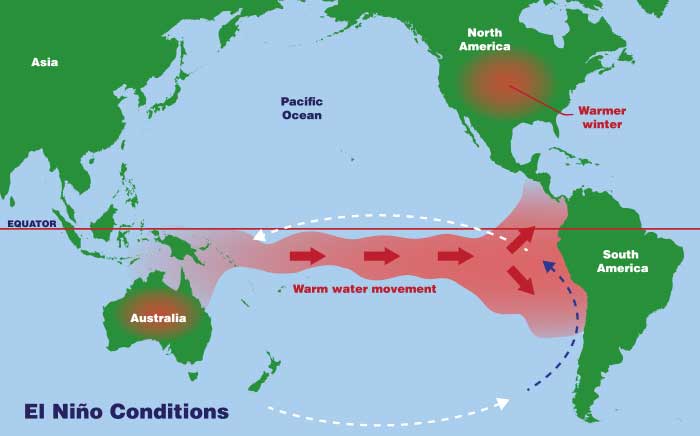
LMAO allow me to draw your attention to a map produced by NASA:
http://scijinks.jpl.nasa.gov/r...
see the red glow over North America labelled "Warmer Winter"?
You can read the full article here: http://scijinks.jpl.nasa.gov/e... -
Re:I'm not complaining.
LMAO allow me to draw your attention to a map produced by NASA:
http://scijinks.jpl.nasa.gov/r...
see the red glow over North America labelled "Warmer Winter"?
You can read the full article here: http://scijinks.jpl.nasa.gov/e... -
Re:On Average Our Planet Has Been Much Warmer
Yes, Mann is one of the authors of that paper. Do you have better evidence, from better proxies, that contradicts it? The MWP event was indeed global in impact, but none of your links show that it was warmer than today, averaged globally.
Of your cited links, the first two are for the same paper, which notes glacial fluctations globally at that time, advancing and retreating, but does not address global average temperatures in any way.
The third link (second paper) actually says ocean temperatures have been cooling for 10,000 years, but reversed this trend 150 years ago. And specifically it says MWP ocean temperatures matched those ~60 years ago (i.e. cooler than today):
[Indo-Pacific temperatures] are within error of modern (~1950 CE) values between 900 and 1200 CE during the Medieval Warm Period (MWP) and are colder by 0.75 +/- 0.35C between 1550 and 1850 CE during the Little Ice Age (LIA), followed by nonmonotonic warming in the past 150 years
The final link is to a bunch of extrapolation and speculation, but the cited paper examines southern South America temperatures specifically, and while the paper finds some relatively warm temperatures there (compared to 1901–1995 averaged temperatures, not today's) it makes no claims about global temperatures, and certainly doesn't claim that they were higher than today. Like many "skeptical" sites the link confuses "current warm period" with "the last few years", yet you'll find nearly all papers define that baseline as the average of 20th century temperatures; around 0.5 degrees C cooler than today's temperatures.
-
Re:tops down, bottoms up!
No the advantage of bottom up measurement is the rent-seekers can "adjust the data" to fit their preconceived prejudices, besides we have a perfectly good means of measuring from the top down, it's a satellite called OCO-2, Orbital Carbon Observatory"USE IF OBSERVING: Sources and sinks of CO2 with high precision and resolution" and the data is Publically Available; it just doesn't agree with what the redistributionists want to see.
-
Re:tops down, bottoms up!
No the advantage of bottom up measurement is the rent-seekers can "adjust the data" to fit their preconceived prejudices, besides we have a perfectly good means of measuring from the top down, it's a satellite called OCO-2, Orbital Carbon Observatory"USE IF OBSERVING: Sources and sinks of CO2 with high precision and resolution" and the data is Publically Available; it just doesn't agree with what the redistributionists want to see.
-
Re:Luckey is a Lackey
Don't son me, when I started in simulation (before this fancy VR) this was still considered high technology. You can do as much pixel trickery as you like you're still pushing a lot of pixels at a high refresh rate. Obviously we still have the issue of motion sickness but research from current batch of front-runners is showing that higher refresh rates can alleviate effects over lower more standard rates. If you seriously think the only differences between your TNT2 and modern graphics used in today's VR are panels built into a visor and a motion tracker then go back to your neck-breaking ceiling-mounted CRT helmet crap that can barely achieve standard-VGA. Resolution matters and pumping out pixels is expensive.
Now get off my lawn. -
A better story
Here is a site reporting this story which is (1) NOT a disgusting malvertising tool like Forbes, and (2) a little closer to the source.
-
Re:Who gives a shit?
Look at this list of NASA spinoff technologies that we use right here on Earth, EVERY SINGLE DAY:
And shut the fuck up.
-
Re:Who gives a shit?
Was the brother confined within a control space, so everything aside from microgravity and speed were the same?
Instead of being a pedantic douchenozzle why don't you go and read up on the NASA Twins Study itself and then come back here and report on everything that NASA did wrong?
-
Expansion distorted by local clumping
Unfortunately for this claim, there's a fascinating "clumping" effect as larger gas clouds collect, forming supernova capable stars within the cloud, and then causing a cascade of stellar formation when the first supernovae explode. The result is that local concentrqtions are disrupted into new, more stqable, more evenly populated states. The supernovae act much like "backfires" in stellar formation by triggering early formaton, which partially exhausts the resources of the cloud.
The result is a surprising normalization of stellar clusters and of the availability of heavier isotopes in these clusters. The phenomenon is described at http://www.nasa.gov/mission_pa....
-
Re:NASA
Huh? What's with all the rude ACs on Slashdot this morning? The news isn't fake at all. In fact, here's the NASA article about it: http://www.nasa.gov/feature/goddard/2016/nasa-s-ibex-observations-pin-down-interstellar-magnetic-field
By the way, this is definitely very interesting. The conditions in our galactic neighborhood likely can have effects on Earth. The Solar System is passing through a dust cloud and there are denser clouds its path. That has an impact on the Sun's magnetic field and can cause it to shrink. One result of this would be more cosmic rays possibly reaching the Earth. Understanding the heliosphere definitely matters and is worth posting. And here's an article about the topic I just mentioned: http://science.nasa.gov/science-news/science-at-nasa/2009/23dec_voyager/
I've always wondered, do people who post this stuff have accounts on here where they act civil and behave? Do they act like this in real life? The criticism of the article is completely unwarranted and is quite rude.
-
Re:NASA
Huh? What's with all the rude ACs on Slashdot this morning? The news isn't fake at all. In fact, here's the NASA article about it: http://www.nasa.gov/feature/goddard/2016/nasa-s-ibex-observations-pin-down-interstellar-magnetic-field
By the way, this is definitely very interesting. The conditions in our galactic neighborhood likely can have effects on Earth. The Solar System is passing through a dust cloud and there are denser clouds its path. That has an impact on the Sun's magnetic field and can cause it to shrink. One result of this would be more cosmic rays possibly reaching the Earth. Understanding the heliosphere definitely matters and is worth posting. And here's an article about the topic I just mentioned: http://science.nasa.gov/science-news/science-at-nasa/2009/23dec_voyager/
I've always wondered, do people who post this stuff have accounts on here where they act civil and behave? Do they act like this in real life? The criticism of the article is completely unwarranted and is quite rude.
-
NASA Data Manipulation
-
Re:When the satellites show that...
When the satellites show that the sea level isn't rising
I doubt that will happen, because we already have evidence that it is rising.