Slashdot Mirror
Domain: nasa.gov
Stories and comments across the archive that link to nasa.gov.
Comments · 16,365
-
Re:Alternative Generator
there are lots of people working on ALS (advanced life support), including me
-
It looks like they had some 4-wheelin' fun
on the way up that dune, not to mention. Remember, if you're not having fun, it's not worth doing. Time to sit back and have a few beers and figure out what to do next.
http://origin.mars5.jpl.nasa.gov/gallery/press/opp ortunity/20050506b.html -
Re:There's competition?
How about the ISS's boxes falling out of windows?
-
Re:I need to find a new primary news source.
Sign up to the Spaceweather list at http://science.nasa.gov/news/subscribe.asp?checke
d =sw -
This could be as bad as
the 'perfect space storm' of 1859.
http://science.nasa.gov/headlines/y2003/23oct_supe rstorm.htm -
Re:Tires worn out
I think they're just filled with dirt, as can be seen in the test article here.
-
Re:I just don't understand.
Engineering model...
http://marsrovers.jpl.nasa.gov/gallery/press/oppor tunity/20050506a/DSC_0037_PIA07986-A476R1_br.jpg
Thats one hell of an RC car... -
Tires worn out
A victim of its own success. Check those treads:
Old and Busted
The once new hotness -
Tires worn out
A victim of its own success. Check those treads:
Old and Busted
The once new hotness -
It Ran Over E.T.!!!
You can see the head right in the center of this picture, with the head facing up and eyes closed. This story about being "stuck" must be just a cover-up so no one is accused of being a hit-and-run driver.
-
Article Correction
The drive that you are seeing in these images that supposedly did not get the rover out of the dune is in reality a short test drive performed on Sol 463. The response from the rover was roughly what was expected by the MER engineers as you can read on the JPL site.
Considering that the wheels spun the equivalent of a 60 meter drive when they got stuck in the first place. (according to Dr. Albert Haldemann, Deputy Project Scientist for MER) they anticipate a fair amount of driving/spinning to get out. Also obviously if thier testing at JPL was wrong they did not want to worsen the situation to the point of no return on thier first try. -
JPL Status report
Opportunity didn't move for two weeks because JPL is being properly conservative and haven't tried until they understood the situation. The first small movement command was given on May 14, and Opportunity moved about the way they expected.
http://marsrovers.jpl.nasa.gov/mission/status_oppo rtunityAll.html#sol464 -
Just a test
According to JPL's site the latest move was not an attempt to *free* the rover.
"Opportunity rotated its wheels on sol 463 for the first time since the rover dug itself into a sand dune more than two weeks earlier. The wheels made about two and a half rotations, as commanded, and the results were a good match for what was expected from tests on Earth. In the loose footing, the rover advanced 2.8 centimeters (1.1 inch) forward, 4.8 millimeters (0.19 inch) sideways and 4.6 millimeters (0.18 inch) downward. After further analysis of the results, the rover team will decide whether to repeat the same careful movement again on sol 465." -
Re:Far Stringtopia
I am waaaay out of my depth, but it seems that natural lasers are pretty common.
And apparently there is an observed nebula colder than the microwave background.
And I mean that nebula is really really big, so maybe just the distibution of temperatures within it would allow for the possibility of really cold regions.
Basically my argument is against your putting "naturally" in quotes. My thesis here is that there is nothing we can do which isnt reproduced by purely unintelligent processes. All we can do is organize things and tidy them up a bit to get useful work out of them. -
Re:From TFA...
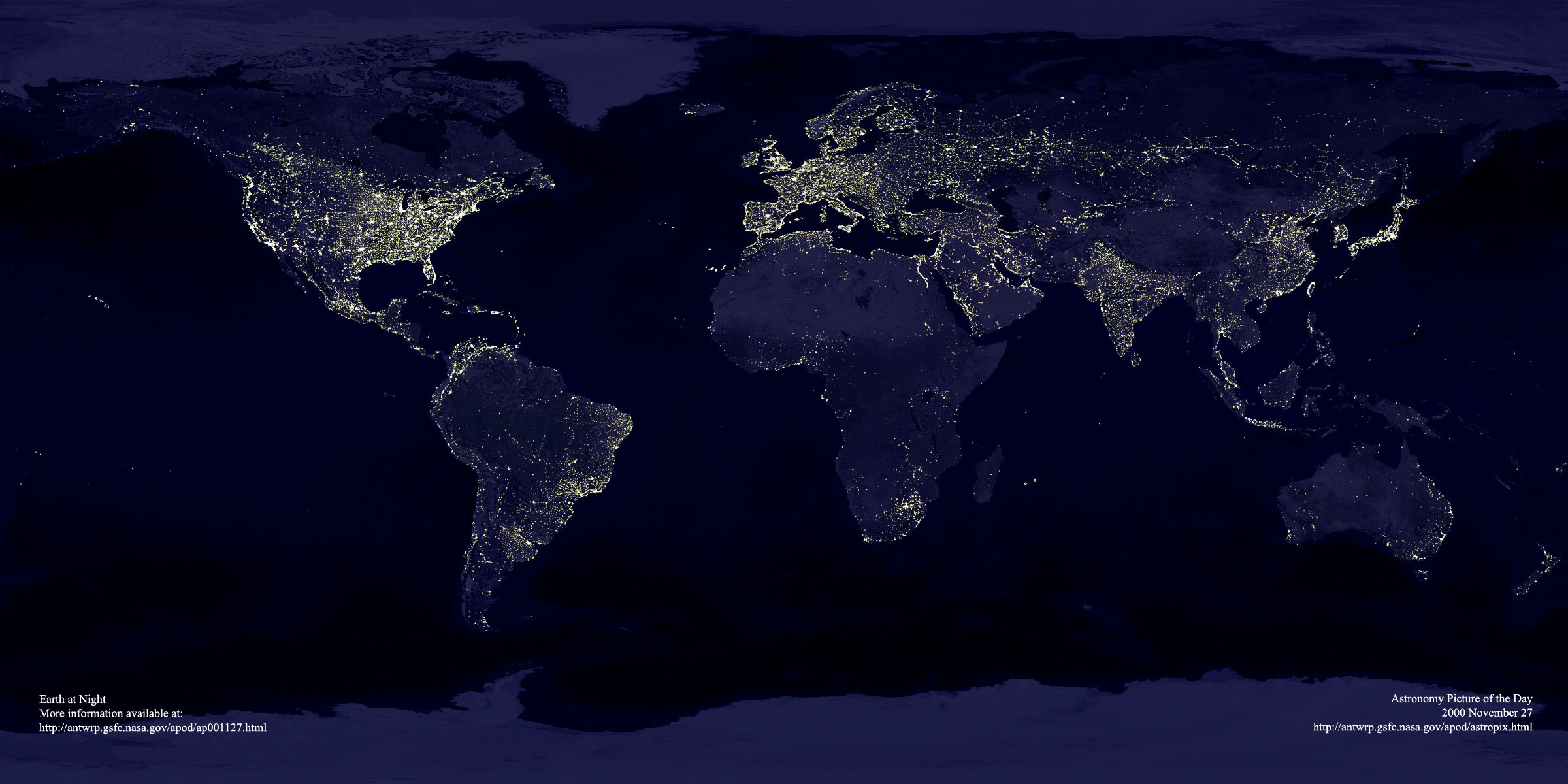
I'd just like to point out that Poland (and Germany, and plenty of others) are NOT in the western hemisphere.
Map -
Re:Short Summary
It violates the laws of physics and is for entertainment value only.
So things like ion drives ( http://www.grc.nasa.gov/WWW/RT2001/5000/5430sovey. html ) and fusion reactors( http://en.wikipedia.org/wiki/Tokamak ). violate the laws of physics? I admit that Lucas wasn't concerned with scientific accuracy. However, he at least made the technology seem plausible. -
thanks
I was just going to post the same question. Image here, for the curious.
-
Re:Images!
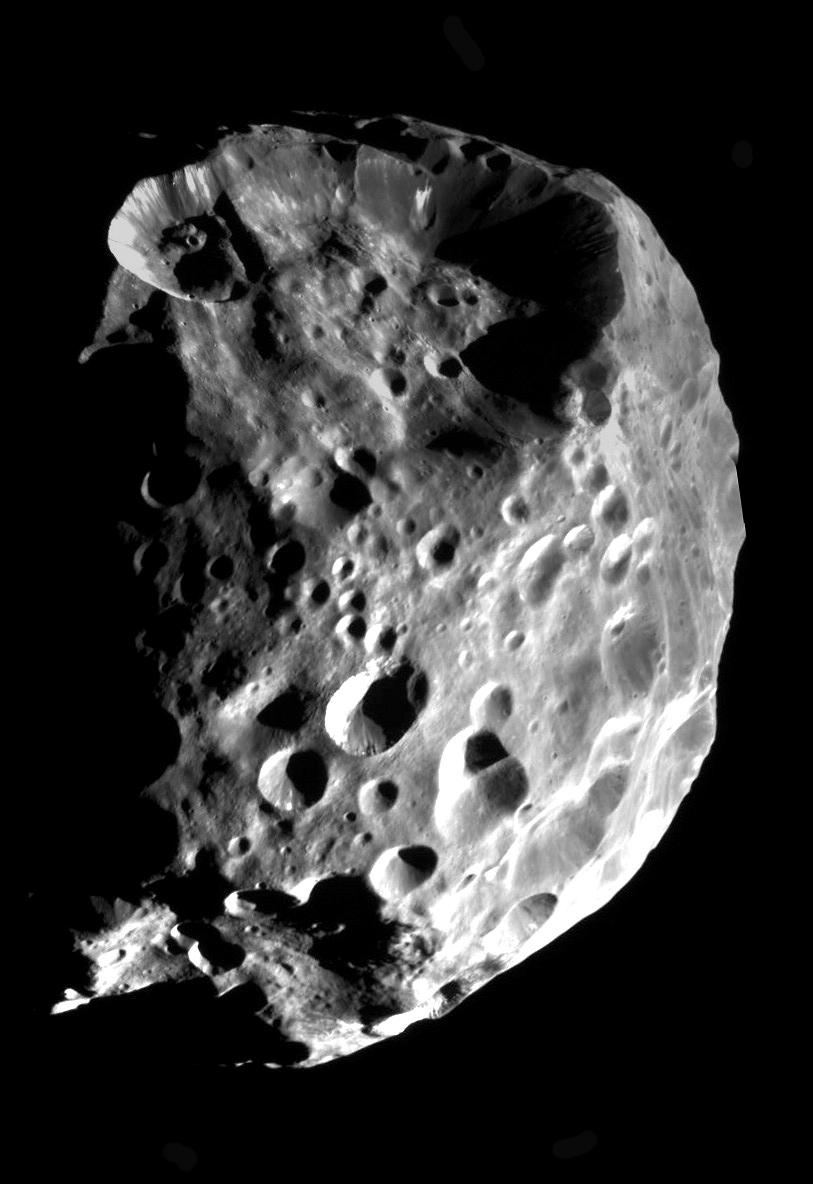
there were some great phoebe images just a little while back:
http://antwrp.gsfc.nasa.gov/apod/image/0406/phoebe 3_cassini_big.jpg -
Images!Cool images and data:
Map and Images of Titan from Hubble Space Telescope
Nasa Titan Photojournal
Saturnian Satellite Fact Sheet
Phoebe best image so far, from Voyager2 in 1981! -
Images!Cool images and data:
Map and Images of Titan from Hubble Space Telescope
Nasa Titan Photojournal
Saturnian Satellite Fact Sheet
Phoebe best image so far, from Voyager2 in 1981! -
Re:"Name That Moon" Contest
goatse
I'm sorry. We can't name it Goatse. I think that award should be reserved for the Goatse Stellar Nursery (A.K.A. NGC 604).
You can't tell me that doesn't look like goatse. I swear! It does! -
Re:Flying the MoonBus
Not to mention the sillyness of "mining water on the moon". Teh moon doesn't have water, it has some rock that's not completely anhydrous. It would take more energy to extract that water than to launch it from Earth.
Actually there is evidence that there is water ice in dark crevices and craters that are permanently dark near the north and south poles of the Moon. It's quite possible that the water trapped in these locations is enough to make it much easier to colonize space.
Look at http://nssdc.gsfc.nasa.gov/planetary/ice/ice_moon
. html -
WRONG!!!
Unless you know of an environmentally cleaner way to get enough power to put "clean coal" out of business than a solar power satellite network.
-
Slowwww
you've gotta be careful with them nasa guys advertisements... Remember not so long ago they loudly claimed the discovery of pure quark stars which got prime time on NASA TV and then the story slowly died... Is there a funding deadline coming up sometime soon? Let's wait a month or two and see whatever comes out of it in peer reviewed places.
-
Re:The Blind Watchmaker -- great book on this subj
The latest on this subject was recently discussed at JPL's Life Detection Seminar. Sorry for being lazy but streaming videos of the presentations can be found somewhere on here: http://www.jpl.nasa.gov/multimedia/ Unfortunately it's still all "extremely hand wavey". The speakers even went so far as to point out the large problems in each others hypotheses, almost to the point of declaring them invalid. So in summarization the Seminar has been mostly a wash, with not much progress made in my estimation. Here is one person's notes on the third speaker: [QUOTE]Dr. Pascale Ehrenfreund leads a team of astrobiologists at Leiden University in the Netherlands. In the third presentation in a "Life Detection" seminar series at the Jet Propulsion Laboratory, Dr. Ehrenfreund, who described herself as an experimentalist rather than a theorist, first put astrobiology into the larger context cosmology and astrophysics. Her specialty is complex molecules in space. Prebiotic molecules either had to be formed in situ on the early earth, or be delivered via comets, asteroids, or interstellar dust. She listed 137 molecules that have been identified in space (see Astrochemistry.net), including a number of complex carbon compounds such as polycyclic aromatic hydrocarbons (PAH). Also of interest are some 80 varieties of amino acids identified in meteorites (living things only use 22). So far, this is all chemistry, not biochemistry; but if such molecules can arrive on earth by extraterrestrial special delivery, presumably they could contribute to the "prebiotic soup," she speculated. Most of the talk consisted of typical astrobiology scenarios and the details of carbon chemistry and interstellar clouds. What really got interesting were the results of her team's own specific laboratory experiments. They put thin films of amino acids (glycine and D-alanine) into a chamber made to simulate a Martian environment, complete with the UV radiation expected at the surface. The goal was to determine, even if such molecules could form in early Martian lakes, whether they could survive long enough to contribute to prebiotic chemistry. The answer was depressing: the amino acids had a half-life of only eight hours under those conditions. They repeated the experiment ten times with the same results. "We have to implement that knowledge into models of regolith mixing," she said, "to understand what kind of results that would give, and how long amino acids can survive...." She quickly changed the subject to future Mars missions, but other problematical facts came to light during the presentation and the Q&A session following: 1. Mars: Dr. Ehrenfreund agreed that the Martian Meteorite that sparked the modern astrobiology movement did not contain signs of life. It was useful in retrospect for arousing interest in astrobiology, she said, but the consensus of scientists is that the alleged biogenic markers were produced by purely physical processes. 2. Water: The primary source of water in our oceans was probably not comets, she agreed, but outgassing or water-rich planetesimals from 2-3 AU. 3. Chirality: She agreed that polypeptides have to be 100% one-handed to function, and suggested that maybe adsorption on minerals provided the sorting of otherwise mixed-handed molecules; she conceded, however, that minerals are often heterogeneous. 4. Dilution: The concentration of amino acids in meteorites is exceedingly low; they would have been hopelessly diluted if a meteorite landed in the oceans. 5. Fellowship: She admitted that molecules delivered from space would have to collect somehow in small areas where they could "meet" one another. She suggested small basins or rock layers, but failed to explain how a rapidly-moving meteorite could protect its precious cargo, or how the molecules, once delivered, could be protected from the same UV radiation that her experiments showed were rapidly destructive. 6. Real vs. Virtual: She agreed with Benner that ribose is very unstable in all conditions, and so are phosp
-
No optical afterglow
A faint x-ray afterglow was detected, but there is currently no convincing detection of the optical afterglow.
See http://gcn.gsfc.nasa.gov/gcn3_archive.html for the latest. -
Re:Mathematics Out of the Closet
-
Re:Democratization of tech
Never is a very long time. Think head-mounted stereo-vision high-resolution displays (perhaps with head-movement sensors), voice-command (using something like the sub-vocalization technologies NASA is working on), data gloves, projected (or virtual) keyboard, all run from a tiny device smaller than an iPod shuffle or USB flash drive, with terabytes of storage, gigabits/sec of wireless bandwidth, and processing power that makes today's supercomputer clusters seem slow. "Enhanced reality" will be the norm. Expect this in the next 20 years, not "never".
Meanwhile, expect a single "home server" setup that takes care of communication, entertainment, environment, and security in the home, as well as backup storage for your personal devices..
-
Re:not the first
Cosmos 1 will be a spacecraft.
Cosmos 1 altitude: >800 km.
International Space Station altitude: 355.7 km
It won't be interplanetary, or even to the moon, but that's never been a criterion for a spacecraft. -
Re:It will be launched while *submerged* !
> Since the Bush administratoin reduced NASA funding and
> further increased military funding, it should be
> embarassing to them, that the first test of a solar sail
> hast to come through private funding, be built in Russia
> and launched from a russian submarine.
I don't see why anyone should be embarrassed. The principle behind solar sails has been demonstrated repeatedly since the early space age. Most notably, the Echo communication reflector http://msl.jpl.nasa.gov/QuickLooks/echoQL.html from 1960 had most of the necessary properties, and underwent drastic orbit perturbations (which came as somewhat of a surprise to some involved) as the result of solar pressure. Everybody who builds anything in space pays attention to it and satellites have commonly added small reflectors and or tilted solar arrays to minimize the attitude disturbances. The effect easy to analyze to almost arbitrary accuracy.
Simply deploying a small reflector (and this experiment is a *very small* structure, of necessity) is almost trivial. That's why no one at NASA or DoD is doing it. If there was a good application for a solar sail, I doubt anyone could be convinced to even try a test flight - you'd just build the final full vehicle with *no* testing of the principle.
I'm not trying to take away from this effort, but the one and only reason that space isn't filled with solar sails already is lack of a needed application - not lack of experience!!
Brett -
Re:I don't understand
And here is NASA's Bittorent link for it.
-
Didn't NASA already do this ... better?
The SRTM mission is 90m resolution over (almost) the entire world. What's the point of this other than to show that Europe can do it too? If the difference is they can do it lots of times and show changes, what objects larger than 200m2 translate themselves more than 200m between satellite passes, and without us noticing?
-
Get Nasa WorldWind
You could download Nasa Worldwind software for free.
There are some issues with Landsat7 data, but hopefully they will get fixed soon.
Its awsome piece of software! offers 7m resolution globally and offers 1m resolution for USA.
On the other hand, ESA has always been stingy in giving access to data. It took them a while to release Titan images; as opposed to Nasa who makes them available almost instanteneously.
I guess thats the difference between the cultures! -
Re:I want my planet!
Someone else already linked up to World Wind from NASA. I had never heard of that, but I have played around with the Blue Marble stuff before (which you can get to from World Wind)
-
I don't understandThe image data for World Wind is based on a publicly-available global 30 meter resolution mosaic made from Landsat imagery. This satellite making this map is said to have 300 meter resolution. Wouldn't that make it much worse?
(BTW, I *highly* recommend checking out World Wind if you haven't seen it. It is one of the most awesome programs ever to exist, bar none.)
-
I don't understandThe image data for World Wind is based on a publicly-available global 30 meter resolution mosaic made from Landsat imagery. This satellite making this map is said to have 300 meter resolution. Wouldn't that make it much worse?
(BTW, I *highly* recommend checking out World Wind if you haven't seen it. It is one of the most awesome programs ever to exist, bar none.)
-
Re:Ummm..... ever think there's a reason?
How about the raw data?
http://www.ghcc.msfc.nasa.gov/MSU/msusci.html -
Re:Rocket Science is ... Rocket Science
1. Solids can also evaporate, but they do so at a rate about 10^40 slower than say water, so it makes no sense to say that solids flow.
2. Glass does not flow, in fact it is about a billion times less viscous than lead http://www.cmog.org/index.asp?pageId=745
http://www.glassnotes.com/WindowPanes.html
3. Hydrogen cools when heated, per the Joule-Thompson effect. Search for the second instance of "James Dewar" http://www.hq.nasa.gov/office/pao/History/SP-4404/ app-a1.htm
And yooouuurrrreeee out! -
Re:So...
There is water ice on the moon.... The moon is not on earth. http://nssdc.gsfc.nasa.gov/planetary/ice/ice_moon
. html -
Re:chinese democracy
China has come a long way toward democracy lately. You sure can't compare them to North Korea.
While this is true, "not as bad as North Korea" isn't much of an endorsement. North Korea is the most benighted country on Earth. Literally. -
Re:Bring back the Saturn rockets!it would have to be delivered in a relatively short amount of time -- hours at the very most
Don't choose asteroids that fly too fast. Earth is 7 light-seconds from the Sun, IIRC, it's plenty of distance by all standards.
Otherwise you'd be claiming that the Deep Impact mission is impossible since it has to be completed "within hours". But obviously it is possible; there are plenty of asteroids that are well studied (at least because we don't want to be hit by them), so you only need to choose the one that you can slow down as needed.
Also, with regard to speed, the asteroid does not have to stand still relative to Earth - it will fall onto the planet then. What you want is to guide it onto some orbit around the Earth, and its speed will translate into the height of the orbit. That speed will have to be considerable - several kilometers per second. So you need that speed.
Besides, Earth's own orbital speed is 30 km/s, and it can be used since asteroid is not linked into Earth's gravity yet. In other words, if your asteroid is flying at 40 km/s it can be nicely parked in an orbit just as it is.
Sorry, but a "solar sail" could never do the job, even it were possible to manufacture and erect one, say, ten million miles across.
I must go and drown myself then, since in 1950s it was absolutely obvious that nobody can or will make more than a few transistors on one silicon crystal. Before that it was ridiculous to even suggest that one can talk to someone else over large distances. Before that nobody doubted that Earth was flat.
A solar sail is perfectly doable as long as you have a plan and you know what you are doing. Sure it would be stupid to unfold one blanket and think that it will work. But you can unfold a million of them, staggered or whatever, and any single failure will be irrelevant. Open your mind.
-
Re:One or two questions related to these articles:
"[...] Every part of Shuttle gets touched before it's ready to fly again. Might as well build a new one."
Every part of a Shuttle is checked before it's ready to fly again. Parts are only replaced as necessary.
"Killed more astronauts too"
Carried more astronauts, too.
Let's see...Apollo 1, Apollo 7-17, Three Skylab missions, and Apollo/Soyuz. That's 16 missions. Three people per mission equals 48 people. 6% (ie 3) of those people died.
Shuttles--More than twice as many missions (107 vs. 48). Crew counts as low as 2 and as high as 7. 14 dead. For the same ratio, that would be 224 people. I'm pretty sure the shuttle, in it's almost-25 year history, has taken well over 224 people into orbit.
But let's try to get a vague idea how many, since I'm too lazy to go through all the missions and count up all the people. Let's say the "average" missions carried four people--I'm pretty sure if I added it up, it would be more but I'll low-ball it. Over 107 missions, that's 428 people. 14 dead is 3%--about half of Apollo.
Here's another entertaining statistic: Apollo lost three astronauts in it's lifetime--1967 to 1975. That's 2.67 astronauts per year. The Shuttle has lost 14 astronauts in a 24 year lifetime. That's 1.71 astronauts per year.
I think the Shuttle is still safer. -
Re:One or two questions related to these articles:
Oh, no doubt. The Lockheed design is far more advanced than the Big Gemini. But from the looks of this design, I'd say it captures many of the features that would have made the Big G an attractive proposition. Tack on a bit more modern technology (e.g. lifting body, non-ablative heat shielding, RCC, etc.) and you've got yourself a winner.
At least, that is, I *hope* they haven't screwed up the design. For example, the Big G used a Parawing for mid-air descent and landing control. The Parawing gave the Big G all the advantages of the Shuttle's landing capabilities without the massive wingspan and dangerous landing velocity. The article merely describes the Lockheed system as "a parachute". Given their flight profile, however, I have a hard time believing that they wouldn't use a parawing. -
Re:One or two questions related to these articles:
-
Re:One or two questions related to these articles:
-
Re:X-33!?!? VentureStar!?!?
Or go back to the MacDonell Douglas Delta Clipper. it actually had a prototype that flew. Easily fixed by the looks of it.
-
Re:One or two questions related to these articles:
Now that I've been corrected (At the size being 38% less than Earth's, which I will admit, unashamedly) I can understand how gravity would be affected.
Not to pick nits, but you still got it wrong. It's not that Mars' gravity is 38% less than Earth's. It's that Mars' gravity is 38% of Earth's gravity. In other words, Mars' surface gravity is 62% lower than that of Earth.
Just to be clear: if you weigh 100 pounds on Earth, you'd weigh 37.7 pounds on Mars. (There's a spiffy calculator on a JPL/NASA web site.)
Furthermore, it's not the size of a planet that accounts for its gravity; it's the mass. Mars is less dense than Earth and it is physically smaller; the combination explains the significantly lower mass. (OK, gravitational force does diminish as the inverse of the square of the distance between your center of mass and the planet's, so the diameter of the planet does factor into the gravitational equation. Still, the dominant term here is mass when you're talking about a person or other object sitting on the planet's surface.)
And no, after ten minutes of looking thru the entire astronomy section of the book, Canals are not mentioned. Maybe this is why the US population (Republicans, Democrats, and morons alike) are getting dumber and dumber each year? Education thru misinformation?
Um, he was being facetious. There are no canals on Mars. The idea that Mars had canals originated with an Italian astronomer who used an optical telescope to view Mars, and spoke of "canali" (channels) which he sketched in his notebooks. This word was mistranslated as "canals," which implies an artificial origin.
So basically, the person to whom you are responding was making a jest about the quality of your textbook. Presumably, a textbook mentioning canals on Mars is either antiquated or badly written, since the existence of canals on Mars has been disproven. -
t/Space still in the competition?
NASA will choose this vehicle scematic or opt for the yet-released Northrop Grumman design in 2008.
Another company competing for NASA's contract to build the CEV is t/Space, which includes a number of notable members of the commercial spaceflight community, such as Burt Rutan, Elon Musk, Gary Hudson, and others. Their approach is expectedly much more market-oriented than Lockheed or Northrop-Grumman's, with the goal of constructing a self-sustaining commercial space infrastructure (like we have for aviation).
For the curious, midterm and final reports from the various competitors to NASA on their space exploration designs are available here. T/Space's midterm report is a particularly insightful read, detailing their plan for how commercial ventures and NASA can best cooperate to foster our access to space.
However, from the wiki article: "Some news reports in mid-March 2005, stemming from an interview with New Scientist, have reported that t/Space intends to withdraw from the competition, citing a high paperwork burden; however, no announcement of a withdrawal has yet been made by t/Space."
Personally, I really hope they're still in the running. -
t/Space still in the competition?
NASA will choose this vehicle scematic or opt for the yet-released Northrop Grumman design in 2008.
Another company competing for NASA's contract to build the CEV is t/Space, which includes a number of notable members of the commercial spaceflight community, such as Burt Rutan, Elon Musk, Gary Hudson, and others. Their approach is expectedly much more market-oriented than Lockheed or Northrop-Grumman's, with the goal of constructing a self-sustaining commercial space infrastructure (like we have for aviation).
For the curious, midterm and final reports from the various competitors to NASA on their space exploration designs are available here. T/Space's midterm report is a particularly insightful read, detailing their plan for how commercial ventures and NASA can best cooperate to foster our access to space.
However, from the wiki article: "Some news reports in mid-March 2005, stemming from an interview with New Scientist, have reported that t/Space intends to withdraw from the competition, citing a high paperwork burden; however, no announcement of a withdrawal has yet been made by t/Space."
Personally, I really hope they're still in the running. -
NASA has always been a separate civilian agency:
Further, NASA was a part of the United States Air Force at the time, not a separate entity with its own (very limited ) budget.
Erm, what?!?
NASA has always been a separate, civilian agency. It grew out of the old National Advisory Committee for Aeronautics (NACA), itself a civilian organization.
The Air Force did have its own space program during the late 1950s and early 1960s (around the same time as the creation of NASA), which centered around the X-20 Dyna-Soar and the Manned Orbiting Laboratory. The USAF even built an astronaut school at Edwards Air Force Base, and Chuck Yeager was the commandant. However, that whole program lost steam in the mid 1960s and was abandoned by 1969. This led the USAF to send its best remaining astronaut pilots to NASA, and convert the school into a test pilot school.
Even so, many of the most famous astronauts from the Apollo days were not USAF pilots. Neil Armstrong was a civilian (he worked for NACA in the X-15 program), and Buzz Aldrin, Jim Lovell and Alan Shepard were US Navy pilots.
The difference between then and now, in terms of budgets is this: First, the entire nation was deathly afraid of the Red Menace and national pride was on the line (nobody wanted go to sleep by the light of a Commie moon); Second, a very charismatic US President had staked his legacy on the US getting to the moon before the end of the 1960s (this at a time when the US had only put one man in space, and briefly, at that) before being assassinated and leaving the entire nation in shock.
Congress voted big dollars to the space program because it helped fight the blasted Commies, and because Lyndon Johnson, among others, helped spread the pork to important states (California, Texas, Missouri, New York, Florida, etc.). It also helped the nation pay its final respects to JFK. By the early 1970s, however, Americans began to question the investment in the space program, regularly saying things such as, "I don't think it makes sense to spend so much money to send people to the moon when we have so many problems here on Earth that we need to deal with first, such as hunger, pollution, disease, poverty, etc."
You made some valid points in the rest of your piece, but your glaring fallacy about NASA's status kind of undermines your credibility, don'tcha think?