Slashdot Mirror
Domain: nasa.gov
Stories and comments across the archive that link to nasa.gov.
Comments · 16,365
-
NASA's impact risk summary
The following NASA page contains an impact risk summary of several near-earth object:
http://neo.jpl.nasa.gov/risk/
Note that this one is in the top three, but with due respect to Douglas Adams, "Don't Panic" appears to be in order. -
Re:Keeping them up longerI'm guessing this "proprietary lifting gas technology" is almost certainly a pressurised envelope.
Traditionally, stratospheric balloon gas is at the same pressure as the surrounding air - the balloons are too lightweight to withstand any real pressure difference. When the helium expands during the day, some must be vented to stop the balloon from bursting. At night, ballast must be dropped to stop the balloon from falling. Thus the balloon can only stay up for a limited number of day/night cycles.
If you use a stronger envelope, the envelope can withstand the daytime pressure buildup. And if the helium is pressurised, you have extra gas to make up for the inevitable slow leakage. It is the only way to keep something up for 18 months.
As for this proprietary nonsense... well NASA have been working on the Ultra Long Duration Balloon for a while. But even that only stays up for 100 days. I wonder how they plan to keep one of those airships up for five times as long?
-
Re:a...hem, lemBut in the documentation, it's always written as LM.
That nay be true for program documentation but NASA has traditionally called it the LEM as noted in this 1999 NASA press release.
Sigs? We dont need no steenking sigs!
-
World Wind
I can't believe this link has been modded down elsewhere!
NASA World Wind
It's a not only a great viewer for satellite images but uses a 3D card to combine it with DEM (digital elevation model) data, kind of like keyhole. Once you've zoomed in (both mouse buttons), use the right mouse button to change the angle and voila! And then, when finally bored of that, check out all the other good data/images like MODIS (fire/flood etc), tsunami, night earth etc with the WMS and Science buttons. -
Mod Parent up
This is a complex issue. The Kurs system was developed and manufactured in Ukraine. After the breakup of the Soviet Union, Ukraine was free to charge whatever they wanted for the system. Toru was designed (in Russia) as a manual backup system. KURS being primary and automatic. Ukraine inherited the intellectual property of the Kurs system and Russia could not just copy it, they had to license it or buy it from Ukraine. To put this in context, the former Soviet Union was going thru an economic meltdown. So they have little money to develop a new system or license the old Kurs system, or even buy them from Ukraine, which is having its own economic problems, and probably couldn't produce them on a timely basis as well. There is no simple answer for this, and it wasn't because the russians were cheap, they just had no money. Computers are made up of a lot of components, and if your suppliers are unable to supply parts, you cannot make the computers. The broken Soviet Union was an economic mess. Think of what would happen if the US broke up in to 50 independent states. What a clusterfuck that could be (or maybe will be). This link for more on the crash: http://human-factors.arc.nasa.gov/ihh/spatial/pap
e rs/pdfs_se/Ellis_2000_collision_in_space.html/ -
Re:Lessons learned?According to "Automated Rendezvous and Docking of Spacecraft" by Wigbert Fehse, the russian automated docking system, "Kurs," is "designed to provide all required navigation measurements during the entire approach from a few hundreds of kilometers down to contact." In other words, it does not require ground or space support to dock. This is also confirmed on:
http://www.nasa.gov/missions/science/dart_into_sp
a ce.htmlAs mentioned in other posts, the russians also developed a manual joystick/video docking system, "Toru," which can be used to dock instead of Kurs if desired. This is the system which caused the problem on MIR, not Kurs.
The russian system has active RF components on both the target and chase spacecraft which are used throughout the automated docking sequence.
The american system uses GPS instead of the RF beacons on the target for the initial approach. However, GPS is also RF based, so to my mind, that is not a huge difference... you could say the difference is that one provides absolute position information whereas the other provides relative information.
For the final approach (within 300m) the american system utilizes visual tracking of passive reflectors on the target to achieve docking. This is the primary difference between the two systems (the russians continue to use RF on final approach).
The potential benefits of the american approach are reduced weight and system complexity on the target. Whether this can achieve the same reliability as the russian system is of course unknown at present.
-
Re:I love GovtSpeak...The Progress ships are automated, but are very closely monitored on final station approach. An astronaut or ground control can take over the operation at the first sign of trouble. Linky. The station is also a very big target. The point of DART was to demonstrate automated rendezvous capability with a much smaller target. That it got within 300 feet is pretty darn good, IMHO.
I know very little about the mission, but I'll take a wild guess here, the navigational systems probably need refining. It sounds to me like it ran itself out of fuel getting itself oriented properly with the target satellite. You can only take so much with you.
-
Re:Country size matters
"Every time the topic of poor broadband availability in the US comes up, this fallacy is repeated."
And every time someone like you posts the "But we have connectivity X-thousand kms away from anything!" I have to say "Look at the picture!"
Canadians clump around cities. Period. It can't be compared to the contiguous 48, especially the US Midwest or South. Thanks to that, you only need to run a few long-distance legs to a major hub and then only worry about those tiny little hops from hub to end-user.
The reason you're connected even though you're a 5-hour drive from anywhere is because you're alone out there. All that was needed was that single long leg out to your community and the job was done.
You say that you're 5 hours away from a city with over 50,000 people in it. OK, how many towns of 5000 people are within 2.5 hours of you?
At this point I'm not an apologist to our broken method of running out public utilities here in the US, but I don't see how you can deny the lower per-capita cost to connect people in Canada. -
Re:Interesting, yet...
Try NASA's WorldWind.
I can see the pyramids quite clearly with it, and the interface is more fun to use than Google Maps. -
Re:Interesting, yet...
Maybe you'll like this:
http://worldwind.arc.nasa.gov/ -
Most popular thing people use World Wind forMost common use we have found for people that use World Wind. "Hey! Look I found ___________!" Even have a hotspots website setup at Worldwindcentral.com
What makes it nice using World Wind is that it is starting to bring together a few different sources of data into one interface.
Now.. if we can just get Europe to forget about their pocketbooks and open up some imagery for free use...
-
Re:Evolution, Not Revolution
A Microsoft Windows user is besieged. And I mean not just with spyware and worms, but also with Windows Updates. They're doing the same thing as Apple's updates (make no mistake--both companies are giving you bug fixes), but there are so many updates for this mysterious vulnerability or that compromise that a typical home user is overwhelmed by not only by the OS prompting them to the point of annoyance that you have new Windows Updates as well as the number of patches and attacks.
Oh yes, that same Game box I have at home. I hadn't used it since some time before Christmas, but I brought it up recently to try out NASA World Wind and before I could run it I needed to install 39 "critical security updates" and two updates to -
Re:Hello Slashdot reader, I am Ignignot & this
Actually, they still do.
-
Re:No problem
This is not entirely true. Read this from NASA's website
-
Re:In Soviet Russia...
And at the NASA website, lasers freeze atoms: here
-
What about Earth-moonbase LOS?
Wouldn't putting a moonbase so close to the Moon's limb will cause line of sight communication problems during parts of the month due to lunar libration?
Possible solutions:
1) very tall antenna
2) relay satellite
-
Re:Defining light?
-
NASA budget
In an attempt to promote something resembling intelligent discussion, here's a link to official information on NASA's budget.
In particular, I'd like to point out the $4.5 billion devoted solely to the Space Shuttle for FY2005, and the $1.6 billion devoted to the International Space Station. -
Re:Hubble, Hubble, Toil and Trouble
I agree with the principle that we should keep Hubble until there is an alternative, but that alternative is not decades away. As someone posted above, JWST is just around the corner, slated to launch in six years.
-
Hubble Telescope replacement
There is a telescope on the drawing board that is ment to be a replacement for Hubble, but it has not even been considered by NASA. it is called the HOP telescope, and would be able to perform many of the same functions as Hubble, but it would be much more sensitive, and it would also be more efficient and easier to maintain.
Not to mention, the upcoming James Webb Telescope will be able to see much farther then Hubble when it comes to the infrared spectrum. But it isn't going to even launch until 2011.
-
Wrong question
I think your question, is Hubble obsolete, is the wrong question to ask.
Hubble IS obsolete. And will be replaced by the http://www.jwst.nasa.gov/JWST. But the JWST won't launch until August, 2011.
Hubble will die soon. So what are scientists to do from 2006 until August 2011? Although we have many world class telescopes on earth, all of them have to contend with the atmosphere, plus earth's orbit - its rotation around the sun affect which part of our sky is visible at night, and because of this annoying thing called "day", those telescopes can only be used at night, which further restrict which part of the universe can be viewed at any given moment.
I'm not insulting earth-based telescopes, but I do believe we need to keep Hubble functioning until the JWST is ready. For safety, Hubble should operate a few months after the JWST is launched, just in case the JWST has flaws that are only discovered after launch... remember Hubble's mirror flaw which required an additional flight to fix? -
Eta Carinae Could Do it Any Time Now...Can you say Eta Carinae? I knew you could. The link shows the supermassive unstable star Eta Carinae, just one of millions of unstable stars in the universe which may go supernova at any time (Eta Carinae may go soon, probably within a half million years). Trouble is that it's a relatively close 7,500 - 10,000 light years away in OUR galaxy. If it blows, it could end up sterilizing the neighborhood, including our planet.
Also see http://www.seds.org/messier/xtra/ngc/etacar.html. There is a lot of weird stuff in the universe, some of it relatively close to us. Our galaxy is about 250,000 LY in diameter, the nearest neighbor galaxy about 2.5 million LY away.) Of course, with our relatively puny lifespans of 80 or so years, we miss most of what's going on around us, and don't pay enough attention to recorded astronomical and geological events to realize that our assumptions about what is normal are completely unfounded. Ignorance is bliss! Woohoo! Pass the Fritos!
-
Re:If Mohammed cannot come to the mountain...
I was at a talk by the guy who pilots the NASA jet that is designed allow astronauts to train for landing. It is a small jet that has a special control system designed to make it respond like the space shuttle (When flying like the shuttle the engines run in reverse).
He talked about the shuttle's autopilot system. He said that it doesn't use GPS and doesn't know its position precisely enough to land. It works fine at high altitudes where being off by a few meters is no big deal.
One time they turned the autopilot on as they where landing and it almost crashed the plane.
-
Re:2 week turnaround
Your facts are a little off.
NASA Shuttle Stats
All of the shuttles are designed for 100 missions each. They have only flown about a fourth of design. This is not true for Endeavor, the youngest of the shuttles, has only flown 13 missions, while Atlantis has only flown 19. Not designed to be retired a decade ago, seeing as how Endeavor's first flight was only 13 years ago. (making it a 3 year program). -
Re:Fuel
"The "saw-tooth" appearance of the altitude profile reflects the fact that due to the very large cross-section and overall low altitude of ISS, atmospheric drag causes a decrease in altitude of approximately 200 m per day. To counteract this height reduction, a periodic reboost (that occurs approximately every 10 to 45 days) of the ISS is required, which increases the altitude temporarily."
-
Re:Burt Rutan: 4 Days. NASA: 2 Years
The above poster pointed out that you're wrong with some facts and figures, but how about some pictures for comparison's sake?
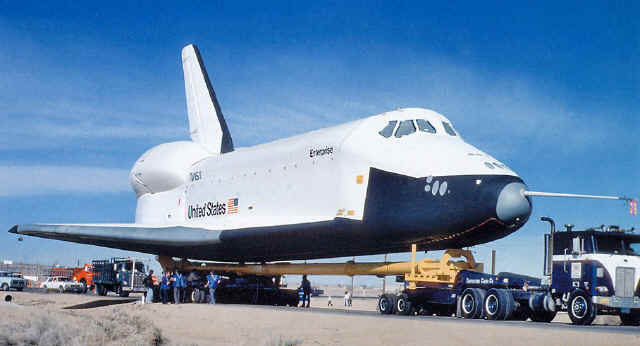
Here's the shuttle durring recovery operations. Note the relative size of the stairs, and how it dwarfs the RV, the van, and the truck near it's rear.
And here is the closest thing that I could find to an old favorite photo of mine from a wonderful book, The Illustrated History of NASA. Showing nicely how the shuttle dwarfs a Mack Truck. -
Re:Elevation
Here's the website:
http://worldwind.arc.nasa.gov/
And a torrent for the download:
http://opensource.arc.nasa.gov/torrents/metainfo.t orrent
-If -
Re:Elevation
Here's the website:
http://worldwind.arc.nasa.gov/
And a torrent for the download:
http://opensource.arc.nasa.gov/torrents/metainfo.t orrent
-If -
What happened to the X33?
I thought this was supposed to replace the Shuttle.
-
Re:Animations
In fact, after the last election I had a nifty idea to create some sort of animated map of the US showing how political affiliations have geographically shifted over the years (primarily, the North slowly turning blue and the South slowly turning red). Then I started to think about extending that to a generic web app to display and animate various demographic data. Basically, a very dumbed down and animated online GIS.
This sounds like it would be most easily done with a Worldwind Add-on! -
Re:Animations
In fact, after the last election I had a nifty idea to create some sort of animated map of the US showing how political affiliations have geographically shifted over the years (primarily, the North slowly turning blue and the South slowly turning red). Then I started to think about extending that to a generic web app to display and animate various demographic data. Basically, a very dumbed down and animated online GIS.
This sounds like it would be most easily done with a Worldwind Add-on! -
Re:We cannot deal with either caseFor certain disasters, space travel IS the way to be prepared. The previous examples of disasters that almost extincted all life on earth (80.90% of it?) are just examples, and are possible ones that just being here when they happens is not the right answer.
Of course, space colonies outside must be truly independent from earth to survive from a big disaster here, thing a bit harder than just putting some people living far from here. And maybe we are already out of time to reach that (i.e. maybe we will found another higher/riskier asteroid than the 2004MN4 within this decade/century and not sure how well prepared we can be against such things by then and that just speaking of something that we can have years to prepare)
-
Rover mission in 2011 not sample return
According to the BBC, the ESA is set to send a robotic probe to Mars around 2011. They apparently want to return samples of Martian soil with the probe...
You'd think the poster would RTA. The 2011 mission is a rover mission.
In addition to the rover project, they also reiterated their support for an existing proposal - a "Mars return" mission, sketched for 2016, in which various space powers would pool their resources to send an unmanned probe to Mars, take soil samples, and bring them back to Earth.NASA is already considering a sample return mission prior to the 2016 timeframe. I am not sure what plans there are for international collaboration. I would like to see the US work more closely with Japan.
-
Re:Blame it on Gundam
-
Re:Is this it?
NASA's New Millennium Program test-flies new technologies all the time. There have been 2 "Deep Space" missions (missions that go beyond Earth Orbit, the first one tested ion propulsion and the second failed as it was piggybacking on the Mars Polar Lander), 3 "Earth Observing" missions, testing out new technologies for Earth observations (such as new radar systems, etc.), and right now there are a few people who are working just a couple cubicles away from me who are working on Space Technology 8, testing new technologies like better and cheaper heat dispersion systems and cooling systems. And there are a few people a couple buildings away who are already working on plans for Space Technology 9.
These "new technology" programs exist, they just don't get the press coverage they probably deserve. -
The next logical step
The next logical step for Mars is sample return. According to this page NASA expects to do a sample return in 2013. I wonder if an earlier European mission will change that plan any?
-
Re:How is this different form NASA's version?
This one's using a Tuned Electromagnetic Resonator Collar (TERC) which relies on capactive changes due muscle and tissue moving about.
It is, apparently, otherwise based on the electromyographic sensor technology which NASA developed to have subvocalized speech drive a web browser: Your link, sans space char.
-
nasa article
This has more detail on the technique: http://www.nasa.gov/centers/ames/news/releases/20
0 4/subvocal/subvocal.html/ -
More on the NASA Ames research
-
NASA prizes for space elevator tech
Following is a modified version of a submission from last month, relevant to this discussion. I believe Edwards' group is planning on competing in the competition. Hopefully congress will lift the $250K prize restriction, allowing NASA to award larger prizes and truly stimulate research in this area:
MSNBC, Space.com, and Wired report that NASA, in collaboration with the non-profit Spaceward Foundation, has announced its first two Centennial Challenges. The Centennial Challenges, inspired by the Ansari X Prize and DARPA Grand Challenge, are prize contests seeking to stimulate private industry development of technologies relevant to space exploration. One contest is the Tether Challenge, for building the sort of super-strong tether needed to make a space elevator feasible. The other is the Beam Power Challenge, for creating a wirelessly-powered ribbon-climbing robot capable of lifting as large a payload as possible within a limited timeframe. The initial set of challenges in 2005 will award $50K to the winners of each contest. A second set of challenges in 2006 will award first, second, and third place prizes worth $100K, $40K, and $10K. It's hoped that these contests will further space elevator technology and help eliminate the 'giggle factor' surrounding them. Additional contests will be announced in the coming weeks, although Congress currently restricts NASA from awarding prizes of more than $250K; the agency is lobbying to try to get this limit raised to $40 million for future prizes. -
Automator is something!An Apple rep at the show gave me a demo of Automator. I wasn't really groking the potential from their little demo which undersells both the power and ease of use.
In about a minute he created a script to download all the recent Images of the Day to a new folder and created a self-running slide show and album for them from iPhoto.
The possibilities for porn surfing boggle the mind.
-
Past viewer statisticsI work for Speedera, the delivery network NASA uses for its main NASA TV live streaming link and the HTTP caching for its major web sites. So you are right that assuming bandwidth isn't going to be a problem. Its just that NASA has to pay for these services and unlike TV, the more people that watch, the more they have to pay.
For some statistics here's some press releases and my previous posting.
-
Re:How do NASA's needs compare to other high bandw
-
Re:Nice shuttle roll-out pics
This one here puzzles me... maybe it's just tricking my eyes but it looks like there's hardly any room in the cockpit for a crew of 4 or 5. Are there any shuttles on display (Smithsonian perhaps?) where visitors can sit in the real thing ?
While it does look a little bit perspective skewed, only two people sit in the cockpit proper - the pilot and commander. The rest of the crew either sits in chairs behind the cockpit on the flight deck, or in chairs on the mid-deck below.
Here's how the seating on STS-107 was arranged:
http://www-pao.ksc.nasa.gov/kscpao/shuttle/countdo wn/sts107/crewseat.htm -
Re:Nice shuttle roll-out pics
http://www-pao.ksc.nasa.gov/kscpao/images/large/0
5 pd0624.jpg This one here puzzles me... maybe it's just tricking my eyes but it looks like there's hardly any room in the cockpit for a crew of 4 or 5. Are there any shuttles on display (Smithsonian perhaps?) where visitors can sit in the real thing ? -
Re:How do NASA's needs compare to other high bandw
Corrected links:
Cassini
Mars rovers.
Sorry about that. -
Re:How do NASA's needs compare to other high bandw
Corrected links:
Cassini
Mars rovers.
Sorry about that. -
Nice shuttle roll-out pics
NASA has some nics pics of the roll-out from Wednesday. This one is my favorite, and thanks to the high resolution it makes great wallpaper.
-
Nice shuttle roll-out pics
NASA has some nics pics of the roll-out from Wednesday. This one is my favorite, and thanks to the high resolution it makes great wallpaper.
-
Re:Peter Norvig?
Besides his Google gig, he has been Division Chief of Computer Sciences at NASA
That would be the Division Chief of the Computational Sciences Division at NASA Ames Research Center.
There's a very specific reason I know this: I worked in that same division from 1994 to 1997, and when I got there, the previous division chief (also named Peter, if I recall correctly) had just left. The WHOLE TIME I worked there, we had a temporary division chief and the foot-dragging NASA management kept promising they were going to get a real new permanent division chief Real Soon Now, but they never did. So then, a year after I left, they finally actually got a permanent division chief. Which would make it four years later. (But I guess they did make a good choice when they finally selected someone...)