Slashdot Mirror
Domain: nasa.gov
Stories and comments across the archive that link to nasa.gov.
Comments · 16,365
-
Re:Tires?
I think the main impediment is the degradation of the solar panels. They generate less and less power, and eventualy there is not enough juice to run the rover.
The solar panels are getting cleaned for some reason, at least for opportunity. Anyway, Martian winter is now behind and they are heading into spring.
The Voyagers had a similar problem with their thermonuclear batteries; it got to a point where they were generating less than 100 Watts (I think), and the JPL guys were (and are) doing miracles to keep the craft functional.
The voyagers are doing just fine. Note the report date. And the output is near 300W. Maybe you confused it with Pioneer 10? -
Re:Tires?
I think the main impediment is the degradation of the solar panels. They generate less and less power, and eventualy there is not enough juice to run the rover.
The solar panels are getting cleaned for some reason, at least for opportunity. Anyway, Martian winter is now behind and they are heading into spring.
The Voyagers had a similar problem with their thermonuclear batteries; it got to a point where they were generating less than 100 Watts (I think), and the JPL guys were (and are) doing miracles to keep the craft functional.
The voyagers are doing just fine. Note the report date. And the output is near 300W. Maybe you confused it with Pioneer 10? -
Re:Always focusing on one...
I'm an allout Opportunity fan. Oppurtunity was by far the more interesting part of the mission.
First it was the one that discovered that there once was water, then it's the one that just explored it's own heatshield and of course it's the one with the most stunning panorama of a crater on mars that I have ever seen.
(Beware huge pic. Preview here)
-
Re:Always focusing on one...
I'm an allout Opportunity fan. Oppurtunity was by far the more interesting part of the mission.
First it was the one that discovered that there once was water, then it's the one that just explored it's own heatshield and of course it's the one with the most stunning panorama of a crater on mars that I have ever seen.
(Beware huge pic. Preview here)
-
Re:Stupid 6th grader. Us 7th graders know better.
In light of the original comment referring to the NASA image at: http://photojournal.jpl.nasa.gov/catalog/PIA05423 the previous comment was not a troll but a humorous comment which referred to the "Pre-School" episode of the cartoon "South Park". For an episode synopsis, see: http://www.tvtome.com/tvtome/servlet/GuidePageSer
v let/showid-344/epid-372425/. -
Here's another one
In Silicon Valley, thousands of geeks drive by the airship hangers at Moffett Field every day. They're so large, clouds sometimes form in them. But the beaches of Santa Cruz are a few miles away, so I guess there'll be no indoor resort in Sunnyvale.
-
The aliens have got a little listAnd in six months, they've going to come and look for all of you!
Deep Impact's larger flyby spacecraft will carry a smaller impactor spacecraft to Tempel 1 for release into the comet's path for a planned collision. The flyby spacecraft will take pictures as the 370-kilogram (816 pound) copper-tipped impactor plunges into Tempel 1 at about 37,000 kilometers (22,990 miles) per hour. The impactor is expected to make a spectacular, football field-sized crater, seven to 15 stories deep, in the speeding comet. Carried aboard the impactor will be a standard mini-CD containing the names of comet, space and other enthusiasts from around the world.
Hopefully they won't be too pissed off. Maybe just an alien wedgie or something? -
Re:Iapetus Ring
Run for cover, Itsa Giant Space Walnut! That means giant Space Squirrels are coming for it.
-
Re:Iapetus Ring
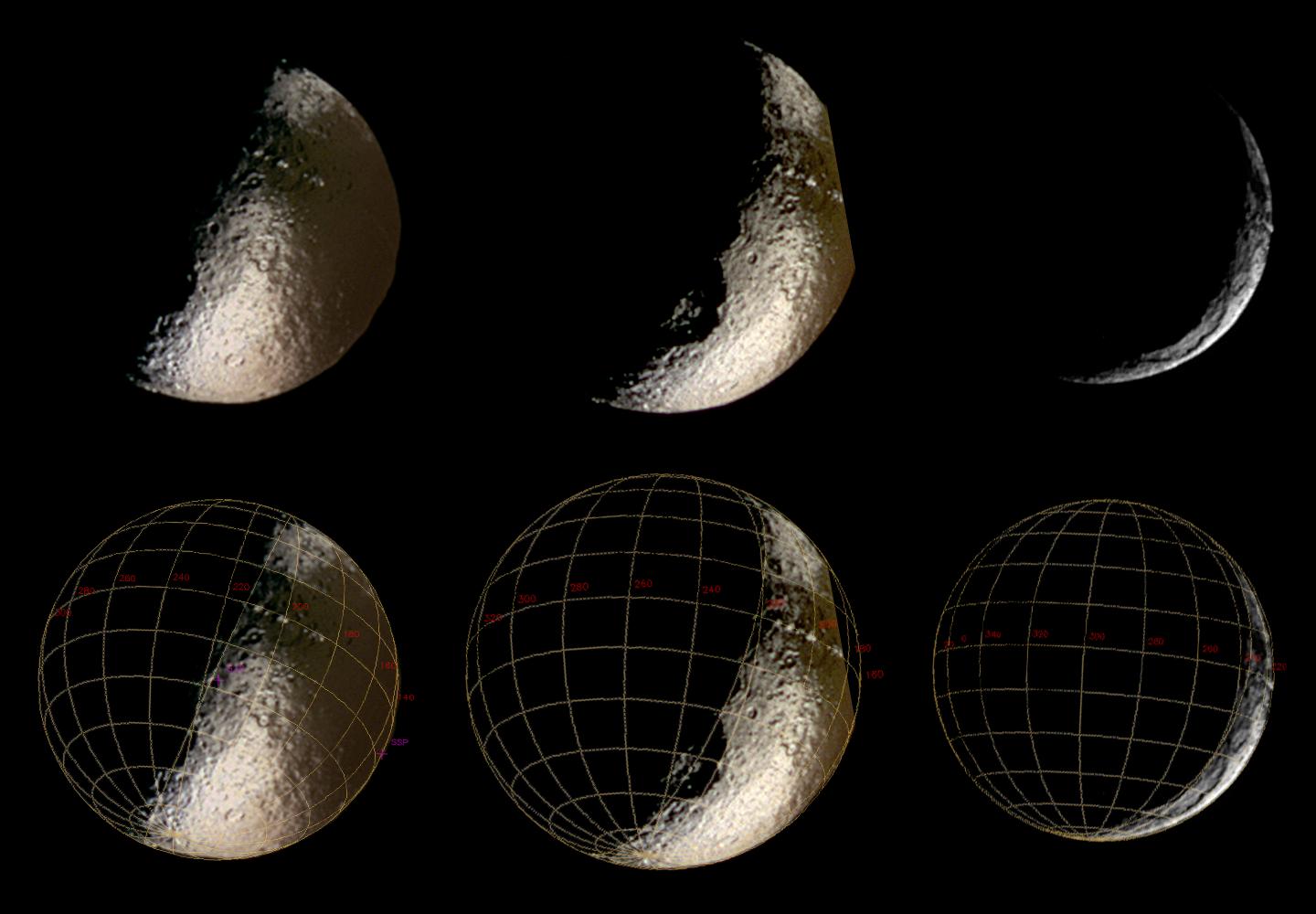
There is an interesting image of this mountain range here. It seems to suggest that the range extends beyond the dark material, tho that area is hidden in shadow. What's interesting here is that the peeks remain clean well into the 'dark zone'. So possibly whatever formed the mountain range happened before the dark material was deposited.
I'm glad someone else noticed this! -
Re: Iapetus picture
http://saturn1.jpl.nasa.gov/multimedia/images/raw
What I thought was more interesting about that picture was the streaks (mid-lower right and top middle)./ casJPGFullS07/N00026377.jpg
Are they particles that are part of Saturn's rings?
(There are also several white dots and a white streak in front of Iapetus, but I assume that they are caused by artifacts, cosmic rays, or transmission problems.) -
Re:Titan is a hippie!
And here is an actual link.
There are some interesting diffraction effects there. -
Re:If that's no space station, what is it?
Another feature I'm quite curious about is this globe-spanning ridge. I haven't seen any mention of it anywhere yet.
It seems (though I may be wrong) to sit dead-center on the darkened portion of the moon and span much of the length of the dark part as well. Is there a connection perhaps? I'd be interested in the opinions of any planetary astronomers.
-
Iapetus Ring
I've noticed in a lot of the images, there appears to be a ring of mountains around most of Iapetus's equator: Here, here and here.
I'm no scientest, but is it possible that this moon once had a ring system like Saturn itself? Over time the ring particles fell out of orbit and formed the mountains along the equator. -
Iapetus Ring
I've noticed in a lot of the images, there appears to be a ring of mountains around most of Iapetus's equator: Here, here and here.
I'm no scientest, but is it possible that this moon once had a ring system like Saturn itself? Over time the ring particles fell out of orbit and formed the mountains along the equator. -
Iapetus Ring
I've noticed in a lot of the images, there appears to be a ring of mountains around most of Iapetus's equator: Here, here and here.
I'm no scientest, but is it possible that this moon once had a ring system like Saturn itself? Over time the ring particles fell out of orbit and formed the mountains along the equator. -
Date in article wrong.
It plunges on January 14th, not 24th.
Press Release -
Black and White
Checked out the raw images - this one shows very clearly the black side of Iapetus and the white side. Very strange....
http://saturn1.jpl.nasa.gov/multimedia/images/raw/ casJPGFullS07/N00026377.jpg -
Re:the other server
on second thought, try this server instead. Seems to be moving rather faster than the now
-
Quick scan for UFO's before they edit them out!
Check This out! It looks like a streaking UFO in one of the raw images.
-
Wow!!
Yikes, everyone take a look at this one:
Amazing detail photo
Can't wait for others of this caliber!!`~ Made me weep!!
(it's a joke son)
-
There are....
....also many more images if you go straight to the raw feed.
-
Re:Cassini Hyugens
Big round thing with holes? Astronomy-related story?
Hmm.
Could this be the perfect time for...? Yes it could.
This remind you of somebody you know? -
If that's no space station, what is it?Iapetus doesn't concern me. What concerns me is Mimas, which has a clearly visible crater with a mountain inside it.
I have a hard time believing that's a natural formation. And I'm concerned that whatever did it might still be bouncing around the universe somewhere.
Anyone have any idea what could have caused a formation like that?
-
If that's no space station, what is it?Iapetus doesn't concern me. What concerns me is Mimas, which has a clearly visible crater with a mountain inside it.
I have a hard time believing that's a natural formation. And I'm concerned that whatever did it might still be bouncing around the universe somewhere.
Anyone have any idea what could have caused a formation like that?
-
Re:Map
If I may, I'd suggest these maps - a bit more detail:
http://encke.jpl.nasa.gov/charts.html
Jw -
Re:Where will it be?
Personally, when I'm hunting for this comet, I always start at Orion, it being one of the easiest constellations to recognize (just look for a straight line of 3 bright stars).
- Above and to your right of Orion (when he's standing straight up) is Taurus, of which bright orange Aldebaran is most visible.
- Keep following that line a few more degrees (I'd say about 3 fingers, your arm stretched out) and you'lle see a fuzzy 7-star cluster - that's the Peliades. Ninth of this month, the comet should be right next to it.
Here's a handy map:
http://encke.jpl.nasa.gov/charts.html
Jw -
Mars Time on your computerYou didn't even mention that they have for download a nice little program (runs on Windows, Linux, Mac OS X, and probably anything else) which will tell you the time on Mars. Or just view it in your browser window (Java required).
Mars24 is a Java program and browser applet which displays a Mars "sunclock", a graphical representation of the planet Mars showing its current sun- and nightsides, along with a numerical readout of the time in 24-hour format. Other displays include a plot showing the relative orbital positions of Mars and Earth and a diagram showing the solar angle for a given location on Mars.
Mars24 runs on many different types of computers, including Windows, Mac OS X, Linux, and more, but it requires Java 1.3.1 or better be installed on the computer. The associated MER Spirit/Opportunity Clock Applet requires only Java 1.1.8 and is compatible with many older web browsers, but it does not include the sunclock or other graphic displays of Mars24.
-
Mars Time on your computerYou didn't even mention that they have for download a nice little program (runs on Windows, Linux, Mac OS X, and probably anything else) which will tell you the time on Mars. Or just view it in your browser window (Java required).
Mars24 is a Java program and browser applet which displays a Mars "sunclock", a graphical representation of the planet Mars showing its current sun- and nightsides, along with a numerical readout of the time in 24-hour format. Other displays include a plot showing the relative orbital positions of Mars and Earth and a diagram showing the solar angle for a given location on Mars.
Mars24 runs on many different types of computers, including Windows, Mac OS X, Linux, and more, but it requires Java 1.3.1 or better be installed on the computer. The associated MER Spirit/Opportunity Clock Applet requires only Java 1.1.8 and is compatible with many older web browsers, but it does not include the sunclock or other graphic displays of Mars24.
-
Mars Time on your computerYou didn't even mention that they have for download a nice little program (runs on Windows, Linux, Mac OS X, and probably anything else) which will tell you the time on Mars. Or just view it in your browser window (Java required).
Mars24 is a Java program and browser applet which displays a Mars "sunclock", a graphical representation of the planet Mars showing its current sun- and nightsides, along with a numerical readout of the time in 24-hour format. Other displays include a plot showing the relative orbital positions of Mars and Earth and a diagram showing the solar angle for a given location on Mars.
Mars24 runs on many different types of computers, including Windows, Mac OS X, Linux, and more, but it requires Java 1.3.1 or better be installed on the computer. The associated MER Spirit/Opportunity Clock Applet requires only Java 1.1.8 and is compatible with many older web browsers, but it does not include the sunclock or other graphic displays of Mars24.
-
Web Hits
9.1 Billion web hits!
-
A new milestone.
Now lets try for a Mars Year,
322 days to go.
Interesting information on Mars Time:
http://www.giss.nasa.gov/tools/mars24/help/notes.h tml
What is time really?
It helps us sync here on Earth, but it certainly
gets crazy once we move into the great beyond.
Wonder what those Mars team members are doing for New Year?
They had to follow a different time.
Cicadian Time would certainly be muddled.
http://www.nsbri.org/Research/Projects/viewsummary -
Direct Link to Video
-
A couple more images
http://eobglossary.gsfc.nasa.gov/Newsroom/NewImag
e s/images.php3?img_id=16774Very
http://eobglossary.gsfc.nasa.gov/Newsroom/NewImage s/images.php3Devastating
If you donated to lokitorrent but not this, I don't know what to say to you... -
A couple more images
http://eobglossary.gsfc.nasa.gov/Newsroom/NewImag
e s/images.php3?img_id=16774Very
http://eobglossary.gsfc.nasa.gov/Newsroom/NewImage s/images.php3Devastating
If you donated to lokitorrent but not this, I don't know what to say to you... -
Better pictures
Here are links to pictures taken when Opportunity was standing a bit closer:
http://marsrovers.jpl.nasa.gov/gallery/all/opportu nity_n331.html http://marsrovers.jpl.nasa.gov/gallery/all/opportu nity_n332.html
I always thought that the heat shield should be a little higher on the list of priorities. Examination of how the heat shield weathered the fall would yield invaluable information that could be used to better safeguard future missions.
But that's just one layman's opinion....
-
Better pictures
Here are links to pictures taken when Opportunity was standing a bit closer:
http://marsrovers.jpl.nasa.gov/gallery/all/opportu nity_n331.html http://marsrovers.jpl.nasa.gov/gallery/all/opportu nity_n332.html
I always thought that the heat shield should be a little higher on the list of priorities. Examination of how the heat shield weathered the fall would yield invaluable information that could be used to better safeguard future missions.
But that's just one layman's opinion....
-
Re:not surprising...
Now now, if you want to get technical, the previous crew consisted of 2 Europeans and 1 American.
See here" for more information. -
Re:How about some facts
No problem, so long as you understand that I neither said nor implied the US paid for the entirety, simply that we paid for the majority of the station as currently built, and will have paid for the large majority at core-complete. I already did it once tonight, might as well just repeat the post (which, for the record, got modded 0 Flamebait.)
We are funding, if not building, nearly all of the station, even the limited core-complete version that was the plan immediately prior to Columbia's loss. The new core-complete plan, as shown here , shows launch methods. Items funded by other countries:
JEM (Japanese Experiment Module, Japan funded)
Columbus (European Research Module, EU funded)
Zvezda (Service module, Russia funded)
RRM (Russian Research Module, Russia funded if it ever launches)
This page has an accurate image showing who funded what; that exact image is hanging over the desk of one of the shuttle payload integration managers, last I knew - the guy responsible for making sure that once something is launched and attached to ISS, it works properly. Of course, looking at that image, SPP is unlikely to ever be built at this point due to lack of funding (according to the Russians), and RRM is unlikely as well (same reason), so shrink the Russian contribution considerably.
Russia funds/funded around 2 percent of ISS; the remainder comes from the US and other Western countries. Japan funds 13%. ESA funds roughly 9%. CSA funds another 2%. And guess who funds the rest? That's right. The US. Roughly 70-75%, depending on how you interpret the numbers, and what year it is. -
Re:In related news...
They are correct; we are funding, if not building, nearly all of the station, even the limited core-complete version that was the plan immediately prior to Columbia's loss. The new core-complete plan, as shown here, shows launch methods. Items funded by other countries:
JEM (Japanese Experiment Module, Japan funded)
Columbus (European Research Module, EU funded)
Zvezda (Service module, Russia funded)
RRM (Russian Research Module, Russia funded if it ever launches)
This page has an accurate image showing who funded what. Of course, SPP is unlikely to ever be built at this point (according to the Russians), and RRM is unlikely as well, so shrink the Russian contribution considerably.
Russia funds/funded around 2 percent of ISS; the remainder comes from the US and other Western countries. And guess who funds the majority of that? That's right. The US. -
Other options
The Defend Air people don't give any data I can find on the dB-vs-MHz effectiveness of their product, but plenty of competitive technologies do. I wish they did, because I want to line my laundry room with the stuff! The washing machine makes a terrible racket in my radio.
There's Hospital Quality shielding done with aluminum foil, and more serious shielding of both E and H fields for MRI machines. I won't even go into the RF-sealed doors...
If you're concerned about magnetic fields, then Mu Metal is the stuff. Just don't bend any of the Hydrogen-annealed variety. You can get sheet and tape in small quantifies from these folks, who by the way also offer "Personal Protection Devices (silver-impregnated fiber baseball caps, not tinfoil hats, please)
For sealing over the gaps, don't forget 3M 1181 Copper Tape, which features electrically-conducting adhesive, but only specifies 80dB isolation at 30MHz-1GHz.
But my favorite so far is Metal Foam, which reminds me of the almost weightless foamed glass Aerogel that was a announced a few years ago... Foamed aluminum is available commercially in 2x2ft sheets from from Austria, Alulight. They claim 40dB isolation in the 2Ghz range and over 100dB to 140dB in the 10Mhz-1GHz range, plus excellent sound isolation, structural, and fire safety properties. What's not to like? Anybody know where the get this stuff in the US? Reade seems out of my range, but I'll ask them.
-
Re:What's a "sol"?
A sol is a local solar day. On Mars, that's 24 hours, 39 minutes, 35.2 seconds. Maddeningly close to ours, but no cigar.
Here's a nice discussion of the topic, with pictures and everything.
-
Re:Interesting.> Where did these numbers come from? They are such small amounts at this scale that it's a little hard for me to believe there is empirical evidence for this. Is there or is this just theory?
Corner cube laser reflectors left by the Apollo missions can (and are) used to measure the moon's distance from the Earth with the required accuracy.
See also http://www.gsfc.nasa.gov/scienceques2002/20030425
. htm. -
Rovers can move autonomously
And even when it is on the roll, each rover doesn't move terribly fast, and often needs to navigate around terrain. Nevermind the fact that if you did want to move a long distance, you'd only be able to move a few metres, take a snapshot of your surrroundings, send them back to Earth, and await the next set of movement instructions. Both sending the snapshot and retreiving the next set of instructions takes several hours due to the distances involved, resulting in quite a bit of time spent not going anywhere.
This isn't the whole story. The rover travels in either of two modes: either directly controlled from Earth in complete detail, or instructed by Earth to move to a specific location but allowed to determine its own path (or to give up if there's no safe path). The rovers would not get very far - and certainly Spirit would not have made it the several kilometers from the landing site to the Columbia Hills - if the movement instructions had to be fully scripted from Earth since typically there's only once chance to upload instructions every Martian day.
-
Rovers can move autonomously
And even when it is on the roll, each rover doesn't move terribly fast, and often needs to navigate around terrain. Nevermind the fact that if you did want to move a long distance, you'd only be able to move a few metres, take a snapshot of your surrroundings, send them back to Earth, and await the next set of movement instructions. Both sending the snapshot and retreiving the next set of instructions takes several hours due to the distances involved, resulting in quite a bit of time spent not going anywhere.
This isn't the whole story. The rover travels in either of two modes: either directly controlled from Earth in complete detail, or instructed by Earth to move to a specific location but allowed to determine its own path (or to give up if there's no safe path). The rovers would not get very far - and certainly Spirit would not have made it the several kilometers from the landing site to the Columbia Hills - if the movement instructions had to be fully scripted from Earth since typically there's only once chance to upload instructions every Martian day.
-
Re:Sensationalist TitleCome on now, is it really good journalism to put the title "Quake Changes Earth's Rotation, Moves Islands" on this, because some dork theorizes that the quake may have accelerated the Earth's rotation, but the change would be too small to measure? Please.
Did you even read the article? Firstly, you call Dr. Gross some dork after complaining about journalistic integrity. But if you did even a slight amount of searching you'd find he's a fairly competent and influential geophysicist, being one of the main figures in solving the puzzle of Chandler's Wobble for instance.
Beyond that, that article mentions two effects he predicted due to the quake, both difficult to measure. One is the speedup of the Earth's rotation, which could be measureable after a long integrating time, or maybe not due to other factors that also accumulate.
But - the other effect he predicted is that the extra 'tilt' that may have gone into the axis of Chandler's wobble (the article doesn't explicitly say this, it might actually be nutation they're talking about but I'm not sure). Anyway, that tilt he thinks will add about an inch to the wobble 'amplitude' which is around 30 feet (how much the poles wobble).
So while these might be too small for specific measure right now, compared to the amplitudes of the factors to begin with (and averaging out the regular seasonal variations in earth's spin), they can prove to be significant for just one geological event, which occured in the blink of an eye in geological timescales.
But hey, thanks for complaining about shoddy journalism while providing your highly competent scientific and journalistic contribution to the story.
-
Re:how far away is Beagle 2?
Here's an excellent Java applet that can you can use to visually display the landing sites of various Martian probes (by default it only shows MER-A and B):
http://www.giss.nasa.gov/tools/mars24/
Bruce -
Re:What about the liquid or ice in this shot?
Its highly unlikely that its either liquid, or ice. We're seeing a smooth area of sand falling down into the crater from above. Keep in mind that although it may look flat, it is actually, quite steep
-
Re:Why not color photos ?
-
Re:Why not color photos ?
-
Re:Must have been a classic "WTF?!" moment at theTo do that you need to push the mean lifetime way beyond the warranty period.
The "90 days" was certainly something they expected - maybe even double that. But they also knew that the Martian winter was coming up and that Mars would go behind the Sun, causing Earth to lose contact with the rovers for a number of days.
I think they were really surprised both rovers made it through the Martian winter. That Opportunity is actually back up to the normal output for the solar panels is a welcome surprise.
Spirit doesn't seem to be doing nearly as well. There's problem with the lubrication of the wheels, the brakes may not be releasing - or the circuit that detects them releasing has gone bad, and the dust accumulation on the solar panels has taken it's toll.
There might be more wrong with the Spirit rover, but even I've been skipping some of the updates on the web site.