Slashdot Mirror
Domain: nasa.gov
Stories and comments across the archive that link to nasa.gov.
Comments · 16,365
-
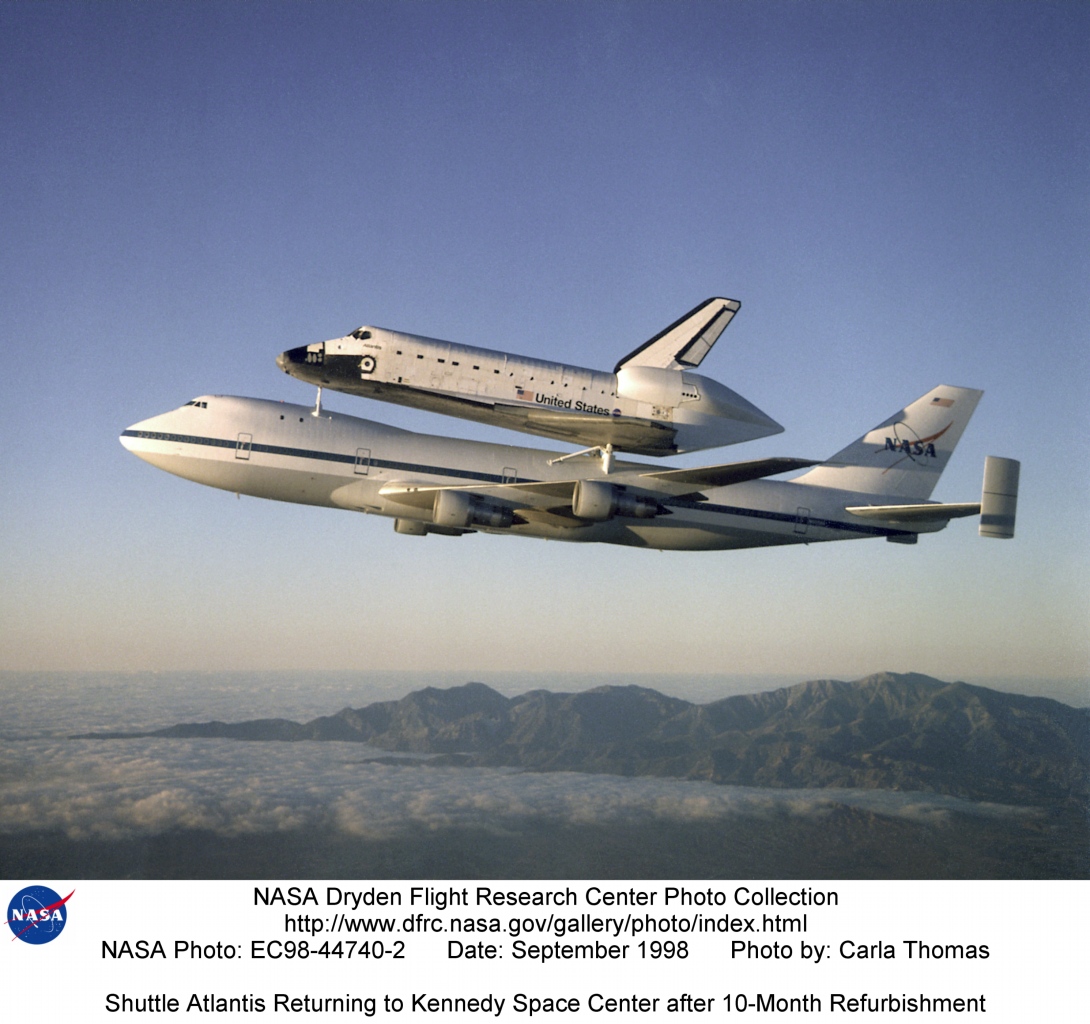
more info about 747 ferry aircraftsHere's some pictures and info about the 747 ferry aircrafts.
- Shuttle Ferry (picture is dated Sept. 1998 direct link to picture another direct link
- Shuttle being carted on top of the 747??
- In flight photo
- Search for similar images on google.
- Shuttle Ferry (picture is dated Sept. 1998 direct link to picture another direct link
-
more info about 747 ferry aircraftsHere's some pictures and info about the 747 ferry aircrafts.
- Shuttle Ferry (picture is dated Sept. 1998 direct link to picture another direct link
- Shuttle being carted on top of the 747??
- In flight photo
- Search for similar images on google.
- Shuttle Ferry (picture is dated Sept. 1998 direct link to picture another direct link
-
Re:Why did they choose Floridia?The lowest inclination available without a performance hit is approximately 28 deg. Anything else requires turning the rocket in flight in the equivalent of an orbit plane change maneuver, which costs delta-v that could have been used to loft payload mass.
If you launch due east from the cape you will end up in a 28 deg orbit. If you launch in a northerly direction you will end up on the ascending side of a > 28 deg orbit. If you launch in a southerly direction you will end up on the descending side of a > 28deg orbit. Please see this handy NASA website for a laymans explanation of why this is so.
Regarding your assertion that the time of year matters: although you don't make it clear, I'm guessing that you are trying to argue that the obliquity of the ecliptic (and resulting seasonal variation in the path of the sun in the sky) somehow make some difference to the achievable launch inclination. This is not the case, because inclination is measured relative to the equatorial plane (which does not change relative to the Earth), not the ecliptic plane. I welcome a correction, if you were making some other kind of argument.
-
Precision Agriculture
Tractors have been computerized for quite some time. Check out NASA's Precision Ag site.
-
Re:Due to this news...That flying rock, I highly doubt that even a CAT 5 hurricane would produce enough wind over the wings to get the aircraft above Vs.
Googling for shuttle stall speed turns up meaningless links, but, google for landing speed and you get this . Scroll down, and you'll find it's using 213 to 225 mph as touchdown speed, and it's likely a valid assumption the range depends on all up landing weight. Working backward using traditional 'airmanship' numbers, touchdown is approximately 110% of stall speed, unless limited by tires etc, so it's probably safe to 'guess' the shuttle stalling in the area of 180 to 190 mph. Again, this is all somewhat subjective, as stall is truely based on angle of attack, and since the shuttle is unpowered, hard to measure a 'level flight' scenario, but, it's pretty reasonable to assume it is incapable of gliding slower than 180 to 190 in a sea level atmosphere just based on it's touchdown speed.
Another little detail, in order to have the wind 'pick up' the shuttle, it'll have to be nosed into wind, and set with the wings at the optimum angle of attack. A shuttle on the wheels is very distinctively 'nose low'. So, not only will you need a cat 5 hurricane, you also need Nasa folks to park it on a slight rise to get the angle of attack right.
I think nasa can rest assured, a shuttle exposed to a cat 5 hurricane by 'just parking outside' is not going to suffer a blow over. It may take some damage from flying debris, but, it's not going to blow over. I believe the structure itself is quite capable of handling hurricane force winds assuming it's parked nose to the wind, it endures much stronger aerodynamic forces during landing.
The launch facilities may be at risk to hurricanes, but the shuttles themselves, are probably safest parked out in the wide open away from potential debris, nose to the wind, and tie-downs are quite optional.
-
Here's historically one up close and personal
An "up close and personal" supernova might have been responsible for the Cambrian-Ordovician mass extinctions and glacial age, some 0.5 billion of years ago. The massive pulse of gamma ray turned the ozone layer into a brown nitrous dioxide layer.
In turn that (A) allowed UV radiation from the sun to cook a lot of organisms. Yes, including those under water. _And_ (B) affected the climate so massively, that the Earth was turned into a cosmic ball of ice for an awfully long time. _And_ (C) must have caused one hell of a nitrous acid rain.
So I'd say you _really_ don't want to see one up close and personal.
Some reading on this topic:
http://heasarc.gsfc.nasa.gov/docs/heasarc/headates
http://www.guardian.co.uk/life/dispatch/story/0,12 978,1053475,00.html
http://www.newscientist.com/news/news.jsp?id=ns999 94198
(On the other hand, _if_ there's a God, you have to give the guy some credit. This is a much more clever way to devastate a planet than just a flood. Very efficient too.) -
Re:Nearby galaxyThere've been supernovae observed within our own Galaxy: the famous example is the Crab Nebula, whose supernova was recorded by Chinese astronomers in the 11th century, and was visible in daylight for months. There's a pulsar there now. There just haven't been any recently.
There are plenty of stars just itching to blow, though. Eta Carinae is about ready to pop, and Betelgeuse isn't far off. Either of these stars blow, we'll have a hell of a show.
-
Re:Nearby galaxyThere've been supernovae observed within our own Galaxy: the famous example is the Crab Nebula, whose supernova was recorded by Chinese astronomers in the 11th century, and was visible in daylight for months. There's a pulsar there now. There just haven't been any recently.
There are plenty of stars just itching to blow, though. Eta Carinae is about ready to pop, and Betelgeuse isn't far off. Either of these stars blow, we'll have a hell of a show.
-
Re:Political Comments not NesissaryIs there any reason to believe JWST/NGST will cost significantly less than hubble? So lets estimate $US1-1.5billion all up. How much does a servicing mission cost to hubble (ignoring the fact that JWST will be at L2)? Something like a couple hundred million? I don't know the actual number, but that's what's in my head. (Do you know it? I'd like to know) The point: I'm *highly* skeptical of your "we just build a new one" claim. Prove it!
Shuttle launches run to around US$500M (the actual cost is unclear, since it's never costed on a per-launch basis) - or at least they used to before all this extra safety stuff was added in. Assuming that NASA does actually manage to get shuttle operational again (which isn't guaranteed) the cost of an individual launch will probably be even higher than it used to be. Then you have to throw in the cost of the replacement hardware.
According to this the JWST will cost US$824.8M. That appears to include launch costs (Ariane V, so probably ~$100M), and operations (for 5-10 years). A large chunk of the cost of the telescope itself will be non-recurring engineering (i.e. design work). Assuming a build-to-print replacement telescope, you could probably do a replacement (with launch costs) for around $400M or less. So, less than a shuttle mission (neglecting the whole L2 issue), and no lives risked.
It still doesn't invalidate my point that 20 years is not particularly "old" for a telescope. Especially when it cost $US1.5billion.
By way of calibration: the Mars Exploration Rover mission cost just shy of a $1B, and will be lucky to last 2 years, let alone 20. Space isn't cheap.
With regard to repairing Hubble, there's only so much stuff you can repair/replace (without actually replacing the whole thing) before it succumbs to old age. It's not clear that it's cost-effective to do another servicing mission - you may save the gyros, only to have other stuff fail. Space is not a benign environment. The cumulative total radiation dose is slowly chewing thorugh HST's electronics (although I believe the last servicing mission replaced the onboard computer, other electronic devices onboard are still the originals), the micrometeoroid background is eating at its structure, the batteries are nearing the end of their cycle life, and the thermal system is slowly degrading as the optical properties of the HST exterior change due to micrometeroid strikes and solar UV. Let it die.
Incidentally, I'm no fan of the Bush Mars plan. I just think that all the noise over Hubble is driven as much by partisan politics as it is by scientific, engineering, and cost considerations.
-
Re:Political Comments not Nesissary
Ok, I'll bite, rather than mod you -1 troll.
1) Age isn't necessarily a bad thing with a telescope. Lots of telescopes are a lot older than that - witness the Anglo-Australian Telescope, the UK Schmidt Telescope, and the recently burned-down Great Melbourne Telescope (aka MSSSO 50") which provided evidence that the universe is accelerating.
oh yeah, and hubble was launched on April 24, 1990 - you do the maths.
2) The replacement, the James Webb Space Telescope is optimised for the Infra-Red and can NOT operate in the blue/UV like hubble. Nor will it be launched until 2012, 4-5yrs *after* the prospective hubble death date.
JWST will also be at the L2 lagrange point, meaning that there is NO possibility of any servicing mission. here is info on the orbit.
3) There are NO better telescopes on the ground for imaging. Hubble has a *diffraction-limited* resolution of about 0.05" - 0.1" (0.05 - 0.1 arcsec). The BEST sites in the world (Mauna kea, cerro paranal) get seeing as good as 0.3-0.4" at the best of times, and that isn't too often.
No, adaptive optics do NOT help because they limit the field-of-view. Hubble has a diffraction limited FOV across the entire chip.
4) Hubble does not have to contend with atmospheric absorption, which makes observations in some bands (like the aforementioned UV) nigh on impossible. -
Re:Speed of Gravitational attraction ?
It just seems silly to me to attempt a N = 10 billion problem when we can't solve an N = ~70 ( roughly known objects in the solar system ) even though we have far better observations of the solar system to work with than we do of the universe at large.
Of course, we can solve solar-system dynamics. The number of particles isn't the problem. The issue is that we can measure solar system dynamics very precisely, so we have to carry out the simulation at high accuracy to match observations. We can measure the large-scale structure of the universe only coarsely, so the simulations don't have to be as precise, although they do need to have many more particles.
Even presuming to pick a starting point of 340k years after the big bang is arbitrary
No, it is not arbitrary: they started the simulation at the photon decoupling time, when the cosmic microwave background radiation was produced. They used observations of the CMBR at that time as the initial data for their simulation.
as the exact age of the universe will likely always remain open to debate. Even the most popular theory and observations have a huge margin of error a great deal larger than 340k years
Actually, the WMAP estimates place the age of the universe at 13.7 +/- 0.2 billion years, but the time of photon decoupling is known to much better precision: 379 +/- 8 thousand years.
I think this excercise would be better served by say using 10 billion points distributed in a solar system model to attempt to create a predictive model of the solar system.
That would be absurd. What points would be model? We don't even have initial data that could be used for more than a hundred or so.
Besides, the point of the "exercise" was to understand the formation of large-scale structure in the early universe. Studying solar-system dynamics doesn't tell us anything about that.
After all the same forces are at work at both levels according to theory and we have much better observational abilities with regards to the solar system for tweaking the simulation till it accurately reflects reality.
That would be useless. The things that would mess up a simulation of the early universe include uncertainty in things like the amount and distribution of ordinary and dark matter, large-scale fluid dynamics, etc. Studying the solar system doesn't help with that. Likewise, studying the early universe doesn't help with simulating the solar system, because what messes up the latter is imprecision in accounting for the configuration of all the bodies in the solar system. The problems the two simulations face are largely orthogonal to each other. -
Re:Bigger Parachute
-
Re:Duplicate story....So, can you make an RTG out of U-235, or does it not emit the right kind of radiation? It's infrared radiation that makes an RTG work, right?
I found this document on RTGs for the Gallileo probe in 1984. A few of the crunchy bits are as follows:
The Galileo orbiter will carry two 285-watt (electrical)* general purpose heat source (GPHS) radioisotope thermoelectric generators (RTGs)
[from a link to a subpage] Two nuclear generators will power the Galileo spacecraft. Each is about 45 inches long, 16 inches in diameter, and weighs 122 pounds.
* The thermal power at the beginning of the mission will be 4,410 W per generator.
So, they're counting on 285 W per generator, but at the start they're going to be getting 4,410 W. I'm assuming the 285 is the output estimated for the tail end of the mission. Now, 4.4 kW isn't a lot of output, but it could easily power a house, even a wasteful American one. And, since the power output is continuous, it can be stored in batteries when not being used directly. Then there's the thermal output, which seems like it should be considerable. How many BTUs would something like this put out?
This article is more generally informative, but it seems that the overarching concern for terrestrial use is leakage. There's some note that the material could be used for a "dirty bomb," which is a concern in this age of terrorism, but people who are determined to do something nasty to other people will use whatever is at their disposal (airplanes, boxcutters, armies, lies to the public, whatever), so I don't think a pile of hot rocks is going to make a huge difference.
Am I way off here? Is there some critical issue that I'm missing? I'm open to being called stupid, just back it up with facts, please.
-
Re:Nuclear energy works!Natural uranium is only slightly radioactive. It has to by mined in huge quantities and purified to produce weapons grade uranium and reactor fuel.
If that were true then I doubt that we would be seeing naturally occuring nuclear reactors.
http://science.slashdot.org/article.pl?sid=02/10/1 6/167237&tid=134&tid=14
That link to APOD should actually have been:
http://antwrp.gsfc.nasa.gov/apod/ap021016.htmlI also just found this page with some interesting information about natural radioactivity with stats like Annual estimated average effective dose equivalent received by a member of the population of the United States:
http://www.physics.isu.edu/radinf/natural.htm -
Oh, the irony...
Isn't it ironic that NASA tried to cut funding for TRMM, a measly $28M for continued operations? Makes you wonder if hurricanes have a sense of humor.
-
NASA Preparing for Frances
From the NASA web site...
An interesting article regarding NASA preparations for Frances. -
HEy Look at this
-
Re:Yawn. Same old story.
Nope. It's not "quite a bit". It's a little bit.
http://en.wikipedia.org/wiki/Population_density 20:31 Sweden:USA.
Looking at a map of population density http://antwrp.gsfc.nasa.gov/apod/image/0303/people earth94_usda_big.gif there's a good chunk of nothingness in both countries, but certainly a greater PERCENTAGE of nothingness in Sweden. -
Re:The sky is falling! The sky is falling!Are all three orbiters at KSC?
I thought one was in long-term overhaul at the Palmdale, CA factory (though this work might have been shifted to KSC, I'm not sure).
I tried looking at the Current Shuttle Status page, but that, along with everything at Kennedy Space Center seems to be offline, already...
-
Re:The sky is falling! The sky is falling!Are all three orbiters at KSC?
I thought one was in long-term overhaul at the Palmdale, CA factory (though this work might have been shifted to KSC, I'm not sure).
I tried looking at the Current Shuttle Status page, but that, along with everything at Kennedy Space Center seems to be offline, already...
-
Re:Damn!
I think you're looking at things the wrong way. The administrations goals for the space program have little to do with the "civillian space program". The "military space program" is thriving.
-
Thats not the Voyager plaque..
Similar to what motivated Voyager scientists to attach a plaque for the outbound trip.
That link in the header is for the Pioneer plaque, not the Voyager golden record..
http://voyager.jpl.nasa.gov/spacecraft/goldenrec.h tml -
Re:End of an Era?
More information can be found here
http://www.hq.nasa.gov/office/pao/History/SP-4204/ contents.html
an exceltent, if long, read
chapter 6 deales with the construction of LP-39 -
Re:Great for GPSGPS works because you can obtain your location based upon the timing signals of a number of FIXED POSITION satellites. Without knowing the locations of the reference points, you cannot determine your location.
This is not correct. My own experience watching my GPS receiver is that the satellites (and their locations) change while I am in a relatively unchanging location. When I move 10-20 miles over a period of hours, the satellite list, and the relative locations plotted on the GPS, change completely. According to NASA, GPS satellite have circular orbit of 20,200 km. A geosynchronous orbit is usually what people mean by "FIXED" and is at 35,786 km. NOAA is responsible for providing GPS ephemerodes and has historical data.
-
Re:Great for GPSGPS works because you can obtain your location based upon the timing signals of a number of FIXED POSITION satellites. Without knowing the locations of the reference points, you cannot determine your location.
This is not correct. My own experience watching my GPS receiver is that the satellites (and their locations) change while I am in a relatively unchanging location. When I move 10-20 miles over a period of hours, the satellite list, and the relative locations plotted on the GPS, change completely. According to NASA, GPS satellite have circular orbit of 20,200 km. A geosynchronous orbit is usually what people mean by "FIXED" and is at 35,786 km. NOAA is responsible for providing GPS ephemerodes and has historical data.
-
Re:oh please
I bet its tons faster than light in super-cold sodium gas. Your statement is meaningless since it has been physicaly demonstrated that light can be slowed,stopped and even made to go FASTER than it normaly travels in a vacuum.
http://science.nasa.gov/headlines/y2002/27mar_stop light.htm -
Gravity
Since atomic clocks can be used to measure effects of gravity, it would be interesting to see how mass producing atomic clock chips could be used to create maps of gravity, seeing how they can be used to reveal geological information.
-
Re:Stupid Question
-
Rename "Clarke orbit"?From a link from the FA link:
In 1895 a Russian scientist named Konstantin Tsiolkovsky looked at the Eiffel Tower in Paris and thought about such a tower. He wanted to put a "celestial castle" at the end of a spindle shaped cable, with the "castle" orbiting the earth in a geosynchronous orbit (i.e. the castle would remain over the same spot on the earth). The tower would be built from the ground to an altitude of 35,800 kilometers. It would be similar to the fabled beanstalk in the children's story "Jack and the Beanstalk," except that on Tsiolkovsky's tower an elevator would ride up the cable to the "castle".
Depending on how it was written, wouldn't this cover at least part of Arthur C. Clarke's idea (and patent) for using geostationary orbits? To fully cover it, the castle would have needed radios, but Marconi hadn't stolen the radio yet... Did it have semaphores? -
Re:really really coolIt's cold, but weight and insulative properties aren't strongly correlated. One of the best insulators in the world is AeroGel which is practically as light as air.
And from TFA, the structure they're talking about can withstand 220 km/h (140 mph) winds.
So I'd say it's pretty sturdy. Lightweight means less inertia which means it's easier to withstand some strong forces.
Cheers, Matt
-
Re:We have been fantisizing about flying cars...
"All heavier-than-air craft stay in the air by accellerating air downwards."
wrong wrong wrong.
to learn how airfoils REALLY work along with a description of the Bernoulli effect that allows them to work, check out this website.
I disagree. I think that NASA's Glenn Research Center has a more complete analysis than the resource you posted. The articles better demonstrate why the Bernoulli effect is not the right theory of lift, although it does contribute.
These pages describe briefly why the popular discriptions of lift theory are wrong or incomplete:
Longer Path or Equal Transit Theory
Skipping Stone or deflection theory
Venturi or Bernoulli theory
This page describes the various factors that contribute to the generation of lift.
The key concept is that all the factors in some way contribute to the turning of the airstream. This turning, or acceleration of the airstream is the reaction force that allows the aircraft to change direction, or, in the case of lift, _not_ change direction by countering the acceleration of gravity. -
Re:We have been fantisizing about flying cars...
"All heavier-than-air craft stay in the air by accellerating air downwards."
wrong wrong wrong.
to learn how airfoils REALLY work along with a description of the Bernoulli effect that allows them to work, check out this website.
I disagree. I think that NASA's Glenn Research Center has a more complete analysis than the resource you posted. The articles better demonstrate why the Bernoulli effect is not the right theory of lift, although it does contribute.
These pages describe briefly why the popular discriptions of lift theory are wrong or incomplete:
Longer Path or Equal Transit Theory
Skipping Stone or deflection theory
Venturi or Bernoulli theory
This page describes the various factors that contribute to the generation of lift.
The key concept is that all the factors in some way contribute to the turning of the airstream. This turning, or acceleration of the airstream is the reaction force that allows the aircraft to change direction, or, in the case of lift, _not_ change direction by countering the acceleration of gravity. -
Re:We have been fantisizing about flying cars...
"All heavier-than-air craft stay in the air by accellerating air downwards."
wrong wrong wrong.
to learn how airfoils REALLY work along with a description of the Bernoulli effect that allows them to work, check out this website.
I disagree. I think that NASA's Glenn Research Center has a more complete analysis than the resource you posted. The articles better demonstrate why the Bernoulli effect is not the right theory of lift, although it does contribute.
These pages describe briefly why the popular discriptions of lift theory are wrong or incomplete:
Longer Path or Equal Transit Theory
Skipping Stone or deflection theory
Venturi or Bernoulli theory
This page describes the various factors that contribute to the generation of lift.
The key concept is that all the factors in some way contribute to the turning of the airstream. This turning, or acceleration of the airstream is the reaction force that allows the aircraft to change direction, or, in the case of lift, _not_ change direction by countering the acceleration of gravity. -
Re:We have been fantisizing about flying cars...
"All heavier-than-air craft stay in the air by accellerating air downwards."
wrong wrong wrong.
to learn how airfoils REALLY work along with a description of the Bernoulli effect that allows them to work, check out this website.
I disagree. I think that NASA's Glenn Research Center has a more complete analysis than the resource you posted. The articles better demonstrate why the Bernoulli effect is not the right theory of lift, although it does contribute.
These pages describe briefly why the popular discriptions of lift theory are wrong or incomplete:
Longer Path or Equal Transit Theory
Skipping Stone or deflection theory
Venturi or Bernoulli theory
This page describes the various factors that contribute to the generation of lift.
The key concept is that all the factors in some way contribute to the turning of the airstream. This turning, or acceleration of the airstream is the reaction force that allows the aircraft to change direction, or, in the case of lift, _not_ change direction by countering the acceleration of gravity. -
Re:Life on Titan?
-
Re:I'll bet...
Everbody, put a lot of money on fusion. Then say HA WE ALREADY DID IT and collect. Because we have, in several different expieraments, one of which is the VX VASMIR project headed up by the ASPL, which will take us to Mars.
I think I may make some money this way. -
Re:Next stop, South Polar region?
Already working on it... (other pole though)
http://mars.jpl.nasa.gov/missions/future/phoenix.h tml/
We're resurrecting (hence the name) the half-built Mars 2001 Lander and sending it to the northern latitudes, where it will dig for icy soil. -
"Other feats"Odyssey has been a great success in its own right, as well as providing critical support for MER. One of those "other feats" mentioned in the writeup included being the relay satellite for something like 90% of the Mars Exploration Rover downlink.
It costs us a lot less energy to just uplink the data from MER to ODY and let them send it back to Earth than for us to send it all the way back to Earth directly. The energy we save that way, we can spend on driving around, doing science, and staying warm. ODY did such a great job relaying data for us that it soon became our preferred communication mode -- we haven't returned any significant amount of data through another path for months. (Though we did recently test that we can also return data via ESA's Mars Express.)
To put it another way, without ODY, we'd have only about 10% of the pretty pictures you can find at the MER home page.
So on behalf of all of us MERfolk: thanks, and congratulations, Odyssey!
-
"Other feats"Odyssey has been a great success in its own right, as well as providing critical support for MER. One of those "other feats" mentioned in the writeup included being the relay satellite for something like 90% of the Mars Exploration Rover downlink.
It costs us a lot less energy to just uplink the data from MER to ODY and let them send it back to Earth than for us to send it all the way back to Earth directly. The energy we save that way, we can spend on driving around, doing science, and staying warm. ODY did such a great job relaying data for us that it soon became our preferred communication mode -- we haven't returned any significant amount of data through another path for months. (Though we did recently test that we can also return data via ESA's Mars Express.)
To put it another way, without ODY, we'd have only about 10% of the pretty pictures you can find at the MER home page.
So on behalf of all of us MERfolk: thanks, and congratulations, Odyssey!
-
The jet engine problemThe big problem is that making small jet engines is still too expensive. Most light planes are still powered by reciprocating engines. There's been talk of small jets for general aviation for decades, but nobody seems to be able to bring it off.
It's not that you can't build a small jet engine. It's that the price doesn't decline much with size. Engines sized for small aircraft aren't much cheaper than those built for business jets.
There was an effort at NASA to fix this problem, but it failed and was cancelled in 2002.
-
The advantages of SiC over SiWhat are the advantages of SiC over Si?
Google to the rescue
First hit: Silicon Carbide High Temperature Integrated Electronics and SensorsSiC-based electronics and sensors can operate in hostile environments (600 C = 1112 F GLOWING RED HOT!) where conventional silicon-based electronics (limited to 350 C) cannot function. Silicon carbide's ability to function in high temperature, high power, and high radiation conditions will enable large performance enhancments to a wide variety of systems and applications.
It goes on to show examples of enhancements like lightweight sensors that could operate inside a jet engine or rad-hard electronics for the same weight and specs as Si.
-
The advantages of SiC over SiWhat are the advantages of SiC over Si?
Google to the rescue
First hit: Silicon Carbide High Temperature Integrated Electronics and SensorsSiC-based electronics and sensors can operate in hostile environments (600 C = 1112 F GLOWING RED HOT!) where conventional silicon-based electronics (limited to 350 C) cannot function. Silicon carbide's ability to function in high temperature, high power, and high radiation conditions will enable large performance enhancments to a wide variety of systems and applications.
It goes on to show examples of enhancements like lightweight sensors that could operate inside a jet engine or rad-hard electronics for the same weight and specs as Si.
-
The advantages of SiC over SiWhat are the advantages of SiC over Si?
Google to the rescue
First hit: Silicon Carbide High Temperature Integrated Electronics and SensorsSiC-based electronics and sensors can operate in hostile environments (600 C = 1112 F GLOWING RED HOT!) where conventional silicon-based electronics (limited to 350 C) cannot function. Silicon carbide's ability to function in high temperature, high power, and high radiation conditions will enable large performance enhancments to a wide variety of systems and applications.
It goes on to show examples of enhancements like lightweight sensors that could operate inside a jet engine or rad-hard electronics for the same weight and specs as Si.
-
Re:Charcoal?
Not quite.
I've got a quitea bit of experience with SiC abrasives, what with the materials engineering and being a bit of a lapidary.
First off, it's nowhere near diamond in terms of hardness. The Mohs scale is semi-arbitary in assignement, and not even vaugely linear. On proper hardness scale (in this case Vickers), diamond has a hardness of around 90 GPa, compared to about 25 GPa for SiC. That's the reason I've got a box full of diamond abrasives, despite the cost (about 30 times more expensive), they are much faster, and last almost indefinitly. More later on this.
Secondly, SiC needs to be rough. If you don't belive me, try grinding a carrot into shape on a window. The glass is very much harder then the carrot, but is nearly perfectly smooth, and as such, the carrot just sides about. Compare with rubbing the carrot on something like a concrete paving slab, which grinds it much better. The reative hardnesses are wrong here, but show the need for surface roughness.
As an aside, if you think that paper cuts are bad from standard office paper, then try getting one from fine SiC abrasive paper. Stiffer paper, cuts deeper, and the abrasive roughs up one side of the cut, so it takes about four times as long to heal. It's a mistake I've made exactly once.
A processor is not a single pure material - if it was, it wouldn't do anything. They are a complex layered system, with layers of copper and SiO. Trying to grind anything with a processor die will just succed in scraping off all that important stuff. The hardness of SiO is Mohs 7, well below that of anything actually used as an abrasive for metals. (It's the same as ground glass, near enough, sometimes used for abrading wood or plastics).
For comparison silicon has a hardness of 12 GPa Vickers. SiC is only around twice as hard as that.
So, no, you can't really use it as an abrasive. If you really want to be very careful, you might be able to use the edge of the die as a scraper, but you'd probably just remove the important stuff.
That's alla moot point, however. I strongly supect that you'll never see the actuall die, it will be under a metal heat spreader. Because they can cope with higher temperatures [0], there is even less need to take the risk of mishandling breaking the die.
And lest you think that SiC would be less likely to break then silicon, I'm afraid not. Aside from the fact that many broken Athlons are due to the top few layers of SiO and metal breaking, SiC is not that tougher than silicon. As any lapidary will tell you, it's perfectly possible to chip saphire and diamond, if you're not careful.
Still, I can't deny that facts aside, it's a wonderfuly evocative metaphor.
[0] And how much higher! Silicon tops out at 350 C, SiC could operatate at 600 C, where is it glowing red hot! sourced from Nasa -
Re:Wow must have been gone for a long time
The scientist, that claimed the Viking Probes showed signs of microbial life, now has a new theory.
He seems to see signs of water on recent Rover images, squished out by the wheels and the RAT tool.
Even if there is/ever was no life, interesting find though, that liquid water exists on such a world. I think this raises the odds of finding life somewhere else quit a bit. Maybe Europa? -
yay for Odyssey!
Odyssey was launched in 2001... here's the mission timeline for more details.
The cute little bugger looks like this.
-
Re:Next stop, South Polar region?
they tried this already, with the Mars Polar Lander. but they lost it.
dont know if they will try again though. -
Re:Wow must have been gone for a long timehttp://marsrovers.jpl.nasa.gov/newsroom/pressrele
a ses/20040302a.htmlThere's a link to a water on Mars press release from a few months back.
-
Re:Wow must have been gone for a long time
Mars Rovers != Mars Odyssey.
Ice on Mars
Odyssey Mission to Mars -
Re:how hot?Here's some more information about this topic:
http://www.grc.nasa.gov/WWW/RT1997/5000/5510neude
c k2.htm
http://www.acreo.se/templates/Page____577.aspx
I just asked Google