Slashdot Mirror
Domain: nasa.gov
Stories and comments across the archive that link to nasa.gov.
Comments · 16,365
-
Kepler probe will watch 100,000 stars in 2007
This method of looking for planetary transits will be tried on 100,000 stars simultaneously by the Kepler space probe in 2007. Kepler points a 95 megapixel camera at the same patch of the sky for several years. They expect to discover about 900 planets, of which 50 may be Earth-size. Their assumptions about planetary size distribution and detectability are given on their website.
-
Re:Smaller Planets?
The Terrestrial Planet Finder is the next big mission to look for..umm..terrestrial planets.
-
Re:Smaller Planets?
Will this method help find smaller planets?
Almost certainly not. The amplitude of the brightness variations, caused by the transit of a terrestrial planet, varies as the square of the ratio between the radius of the star and the planet. For the Sun/Earth values, this figure comes out as a 0.008% variation in brightness, or -- in astronomical terms -- a change of 0.2 millimagnitudes.
Measuring such small changes is extremely difficult, even using very large (5-10m) ground-based telescopes that have fancy optics and a high throughput. That's why terrestrial planet finding using the transit method will have to wait for NASA's Kepler mission. Scheduled for launch in 2007, this mission will look for minute brightness variations in c. 100,000 nearby Solar-type stars.
-
Re:When construction resumes...Exact date? Best guestimate is that Discovery gets the nod in March 2005.
NASA has started providing semi-regular updates as to Shuttle Status again.
-
Boba Fett?Looks like the engineers are big Boba Fett fans. Here and Here
Also the vision system looks really cool with some pics and a quote:
"Using a sophisticated measurement constraint system, which employs knowledge of human kinematics, the stereo vision system is now able to track the 3D location of a person's hands relative to their head location."
-
Boba Fett?Looks like the engineers are big Boba Fett fans. Here and Here
Also the vision system looks really cool with some pics and a quote:
"Using a sophisticated measurement constraint system, which employs knowledge of human kinematics, the stereo vision system is now able to track the 3D location of a person's hands relative to their head location."
-
Re:Michael!
IIRC, when the Shoemaker-Levy comet crashed on Jupiter in 1994, NASA's webserver couldn't cope with the traffic.
But then again... it was 1994. -
Re:You just seeing this?
-
Re:Michael!
Well, you're correct, but I wasn't referring to 10 times the actual image resolution.
What I meant was 10 times the "full-res" image... not specifying 10 times _what_ exactly, implying (not very successfully) the file size.
On another note, I was looking in the folder where the 4mb file is located (here) and noticed that file last modified date is Thu, 09 Nov 2000 16:02:36 GMT... just thought it was interesting that it seems to be 4 years old. -
Dont forget the Ion drive
Remember, an Ion Drive powered the Deep Space 1.
-
If you want the 40 Meg Tiff of this image...
The Nasa site seems to be screwy so...
The Wayback machine to the rescue!
http://web.archive.org/web/20040203105423/http://v isibleearth.nasa.gov/cgi-bin/viewrecord?5826
Which gives you the direct link:
http://visibleearth.nasa.gov/data/ev58/ev5826_land _lights_16384.tif -
old news
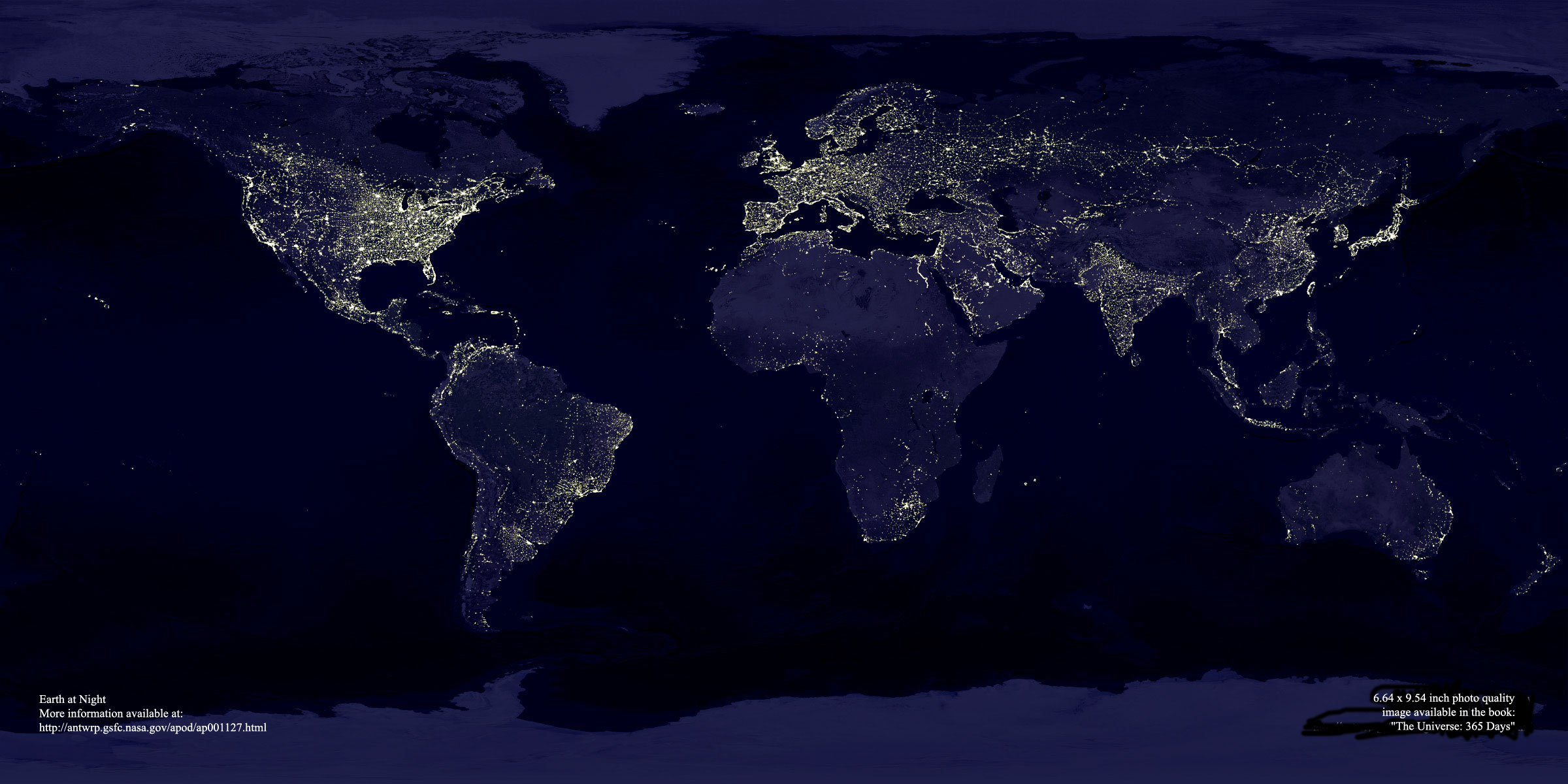
the Blue Marble images (this "City Lights" image is from the Blue Marble project) have been up and publicly available from nasa.gov for years. Full res TIFFs (21,600 by 21,600 pixels) available by special request.
-
Re:Michael!
It's gotta be a typo... the page of hi-res images lists a 4mb tiff image that is described as "full-res".
If there were a 40mb tiff would that be a "10x full-res" image? -
Re:Had it on my desktop,...
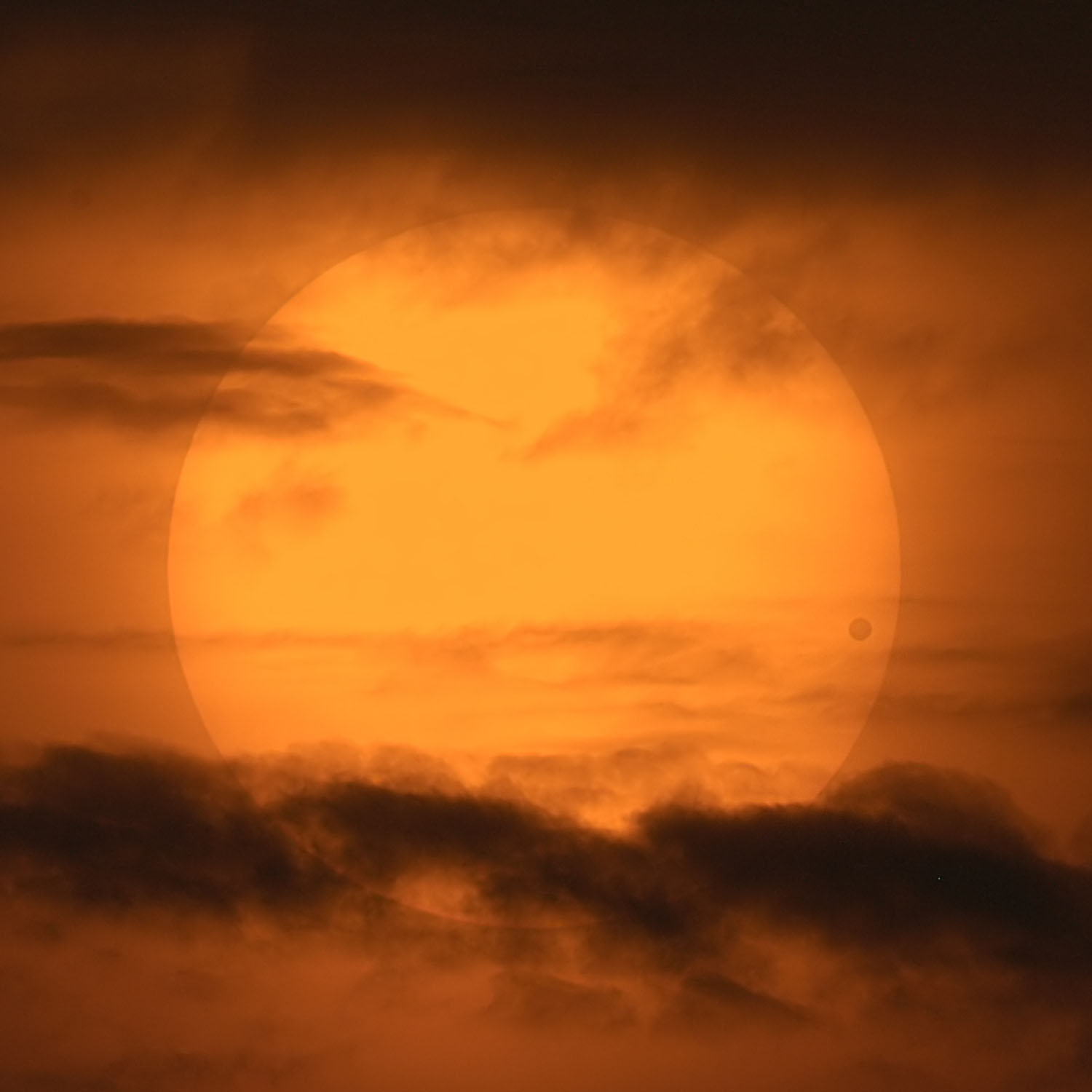
An APOD picture I like better was posted June 23 - of the Venus transit of the Sun. The higher resolution version, at 1500 by 1500, makes the best desktop pic, although it will need a little work in the GIMP or PhotoShop to make it fit your desktop's aspect ratio.
-
Re:Had it on my desktop,...
An APOD picture I like better was posted June 23 - of the Venus transit of the Sun. The higher resolution version, at 1500 by 1500, makes the best desktop pic, although it will need a little work in the GIMP or PhotoShop to make it fit your desktop's aspect ratio.
-
Re:2002?I wouldnt doubt it, the one Ive had as a desktop background for a while now is dated Nov27, 2000. The type of image is nothing new, but it could be using newer images than the one I have.... Another interesting image is the one of a sunset over europe.
Tm
-
Re:You just seeing this?
Here's one from a few years ago. It's darker so you can see the lights better.
-
Re:2002?
Or older still...
$wget -S --spider http://photojournal.jpl.nasa.gov/tiff/PIA02991.tif
3 Last-Modified: Thu, 09 Nov 2000 16:02:36 GMT -
Re:You just seeing this?
The JPL has one, and its zoomable to: http://wmt.jpl.nasa.gov/
-
Re:You just seeing this?
-
Re:You just seeing this?
Sorry, but who cares, it's a beautiful picture.
My personal favorite -
Repeat, But Lighter
Looks like they decided to repeat this imagine on APOD, it was last up Nov 2000. They decided to lighten the image a little, I guess the last one was too dark.
I was able to buy a poster size version from my campus poster sale last year, I'm a big fan. -
again?
Each day a different image or photograph of our fascinating universe is featured, along with a brief explanation written by a professional astronomer.
Hmm... looks very similar to something else I've seen...
Actually, I made a wallpaper out of this once... of just North America anyways. -
Re:RTFS
i found the bbc article selfcontradictory or at best badly written as it says both "When physicists say "teleportation", they are describing the transfer of key properties from one particle to another without a physical link." as well as "...used an 800m-long optical fibre fed through a public sewer system tunnel to connect labs..." and "The link establishes a channel between the labs, dubbed Alice and Bob. This enables the properties, or "quantum states", of light particles to be transferred between the sender (Alice) and the receiver (Bob)"
isn't optical fibre a physical connection? i would say so... the article seems not to be so much about entanglement teleportation as it is about entanglement copying (imo the difference is that between modifying a quantum state in one half of the pair and detecting the changed state in the other pair (= teleportation) and detecting the quantum state then sending that information to modify another quantum state (= copying and what i think the bbc article describes)
anyway, from http://www.jpl.nasa.gov/releases/2003/47.cfm:
Einstein thought this connection violated the relativity rule that information can't travel faster than the speed of light. Adami and Dr. Robert Gingrich, also of JPL, are the first to apply Einstein's relativity theory to quantum entanglement between particles. They compared the amount of entanglement when the particles were at rest to when they were given a boost. Their findings show that while speeding up ordinary entangled pairs would lead to a loss of the precious entanglement, certain special pairs can be created whose entanglement is increased instead. This increases the connection between them.
Understanding how some of the characteristics of a particle can become entangled through relative motion alone when they seemed to be unentangled or unconnected when at rest could have many applications. For example, entangled particles could be used to synchronize atomic clocks, which are essential for navigating spacecraft in deep space.
hmm so let's assume the spacecraft is travelling at close to the speed of light; if (maybe not such a big if considering the link above) an entaglement is possible in that situation wouldn't any communication (which might be something as "simple" as purposely breaking the entanglement in a way that makes if easily detectable that the break did occur) wouldn't that in effect be faster than light communication? (near lightspeed velocity of craft + instantaneous dis-entanglement)
just reacting to your "non-negotiables" -
Re:No matter..
(all the waste is recycleable so I oppose plans to dump it into the ground)
Uh, no. Spent fuel can be reprocessed, but high level waste remains from the process. There's also ow-level waste, which ranges from spent protective gear, to decommissioned reactor vessels. Neither is in no way "recyclable".
Neither fossil fuels nor nuclear fission is suitable for a long-term general-ues energy source.
Fusion may or may not prove practical, however we do have a large fusion reactor located just 93 million miles away. We should make better use of it (including not just photovoltaic but passive solar, wind, possibly OTEC) and also direct efforts greater efficiency.
-
Re:The final frontier
I agree. One really exciting conceptual propulsion system is the idea of being able to push against the quantum vacuum that underlies all of reality.
A simplistic metaphor would be to imagine someone in zero-G trying to move around; then putting them in water and letting them swim. Chemical propulsion means you have to carry all the mass with you that you push against in order to propel yourself. With "Space Drive", you would still need to expend energy; but presumably much less than with current methods.
Nasa: Ideas Based On What We'd Like To Achieve
Nasa: Some Emerging Possibilities -
Re:The final frontier
I agree. One really exciting conceptual propulsion system is the idea of being able to push against the quantum vacuum that underlies all of reality.
A simplistic metaphor would be to imagine someone in zero-G trying to move around; then putting them in water and letting them swim. Chemical propulsion means you have to carry all the mass with you that you push against in order to propel yourself. With "Space Drive", you would still need to expend energy; but presumably much less than with current methods.
Nasa: Ideas Based On What We'd Like To Achieve
Nasa: Some Emerging Possibilities -
Re:This bothered me as well..And this is what NASA has to say about the so-called Allais effect at http://science.nasa.gov/newhome/headlines/ast06au
g 99_1.htm :" In a marathon experiment, Maurice Allais released a Foucault pendulum every 14 minutes - for 30 days and nights -without missing a data point. He recorded the direction of rotation (in degrees) at his Paris laboratory. This energetic show of human endurance happened to overlap with the 1954 solar eclipse. During the eclipse, the pendulum took an unexpected turn, changing its angle of rotation by 13.5 degrees.
Both before and after the eclipse, the pendulum experienced normal rotation (Foucault effect of 0.19 degrees/minute). This 13.5-degree excursion in the angular plane persisted throughout the length of the eclipse, a total of 2.5 hours of observations. Allais got similar results when he later repeated the experiment during a solar eclipse in 1959."
So we have ourselves at least 3 different descriptions of the same effect. And thats not the only pitfall, what is most unsatisfying, is that we _ALL_ have to wait until the next solar eclipse is about to happen.
Robert
-
Relevant links
Commerical and military: http://www.syntheticvision.com/ General Aviation: http://avsp.larc.nasa.gov/pdfs/SVS_GA_FAA-WS/SVS-
G A_Overview.pdf University Research: http://opl.ecn.uiowa.edu/ -
Re:What about after landing?
Actually, the NASA Aviation Safety and Security Program at NASA Langley (which is a part of this project, I believe) is doing just that.
-
Not shielding, a new horizontal force possibly.IANA physicist but the pdf is accessible to anyone with high school physics and some interest in physics news. More accessible references below.
Most of the posts are supposing the physicists doing this are real dumb. That in itself, is stupid. I think one or two have interesting points (e.g. "Einstein is Saf e") and most of the others are way off base. The paper is a summary of research by other people. The problem being discussed was noticed by Allais 50 years ago when he ran a month long pendulum experiment (three drops per minute I believe) that happened to intersect the time of an eclipse. The paper goes over a number of possible reasons for error and includes some as yet unpublished data on experiments intended to uncover them. The possibilities are c reative and followed up scientifically, for example one is done in remote China with nobody within 200 meters. All tests showed the suggested errors to be miniscule, although the paper does suggest that a combination of them might just cover it.
It would appear that a significant anomaly has been detected by various experiments and that professional scientists are taking it much more seriously than say cold fusion. It also is clear that there is a lot still to learn about gravity and that NASA is one of the groups that is working hard to figure out why its space probes don't move as expected. Some people even think gravity moves 20 times faster than light and other stories. It is not a shut case yet. In the paper mentioned in the post, they are saying that most people couldn't in the past solve the problem because they were thinking in terms of the Moon "shielding" the Earth from gravity, which the paper does not believe. They think it is more like an extra horizontal force that sometimes occurs during eclipses (of which there are different kinds including variations of angles). So all the posts about shielding are off base.
NASA has suggested that if experimental error really can't be the culprit, it might be caused by the same thing that apparently is accelerating Voyager more than expected.
I'd like to quote from a NASA article on the people who built Gravity Probe B.
A National Research Council panel, among them Cliff Will, wrote in 1995, "In the course of its design work on Gravity Probe B, the team has made brilliant and original contributions to basic physics and technology. Its members were among the first to measure the London moment of a spinning superconductor, the first to exploit the su perconducting bag method for excluding magnetic flux, and the first to use a 'porous plug' for confining superfluid helium without pressure buildup. They invented and proved the concept of a drag-free satellite, and most recently some members of the group have pioneered differential use of the Global Positioning System (GPS) to create a highly reliable and precise aircraft landing system."
I think that is cool. It says to me we have a good chance about learning a lot more about gravity and lots of other fundamental physics in the near to medium term future.
The paper also notes that one more individual experiment will not solve it; many simultaneous and comprehensive experiements are needed over the next few eclipses. It also suggests that it might be interesting to investigate "gravitational lensing by relativistic dark matter" although I cannot tell if that suggests we are in the midst of a river of high speed dark matter or what, something invisible passing between the Earth and Moon? Somebody with astrophysics degree please finally step in. Sounds like it might be interesting to have the ISS get involved too!
Links:
NASA decrypting the eclipse ('99)
Gravitational Anomalies - Literature List
In Search of Gravitomagnetism (NASA Gravity Probe B) -
Not shielding, a new horizontal force possibly.IANA physicist but the pdf is accessible to anyone with high school physics and some interest in physics news. More accessible references below.
Most of the posts are supposing the physicists doing this are real dumb. That in itself, is stupid. I think one or two have interesting points (e.g. "Einstein is Saf e") and most of the others are way off base. The paper is a summary of research by other people. The problem being discussed was noticed by Allais 50 years ago when he ran a month long pendulum experiment (three drops per minute I believe) that happened to intersect the time of an eclipse. The paper goes over a number of possible reasons for error and includes some as yet unpublished data on experiments intended to uncover them. The possibilities are c reative and followed up scientifically, for example one is done in remote China with nobody within 200 meters. All tests showed the suggested errors to be miniscule, although the paper does suggest that a combination of them might just cover it.
It would appear that a significant anomaly has been detected by various experiments and that professional scientists are taking it much more seriously than say cold fusion. It also is clear that there is a lot still to learn about gravity and that NASA is one of the groups that is working hard to figure out why its space probes don't move as expected. Some people even think gravity moves 20 times faster than light and other stories. It is not a shut case yet. In the paper mentioned in the post, they are saying that most people couldn't in the past solve the problem because they were thinking in terms of the Moon "shielding" the Earth from gravity, which the paper does not believe. They think it is more like an extra horizontal force that sometimes occurs during eclipses (of which there are different kinds including variations of angles). So all the posts about shielding are off base.
NASA has suggested that if experimental error really can't be the culprit, it might be caused by the same thing that apparently is accelerating Voyager more than expected.
I'd like to quote from a NASA article on the people who built Gravity Probe B.
A National Research Council panel, among them Cliff Will, wrote in 1995, "In the course of its design work on Gravity Probe B, the team has made brilliant and original contributions to basic physics and technology. Its members were among the first to measure the London moment of a spinning superconductor, the first to exploit the su perconducting bag method for excluding magnetic flux, and the first to use a 'porous plug' for confining superfluid helium without pressure buildup. They invented and proved the concept of a drag-free satellite, and most recently some members of the group have pioneered differential use of the Global Positioning System (GPS) to create a highly reliable and precise aircraft landing system."
I think that is cool. It says to me we have a good chance about learning a lot more about gravity and lots of other fundamental physics in the near to medium term future.
The paper also notes that one more individual experiment will not solve it; many simultaneous and comprehensive experiements are needed over the next few eclipses. It also suggests that it might be interesting to investigate "gravitational lensing by relativistic dark matter" although I cannot tell if that suggests we are in the midst of a river of high speed dark matter or what, something invisible passing between the Earth and Moon? Somebody with astrophysics degree please finally step in. Sounds like it might be interesting to have the ISS get involved too!
Links:
NASA decrypting the eclipse ('99)
Gravitational Anomalies - Literature List
In Search of Gravitomagnetism (NASA Gravity Probe B) -
cool...
interesting read, if anybody is looking for more info nasa has a good writeup on scramjets...
NASA - What's a Scramjet? -
Re:It wasn't on its own or was it?
clickable version of the above link
-
Re:Notice how in 2014...
Interesting side note: The end of the Mayan Grand Cycle is suppose to coincide with the transit of venus. The mayans, and some other mesoamerican peoples, believed that venus was quetzacoatl and his transit of the sun would bring an end to the cycle. So the real question is whether or not we'll make it to December and, more importantly, whether we'll get to see the transit before everything goes.
-
Re:One possible explanation
Well, it's yer space-time warping by large gravitational fields innit.
Check out http://imagine.gsfc.nasa.gov/docs/ask_astro/answer s/961102.html for a pretty good explanation.
-
Re:One possible explanation
MOND evidently has problems; while dark matter can explain both galactic rotation curves and cosmological behavior, MOND is hard to make consistent with both. (And it's also, I've heard, extremely hard to make consistent with any relativistic theory of gravity.)
As for the "apparent need" for FTL expansion in the early universe, by which I assume you mean inflation, some very specific predictions of inflation are now verified by WMAP, including the structure of the acoustic peaks in the CMBR angular power spectrum.
Wacky as they may seem, dark matter, dark energy, and inflation are the mainstream theories right now for a reason: the alternatives so far simply don't work as well. -
Re:Yes but what about the ants?
I'm only half sarcastic. If you check here you'll see that this soldering thing has become an actual project on the station.
after looking at the list of projects going on on the ISS, I still am left wondering what they are doing to justify the crippling cost of building an orbital manned habitat. How many of these things are practically automated anyway? What is the justification of putting humans in this station when they are completely dependent on re-supply missions? How much time and money is spent on building, maintaining and expanding the thing as opposed to doing science?
I'm all for manned space exploration but only if it can lead to self sufficiency. ISS will never have any hope of being cut free of earth based support. I have yet to see a convincing argument that ISS is uniquely suited to any experiment that could be done by machine, on earth, on another world or in transit to another world.
ISS is a dead end and everything being done on it could be done while on the way to settling space in a more practical manner. Please cite some examples if you disagree. -
Re:Trace of Dinosaurus Rex on Mars
that's what I thought... coprolite. I was thinking a meter was huge but maybe not for a huge animal. Maybe that corresponds to surviving on a cold planet. Another idea is that of an underground animal who left it. It just does not look worn alot so it is hard to say it if it is old. We need closer pictures but I guess by the time the pictures come to NASA it is too late to head back for more? Peculiarities are the stretching in the first half and compression in the second half and that it is not even 1/2 way buried. The picture looks like a slope goes down to the rock from the foregound. Weird and interesting stuff. The lay of the ground looks like a bottom of a wash rather than a sandy area to me. I guess a hot impact would vaporize the gases and maybe leave something like that?
BTW, how does the rover take animated gifs? Tring to find pictures of surrounding area. -
If you don't use rosin...
... wouldn't that prevent the problem of circling solder? It seems to me that the rosin wouldn't be necessary in space because oxidation doesn't need to be prevented. NASA says that "hydrogen and helium are the prime components and are only present at extremely low densities" in space. Thus, the only reason I could see rosin being necessary is if the soldering would take place inside the space vessel. Otherwise, it seems to me that rosin could be removed from solder that is to be used on the space-side of these vessels.
-
Yes but what about the ants?
Did we get results yet on their screw sorting capabilities?
$100 billion dollar space station and this is the kind of results we get? This is almost as pathetic as this. -
Re:Movie (I hope NASA can handle it)
A link, even: linky
-
From an astronomer
Ground based astronomy isn't as sexy as space based astronomy, but has one big advantage -- light gathering power. We can build 8-meter (SUBARU and GEMINI), 10-meter (KECK), and in the near future 30 to 50-meter telescopes. The JWST, by comparison, is only 6.5 meters, and that's still 7 years away (at least). It's expensive to get telescopes into orbit, first off, and to send a probe up, well, you only get one look at the system with that! Additionally, launching anything drives the cost up by tens of millions of dollars. Ground based telescopes are easier to service, last virtually forever, and only have the disadvantage of having the atmosphere to fight with. Adaptive optics, and camera technology have significantly advanced in recent years, so that ground based telescopes with adaptive optics have huge advantages over those without it. They haven't caught the space telescopes yet, but the gap is closing. I'm a huge advocate of hubble, chandra and other space-based missions, but what can be accomplished on the ground (such as this) should NOT be overlooked!
-
JPL link
I think the JPL press release the link i sposed to point to is here
-
Does it have to be water?
Everyone is so excited about the possibility of liquid water on Mars, but has anyone considered that it might be some other type of liquid? Something with different properties that would explain the odd patterns?
This article intrigued me, but why is everyone so focused on water? Could the carbon dioxide or some other atmospheric gas be condensing in the cold north to form the odd runoff channels on the rock. This rock faces away from the sun and would therefore be one of Mars' coldest points. Could that be why there is little other than carbon dioxide in the atmosphere? Could wind erosion and perhaps even blast shockwaves from meteorites have been causing the errosive-looking paterns in such an enviroment? With the atmosphere being lighter, wouldn't meteorites hit harder and more frequently than Earth? Finally, can we draw any similarities to our own moon's surface, a place which we know much more about?
(I ask because I have no idea) -
Re:Winter on Mars?
You are correct, kinda. Mars is a little different than Earth if you examine its orbit and its tilt, which has a lot to do with the 'global winter' that everyone seems to be talking about.
This might help:
http://cmex-www.arc.nasa.gov/CMEX/data/MarsEssy/se asons/seasons.htm -
Re:The way the tin foil hat crowd will see it...
So that's where the Beagle ended up!
-
more evidence...
more evidence from a diff perspective. It seems pretty likely now that water *did* or perhaps is even still, on Mars. cool.
CB)(*&^%$ -
Re:Standard dissapointment
That's why Polymer muscles are the way to go.
-
Acronyms and Terms ExplainedI have a few of these:
GPS = global positioning system (but you knew that)
ephemeris calculation = modeling a satellite's orbit based on a handful of numbers, demonstrated by http://ssd.jpl.nasa.gov/eph_help.html
RINEX = Receiver Independent Exchange Format, http://www.ngs.noaa.gov/CORS/Rinex2.html
SLOC = source lines of code
COCOMO = an obsolete software development cost model http://www.jsc.nasa.gov/bu2/COCOMO.html