Slashdot Mirror
Domain: nasa.gov
Stories and comments across the archive that link to nasa.gov.
Comments · 16,365
-
Re:July 1?
HA! Even less point in getting the latest from the original source, right?
-
Re:Solar *activity* not *output*
Not solar output falling 60%, which would lead to completely frozen Earth, but solar activity, i.e. the 11 year sunspot cycle. Predicting levels near or at those found during the Maunder minimum. This does imply some reduced level of solar output.
About plus or minus 0.1% change in total solar irradiance between solar maximum and solar minimum:
http://science.nasa.gov/scienc...
It's not just the solar cycle but two cycles matching each other, the solar cycle and the flipping of the It's magnetic poles. Not about to claim what the Suns output would/will be.
-
Re:Every cycle
Well, except that every solar cycle since I can remember, I've heard somebody predicting that the next solar cycle is about the start a new Maunder minimum, and it will mean mini ice age. Every one. This one is a prediction based on fitting a model only to the last three cycles. i'm not impressed. For reference, here's the MSFC page on solar cycle modelling: http://solarscience.msfc.nasa....
Maybe instead of studying the sun, we should study people who study the sun and see what the relative period is of these people claiming mini ice ages and see if there is any convergence with the periods within which other scientists claim global warming.
-
Re:Solar *activity* not *output*
Not solar output falling 60%, which would lead to completely frozen Earth, but solar activity, i.e. the 11 year sunspot cycle. Predicting levels near or at those found during the Maunder minimum. This does imply some reduced level of solar output.
About plus or minus 0.1% change in total solar irradiance between solar maximum and solar minimum:
-
Every cycle
Well, except that every solar cycle since I can remember, I've heard somebody predicting that the next solar cycle is about the start a new Maunder minimum, and it will mean mini ice age. Every one.
This one is a prediction based on fitting a model only to the last three cycles. i'm not impressed.
For reference, here's the MSFC page on solar cycle modelling: http://solarscience.msfc.nasa.... -
Re:yes thats it, pander to another industry
NASA is _terrible_ at designing rockets.
They do it at great expense and time.
http://www.nasa.gov/pdf/586023...Page 9 - Spacex tool ~440M to develop falcon 9. A more typical NASA approach might take 1.4 billion.
-
Re:Orbiting the moon
-
Gelatinous cubes
Figure out a cheap way to make a low-density material aerogel in space. Make a large quantity of it as a single mass (doesn't have to be a cube - could be a sphere) and put it into an eccentric orbit which intersects some of the orbits with the most junk. The stuff is good at catching small high-velocity particles without fragmenting. The high surface area to mass ratio means its orbit will decay a lot quicker than regular junk. So put it into a (relatively) high orbit where it'll collect junk for a few years, before aerodynamic drag degrades its orbit and it (and the junk it's caught) burns up on re-entry.
-
Automatically identify curious features?
Test it on this:
-
Re: Coral dies all the time
I've found nothing to suggest that that band is special in anyway.
It's only "special" because we're pumping gigatonnes of CO2 into the air every year. That makes its effects relevant to us.
Regarding the earth's energy fluxes (in and out), we can measure those accurately with satellites (not just the less-accurate surface measurements you cite further down). See this picture for figures, and details, particularly Fig 2 - the energy imbalance is +0.58±0.15 W/m^2, even during a solar minimum (and you'll note the error levels are perfectly reasonable).
just because you publish something and it gets peer reviewed, it doesn't mean anything in the paper is valid or that the underlying conclusions of the paper are beyond criticism.
It's not an absolute guarantee of truth (there's no such thing) - but it's the closest we've been able to get. Individual papers can be wrong (though far more often they're simply incomplete), but you can't dismiss all peer-reviewed papers because of that, particularly when similar conclusions are reached from independent evidence, all across the field, for decades.
As to whether my own intelligence is enough... you're missing the point. It has to be enough. If it isn't then I have no choice but to simply assume something is valid or disbelieve everything by default.
Or, you could accept that certain other people are better equipped (by means of study, experience and access to data, if not intelligence) to make judgements about the evidence, than yourself, and defer to their conclusions. You can't hope to make an informed conclusion yourself about any field you know so little about, any more than myself or any layman. To assume your own meagre knowledge is sufficient to contradict the findings of experts is pure Dunning-Kruger effect.
As to your question about whether a scientific paper has ever misrepresented itself... this is a very odd statement you're making. You're suggesting that no scientist has ever lied?
I did not say that. I said there's such broad agreement among climatologists and institutions - are they all misrepresenting the truth? Every one of them?
To dismiss consensus as "political" is to accuse every scientist and institution that endorses the consensus opinion, of falsifying their conclusions for political reasons, which would be career suicide. All those scientists are doing their jobs by evaluating the decades of evidence and reaching conclusions - are you really claiming they're all lying to us?
-
From Unmannedspaceflight.com
Steve5304: Rumors that Contact with new horizons has been lost again or was never regained. Unconfirmed
Alan Stern: Such rumors are untrue. The bird is communicating nominally.
Alan Stern is the director of the New Horizons mission. So no worries.
This was a really minor glitch and will have no impact on the mission as a whole. There weren't even any significant observations planned for today.
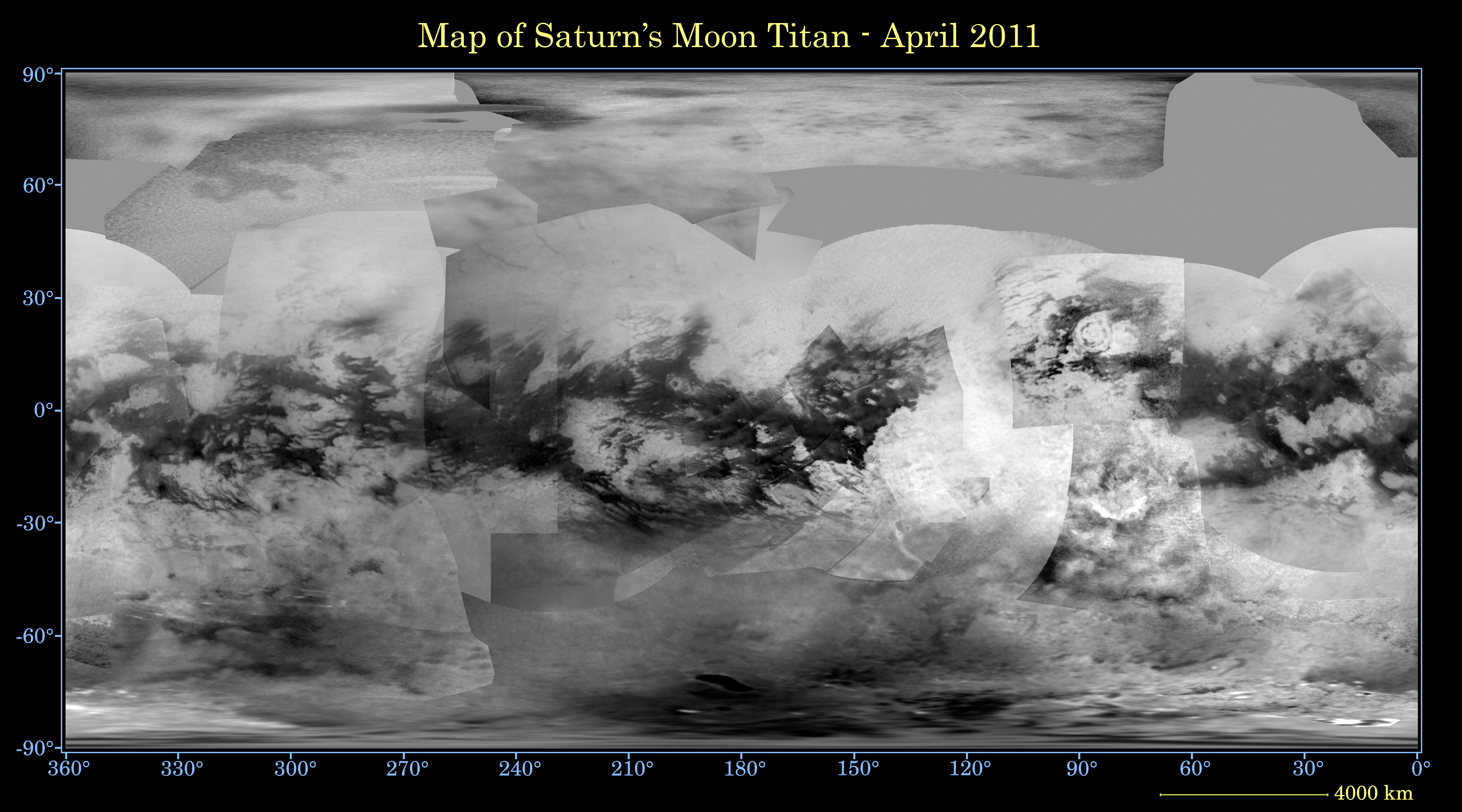
(As a side note, the closer we get to Pluto and the more we see of it (dark band at the bottom is around the equator), the more it's starting to remind me of an airless Titan
-
Re:Alarming Freedom
Research the topic "how do cloud formation affect global warming".
Is it a fact we understand the impact of cloud formation on global warming?
Read what NASA thinks about it? http://isccp.giss.nasa.gov/rol...
Here is an excerpt: "Right now, we do not know how important the cloud-radiative or cloud-precipitation effects are and can not predict possible climate changes accurately."
My point is not diminish the concern of global warming, but to make the point that when we start talking about science in absolutes, we start to sound like religous fanatics, rather than rational and objective. -
Nice place to visit, maybe even stay a while
Say, people are beginning to pay attention. High enough, the climate is nice. Possibly not as nice as Jamaica. But nicer than, say, the moon:
-
Re:Once Again
"Everything at NASA is always overbudget and behind schedule." This is simply not true. Some programs at NASA are on time and under budget. Take a look at New Horizons or the Van Allen Probes. http://www.nasa.gov/news/budge... "made billions raping us of our tax dollars" is offensive to me. I think it's excessive language and it's not realistic. NASA's budget has remained 0.5% of the federal budget for decades, and NASA's results compare very favorably to those of other countries' space programs and with commercial efforts. I invite you to work in the space industry for a few years and then come back and tell us all how much more efficiently and accountably it could be working.
-
Re: Coral dies all the time
Well, you took the time to write all that out, so I'll do you the courtesy of a response, but I will point out that none of it is worth saying without citations (which was the entire point of this thread).
You call it "common knowledge", but when it contradicts the published, peer-reviewed results from any number of studies, which are compiled, published and endorsed by organisations like NOAA, CRU, CSIRO, and the IPCC in numerous countries, then your "common knowledge" doesn't seem to be all that common at all. I provided linked citations of reputable sources for my claims, so you'll need data at least as reputable (please, no blogs or news articles). I've heard claims just like yours countless times, and nobody has yet provided any reliable data to back them up.
"[surface temperature stations] are mostly not very accurate" - a vague claim, but in aggregate they can still give a very accurate picture of the temperature trend.
"[satellites] have their readings INCREASED every year...The current "correction" is about
"the depths of the ocean are not warming... It rarely goes below 100 meters much less 200 meters." - the data shows that ocean heat content has been rising steadily down to 2,000m. Below that, NASA finds no significant change. But there's a huge amount of energy going into that top 2km of the world's oceans.
"there is no way to know how much [sea level rise] is the result of a climate change and how much is climate cycle." - well, we know that sea level rise accelerated significantly in the last 150 years. We know that it's consistent with predictions based on thermal expansion and measured ice loss. If it's part of a long-term cycle, there needs to be a cause, and there's no credible evidence of any cyclic cause at that timescale.
"There are regions that are losing ice and regions that are gaining ice... How much ice are you saying has melted... just give me your rough estimate." - Shepherd et al 2012 finds a net ice mass loss of over 200 gigatonnes/year for the last couple of decades, using multiple lines of evidence.
"ice extent is very easy to estimate. And ice extent doesn't show a decline." I cite ice mass because it's what matters, for rising heat content and for sea levels. Ice extent is a fairly inaccurate indicator of overall ice melt. That said, ice extent has been declining in the Arctic and Greenland while increasing in the Antarctic (despite overall ice mass decreasing there by around 70 Gt/y).
"if the ice packs were melting over all to any significant degree you'd see a great deal more sea level rise than we have seen thus far... We can look at the volume of water in the oceans and compare the change to your ice loss figures." - Yes, and it matches well with what we've observed, including accounting for thermal expansion (which, if you're tacitly admitting exists, requires significant ocean warming).
Citations - yes please. At this stage, if you have any further claims to make, I want to see only links to reputable published data and peer-reviewed studies, not talk of "common knowledge" or speculation from laymen or reporters.
-
Press Conference is on now (12:50 EDT)
Video stream
-
Re:But what about nitrogen?
No, not oxygen, but nitrogen. There's some, but not enough to be useful: https://www.nasa.gov/content/g...
-
Re:Because titan has ice, pluto isn't even a plane
I believe Voyager 1 still hasn't passed pluto if projected back down onto its orbital plane.
Voyager 1 is almost 20 billion miles away from us now, and is traveling about 35 degrees out of the ecliptic. Some really rough trigonometry shows that if you project that down onto the ecliptic, it's still about 16 billion miles away from the Sun, which is almost three times the length of the long axis of Pluto's entire orbit. -
Omnomnomnom
Black holes also apparently emit sound. Isn't that an eerie thought? Frequency is astronomically low though.
-
Re:Funding
Apollo 17 astronauts covered nearly the same distance (22 miles) in less than 22 hours.
You might want to check your figures.
That was done in three traversals where the rover returned to the LEM after each traversal.On Apollo 17 the rover went 35.9 km in 4 hours 26 minutes total drive time. The longest traverse was 20.1 km and the greatest range from the LM was 7.6 km.
The LRV never got further than 7.6km from the LEM. There is the same issue with Mars. One has a limited range from base camp and Mars is much larger than the Moon.
Maybe we should be sending better rovers to Mars.
One major difference is also that the Apollo astronauts came back to Earth. Mars astronauts probably won't.
-
Re:Funding
Citation, please.
http://www.nasa.gov/topics/ear...
Scientists on the project say they are faster, but can only work 4 hours a day for a few months out of the year whereas the robot will work 24 hours/day nonstop so the robot can collect more data and samples per day.
-
Re:IMAX is a brand?
That's weird I always assumed IMAX was just a generic term for theatre with a big ass screen?
Let me put this another way... ask anyone what do you call a movie theatre with a big ass multi-story curved screen?
In various contexts people talk about IMAX cameras and film formats even NASA folks talking about the imax camera for curiosity
Who knows that IMAX is a brand? Perhaps they have already suffered severe dilution and currently deserve no trademark/brand projection of any kind.
NASA isn't using "IMAX" as a general term for high def camera, they use actual IMAX branded cameras:
https://www.nasa.gov/multimedi...
Your belief that IMAX is a generic term is exactly why IMAX has to vigorously defend their trademark, even if they've overstepped this time.
-
Re:Effect of nukes on NEOs
This obviously isn't too helpful for a world-ending impactor (hundreds of miles+)
Anything that size is already known. It is unlikely that any NEO bigger than a few km, or about 10 billion tonnes, is still undetected. For a NEO that size, a 10MT warhead (about the size of a minivan) could blow it to smithereens.
NASA is currently working on detecting NEOs between 140m and 1000m.
-
Re:Of ALL places, I learned this on /. ... apk
-
Way Premature - And Probably Unnecessary
There are wide variety of possible cosmic collision threats - with only rare once-a-century (or less frequent) size events being candidates for any sort of deflection scheme. More frequent ones we can absorb with minimal damage. The 2013 Chelyabinsk event was a 20 meter class asteroid, and we get hit with a few of these a year. Even a repeat of the Chelyabinsk over a much larger city would not be catastrophic, as a natural catastrophe it might rank as a "major storm" in terms of damage potential.
It is larger asteroids, above the 20 meter size, that are destructive enough to consider an international interception mission.
Barringer Crater in Arizona is an example of a 50 meter object (a once in a millennium event), such an impact would be highly destructive in a populated area. Current collision threat programs have identified 96% of the "civilization ender" 1+ km class objects (once in a million year event), and are moving toward identifying 90% of the 140 meter class (once in 10,000 years).
The ideal method dog dealing with any collision threat is to detect it long in advance, accurately measure its trajectory, and then modify it just enough to avoid a predicted collision years later (perhaps many decades later, even centuries later for really big ones). Smaller objects need smaller nudges and can be diverted at later dates than big ones. An aggressive monitoring system is the first line of defense, without detection there can be no defense, and the better your detection the easier deflection becomes, and the cost of monitoring is much less than a single interception mission.
A variety of nudging techniques have been proposed: kinetic collision diversion, gravity attractor tugs, and nuclear deflection schemes primarily, but all of them are in early stages of development and have some promise. Different deflection schemes might be needed based on the nature of the threat object (size, physical nature, etc.).
Until we have candidate defection systems to evaluate, and actually test, it is way premature to discuss storing nuclear devices for this purpose. Probably storing a ready made device would be of no value. When we detect a threat requiring deflection we would first need to organize the whole launch and space probe project, which would likely take a few years (assuming warning times on the order of decade) during which time a nuclear device customized to the mission could be manufactured as needed. If the world decides (after suitable development and testing) that a ready-to-launch-on-short notice vehicle is a good idea to deal with small threats detected months in advance, and it is determined that a nuclear device is the proper technique, then we would only need one such system to be built and kept ready - with a grand total of one special purpose nuclear device.
-
Re:Effect of nukes on NEOs
RTFA They specifically look at a standoff explosion versus a surface or subsurface explosion and prefer the standoff explosion precisely because they are aware of the possibility of blowing something up with a nuclear weapon. Amazingly enough, the professional rocket scientists at NASA actually considered the consequences of the alternative tactics before making their recommendation
-
Re:Wind is the answer!
Well, NASA says it's 250 F in the sun and -250 F in the shade. They do use a radiator to dump waste heat, and it's big... 1680 square feet big. But that takes care of the environment plus the equipment and that is a lot of waste heat being moved. So it's kind of being used now, but there's not enough differential for creating power. I was thinking waffles of high pressure capillary tubes for the heater/condenser... but it's all just spitballing...
For results send up Jamie Hyneman. For a space station in the back yard, send Adam Savage along.
http://science.nasa.gov/science-news/science-at-nasa/2001/ast21mar_1/ -
Re:HÃ?
Space probes do get started on earth, and have to go through a somewhat unreliable launch process to get to space. There is a fear that if the rocket were to blow up, radioactive material released into the atmosphere would be dangerous.
It almost certainly wouldn't be. Even in the worst-case scenario, that the RTG vaporized on reentry, it would be heavily dispersed. Still, NASA calculated for a similar case, there could be several thousand deaths (page 66). (Not that you could peg any one death to it, but rather thousands of additional cancers compared to not having an accident with an RTG launch failure.) Plus some land contamination with radioactive dust.
So it's not completely insane to be concerned. They figure your personal odds of dying because of it to be one in a trillion, which most of us would say is too low to think about. But I can understand why a few people might say that even one-in-a-trillion (especially since it's repeated for everybody on the planet) is worth considering. It's not as simple as having it millions of miles away in space.
-
Re:Encryption? Air-gapping? Pah! That's for pansie
You'd think people would treat data like that as sensitive, but security people are remarkably bad at that. NASA lost a similar data set (at least the PII, and possibly the submitted data for SF85 and SF 85P) when a laptop containing it was stolen from a car in Washington: stolen nasa laptop. They let my personal data get out in that one, now apparently they've done it again at OPM.
Somewhat amusingly, the NASA CIO office had predicted such an incident just a few months before the laptop theft in their newsletter see page 6 of this pdf NASA OCIO newsletter
-
Re:Offshoring
I quote NASA themselves to cut your bullshit:
For fiscal year (FY) 2012, NASA received $397 million for its Commercial Crew Program; less than half its $850 million request. In light of this development, in August 2012, NASA revised its Commercial Crew Acquisition Strategy to rely on Space Act Agreements rather than FAR-based contracts for the integrated design phase of the program. The Agency also delayed the expected completion date of the commercial crew development phase from 2016 to 2017.
https://oig.nasa.gov/audits/re...Congress is the cause the delays you little shill. Not SpaceX.
-
Re:Offshoring
However the reasons where clearly due to Space X's failure to get their act together and provide confidence that they will be human rated in time to take over when the contract with the Russians was set to end. So NASA really doesn't have much choice, because if Space X isn't ready when the current seats we have from the Russians end, we'd be in a place where no US crew replacements would be possible.
Bullshit. SpaceX recently did a test of their crew escape mechanism:
https://www.youtube.com/watch?...
http://www.nasa.gov/press-rele...If the project has had any delays so far it has been purely because of continued Congress underfunding. They keep cutting it below what NASA asks. While the pork barrel SLS just got itself a budget increase.
-
Re:FFS, it's been available for decadesFrom http://www.giss.nasa.gov/tools...:
The model version being used for the CMIP5 simulations will soon be available in a complete package, though there are nightly snapshots of the current code repository available (including the frozen 'AR5_branch'), but users should be aware that these snapshots are presented 'as is' and are not necessarily suitable for publication-quality experiments.
In other words, the model isn't ready/reliable. Perhaps you'd better stop staring at the Sun for so long, AC: the risks to your health are much greater than those posed by Global Warming.
-
Re:Many are already using HTTPS and IPv6
OK, but explain to me why https://www.nasa.gov/ needs SSL/TLS at all, including the ongoing costs to maintain certificates and infrastructure, when it's a purely informational site?
It's like insisting that posters of cars should be retrofitted with air-bags and collision detection.
-
Re:Projections based on what?
So your not entering the bet will be your own admission that even you can make climate predictions ten years into the future.
I don't recall making any claims about times spans below the threshold for judging average climate. According to NASA, that threshold is around 30 years. So it is reasonable to consider the climate 10 years from now to be approximately the same as the climate today. Therefore, on that basis alone, I won't be taking your bet.
My claim was simple:
we don't know what the climate will be in 100 years
That doesn't mean we don't have any clue... just that we don't know with the precision that would require us to prepare for the certain end of humanity.
-
Re:Meaningless politial release
Now if they'd only make available [1] the models (as in code)
The code for many climate models is available if you care to take the time to look for it. For instance the NASA/GISS Model E code. Finding a supercomputer to run it on is a problem but you can scale it down to run on your PC if you like.
-
NASA agreesThe bottom line direct from NASA is that there's a 12% chance every decade (or 72% chance every century if you do the math) of a direct hit from the sun. Such an event could send us back to the middle ages, or at least cause widespread destruction and panic (no water, electricity, transport, etc. for days, weeks, possibly months, and all or most computer circuitry, including SSDs (though not optical media) would be frazzled).
I'm going to temper that apocalyptic-looking premise with a quote from that NASA article which may provide a little... comfort.The worst geomagnetic storm of the Space Age, which knocked out power across Quebec in March 1989, registered Dst=-600 nT. Modern estimates of Dst for the Carrington Event itself range from -800 nT to a staggering -1750 nT.
So, that's 'only' up to 3x as bad as an event that happened in 1989, and we seemed to have got through that okay (their power was cut for 11 hours apparently).
Maybe even NASA is over-reacting a bit on this then..... But like CO2 emissions, it's best not to take the chance. It is possible to protect the grid to a large extent if the world cared enough the risk. I think we're talking in the range of $billions of investment to save $trillions of damage when the inevitable happens (definitely a question of when, rather than if). -
Global warming has continued unabated since 1950
As evidenced by satellite data, the Earth has experienced a positive energy imbalance since 1950, accumulating more heat than it radiates into space. This additional heat warms the land, melts the ice, increases the air temperature, and accumulates in the ocean.
The 2014 global land-ocean temperature index data produced by NASA’s Goddard Institute for Space Studies shows an average rise of 0.12C per decade from 1950 to 2014. In 2012 Nuccitelli et al combined the ocean heat content measurements (surface and subsurface) with the land, ice and atmospheric measurements, showing a global energy increase of 20×10J since 1960.
There is a myth that global warming stopped in 1998—often called a pause or hiatus—because the surface air temperature rose only 0.05C per decade from 1998 to 2012 while atmospheric CO2 levels continued to rise. This argument is flawed for several reasons.
The myth ignores the surface temperature data before 1998 and after 2012. This is an example of cherry-picking: choosing a subset of data to fit an argument while ignoring the data that contradict it. By taking the fifteen year period starting in 1996, one could claim that global warming has increased since the rise for that period was 0.14C per decade. It is only by considering the entire dataset that we see an accurate picture.
The myth ignores the natural variability in the Earth’s climate due to trade winds, sun intensity, and volcanos and assumes the data measures only AGW (anthropogenic global warming). This is an example of misrepresentation. For example, due to the El Niño Southern Oscillation cycle, 1998 saw a particularly strong El Niño warming while 2012 saw a weak La Niña. This caused a considerable ENSO cooling during that period that partially masked the warming trend from AGW.
The myth jumps to the conclusion that a short-term slowdown in the temperature rise will continue forever. There have been similar short-term pauses throughout the twentieth century, but each was followed by a larger short-term rise that offset it. The long-term record shows a clear warming trend of 0.12C per decade.
Finally, the myth focuses on the surface air temperatures and ignores the increasing ocean heat content, increasing sea level, and decreasing arctic sea ice mass—another example of cherry-picking. For example, the Nuccitelli data shows an energy increase of 6×10J since 1998. Taken together, these demonstrate the simple fact that the Earth is warming overall, matching the satellite data.
You can find more at Skeptical Science.
-
Re:Y2K not as bad as predicted either
http://www.nasa.gov/content/wi... - this was only a year ago
they still do wind testing -
Re:Exodus
... you cherry-picked a quote out of it:
Of the two forms of pollution, the carbon dioxide increase is probably the more influential at the present time in changing temperatures near the earth's surface (Mitchell, 1973a).
While completely ignoring the very next sentence:
"If both the CO2 and particulate inputs to the atmosphere grow at equal rates in the future, the widely differing atmospheric residence times of the two pollutants means that the particulate effect will grow in importance relative to that of CO2."
If, Jane. If both the CO2 and particulate inputs to the atmosphere grow at equal rates in the future. But that didn't happen after ~1975 in the U.S.A. or in Europe.
... In the context of the recent GLOBAL COOLING, it states:
While the natural variations of climate have been larger than those that may have been induced by human activities during the past century, the rapidity with which human impacts threaten to grow in the future, and increasingly to disturb the natural course of events, is a matter of concern....
Now, I know you are completely inept when it comes to context, but that statement is the overarching context of their later comments (given above) about CO2 and aerosols.
Even if I'm completely inept when it comes to context, it seems to me like those statements apply to both carbon dioxide and aerosols. And they were right about both. Globally, we just stopped emitting so much SO2 after ~1975 but kept emitting CO2 even faster.
... They clearly express concern that man's influence is increasing, and suggest that aerosols could very well overwhelm CO2 if the current trends continued. So don't try to give me crap about what I understand and what I don't. I'm not cherry-picking, YOU did. I just gave the LARGER context of the statement that you cherry-picked out of it. [Jane Q. Public, 2015-06-04]
If the current emissions trends in 1975 had continued, the global dimming caused by aerosols could have overwhelmed warming by CO2. That's a perfectly reasonable if statement. But since global aerosol emissions declined after ~1975 (see fig 1), that if statement doesn't apply to our universe.
As I have stated so many times in the past, this is exactly the kind of behavior I have come to expect from you, and why I do not engage you in debate. I may make mistakes, but at least I am honest. I have pointed out many times where you were clearly were not. And that was one of them. [Jane Q. Public, 2015-06-04]
Good grief, Jane. It's bizarre to be accused of not being honest because I didn't quote an if statement from a report that doesn't apply to our universe where aerosol emissions declined after ~1975.
I quoted the 1975 NAS statement that CO2 warming could be "about 0.5C between now and the end of the century" because it applies to our universe. The 2007 IPCC estimate of radiative forcing up to 2005 shows that aerosol emissions roughly cancelled al
-
Re: Data doesn't fit political needs! New Model ST
So, you're saying that nitrogen, oxygen, and CO2 are the only components of the atmosphere? Sorry, I did the math. You are leaving out quite a bit, especially WATER.
Heat capacity IS spectral absorption. RAMAN+IR spectral absorption. If you disagree, then one of us doesn't know what he is talking about, and I have the degree in the subject.
No, it most certainly is not. You take a transparent vessel, put a heat lamp in front of it, and stand on the other side. Normal air? You can feel the heat through the vessel. Fill the vessel with CO2 gas, and you immediately notice a significant reduction in the heat felt. You can quantify the decrease using IR sensors/FLIR cameras and plate thermometers. Very straightforward.
[citation needed]
More gas, more absorption.
Yes, until 100% of the radiation is absorbed, which happens at a pretty low concentration, one that we already passed. IE there is no difference between an atmosphere where 100% of photons are absorbed within 20 meters, and one where it happens within 10. This is because it is SATURATED. More doesn't matter. That is what the word "saturation" means.
"so the CO2 does not stay where it is generated for very long"
Yale begs to disagree. http://e360.yale.edu/digest/co... CO2 domes are a well known phenomenon, and any organization that DENIES their existence should immediately lose credibility in this discussion. Luckily for NASA, that isn't at all what that web page is about.
Also, please stop making shit up because it sounds like it supports your argument. All you are doing is destroying your own credibility. Ideas are not soldiers. You are not obligated to support ideas that are on your side even if they are wrong or weak.
"[citation needed]"
https://en.wikipedia.org/wiki/...
http://news.nationalgeographic...
http://visibleearth.nasa.gov/v...
Really, just a duckduckgo search for "percentage of land that is irrigated" and "percentage of land that is paved". Its a lot. If you don't believe me, take the window seat next time you fly across country and MARVEL at the number of huge circles of irrigated farmland. Or just look out the window of your apartment and note how much of the area that you can see is or isn't paved. -
Re: Data doesn't fit political needs! New Model ST
Except the blanket ISN'T transparent. You are adding GREY specs that are very slightly LIGHTER than the average of the rest of the material.
1) Nitrogen and oxygen are transparent to IR, so for all intents and purposes, the "blanket" in this analogy is transparent too.
2) You are conflating heat capacity with spectral absorption. These are not even remotely related.
Yes, you can do that experiment, but you would need to compare it to regular atmosphere (with the average humidity taken across the entire planet). Do that, and you find that the difference is within the margin of error.
No, it most certainly is not. You take a transparent vessel, put a heat lamp in front of it, and stand on the other side. Normal air? You can feel the heat through the vessel. Fill the vessel with CO2 gas, and you immediately notice a significant reduction in the heat felt. You can quantify the decrease using IR sensors/FLIR cameras and plate thermometers. Very straightforward.
Water vapor absolutely does NOT trap IR the same way as CO2.
Thank you for basically repeating what I just said, glad we're in agreement.
CO2 has a thin, sharp, very tall peak, meaning it becomes saturated at low concentrations
Wrong on two levels.
For one, there's no concept of "saturation" at work here - CO2 will absorb ALL of the IR energy in the appropriate wavelengths. It's not like the molecules get "full" and let the rest of the IR pass through. The only factor that determines how much of the total radiation is absorbed is the density of the gas: More gas, more absorption.
For two, CO2 has three major peaks and one minor peak, not just one, and they aren't terribly sharp.
Oops, sorry, left the "nature" groups out. Go to the high desert where there are no people (and thus less CO2),
CO2 doesn't quite work that way. The atmosphere is constantly being mixed, especially at high altitudes, so the CO2 does not stay where it is generated for very long. That's what makes this a GLOBAL problem.
Deserts are cold at night because there's no mass to hold the heat. The sand does not hold much thermal energy and there is no entrapment of the radiation from other surfaces because it's basically flat. All emitted thermal radiation quickly escapes into the atmosphere instead of being trapped by buildings and trees.
This is another experiment you can try: Park your car overnight such that it is half under a tree. If it dips below the dew point overnight, you'll likely find that the parts of your car that have a clear view of the sky have more dew on them than the parts that can only "see" the tree, which may not have any dew on them at all. The car emits thermal radiation, and the tree absorbs/reflects some of that radiation back where the sky does not. The result is the exposed portions of the car can more easily shed the thermal energy and thus collect more dew.
95% Humidity areas away from civilization also have dense forests which trap the heat overnight.
And we do, in fact, pump a LOT of water into the air. It's on the same order of magnitude as would be expected for the observed warming.
[citation needed] - Gonna have to see where you're getting these numbers.
=Smidge= -
Re:Error 1201 on Apollo 11
Error 1201 was not enumerated but luckily someone had read the system documentation https://www.hq.nasa.gov/alsj/a...
-
Re: TL;DR
Numerous pages, including this one from NASA, say that from an outside perspective it takes an infinite length of time for an object to cross the event horizon. Here's an "Ask a Physicist" column about black holes that says that time distortion reaches infinity at the event horizon. The Wikipedia article on event horizons says the same thing.
From our perspective, nothing ever passes the event horizon and thus the information is never lost.
-
Re:just a though
Probably not a conventional ramjet
"In a ramjet, the high pressure is produced by "ramming" external air into the combustor using the forward speed of the vehicle"
https://www.grc.nasa.gov/WWW/k...Perhaps you mean the Bussard ramjet or ramscoop
"The Bussard ramjet is a theoretical method of spacecraft propulsion proposed in 1960 by the physicist Robert W. Bussard, popularized by Poul Anderson's novel Tau Zero, Larry Niven in his Known Space series of books, Vernor Vinge in his Zones of Thought series, and referred to by Carl Sagan in the television series and book Cosmos. Bussard ramscoops are also seen in Star Trek, where they are situated at the glowing tips of the warp nacelles of spacecraft, although the hydrogen is not used as nuclear fuel."
http://en.wikipedia.org/wiki/B...I like the idea since it would consume the hydrogen that could potentially pierce the spacecraft at relativistic speeds
-
Re:Exodus
Yes, what you're saying matches my conclusions.
Of course, the link between clouds and temperature is even less straightforward. As I recall the research suggests there is only a very small effect on average temperatures, though there is a dramatic effect on the diurnal variation - cloud cover tends to stabilize temperatures, causing slower heating during the day, but also slower cooling at night.
Yes. Another complication is that high, thin clouds warm the surface while "low, thick clouds primarily reflect solar radiation and cool the surface of the Earth."
-
Re:Corruption? In Russia?
Yeah, I mean, take a look at NASA, it always had such a proud and distinguished record...
Oh, wait...
Seriously though: whether in Russia or in the USA, such an important agency, in charge of a large budget, is bound to generate fraud and shady dealings. At least, the Russian government is doing something about it.
-
Re:I'll believe it when I see it...
Been there, done that. Meanwhile, Mars gets all the love, including a new rover.
-
Of course they shed into the ocean
If you've been looking at this for a while you know the antarctic ice mass grows in the middle and cleaves around the edges. The antarctic mass has been growing steadily for 45 years and has never been bigger than now.
How and why it's growing so much in a supposed "warming" world I leave to your imagination although keep in mind a new paper shows the rate of warming in the 20th century is the same rate as the previous 80 centuries.
Refs:
http://www.nasa.gov/content/go...
http://multi-science.atypon.co... -
Re:Strangely mixed signals here
And even the graph shows a downward trend.
For ice trends it's important to note if you are talking Arctic versus Antarctic as well as land versus sea ice. Here's a link for sea ice extent in both Arctic and Antarctic from NASA. Shows pretty clear downwards trends in Arctic and upward in Antarctic. Incidentally, the IPCC first report in 1990 estimated warming would reduce Arctic sea ice, but precipitation changes would increase overall ice mass in Antarctic...
-
Re:More hysteria
And your source for data that says ice is accumulating in the Antarctic Interior?
Most of the interior is a desert, no more than a few centimeters of ice crystal precipitation per year.
I don't know about the parent's sources for interior ice, but here is a link from NASA for sea ice extent and area of both the Arctic and Antarctic. Pretty clearly shows a downward trend since 78 for the Arctic and upward since 78 for Antarctic. Pretty much in keeping with the IPCC original predictions back as far as 1990 expecting warming to reduce Arctic sea ice, and resulting precipitation to increase accumulations in Antarctic.