Slashdot Mirror
Domain: nasa.gov
Stories and comments across the archive that link to nasa.gov.
Comments · 16,365
-
Re:Heard this nonsense before:
there is some truth to this somewhat rambling parent comment.
In fact, at a meeting in Washington this past summer to debate the future of HST, one of the most interesting presentations was by the editor of Sky and Telescope. He pointed out that despite the optimistic timelines for launching new satellites, not a single one has come in on schedule, and in fact HST itself was delayed for seven years beyond the projected launch date. "few [amateur astronomers] will put any faith in NASA's claim that HST's successor will be in orbit by 2011."
And HST was built with only modestly new components. The next space telescope is now being designed with some very new technology -- including the biggest mirror ever lofted into space -- and you think there will be no delays or unforseen difficulties?
His final point was that much of the science as well as amateur community benefits and takes interest from the very existence and productivity of Hubble, and to take away a working observatory for the mere promise of one "next year" or "in 5 years" would be a big blow to astronomy.
for his report, see here -
They liked it back on august...
Back in August, a NASA panel recommended keeping Hubble:
pdf link at nasa
But they did want proposed experiments to go through another round of peer review. -
Cost
-
Hubble telescope is incredible but
We shouldn't keep doing costly upgrades
Also isn't possible to build a newer,bigger version of Hubble for less money. Say a billion dollars ?
And also why does it take so long to build a space telescope. Why weren't we prepared for a replacement ? Is ground based going to cut it ? Keck ?
Nasa projects interferometer mission in 2009 but not soon enough.
-
The next generation is already being worked on.Link
Therefore a logical decommissioning date would be just after the new scope is up and checks out functionally.
Has anyone thought about automating this stuff? Make these things modular so unmanned robots can do the servicing and updating. Embed little marker tags into the craft so an approaching repair-bot can find its way around, like those robots that follow colored lines on the floor.
-
Re:$600 Million
According to the JWST Website, the next generation space telescope will cost "$824.8 million". What were you saying about comparative cost, again?
-
Re:For the time being.
Lunar observatory? How 'bout the James Webb Space Telescope, slated to launch on August 2011.
-
MIT Open Courseware
MIT Open Courseware These are not whitepapers and the like. Rather, they are mostly lecture notes from the professors who teach the classes there - Enjoy!
p.s. - Check out the link in my earlier post -
NASA Technical Report Server
NTRS - Enjoy!
-
TPF: Terrestrial Planet Finder
I'm really disappointed that this wasn't on their list. .
Terrestrial Planet Finder
If this thing finds Earth-like planets in our nearby galactic neighborhood, it could change the whole way we view our places in the cosmos. -
Re:No Need to 'Eyeball Guess', stupid. Just RTFA!
Smallest visible features are not the same as the size of each pixel though.
Let's work out just how big each pixel is:
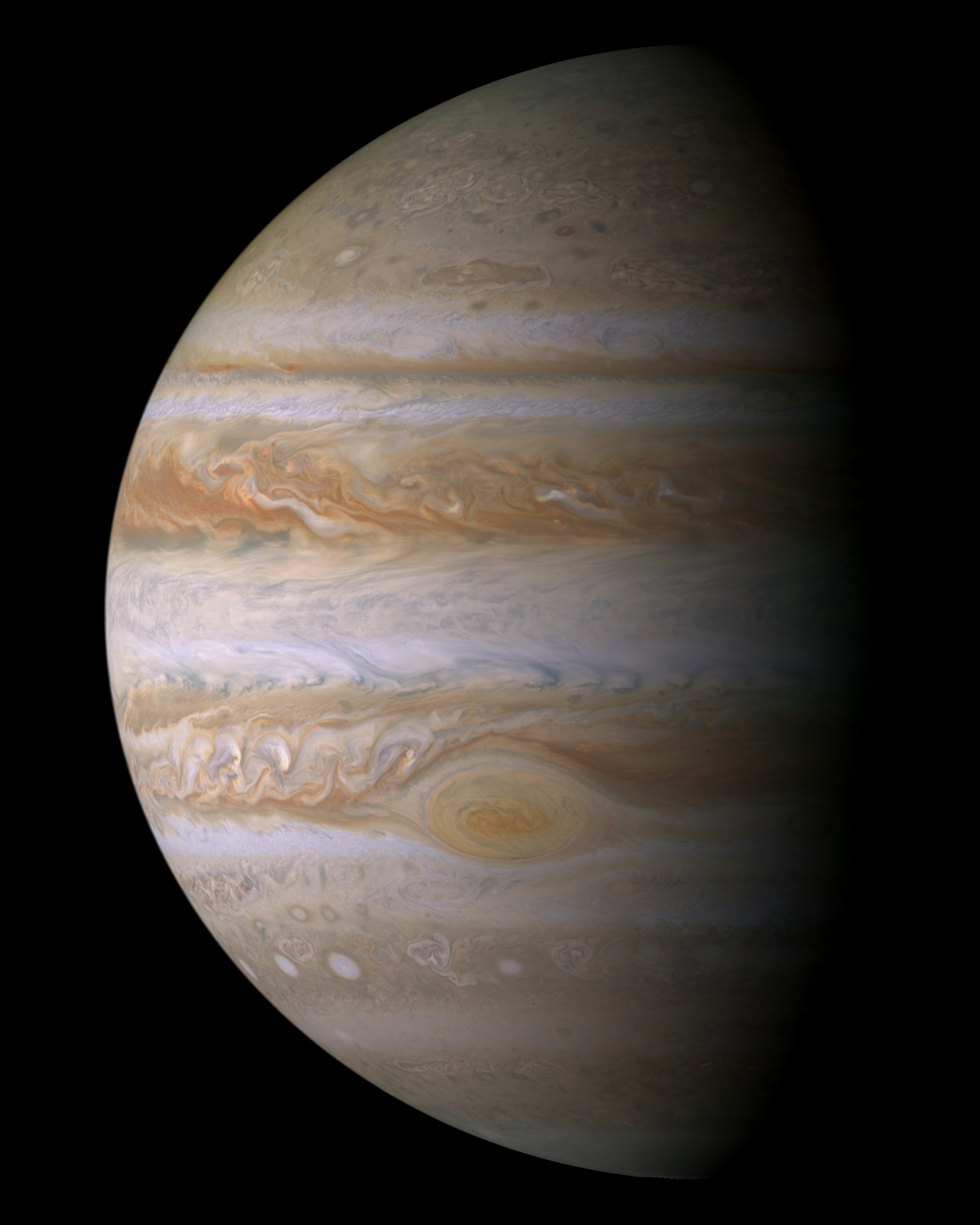
The largest image there has about 2240 pixels from the top of jupiter to the bottom. According to this website at NASA, jupiter has a diameter of 142,800 km.
142800/2240 is 63.75 km per pixel.
Oh, this works out the same as what it said on the website. Whoops. Ah well, at least you have an independent confirmation.
Just for the record, Pennsylvania is 309 miles long and 174 miles wide. That's 497 km x 280 km. Let's assume a square Pennsylvania of the same area, and we get 373 km per pixel. -
Re:No Need to 'Eyeball Guess', stupid. Just RTFA!
Here's one...(4.4 MB)
-
Featured on APOD today
One of the images was featured on the Astronomy Picture of the Day site, so they have a mirror.
-
Featured on APOD today
One of the images was featured on the Astronomy Picture of the Day site, so they have a mirror.
-
Re:Here ya' go...
Well, NASA planned to create a Mars-Internet. I am not sure if the project will be continued, because of some problems with some probes NASA sent to Mars. Anyway, you can find some information here: Marsnet
-
Re:How about an investigation no just me
I need that site to get backgrounds for computers. The only reason I subscribed wasn't the quality of the work - its good, but not great - I mean, these little men in these giant settings are lame, and these little wizards hanging around can be gay, and his renditions of catastrophic events in Space seem gay, and some of his planets capes have celestial bodies so close together that the gravity would be severe.
I think about Alpha Centurai and the binary star system and the possibility of another heaven and another earth, and wish there were more renditions of that - you know, pictures of new animals and sentient life and they are only 4.2 light years away.
I used to read H.M. Hoover Books. She wrote some interesting things and sometimes I wish they were real. I also like Ayn Rand. I want a near light or FTL spaceship with a holo-doc like on Voyager.
But Digital Blasphemy's art can seem gay when you can see reality every day at http://antwrp.gsfc.nasa.gov/apod/. Everyday a really nice picture from reality gets posted. I would say some are background desktop quality.
Sometimes I wish the Stargate was real, and I could travel to Alpha Centurai on it.
The think I do like about Digital Blasphemy is that when I help people setup their computers, I have them pick a background from there, and since he is offering a pay-for service, it's nice to have such a large online archive available. I wish he would charge less.
I liked how on Turok when you got an extra life from collecting enough spirit tokens, he screamed; "I AM TUROK." My friends and I would laugh and say, Whoa, whoa, relax CHIEF.
I thought SpaceBalls and Blazing Saddles were funny. I should see them soon.
I only eat ethnic food now. I like Indian (Punjabi Style, North and South and Goa), Pakistani, Japanese (Sushi and Yakitori), good Mexican food, not Tex Mex and Thai food. And I eat it hot and spicy.
I like good wine but it doesn't pair well with Spicy Food. I'll drink beer with Spicy Food. I like Hoegaarden for beer. And Corona Light, Becks, Sapporo, and Pilsner Urquell. Oh yeah, and Lindeman's Peche Lambic for dessert.
Aqua Teen Hunger Force rules. I don't need no instructions to know how to ROCK.
-
NASA's is way cooler...
http://robonaut.jsc.nasa.gov/status/Sep_Robonaut_
S tatus_03.htm
Robonaut + Segway = Really, really cool! And in response to the question I know will be asked (what's with those huge braces in all the photos), the reason those are there is this: just in case, for some reason, the thing falls down, they don't want it to hit the ground. The Segway RMP part is worth about $5000, but the Robonaut torso is worth either $250,000 or $750,000 (I can't remember which), and it banging into the ground would be a very bad thing.
Mr. Spleen -
....required someone MAKE a copy.
Having a copy of a video on your hard drive is (arguably) fair use. If your next door neighbor makes a copy of it, then that was and will still be copyright infringement. Under the new law, however, merely having the file up on an open FTP server or Samba share will count as copyright infringement EVEN IF IT CANNOT BE PROVED THAT YOUR NEIGHBOR MADE A COPY-- or for that matter, even if he DIDN'T make a copy. Because it's possible, you're guilty of copyright infringement
Huzzah for the senator from the MPAA.... -
Re:Little Off TopicI thought you said Hydrogen was hard to come by on the moon? Either its scarce or it makes up a large percentage of the "atmosphere" (along with helium). It can't be both.
According to NASA, the total mass of the lunar atmosphere is around 25 000 kilograms - less mass than a railroad car. Therefore hydrogen is scarce.
Best wishes,
Mike. -
Re:1967 Outer Space TreatyCorrect... I claimed Jupiter back in 1993 and my suit for damages and loss of amenity against the "owners" of the Shoemaker-Levy 9 comet is coming along quite nicely now...
-
1967 Outer Space Treaty
http://history.nasa.gov/1967treaty.html
From Article II:
"Outer space, including the moon and other celestial bodies, is not subject to national appropriation by claim of sovereignty, by means of use or occupation, or by any other means." -
Re:Built In Rockets?: Sadly, No
> > The Space Shuttle Columbia delivered Chandra to a low Earth orbit. Then, the Inertial Upper Stage rocket boosted Chandra up to a higher altitude where a built-in propulsion system took Chandra to its final orbit.
> I'm wondering whether there's some juice still left in Chandra's propulsion systems.
Sadly, no. Changing orbits between the Shuttle's LEO and Chandra's large elliptical orbit (it moves almost one third the way to the moon) requires massive amounts of fuel. The Inertial Upper Stage is actually a large two-stage solid-fuel booster with over 25,000 lbs of fuel and 40,000 lbs thrust. This rocket is discarded along the way. Chandra, itself, has some fuel and some tiny thrusters (105 lb thrust each), but that is completely inadequate for a big job like moving back to LEO.
As Douglas Adams said, "Space is big. You just won't believe how vastly, hugely, mind-bogglingly big it is. I mean, you may think it's a long way down the road to the drug store, but that's just peanuts to space." Unfortunately, this harsh reality means that moving in space is expensive, mind-bogglingly expensive. -
Re:Shoestring is the right wordWhen are the other probes due to land?
Spirit Lands: January 3, 2004 between 8-9 pm PST
Opportunity Lands: January 24, 2004 between 8-9 pm PSTFrom the rover homepage. Also check the Athena science package homepage, and read the news archives to get an idea of how much work went into the instruments alone.
-
Diffraction makes it unfeasible
The problem with puting a huge laser on the moon is that if you want the spot on earth to be smaller then say, texas, the laser on the moon have to have a very very large aperture.
Some aspects of lasers and the distance to the moon can be found here
-- -
Re:Practical?
Uh, we bounce lasers from earth to the moon, all day long, every day. They are measuring the distance to the moon, using the speed of light. It doesn't diverge any practical distance at all.
Read here
We are hitting a reflectr 46cm^2 thats A LOT less than a mile deviation. the 46cm is just for things like vibration, and aiming issues.
BTW, this laster tells us the moon is drifting away from the earth, at 3.8cm per year! -
No, of course not.In fact, it is a massive event oppurtunity for a popular IBM supported OSS project that'll beat the shit out of SunONE.
Heard those suckers will repeat it again on a bigger scale for
-
Astronomy Picture of the Day
Yesterday's Astronomy Picture of the Day has a good animation, and today's has a picture of the eclipsed moon in infrared.
-
Astronomy Picture of the Day
Yesterday's Astronomy Picture of the Day has a good animation, and today's has a picture of the eclipsed moon in infrared.
-
Re:Slight Correction...
If it's an annular or partial eclipse you'll have problems, but a total eclipse isn't all that dangerous. A peak at a UV image of the sun reveals that the UV is limited to the lowermost corona and photosphere. Also the cornea and lens of your eye absorb most of the UV. It's the infrared radiation that's going to burn your retina. Cataracts aren't any funner than a burnt retina.
-
Danjon Scale
Amateur astronomers are encouraged to make a note of the appearance of the eclipse and rank it on the Danjon scale. The scale looks something like this:
L = 0 Very dark eclipse. Moon almost invisible, especially at mid-totality.
L = 1 Dark Eclipse, gray or brownish in coloration. Details distinguishable only with difficulty.
L = 2 Deep red or rust-colored eclipse. Very dark central shadow, while outer edge of umbra is relatively bright.
L = 3 Brick-red eclipse. Umbral shadow usually has a bright or yellow rim.
L = 4 Very bright copper-red or orange eclipse. Umbral shadow has a bluish, very bright rim.
The data is collected by Sky & Telescope and eventually NASA. For lack of another address, (astronomy AT valivingmuseum.org) is collecting data. Along with your rating on the Danjon scale, please include the following:
-Time of Viewing & time zone
-Sky Conditions: (e.g. clear, thin clouds, partly cloudy, etc.)
-General Location -
Re:What is this?
1) The eastern coast will see it
2) All of the rest of America will see it, but only while the moon is rising, Australia's actually the only continent that won't see it.
3) Slashdot serves the entire planet. It is relevant to more people than it isn't. -
conspiracyAnyone notice how the day Matrix Reloaded hit theaters there was also a lunar eclipse? And now we have another one in time for Revolutions... It's a conspiracy, I tell you! The Matrix has you!
But seriously... here's a nice animation of what we can expect tonight.
-
NASA's right...
This has been a very busy week for the Sun!
-
Mars is far and as inhabitable as MoonMars is where we need to go.
Mars may be cool but if you don't want to tranform the whole planet into second Earth there are almost no advantages of having Mars colonies compared to Moon colonies and there are many disadvantages caused by its distance from Earth. On average opositions it is 202 times farther from Earth than Moon and light travels a few minutes from it. It takes months for spaceprobes to travel to Mars during most favorable conditions.
It is important to explore Mars but its colonization is a completely different story.
-
Mars is far and as inhabitable as MoonMars is where we need to go.
Mars may be cool but if you don't want to tranform the whole planet into second Earth there are almost no advantages of having Mars colonies compared to Moon colonies and there are many disadvantages caused by its distance from Earth. On average opositions it is 202 times farther from Earth than Moon and light travels a few minutes from it. It takes months for spaceprobes to travel to Mars during most favorable conditions.
It is important to explore Mars but its colonization is a completely different story.
-
Re:Next StepMookielock has mindset that should be more prevalent in the United States. NASA has become a bureaucratic behemoth. FYI: NASA was formed as a result of the Sputnik crisis of confidence. NASA may project some greater goals, but many forget it is also an arm of politics.
In addition to the natural resorces the ablity to reseach dark-matter/energy and particle physics will be greatly enhanced without some of the disturbances from the earth (albeit, there will some new problems as well).
But above all, IMHO, the public will need to accept that there will be several deaths dealing with this exploration, and the projects need to continue regardless.
-
Re:Why?
Um, no, that is completely wrong. Apollo missions 14, 15, 16, and 17 all landed on the moon and returned safely. Please check your facts before posting.
See this NASA website for a brief overview of the Apollo missions. -
Re:Why?
-
Re:Flash?I suppose it depends on what you consider "useful." I'm not big on the ads, but then, I'm not big on ads, regardless if they're interactive of not.
Being a long time fan of animation, I've enjoyed the new ways that the medium is being used on the web. But what I haven't seen mentioned on here (yet) is Flash's use off-line. My company has created numerous presentaions in Flash and Director, because there's so much more that we can do in those applications than we can in PowerPoint. It's certainly not perfect, but I have enjoyed the ability to create more interesting and in-depth animations in a GUI rather than notepad.
As for some sites that have "good" Flash, I can't speak for anyone else, but here's some spots that I've enjoyed:
NASA's home page. They mixed in the Flash rather well, IMHO.
I don't see it anymore, but Tron 2.0's website used to have a link to their "fCon" mock site, which had been built in Flash (IIRC). This was about as well-put together of a teaser site for a game that I've seen.
Atomfilms's animation section has boatloads of Flash animations, both interactive and non-interactive, and also -- not surprisingly -- some great, some not so great.
Finally, Salon every now and then has some editorial cartoons built in Flash, which, to me, is probably one of the best uses of the application.
Oh, and on my company's Intranet we have several online demos/tutorials/examples that have been created in Flash, which make "distance learning" much easier.
Personally, I enjoy working in Flash because of my background in animation and video. I've seen it used well. and I've seen it used poorly. Just like HTML, it's nothing more than a tool that is only as good as the person who uses it.
Matt
-
Re:The high activity may repeat in two weeks
The limb of the sun is what we preceive to be its edge. Because the sun is rotating (every 2 weeks? 11 days? Too lazy to get my ASTR text atm...) the sun-spots at the base of these flares move across the limb of the sun onto the far side, and will re-appear fairly soon.
-
Re:Astronomy picture of the day
http://antwrp.gsfc.nasa.gov/apod/ap030630.html for the linkagely handicapped. Awesome picure. Makes you think that God really doesn't care.
-
Astronomy picture of the day
... and as usual the Astronomy Picture of the Day, already has a good picture posted
-
Future JPL interstellar probes..
Why not supply a link to the JPL voyager page , it has much more info.
Voyagers 1/2 have to be the most most productive space missions ever - so much of what we know about the outer planets/moons (volcanos on Io, oceans on Europa, storms on Neptune) came from Voyager first..
But Voyager was not primarily designed as an interstellar probe, and will probably run out of steam around 2020, so JPL are proposing various possible new missions - one is a solar sail based Interstellar probe which will travel around 200 AU in 15 years - much faster than Voyager. Because of its speed (14 AU/year) it could be doing science at 400 AU and beyond.. Its instruments will be far more powerful (and smaller) than Voyagers, probably including a modern CCD telescope to look at Kupier belt objects.
I say make a few of these and let them rip.. -
Future JPL interstellar probes..
Why not supply a link to the JPL voyager page , it has much more info.
Voyagers 1/2 have to be the most most productive space missions ever - so much of what we know about the outer planets/moons (volcanos on Io, oceans on Europa, storms on Neptune) came from Voyager first..
But Voyager was not primarily designed as an interstellar probe, and will probably run out of steam around 2020, so JPL are proposing various possible new missions - one is a solar sail based Interstellar probe which will travel around 200 AU in 15 years - much faster than Voyager. Because of its speed (14 AU/year) it could be doing science at 400 AU and beyond.. Its instruments will be far more powerful (and smaller) than Voyagers, probably including a modern CCD telescope to look at Kupier belt objects.
I say make a few of these and let them rip.. -
Re:Thought of evaluating the data, not the biases?
Looking around on the web some more, Mt Pinatubo released very little C02, what it did was release a lot of ash which diffused the solar radiation and made it possible for plants to absorb atmospheric C02 for some reason.
So it had the inverse effect to what you are claiming. Well done. -
The CNN Article Is Wrong
Never trust the mainstream media to get a science story right!
Voyager 1 *might* have reached the Termination Shock--NOT the heliopause. The termination shock is where the solar wind--electrically charged (ionized) hydrogen atoms blown off the surface of the sun--slows from 700,000-1.5 million miles per hour, down to under 250,000 mph. This indicates it's getting nearer to interstellar space because the solar wind is getting weaker, and it's having more trouble pushing against the interstellar winds of the galaxy. The termination shock lies somewhere between 80 and 100 AU. Between the termination shock and the heliopause (the true edge of the solar system), is the "heliosheath" region--kind of the Siberia of our solar system (distant, cold, dark). The heliopause lies around 120-150 AU.
In effect, Voyager 1 may have reached the outtermost region of our solar system (which no craft has ever done before), but it still has 10-20 years to go to reach interstellar space. Here's NASA's press release. Note they say Voyager is about to reach the solar system's final frontier--not the edge of the solar system:
http://www.gsfc.nasa.gov/topstory/2003/1105voyager -
Re:Heliopause
According to the NASA release, it's the heliosheath that's possibly been reached, not the heliopause.
The heliosheath is the area between the termination shock and heliopause. It looks like there's some debate about whether the termination shock has actually been crossed or not, but I guess they're agreed that certain readings have changed.
See also an APOD about this. -
Re:Heliopause
According to the NASA release, it's the heliosheath that's possibly been reached, not the heliopause.
The heliosheath is the area between the termination shock and heliopause. It looks like there's some debate about whether the termination shock has actually been crossed or not, but I guess they're agreed that certain readings have changed.
See also an APOD about this. -
Lesson 2
...and if you run out of ground - one of the multi-kilometer drops at the edge of Valles Marineris would be spectacular (being American, the craft would explode when it hit) but even a six-foot edge or hole would probably do - it's too late to stop even if there was no transmission lag. Oh, well.
-
Re:Fuel running out
Apart from powering the instruments (and communication) some power is needed to heat some instruments to working temperature. Space is coooold... According to site only the ultraviolet spectrometers need heating.