Slashdot Mirror
Domain: nasa.gov
Stories and comments across the archive that link to nasa.gov.
Comments · 16,365
-
Blood boiling? Such melodrama!
"Should the suits fail at 35,000 feet (10,668 metres) Andy and Colin would lose consciousness. At 80,000 feet (24,384 metres) the pilots would die within a matter of seconds, as the low pressure would make their blood boil almost immediately."
All this gory talk makes good copy, but it ain't necessarily so: You would lose fluids as vapour from your airways, but this would be gradual. Images of blood boiling in your tortured veins is simply alarmist. Your blood pressure is high enough, and your veinous system is elastic and resilient enough to prevent bulk boiling occurring. More details are here , and essentially all over the web. The seminal publication is "Bioastronautics Data Book, Second edition, NASA SP-3006", which I can't find online, unfortunately. Them Rocket Scientists sure know lotsa stuff!
T&K. -
Re:What were Apollo 2 thru 6 ???
What were Apollo 2 thru 6? Or did they just skip fromn 1 to 7, and if so, was that the origin of so many computer software versions jumping to 7.x just to artificially make them appear more mature?
I knew I should have looked that up. Here goes:
- Apollo 4 - First unmanned test of the full Apollo system (although the Lunar Module was a mockup)
- Apollo 5 - Unmanned, tested the Lunar Module
- Apollo 6 - Intended to simulate Command Module reentry at the speed it would have been travelling at on return from the Moon. Unmanned for obvious reasons. Numerous engine problems meant that it failed to achieve the required speeds.
As for Apollos 2 and 3, they didn't exist. Before the missions that tested the operations of the actual Apollo spacecraft, there were a series of missions for testing the Saturn V launch stack and the reentry heat shield, designated AS-201, AS-202, AS-203, and AS-204. AS-204 was intended to be the first manned Apollo mission, and was the one Ed White, Gus Grissom, and Roger Chaffee were preparing for when the disastrous fire happened.
After the fire, AS-204 was renamed Apollo 1 as a retroactive memorial. Then it gets a little weird. The NASA Project Designation Committee decided that the first full Apollo test mission would be named Apollo 4, and that the remaining 3 AS-20x missions would not be renamed. Why they did this seems to be a bit of a mystery.
Thus, the lack of an Apollo 2 or Apollo 3 can be blamed on a committee. It seems somehow appropriate.
And just to add some symmetry on the other end, there were 3 missions that were to be Apollos 18-20. These were cancelled to free up Saturn V launchers for Skylab, and funds for...wait for it...the space shuttle.
Only one of the Saturn V's set aside for Skylab was actually used. The other two are on display, one each at Johnson Space Center, and Kennedy Space Center (the specifics of which pieces of what rockets are where is a bit complicated, and not terribly interesting). A full-scale test version is on display at the Space and Rocket Center in Huntsville, Alabama, but it was not built to actually fly.
-
Re:What were Apollo 2 thru 6 ???
What were Apollo 2 thru 6? Or did they just skip fromn 1 to 7, and if so, was that the origin of so many computer software versions jumping to 7.x just to artificially make them appear more mature?
I knew I should have looked that up. Here goes:
- Apollo 4 - First unmanned test of the full Apollo system (although the Lunar Module was a mockup)
- Apollo 5 - Unmanned, tested the Lunar Module
- Apollo 6 - Intended to simulate Command Module reentry at the speed it would have been travelling at on return from the Moon. Unmanned for obvious reasons. Numerous engine problems meant that it failed to achieve the required speeds.
As for Apollos 2 and 3, they didn't exist. Before the missions that tested the operations of the actual Apollo spacecraft, there were a series of missions for testing the Saturn V launch stack and the reentry heat shield, designated AS-201, AS-202, AS-203, and AS-204. AS-204 was intended to be the first manned Apollo mission, and was the one Ed White, Gus Grissom, and Roger Chaffee were preparing for when the disastrous fire happened.
After the fire, AS-204 was renamed Apollo 1 as a retroactive memorial. Then it gets a little weird. The NASA Project Designation Committee decided that the first full Apollo test mission would be named Apollo 4, and that the remaining 3 AS-20x missions would not be renamed. Why they did this seems to be a bit of a mystery.
Thus, the lack of an Apollo 2 or Apollo 3 can be blamed on a committee. It seems somehow appropriate.
And just to add some symmetry on the other end, there were 3 missions that were to be Apollos 18-20. These were cancelled to free up Saturn V launchers for Skylab, and funds for...wait for it...the space shuttle.
Only one of the Saturn V's set aside for Skylab was actually used. The other two are on display, one each at Johnson Space Center, and Kennedy Space Center (the specifics of which pieces of what rockets are where is a bit complicated, and not terribly interesting). A full-scale test version is on display at the Space and Rocket Center in Huntsville, Alabama, but it was not built to actually fly.
-
Re:We shouldn't depend on Government
> It would be MUCH better if the Government
> provided incentives to the various companies who
> are attemping to build space transportation
> systems. Those folks will be in it for profit, and
> their isn't any profit in destroying your launch
> systems to meet a schedule.
Exactly! Government incentives for commercially developed space transportation is definitely the way to go. I mean, what could go wrong? -
Re:Can it really be fixed?As someone that works at NASA, but not employed by NASA, I can say that you do not understand what NASA does.
Everyone is focused on space flight. Yes, NASA does space. NASA also does earth science, atmospheric science, biology, aeronautics and even IT.
Next time, you land safely in a commercial airliner, thank NASA. They assist the FAA when bad stuff happens. Our servicemen are protected by NASA, as we assist the DOD in testing new designs. NASA assists in detecting problems with the ozone layer. We are working on some new power grids. Take a look at NASA's strategic plan for a sense of what we are working on.
Everyone thinks about the Apollo & Shuttle missions when they hear NASA. But there is a lot more going on than meets the eye.
Just a few recent links from NASA:
Wake turbulence- link
Fire fighting (earth science)- link
Biology- link
Go ahead, cut NASA funding. The US will start a neo-dark age.
-
Re:Can it really be fixed?As someone that works at NASA, but not employed by NASA, I can say that you do not understand what NASA does.
Everyone is focused on space flight. Yes, NASA does space. NASA also does earth science, atmospheric science, biology, aeronautics and even IT.
Next time, you land safely in a commercial airliner, thank NASA. They assist the FAA when bad stuff happens. Our servicemen are protected by NASA, as we assist the DOD in testing new designs. NASA assists in detecting problems with the ozone layer. We are working on some new power grids. Take a look at NASA's strategic plan for a sense of what we are working on.
Everyone thinks about the Apollo & Shuttle missions when they hear NASA. But there is a lot more going on than meets the eye.
Just a few recent links from NASA:
Wake turbulence- link
Fire fighting (earth science)- link
Biology- link
Go ahead, cut NASA funding. The US will start a neo-dark age.
-
Re:Can it really be fixed?As someone that works at NASA, but not employed by NASA, I can say that you do not understand what NASA does.
Everyone is focused on space flight. Yes, NASA does space. NASA also does earth science, atmospheric science, biology, aeronautics and even IT.
Next time, you land safely in a commercial airliner, thank NASA. They assist the FAA when bad stuff happens. Our servicemen are protected by NASA, as we assist the DOD in testing new designs. NASA assists in detecting problems with the ozone layer. We are working on some new power grids. Take a look at NASA's strategic plan for a sense of what we are working on.
Everyone thinks about the Apollo & Shuttle missions when they hear NASA. But there is a lot more going on than meets the eye.
Just a few recent links from NASA:
Wake turbulence- link
Fire fighting (earth science)- link
Biology- link
Go ahead, cut NASA funding. The US will start a neo-dark age.
-
Way to Make Money = More Risk TakersI'm really sick of the space program, especially the US one. While I agree that safety is very important, I really feel that too much money is being spent to make overly complicated transport vehicles that address some safety concerns while opening up a whole new slew of things that can go wrong.
If there was more money to be made from going into space, more people would be willing to take greater risks in order to do so. I can't help wondering if there will eventually be a "wagon train to the stars" (to crib from Gene Roddenberry) where ordinary men and women put their lives on the line in simple, inexpensive rockets in order to reap the rewards of space. What were the odds of an early settler heading across the US in one of those original wagon trains, bound for new lands and most importantly new money? Personally I'd probably strap into a rocket if the odds were 50%, just to get into space; and I know I'd do it if the odds were up around 70% without a second thought.
The only real hope I see for space is the X-Prize, which of course gets heavy coverage here. However I'd like to include a snippet from their factsheet which has particular relavence here:Historical Analog: By 1929, governments, individuals, newspapers and major corporations had offered more than 50 major aeronautical prizes. Among them was the Orteig Prize, a $25,000 cash prize sponsored by a wealthy hotel owner, Raymond Orteig, for the first person or persons to fly non-stop between New York and Paris. The Orteig Prize stimulated not one, but nine separate attempts to cross the Atlantic. To initiate the flights, competitors raised and spent some $400,000, or 16 times the amount of the prize. As a result of these early aviation prizes, the world's $250 Billion aviation industry was created. The X PRIZE hopes to spur the creation of a vibrant commercial space industry through the $10M competition.
We can only hope that the space industry sees such a revolution take place. Although the The Dawn of the Space Age began October 4, 1957 with the launch of Sputnik I, the sun still hasn't moved that far from the horizon in all those years.
Jonah Hex -
Re:ShuttleI envisaged a scenario where Saturn V would launch components of a Mars return vehicle to EO. Wasn't skylab assembled in this manner?
Nope. Skylab was a modified upper stage of Saturn V launched in one shot. There were post-deployment repairs though.
-
Re:Have we become obsessive?"What if they, for example, wore air tight space suits?"
That should work--for awhile. But consider all the other factors: those suits will have to go in and out of the shelter, as well as scientific instruments and other goodies; waste matter of various kinds; venting from the shelter (assuming emergency protocols for clearing out airborne toxins), etc. Obviously any attempt to avoid contamination would have to include some heavy-duty sterilization protocols, but [insert jurassic park reference about "nature will find a way" here]. Don't forget that bacteria survived for a few years in equipment left on the moon: Pete Conrad (Apollo 12) - "The thing that had the bacteria in it was the television camera. The Styrofoam in between the inner and outer shells. There's a report on that. I always thought the most significant thing that we ever found on the whole goddamn Moon was that little bacteria who came back and lived and nobody ever said shit about it."
So, finding life on Mars would seriously complicate setting up camp there, and probably require extensive robotic and remote exploration first.
-
Re:sharpest ground-based images of Mars to dateWould it even be feasible to send probes to Venus, or is it just too hot?
Several probes have been sent to Venus by the Russians. At least one lander managed to stay operating long enough to send back a lot of data from the surface.
-
Re:sharpest ground-based images of Mars to dateWould it even be feasible to send probes to Venus, or is it just too hot?
Several probes have been sent to Venus by the Russians. At least one lander managed to stay operating long enough to send back a lot of data from the surface.
-
Re:So...
-
Re:Search for life in Europa instead
Are we talking about bacteria that might survive the interstellar trip and all its radiation [...] he former seems like a very low risk
First, it's an interplanetary trip -- there's a big difference.
Second, we already have an example of bacteria surviving on a space probe. Some Streptococcus mitis survived Surveyor 3's trip from the Earth to the Moon and the two and a half years of exposure to vacuum, temperature extremes, and radiation between when it landed in April, 1967 and when the Apollo 12 astronauts took some parts of Surveyor 3 back home in November, 1969.
Given our very small sample size of spacecraft returned for analysis and the fact that one showed surviving bacteria, I don't think one can qualify the risk of bacterial survival as "very low." When dealing with a situation in which a single bacterial spore could compromise the ecosystem of an entire moon, it pays to be cautious.
Never underestimate the bacterium -- it's been through more shit than you can imagine -
Better Venus linkI narfed that first URL. I'd swear it passed a preview.
Here's a better one one without whitespace.
Click on the Venera links.
-
Re:Nice close-up for wallpaper
Better yet, see NASA's site for the pictures
-
Re:post processing?
Yesterday's APOD was exactly this kind of image using the same kind of technique.
-
Re:ex-patriots responseI'm a programmer for the Brazillian federal government as a contractor. My wife's also a doctor.
About the hospitals, the public ones have really long lines but give %100 free service. If you have insurance, the better hospitals (fleury and einstein in sao paulo) are on par with anything I've experienced in the states. Extreme cases are just that, out of context.
As for the general issue of free software in brazil, well, java is huge here - open for a closed standard but not exactly free (as in speech). Another important point is that IBM has, if not all, most government contracts for development - I'm actually working for an IBM partner. On the positive side, tomcat/apache, eclipse, linux (even on the desktop) are all essential parts of the picture.
iksrazal
-
Re:Seriously...
What do you mean we've never gotten two spacecraft to move into relative position to each other?
Gemini 6 and 7
Also, check out the many many many Progress resupply missions to Mir and the ISS, and the Salyut stations. Lots of those were automated, no human control for the docking. -
Soviet Satellite First In Orbit!
Much to the surprise of many, the Soviet Union launched a satellite called Sputnik into orbit.
But seriously folks, as if duplicate posts on Slashdot aren't bad enough, now we're digging up technology that's been around for well over a decade and hasn't changed all that much since?
As others have pointed out, autotuners are old news. I'm not sure why the goings on of the music, film, and television industries are so surprising to everyone.
Radio stations don't get directly paid for music they play and promote but you can bet that 'promotional items' ranging from any consumer electronic equipment up to cars are give to radio stations for "on air promotion." Remember that Playstation contest that you local radio station had? They gave away 12 playstations on the air, but you can bet that 15 were sent to the station.
As has been discussed but seemed to be a revelation to many, radio stations have to *pay* ASCAP and BMI for the music they play. That's why those firms are up in arms about Internet radio. (Aside from the fact that old media still doesn't get the Internet.)
I shudder to think how many things veterans of the entertainment industry take for granted but Slashdotters would find outrageous. Had I known that autotuners would make Slashdot, I would've submitted the story years ago. Hmm. I wonder what other items Slashdotters don't know about.
Did you hear about this new operating system called OS/2? -
Re:Even larger is the "Medium Resolution" version
That link is malformed.
Try Here
Preview is your friend. -
Re:Time to shrink NASA
How this parent get modded to 5?
> NASA as an organization doesn't really care about cheap, reliable space launches, because that would mean that their budget would be cut!
NASA has quite a few projects under research and development. See NASA Projects -- NASA is researching cheaper ways to conduct space launches. Believe me, it behooves them to do so. Cutting costs in ANY area leaves more to apply to additional research. Congress doesn't ask NASA for bill based on the "cost of exploring space" -- they toss whatever crumbs they can spare from the budget. Granted, congress monitors how the money is spent, but to say cost savings = budget cuts is a massive oversimplification. -
Re:stop making space planes, dammitOriginally, there were to be two parallel projects, one military for the USAF and the other civil for NASA. The cost of doing both projects was seen to be much too large so the requirements were merged.
The USAF/NRO needed reconnaisance capability that comes between the U2 or SR71 spy planes and spy satellites. The spy planes were vulnerable and spy satellites take too long to get into position. Also they have a limited 'retasking' capability because of the fuel that is needed for orbit changes. Also, older generation spy satellites used film and it could take a week for pictures to be taken, returned to earth and processed.
So the USAF/NRO wanted something that could fly one orbit and then reenter. The problem is that they needed to be able to land back in the continental US. A capsule can land at sea, but a shuttle needs a runway. The problem was that to find a runway, they needed to be able to fly the shuttle 'cross-range' so that they could always get back to a runway. This means the shuttle comes in relatively shallow, but this means the reentry lasts longer. They also wanted to fly polar orbits as the planning was taking place during the cold war and the USSR was the enemy and the earth would rotate about 2000Km during the orbit.
What NASA originally wanted was a vehicle that came in steeper, essentially in a controlled stall. The problem is that you lose both height and velocity quite quickly so you need to be close to your landing runway. In fact, I understand that one design had a cross range capability of just over 300Km (i.e. distance from de-orbit burn to landing). If you weren't in the right orbit, you had to wait for the earth to rotate completely, which the USAF didn't want.
The other issue was that the steeper profile would mean more heat, albeit for a shorter time and a smaller section of the craft. The leading edges would not have experienced significant heating levels.
If you want to read more, a lot of this is published on NASAs web site. A somewhat sanitised view is here. The full texts of some reports are also available if you hunt around and these show that NASA's reentry experts were rather unhappy with the USAF's requirement.
Another critical requirement was the need for a large payload capability. This essentially prevented the use of "lifting bodies" - large aerodynamic structures that generate lift from the fuselage.
-
Re:In Space No One Can Hear You Scream
With no atmosphere, there is no shockwave. Sure, the debris from the explosion would eventually hit you, but no one would seriously try to call actual matter hitting you "sound."
I repeat: Explosions in space have no shockwaves. A nuke detonated 10 feet over the surface of the moon would amount to little more than a small dust cloud a few feet in diameter (if anything) when the remaining atoms slammed into the surface. It would be nothing compared to a similar detonation on Earth.
Uhhh... Fantastic science there dude. So let me get this straight... a 10 to 100 MEGA ton weapon explodes 10 ft away from the moon and a small dust cloud a few feet in diameter is all that happens. AN EXPLOSION IS THE RAPID EXPANSION OF GASES!!!! For the love of god think before you open your mouth again. 1 Mega ton = 1 million tons of TNT (http://hypertextbook.com/facts/2000/MuhammadKalee m.shtml). That is not 1 mega ton = 1 million tons of force(units are wrong any way), but the force of 1 million tons of TNT exploding... A nuke does not need air around it to cause damage. It does not need air to create a shock wave; it provides it own super heated gases from the explosion. [W]hen the remaining atoms slammed into the surface... a nuke does not totally turn to energy. The bomb casing and a large portion of the radioactive material still remain to be flung about at incredible speeds. Come on paint chips in space are a real hazard to the space shuttle and they are only moving at a ~22K miles an hour (a href=http://www.wstf.nasa.gov/Hazard/Hyper/debris. htm>http://www.wstf.nasa.gov/Hazard/Hyper/debris.h tm.
How do you account for phenomena such as solar wind (http://science.msfc.nasa.gov/ssl/pad/solar/sun_wi nd.htm)? Basically the sun (a huge nuclear reaction) is spraying atoms into space as it "burns". Even the moon has a thin atmosphere (http://www.agu.org/sci_soc/prrl/prrl9826.html).
It is science fiction, not science fact. Hell all the cop dramas out there totally ignore the laws of this country. Does everything need to line up with realty to make a good show. HELL NO! Look at all the crap "reality" TV shows. Let watch the "realty" sci-fi show. You get to watch shuttle telemetry reading for 3.5 hours! YAY! You guys must be really bored with your lives if you sit around debate the science of TV and movies. LIGHTEN UP AN LIV A LITTLE.
Friendly -
Re:2001 space odyssey
Most of it was. The velcro shoes. The artificial gravity through centripetal force from a spinning ship. And, as far as I have read, even that moment when he survived being ejected from the pod into the vacuum of space without his helmet by just holding his breath.
I think that particular scene was questioned by quite a few people. I know I did. I had always heard the theory that the inside of our bodies have pressure. Since space does not, the idea is that, without a pressurized space suit, we would explode or at least be killed by exposure to the vacuum. This hypothesis has actually been proven to be false. Here's another link with some discussion of the topic. I used to have a much better link that discussed all of this including some info on a Russian astronaut who recently died in space, but I can't find it. -
Re:'Cause..NASA's solid rocket boosters use powdered aluminum as a propellant.
Close enough, but not exactly true. Here's what NASA claims:
The propellant mixture in each SRB motor consists of an ammonium perchlorate (oxidizer, 69.6 percent by weight), aluminum (fuel, 16 percent), iron oxide (a catalyst, 0.4 percent), a polymer (a binder that holds the mixture together, 12.04 percent), and an epoxy curing agent (1.96 percent).
I'm sure the blimp wasn't made out of ammonium perchlorate!
-
Re:stop making space planes, dammit
Well, first let me say IAAAE (I am an Aerospace Engineer) I work with hypersonic vechicles, so I know a thing or three about high temperature materials. As far as I know, there is no metal or metallic alloy that can withstand 1650C without yielding. According to NASA TPSX Inconel, the best commonly used alloy has a single use temperature limit of about 1030K, or 757C. It melts at ~1400C On the other hand, there have been significant advances in ceramics in the last 30 years. Current experimental ceramics can withstand temps up to 5000K. To demonstrate how important this is consider this: The temperature on the surface of the vehicle is directly proportional to the radius of curvature at that point. I.e a pointy vehicle has a hotter nose than a blunt one, which is why reentry capsule have a very blunt leading edge. Heres the kicker, the radius of the nose at a given temperature increases or decreases proportional to T^8. In other words if you double the amount of heat that your surface can take, you can decrease that radius of curvature by 256 times. So if your old heat tiles could withstand 1500K and you needed a nose radius of 10m to prevent damage, now if youve got a material that can take 3000K, your new nose radius can be ~4cm. Think MIT dome vs Baseball.
-
Re:Overhyped "once-in-a-lifetime" statements
A few more details on close encounters with Mars courtesy of NASA/JPL's Solar System Simulator:
Aug 12, 1971: 56.19 million km
Aug 27, 2003: 55.76 million km
Sept 11, 2035: 56.90 million km.
So, every 32 years the two planets get pretty close, the 2035 encounter being only 1 million km farther or about 2% farther than this week's opposition. Now, the Aug 28, 2287 event will find the two planets 55.7 million km apart, or about 1/1000th closer. Whoopty doo. -
Re:Overhyped "once-in-a-lifetime" statements
A few more details on close encounters with Mars courtesy of NASA/JPL's Solar System Simulator:
Aug 12, 1971: 56.19 million km
Aug 27, 2003: 55.76 million km
Sept 11, 2035: 56.90 million km.
So, every 32 years the two planets get pretty close, the 2035 encounter being only 1 million km farther or about 2% farther than this week's opposition. Now, the Aug 28, 2287 event will find the two planets 55.7 million km apart, or about 1/1000th closer. Whoopty doo. -
Re:Overhyped "once-in-a-lifetime" statements
A few more details on close encounters with Mars courtesy of NASA/JPL's Solar System Simulator:
Aug 12, 1971: 56.19 million km
Aug 27, 2003: 55.76 million km
Sept 11, 2035: 56.90 million km.
So, every 32 years the two planets get pretty close, the 2035 encounter being only 1 million km farther or about 2% farther than this week's opposition. Now, the Aug 28, 2287 event will find the two planets 55.7 million km apart, or about 1/1000th closer. Whoopty doo. -
Re:Overhyped "once-in-a-lifetime" statements
A few more details on close encounters with Mars courtesy of NASA/JPL's Solar System Simulator:
Aug 12, 1971: 56.19 million km
Aug 27, 2003: 55.76 million km
Sept 11, 2035: 56.90 million km.
So, every 32 years the two planets get pretty close, the 2035 encounter being only 1 million km farther or about 2% farther than this week's opposition. Now, the Aug 28, 2287 event will find the two planets 55.7 million km apart, or about 1/1000th closer. Whoopty doo. -
Re:Overhyped "once-in-a-lifetime" statements
A few more details on close encounters with Mars courtesy of NASA/JPL's Solar System Simulator:
Aug 12, 1971: 56.19 million km
Aug 27, 2003: 55.76 million km
Sept 11, 2035: 56.90 million km.
So, every 32 years the two planets get pretty close, the 2035 encounter being only 1 million km farther or about 2% farther than this week's opposition. Now, the Aug 28, 2287 event will find the two planets 55.7 million km apart, or about 1/1000th closer. Whoopty doo. -
Re:Digital Cameras in freezers on rockets.Well the cooling of the cameras are to make the readout noise lower and to remove the ambient infrared radiation all warm things give off. Much of the instruments optics need to be cooled more than any laser cooling of individual atoms can accomplish (just a thermal mass problem). Hence the refrigeration system.
And as for the ability to hold it still, the Hubble has a near infrared camera, NICMOS, that is cooled the same way. It has both gyros and optical instraments watch for drift and large momentum wheels and motors to remove any measured drift. In space this is not to difficult. The real trick was/is to keep a telescope pointed at an object aboard an airplane at 41,000 feet. Have a look at the SOFIA project to put a 2.7 meter telescope in a 747 and its predisesor the KAO.
-
Re:Digital Cameras in freezers on rockets.Well the cooling of the cameras are to make the readout noise lower and to remove the ambient infrared radiation all warm things give off. Much of the instruments optics need to be cooled more than any laser cooling of individual atoms can accomplish (just a thermal mass problem). Hence the refrigeration system.
And as for the ability to hold it still, the Hubble has a near infrared camera, NICMOS, that is cooled the same way. It has both gyros and optical instraments watch for drift and large momentum wheels and motors to remove any measured drift. In space this is not to difficult. The real trick was/is to keep a telescope pointed at an object aboard an airplane at 41,000 feet. Have a look at the SOFIA project to put a 2.7 meter telescope in a 747 and its predisesor the KAO.
-
Close?
This approach will be only 12,000 miles closer than one in 1924.
It's nice to see people taking an interest, but c'mon...Viking took better pictures.
-
Re:Bad choice for a name?
The Ikarus/Icare Project was used for a completely solar powered plane.
Daedalus is the name for a series of human muscle powered plane. -
Re:It's new name...
Generally, they name these observatories after famous deceased astronomers.
Except, of course, when they toot their own horn by naming them after NASA bureaucrats, a break in tradition that was not particularly well-received among astronomers. -
Some info on current space missions...Will the future of space exploration be dominated by names other than Russia and the USA?
This question implies that space exploration in the past was dominated by the two superpowers. From a manned spaceflight perspective, this implication is quite correct; but from an unmanned perspective, it is rather inaccurate. Over the last three decades, a large proportion of the activity in unmanned space exploration has been undertaken by countries other than two superpowers. And let's not forget that, unlike most unmanned misisons, the moon race was about politics, not science.
Looking towards the future, quite a bit of the exploration of our solar system involves both USA/Russia and other countries, either in collaboration or in competition. Particular missions to keep an eye on include:
- Beagle 2 , the probe onboard the European Space Agency's Mars Express mission. Beagle 2 is scheduled to touch down on Mars this December, and amongst its tasks it will be searching for life, using techniques far more accurate than the previous tests by the Viking Lander probes. Mars Express, the spacecraft carring Beagle 2, blasted off from Baikonur Cosmodrome on a Russian-built rocket earlier this year; movies of the launch can be found here
- Two Mars Exploration Rovers , which are robots based on NASA's very successful 1997 Pathfinder mission. The two rovers are due for touchdown in January 2004; they are targeted at analysing the geology of Mars.
- Cassini , a NASA probe destined for Saturn. Apart from flybys by deep-space probes, we've never had a decent look at Saturn and its satellites. On-board Cassini is the Huygens probe, which will be dropped through the thick hydrocarbon atmosphere of Titan. Titan is the largest of Saturn's moons, and the only satellite in the solar system to have an atmosphere.
- MESSENGER , a NASA mission to Mercury due for launch next year, which will arrive in orbit around the innermost planet in 2009. Amongst other things, MESSENGER will ascertain whether Mercury has deposits of water ice deep within high-walled impact craters near its poles.
- Venus Express , the European Space Agency's sister misison to Mars Express, will depart for Venus in December 2005, arriving at the planet the following summer. It will analyse the atmosphere and the surface of the planet, and hopefully explain the anomalous chemical compositions within the atmosphere, which some have suggested are due to microbial life.
So, we can see that there is a lot going on at the moment in the field of space exploration. Over the past few days, I've been watching HBO's "From the Earth to the Moon", and its made me regret that I wasn't alive during the space race. But, on reflection, there is plenty going on right now to get excited about!
-
Some info on current space missions...Will the future of space exploration be dominated by names other than Russia and the USA?
This question implies that space exploration in the past was dominated by the two superpowers. From a manned spaceflight perspective, this implication is quite correct; but from an unmanned perspective, it is rather inaccurate. Over the last three decades, a large proportion of the activity in unmanned space exploration has been undertaken by countries other than two superpowers. And let's not forget that, unlike most unmanned misisons, the moon race was about politics, not science.
Looking towards the future, quite a bit of the exploration of our solar system involves both USA/Russia and other countries, either in collaboration or in competition. Particular missions to keep an eye on include:
- Beagle 2 , the probe onboard the European Space Agency's Mars Express mission. Beagle 2 is scheduled to touch down on Mars this December, and amongst its tasks it will be searching for life, using techniques far more accurate than the previous tests by the Viking Lander probes. Mars Express, the spacecraft carring Beagle 2, blasted off from Baikonur Cosmodrome on a Russian-built rocket earlier this year; movies of the launch can be found here
- Two Mars Exploration Rovers , which are robots based on NASA's very successful 1997 Pathfinder mission. The two rovers are due for touchdown in January 2004; they are targeted at analysing the geology of Mars.
- Cassini , a NASA probe destined for Saturn. Apart from flybys by deep-space probes, we've never had a decent look at Saturn and its satellites. On-board Cassini is the Huygens probe, which will be dropped through the thick hydrocarbon atmosphere of Titan. Titan is the largest of Saturn's moons, and the only satellite in the solar system to have an atmosphere.
- MESSENGER , a NASA mission to Mercury due for launch next year, which will arrive in orbit around the innermost planet in 2009. Amongst other things, MESSENGER will ascertain whether Mercury has deposits of water ice deep within high-walled impact craters near its poles.
- Venus Express , the European Space Agency's sister misison to Mars Express, will depart for Venus in December 2005, arriving at the planet the following summer. It will analyse the atmosphere and the surface of the planet, and hopefully explain the anomalous chemical compositions within the atmosphere, which some have suggested are due to microbial life.
So, we can see that there is a lot going on at the moment in the field of space exploration. Over the past few days, I've been watching HBO's "From the Earth to the Moon", and its made me regret that I wasn't alive during the space race. But, on reflection, there is plenty going on right now to get excited about!
-
Some info on current space missions...Will the future of space exploration be dominated by names other than Russia and the USA?
This question implies that space exploration in the past was dominated by the two superpowers. From a manned spaceflight perspective, this implication is quite correct; but from an unmanned perspective, it is rather inaccurate. Over the last three decades, a large proportion of the activity in unmanned space exploration has been undertaken by countries other than two superpowers. And let's not forget that, unlike most unmanned misisons, the moon race was about politics, not science.
Looking towards the future, quite a bit of the exploration of our solar system involves both USA/Russia and other countries, either in collaboration or in competition. Particular missions to keep an eye on include:
- Beagle 2 , the probe onboard the European Space Agency's Mars Express mission. Beagle 2 is scheduled to touch down on Mars this December, and amongst its tasks it will be searching for life, using techniques far more accurate than the previous tests by the Viking Lander probes. Mars Express, the spacecraft carring Beagle 2, blasted off from Baikonur Cosmodrome on a Russian-built rocket earlier this year; movies of the launch can be found here
- Two Mars Exploration Rovers , which are robots based on NASA's very successful 1997 Pathfinder mission. The two rovers are due for touchdown in January 2004; they are targeted at analysing the geology of Mars.
- Cassini , a NASA probe destined for Saturn. Apart from flybys by deep-space probes, we've never had a decent look at Saturn and its satellites. On-board Cassini is the Huygens probe, which will be dropped through the thick hydrocarbon atmosphere of Titan. Titan is the largest of Saturn's moons, and the only satellite in the solar system to have an atmosphere.
- MESSENGER , a NASA mission to Mercury due for launch next year, which will arrive in orbit around the innermost planet in 2009. Amongst other things, MESSENGER will ascertain whether Mercury has deposits of water ice deep within high-walled impact craters near its poles.
- Venus Express , the European Space Agency's sister misison to Mars Express, will depart for Venus in December 2005, arriving at the planet the following summer. It will analyse the atmosphere and the surface of the planet, and hopefully explain the anomalous chemical compositions within the atmosphere, which some have suggested are due to microbial life.
So, we can see that there is a lot going on at the moment in the field of space exploration. Over the past few days, I've been watching HBO's "From the Earth to the Moon", and its made me regret that I wasn't alive during the space race. But, on reflection, there is plenty going on right now to get excited about!
-
Some info on current space missions...Will the future of space exploration be dominated by names other than Russia and the USA?
This question implies that space exploration in the past was dominated by the two superpowers. From a manned spaceflight perspective, this implication is quite correct; but from an unmanned perspective, it is rather inaccurate. Over the last three decades, a large proportion of the activity in unmanned space exploration has been undertaken by countries other than two superpowers. And let's not forget that, unlike most unmanned misisons, the moon race was about politics, not science.
Looking towards the future, quite a bit of the exploration of our solar system involves both USA/Russia and other countries, either in collaboration or in competition. Particular missions to keep an eye on include:
- Beagle 2 , the probe onboard the European Space Agency's Mars Express mission. Beagle 2 is scheduled to touch down on Mars this December, and amongst its tasks it will be searching for life, using techniques far more accurate than the previous tests by the Viking Lander probes. Mars Express, the spacecraft carring Beagle 2, blasted off from Baikonur Cosmodrome on a Russian-built rocket earlier this year; movies of the launch can be found here
- Two Mars Exploration Rovers , which are robots based on NASA's very successful 1997 Pathfinder mission. The two rovers are due for touchdown in January 2004; they are targeted at analysing the geology of Mars.
- Cassini , a NASA probe destined for Saturn. Apart from flybys by deep-space probes, we've never had a decent look at Saturn and its satellites. On-board Cassini is the Huygens probe, which will be dropped through the thick hydrocarbon atmosphere of Titan. Titan is the largest of Saturn's moons, and the only satellite in the solar system to have an atmosphere.
- MESSENGER , a NASA mission to Mercury due for launch next year, which will arrive in orbit around the innermost planet in 2009. Amongst other things, MESSENGER will ascertain whether Mercury has deposits of water ice deep within high-walled impact craters near its poles.
- Venus Express , the European Space Agency's sister misison to Mars Express, will depart for Venus in December 2005, arriving at the planet the following summer. It will analyse the atmosphere and the surface of the planet, and hopefully explain the anomalous chemical compositions within the atmosphere, which some have suggested are due to microbial life.
So, we can see that there is a lot going on at the moment in the field of space exploration. Over the past few days, I've been watching HBO's "From the Earth to the Moon", and its made me regret that I wasn't alive during the space race. But, on reflection, there is plenty going on right now to get excited about!
-
Some info on current space missions...Will the future of space exploration be dominated by names other than Russia and the USA?
This question implies that space exploration in the past was dominated by the two superpowers. From a manned spaceflight perspective, this implication is quite correct; but from an unmanned perspective, it is rather inaccurate. Over the last three decades, a large proportion of the activity in unmanned space exploration has been undertaken by countries other than two superpowers. And let's not forget that, unlike most unmanned misisons, the moon race was about politics, not science.
Looking towards the future, quite a bit of the exploration of our solar system involves both USA/Russia and other countries, either in collaboration or in competition. Particular missions to keep an eye on include:
- Beagle 2 , the probe onboard the European Space Agency's Mars Express mission. Beagle 2 is scheduled to touch down on Mars this December, and amongst its tasks it will be searching for life, using techniques far more accurate than the previous tests by the Viking Lander probes. Mars Express, the spacecraft carring Beagle 2, blasted off from Baikonur Cosmodrome on a Russian-built rocket earlier this year; movies of the launch can be found here
- Two Mars Exploration Rovers , which are robots based on NASA's very successful 1997 Pathfinder mission. The two rovers are due for touchdown in January 2004; they are targeted at analysing the geology of Mars.
- Cassini , a NASA probe destined for Saturn. Apart from flybys by deep-space probes, we've never had a decent look at Saturn and its satellites. On-board Cassini is the Huygens probe, which will be dropped through the thick hydrocarbon atmosphere of Titan. Titan is the largest of Saturn's moons, and the only satellite in the solar system to have an atmosphere.
- MESSENGER , a NASA mission to Mercury due for launch next year, which will arrive in orbit around the innermost planet in 2009. Amongst other things, MESSENGER will ascertain whether Mercury has deposits of water ice deep within high-walled impact craters near its poles.
- Venus Express , the European Space Agency's sister misison to Mars Express, will depart for Venus in December 2005, arriving at the planet the following summer. It will analyse the atmosphere and the surface of the planet, and hopefully explain the anomalous chemical compositions within the atmosphere, which some have suggested are due to microbial life.
So, we can see that there is a lot going on at the moment in the field of space exploration. Over the past few days, I've been watching HBO's "From the Earth to the Moon", and its made me regret that I wasn't alive during the space race. But, on reflection, there is plenty going on right now to get excited about!
-
Surely you jest!
Real socio-economic advancement is happening, by . . . nonetheless succeeding in fields that reward true hard work, skill, intelligence, and risk taking behavior (e.g., business . . .
The business world rewards intelligence and risk-taking behavior? My Introduction to Management textbook said, "the people who get promoted often are not the best workers, but the best politicians." In my experience, it's quite often the people who exhibit "intelligence and risk taking behaviors" are the ones who are labeled "management issues" or "not a team player" or "not a Company man" and are let go. Why? They represent a threat. No, there is tremendous pressure to get along by going along at the expense of these very attributes. All too often, this meets with disastarous results.
-
Grrr...Submitted this story yesterday....
Anyhow, JPL sent out a press release yesterday: New Findings Could Dash Hopes for Past Oceans on Mars
After a decades-long quest, scientists analyzing data from NASA's Mars Global Surveyor spacecraft have at last found critical evidence the spacecraft's infrared spectrometer instrument was built to search for: the presence of water-related carbonate minerals on the surface of Mars.
However, the discovery also potentially contradicts what scientists had hoped to prove: the past existence of large bodies of liquid water on Mars, such as oceans. How this discovery relates to the possibility of ephemeral lakes on Mars is not known at this time.... [continues]
-
Re:Focus on impact craters
Definitely. Impact craters give clues about:
How recently were different parts of Mars resurfaced by flooding, weather, etc.
How long has the Martian surface remained unchanged, compared to Earth and other planets and moons
The distribution and characteristics of different ejecta morphologies (the shape of the blanket of material thrown around the crater by the impact) across the planet has been used to chart the depth and location of subsurface water and ice.
Craters which appear to contain sediments from ancient lakes have been studied as potential landing sites for future sample return missions.
A good site to read about crater classification
I would particularly suggest the south part of the planet, which is heavily cratered. The Noachis area makes a particularly interesting site.
I also run accross this good website with some basics in computer vision to automate the crater classification task! -
Ski Run
The Apod showed this Mars mountain a month or so back, and one of my ski discussion boards noticed that there's a nice little bowl in the upper right. I'd like a better photo to pick some lines for my first interPlanetary ski trip.
(We have solutions for the whole
M@ -
Re:Re-photograph the "face"I would suggest re-photographing the famous (or infamous) "face" on Mars. I know NASA already did that once, but at a different angle and under different lighting coniditions, which resulted in an image that is hard for many to correlate with the earlier, fuzzy "face" photo.
They've done it many times. See Cydonia Region of Mars for lots of high res images, alongside the Viking image that started the whole myth.
-
Hydro Thermal Vents
A recent New Scientist article mentions: Unusual warm spots on Mars might represent "ice towers" similar to those seen in Antarctica, say researchers. They could even harbour life...
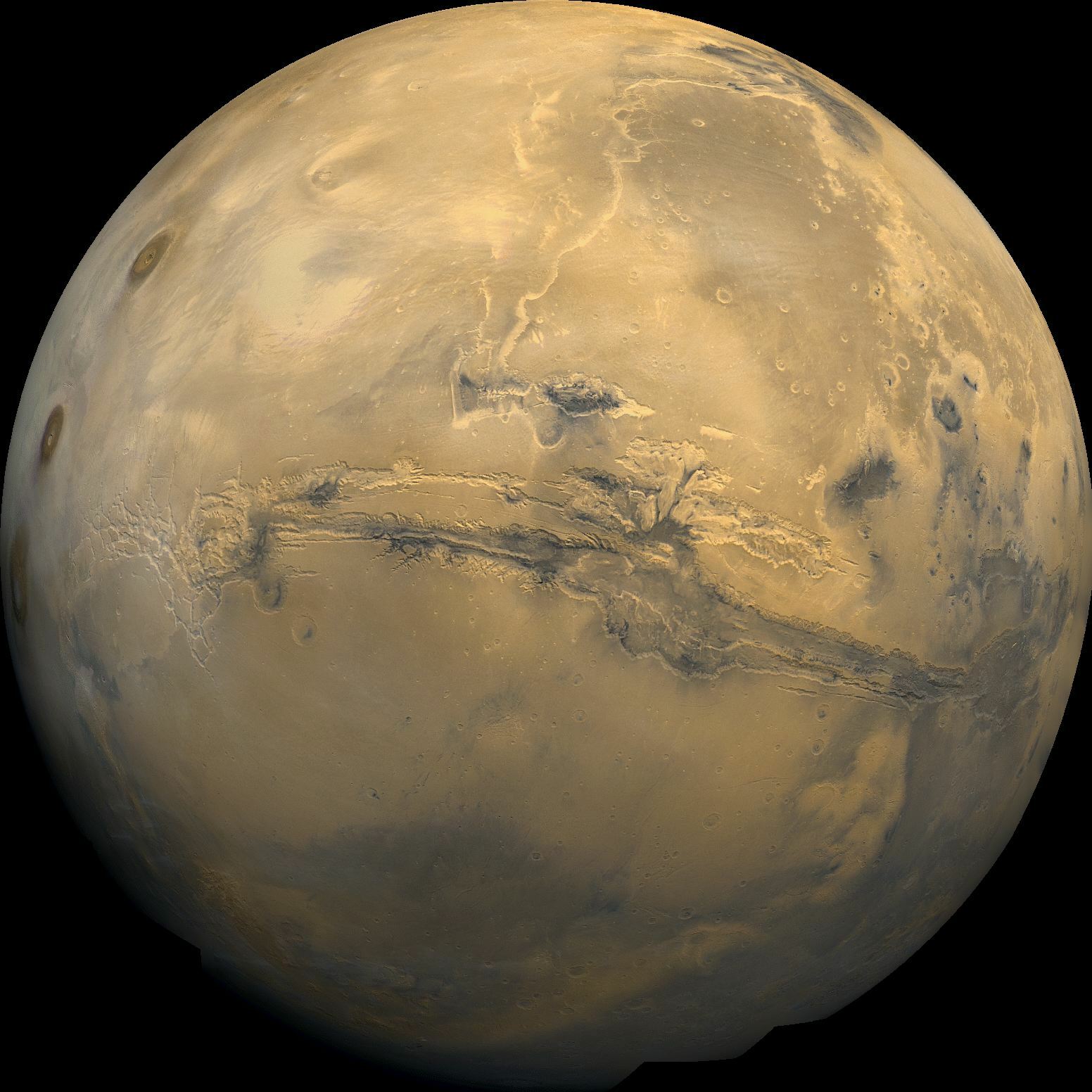
These are located in the Hellas Basin, a large feature on the bottom left of Mars, viewed from Earth. Here's a photo of Mars, the elliptical bright feature at lower-center in the image is the Hellas Basin, the largest unequivocal impact basin (formed by an asteroid or comet) on the planet. Hellas is approximately 2200 km (1,370 mi) across. Really amazing detail, photo was taken by the Mars Global Surveyor, check out many more of its pics here.
So THAT looks like an excellent area to Survey!
-
Hydro Thermal Vents
A recent New Scientist article mentions: Unusual warm spots on Mars might represent "ice towers" similar to those seen in Antarctica, say researchers. They could even harbour life...
These are located in the Hellas Basin, a large feature on the bottom left of Mars, viewed from Earth. Here's a photo of Mars, the elliptical bright feature at lower-center in the image is the Hellas Basin, the largest unequivocal impact basin (formed by an asteroid or comet) on the planet. Hellas is approximately 2200 km (1,370 mi) across. Really amazing detail, photo was taken by the Mars Global Surveyor, check out many more of its pics here.
So THAT looks like an excellent area to Survey!
-
Re:Re-photograph the "face"I would suggest re-photographing the famous (or infamous) "face" on Mars. I know NASA already did that once, but at a different angle and under different lighting coniditions, which resulted in an image that is hard for many to correlate with the earlier, fuzzy "face" photo.
You don't see the face in NASA's latest pic? It's not as obvious as it was in the previous image but you could do a little Photoshop job on it and imagine what a better picture would look like.
I get the feeling someone at NASA considers the "face" an annoyance...
Wouldn't it be fun if clouds were turtles? Wouldn't it be fun if the laundry on the bedroom chair was a friendly monster? Wouldn't it be fun if rock mesas on Mars were faces or interplanetary monuments? Clouds, though, are small water droplets, floating on air. Laundry is cotton, wool, or plastic, woven into garments. Famous Martian rock mesas known by names like the Face on Mars appear quite natural when seen more clearly, as the above recently released photo shows. Is reality boring?
They get a lot of publicity from the face, mostly from credulous simpletons who ascribe some sort of actual importance to it, and I bet this annoys them to no end- they're trying to attract everyone's attention to the actual science they're doing, and all they get asked about are the findings relevant to mysticism and pseudoscience.