Slashdot Mirror
Domain: nasa.gov
Stories and comments across the archive that link to nasa.gov.
Comments · 16,365
-
Re:Orbital Brothel
The Russians have done a lot of thought about this subject, and the general conclusion is that it's not practical or ethical. Besides which, it'd be damn hard to do. It takes about 30 minutes just to use the toilet up there, because of the lack of gravity-induced friction (traction) forces. Sex is all about friction. You'd need to strap one party down, and the other one would need hand- and foot-holds just to maintain contact. It would take 10 minutes just to get into position, not to mention the fact that if I were another crew member and I saw ejaculate floating around or stuck in the air filters (or heaven forbid, any of the flight controls) I'd probably kick your ass... it just doesn't seem worth it.
-
Re:Hear, hear.
HEAR,HEAR!!
The Best Of NASA's Spinoffs. -
Re:SCO: axis of evil?
North Korea
My favorite map of the Earth. NASA's composite image entitled the Earth at Night. It displays a facinating combination of population density and economic development by measuring human lightsources at night.
They say a picture is worth a thousand words, and this picture speaks volumes about the North Korea / South Korea situation.
- -
Re:flightFlight happens exclusively in atmospheres. </quote>
Definition of flight from dictionary.com
1. The motion of an object in or through a medium, especially through the earth's atmosphere or through space. 2. An instance of such motion. 3. The distance covered in such motion.
Seems pretty plain to meEven NASA calls it space flight:
Keep in touch -
Re:flightFlight happens exclusively in atmospheres. </quote>
Definition of flight from dictionary.com
1. The motion of an object in or through a medium, especially through the earth's atmosphere or through space. 2. An instance of such motion. 3. The distance covered in such motion.
Seems pretty plain to meEven NASA calls it space flight:
Keep in touch -
And I own the moon.Microsoft, through it's demented mouthpiece, has said it, "All your base are belong to us." Nuts, they think they own everything. Applying the M$ way of thought to the situation, they think they own the data carried by Unix too. I'd be worried if it were not so transparent and insane that not even the US court system will go for it.
Still, it's all gravy for M$. All this talk about Unix being "destroyed" by evil Linux and threats on all still shelling out money for licensed Unix, it's all FUD M$ is loving. Having failed to compete on technical merits and abandoned their "Unix killer", NT, this is the best they can do? Pathetic, but the FUD might just keep Linux numbers down long enough for them to implement Paladium and lock everyone else out.
Right, and I own the moon and will license it to the Chinese because I bought the patents on the first liquid fueled rocket. It's mine, bitches! Everything flows from it and all of you are theives of my Intelectual Property, -burp-.
-
Re:let's get ready to rumble!4-1 is a very very poor ratio for a glider.</quote>
But a hell of a lot bettr than a pure rocket
Actually, the record was 350,000 feet, which is even more. Here's a link at nasa x-15 Wonder what would have happened if they had continued along that line?
-
screw that
what the hell are these black spots? black holes? those things are f'n MASSIVE. wow. back to your regularly scheduled slashdot...
-
Full text available on-lineThe article's annoyingly short, but the book it references (On Mars: Exploration of the Red Planet. 1958-1978) is available for free download via the web. The Top Ten problems list is in chapter 8.
You can find a huge selection of other NASA-related books (including charts, diagrams and pictures) here.
-
Full text available on-lineThe article's annoyingly short, but the book it references (On Mars: Exploration of the Red Planet. 1958-1978) is available for free download via the web. The Top Ten problems list is in chapter 8.
You can find a huge selection of other NASA-related books (including charts, diagrams and pictures) here.
-
Full text available on-lineThe article's annoyingly short, but the book it references (On Mars: Exploration of the Red Planet. 1958-1978) is available for free download via the web. The Top Ten problems list is in chapter 8.
You can find a huge selection of other NASA-related books (including charts, diagrams and pictures) here.
-
Re:Not the first
Anderson accepted, to a degree, that 'one can argue that the first mission to Mars should have biological emphasis,' but the realities were 'that the biological and organic experiments were not ready when the payload was selected, are not ready now, and probably will not be ready in 1975.' First here
-
Not the first
The article claims that Viking "involved the first probe to orbit another planet", but this is incorrect. Mariner 9 went into orbit around Mars in November 1971, just days ahead of the USSR's Mars 2 and Mars 3 spacecraft. There was also Mars 5 in early 1974 and Venera 9 and Venera 10, two Soviet Venus orbiters, in late 1975.
-
Not the first
The article claims that Viking "involved the first probe to orbit another planet", but this is incorrect. Mariner 9 went into orbit around Mars in November 1971, just days ahead of the USSR's Mars 2 and Mars 3 spacecraft. There was also Mars 5 in early 1974 and Venera 9 and Venera 10, two Soviet Venus orbiters, in late 1975.
-
Not the first
The article claims that Viking "involved the first probe to orbit another planet", but this is incorrect. Mariner 9 went into orbit around Mars in November 1971, just days ahead of the USSR's Mars 2 and Mars 3 spacecraft. There was also Mars 5 in early 1974 and Venera 9 and Venera 10, two Soviet Venus orbiters, in late 1975.
-
Not the first
The article claims that Viking "involved the first probe to orbit another planet", but this is incorrect. Mariner 9 went into orbit around Mars in November 1971, just days ahead of the USSR's Mars 2 and Mars 3 spacecraft. There was also Mars 5 in early 1974 and Venera 9 and Venera 10, two Soviet Venus orbiters, in late 1975.
-
Not the first
The article claims that Viking "involved the first probe to orbit another planet", but this is incorrect. Mariner 9 went into orbit around Mars in November 1971, just days ahead of the USSR's Mars 2 and Mars 3 spacecraft. There was also Mars 5 in early 1974 and Venera 9 and Venera 10, two Soviet Venus orbiters, in late 1975.
-
Not the first
The article claims that Viking "involved the first probe to orbit another planet", but this is incorrect. Mariner 9 went into orbit around Mars in November 1971, just days ahead of the USSR's Mars 2 and Mars 3 spacecraft. There was also Mars 5 in early 1974 and Venera 9 and Venera 10, two Soviet Venus orbiters, in late 1975.
-
Re:ehmmm! ...NERVA?...anybody?Nope, this isn't based on NERVA. Nerva uses nuclear-thermal propulsion, while Project Prometheus is developing fission reactors for nuclear-electric propulsion. The JIMO spacecraft will use a ten-or-so kilowatt fission reactor to produce electricity to power an ion drive.
It's currently thought that electric propulsion will be more efficient than thermal propulsion. The thermal drives produce more thrust than a similar power ion drive, but the ion drive has a far higher specific impulse. Eventually, ion drives will probably be replaced by something like VASIMR or some other similar magneto-plasmadynamic drive. These can be throttled to produce either high thrust or high specific impulse, which would merge the best aspects of NERVA and ion-drive systems into a single electrically powered package.
-
Re:safe?
Considering that this has already happened three times, I'm not too worried.
-
Re:overblown
Ummm....no, no it doesn't.
Ummm....yes, yes it does. Your turn.
H2 is a very stable molecule. You need to break it up into free radicals before any chemistry can happen. Even if you have an H2 and O2 mixture, you need to start the reaction with something like a flame or spark.
Given a "choice" between forming stable molecules (like H20) and unstable ones (O2, OH-), the more stable will win
Free radicals don't get a choice. They're so reactive they grab onto the first thing they bump into. In the stratosphere, that's much more likely to be an ozone molecule than another free radical.
These catalytic cycles end when radicals recombine with each other to form water or hydrogen:
OH + HO2 -> H2O + O2
H + HO2 -> H2 + O2
If you're inclined to respond , do me a favor and read this first. -
Re:Nuclear Propelled, Not Powered, Is The Big DealNot really. NASA has already launched test probes that use Ion drives to great success. But the electricity was derived from their existing processes, so I guess you are correct in that this is the first attempt to marry the capability to generate lots of energy (nuclear) to much larger Ion drives.
First to combine nuclear+ion drive, yes. Cassini-Huygens used nuclear (Radioisotope Thermoelectric Generator) power for onboard systems, though, and Deep Space 1 used (solar-powered) ion drive.
Spacecraft aren't the only systems powered by RTGs; medical devices are as well.
-
Re:Nuclear Propelled, Not Powered, Is The Big DealNot really. NASA has already launched test probes that use Ion drives to great success. But the electricity was derived from their existing processes, so I guess you are correct in that this is the first attempt to marry the capability to generate lots of energy (nuclear) to much larger Ion drives.
First to combine nuclear+ion drive, yes. Cassini-Huygens used nuclear (Radioisotope Thermoelectric Generator) power for onboard systems, though, and Deep Space 1 used (solar-powered) ion drive.
Spacecraft aren't the only systems powered by RTGs; medical devices are as well.
-
Why go to Jupiters moons?
For those who wonder why Jupiters moons are interesting, and worth visiting, I'll try to give a brief summary here. JIMO will be visiting Jupiters four Galilean moons, named after their initial discovery by Galileo Galilei (through his now-famous telescope). In order of distance from Jupiter, they are Io, Europa, Ganymede and Callisto.
Io is the only moon in the solar system to show volcanic activity; plumes of gas ejected from its volcanos, rising up to 250km above the surface, have been detected from Earth. The energy to keep the interior of Io molten comes from the tidal friction generated as the moon moves through Jupiter's strong gravitation field. Io is a great laboratory for understanding volcanic activity in general.
Europa, the next moon out, is one of the most likely places for life to exist in the Solar System (excepting, of course, Earth). Images of the moon reveal a very smooth surface (in fact, the smoothest in the Solar System), criss-crossed by long, narrow, straight features. These features appear to be fissures in the surface; combined with the fact that the surface is almost pure ice (which we know from spectroscopy studies), it appears that Europa may have a large sub-surface ocean of liquid water, covered by a crust of ice.
Support for the existence of this ocean comes from the discovery of ice rafts on the surface, much like found in polar regions on Earth, and from the detection of a weak magnetic field by the Galileo spacecraft. Europa is too small to have its own magnetic field, but if it contains a large quantity of conducting fluid (such as water with a high concentration of dissolved minerals), then its motion through Jupiters magnetic field will generate a field of its own.
The significance of the sub-surface water on Europa is that liquid water is one of the principal prerequesites for life (as we know it). Speculation as to whether life does indeed exist on Europa is ongoing; to find out, a cryobot/hydrobot mission to the moon is required. The cryobot would melt its way through the icy crust, and the hydrobot would descend through this hole and explore the oceans underneath. Interest incryobot/hydrobot technology was spurred on by the discovery of Lake Vostok in Antarctica, the world's fourth-largest freshwater lake, which is trapped under 2km of ice sheet, and may contain prehistoric lifeforms.
Ganymede is the largest moon in the Solar System, larger even than the planet Mercury. Both Ganymede and Callisto have heavily-cratered surfaces, indicative of millenia of meteorite bombardment. Both are a mixture of rock and ice, although the detection of a weak magnetic field around Callisto indicates that it may have a sub-surface ocean, like Europa. The existence of this ocean is puzzling, since Callisto is too far from Jupiter for tidal heating to be able to melt ice. Some have suggested that Calliso's ocean contains an antifreeze (maybe ammonia), which keeps the water liquid well below its normal solidification temperature.
IMHO, I think Europa is the jewel in the crown of the Galilean moons, due to the possibility that life may exist there. Unfortunately, as one can tell from JIMO's full name (Jupiter Icy Moons Orbiter), there are no plans to land on this fascinating world. In "2010: Odyssey Two", Arthur C. Clarke writes about a manned landing on Europa which discovers life; it would be great for me to see this happen in my lifetime, let alone by 2010.
-
Cassini (the Saturn probe) was nuclear
It looks like nobody has said this yet, so I'll pitch in -- the Cassini space probe, which was launched on October 15, 1997, was also nuclear-powered. There were protests around NASA right before the launch took place, but it went up anyway without a hitch.
According to JPL's Cassini "safety" page, they explain that the probe is powered by three radioisotope thermoelectric generators (RTGs) which provide energy by the natural radioactive decay of Pu-238. This isn't fission or fusion at work, but merely the harvesting of heat generated by the radioactive decay. The big question for environmentalists (and NASA) was whether these RTGs would remain contained in the event of a launch disaster.
The big difference between the RTGs of Cassini and the nuclear technology in JIMO is that JPL wants to have a full-fledged nuclear fission reactor this time around. This would obviously provide a lot more power for the mission, at the expense of extreme public scrutiny. It will be interesting to see how this situation pans out. -
Cassini (the Saturn probe) was nuclear
It looks like nobody has said this yet, so I'll pitch in -- the Cassini space probe, which was launched on October 15, 1997, was also nuclear-powered. There were protests around NASA right before the launch took place, but it went up anyway without a hitch.
According to JPL's Cassini "safety" page, they explain that the probe is powered by three radioisotope thermoelectric generators (RTGs) which provide energy by the natural radioactive decay of Pu-238. This isn't fission or fusion at work, but merely the harvesting of heat generated by the radioactive decay. The big question for environmentalists (and NASA) was whether these RTGs would remain contained in the event of a launch disaster.
The big difference between the RTGs of Cassini and the nuclear technology in JIMO is that JPL wants to have a full-fledged nuclear fission reactor this time around. This would obviously provide a lot more power for the mission, at the expense of extreme public scrutiny. It will be interesting to see how this situation pans out. -
Cassini (the Saturn probe) was nuclear
It looks like nobody has said this yet, so I'll pitch in -- the Cassini space probe, which was launched on October 15, 1997, was also nuclear-powered. There were protests around NASA right before the launch took place, but it went up anyway without a hitch.
According to JPL's Cassini "safety" page, they explain that the probe is powered by three radioisotope thermoelectric generators (RTGs) which provide energy by the natural radioactive decay of Pu-238. This isn't fission or fusion at work, but merely the harvesting of heat generated by the radioactive decay. The big question for environmentalists (and NASA) was whether these RTGs would remain contained in the event of a launch disaster.
The big difference between the RTGs of Cassini and the nuclear technology in JIMO is that JPL wants to have a full-fledged nuclear fission reactor this time around. This would obviously provide a lot more power for the mission, at the expense of extreme public scrutiny. It will be interesting to see how this situation pans out. -
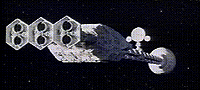
Spacecraft shape
The shape of this spacecraft reminds me a bit of another Jupiter mission.
-
Re:Sad...
Actually, there's a plan for bailing out of the shuttle. It's not good durring ascent, or above a certain altitude (100,000 ft.?) durring reentry and aproach, but they CAN leave the craft.
The official NASA write up on it is here.
Here's a good diagram of it.
Here's a site with some good info on it, including pics of the tests that NASA did with the system on other aircraft.
A random image of a shuttle crew member training to bail out with this system.
And here's a wonderful article explaining it again with a step by step procedure at the bottom of the page. -
Re:Sad...
Actually, there's a plan for bailing out of the shuttle. It's not good durring ascent, or above a certain altitude (100,000 ft.?) durring reentry and aproach, but they CAN leave the craft.
The official NASA write up on it is here.
Here's a good diagram of it.
Here's a site with some good info on it, including pics of the tests that NASA did with the system on other aircraft.
A random image of a shuttle crew member training to bail out with this system.
And here's a wonderful article explaining it again with a step by step procedure at the bottom of the page. -
Re:Hubble has great accomodations
I can see the congressional hearing now: "Our brave astronauts lost their lives to bring us 500 channels?"
You mean like the TRDS satellite that was carried aboard STS 51L (Challenger's final flight.)
I know that TRDS does more than transmit TV signals, but that *is* a part of it. The shuttle almost never takes off with just one purpose. Just look at all the stuff that was going on on 51L.
Your point is taken though. Let's keep the astronauts involved in real science, exploration and maintaince. Things that unmanned launch vehicles can't do. And let's use unmanned launch vehicles for everything else. -
Wrong!This myth is completely without substance. Volcanoes introduce very little chlorine into the stratosphere. Stratospheric chlorine has been measured to be more than 80% due to CFCs, whereas the largest volcanic injection ever observed (El Chichon, which you mention) increased the stratospheric chlorine content by only 2%. When people look at the chlorine content of the stratosphere, they find it to be dominated by CFCs, so if you want to blame nature, you must find a natural source of CFCs.
This study by NASA explains why volcanic plumes, which contain tremendous amounts of chlorine, don't leave much chlorine in the strtatosphere.
-
Wrong!This myth is completely without substance. Volcanoes introduce very little chlorine into the stratosphere. Stratospheric chlorine has been measured to be more than 80% due to CFCs, whereas the largest volcanic injection ever observed (El Chichon, which you mention) increased the stratospheric chlorine content by only 2%. When people look at the chlorine content of the stratosphere, they find it to be dominated by CFCs, so if you want to blame nature, you must find a natural source of CFCs.
This study by NASA explains why volcanic plumes, which contain tremendous amounts of chlorine, don't leave much chlorine in the strtatosphere.
-
Wrong!This myth is completely without substance. Volcanoes introduce very little chlorine into the stratosphere. Stratospheric chlorine has been measured to be more than 80% due to CFCs, whereas the largest volcanic injection ever observed (El Chichon, which you mention) increased the stratospheric chlorine content by only 2%. When people look at the chlorine content of the stratosphere, they find it to be dominated by CFCs, so if you want to blame nature, you must find a natural source of CFCs.
This study by NASA explains why volcanic plumes, which contain tremendous amounts of chlorine, don't leave much chlorine in the strtatosphere.
-
Re:New Guidelines
The cost was insignificant to anyone who is/was floored by this picture. Anyone who looked at that image for the first time and did not feel the hair stand up on the back of his/her neck (or some equivalent response) probably does not possess adequate intelligence to express a rational opinion on federal spending.
-
Re:our sun, the planetsYou are correct, but the results are quite different. Though the technique used now is fundamentally the same as what Michelson used, Michelson would have been very hard pressed to measure oblatness because he (and Pease) were very limited in how they could change their baselines. In effect, Michelson and Pease could only measure the diameter across one direction of the star, so they could not have made an oblateness measurement.
The modern interferometers, besides having very long observing baselines, also make such a large number of baseline observations that they can actually do an inverse transform and get an image.
If you are interested, some nice info is found here, and the best collection of stellar interferometry links is found here.
-
Re:Sad...Sheesh.. what is this.. the day of dis-information? I know
The space shuttle is anything but re-usable. The boosters are not re-used, the tank is lost anyway and after landing, the shuttle is completely dis- and re-assembled. Check here
As for the fule tank.. of course it is lost.. from the height it is detached, there is no way it could make it back to earth in 1 useable peice.
The third part.. you buy a used car without checking it over? You have to take the shuttles apart after use, how else are you going to make sure it is in top working order. That's why there are/were 5, so one could fly every couple of weeks (remember, NASA orignally said there would be almost 200 flights a year of the shuttle when this all first started). About a 2 month cycle time between a shuttle's flights.
State-of-the-art expendable launchers can haul people into space (and bring them safely back) at a fraction of the cost: use a ballistic capsule with escape rocket and a parawing for enhanced flexibility during landing.
People.. that's great. What about space construction, space research, plant/aninal tests. You can't fit much in a capsule.
The shuttle's only purpose is to fly to the ISS. The ISS's only purpose is to justify the existence of the shuttle. For the Hubble telescope alone, the shuttle would never have been built.
Gee, the shuttle was designed and built 20 years or so before those two.. so, I doubt that. It was designed to carry heavy loads into space, and to carry more than 2 or 3 people so meaningful experiments could take place.
For what it was designed for, a hauler, it is working fantastic. About 1/3 of the ISS structure cannot be launced into space via rocket.. just because of that the equipment is or how it's designed. THIS is what the shuttle was designed to do.
Yes, it is a pricy bit of equipment to run, yes it is old tech. Yes, it needs replaced. But at least post your post with something factual next time... sheesh, another +4 for wrong information.
-
Re:Just a thought...
Oh yeah, that's about the brightest idea I've ever heard. SRBs should have NEVER been rated for manned spaceflight...once they're running, they're running, and that's it. No throttling. No kill-switch. You wait until the propellant is gone.
As for the SSMEs not having much to do with getting the orbiter into space I say this: uhhhhh, what?
Here's a great site that explains the physics of the SRBs. Before this page gets Slashdotted to hell and back, I'll recap what it says: each SRB produces 3.3 million pounds of thrust, and each one weighs 1.3 million pounds (191,000 pounds dry-weight, plus 1.1 million pounds of propellant). That means the combined pair can lift about 4 million pounds. The shuttle itself weighs 171,000 pounds (empty, with engines), and the external tank weighs 66,000 pounds. So with a little rounding off, you can add 3.75 million pounds to the stack before you have an equal balance between thrust and weight (which will get you nowhere near orbit). The aforementioned external tank carries 1.3 million pounds of liquid oxygen and 227,000 pounds of liquid hydrogen. More neat rounding brings us to 1.6 million pounds of fuel, 2.15 million pounds remaining. Let's assume the shuttle is carrying its max payload -- 63,500 pounds. Leaves us with 2.08 million pounds.
So:
Booster Stack Weight + Fuel: 4.52 million pounds.
Thrust of SRBs (combined): 6.6 million pounds.
Resulting Thrust-to-Weight Ratio: 1.4.
By comparison, a F-15 has a thrust-to-weight ratio of 1.19, giving the shuttle a 15% advantage, when using SRBs alone.
That's right. I haven't forgotten about the SSMEs. When run at 104%, they provide an extra 488,000 pounds of thrust each. That's an extra 1.46 million pounds of thrust. Thus, our 4.52 million pound stack now has a 8.06 million pounds of thrust, resulting in a thrust-to-weight ratio of 1.78, or a 66% advantage over the F-15. Note that these figures are assuming that the SSMEs are run at 104% from ignition (which they're not), but also bear in mind that as the shuttle burns fuel, which it does as a prodigious rate, the overall weight of the stack is reduced while the thrust remains constant, so as the vehicle climbs, it's thrust-to-weight ratio improves, and continues to do so after the SRBs are cut loose.
Now, IANARS (RS = Rocket Scientist), but it seems to me that if we want to scale up the SRBs so that they alone can carry the shuttle into orbit, the weight of the propellant is going to exceed the maximum thrust of the SRBs before you can get enough propellant for the entire burn into orbit.
What I'm trying to say is this: leave the rocket science to the rocket scientists. -
Re:Just a thought...
Oh yeah, that's about the brightest idea I've ever heard. SRBs should have NEVER been rated for manned spaceflight...once they're running, they're running, and that's it. No throttling. No kill-switch. You wait until the propellant is gone.
As for the SSMEs not having much to do with getting the orbiter into space I say this: uhhhhh, what?
Here's a great site that explains the physics of the SRBs. Before this page gets Slashdotted to hell and back, I'll recap what it says: each SRB produces 3.3 million pounds of thrust, and each one weighs 1.3 million pounds (191,000 pounds dry-weight, plus 1.1 million pounds of propellant). That means the combined pair can lift about 4 million pounds. The shuttle itself weighs 171,000 pounds (empty, with engines), and the external tank weighs 66,000 pounds. So with a little rounding off, you can add 3.75 million pounds to the stack before you have an equal balance between thrust and weight (which will get you nowhere near orbit). The aforementioned external tank carries 1.3 million pounds of liquid oxygen and 227,000 pounds of liquid hydrogen. More neat rounding brings us to 1.6 million pounds of fuel, 2.15 million pounds remaining. Let's assume the shuttle is carrying its max payload -- 63,500 pounds. Leaves us with 2.08 million pounds.
So:
Booster Stack Weight + Fuel: 4.52 million pounds.
Thrust of SRBs (combined): 6.6 million pounds.
Resulting Thrust-to-Weight Ratio: 1.4.
By comparison, a F-15 has a thrust-to-weight ratio of 1.19, giving the shuttle a 15% advantage, when using SRBs alone.
That's right. I haven't forgotten about the SSMEs. When run at 104%, they provide an extra 488,000 pounds of thrust each. That's an extra 1.46 million pounds of thrust. Thus, our 4.52 million pound stack now has a 8.06 million pounds of thrust, resulting in a thrust-to-weight ratio of 1.78, or a 66% advantage over the F-15. Note that these figures are assuming that the SSMEs are run at 104% from ignition (which they're not), but also bear in mind that as the shuttle burns fuel, which it does as a prodigious rate, the overall weight of the stack is reduced while the thrust remains constant, so as the vehicle climbs, it's thrust-to-weight ratio improves, and continues to do so after the SRBs are cut loose.
Now, IANARS (RS = Rocket Scientist), but it seems to me that if we want to scale up the SRBs so that they alone can carry the shuttle into orbit, the weight of the propellant is going to exceed the maximum thrust of the SRBs before you can get enough propellant for the entire burn into orbit.
What I'm trying to say is this: leave the rocket science to the rocket scientists. -
Re:Who writes these articles? Or am I iggernint?
How is a plasma not a fluid?
because it's plasma!
"Although plasma includes electrons and ions and conducts electricity, it is macroscopically neutral: in measurable quantities, the number of electrons and ions are equal. The charged particles are affected by electric and magnetic fields applied to the plasma, and the motions of the particles in the plasma generate fields and electric currents from within. This complex set of interactions makes plasma a unique, fascinating, and complex state of matter." -
LandSat 7: coverage and timing vs resolution
LandSat 7 is simply not as capable of a sensor as some of the others out there. Shutting it down without shutting down better sensors is wasterful and strategically pointless.
I'm not sure about that. For one thing, it's more plausible for an old satellite to "malfunction" than a new one. The other thing you need to consider is timing and coverage. Just because satellite A is better than B doesn't mean that it will be where you need the data at a particular time. No matter how you slice it, the data volume and coverage from A+B > the volume and coverage from A, unless the data from B is literally worse than useless.
Your "simple inductive logic" reminds me of an old joke: A mathematician, a physicist and an engineer
I know. That's why I identified formulating projections on the basis of past known events as inductive logic, rather than deductive logic. We're calculating probability density functions here, not proving that something is definitely so or not so.
By the way, can you give any substaniated examples of a satellite being shut down permanently when it was putting out data of military significance?
Yup! SeaSAT failed after 116 (or 106, or 99, depending on which source you believe) days of operation. The person doing the analysis showed me the pictures. I was just an undergraduate at the time. The high-res SAR data stopped coming through well before the low-res -- odd, considering the failure of the satellite was attributed to a massive power failure. The data were militarily significant for the better coverage of ocean floor topography than was practically feasible to gather with sonar -- again, coverage is key here, not resolution. Sonar gives you better resolution, satellite geoid and topography gives you better coverage, particularly in areas where it's difficult to conduct bathymetric surveys--around Novaya Zemlaya for example. Subsurface topography is the widely acknowledged military significance of these data. The person doing the analysis was specifically asked to decimate these data prior to publication-- remove the spikes. Sub holes, strategic canyons and particularly "anthropogenic time-dependent spikes in the sea surface topography". Sub wakes. He did it. I would have, too.
The later GeoSAT satellite data were held by the US Navy and not declassified until after the Cold War.
-
Re:Reports of its death have been greatly exaggera
These satellites contain other instruments on board which can be used to continue the mission.
No it doesn't.
As noted here and here and probably elsewhere, Landsat 7 contains only a single istrument -- the ETM (Enhanced Thematic Mapper).
It's nothing like the Voyager spacecraft, which were multi-purpose and indeed contained many instruments. Landsat 7 was designed for exactly one specific function. If the ETM is badly broken, the whole satellite is pretty much a loss.
-
Re:Reports of its death have been greatly exaggera
These satellites contain other instruments on board which can be used to continue the mission.
No it doesn't.
As noted here and here and probably elsewhere, Landsat 7 contains only a single istrument -- the ETM (Enhanced Thematic Mapper).
It's nothing like the Voyager spacecraft, which were multi-purpose and indeed contained many instruments. Landsat 7 was designed for exactly one specific function. If the ETM is badly broken, the whole satellite is pretty much a loss.
-
Software fix?It looks to me like software fix would be possible, but the quality will be reduced. From this page it looks like a broken SLC would reduce the resolution of the image.
The images must not look too bad, since it took them over a week to notice the problem.
-
NASA report on Electromagnetic Compatibility (EMC)
For those interested in information about actual incidents where Electromagnetic Interference (EMI) has caused failure or degradation in performance to aircraft systems, refer to the following paper:
Electronic Systems Failures and Anomalies Attributed to Electromagnetic Interference
Section 2.3 - Aircraft passenger carry on devices - is relevant to the current discussion and can be found on page 11. -
Re:Anyone actually use a beowolf cluster?
Yes - NASA is using Beowulf clusters.
Beowulf at NASA/GSFC - Earth and Space Sciences Project - NASA Goddard Space Flight Center
http://beowulf.gsfc.nasa.gov/ -
Re:So what?I'm pretty sure that the solar density at Mars is too weak to be useful for this application. Mars solar density is 589.2 W/m^2, versus Earth's 1367.6 W/m^2, a ratio of
Solar cells would have to get a lot more efficient to put this contraption on Mars.
-
Re:There's been a paradigm shift
As I understand it, the "faster, better, cheaper" game is all but over for NASA. After several notable failures (read: Mars Polar Lander and Climate Orbiter, etc.) NASA has scaled back significantly and is now trying to focus more heavily on testing and verification.
The Jet Propulsion Laboratory in Pasadena, CA, for example, is establishing the Laboratory for Reliable Software to aid in building, uh, more reliable software.
I agree, though, that the budgetary restrictions set by Congress are likely to be a problem. Trying to produce projects with the same old budgets, but with more robust verification procedures, can only reduce the amount of science that can be done on any given mission. -
Re:Hold the champagne...
All in the name of progress! Where are we going to go when this place becomes so hot and toxic that only the people who made billions polluting it will afford the luxury of living here.
-
Linux and Space Probe Longevity
Who can be the first to get Linux out of the Solar System? (R.I.P. Pioneer 10, 1972-2003)