Slashdot Mirror
Domain: nasa.gov
Stories and comments across the archive that link to nasa.gov.
Comments · 16,365
-
Re:More proof
You are retarded. Check the albedo(s) and irradiance. Depending on what aspects of reality you're choosing to ignore, Venus should either be much hotter or much cooler than Earth.
Your theory is so completely divorced from reality that it is trivial to find observations which exclude it. Post the "right" calculations if you dare.
-
Re:Science by democracy doesn't work?
All you have to do is look at OCO splash page banner to see that the US contribution to CO2 pales even against geologic sources.
-
Re:A question for all the"deniers".
Have you ever written a simulation? I have. You have to use simplification of calculations and use predetermined result tables to avoid doing the calculations to get any kind of speed in result return. This causes deviance from true simulation. The only way to accurately simulate the real thing is to build the real thing.
As someone who has written a number of simulations, you are full of shit. You certainly don't use lookup tables to determine results of the thing that you are calculating; if you have a well behaved submodel that is part of the larger simulation, you can use precomputed results but that is completely different. Further, you can get the simulations that they are running; here's one: GISS GCM E. They are 'true simulations' in any meaningful definition of the word; they are not using "predetermined result tables" to determine the results of the simulation.
-
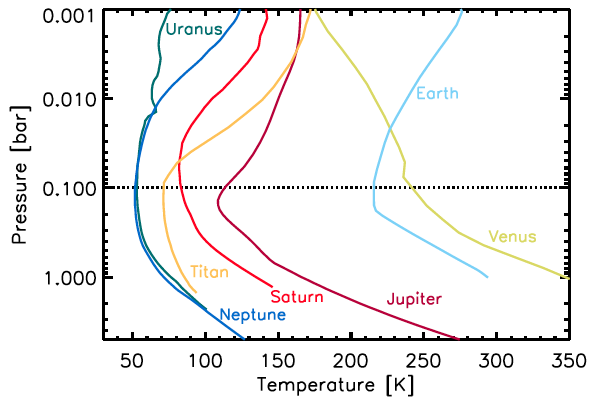
Re:Venus and Earth
You will not get the correct answer. If you arrive at a coincidentally close answer, you still have to account for albedo; the energy input is not what you think it is.
But let's go through it anyway. Inverse square law says we divide by distance squared, so it's 1/(venus orbit distance)^2, Venus is
But even if that were correct, it still would not explain any of the rest of the differences in temp/pressure profile. This "atmospheric composition is irrelevant" dog won't hunt no matter what you do. The outer planets have the most similar temp/pressure curves, but they all look pretty different. Every wiggle in the curve is another observation your theory can't explain. There must be other factors involved than what your "simple" theory describes. Atmospheric science explains these observations well.
This is like saying polio and ebola have the same number of letters so therefore germs don't cause disease.
-
Re:NASA Doesn't Think So
NASA seems to think that climate change is being caused by human activities and they back it up with a lot of references to studies on the matter. IMHO, we're never going to convince people to change their behaviors or give up their luxuries. If we want to make a difference we need to develop the technologies that make it more advantageous to adopt the renewable solution (like kick-ass cars and cheaper home energy).
The Nasa climate scientists (Gavin Schmidt) who claimed 2014 set a new record for global warmth last night admitted they were only 38 per cent sure this was true.
That NASA?
-
Re:More proof
the consensus view of the American public is that they do not want to sacrifice their lifestyles for the environment, especially in this case since the benefits are non-tangible
I wonder how they will feel about their lifestyles in 100 years, when they have to keep buying longer and longer snorkels just to get around in the non-tangible seawater surrounding their homes? The U.S. Navy, however, is taking climate change seriously: U.S. Navy bracing for climate change
-
NASA Doesn't Think So
NASA seems to think that climate change is being caused by human activities and they back it up with a lot of references to studies on the matter. IMHO, we're never going to convince people to change their behaviors or give up their luxuries. If we want to make a difference we need to develop the technologies that make it more advantageous to adopt the renewable solution (like kick-ass cars and cheaper home energy).
-
Re: Tiros: first global weather photo
Yea, odd.. Actually the http server delivers the same picture - cf. http://history.nasa.gov/SP-168...
-
Tiros: first global weather photo
Although I personally find the idea of resurrecting an old dish rather 'non-news', Tiros was pretty cool series of satellites. Here is the the first (composite) photo of global weather taken using the infrared cameras on an early Tiros: https://history.nasa.gov/SP-16...
-
Re:Hey NASA...
instead of making questionable measurements of the planet, why don't you figure out how to build a decent space vehicle? Which is your raison d'etre.
One of them. NASA was established by the National Aeronautics and Space Act of 1958. In the list of what NASA was established to do, the first item is: (1) The expansion of human knowledge of phenomena in the atmosphere and space;
(building space vehicles was number 3 on the list)
Then why are they trumpeting the results of land-based measurements and ignoring the space-based measurements that measure the atmosphere, and show no warming?
-
Re:Hey NASA...
instead of making questionable measurements of the planet, why don't you figure out how to build a decent space vehicle? Which is your raison d'etre.
One of them. NASA was established by the National Aeronautics and Space Act of 1958. In the list of what NASA was established to do, the first item is:
(1) The expansion of human knowledge of phenomena in the atmosphere and space;(building space vehicles was number 3 on the list)
-
Re:wee little issue
You can download the code they use for the calculations. Feel free to analyze it, and write a paper about any flaws you find. http://data.giss.nasa.gov/gist...
-
Re:parachutes?
Parachutes? Isn't the atmosphere like 98% thinner than Earth? That'd work about as well as parachuting onto the moon.
And you would be incorrect.
The Low-Density Supersonic Decelerator is testing next-generation parachutes for landing things on Mars. They launch the test platform high up into Earth's atmosphere, where the air pressure and other conditions are most like Mars, then they test how the various new parachute and other drag tech works to slow it down again. Disclosure: My wife is one of the engineers that worked on the platform itself.
The parachute is not designed to be the final landing device, but if you don't use a parachute or other drag device as you approach when there is measurable atmosphere you'll burn up or crash hard. The atmosphere doesn't have to be very thick to still have friction.
Given what they said about Beagle's failure to deploy, I wonder if it broke during the airbag bounce process and the panel jammed. -
A Common Driver Language
A CDL (or more aptly Common Hardware Language, CHL) needs to be developed so that all the OS needs to understand in communicating is that it can do certain _guaranteed_ "BASIC modular hardware functions". Basic stuff such as "send.[hardware component].data([minimal template protocol script design here])", "read.[hardware component].data([minimal template protocol script design here])",
The Modular (Common) Hardware Components themselves should also have this "Basic Modular Hardware Function" i.e. CHL (Pronounced - CH ool) capability built in as a "fall-back" language for Gen-1 devices and will always maintain this backwards compatibility...
Ultimately this is about what USB should have been from the start.
Done right, elegantly and enforced. (By done right I mean the science and code has to be air tight, something that NASA (refer to Fault Tree Analysis) would give a pass mark to, and not this tripe "send it to market first and fix it later" bs we have grown accustomed to)There is no rush to get this done, just do it right the first time for once. Then we can finally work on doing tablets and laptops, like should have happened years ago (decades if including consoles!!).
There is no reason why Gen100 hardware parts can't co-exist with gen1 using the latest OS for the device. Removing the hardware abstraction layer from the OS and giving it back to the HARDWARE devices themselves is what this is really about. After all, the OS these days is a glorified UI which 9/10 behaves poorly and against its users wishes.
Just an added thought, I think there needs to be a backbone (switching) layer to interface the modular devices with. One that accepts electrical & photon interfacing at each node.
Sincerely,
Mod PC -
Re:This makes sense nomatter your politik
Methane doesn't last long in the atmosphere
that '25 times as powerful as CO2' statistic is its equivalent over a 100-year period. even though methane may not last long before being oxidized into CO2, during that period it has a much greater forcing.
trust me here, methane aint nothin to fuck with. tightening up leaks is inarguably a good thing.
OH BS;
Methane degrades into CO2, in fact, so in simulations I did (Archer and Buffett, 2005) the radiative forcing from the elevated methane concentration throughout a long release was about matched by the radiative forcing from the extra CO2 accumulating in the atmosphere from the methane as a carbon source.
If the warmistas at realclimate say it ain't the methane, it ain't the methane! Everybody is just freaking becuase there has been no statisically significant lower troposheric warming for over 18 years and OCO is showing that the significant sources of Atmospheric CO2 isn't the evil(tm) westerners but the Chinese, the rain forrests and geological sources.
-
Re:Great to see
"returning to the moon" -- Lunar Reconnaissance Orbiter, a NASA spacecraft, is operational in orbit around the moon right now and has been there since 2009. NASA just makes it look so easy that when they do it, nobody notices.
http://en.wikipedia.org/wiki/L...
http://www.nasa.gov/mission_pa... -
data
I find you quite arrogant and condescending.
So, basically, you consider it condescending that I insist that you should actually look at data. Real data. Not blog posts.
And you complain that I only gave you a link to one source of data. OK, here are data from four continents:
Berkeley Earth: http://berkeleyearth.org/
Hadley Center Climate Research Unit: http://www.cru.uea.ac.uk/cru/d...
Goddard Institute for Space Studies: http://data.giss.nasa.gov/gist...
Japanese Meteorological Agency: http://ds.data.jma.go.jp/tcc/t...
Australian Meteorological Agency: http://www.bom.gov.au/state-of...
NOAA: http://www.ncdc.noaa.gov/cag/t... -
Re: What exactly do you mean by
And yet, it is denounced by the earth scale experiment.
Do you mean that you don't think that current temperatures aren't showing a rise?
Because they do. -
Uncertainty
"the measured temperatures are a nice validation that the models are in the right ballpark"
Well, within a factor of two. That's some ballpark.
That's right: the current estimate for the climate sensitivity to carbon dioxide is 3C plus or minus 1.5C (that is: 1.5C to 4.5C). That's a big ballpark, but, indeed, that's the quoted uncertainty. Here's a graph of model simulations, showing this variability: http://earthobservatory.nasa.g...
But the interesting thing is, the deniers aren't jumping on that-- they are, instead, all about how confident the scientists are.
If someone were trying to base public policy on a set of computer models which predicted changes in, say, IQ scores of black Americans, or academic success of women in STEM fields, and the predictions were off by a factor of two, how seriously would people take those models, or the people who came up with those models? Their proponents would be laughed at by everyone who wasn't vilifying them.
Perhaps you'd think that. But, instead, you will be hard pressed to find a denier website that even acknowledges this. Pointing out that the scientists acknowledge uncertainty in their models would destroy their argument that scientists are unwilling to acknowledge any uncertainty in their models.
-
Re:Mars Needs Nothing
The month-long day/night cycle and low gravity are significant issues for long-term habitation of the Moon. There's also evidence now that Moon quakes regularly hit 5.5 Richters and last for 10 minutes. Mars presents plenty of challenges, but it's nowhere near as bad as the Moon.
-
Yes, I can document NASA's task change.
Yes, I can document NASA's task change.
Under the auspices of the White House OSTP (Office of Science and Technology Policy), the NTSC (National Science and Technology Council) created CENRS (Committee on Environment, Natural Resources, and Sustainability) as a response to a presidential mandate in 1989 (in case you were wondering, this was under president George H.W. Bush).
The CENRS created as part of itself the SGCR (Subcommittee on Global Change Research), which is the steering committee for the USGCRP (U.S. Global Change Research Program), which consists of 13 organizations:
- Department of Health and Human Services
- U.S. Agency for International Development
- Department of the Interior
- Department of Commerce
- Department of Defense (Acting)
- Smithsonian Institution
- Department of Agriculture
- National Aeronautics and Space Administration http://www.globalchange.gov/ab...
From their web site.As part of this, as a result of a presidential budgetary mandate by President Obama that an additional $1.8B (for a total of $2.4B) be earmarked for the Earth Observation Satellites (effectively canceling the asteroid capture mission - this i a redirection of existing budget, not an increase of funds):
http://www.nasa.gov/about/obam...
Obama's April 15th 2010 speech at Kennedy:"We will increase Earth-based observation to improve our understanding of our climate and our world -- science that will garner tangible benefits, helping us to protect our environment for future generations."
http://inhabitat.com/obama-giv...
"NASA’s about to lend a heavier hand in the fight against climate change. The news that President Obama would be rearranging NASA’s budget to focus more on what can be done to stop global warming was met with some opposition, but we’re elated that he’s bringing some of that cash down to Earth."
See also:
http://inhabitat.com/obama-giv...
http://spectator.org/blog/5978...
http://www.whitehouse.gov/the-...
http://inhabitat.com/new-nasa-...Meanwhile, actual NASA budgets have remained flat, so these monies have come from actual space and aeronautics programs, rather than new budget:
http://www.behindmyback.org/20...
"NASA’s investment in the 13-AGENCY CCSP is 58% of the total amount of the President’s 2009 Budget Request for CCSP."
= most of the money is coming from NASA.See also this report, which indicates that 37% of the 2014 NASA budget went to the Earth science program, supporting climate change research - and NOT space or aeronautics research:
http://www.law.umaryland.edu/m...But you know... feel free to argue with the congressional record, newspapers, NASA itself, and President Obama's speech at Kennedy.
-
Re:A Natural
And it doesn't seem to be hurting the astronauts on the ISS (from the year 2000)
The ECLSS Water Recycling System (WRS), developed at the MSFC, will reclaim waste waters from the Space Shuttle's fuel cells, from urine, from oral hygiene and hand washing, and by condensing humidity from the air. Without such careful recycling 40,000 pounds per year of water from Earth would be required to resupply a minimum of four crewmembers for the life of the station.
Not even research animals are excused from the program.
"Lab animals on the ISS breath and urinate, too, and we plan to reclaim their waste products along with the crew's. A full complement of 72 rats would equal about one human in terms of water reclamation," says Layne Carter, a water-processing specialist at the MSFC.
It might sound disgusting, but water leaving the space station's purification machines will be cleaner than what most of us drink on Earth.
"The water that we generate is much cleaner than anything you'll ever get out of any tap in the United States," says Carter. "We certainly do a much more aggressive treatment process (than municipal waste water treatment plants). We have practically ultra-pure water by the time our water's finished."
-
before you hit Kickstarter... Re:The Price of Art
Sounds like it could be a kickstarter project. But hold that thought.
The James Webb space telescope is scheduled for 2018 launch at the bargain price of only $8.8 billion.
The Webb's mirror is 6.4 meters across, compared to the Hubble's 2.4 meter diameter.
So roughly 32 square meters for the Webb vs. about 4.5 square meters for the Hubble.
Considering Nasa's usual tempo, another three years (2018) isn't all that long.
Very cool stuff. It is thinks like this that make me think the human race is more of a "glass half full" species. -
29 seconds? 1 minute 21 seconds is official timehttps://blogs.nasa.gov/spacex/
Not sure where 29 seconds came from. I didn't see it in the article linked. Official NASA count is 1 minute 21 seconds... not that it's too significant of an error in the original post.
"The SpaceX Falcon 9 launch scheduled for this morning at 6:20 a.m. EST aborted with one minute, 21 seconds left on the countdown clock. A thrust vector control actuator for the Falcon 9’s second stage failed to perform as expected, resulting in a launch abort.
"SpaceX is evaluating the issue and will determine the next opportunity to launch the company’s fifth commercial resupply services mission to the International Space Station. The next available opportunity to launch to the station would be Friday, Jan. 9."
-
NASA Spinoff
Vague statements about technological advances probably won't cut it either. Of the small percentage of people who actually care about general technological advanced, an even smaller percentage are convinced it's best done through dangerous and expensive space programs.
A friend of mine works for a contractor that produces NASA's "Spinoff" publication, which highlights the broad contributions from NASA research and programs: http://spinoff.nasa.gov/. Several of us were ribbing him about how NASA does a pretty bad job of publicizing the publication designed to showcase its public benefits.
-
Re:Nasa's budget is ridiculous
No, he just knows how to multiply. 350 million people x $0.005 = $1.75 million. The projected NASA budget for 2015 is a little under $17 billion, which works out to a little over $48.00 per American. If you come up with a wildly different number, either show your work and provide cites for the numbers, or STFU.
-
That's yer problem right there
Temperature Data Adjustments
Graph of NCDC temperature data adjustments (degrees F) by year (note: only goes up to 1999)
Difference Between RAW and FINAL USHCN Data Sets
Compare this to:
Global Land-Ocean Temperature Index graph (note: goes up to 2013; baseline period 1951-1980)
Global Land-Ocean Temperature Index (up to 2013)
Or Compare to:
Global Temperature [Anomaly] (meteorological stations) graph (note: goes up to 2013; baseline period 1951-1980)
Global Temperature (meteorological stations)
Conclusion: if you add temperature corrections, that monotonically increase from 0.0 to +0.5 F from 1960-1990, to the raw temperature data, you see a trend in the adjusted data rising +0.5 F in the period 1960 - 1999.
The Pause The data adjustments graph shows the adjustments leveling out at 1990 and being relatively flat at about +0.5 F from 1990 - 1999. If that continued from 2000 - 2014, that could explain the "pause." Note to a prior poster: the "pause" is not determined by cherry-picking some point in the past. You determine the pause by starting with the latest data point and moving backwards to determine the length of time the data shows no trend. One can analyze time series both forwards and backwards. Now, if you see reference to 1998, that is a red flag - 1998 is an outlier, and everyone agrees it is an outlier. It should be tossed out for most analyses. -
That's yer problem right there
Temperature Data Adjustments
Graph of NCDC temperature data adjustments (degrees F) by year (note: only goes up to 1999)
Difference Between RAW and FINAL USHCN Data Sets
Compare this to:
Global Land-Ocean Temperature Index graph (note: goes up to 2013; baseline period 1951-1980)
Global Land-Ocean Temperature Index (up to 2013)
Or Compare to:
Global Temperature [Anomaly] (meteorological stations) graph (note: goes up to 2013; baseline period 1951-1980)
Global Temperature (meteorological stations)
Conclusion: if you add temperature corrections, that monotonically increase from 0.0 to +0.5 F from 1960-1990, to the raw temperature data, you see a trend in the adjusted data rising +0.5 F in the period 1960 - 1999.
The Pause The data adjustments graph shows the adjustments leveling out at 1990 and being relatively flat at about +0.5 F from 1990 - 1999. If that continued from 2000 - 2014, that could explain the "pause." Note to a prior poster: the "pause" is not determined by cherry-picking some point in the past. You determine the pause by starting with the latest data point and moving backwards to determine the length of time the data shows no trend. One can analyze time series both forwards and backwards. Now, if you see reference to 1998, that is a red flag - 1998 is an outlier, and everyone agrees it is an outlier. It should be tossed out for most analyses. -
NASA Environmentally Responsible Aviation
FYI, NASA Environmentally Responsible Aviation (ERA) Project explores and documents the feasibility, benefits and technical risk of vehicle concepts and enabling technologies to reduce aviation’s impact on the environment. http://www.aeronautics.nasa.go...
-
Re:Fuck yeah, moonbase!
Moonquakes could be a serious concern for underground bases. http://science.nasa.gov/scienc...
-
Re: And on a local level...
I'd love to see references or articles how temperature is measured to this degree of accuracy then how they are aggregated to a single number
Happy to oblige:
http://www.ncdc.noaa.gov/monit...
http://pubs.giss.nasa.gov/abs/...
-
Re: And on a local level...
I'd love to see references or articles how temperature is measured to this degree of accuracy then how they are aggregated to a single number
Happy to oblige:
http://www.ncdc.noaa.gov/monit...
http://pubs.giss.nasa.gov/abs/...
-
Re: And on a local level...
I'd love to see references or articles how temperature is measured to this degree of accuracy then how they are aggregated to a single number
Happy to oblige:
http://www.ncdc.noaa.gov/monit...
http://pubs.giss.nasa.gov/abs/...
-
Before or after?
Of course it's a legitimate question. It's not that you're asking loaded questions in bad faith and have no intention of believing anyone who gives you an honest answer. And people who are asking legitimate questions always put climate science in scare quotes. And they would never ask a leading question that they could easily learn more about with some google searches. Nor is it trolling to make unfounded, baseless, and unsourced accusations about climate science being shadowy manipulators of data that refuse to provide any details about how they derive their work.
You're not a troll at all. Just a reasonable person interested in honest discourse. Exactly the kind of person I frequently see here on Slashdot.
(For those who are truly interested in learning more on the topic of how they correct biases in sea level temperature, unlike the guy "just asking questions" above, perhaps you might find this NASA paper informative and interesting)
-
Re:Before or after?The data is corrected and adjusted, not fudged. The methods have been disclosed.
This is a legitimate question
Since the answer is a trivial google search away, I doubt that. I found this in 5 seconds: http://data.giss.nasa.gov/gist...
-
Re:Voyager
There are some real oddballs in the Voyager FAQ:
Question: Just out of curiosity, I would like to ask you from whom you have received the greeting in Turkish?
The message is on your web site is not in turkish. It is in a half Arabic fundamentalist greeting.
As a Turk we would say this message sounds Arabic, other than Turkish. For this reason we strongly recommend that you change this language into modern National Turkish.Answer: See http://voyager.jpl.nasa.gov/spacecraft/languages/turkish.html
The message translated to English is "Dear Turkish-speaking friends, may the honors of the morning be upon your heads".
Who the puck is playing political field hockey with a scientific project? Why is this in the FAQ?
-
Re:Voyager
There are some real oddballs in the Voyager FAQ:
Question: Just out of curiosity, I would like to ask you from whom you have received the greeting in Turkish?
The message is on your web site is not in turkish. It is in a half Arabic fundamentalist greeting.
As a Turk we would say this message sounds Arabic, other than Turkish. For this reason we strongly recommend that you change this language into modern National Turkish.Answer: See http://voyager.jpl.nasa.gov/spacecraft/languages/turkish.html
The message translated to English is "Dear Turkish-speaking friends, may the honors of the morning be upon your heads".
Who the puck is playing political field hockey with a scientific project? Why is this in the FAQ?
-
Re:I'm sorry
And try to find the original packaging...
That one, we have: Heat Shield Impact Site.
-
Re:That's revolutionary
First of all the World's equator is primarily ocean, so trees don't work well there; even where there is land on the equator, the land is notoriously infertile. Equatorial land tends to have elevated rainfall and temperatures, this causes the micro-organisms in the soil to decompose organic matter at high rates, if you go to Orbiting Carbon Observatory-2, it's easy to see the the world's highest levels of atmospheric CO2 are located over the South American and African equatorial rainforests, even equatorial waters have high levels of CO2 over them.
The Sahara is a desert mostly because it lies in the horse latitudes, pretty much everywhere on latitude 30N and 30S is desert. -
Re:What happens to the CO2 when the tree dies?
Your response is thoughtful and informative - I'm just skeptical that this is any more than a feel good effort with no real world benefit. The good news is that the world is reforesting without our intervention. About 25% of the carbon that we release is sequestered by biomass. Some of that may be algae, but some of that is also a greening arctic: http://earthobservatory.nasa.g...
-
Re: Shut it down
http://spinoff.nasa.gov/Spinof... http://en.m.wikipedia.org/wiki... http://www.discovery.com/tv-sh... http://science.howstuffworks.c... I googled that for you. Does that help?
-
Re:The idea is interesting but I'm not convinced.
"It's not like your average scientist can just ask to get whatever tested in microgravity."
http://quest.nasa.gov/smore/ba...
Sigh. NASA *itself* doesn't even need space for microgravity...
Yes, a hole in the ground is beyond the reach of the average scientist. Therefore, rockets.
Got it.
-
NASA & LENR
There is a lot of snark going on here. NASA is also looking into LENR. I think we should step back and stop being close minded buffoons and just wait for some evidence.
-
Re:Need a wrench
$10,000-$20,000, same as the first one. It currently costs about $10,000 per pound to get anything to low Earth orbit.. Doesn't matter if it is a wrench or a can of ham salad or toilet paper - $10,000 per lb. You have to put the thing on a pricey rocket to get it to orbit. If you go to Mars, things get even more expensive.
Cost to get the material for the 3D-printer is going to be the same.
The thing this is useful for isn't for the things that you know that you need, but for the things that you didn't think of, alternatively the things that you know could be useful but aren't entirely sure about.
Spare parts for things that aren't supposed to break. 3D-printing means that you don't have to store one of each. -
Re:Palladium foil with just the right parameters
oops, sorry, goofed on that first link. Here.
-
Re:Need a wrench
$10,000-$20,000, same as the first one. It currently costs about $10,000 per pound to get anything to low Earth orbit.. Doesn't matter if it is a wrench or a can of ham salad or toilet paper - $10,000 per lb. You have to put the thing on a pricey rocket to get it to orbit. If you go to Mars, things get even more expensive.
This work that they are doing on the "Irrelevant Space Stopgap" is the stuff that they need to figure out before we can get to Mars or beyond. We have to sort out parts and tools and make sure that the astronauts can get their hands on what they need to get the job done and go to these places. Yes, it's a lot of seemingly basic and mundane crap, but it needs to be done and it is being done on the ISS today. There isn't a Tractor Supply on Phobos (not to my knowledge, anyway).
-
Re:oh wow
The really trippy thing is, comets pass through it successfully. (Don't try this at home folks)
-
Re:"Could",
Nah, if he was so confident in that prediction, why did he later change it?
-
Re: My sockets are made of high quality steel
It was printed with ABS plastic: http://www.nasa.gov/mission_pa...
Not sure why people here are so hung up on plastic though. It's better than nothing at all, and doesn't stop you from getting a metal one in the future.
-
Re:What a (almost) complete waste
It's too bad that NASA never invents anything that can be used outside of space travel.