Slashdot Mirror
Domain: nasa.gov
Stories and comments across the archive that link to nasa.gov.
Comments · 16,365
-
Re:communication via relay?
You CANNOT fit a 100 foot dish to a satellite and orbit it around Mars or Jupiter, etc, to pick up signals from further out and relay them to earth. Its simply not possible.
Perhaps this is only not possible by conventional thinking, if even then. But picture the Space Elevator hoisting up a large dish, or several small pieces of it. Beyond that, if we can launch an International Space Station that weighs 393,733 lbs, then even a dish factory in space is fathomable. ("Break your satellite? Need new parts? Just order on the universe wide web at uww.spaceparts.com!") -
Re:It's still serving part of its mission.
pic of it: plaque
-
It's still serving part of its mission.
From the info at Nasa's page on Pioneer 10 "A plaque was mounted on the spacecraft body with drawings depicting a man, a woman, and the location of the sun and the earth in our galaxy."
-
Re:Not too shocking...
I wish our legacy had better pornography on it
-
Pioneer 10 is dyingIt is official, NASA confirms: Pioneer 10 is dying.
One more crippling bombshell hit the already beleaguered Pioneer community when NASA confirmed that Pioneer 10's signal strength had dropped yet again. Coming on the heels of a recent NASA commnications attempt which plainly states that Pioneer 10 has lost all communication with home, this news serves to reinforce what we've known all along, Pioneer 10 is collapsing in complete disarray, as fittingly exemplified by being completely unable to send a receivable signal in the last NASA communications attempt.
-
Re:Retarded logic
Well, as much as I respect Richard Feynman, Sir Isaac Newton didn't see any research come out of the shuttle program either, because he was dead for all of it. Richard Feynman died in 1988, and is therefore not really in a good position to comment on the science done on the shuttle since it resumed operations from the Challenger Disaster.
Arguing from authority is bad debate technique, and using someone reporting on the state of science from a program that has been functioning for 15 years after his death is just a cheap shot. Since an assertion of none can be challenged with a single instance, I direct you here. All of these experiments were made possible by STS and ISS (mostly STS, 'cause the space station isn't doing much science).
So, if you're John Edward or Sylvia Browne channeling Feynman for us, could you pass the word to him?
-
Re:The future? Just like the past should be...You'll note also that it took people outsid of NASA to subversively reveal the trouble with the O-rings. NASA itself ( as well as Morton-Thiokol) tried to everything they could to bury the whole thing under "spin." They're going about it now too, if you look carefully.
I suggest you take a look at these email messages released by NASA. Are they telling us everything they know? I doubt it. But this doesn't appear to be an attempt to bury the whole thing under "spin" either.
-
What about the space elevator?
This is a bit of a tangent, but...
This guy has written a report for NASA about the short term feasability of a Space Elevator, which would completely revolutionize access to space.
On the other hand, his english is sometimes not much better than CmdrTaco.
So, my question would be, does anyone know this guy, or know about what he's talking about enough, to tell us if this is at all feasible, and whether it would be a good replacement of our barbaric shuttles and rockets? S. Loisel -
What about the space elevator?
This is a bit of a tangent, but...
This guy has written a report for NASA about the short term feasability of a Space Elevator, which would completely revolutionize access to space.
On the other hand, his english is sometimes not much better than CmdrTaco.
So, my question would be, does anyone know this guy, or know about what he's talking about enough, to tell us if this is at all feasible, and whether it would be a good replacement of our barbaric shuttles and rockets? S. Loisel -
Re:The future...of foam...
-
Check out the animation I did of the sensor data
I did my own this animation of the shuttle sensor data found on the NASA page here. I have a
My, admittedly amateur, conclusion is that one of the carbon shields located on the front of the wing (right ahead of the wheel well) failed for some reason. Check out the animation page to see why I say this. -
Re:Say what?One reason might be that prior to accident, at least one of the nasa guys (while discussing whether the foam might have damaged the craft and what would be consequences of such damage) described a possible damage scenerio which looks very similar to what happened to my untrained and underinformed eyes. Even though they could have done nothing at all to prevent that, once the craft is in orbit and damage is done, if that is indeed the culprit, they will get very bad publicity for ignoring even their internal consultants. Again.
-
Re:Re Measurement Units
Silly poncy Europeans. Everybody knows that here in civilization, we measure things in Neutral Buoyancy Labs. The interesting thing is, the derivative unit for pressure (asston per square Neutral Buoyancy Lab) is, at unity, pretty close to atmospheric pressure.
Furlongs per fortnight...gimme a break. -
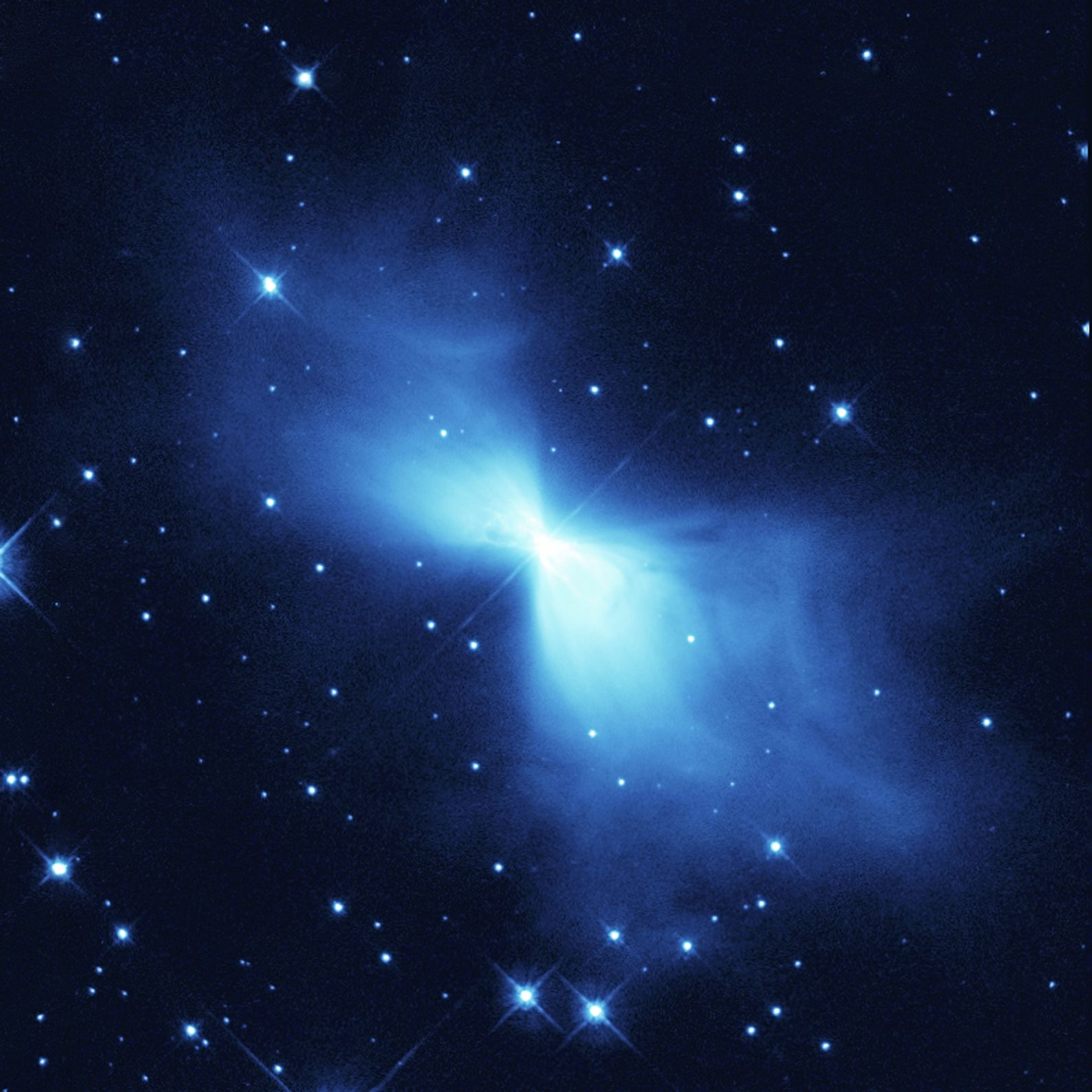
Image of Nebula
For those who are interested, the "high" quality image of the nebula can be found here at the Astronomy Picture of the Day for Tues. 2/20/03.
Click on the image and you'll get the enlarged verson. -
Re:Hrm
When was the Big Bang theory proven and the guesstimation of 11 billion years determined to be fact?
What would you approve as a "proof" of the Big Bang "theory" anyway? There are no observations that contradict the theory, even though scientists have been looking for them for nearly a century. How much longer do they have to keep looking until you accept it as a fact?
Anyway, the figure 11 billion years is infact not quite correct - as reported recently on Slashdot, the WMAP satellite has measured the age of the universe to be 13.7 billion years +/- 1%.
-
Old photo - old news
This image (and a much better description) were the APOD on the 20th. The image is from 1998.
Apod.
I think Slashdot should have a box on the right with the APOD (astronomy picture of the day.) Of course, then it might get slashdotted... maybe someone nice could setup a mirror.
M@ -
Re:Grumble, grumble - absolute zeroActually, there is another method of cooling an object, you physically slow it's atomic vibration. It's been demonstrated down to at least 0.0000001 C above absolute zero (see NASA's site) using lasers and magnetic traps. Research utilizing the technique include Bose-Einstein Condensates and Superfluids.
~~~~~Chris Giorgi~~~~~
-
6 year old news?
It seems JPL released this news on June 20, 1997:
Boomerang Nebula Boasts The Coolest Spot In The Universe
Only the high-res Hubble image of the nebula is the new news. -
6 year old news?
It seems JPL released this news on June 20, 1997:
Boomerang Nebula Boasts The Coolest Spot In The Universe
Only the high-res Hubble image of the nebula is the new news. -
Been done before
Are there any means of going back to a safe version of the firmware, or are there means of automatically rebooting the on-board computer?
You can bet that there is at least one level of safemode in that thing. DS1 had such, and both hardware and communications-loss watchdog timers. DS1 recovered from a total failure of its star tracker to boot, and was navigated for some time using only its science camera and on-board software hastily written and uploaded for the purpose. -
Been done before
Are there any means of going back to a safe version of the firmware, or are there means of automatically rebooting the on-board computer?
You can bet that there is at least one level of safemode in that thing. DS1 had such, and both hardware and communications-loss watchdog timers. DS1 recovered from a total failure of its star tracker to boot, and was navigated for some time using only its science camera and on-board software hastily written and uploaded for the purpose. -
Deep Space 1 was more impressive
The DS1 mission also used a xenon-ion thruster, and had several recoveries from mishaps more severe than anything sustained by Artemis. See The DS1 home page.
-
Re:Isn't this law more about profit?
Maybe he should have been more vague...
That way we'd all own something like a HP Beowulf Complex (Pavilions are much too small) 4550, or IBM's latest NetVista HIVE 8000.
Of course, laptops would just suck. -
Fewer places to fly them, too
Goddard Space Flight Center, outside D.C., had the longest running series of model rocket launches in the country. The twice-a-month launches were well run and closely supervised, but Goddard suspended the program after 9/11. It's a shame; one of my son's earliest memories is a "girl with a green rocket" he saw at a launch I took him to when he was a toddler, and he was excited about flying his own rocket. Now we have to drive 100 miles farther to get to an organized launch.
-
Re:Why not build one IN SPACE
See http://lisa.jpl.nasa.gov/. They are planning one -- 5 million kilometer arms, sensitivity to 10^-23 and at much lower frequencies than LIGO. The instrumentation requiremts for this are pretty scary: The distance between proof masses on spacecraft separated by five million kilometers will be measured with an accuracy of better than ten picometers to sense the passage of gravitational waves.
-
Re:Fuel
I love ion thrusters too. I think you'll be seeing more and more of them. Dr. Mark Raymond of JPL kept up a mission log on the Deep Space 1 mission which used Ion propulsion to meet and dramatically exceed its design criteria. Some great photos of that Ion engine are here.
-
Re:Fuel
I love ion thrusters too. I think you'll be seeing more and more of them. Dr. Mark Raymond of JPL kept up a mission log on the Deep Space 1 mission which used Ion propulsion to meet and dramatically exceed its design criteria. Some great photos of that Ion engine are here.
-
Re:hmm...
A gravitational wave detector is being built in space; it's called LISA.
-Gabe -
They are building one IN SPACE
... it's called LISA.
-Gabe -
Space debris animation
There's some info and a really cool animation (gif) at the Aerospace Corporation Site that gives a little sense of the amount of junk out there.
The Johnson Space Center orbital debris site used to have some nice graphics too, but it's currently out. -
Re:Off-scale and zero readings are still useful
Most likely the tire did blow, but why? NASA has said over and over that the heat inside the left wing was not indicative of a hull breach. This email, posted on NASA's web site, details the scenario of a tire rupturing in the wheel well. Essentially what happens is it blows the hatch off (the overpressure inside the wheel well puts a quarter million pounds of load on the hatch), the hatch flies into the slipstream, then the orbiter is no longer a craft, it's just debris.
NASA has said for two weeks straight that the foam was not the cause of this orbiter breakup, this isn't a guess, they have done the math using a model that overpredicts the damage then overpredicts the effects of that damage and it was deemed NOT A SAFETY CONCERN, and that it would NOT affect the flight properties of the vehicle.
Rich Garcia of the Directed Energy Directorate told the media they had "high-resolution" images of the orbiter taken from Hawaii and from the New Mexico labs. The Directed Energy Directorate makes beamed energy weapons, they've already created and are producing the world's first laser attack aircraft for the Air Force. They use dynamic optics and reflected laser light to compensate for the refraction of the atmosphere in real time. Their dynamic optics have hundreds of actuators and are able to self-adjust to compensate for this refraction due to the atmosphere, enabling them to literally subtract out the interference caused by the atmosphere. What this means is that the atmosphere is not translucent to them, it is transparent (about ninety-five percent more transparent than it is to "normal" optics).
This process not only "takes the twinkle out of stars," it also allows them to use the telescopes to propagate lasers
UP THROUGH THE ATMOSPHERE.It's long past time we stopped trying to blame NASA and point the finger where it belongs, at the US Air Force/Directed Energy Directorate.
-
Re:sounds familiar...
Here is the NASA site with impact photos of the Mir, the space shuttle and another satellite called the LDEF: http://hitf.jsc.nasa.gov/hitfpub/problem/actualim
p acts.html.
-
A theory, based on the LeonidsQuoting a webpage from NASA in 2001:
Leonid meteor storms happen when Earth passes through clouds of dusty debris shed by comet 55P/Tempel-Tuttle when it comes close to the Sun every 33 years. This year our planet is heading for close encounters with four such clouds. They bubbled off Tempel-Tuttle in 1699, 1766, 1799 and 1866.
The same article goes on to mention that, in 1998, we passed through a cloud shed by that comet in 1333. Unless Tempel-Tuttle is picking up new material when it is at the apogee of it's 33 year orbit, then we are witnessing a comet slowly go *poof* - the material is not vanishing into oblivion, though - it is being left behind as space pollution.
The same goes for the Perseids (comet Swift-Tuttle), and every other meteor shower that the Earth plows through each year.
It's too bad that the original article did not mention this - was the real-life data overlooked, or did the model take this into account, and it still shows that 99% of the expected comets are missing?
-
Re:Laser Blast
Is this purple beam part of a missile defense system?
NASA orbiter struck by "electrical phenomena" - San Francisco Chronicle - "The pictures, taken with a Nikon-880 digital camera on a tripod, reveal what appear to be bright electrical phenomena flashing around the track of the shuttle's passage, but the photographer, who asked not to be identified, will not make them public immediately." - February, 2003
Orbiter hit by "purple lightning" - San Francisco Chronicle - "Investigators are combing records from a network of ultra-sensitive instruments that might have detected a faint thunderclap in the upper atmosphere at the same time a photograph taken by a San Francisco astronomer appears to show a purplish bolt of lightning striking the shuttle." - February, 2003
NASA admits photographs of "bolt of something" exist - NASA - "DITTEMORE: I have seen the photo. We have sent the photo off to be examined, to verify its validity. We have not completed that activity yet. We have invited some atmospheric scientists to come to the Johnson Space Center to help us understand is there any phenomena that they know of that might exist in the upper atmosphere." - February, 2003
Starfire uses a telescope for "sending and receiving laser beams" - CRN - industry newsweekly - "For the Starfire Optical Range (SOR), a division of the U.S. Air Force Research Laboratory's Directed Energy Directorate at Kirtland Air Force Base, near here, measuring the effect of that air turbulence is critical to a project that uses a telescope for sending and receiving laser beams." - January, 2003
Directed Energy Directorate's "plasma projectiles" - Global Security - "Garcia said the directed-energy unit, which also is working on laser weapons, space-based optics and plasma projectiles some have likened to firing a bolt of lightning, has about 600 employees with an annual budget of about $120 million." - February, 2003
The curiously mislabeled document on NASA's web site. Check the title if you load this document.
-
Re:Laser Blast
Is this purple beam part of a missile defense system?
NASA orbiter struck by "electrical phenomena" - San Francisco Chronicle - "The pictures, taken with a Nikon-880 digital camera on a tripod, reveal what appear to be bright electrical phenomena flashing around the track of the shuttle's passage, but the photographer, who asked not to be identified, will not make them public immediately." - February, 2003
Orbiter hit by "purple lightning" - San Francisco Chronicle - "Investigators are combing records from a network of ultra-sensitive instruments that might have detected a faint thunderclap in the upper atmosphere at the same time a photograph taken by a San Francisco astronomer appears to show a purplish bolt of lightning striking the shuttle." - February, 2003
NASA admits photographs of "bolt of something" exist - NASA - "DITTEMORE: I have seen the photo. We have sent the photo off to be examined, to verify its validity. We have not completed that activity yet. We have invited some atmospheric scientists to come to the Johnson Space Center to help us understand is there any phenomena that they know of that might exist in the upper atmosphere." - February, 2003
Starfire uses a telescope for "sending and receiving laser beams" - CRN - industry newsweekly - "For the Starfire Optical Range (SOR), a division of the U.S. Air Force Research Laboratory's Directed Energy Directorate at Kirtland Air Force Base, near here, measuring the effect of that air turbulence is critical to a project that uses a telescope for sending and receiving laser beams." - January, 2003
Directed Energy Directorate's "plasma projectiles" - Global Security - "Garcia said the directed-energy unit, which also is working on laser weapons, space-based optics and plasma projectiles some have likened to firing a bolt of lightning, has about 600 employees with an annual budget of about $120 million." - February, 2003
The curiously mislabeled document on NASA's web site. Check the title if you load this document.
-
Re:What properties?
perhaps explosives could blast it to smithereens, all small enough to burn up in the atmosphere?
IANA physicist, but it seems to me that the parent contribution here, like many contributions in this thread, seriously underestimates the magnitude of the forces we are talking about.
Would the fragments of a demolished asteroid burning up in the atmosphere be significantly less disruptive than having the intact asteroid smash into the Earth? What were the global effects of the dinosaur killer?
It threw up huge amounts of dust? If fragments of the asteroid "burn up in the Earth's atmosphere" will that produce a worse dust problem or a better dust problem than if one big asteroid strikes the surface?
Heat radiation ignited continent wide firestorms? Would a rain of billions of tons of meteors burning up in the atmosphere ignite a firestorm? The Tunguska object ( if it existed ) was something like 50 to 80 meters in diameter. If I have done my math right, it would have massed something like half a million to a couple of million tons. The dinosaur killer was supposed to be something like 10 to 20 km in diameter, I believe. That would be 10 to 100 trillion tons.
Kinetic energy is, IIRC, one half mass x velocity squared. Earth's escape velocity is 11 kilometres per second. Suppose that was Tunguska's initial velocity? IANA Physicist, but wouldn't a one kilogram meteor, at 11,000 meters per second, surrender 60,500,000,000,000 Joules? 1.5*10^12 calories? It takes something like 660,000,000 calories to boil a cubic metre of water. And so your one kilogram meteor could boil 23,000 cubic metres of water. If I have done my arithmetic right, Tunguska could have boiled something like several tens of thousands of cubic metres of water. And, the dinosaur killer could have boiled at least 10^17 cubic metres of water. The Earth's atmosphere currently contains 1,290 cubic kilometres of water . A dinosaur killer, that burned up, and surrendered all its energy in the atmosphere, would release enough heat to raise the amount of water vapour in the atmosphere one thousand fold.
Maybe the Earth would be better off if the next dinosaur killer stayed in one piece, and spent some of its energy busting rock?
-
Re:One has to question
"Why Jupiter, who's size compared to Earth is immense, has not had a large asteroid annihalate it yet? (ok, maybe it has, i don't know)"
It has been hit, very spectacularly, had it been Earth that was hit I doubt we would be discussing this.
See:
Comet Shoemaker-Levy Collision with Jupiter
-
Ion propulsion
Deep Space 1 (DS1) was the first probe to use ion propulsion. There were 12 other advanced technology used on that probe. You can find more here.
-
Re:Why not warn?
"I mean, we have TONS of nuclear weapons [...] who is to say that a 100 year or so effort to put that much firepower into space to avert such an object wouldnt come to not?"
Actually, for the first time in the history of the planet, a species is now on the verge of being able to influence such events - and within less than 100 years (basically NOW in geological/astronomical terms). Humans probably couldn't do much more than duck & cover if an imminent strike was discovered in the next few decades, but in 50-75 years there is a high likelyhood will have developed the necessary tools to change the inevitable (eg. a permanent extra-earth presence ensuring survival, much better propulsion systems, and better technologies than near-useless nuclear weapons for such a situation, etc)
More than almost anything, this ability would really show that we've "arived" -
Re:Why not warn?
"I mean, we have TONS of nuclear weapons [...] who is to say that a 100 year or so effort to put that much firepower into space to avert such an object wouldnt come to not?"
Actually, for the first time in the history of the planet, a species is now on the verge of being able to influence such events - and within less than 100 years (basically NOW in geological/astronomical terms). Humans probably couldn't do much more than duck & cover if an imminent strike was discovered in the next few decades, but in 50-75 years there is a high likelyhood will have developed the necessary tools to change the inevitable (eg. a permanent extra-earth presence ensuring survival, much better propulsion systems, and better technologies than near-useless nuclear weapons for such a situation, etc)
More than almost anything, this ability would really show that we've "arived" -
elevator cable would generate a lot of power too
Imagine how much voltage would be across the ends of a 35KM long carbon (conductive?) cable being swung through the earth's magnetic field.
Like a collosal version of the space tetherexperiment.
You might not need those solar power sats.. anyone care to do the math ? -
Speed of light
am I mistaken, or will this clock (or the technology therin) help nasa and the relativity theorists? The already have "precise" clocks according to this
It was my understanding that the more precise the clock the easier it would be to test the speed of light.
-
Re:Devil's advocate (keep it quiet)
only 4 government employees whose job description includes looking for asteroids to hit earth; most of the people doing this are amateur astronomers. They won't keep it quiet.
I hate to tell you this, but it's the government guys with the large automated telescopes and racks of computers that find most of the asteroids, like NASA
-
Hmmm, this got me thinking.
-
Re:I think you mean CR20?Thanks again for your updates, but the article is about CP20
You are most welcome. And yes (*blush*) I should have typed 2003-CD20!
And is only listed [unipi.it] as having close approaches to Venus.
Our model shows a number of close Earth approaches for 2003-CD20. During the next 100 years, we show close Earth approaches in: 2006, 2009, 2012-2019, 2021, 2023-2025, 2028-2036, 2039, 2043, 2045-2074, 2076-2079, 2081-2084, 2087-2094, 2096, 2098-2099, and 2102.
It is very likely that over the next few days or weeks, additional observations will allow the model for 2003-CD20 to be refined. It would not surprise me to see some of those close encounter points moving away from Earth's orbit and reducing the risk from this asteroid.
Given the complex encounter at both the ascending node and descending node, I am not surprised that some models are different.
You might want to also look at the NEO program 2003-CD20 page.
-
Re:uhh,Take a look here:
http://hummer.larc.nasa.gov/acmbexternal/Personnel If you watch the "speedup" movie, the guy talks about processing speeds equivalent to "100,000 gigs" (not sure if it's GHz or GFLOPS or what though) that sounds aweful fast. The demo shows the thing calculating fractals 35x faster than a PC while consuming only 0.1% of the resources.
Obviously, I have no clue how this thing works other than that its mighty fast. I'm also thinking that with a bunch of these things, cracking RSA might not be so difficult after all.
-
Who's Looking For Near Earth Objects?That being said, I remember reading an article (wish I could find it and cite it) that said there were only 4 government employees whose job description includes looking for asteroids to hit earth; most of the people doing this are amateur astronomers.
Actually there are about 100 people worldwide searching for NEOs according to NASA's Ames Research Centre Asteroid Coment Impact Hazards Website.
The most productive NEO search program is the USAF/MIT run LINEAR which has discovered more NEOs than all other search programs combined.
Other search progrms include
- NEAT
- Spacewatch
- Lowell Observatory Near-Earth Object Search (LONEOS)
- Catalina Sky Survey
- Japanese Spaceguard Association (JSGA)
- Asiago DLR Asteroid Survey (ADAS)
I haven't been able to read the article because it's slashdotted, but it makes me wonder why they would have something like the Torino Impact Scale if they weren't going to use it to inform the public. So far only one object has ever has ever been classifed a "1" on the tornio scale, but that doesn't look like it's going to a a problem. But with most NEOs still unidentified the most likely warning we will have is none at all.
-
Who's Looking For Near Earth Objects?That being said, I remember reading an article (wish I could find it and cite it) that said there were only 4 government employees whose job description includes looking for asteroids to hit earth; most of the people doing this are amateur astronomers.
Actually there are about 100 people worldwide searching for NEOs according to NASA's Ames Research Centre Asteroid Coment Impact Hazards Website.
The most productive NEO search program is the USAF/MIT run LINEAR which has discovered more NEOs than all other search programs combined.
Other search progrms include
- NEAT
- Spacewatch
- Lowell Observatory Near-Earth Object Search (LONEOS)
- Catalina Sky Survey
- Japanese Spaceguard Association (JSGA)
- Asiago DLR Asteroid Survey (ADAS)
I haven't been able to read the article because it's slashdotted, but it makes me wonder why they would have something like the Torino Impact Scale if they weren't going to use it to inform the public. So far only one object has ever has ever been classifed a "1" on the tornio scale, but that doesn't look like it's going to a a problem. But with most NEOs still unidentified the most likely warning we will have is none at all.
-
Who's Looking For Near Earth Objects?That being said, I remember reading an article (wish I could find it and cite it) that said there were only 4 government employees whose job description includes looking for asteroids to hit earth; most of the people doing this are amateur astronomers.
Actually there are about 100 people worldwide searching for NEOs according to NASA's Ames Research Centre Asteroid Coment Impact Hazards Website.
The most productive NEO search program is the USAF/MIT run LINEAR which has discovered more NEOs than all other search programs combined.
Other search progrms include
- NEAT
- Spacewatch
- Lowell Observatory Near-Earth Object Search (LONEOS)
- Catalina Sky Survey
- Japanese Spaceguard Association (JSGA)
- Asiago DLR Asteroid Survey (ADAS)
I haven't been able to read the article because it's slashdotted, but it makes me wonder why they would have something like the Torino Impact Scale if they weren't going to use it to inform the public. So far only one object has ever has ever been classifed a "1" on the tornio scale, but that doesn't look like it's going to a a problem. But with most NEOs still unidentified the most likely warning we will have is none at all.
-
Who's Looking For Near Earth Objects?That being said, I remember reading an article (wish I could find it and cite it) that said there were only 4 government employees whose job description includes looking for asteroids to hit earth; most of the people doing this are amateur astronomers.
Actually there are about 100 people worldwide searching for NEOs according to NASA's Ames Research Centre Asteroid Coment Impact Hazards Website.
The most productive NEO search program is the USAF/MIT run LINEAR which has discovered more NEOs than all other search programs combined.
Other search progrms include
- NEAT
- Spacewatch
- Lowell Observatory Near-Earth Object Search (LONEOS)
- Catalina Sky Survey
- Japanese Spaceguard Association (JSGA)
- Asiago DLR Asteroid Survey (ADAS)
I haven't been able to read the article because it's slashdotted, but it makes me wonder why they would have something like the Torino Impact Scale if they weren't going to use it to inform the public. So far only one object has ever has ever been classifed a "1" on the tornio scale, but that doesn't look like it's going to a a problem. But with most NEOs still unidentified the most likely warning we will have is none at all.