Slashdot Mirror
Domain: nasa.gov
Stories and comments across the archive that link to nasa.gov.
Comments · 16,365
-
For those with only a passing interest
For all of the armature astronomers out there with a passing interest in this stuff, here are some helpful links for this years storm:
Where to find a dark place to view from: DarkSky.org
The storm forecast by city (US/World) from NASA: NASA
Astronomy Links In General:
NASA's J-Pass Satellite Passes: Near earth objects(Java,Email)
NASA's SkyWatch 1.4: Excellent for finding events (Java)
Satellite Related Software: For UNIX, Mac, Windows, Palm & more
SpaceWeather.com: Plan to see the auroras
SlashDot.org: Leonid's Last Year
Weather.com: Don't forget to check before you leave
By MichaelCrawford: This
Tips: viewing and what I bring with me.
-
Re:PredictabilityFlares are not "predicted" easily. The physics is not well understood, and the observational resolution (e.g., from magnetographs) is not good enough to predict well where or when a flare will pop up. In any event, geomagnetic storms are not caused by flares but mostly by Coronal Mass Ejections (CMEs) that hit the Earth. Some flares result in CMEs and some do not. The CMEs that affect us are the ones that hit us, but not all CMEs hit us. Spacecraft like SOHO might see a flare eruption, but they cannot reliably tell if the CME is heading towards or away from Earth. The best candidates seem to be what they call "halo events." One of the big problems with CMEs is that they are very hard to detect because the amount of light they give off is millions of times less intense than then background light from the Sun.
We also get hit by CMEs that are caused by "backside events," which are flares or other disturbances that erupt behind the limb of the Sun and we didn't see them occur. STEREO is supposed to help there.
One researcher in the field of solar weather forecasting put the maturity level of space weather forecasting 50 years behind that of terrestrial weather forecasting. That was the state in 2000 and not much has improved since. The biggest difference is that for Earth weather forecasting we have continuous global weather observations on both the ground and from space. There is only a tiny fraction of coverage for space weather, and as I mentioned in my first post it still isn't clear what kinds of instruments are sufficient.
Good information resources on space weather can be found at the Space Environment Center at NOAA's web site. They have a nice education page on space weather. For a look into what the space weather field priorities are, one place to start is the Living With A Star program page.
-
Re:PredictabilityFlares are not "predicted" easily. The physics is not well understood, and the observational resolution (e.g., from magnetographs) is not good enough to predict well where or when a flare will pop up. In any event, geomagnetic storms are not caused by flares but mostly by Coronal Mass Ejections (CMEs) that hit the Earth. Some flares result in CMEs and some do not. The CMEs that affect us are the ones that hit us, but not all CMEs hit us. Spacecraft like SOHO might see a flare eruption, but they cannot reliably tell if the CME is heading towards or away from Earth. The best candidates seem to be what they call "halo events." One of the big problems with CMEs is that they are very hard to detect because the amount of light they give off is millions of times less intense than then background light from the Sun.
We also get hit by CMEs that are caused by "backside events," which are flares or other disturbances that erupt behind the limb of the Sun and we didn't see them occur. STEREO is supposed to help there.
One researcher in the field of solar weather forecasting put the maturity level of space weather forecasting 50 years behind that of terrestrial weather forecasting. That was the state in 2000 and not much has improved since. The biggest difference is that for Earth weather forecasting we have continuous global weather observations on both the ground and from space. There is only a tiny fraction of coverage for space weather, and as I mentioned in my first post it still isn't clear what kinds of instruments are sufficient.
Good information resources on space weather can be found at the Space Environment Center at NOAA's web site. They have a nice education page on space weather. For a look into what the space weather field priorities are, one place to start is the Living With A Star program page.
-
Re:PredictabilityN.B. Space weather is much less predictable than terrestrial weather, and that is not well at all. Sometimes flare events cause space weather events at earth, sometimes not. Space weather events increase with solar activity, but some of the most intense events happen around the minimum in the solar activity cycle. There are very few monitoring stations (on the ground or in space) that can make the necessary measurements. The physics behind these events is not well known, and it isn't well known what kind of monitoring equipment is best (visible imagers, ultraviolet imagers, magnetographs, etc.).
Aurorae aren't the only things "regular" folk see. Six million people in Quebec lost power because of a solar storm. Commercial and military institutions lose satellites fairly frequently due to solar storms. Most of the people in the US lost pager service for this reason.
These issues are a high priority for NASA, NOAA, and the Air Force. Lots of good data have come from SOHO, WIND, and ACE, but these are either nearing the end of their lives or they are done. STEREO should provide the next round of very good data. Just about any spacecraft that measures the solar wind contributes to understanding space weather, and some missions are designed with that as their primary mission. There are also ground-based programs that make very valuable observations. A good page with some space missions can be found here.
-
Re:PredictabilityN.B. Space weather is much less predictable than terrestrial weather, and that is not well at all. Sometimes flare events cause space weather events at earth, sometimes not. Space weather events increase with solar activity, but some of the most intense events happen around the minimum in the solar activity cycle. There are very few monitoring stations (on the ground or in space) that can make the necessary measurements. The physics behind these events is not well known, and it isn't well known what kind of monitoring equipment is best (visible imagers, ultraviolet imagers, magnetographs, etc.).
Aurorae aren't the only things "regular" folk see. Six million people in Quebec lost power because of a solar storm. Commercial and military institutions lose satellites fairly frequently due to solar storms. Most of the people in the US lost pager service for this reason.
These issues are a high priority for NASA, NOAA, and the Air Force. Lots of good data have come from SOHO, WIND, and ACE, but these are either nearing the end of their lives or they are done. STEREO should provide the next round of very good data. Just about any spacecraft that measures the solar wind contributes to understanding space weather, and some missions are designed with that as their primary mission. There are also ground-based programs that make very valuable observations. A good page with some space missions can be found here.
-
Re:PredictabilityN.B. Space weather is much less predictable than terrestrial weather, and that is not well at all. Sometimes flare events cause space weather events at earth, sometimes not. Space weather events increase with solar activity, but some of the most intense events happen around the minimum in the solar activity cycle. There are very few monitoring stations (on the ground or in space) that can make the necessary measurements. The physics behind these events is not well known, and it isn't well known what kind of monitoring equipment is best (visible imagers, ultraviolet imagers, magnetographs, etc.).
Aurorae aren't the only things "regular" folk see. Six million people in Quebec lost power because of a solar storm. Commercial and military institutions lose satellites fairly frequently due to solar storms. Most of the people in the US lost pager service for this reason.
These issues are a high priority for NASA, NOAA, and the Air Force. Lots of good data have come from SOHO, WIND, and ACE, but these are either nearing the end of their lives or they are done. STEREO should provide the next round of very good data. Just about any spacecraft that measures the solar wind contributes to understanding space weather, and some missions are designed with that as their primary mission. There are also ground-based programs that make very valuable observations. A good page with some space missions can be found here.
-
Re:PredictabilityN.B. Space weather is much less predictable than terrestrial weather, and that is not well at all. Sometimes flare events cause space weather events at earth, sometimes not. Space weather events increase with solar activity, but some of the most intense events happen around the minimum in the solar activity cycle. There are very few monitoring stations (on the ground or in space) that can make the necessary measurements. The physics behind these events is not well known, and it isn't well known what kind of monitoring equipment is best (visible imagers, ultraviolet imagers, magnetographs, etc.).
Aurorae aren't the only things "regular" folk see. Six million people in Quebec lost power because of a solar storm. Commercial and military institutions lose satellites fairly frequently due to solar storms. Most of the people in the US lost pager service for this reason.
These issues are a high priority for NASA, NOAA, and the Air Force. Lots of good data have come from SOHO, WIND, and ACE, but these are either nearing the end of their lives or they are done. STEREO should provide the next round of very good data. Just about any spacecraft that measures the solar wind contributes to understanding space weather, and some missions are designed with that as their primary mission. There are also ground-based programs that make very valuable observations. A good page with some space missions can be found here.
-
Re:PredictabilityN.B. Space weather is much less predictable than terrestrial weather, and that is not well at all. Sometimes flare events cause space weather events at earth, sometimes not. Space weather events increase with solar activity, but some of the most intense events happen around the minimum in the solar activity cycle. There are very few monitoring stations (on the ground or in space) that can make the necessary measurements. The physics behind these events is not well known, and it isn't well known what kind of monitoring equipment is best (visible imagers, ultraviolet imagers, magnetographs, etc.).
Aurorae aren't the only things "regular" folk see. Six million people in Quebec lost power because of a solar storm. Commercial and military institutions lose satellites fairly frequently due to solar storms. Most of the people in the US lost pager service for this reason.
These issues are a high priority for NASA, NOAA, and the Air Force. Lots of good data have come from SOHO, WIND, and ACE, but these are either nearing the end of their lives or they are done. STEREO should provide the next round of very good data. Just about any spacecraft that measures the solar wind contributes to understanding space weather, and some missions are designed with that as their primary mission. There are also ground-based programs that make very valuable observations. A good page with some space missions can be found here.
-
Re:Useful for educators
As I have mentioned in a previous post, engaging these people is never useful. People who deny the moon landing, evolution, or the Nazi generated holocaust are asserting an opinion in an effort to save a personal belief, and are not engaging in meaningful dialog.
Although I agree with most of what you've said here, I don't think that these are the people who NASA is targetting.
A couple of months ago I helped take some telescopes around some schools as part of a local astronomy promotion program. The class of eight-year-old children we visited were finishing up a space travel project.
Before we went out with the telescopes, we gave them a talk. All that the were really interested in was saying that the Moon landings were faked. They'd even had a debate about it as part of the project, and the pro-fake side had totally cleaned up.
The reason was that their only source of information was this stupid idiotic documentary that had rescreened locally a few nights earlier. The only "facts" they had to check were the ones presented on TV and, to be honest, the teachers didn't know how to help the other side counter the arguments. One of the saddest parts was the parents, who were there, were also ignorant. They weren't on some personal vandetta and they weren't conspiracy theorists. They just didn't understand how to critically evaluate that trash, and how to convince their children.
Part of NASA's goal is to help educate, if for no other reason than to make sure that it's capable of carrying out it's mission goals, which it can't do with an ignorant public. If these teachers had the information available, they might have actually been able to sway the debate in a meaningful direction instead of letting the children enforce their own ignorance.
-
Re:Plus,
The article doesn't explain how they go about detecting such a star
This one does. Sort of. -
Superimposed shot?
This pic is pretty interesting (to me, anyway). It looks like the module is superimposed over one of the crosshairs. Can anyone help me out and explain this one to me?
-
Re:Very un space friendly.
Only sad if you don't consider all the benefits that have come from space technology. Some examples:
*Biotech:
"Brain tumors can be one of the most difficult types of cancer to treat. Improvements by Wisconsin-based Quantum Devices, Inc., in the Light Emitting Diodes (LEDs) developed for ASTROCULTURE(TM) have helped advanceScientist with Light-emitting diode photodynamic therapy. ASTROCULTURE(TM) is a commercial plant research facility developed by the Wisconsin Center for Space Automation and Robotics, a Commercial Space Center."
*Manufacturing:
Brush Wellman Incorporated successfully produced the world's largest aluminum-beryllium casting with the assistance of ground-based casting data and computational models developed by the Solidification Design Center, a Commercial Space Center. This alloy is very lightweight, making it useful in a number of aerospace applications. This work is helping advance manufacturing technology relating to the material.
*Agriculture:
Seed production is an essential part of crop production: without a good supply of seeds, farmers can not plant their fields. In 1996, the Wisconsin Center for Space Automation and Robotics (WCSAR), a Commercial Space Center, and Pioneer Hi-Bred International launched a research effort to accelerate plant growth so that new seeds could be produced in the shortest possible amount of time. This research was done using the Commercial Plant Biotechnology Facility, designed for space-based research and featuring a totally enclosed and precisely controlled environment, and was able to reduce plant growth cycles. An example of this was reducing the soybean growth cycle from an average of 110 days to an average of 62 days a significant improvement. This was made possible through the advanced software and related technologies, and the use of ASTROCULTURE(TM) technologies that have been proven on the Shuttle.
Besides, it sures beats spending money on trying t kill each other down here.
-
Re:Say we all know
Luna-1 was launched to the moon in 1959... but missed.Here is the description of Luna-1
Luna-2 crash landed to the moon in 1959
-
Re:Say we all know
Luna-1 was launched to the moon in 1959... but missed.Here is the description of Luna-1
Luna-2 crash landed to the moon in 1959
-
Re:This wil be moot soon
With its 2.4 meter diameter mirror, the smallest object that the Hubble can resolve at the Moon's distance of around 400,000 kilometers is about 80 meters across. More info including cool pics here.
-
You may disagree...
and you may mod me down, but I honestly believe this country can do a lot of good by funding a mission to the goatse quadrant. It may not improve our lives or our children's lives, but it may improve our children's children's asses. Thank you.
-
Re:Fox is largely to blame.After the Fox special we got a bunch (i dunno the exact number - maybe 20 to 100) of email along these lines:
When are you going to come clean about all those bogus trips to the moon. The anomalies are so many and obvious that a second grader could figure out the truth. What else do you fake for the billions you waste?
and we're just an Earth science site! earthobservatory.nasa.gov I think it's completely appropriate to have a formal, well-written and documented response. (although badastronomy.com has covered the topic very well already) We also get the occasional "global warming is obvious crap" and "the ozone hole has always been there" type stuff. Should we ignore them too? -
Re:It would be nice...To return one of those probes back. It would provide a wealth of information on the effects of radiation and other space agents on various materials and electronics. May be stick a few automated experiments for scientific purposes.
We did get part of the Surveyor probe back; that was a robot moon lander. ISTR Alan Shepard brought bits of it home on Apollo 12. He was promptly disqualified for improving the lie of his ball, and thus his legendary golf shot never counted.
Bringing probes back from deep space is rarely an option - it's a matter of energy. Galileo is irrevocably trapped in the Jupiter system, and doesn't have the fuel to get out of that colossal gravity well; meanwhile Voyager is barreling out of the Solar System at a ridiculous speed, and hasn't a hope of turning round.
Perhaps we might have been able to bring Deep Space One home at the end of its planned mission, but instead it was decided to send it on a rendezvous course with a comet; a high-risk mission that paid off magnificently.
Burning up or freezing to death and returning data to the last has got to be a better fate for a probe than being grabbed by some astronaut and put in a museum...
-
OMFG Galileo spacecraft flying over Amalthea!
-
Re:A bit of FYI on Huygens and Cassiniand also discovered one of Saturn's many moons.
He discovered Titan, the moon in the picture, the moon that the Huygens probe is going to 'land' on.
Haven't seen the story on APOD yet in the comments, so here it is.
-
Re:Many of you feel sorry for this spacecraft...
Are the instructions in English or metric?
Really, would it matter? -
Raw Soy Bean...... and how does that benefit gastronaughts with the following food available: Space Menu
gus
-
SPACE GOATSE!!!
http://antwrp.gsfc.nasa.gov/apod/ap021102.html Omg! It's goatse in space!
-
Re:Hm
-
Brand new pictures!
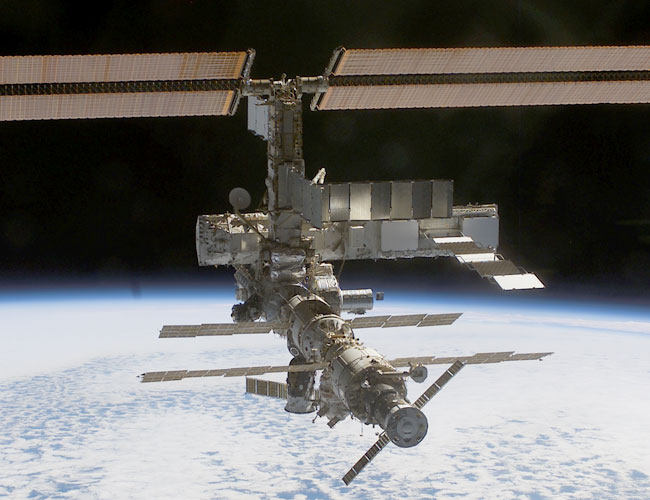
Perhaps coincidentally (they don't mention the birthday, but rather the new look with the solar wings out), the ISS is the Astronomy Picture of the Day. Permanent links: here -- bigger
-
Brand new pictures!
Perhaps coincidentally (they don't mention the birthday, but rather the new look with the solar wings out), the ISS is the Astronomy Picture of the Day. Permanent links: here -- bigger
-
Brand new pictures!
Perhaps coincidentally (they don't mention the birthday, but rather the new look with the solar wings out), the ISS is the Astronomy Picture of the Day. Permanent links: here -- bigger
-
Robert Goddard proposed this in 1904
I'm not sure if that makes this a "new" idea. In a paper Robert Goddard, the father of modern rocketry, wrote in his freshman year at Worcester Polytechnic Institute, he proposed, "in detail a railway line between Boston and New York, in which the cars were run in an evacuated tube and were prevented from metal-to-metal contact with the guide rails by electromagnets." This quote is from a Goddard Biography by Edward Pendray. Goddard estimated a Boston to New York travel time of 10 minutes.
-
Doesn't make sense.
I used to think about this a lot, for the following reason:
Imagine if we had a tube at ground level going all the way around the Earth.
If the tubes are vacuums, you can continually accelerate an object within them, since there is no terminal veolicity at constant acceleration the way there is from air. (At least at nonrelativistic speeds.)
Now let's calculate what orbital speeds are at sea level. At sea level, if you start out with zero downward momentum, you fall less than 10 meters in 1 second. If during that time you shoot forward far enough in a straight line that the Earth's curviture lifts you 10 feet, you've achieved orbit. NASA gives the Earth's diameter at the equator as 12,756 KM. Now the following calculation is REALLY easy using a diagram, but a bit tricky to describe. It uses only the pythagorean theorem.
Draw a circle, and two radii, one due west, one appreciably north. Draw a tangent at the circumference where the westerly radius touches (tangents are at right angles with radii). Now extend the second radius until it touches the tangent line. You should have a triangle whose hypotenuse is 12,756 KM + 10 M, of which one leg is 12,756 KM, and the other leg unknown. The other leg (along the tangent line) represents how much we need to move forward in 1 second, and we calculate it by taking the square root of the difference between 12,756.01 squared and 12,756 squared.
This number is 15.972. In other words, by MY calculation (I'm fresh out of high school though, so YMMV), orbiting at sea level requires you to go 15.972 miles in a single second. Compare that with the Space shuttle's "velocity of 27,880 km per hour" (/3600 seconds-per-hour) = 7.744. In other words, at an altitude of 322 KM, it can take nearly twice as long fall the same amount, which is explained by lower value of acceleration-due-to-gravity at that height. (Repeating our calculations above, substituting 12,756+322 for 12,756, we get sqrt( (12756+322+0.01)^2 - (12756+322)^2 ) = 16.172 KM, versus the 15.972 we had at ground level. However, to cover the same 10 feet, it now has a longer time to fall.
ANYWAY, the upshot of all this is that if you can accelerate something to 15.972 KM/s or (57,499.2 KM/h or (x0.62) 35,649 miles per hour, it will coast its way along without needing anything under it, and without consuming further gas.
This could be a really great way to deliver packages.
Draw a circumference at sea level that goes through a lot of interesting places, lay down a vacuum line (it doesn't actually need to support anything!! All it needs to do is be thin plastic that holds its shape at 1 atmosphere crush) all around it, then start this huge, heavy monolithic Delivery Bird sailing around at 35,649 mph, reaching every point along your line every fifteen minutes. I'm not sure how you get packages (including passengers) on and off the thing, but it sure sounds cool.
So, in conclusion, it's too cool to work. -
Re:"the shining star of international co-operation
Actually they did almost 30 years ago.
In 1975 Apollo 18 and Soviet Soyuz 19. This was the the last manned American space mission before the first shuttle flight. -
Is it worth ... what?
I have opposed the ISS all along (gasp) much as I did the shuttle. The manned space program in general, including or perhaps especially Apollo, has been hard to justify. (The foundation of Apollo was not so much science as the Cold War. Note we haven't been back in 30 years and have no plans of doing so. Yes, it was really cool and as a symbol continues to inspire; perhaps that's the best part. But out failure to return suggests we're really not all that interested in voyaging in space.) Manned spaceflight has a great gee-whiz factor which I share and circularly develops our understanding on how to sustain humans in space -- in others words, men in space help put more in space. Yippee.
Unmanned probe programs from Cassini back to the ancient Mariner, on the other hand, have produced reams of data for a fraction of the cost and danger. The 25 y.o. Voyager program is still working, and they were done on a shoestring compared to ISS. That sort of thing makes me go "wow!" more than several people orbiting the Earth in a claustrophobic tin can.
Congress cries poverty at unsexy robotic probes, yet relatively easily goes for the big-ticket man-in-space programs. This is due to the public as much as the politicians; it's hard to care about a ream of data as much as pictures of an astronaut. Yet I know people in the industry who talked a great deal of how the expensive Shuttle devastated virtually all other programs, in a period when our interplanetary probes were at their zenith -- Voyager, Viking, etc.
This is just to speak of pure research. The greatest practical application of spaceflight has been the launching of satellites for communications, weather observation, and so on. If anything the U.S. lags in this area, as more and more launches go to rockets from France, China, and Russia. My engineer friend's American company has several launches planned on Russian rockets of ancient but reliable technology.
Certainly the people who frequent this site appreciate the power of technology. We're moving to a level of computational power, AI, robotics, etc. whose primary emphasis is to relieve humans of repetitive, demanding, or dangerous tasks. And if our technology fails with a probe, we lose a machine and not a life. Why not apply our emphasis here?
I don't discount the amazing achievements of manned spaceflight -- and it's a cheap part our trillion+ budget with lots of bang for the buck -- but I do question the allocation of these funds. I think we are many years behind what we could have achieved, and what the space program might have driven our engineering to achieve. As for interplanetary travel, I would love to see humans do it but know that unmanned missions can get there much sooner and return more information for less money and without the compromises forced by life support. Ultimately, who cares whether man of machine collects the data?
Thoughts? -
Is it worth ... what?
I have opposed the ISS all along (gasp) much as I did the shuttle. The manned space program in general, including or perhaps especially Apollo, has been hard to justify. (The foundation of Apollo was not so much science as the Cold War. Note we haven't been back in 30 years and have no plans of doing so. Yes, it was really cool and as a symbol continues to inspire; perhaps that's the best part. But out failure to return suggests we're really not all that interested in voyaging in space.) Manned spaceflight has a great gee-whiz factor which I share and circularly develops our understanding on how to sustain humans in space -- in others words, men in space help put more in space. Yippee.
Unmanned probe programs from Cassini back to the ancient Mariner, on the other hand, have produced reams of data for a fraction of the cost and danger. The 25 y.o. Voyager program is still working, and they were done on a shoestring compared to ISS. That sort of thing makes me go "wow!" more than several people orbiting the Earth in a claustrophobic tin can.
Congress cries poverty at unsexy robotic probes, yet relatively easily goes for the big-ticket man-in-space programs. This is due to the public as much as the politicians; it's hard to care about a ream of data as much as pictures of an astronaut. Yet I know people in the industry who talked a great deal of how the expensive Shuttle devastated virtually all other programs, in a period when our interplanetary probes were at their zenith -- Voyager, Viking, etc.
This is just to speak of pure research. The greatest practical application of spaceflight has been the launching of satellites for communications, weather observation, and so on. If anything the U.S. lags in this area, as more and more launches go to rockets from France, China, and Russia. My engineer friend's American company has several launches planned on Russian rockets of ancient but reliable technology.
Certainly the people who frequent this site appreciate the power of technology. We're moving to a level of computational power, AI, robotics, etc. whose primary emphasis is to relieve humans of repetitive, demanding, or dangerous tasks. And if our technology fails with a probe, we lose a machine and not a life. Why not apply our emphasis here?
I don't discount the amazing achievements of manned spaceflight -- and it's a cheap part our trillion+ budget with lots of bang for the buck -- but I do question the allocation of these funds. I think we are many years behind what we could have achieved, and what the space program might have driven our engineering to achieve. As for interplanetary travel, I would love to see humans do it but know that unmanned missions can get there much sooner and return more information for less money and without the compromises forced by life support. Ultimately, who cares whether man of machine collects the data?
Thoughts? -
Is it worth ... what?
I have opposed the ISS all along (gasp) much as I did the shuttle. The manned space program in general, including or perhaps especially Apollo, has been hard to justify. (The foundation of Apollo was not so much science as the Cold War. Note we haven't been back in 30 years and have no plans of doing so. Yes, it was really cool and as a symbol continues to inspire; perhaps that's the best part. But out failure to return suggests we're really not all that interested in voyaging in space.) Manned spaceflight has a great gee-whiz factor which I share and circularly develops our understanding on how to sustain humans in space -- in others words, men in space help put more in space. Yippee.
Unmanned probe programs from Cassini back to the ancient Mariner, on the other hand, have produced reams of data for a fraction of the cost and danger. The 25 y.o. Voyager program is still working, and they were done on a shoestring compared to ISS. That sort of thing makes me go "wow!" more than several people orbiting the Earth in a claustrophobic tin can.
Congress cries poverty at unsexy robotic probes, yet relatively easily goes for the big-ticket man-in-space programs. This is due to the public as much as the politicians; it's hard to care about a ream of data as much as pictures of an astronaut. Yet I know people in the industry who talked a great deal of how the expensive Shuttle devastated virtually all other programs, in a period when our interplanetary probes were at their zenith -- Voyager, Viking, etc.
This is just to speak of pure research. The greatest practical application of spaceflight has been the launching of satellites for communications, weather observation, and so on. If anything the U.S. lags in this area, as more and more launches go to rockets from France, China, and Russia. My engineer friend's American company has several launches planned on Russian rockets of ancient but reliable technology.
Certainly the people who frequent this site appreciate the power of technology. We're moving to a level of computational power, AI, robotics, etc. whose primary emphasis is to relieve humans of repetitive, demanding, or dangerous tasks. And if our technology fails with a probe, we lose a machine and not a life. Why not apply our emphasis here?
I don't discount the amazing achievements of manned spaceflight -- and it's a cheap part our trillion+ budget with lots of bang for the buck -- but I do question the allocation of these funds. I think we are many years behind what we could have achieved, and what the space program might have driven our engineering to achieve. As for interplanetary travel, I would love to see humans do it but know that unmanned missions can get there much sooner and return more information for less money and without the compromises forced by life support. Ultimately, who cares whether man of machine collects the data?
Thoughts? -
Story straight from Nasa
-
What do you want for your birthday?
Station: World peace?
Astronaut David A. Wolf: Heh. Yeah, right.
Station: Well.... how about understanding between all peoples and religions?
Wolf: Damn programmers. Filthy hippies.
Station: An end to social injustice?
Wolf: Those pinko bastards programmed you for that! Disregard it!
Station: Could you tell everyone that a sentient computer in orbit has found aliens and carries a message of peace and love from the cosmos?
Wolf: We'd be a laughing stock! Look, why don't you ask for something that we can give you up here, right now?
Station: I'm sorry, Dave, I'm afraid I can't do that.
Wolf: Uh-oh. -
Re:Great
PR, but what's the use? Detailed pics of Saturn and rings, yay, but nothing we don't have. Although, the huygens probe actually looks useful, I think NASA should be more ambitious.
Pretty pictures of Saturn are the least of what's coming back. Go to the mission objectives page for the probe to see all of the experiments that will be done.
What, exactly, do you _want_ them to do? Bear in mind that sending humans *anywhere* costs at least 20 times what a probe with comparable scientific capabilities costs. -
Re:EuropaAnybody know if there are any planned missions to Jupiter's moon Europa? I read somewhere that there are water there and hence potential life ('Europeans' rather than 'Martians')
There used to be plans for a whole set of Europa probes - first an orbiter, then landers to use seismographs to determing the thickness of the crust and whether there's water down there, then eventually a submarine... Sadly, this all seems to have been cancelled.
The NASA page about the Europa project is still there, and loads - momentarily - before redirecting you to their updated site, from which all references to Europa seem to have been expunged...
Incidentally, there might be less confusion if you call them 'Europans' rather than 'Europeans'. There are about half a billion Europeans already, and we don't live anywhere near Jupiter.
-
Yes, Cassini flew by Earth. No, we didn't all die
The parent asks about the portion of Cassini's trajectory which passed very close to the Earth. On August 18, 1999, the spacecraft swept past the Earth at a minimum altitude of just over 700 miles. You can read about it here:
http://www.jpl.nasa.gov/releases/99/csearthflyby.
h tmlWhy fly so close? The JPL team arranged it so that Cassini went past the "back" side of the Earth. The earth circles around the Sun at a pretty good clip (about 30 km/sec). Cassini came towards the Earth from behind in its orbit. The gravitational force of the Earth on the spacecraft pulled it forward, speeding it up as it went by. By the same token, the spacecraft slowed the Earth down a little bit, but by an insignificant amount. This is one of the two sorts of "gravitational slingshot" manuevers the celestial mechanics can use to give spacecraft more speed without using lots of fuel.
Simple analogy: stand on a sidewalk as cars drive past at 30 mph. Just as one car is about to pass you, toss a tennis ball out in front of it. The collision will greatly increase the speed of the tennis ball in the direction of the car's motion (and only very slightly decrease the speed of the car). We can't bounce spacecraft off the Earth in the same way
For information on the risks associated with the flyby, please read
-
Re:Does anyone know....
Yep, way back in 1999.
-
Re:they need to centralize and play hardballThat, and the fact that each of the NASA centers utilizes different accounting methods and software. Until they standardize on how they manage their contracts and accounts, NASA will continue to be a huge budgetary sink.
You mean the NASA Integrated Financial Management Program?
Frankly the biggest problem with NASA is this god damn fascination with Alabama! The governor of Alabama must have pictures of George W. Bush at an anti-war rally or something because Marshall Space Flight Center continually fucks things up yet continues to receive projects! -
Find the polluters on the animated map
http://earthobservatory.nasa.gov/Newsroom/Aerosol
s
please tell me where you see the greatest levels of pollution over the year?
Are you shocked at the polution coming from India, Russia, and Europe? I'm certainly not. Now - compare it to the USA.
That's right.. its a piss in the ocean in comparison.
What amazes me is that the Russians, who have been whining and crying about Kyoto... good Lord! Look at Russia during the winter months.
The rest of the world is so full of crap when they complain about us.. but then, hard facts and evidence don't really matter to hippies, tree-huggers, or liberals. -
Re:Political difficulties
Firstly, you are aware of the difference between nuclear rockets and anti-matter propulsion, right? Nuclear rockets are basically nuclear reactors with their outputs attached to rocket engines instead of turbines.
Anti-matter drives are not going to be used inside the atmosphere. Using any sort of nuclear rocket inside the atmosphere is retarded. How safe do you want it to be? What are the consequences of a rocket full of uranium exploding over a populated area? Anyhow, chemical boosters work fine (and could work even better if people put their mind to it) for getting stuff into orbit. Getting stuff into orbit is a political problem these days, not so much a technical one.
Moving things around in inter-planetary space is another story. There's all sorts of cool methods: ion rockets, nuclear rockets and laser/solar sails.
Anti-matter propulsion canes all of these tho for energy density; you're getting down into the guts of physics here. No more `let's make this hydrogen and oxygen go boom!' engines, nor `let's use this decaying uranium to heat up some water! w00t!' engines, you're getting matter to convert directly and completely into energy.
So, yeah, no one's going to use nuclear rockets, nor anti-matter rockets inside the atmosphere. Long term, anti-matter looks to be the way to go; it's got the energy density we need and it ain't going to be expensive forever. -
Re:Political difficulties
Firstly, you are aware of the difference between nuclear rockets and anti-matter propulsion, right? Nuclear rockets are basically nuclear reactors with their outputs attached to rocket engines instead of turbines.
Anti-matter drives are not going to be used inside the atmosphere. Using any sort of nuclear rocket inside the atmosphere is retarded. How safe do you want it to be? What are the consequences of a rocket full of uranium exploding over a populated area? Anyhow, chemical boosters work fine (and could work even better if people put their mind to it) for getting stuff into orbit. Getting stuff into orbit is a political problem these days, not so much a technical one.
Moving things around in inter-planetary space is another story. There's all sorts of cool methods: ion rockets, nuclear rockets and laser/solar sails.
Anti-matter propulsion canes all of these tho for energy density; you're getting down into the guts of physics here. No more `let's make this hydrogen and oxygen go boom!' engines, nor `let's use this decaying uranium to heat up some water! w00t!' engines, you're getting matter to convert directly and completely into energy.
So, yeah, no one's going to use nuclear rockets, nor anti-matter rockets inside the atmosphere. Long term, anti-matter looks to be the way to go; it's got the energy density we need and it ain't going to be expensive forever. -
Re:Political difficulties
Firstly, you are aware of the difference between nuclear rockets and anti-matter propulsion, right? Nuclear rockets are basically nuclear reactors with their outputs attached to rocket engines instead of turbines.
Anti-matter drives are not going to be used inside the atmosphere. Using any sort of nuclear rocket inside the atmosphere is retarded. How safe do you want it to be? What are the consequences of a rocket full of uranium exploding over a populated area? Anyhow, chemical boosters work fine (and could work even better if people put their mind to it) for getting stuff into orbit. Getting stuff into orbit is a political problem these days, not so much a technical one.
Moving things around in inter-planetary space is another story. There's all sorts of cool methods: ion rockets, nuclear rockets and laser/solar sails.
Anti-matter propulsion canes all of these tho for energy density; you're getting down into the guts of physics here. No more `let's make this hydrogen and oxygen go boom!' engines, nor `let's use this decaying uranium to heat up some water! w00t!' engines, you're getting matter to convert directly and completely into energy.
So, yeah, no one's going to use nuclear rockets, nor anti-matter rockets inside the atmosphere. Long term, anti-matter looks to be the way to go; it's got the energy density we need and it ain't going to be expensive forever. -
Re:farther out = more moons?
The moon has the highest ratio of mass to its parent body as than any other moon in the Solar system.
You're wrong by a factor of 10:
Moon/Earth Mass Ratio 0.012300034 ± 3e-9
Charon/Pluto Mass Ratio 0.122 ± 0.005
it would be a lot more correct to say that the Earth-Moon system was a dual planetoid system and not a planet-moon system.
The Earth-Moon barycenter falls *inside* the Earth. Sounds like a planet-moon system to me. -
Re:closest star
Actually, Alpha Centauri is a star system, not a star. The closest star (other than the Sun of course) is Alpha Centauri C (aka Proxima Centauri). But then again, maybe NASA just doesn't know what they're talking about...
-
Re:No explanation != Amazing DiscoveryThe biggest problem with your reasoning is that a balloon cannot go into space. By the very nature of how a balloon works (look up Archimedes Principle), it cannot "go into space." It is still in the atmosphere, albeit near the top, so what it picked up was something still in the atmosphere.
misunderstanding
n. A failure to understand or interpret correctly.condescend
intr.v. condescended, condescending, condescends
To deal with people in a patronizingly superior manner. -
Re:What's their budget?
NASA does have a low budget for a agency, but you have to consider just how many people it actually serves with those dollars. While you could technically argue, "all of humanity", so far tests in space have not, in my mind, led to any huge improvements in human life. Before I get flamed to pieces, I just want to point out that while NASA certainly is doing a lot of good, the Department of Education has a more immediate and obvious positive (hopefully!) effect on the nation as a whole, and it serves millions and millions of children. Its budget is only 56 billion dollars, about 4 times as much as NASA's.
14 billion dollars is a lot of money. I believe that NASA deserves it, even if sometimes it seems that they sometimes do experiments in space just for the hell of it or for publicity. However, I also think that the size of their current budget is about right. -
Re:What's their budget?
NASA does have a low budget for a agency, but you have to consider just how many people it actually serves with those dollars. While you could technically argue, "all of humanity", so far tests in space have not, in my mind, led to any huge improvements in human life. Before I get flamed to pieces, I just want to point out that while NASA certainly is doing a lot of good, the Department of Education has a more immediate and obvious positive (hopefully!) effect on the nation as a whole, and it serves millions and millions of children. Its budget is only 56 billion dollars, about 4 times as much as NASA's.
14 billion dollars is a lot of money. I believe that NASA deserves it, even if sometimes it seems that they sometimes do experiments in space just for the hell of it or for publicity. However, I also think that the size of their current budget is about right. -
What's their budget?
If their budget is low, compare it to NASA's here, and just imaging if they discovered it before the U.S. did.